
The universe is held together by a handful of essential interactions known as the fundamental forces. These four forces—gravitational, electromagnetic, strong nuclear, and weak nuclear—govern every physical phenomenon, from the structure of atoms to the formation of galaxies. In Physics, understanding these forces allows students to explore the common principles that link diverse systems, whether they are atomic nuclei or distant stars. The study of Modern Physics provides the conceptual and mathematical tools needed to analyze these interactions at their most fundamental levels.
Each force plays a unique role. The strong nuclear force, responsible for holding quarks together in protons and neutrons, operates at subatomic scales and is key to processes in Nuclear Physics like Nuclear Fission and Nuclear Fusion in Nuclear Physics. Meanwhile, the weak nuclear force governs radioactive decay and plays a critical role in Nuclear Reactions and Radioactivity and Isotopes.
The electromagnetic force, described thoroughly in Atomic Physics, is essential for understanding atomic structure, as seen in topics like Structure of the Atom and Quantum Numbers and Electron Configuration. This force governs how particles with charge interact, from electron orbitals to the behavior of materials explored in Condensed Matter Physics. The gravitational force, though the weakest of the four, becomes dominant at macroscopic scales and forms the backbone of our understanding of space and time through Relativity.
The four fundamental forces are best understood through the lens of Particle Physics, where interactions are mediated by particles known as Bosons (Force Carriers). Matter itself consists of Fermions (Matter Particles), which interact via these bosons. The Standard Model organizes these particles and their forces, but deeper theories like Quantum Field Theory strive to unify them, offering profound insights into the fabric of reality.
At the quantum level, the dynamics of the fundamental forces are described by the principles of Quantum Mechanics. Students encounter foundational ideas such as Wave-Particle Duality, Quantum Superposition, and Quantum Entanglement in Quantum Mechanics, which explain how particles behave and interact. Concepts such as Quantum Tunneling and the Wave Function and Schrödinger’s Equation provide the mathematical foundation for understanding quantum states, while the Heisenberg’s Uncertainty Principle sets limits on measurement precision.
The behavior of systems influenced by fundamental forces can also be analyzed using Statistical Mechanics, which links microscopic particle interactions with macroscopic observables like temperature and pressure. This is especially important in fields like nuclear, particle, and condensed matter physics, where collective behaviors emerge from fundamental interactions.
Ultimately, learning about the fundamental forces allows students to unify diverse phenomena under a shared physical framework. From atomic interactions to cosmic evolution, the forces shape every aspect of reality. By mastering this topic, learners gain a deep appreciation of the hidden order behind nature’s complexity and a strong foundation for further studies across the spectrum of physical sciences.
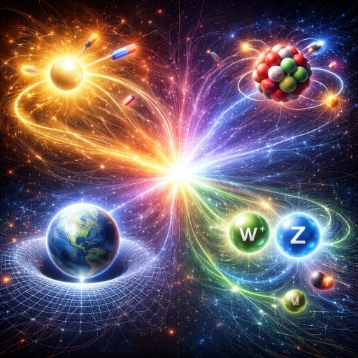
This vibrant space-themed image visualizes the four fundamental forces as distinct motifs connected to a brilliant central convergence. In one area, Earth rests on a curved grid, suggesting gravity and the bending of spacetime. Another region shows a radiant sphere with magnet-like elements and swirling field lines, evoking electromagnetism. A tightly packed cluster of multicolored spheres represents the strong force binding particles in the nucleus. Nearby, glowing particles and interaction-like orbs suggest the weak force associated with particle transformations and decay. Flowing, multicolored light trails connect the four regions, emphasizing that these forces act together across scales to govern the behavior of matter and energy.
- Particle Physics topics:
- Particle Physics – Overview
- Fundamental Forces
- Fermions – Matter Particles
- Bosons – Force Carriers
Table of Contents
The Four Fundamental Forces of Nature
Strong Nuclear Force
Overview:
The strong nuclear force is the most powerful of the four fundamental forces and is responsible for binding quarks together to form protons and neutrons. It also holds these nucleons together within the atomic nucleus, making it essential for the stability of matter. Without the strong nuclear force, atomic nuclei would not exist, as the repulsive electromagnetic force between protons would tear them apart.
Key Characteristics:
- Force Carrier: Gluons
- Strength: The strongest of all fundamental forces
- Range: Extremely short (~10⁻¹⁵ meters)
- Affected Particles: Quarks and hadrons (particles made of quarks)
Mechanism:
The strong force operates through the exchange of gluons, massless particles that mediate the force between quarks. Unlike other forces, the strong force gets stronger as quarks are pulled apart, a property known as confinement. Gluons themselves also carry the strong force, leading to complex binding interactions that govern Quantum Chromodynamics (QCD).
Applications:
- Nuclear Stability: Keeps protons and neutrons bound in atomic nuclei.
- Nuclear Energy: Releases energy in fission (nuclear reactors) and fusion (stars, hydrogen bombs).
- Particle Physics: Studied in high-energy collisions in particle accelerators to understand quark-gluon interactions.
Electromagnetic Force
Overview:
The electromagnetic force governs interactions between charged particles, responsible for electricity, magnetism, and light. It explains chemical bonding, the structure of atoms, and the behavior of electromagnetic waves. This force is unified under Quantum Electrodynamics (QED).
Key Characteristics:
- Force Carrier: Photon
- Strength: Weaker than the strong force but stronger than the weak force and gravity
- Range: Infinite, but decreases with distance (inverse-square law)
- Affected Particles: All particles with electric charge
Mechanism:
The electromagnetic force arises due to the exchange of virtual photons between charged particles. Like charges repel, while opposite charges attract. The force is also responsible for the propagation of electromagnetic waves (light, radio waves, X-rays) across space.
Applications:
- Electricity & Magnetism: Governs electrical circuits, magnetism, and electromagnetic induction.
- Light and Optics: The entire spectrum of electromagnetic radiation (radio waves to gamma rays) originates from this force.
- Chemistry & Biology: Determines atomic and molecular structures, essential for all chemical reactions.
- Technology: Used in lasers, radios, smartphones, and fiber-optic communication.
Weak Nuclear Force
Overview:
The weak nuclear force is responsible for processes that change one type of particle into another, such as in beta decay and nuclear fusion. Though stronger than gravity, it is weaker than the strong nuclear and electromagnetic forces. The weak force plays a crucial role in radioactive decay and the synthesis of elements in stars.
Key Characteristics:
- Force Carriers: W⁺, W⁻, and Z⁰ bosons
- Strength: Weaker than the strong and electromagnetic forces
- Range: Extremely short (~10⁻¹⁸ meters)
- Affected Particles: Quarks and leptons
Mechanism:
The weak force changes the flavor of particles, such as transforming a neutron into a proton in beta decay. This occurs via the exchange of heavy W and Z bosons, making the weak force extremely short-ranged. The weak force also plays a role in neutrino interactions, which are crucial in astrophysics and particle physics.
Applications:
- Radioactive Decay: Drives beta decay, enabling radiocarbon dating in archaeology.
- Stellar Fusion: Powers the Sun and stars, allowing hydrogen nuclei to fuse into helium.
- Particle Physics: Governs neutrino interactions, providing insights into the universe’s evolution.
Gravitational Force
Overview:
Gravity is the weakest of the four fundamental forces but dominates at large scales, shaping the structure and dynamics of the universe. Unlike the other three forces, gravity is not part of the Standard Model. Instead, it is described by Einstein’s General Theory of Relativity, which explains gravity as the warping of spacetime by mass and energy.
Key Characteristics:
- Force Carrier: Graviton (hypothetical)
- Strength: Weakest of all fundamental forces
- Range: Infinite, following the inverse-square law
- Affected Particles: All particles with mass and energy
Mechanism:
Gravity arises due to the curvature of spacetime around massive objects. Although successful at cosmic scales, gravity remains incompatible with quantum mechanics, leading to theories like string theory and loop quantum gravity, which predict a quantum particle called the graviton.
Applications:
- Planetary Motion: Governs the orbits of planets, moons, and satellites.
- Astrophysics: Drives the formation of stars, galaxies, and black holes.
- Gravitational Waves: Predicted by Einstein, these ripples in spacetime were confirmed by LIGO observatories.
- Everyday Life: Keeps us anchored to Earth, governs tides, and influences fluid dynamics.
Understanding these four forces remains one of the greatest challenges in physics, particularly in unifying gravity with the quantum realm. Advances in quantum field theory, cosmology, and particle physics continue to push the boundaries of our understanding of the universe.
Comparison of Fundamental Forces
| Force | Strength | Range | Mediator | Acts On |
|---|---|---|---|---|
| Strong Nuclear | Strongest | Very short (~ m) | Gluon (g) | Quarks and gluons |
| Electromagnetic | Second strongest | Infinite | Photon (γ) | Charged particles |
| Weak Nuclear | Second weakest | Very short (~ m) | W⁺, W⁻, Z⁰ bosons | Quarks and leptons |
| Gravitational | Weakest | Infinite | Graviton (hypothetical) | All particles with mass and energy |
Unification of Forces
Physicists have successfully unified the electromagnetic and weak nuclear forces into the electroweak force, explaining their shared behavior at high energies. Efforts to unify all forces, including the strong force and gravity, into a single Theory of Everything (ToE) remain one of the greatest challenges in theoretical physics.
- Grand Unified Theories (GUTs): Attempt to merge the strong, weak, and electromagnetic forces.
- String Theory and Quantum Gravity: Explore ways to incorporate gravity into quantum mechanics.
Why Study Fundamental Forces
The Four Fundamental Interactions of Nature
The universe is governed by four fundamental forces: gravity, electromagnetism, the strong nuclear force, and the weak nuclear force. Students explore how each force operates, its relative strength, and its interaction range. These forces explain everything from atomic bonding to planetary motion. Understanding them provides a unified view of physical interactions.
Gauge Theory and Force Carriers
Students study how forces are described through exchange of gauge bosons in quantum field theory. Concepts like local symmetry, gauge invariance, and field quantization become central to understanding interactions. This builds a foundation for advanced theoretical physics. It unifies particle and field descriptions of forces.
Role in Atomic and Nuclear Stability
The strong and weak nuclear forces govern processes inside atomic nuclei, including binding energy and radioactive decay. Students explore how these forces affect nuclear structure and stability. This knowledge supports applications in nuclear energy, astrophysics, and particle decay. It reveals the intricate dynamics of subatomic matter.
Electromagnetism and Technological Foundations
Electromagnetism governs the behavior of charged particles and underlies most modern technologies. Students learn how electric and magnetic fields interact and how light is an electromagnetic wave. This supports understanding of electronics, optics, and telecommunications. It shows the practical impact of mastering a fundamental force.
Toward a Unified Theory
The search for a unified theory aims to combine all fundamental forces under one framework. Students explore electroweak unification and theories like quantum gravity and string theory. These ideas push the boundaries of known physics. They offer students a vision for future breakthroughs in understanding the universe.
Conclusion of Fundamental Forces
The four fundamental forces—strong nuclear, electromagnetic, weak nuclear, and gravitational—govern every physical interaction in the universe. While the Standard Model explains three of these forces with remarkable precision, gravity remains outside this framework. Understanding these forces is essential for unlocking the deepest mysteries of the cosmos, from the smallest subatomic particles to the largest galactic structures.
Frequently Asked Questions: Fundamental Forces in Particle Physics
1. What are the four fundamental forces in physics?
The four fundamental forces in physics are gravity, electromagnetism, the weak nuclear force, and the strong nuclear force. These interactions govern how particles and objects interact at all scales, from subatomic particles to galaxies, and every other force or effect can ultimately be traced back to one or more of these four.
2. How does the electromagnetic force act between particles?
The electromagnetic force acts between particles that carry electric charge. It is responsible for electric and magnetic effects, from the attraction and repulsion of charged particles to the structure of atoms and chemical bonding. In particle physics, it is described by quantum electrodynamics, where charged particles interact by exchanging photons, the electromagnetic force carriers.
3. What is the strong nuclear force and what does it do?
The strong nuclear force is the interaction that binds quarks together to form protons, neutrons, and other hadrons, and also holds protons and neutrons together in atomic nuclei. It is the strongest of the four forces at very short distances but acts only over a tiny range comparable to the size of a nucleus. In the Standard Model, it is described by quantum chromodynamics, and its force carriers are gluons.
4. What is the weak nuclear force and where does it appear?
The weak nuclear force is responsible for processes in which particle types change, such as beta decay in nuclei and various decays of quarks and leptons. It acts over a very short range and is much weaker than the strong and electromagnetic forces at everyday scales. In the Standard Model, the weak interaction is mediated by the W+, W−, and Z0 bosons and plays a crucial role in nuclear reactions in stars and in particle decays.
5. How does gravity fit into the picture of fundamental forces?
Gravity is the attraction between objects with mass and energy. It dominates at large scales, shaping planets, stars, and galaxies, but is extremely weak compared with the other forces at the level of elementary particles. In particle physics, gravity is not yet successfully described by a complete quantum theory; a hypothetical graviton is often mentioned as its quantum carrier, but it has not been observed.
6. What are force carriers and how do they relate to fundamental forces?
In quantum field theory, each fundamental force is associated with a field, and the quanta of these fields are force-carrying particles called gauge bosons. Photons carry the electromagnetic force, W and Z bosons carry the weak force, and gluons carry the strong force. When matter particles interact, they exchange these bosons, and the exchange changes their momentum, energy, or identity in ways we describe as forces.
7. How do the strengths and ranges of the fundamental forces compare?
The strong force is the strongest but has a very short range inside nuclei. The electromagnetic force is weaker but has infinite range, acting between all charged particles. The weak force is stronger than gravity but weaker than the strong and electromagnetic forces, and it acts over an extremely short range. Gravity is the weakest at particle scales but has infinite range and dominates at astronomical scales.
8. What is unification of forces in particle physics?
Unification refers to the idea that different fundamental forces may be different aspects of a single interaction at very high energies. The electromagnetic and weak forces are already unified in the electroweak theory. Grand unified theories propose that the strong, weak, and electromagnetic forces merge at even higher energies, and some speculative theories aim to include gravity as well in a single unified framework.
9. What is the electroweak interaction?
The electroweak interaction is a unified description of the electromagnetic and weak forces in the Standard Model. At very high energies, they behave as one force described by a single gauge theory. As the universe cooled, this symmetry broke, and the electroweak force split into the distinct electromagnetic and weak interactions we observe today, with photons and W/Z bosons as different force carriers.
10. How do fundamental forces influence particle decays and scattering?
Fundamental forces control how particles scatter off each other, bind together, or transform into new particles. The strong force governs hadron structure and high-energy collisions of quarks and gluons, the electromagnetic force shapes interactions of charged particles and photons, the weak force allows flavour-changing decays, and gravity affects trajectories at large scales. The relative strength and range of each force determine which processes dominate in a given situation.
11. How are fundamental forces studied in experiments?
Fundamental forces are studied by observing how particles behave in accelerators, detectors, and astrophysical environments. By colliding particles at high energies, measuring scattering angles, decay products, and cross-sections, physicists test theoretical predictions about the forces and their carriers. Precision measurements and rare processes can reveal small deviations from the Standard Model and hint at new physics.
12. Why is it important for students to learn about fundamental forces?
Learning about fundamental forces helps students see how a small set of basic interactions can explain an enormous variety of phenomena, from atomic structure and nuclear reactions to stars and galaxies. It connects classical ideas of forces with modern quantum and relativistic theories, and provides a foundation for further study in particle physics, astrophysics, and many areas of advanced science and engineering.
Fundamental Forces: Review Questions and Answers:
1. What are the fundamental forces in nature?
Answer: The fundamental forces in nature include gravity, electromagnetism, the weak nuclear force, and the strong nuclear force. They govern all interactions between particles and determine the behavior of matter at every scale.
2. How does gravity differ from the other three forces?
Answer: Gravity is a long-range force that acts on all mass and energy, but it is much weaker than the other forces. Unlike the other three, which are described by quantum field theories, gravity is best explained by general relativity.
3. What role does electromagnetism play in particle interactions?
Answer: Electromagnetism governs the interactions between charged particles. It is responsible for the behavior of atoms, chemical bonding, and the propagation of light, and is mediated by the massless photon, giving it an infinite range.
4. What is the significance of the weak nuclear force?
Answer: The weak nuclear force is essential for processes like beta decay and neutrino interactions. It has a very short range due to its massive mediators (W and Z bosons) and plays a key role in stellar processes and particle transformations.
5. How does the strong nuclear force operate at the subatomic level?
Answer: The strong nuclear force binds quarks together within protons and neutrons and holds the atomic nucleus together. It is mediated by gluons, exhibits color confinement, and is characterized by its extremely short range and high strength.
6. What experimental evidence supports the existence of these fundamental forces?
Answer: Evidence comes from diverse experiments such as gravitational observations, electromagnetic spectroscopy, radioactive decay studies, high-energy collider experiments, and precise measurements of particle interactions that confirm the predictions of quantum field theories.
7. How are force carriers involved in mediating these interactions?
Answer: Force carriers, or gauge bosons, mediate the fundamental forces by being exchanged between interacting particles. Photons carry the electromagnetic force, gluons mediate the strong force, and the W and Z bosons are responsible for the weak force.
8. What is the role of the Higgs field in the context of fundamental forces?
Answer: The Higgs field gives mass to elementary particles through spontaneous symmetry breaking. Its associated particle, the Higgs boson, confirms the mechanism that distinguishes the massless gauge bosons of electromagnetism from the massive ones of the weak force.
9. How do theoretical models aim to unify some of these forces?
Answer: Theoretical models, such as the electroweak theory, successfully unify the electromagnetic and weak forces. Ongoing research in grand unified theories (GUTs) and string theory seeks to combine all four forces, including gravity, into a single coherent framework.
10. What challenges remain in our understanding of fundamental forces?
Answer: Major challenges include reconciling gravity with quantum mechanics, explaining dark matter and dark energy, understanding the full implications of force unification, and probing physics beyond the Standard Model with higher precision experiments.
Fundamental Forces: Thought-Provoking Questions and Answers
1. How might a unified theory of all fundamental forces revolutionize our understanding of the universe?
Answer: A unified theory would merge gravity with the quantum forces, providing a complete framework for all interactions. This could resolve longstanding puzzles such as the nature of singularities and dark matter, and lead to groundbreaking technological advances by unlocking new principles of energy and matter control.
2. What implications does the separation of gravity from the other forces have for modern physics?
Answer: The inability to quantize gravity like the other forces highlights a major gap in our understanding. This separation suggests that our current theories may be incomplete and motivates research into quantum gravity, which could fundamentally alter our approach to cosmology and high-energy physics.
3. How do symmetry and symmetry breaking influence the behavior of fundamental forces?
Answer: Symmetry principles dictate conservation laws and the forms of interactions. Spontaneous symmetry breaking, such as that in the Higgs mechanism, differentiates forces by giving mass to certain gauge bosons while leaving others massless, which in turn affects the range and strength of these forces.
4. What role could quantum gravity play in unifying our understanding of fundamental forces?
Answer: Quantum gravity aims to describe gravity using quantum mechanics. Its successful formulation could integrate gravity with the Standard Model forces, leading to a comprehensive theory that explains all particle interactions and potentially unravels the mysteries of black holes and the early universe.
5. How might advances in particle accelerator technology impact our exploration of fundamental forces?
Answer: Higher-energy accelerators could produce new particles or force carriers predicted by theories beyond the Standard Model. Such discoveries would refine our understanding of force unification, test the limits of current models, and possibly reveal new interactions that govern the behavior of matter.
6. In what ways could the study of fundamental forces inform our search for dark matter and dark energy?
Answer: A deeper understanding of fundamental forces may uncover new particles or interactions that account for dark matter and dark energy. Investigating anomalies in force behavior could provide clues about the constituents of the universe that are currently invisible to us.
7. How can gravitational wave astronomy contribute to our understanding of the fundamental forces?
Answer: Gravitational waves offer insights into extreme astrophysical events and the behavior of gravity under conditions unattainable on Earth. Studying these waves can test predictions of general relativity and help bridge the gap between classical gravity and quantum theories.
8. What potential breakthroughs in technology might arise from a better understanding of force carriers?
Answer: Insights into force carriers could lead to innovations in energy generation, quantum computing, and materials science. For instance, controlling electromagnetic interactions at the quantum level might enable new types of sensors, communication systems, or even propulsion technologies.
9. How do the ranges of the fundamental forces affect the structure and evolution of the universe?
Answer: The infinite range of gravity and electromagnetism versus the short ranges of the weak and strong forces determine the scales at which these forces dominate. This influences everything from the formation of atoms and molecules to the dynamics of galaxies and the large-scale structure of the cosmos.
10. What challenges must be overcome to experimentally detect phenomena predicted by force unification theories?
Answer: Detecting such phenomena requires extremely high energies and sensitive detectors to observe rare or subtle effects. Overcoming these challenges involves technological advances in accelerator design, detector precision, and data analysis methods to isolate new physics signals from background noise.
11. How might interdisciplinary research between particle physics, astrophysics, and cosmology enhance our understanding of fundamental forces?
Answer: Interdisciplinary research combines theoretical models and experimental data from different fields, offering a more comprehensive picture of the universe. Such collaboration can lead to new insights into force interactions, reveal connections between micro- and macro-scale phenomena, and inspire innovative approaches to longstanding problems.
12. What ethical and societal considerations should guide the research and application of fundamental force studies?
Answer: Research in fundamental forces can lead to powerful technologies with far-reaching impacts. It is essential to consider issues such as energy security, environmental sustainability, and the potential for dual-use technologies. Ensuring transparency, international cooperation, and equitable access to advancements are key ethical considerations.
Fundamental Forces: Numerical Problems and Solutions
1. Calculate the gravitational force between two 1 kg masses separated by 1 m. (G = 6.674×10⁻¹¹ N·m²/kg²)
Solution:
F = G * (m₁ * m₂) / r² = (6.674×10⁻¹¹) * (1*1) / (1)² = 6.674×10⁻¹¹ N.
2. Determine the Coulomb force between two electrons separated by 1.0×10⁻¹⁰ m. (k = 8.988×10⁹ N·m²/C², e = 1.602×10⁻¹⁹ C)
Solution:
F = k * (e²) / r² = 8.988×10⁹ * (1.602×10⁻¹⁹)² / (1.0×10⁻¹⁰)²
≈ 8.988×10⁹ * 2.566×10⁻³⁸ / 1.0×10⁻²⁰
≈ 2.306×10⁻⁸ N.
3. If the mass of a W boson is 80 GeV/c², convert this mass to kilograms. (1 GeV/c² ≈ 1.783×10⁻²⁷ kg)
Solution:
Mass = 80 × 1.783×10⁻²⁷ kg ≈ 1.426×10⁻²⁵ kg.
4. Calculate the range of the weak force using the uncertainty principle approximation, λ ≈ ħ/(m_W c), with m_W ≈ 80 GeV/c² and ħc ≈ 197 MeV·fm.
Solution:
Convert 80 GeV to MeV: 80 GeV = 80,000 MeV.
λ ≈ (197 MeV·fm) / (80,000 MeV) ≈ 0.00246 fm.
5. A nucleus has a mass defect of 0.1 u. Calculate the binding energy released in MeV. (1 u = 931.5 MeV)
Solution:
Binding energy = 0.1 u × 931.5 MeV/u = 93.15 MeV.
6. Determine the electromagnetic potential energy between two protons separated by 2.0×10⁻¹⁵ m. (k = 8.988×10⁹ N·m²/C², e = 1.602×10⁻¹⁹ C)
Solution:
U = k * (e²) / r = 8.988×10⁹ * (1.602×10⁻¹⁹)² / (2.0×10⁻¹⁵)
≈ 8.988×10⁹ * 2.566×10⁻³⁸ / 2.0×10⁻¹⁵
≈ 1.153×10⁻¹³ J.
Converting to MeV: 1.153×10⁻¹³ J / (1.602×10⁻¹³ J/MeV) ≈ 0.72 MeV.
7. Calculate the de Broglie wavelength of an electron with kinetic energy 1 MeV. (Use λ ≈ hc/√(2mE), with hc ≈ 1240 eV·nm, m = 511 keV/c²)
Solution:
For a rough estimate with relativistic corrections, use λ ≈ hc/E.
E = 1 MeV = 1×10⁶ eV, so λ ≈ 1240 eV·nm / 1×10⁶ eV ≈ 0.00124 nm.
8. Convert an energy of 1 TeV to joules. (1 TeV = 10¹² eV, 1 eV = 1.602×10⁻¹⁹ J)
Solution:
Energy = 10¹² eV × 1.602×10⁻¹⁹ J/eV = 1.602×10⁻⁷ J.
9. Using Coulomb’s law, calculate the repulsive force between two protons in a nucleus separated by 2.0×10⁻¹⁵ m. (Same as Problem 6; answer ≈ 1.153×10⁻⁸ N)
Solution:
Using the formula from Problem 2 with appropriate values for protons (charge = e):
F ≈ k * (e²) / r² = 8.988×10⁹ * (1.602×10⁻¹⁹)² / (2.0×10⁻¹⁵)²
≈ 8.988×10⁹ * 2.566×10⁻³⁸ / 4.0×10⁻³⁰
≈ 5.76×10⁻⁹ N.
10. A photon is emitted in a nuclear transition with an energy of 2.0 MeV. What is its wavelength? (hc ≈ 1240 MeV·fm)
Solution:
λ = hc/E = 1240 MeV·fm / 2.0 MeV = 620 fm = 6.20×10⁻¹³ m.
11. Calculate the force experienced by a 1 kg mass due to gravity at a distance of 1 m from another 1 kg mass. (Repeat of Problem 1; answer = 6.674×10⁻¹¹ N)
Solution:
F = 6.674×10⁻¹¹ N (as calculated in Problem 1).
12. In a particle collider, if the luminosity is 10³⁴ cm⁻²·s⁻¹ and the production cross-section for a process is 5 pb (1 pb = 10⁻³⁶ m²), what is the expected event rate?
Solution:
First, convert luminosity: 10³⁴ cm⁻²·s⁻¹ = 10³⁰ m⁻²·s⁻¹.
Cross-section = 5 pb = 5×10⁻³⁶ m².
Event rate = Luminosity × Cross-section = 10³⁰ × 5×10⁻³⁶ = 5×10⁻⁶ events/s.