
Nuclear Fission is the process in which a heavy atomic nucleus splits into smaller daughter fragments, releasing a significant amount of energy alongside free neutrons. While atomic physics focuses on outer electron energy levels, nuclear fission operates deep within the core of matter, where the delicate balance between the strong nuclear force and electrostatic repulsion determines atomic stability.
This process forms the foundation of modern nuclear energy, powering electricity grids, driving medical isotope production, and enabling deep-space radioisotope thermal generators. Understanding fission requires analyzing nuclear reaction kinetics, chain reaction dynamics, mass defect conversions, and reactor safety engineering.
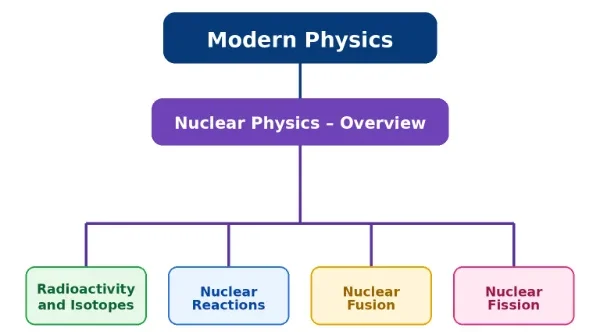
This structure chart places Nuclear Fission within the wider Nuclear Physics cluster under Modern Physics.
    It shows that Nuclear Fission is one of four related subtopics, alongside Radioactivity and Isotopes, Nuclear Reactions, and Nuclear Fusion.
    The chart helps students understand that fission is not an isolated topic, but part of a connected study of nuclear structure, instability, reaction processes, and energy transformation.
1. Learning Pathway within Nuclear Physics
Nuclear Fission is part of a broader network of concepts within modern physics and nuclear science. The following topics provide context, connections, and contrasts that deepen understanding of how energy is released from atomic nuclei.
Modern Physics
Provides the physical principles governing energy release, particle interactions, and mass-energy equivalence in nuclear processes.Nuclear Fission
Describes how heavy nuclei split into smaller fragments, releasing energy and enabling controlled or chain reactions.Nuclear Physics – Overview
Places fission within the broader study of nuclear structure and transformation processes.Nuclear Reactions
Frames fission as a specific type of reaction involving energy release and particle emission.Radioactivity and Isotopes
Provides the underlying instability in certain nuclei that enables fission processes.Nuclear Fusion
Contrasts with fission by releasing energy through the combination rather than the splitting of nuclei.2. Theoretical Deep Dive: Mechanics of Fission & Reaction Equations
A typical nuclear fission reaction occurs when a heavy, unstable nucleus such as uranium-235 absorbs a thermal neutron. The absorbed neutron increases internal excitation energy, causing the compound nucleus (uranium-236) to deform into an elongated dumbbell shape. When Coulomb repulsion between proton clusters overcomes the short-range strong nuclear force across the narrow neck, the nucleus snaps into two smaller fragments, emitting 2 to 4 fast neutrons and prompt gamma radiation.
23592U + 10n → 23692U* → 9236Kr + 14156Ba + 3 10n + Energy
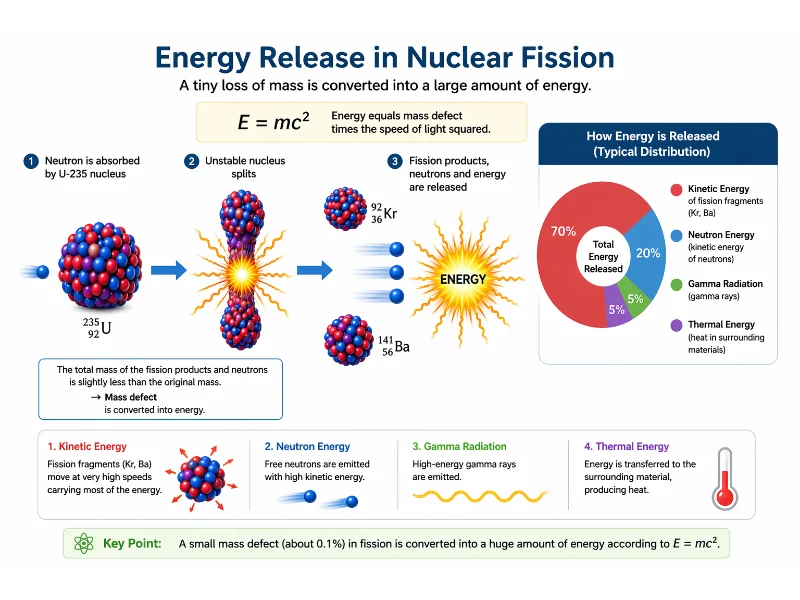
This diagram illustrates a typical nuclear fission process.
    A neutron collides with a uranium-235 nucleus, causing it to become unstable and split into two smaller nuclei, krypton-92 and barium-141.
    The reaction also releases three free neutrons and a significant amount of energy.
    The emitted neutrons can trigger further fission events, leading to a chain reaction.
Probabilistic Outcomes in Plutonium Fission
Unlike simple chemical reactions, nuclear fission does not produce a single fixed set of products. When a heavy nucleus such as plutonium-239 undergoes fission, it can split in many different ways. The exact outcome varies from one event to another, making fission a fundamentally probabilistic process governed by mass-yield curves.
10n + 23994Pu → 13454Xe + 10340Zr + 3 10n + Energy
10n + 23994Pu → 14356Ba + 9538Sr + 2 10n + Energy
10n + 23994Pu → 14054Xe + 9638Sr + 4 10n + Energy
10n + 23994Pu → 13050Sn + 10744Ru + 3 10n + Energy
Concept Check: Fission Initiators and Products
Q1. What initiates most nuclear fission reactions in reactors?
A thermal neutron colliding with and being absorbed by a heavy fissile nucleus.
Neutron absorption creates an unstable, excited compound nucleus that deforms and undergoes splitting.
Q2. Why do different fission events of the same isotope yield different product elements?
Nuclear fission is quantum-probabilistic. The deforming nucleus splits across a distribution of mass asymmetries depending on nuclear shell stability.
3. Core Physics Principles: Chain Reactions & Energy Distribution
The neutrons released during fission can trigger further fission events in nearby nuclei, creating a self-sustaining process known as a chain reaction. Controlling this multiplication factor (k) distinguishes reactors from explosive devices:
- Subcritical (k < 1): Neutron production is lower than absorption/leakage; the chain reaction dies out.
- Critical (k = 1): Neutron production exactly balances losses, maintaining a steady power output in commercial reactors.
- Supercritical (k > 1): Reaction rate grows exponentially; managed during power ramp-ups or uncontrolled in nuclear weapons.
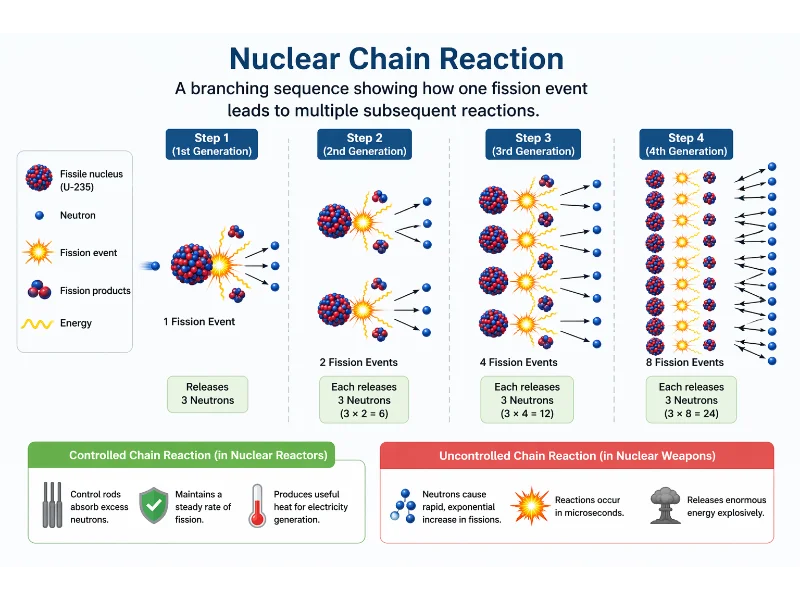
This diagram illustrates a nuclear chain reaction in which a single fission event releases neutrons that go on to induce further fission in nearby nuclei.
    The process progresses through successive generations, with each stage producing more fission events and additional neutrons.
    It contrasts controlled chain reactions in nuclear reactors with uncontrolled exponential multiplication.
Check Your Understanding: Chain Reaction Dynamics
What determines whether a fission chain reaction remains self-sustaining?
A. Number and economy of free neutrons available to cause subsequent fissions
B. Temperature of the external surroundings
C. Color of the fuel material
D. Volume of the containment vessel alone
B. Temperature of the external surroundings
C. Color of the fuel material
D. Volume of the containment vessel alone
The correct answer is A. Sustainable chain reactions depend on effective neutron economy—ensuring on average at least one emitted neutron causes another fission before escaping or being parasiticly absorbed.
4. Mathematical Foundations: Mass Defect & Energy Distribution
The total rest mass of the fission products and emitted neutrons is strictly less than the rest mass of the original target nucleus and incident neutron. This missing mass (Δm) is liberated as kinetic and radiant energy according to Einstein’s mass-energy equivalence:
$$ E = \Delta m \, c^2 $$
For a single 235U fission event, approximately 200 MeV of energy is released and partitioned as follows:
- Kinetic Energy of Fission Fragments: ≈ 165 MeV (≈ 80–85%, converted directly into thermal heat via lattice collisions)
- Kinetic Energy of Prompt Neutrons: ≈ 5 MeV
- Prompt Gamma Rays: ≈ 7 MeV
- Delayed Decay Energy: ≈ 23 MeV (from radioactive decay of daughter fragments via beta particles, neutrinos, and delayed gammas)
5. Practical Applications, Safety & Historical Case Studies
Nuclear Power Generation
Controlled fission in light water reactors uses moderators (water/graphite) to slow fast neutrons and control rods (cadmium/boron) to regulate flux, turning thermal energy into steam to drive turbines.Medical Radioisotopes
Fission reactors produce essential medical isotopes like Technetium-99m (via Molybdenum-99 fission fragments) for diagnostic PET/SPECT scans and cancer radiotherapy.Scientific Research & Materials Testing
Research reactors provide intense thermal neutron beams for neutron scattering experiments, material stress analysis, and element activation studies.Deep-Space Exploration
Radioisotope Thermoelectric Generators (RTGs) and nuclear thermal propulsion systems supply continuous power to space probes operating far beyond solar range.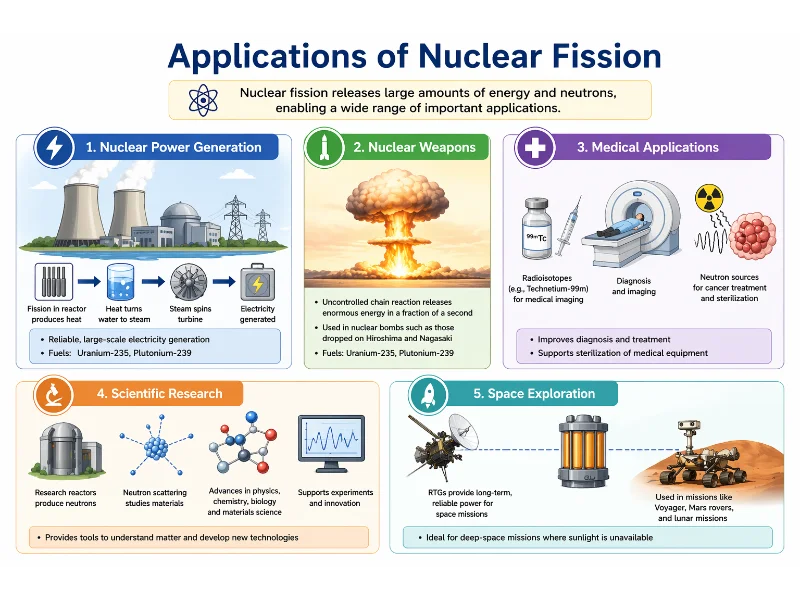
Case Studies: Nuclear Incidents and Engineering Lessons
1. Chernobyl (1986, Ukraine): Positive void coefficient and unsafe control rod withdrawal during a test caused an explosive prompt-critical power surge. Lesson: Elimination of positive void coefficient designs, mandatory containment buildings, and standardized safety culture protocols.
2. Fukushima Daiichi (2011, Japan): Tsunami flooded emergency diesel generators, cutting decay heat cooling pumps and causing zircaloy-steam hydrogen explosions. Lesson: Implementation of passive safety cooling systems (requiring no electrical power) and elevated seawall defenses.
3. Three Mile Island (1979, USA): Relief valve stuck open combined with misleading control room indicators led to partial core meltdown. Lesson: Redesign of human-machine control interfaces, advanced sensor telemetry, and rigorous operator simulation training.
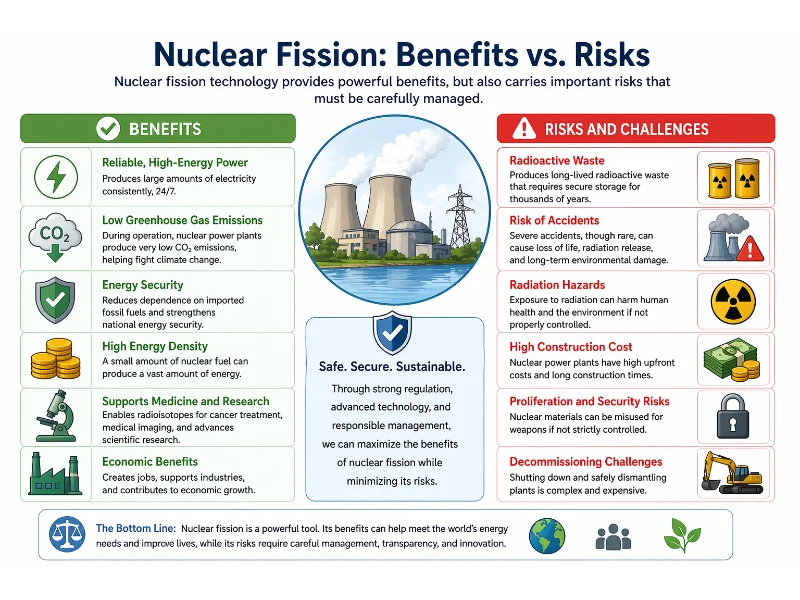
6. Key Terms Glossary
- Nuclear Fission
- The splitting of a heavy atomic nucleus into two lighter nuclei accompanied by neutron release and large energy output.
- Fissile Material
- Nuclides capable of undergoing fission upon absorbing low-energy thermal neutrons (e.g., Uranium-235, Plutonium-239).
- Critical Mass
- The minimum mass of fissile material required to maintain a self-sustaining nuclear chain reaction at k = 1.
- Moderator
- A medium (like light water, heavy water, or graphite) used to slow down fast fission neutrons to thermal energies via elastic collisions.
- Control Rods
- Neutron-absorbing rods (containing boron, cadmium, or hafnium) inserted into a reactor core to regulate the multiplication factor.
- Mass Defect
- The difference in mass between the original reactants and the final fission products, converted directly into energy via E = Δmc2.
7. Frequently Asked Questions
What is nuclear fission?
Nuclear fission is the process in which a heavy atomic nucleus splits into two or more lighter nuclei, often accompanied by the emission of neutrons and a large amount of energy. This split happens because heavy nuclei are unstable and splitting reduces their total binding energy per nucleon, releasing the excess energy.
Which isotopes commonly undergo fission in reactors?
Common isotopes used in nuclear fission reactors include uranium-235 and plutonium-239. These isotopes have a sufficient combination of neutron capture cross-section and instability that allows them to split under neutron bombardment, sustaining a nuclear chain reaction.
What is a chain reaction in the context of nuclear fission?
A chain reaction occurs when neutrons emitted by a fission event go on to induce fission in other nearby nuclei, releasing more neutrons and energy. If enough fissile nuclei and neutrons are present, and conditions are controlled, the reaction can be self-sustaining.
What is critical mass and why is it important for fission reactors?
Critical mass is the minimum amount of fissile material needed so that the neutrons released by each fission event on average cause at least one more fission event, sustaining a chain reaction. Proper geometry, neutron moderation, and control systems help maintain a stable, controlled reaction in reactors.
How much energy is released in a typical fission reaction?
A typical fission reaction releases on the order of 200 MeV (million electron-volts) per fission event. This corresponds to a huge amount of energy per unit mass compared with chemical reactions and is the reason nuclear power is so energy-dense.
What role do moderators and control rods play in a fission reactor?
Moderators (such as water or graphite) slow down fast neutrons produced by fission so they can be more readily captured by fissile nuclei. Control rods, made from materials that absorb neutrons, are inserted or removed to regulate the neutron flux and control the rate of fission.
What are the differences between nuclear fission in reactors and in nuclear weapons?
In reactors, nuclear fission is controlled: neutron flux, geometry, and mass are regulated so the chain reaction proceeds steadily. In weapons, the configuration is designed to reach supercritical mass rapidly, leading to an uncontrolled chain reaction and explosive energy release.
What are the byproducts of nuclear fission and what are the concerns?
Fission produces lighter nuclei (fission fragments), free neutrons, and gamma radiation. The fragments are usually radioactive and decay further, producing radiation and heat. Long-lived radioactive waste requires secure long-term geological disposal.
8. Assessment Exercises
Part 1: Review Questions
Q1. What is nuclear fission and what initiates it?
Answer: Nuclear fission is the splitting of a heavy nucleus into lighter fragments, initiated when a fissile nucleus absorbs a low-energy neutron and becomes unstable.
Q2. How do neutrons sustain a nuclear chain reaction?
Answer: Each fission event liberates 2 to 4 free neutrons. If these neutrons are slowed down and captured by nearby fissile nuclei, they induce subsequent fission events in a chain sequence.
Q3. What is critical mass?
Answer: Critical mass is the minimum mass of fissile material required for the neutron production rate to equal neutron loss (absorption + leakage), keeping the effective multiplication factor k = 1.
Q4. How does mass defect explain energy release in fission?
Answer: The total mass of the fission products and emitted neutrons is less than the original nucleus and incident neutron. This missing mass (Δm) turns into kinetic and radiant energy via E = Δmc2.
Q5. How do control rods regulate reactor power?
Answer: Control rods contain high neutron-absorption cross-section elements (cadmium, boron). Inserting them removes free neutrons from the core, decreasing k and slowing the reaction.
Part 2: Applied & Thought-Provoking Scenarios
Q1. How might next-generation Fast Neutron or Molten Salt Reactors improve sustainability?
Answer: Fast reactors eliminate thermal moderators to burn long-lived transuranic actinide waste as fuel. Molten salt reactors operate at ambient pressure with passive cooling, eliminating high-pressure steam explosion risks.
Q2. How does the concept of neutron economy affect reactor safety design?
Answer: Maintaining a precise balance between neutron generation, thermalization, parasitic absorption, and control rod capture ensures the reactor remains stable without risking uncontrolled criticality surges.
Q3. What ethical obligations govern dual-use fission research?
Answer: Scientists and governments must balance civil power generation benefits against proliferation risks, requiring strict IAEA oversight, safeguards, and fuel enrichment caps.
Part 3: Numerical Problems with Step-by-Step Worked Solutions
Problem 1: Energy Release from Mass Defect in Atomic Mass Units
Calculate the energy released in MeV when a single fission event of uranium-235 produces a mass defect of Δm = 0.2 u. (Use 1 u = 931.5 MeV).
Solution:
$$ E = \Delta m \times 931.5 \text{ MeV/u} = 0.2 \times 931.5 = 186.3 \text{ MeV} $$
Answer: 186.3 MeV.
Problem 2: Fission Rate for a 1000 MW Reactor
A reactor operates at a thermal power level of 1000 MW (1.0 × 10⁹ W). If each fission releases 200 MeV, calculate the required number of fissions per second.
Solution:
Convert 200 MeV to Joules: 200 × (1.602 × 10−13 J) = 3.204 × 10⁻¹¹ J per fission.
$$ \text{Fissions/sec} = \frac{1.0 \times 10^9 \text{ J/s}}{3.204 \times 10^{-11} \text{ J/fission}} \approx 3.12 \times 10^{19} \text{ fissions/s} $$
Answer: 3.12 × 10¹⁹ fissions/second.
Problem 3: Decay Constant Calculation
Determine the decay constant λ for a radioactive fission product with a half-life of 30 years. (1 year = 3.156 × 10⁷ s).
Solution:
Half-life in seconds: t1/2 = 30 × (3.156 × 107 s) = 9.468 × 10⁸ s.
$$ \lambda = \frac{\ln 2}{t_{1/2}} = \frac{0.69315}{9.468 \times 10^8 \text{ s}} \approx 7.32 \times 10^{-10} \text{ s}^{-1} $$
Answer: 7.32 × 10⁻¹⁰ s−1.
Problem 4: Sample Decay Across 10 Half-Lives
A radioactive sample initially contains 1.0 × 10²⁰ atoms. How many radioactive atoms remain after 10 half-lives?
Solution:
$$ N = N_0 \left(\frac{1}{2}\right)^{10} = (1.0 \times 10^{20}) \times \frac{1}{1024} \approx 9.77 \times 10^{16} \text{ atoms} $$
Answer: 9.77 × 10¹⁶ atoms.
Problem 5: Energy Equivalent of TNT Explosion
A fission device releases energy equivalent to 20 kilotons of TNT. Calculate the total energy in Joules (1 kiloton TNT = 4.184 × 10¹² J).
Solution:
$$ E = 20 \times (4.184 \times 10^{12} \text{ J}) = 8.368 \times 10^{13} \text{ J} $$
Answer: 8.368 × 10¹³ Joules.
Problem 6: Total Energy from Complete Fission of 1000 kg U-235
Calculate the total thermal energy released in Joules if 1000 kg of pure U-235 undergoes complete fission (assuming 200 MeV per fission event).
Solution:
Number of nuclei:
$$ N = \frac{1000 \text{ kg}}{0.235 \text{ kg/mol}} \times (6.022 \times 10^{23} \text{ nuclei/mol}) \approx 2.5625 \times 10^{27} \text{ nuclei} $$
Energy per fission: 200 MeV = 3.204 × 10⁻¹¹ J. Total energy:
$$ E_{\text{total}} = (2.5625 \times 10^{27}) \times (3.204 \times 10^{-11} \text{ J}) \approx 8.21 \times 10^{16} \text{ J} $$
Answer: 8.21 × 10¹⁶ Joules.
Problem 7: Exponential Neutron Population Growth across Generations
In a multiplication cycle where each fission produces an average of 2.5 neutrons, starting with 1.0 × 10¹² initial neutrons, calculate the total neutron count after 5 unmitigated generations.
Solution:
$$ N_5 = N_0 \times (2.5)^5 = (1.0 \times 10^{12}) \times 97.65625 \approx 9.77 \times 10^{13} \text{ neutrons} $$
Answer: 9.77 × 10¹³ neutrons.
History, Challenges, and Future Prospects
The discovery of nuclear fission transformed 20th-century geopolitical structures and global energy infrastructure.
Historical Milestones: In December 1938, Otto Hahn and Fritz Strassmann detected barium after bombarding uranium with neutrons. Lise Meitner and Otto Frisch provided the theoretical physical interpretation in early 1939, naming the process “fission.” Enrico Fermi achieved the first controlled self-sustaining chain reaction with the Chicago Pile-1 reactor in December 1942.
Current Challenges: Deep geological disposal of long-lived high-level radioactive waste (actinides), managing high capital construction costs for Generation III+ reactors, and maintaining non-proliferation compliance across international supply chains.
Future Frontiers: Commercializing Small Modular Reactors (SMRs) with factory-fabricated safety assemblies, deploying Generation IV high-temperature gas reactors, and implementing closed fuel cycles using fast breeder reactors to transmute actinide waste into clean power.
Cluster Navigation & Academic References
Related Modern Physics Topics
- Modern Physics Hub — Overview of non-classical physical principles.
- Nuclear Physics Overview — Sub-hub covering nuclear structure, binding energy, and forces.
- Radioactivity and Isotopes — Alpha, beta, and gamma decay mechanisms.
- Nuclear Reactions — Scattering cross-sections, transmutation, and Q-values.
- Nuclear Fusion — Stellar nucleosynthesis and plasma confinement.
External References & Data Sources
- IAEA: What Is Nuclear Energy? — International overview of nuclear science and power systems.
- NRC: What Is a Chain Reaction? — U.S. Nuclear Regulatory Commission educational guide.
- World Nuclear Association: Physics of Nuclear Energy — Technical guide on reactor kinetics and uranium fuel cycles.
Archived version: This learning resource is archived on Zenodo at https://zenodo.org/records/20570351.
Suggested citation: Gan, J. (2026). Nuclear Fission: Chain Reactions, Energy Distribution, and Reactor Dynamics. Prep4Uni.online. Zenodo. https://doi.org/10.5281/zenodo.20570351