
At the foundation of the physical universe lies a division between two major categories of particles: fermions and bosons. Fermions are the matter-building particles, while many bosons act as force carriers in the interactions between particles. In Physics, fermions help explain why matter has structure, stability, and variety. Electrons, quarks, protons, neutrons, and neutrinos all belong to the fermion family.
The defining feature of fermions is that they obey the Pauli exclusion principle. This principle states that no two identical fermions can occupy exactly the same quantum state at the same time. This rule explains electron shells, chemical bonding, the structure of atoms, the periodic table, the stability of matter, and why ordinary solid objects do not collapse into themselves.
In the context of Modern Physics, fermions are central to explaining atomic structure, chemical behaviour, and the formation of matter at every scale. Within Atomic Physics, they define electron shells and bonding patterns, as explored in Quantum Numbers and Electron Configuration and the Structure of the Atom. Fermions come in two main families: quarks and leptons. Electrons are leptons, while quarks combine to form protons and neutrons, the key constituents of atomic nuclei.
In Nuclear Physics, fermions provide the basis for understanding nuclear structure and nuclear change. Protons and neutrons are composite fermions made of quarks, and their behaviour helps explain processes such as Nuclear Fission and Nuclear Fusion. In Nuclear Reactions, the behaviour of protons, neutrons, electrons, and neutrinos is also important for understanding decay modes, conservation laws, and nuclear stability, including processes involving Radioactivity and Isotopes.
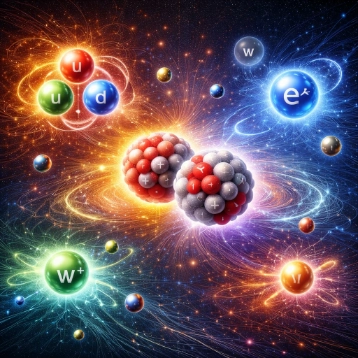
This illustration represents fermions through a pair of dense particle clusters resembling a proton and a neutron.
    Three bright spheres grouped together suggest quark constituents, while a glowing sphere evokes an electron.
    Sweeping ribbons of light connect the elements, emphasizing that fermions are fundamental building blocks of matter.
Quick Check: Why Are Fermions Important?
Fermions are called the building blocks of matter because electrons, quarks, protons, neutrons, and neutrinos belong to the fermion family.
Which statement best explains why fermions matter in physics?
A. Fermions are always force carriers and never form matter.
B. Fermions obey the Pauli exclusion principle, helping explain atomic structure and the stability of matter.
C. Fermions exist only inside black holes.
D. Fermions are classical particles with no quantum behaviour.
B. Fermions obey the Pauli exclusion principle, helping explain atomic structure and the stability of matter.
C. Fermions exist only inside black holes.
D. Fermions are classical particles with no quantum behaviour.
The correct answer is B. Fermions obey the Pauli exclusion principle, which prevents identical fermions from occupying the same quantum state. This rule explains electron shells, chemical behaviour, and the stability of matter.
1. Matter Constituents and Structural Formation
Fermions are best studied within the broader framework of Particle Physics, where their interactions are described alongside Bosons. In the Standard Model, gauge bosons mediate interactions governed by the Fundamental Forces.
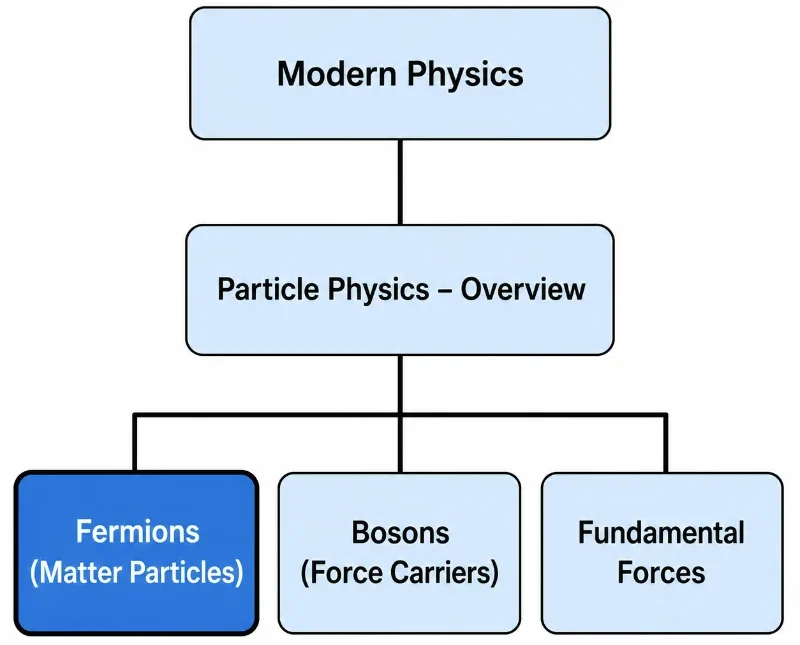
Structure chart placing Fermions within Modern Physics and Particle Physics.
    It branches into Fermions (Matter Particles), Bosons (Force Carriers), and Fundamental Forces.
    The chart illustrates how matter particles connect with force mediators and interaction frameworks.
Modern Physics
Provides the quantum rules that define particle properties such as spin, mass, and interaction behavior.Fermions (Matter Particles)
Describes quarks and leptons that form all matter and obey exclusion principles that shape atomic and molecular structure.Bosons (Force Carriers)
Explains how interactions between matter particles occur through force-mediating exchange particles.Fundamental Forces
Defines the interaction mechanisms that govern how fermions attract, repel, and transform.Particle Physics – Overview
Integrates matter particles into the broader classification and interaction framework of the subatomic world.2. Theoretical Deep Dive: Structure of Fermions
Fermions are divided into two main groups: quarks and leptons. Quarks combine to form composite particles such as protons and neutrons, while leptons exist as fundamental particles.
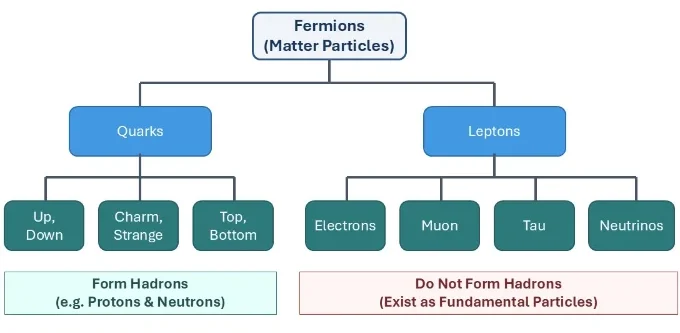
Quarks: Constituents of Hadrons
Quarks possess color charge and interact via the strong nuclear force mediated by gluons. They exist in six flavors:
- Up (u): Electric charge = +2/3 e
- Down (d): Electric charge = −1/3 e
- Charm (c): Electric charge = +2/3 e
- Strange (s): Electric charge = −1/3 e
- Top (t): Electric charge = +2/3 e (heaviest quark)
- Bottom (b): Electric charge = −1/3 e
Due to color confinement, quarks are permanently bound inside composite hadrons:
- Baryons: Bound states of 3 quarks (e.g., Proton = uud, Neutron = udd).
- Mesons: Bound states of 1 quark and 1 antiquark (e.g., pions).
Leptons: Fundamental Light Particles
Leptons do not experience the strong nuclear force. They are organized into three generations:
- First Generation: Electron (e−, charge −1, mass 0.511 MeV/c2) and Electron Neutrino (νe).
- Second Generation: Muon (μ−, charge −1, mass ≈ 105.7 MeV/c2) and Muon Neutrino (νμ).
- Third Generation: Tau (τ−, charge −1, mass ≈ 1777 MeV/c2) and Tau Neutrino (ντ).
Concept Checks: Quarks vs Leptons
Which statement correctly contrasts quarks and leptons?
Quarks carry color charge and bind via gluons to form hadrons (protons, neutrons). Leptons do not carry color charge and do not participate in strong interactions.
3. Core Physics Principles: Spin & Fermi-Dirac Statistics
Fermions possess intrinsic half-integer spin (s = 1/2, 3/2…). This requires their collective wavefunctions to be anti-symmetric under particle exchange, subjecting them to Fermi-Dirac statistics:
$$ f(E) = \frac{1}{e^{(E – E_F)/k_B T} + 1} $$
The Pauli Exclusion Principle directly follows: no two identical fermions in a system can occupy the exact same set of quantum numbers (n, ℓ, mℓ, ms).

Diagram of spin-1/2 quantum states.
    Spin-up corresponds to spin projection m_s = +1/2.
    Spin-down corresponds to spin projection m_s = -1/2.
    These distinct spin projections allow two electrons to share an orbital shell.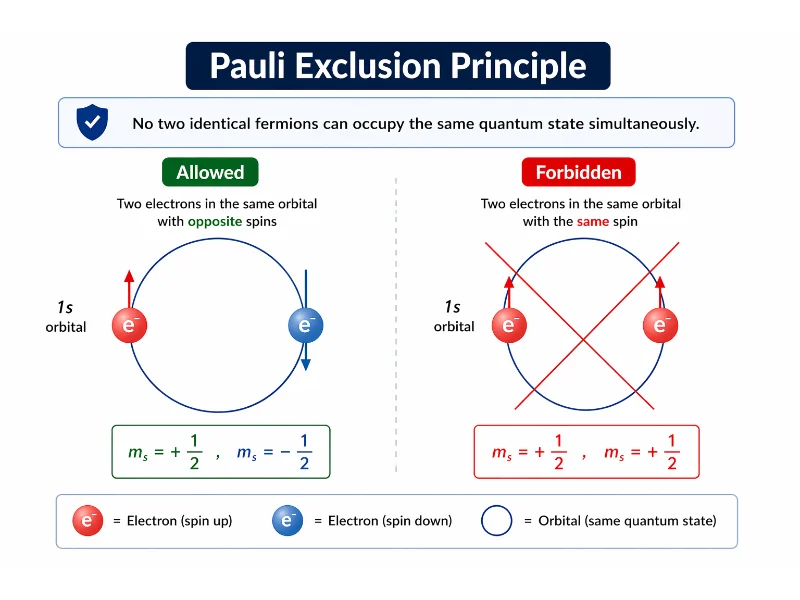
Illustrating Pauli Exclusion Principle in a 1s orbital.
    Left: Allowed state containing opposite spin orientations (+1/2 and -1/2).
    Right: Forbidden state containing identical spin orientations (+1/2 and +1/2).
4. Mathematical Foundations: Fermi Energy & Degeneracy Pressure
In a dense system of non-interacting fermions at absolute zero, all quantum states are filled up to the Fermi Energy (EF):
$$ E_F = \frac{\hbar^2}{2m} \left( 3\pi^2 n \right)^{2/3} $$
Compressing fermions forces them into higher momentum states, creating non-thermal degeneracy pressure:
$$ P_{\text{deg}} \propto n^{5/3} $$
Electron degeneracy pressure prevents gravitational collapse in White Dwarf stars, while neutron degeneracy pressure supports Neutron Stars.
5. Case Studies, Neutrino Physics & Applications
Case Study: Neutrino Physics & Supernova 1987A
Neutrinos carry zero electric charge and interact exclusively via the weak nuclear force and gravity. On February 23, 1987, detectors (Kamiokande II, IMB) recorded a 13-second burst of 24 anti-neutrinos from Supernova 1987A hours before visible light escaped, giving birth to extra-solar neutrino astronomy.
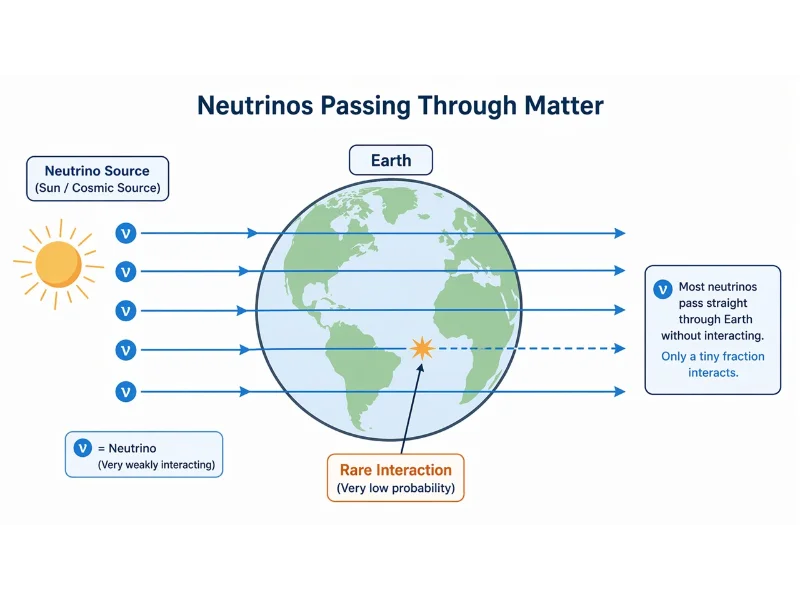
Illustration of high-energy neutrinos penetrating planetary matter.
    Because neutrinos experience no electromagnetic or strong interaction, they travel through solid matter nearly unimpeded.
    This property makes them probes for core stellar fusion processes.
Technological Applications of Fermions
Semiconductor Microelectronics
Controlling electron Fermi levels and band gaps in doped silicon enables transistors, microprocessors, and integrated digital circuits.Muon Tomography
Atmospheric cosmic-ray muons penetrate dense structures, enabling non-destructive 3D imaging of archaeological pyramids and nuclear waste casks.Positron Emission Tomography (PET)
Clinical PET scans detect annihilation gamma pairs produced when antimatter positrons (anti-electrons) collide with cellular electrons.Neutrino Astronomy & Detection
Underground facilities (Super-Kamiokande, IceCube) detect solar, atmospheric, and cosmic neutrinos to study stellar fusion and core-collapse supernovae.6. Key Terms Glossary
- Fermion
- A fundamental or composite particle possessing half-integer spin (1/2, 3/2…) obeying Fermi-Dirac quantum statistics.
- Pauli Exclusion Principle
- The quantum mechanical rule stating that two identical fermions cannot occupy identical quantum states simultaneously.
- Quark
- An elementary spin-1/2 fermion carrying electric and color charges, existing in 6 flavors (up, down, charm, strange, top, bottom).
- Lepton
- An elementary spin-1/2 fermion that does not experience the strong nuclear force (electron, muon, tau, and their neutrinos).
- Baryon
- A composite hadron composed of 3 valence quarks (e.g., proton, neutron).
- Fermi Energy (EF)
- The energy level of the highest occupied quantum state in a system of fermions at absolute zero temperature.
7. Frequently Asked Questions
What are fermions in particle physics?
Fermions are particles with half-integer spin (1/2, 3/2…) that obey Fermi–Dirac statistics and the Pauli exclusion principle, constituting the building blocks of physical matter.
How do fermions differ from bosons?
Fermions have half-integer spin and cannot share identical quantum states. Bosons have integer spin (0, 1, 2…) and can occupy the same quantum state freely.
What are the main types of fermions in the Standard Model?
Fermions are divided into 6 quarks (up, down, charm, strange, top, bottom) and 6 leptons (electron, muon, tau, and 3 corresponding neutrinos), plus their antiparticles.
What is the Pauli exclusion principle?
It is the rule that no two identical fermions can occupy the exact same quantum state simultaneously, creating electron shell structures and degeneracy pressure.
What is degeneracy pressure?
A quantum pressure generated when fermions are compressed tightly together, forcing them into high-momentum states due to the Pauli exclusion principle.
8. Assessment Exercises
Part 1: Review Questions
Q1. What defines a fermion?
Answer: A particle with half-integer spin that obeys Fermi-Dirac statistics and the Pauli Exclusion Principle.
Q2. What quark combination forms a neutron?
Answer: One up quark (+2/3 e) and two down quarks (−1/3 e, −1/3 e), yielding a net electric charge of 0.
Q3. Why do neutrinos interact so weakly with matter?
Answer: Neutrinos carry zero electric charge (no electromagnetic interaction) and no color charge (no strong interaction), interacting solely via the short-range weak force and gravity.
Part 2: Applied & Thought-Provoking Scenarios
Q1. How does electron degeneracy pressure support White Dwarf stars against gravitational collapse?
Answer: Gravity compresses core electrons into extremely small volumes, forcing them into higher kinetic energy states per the Pauli exclusion principle, producing non-thermal resistance pressure.
Q2. What distinguishes a particle’s intrinsic identity from its quantum state?
Answer: Identity represents immutable intrinsic traits (mass, charge, spin). State represents transient quantum orbital configurations (energy level, spatial orientation, spin projection ms).
Part 3: Numerical Problems with Step-by-Step Worked Solutions
Problem 1: De Broglie Wavelength of an Electron
Calculate the de Broglie wavelength λ of an electron (me = 9.109 × 10⁻³¹ kg) moving at 2.0 × 10⁶ m/s. (Use h = 6.626 × 10⁻³⁴ J·s).
Solution:
$$ \lambda = \frac{h}{m_e v} = \frac{6.626 \times 10^{-34} \text{ J s}}{(9.109 \times 10^{-31} \text{ kg}) \times (2.0 \times 10^6 \text{ m/s})} \approx 3.637 \times 10^{-10} \text{ m} $$
Answer: 3.637 × 10⁻¹⁰ m (0.364 nm).
Problem 2: Electron Rest Mass Conversion to Kilograms
Convert the electron rest mass of 0.511 MeV/c2 into kilograms. (1 MeV/c2 = 1.783 × 10⁻³⁰ kg).
Solution:
$$ m = 0.511 \times (1.783 \times 10^{-30} \text{ kg}) \approx 9.11 \times 10^{-31} \text{ kg} $$
Answer: 9.11 × 10⁻³¹ kg.
Problem 3: Relativistic Energy of an Electron
Calculate the total relativistic energy in MeV of an electron moving at speed v = 0.8c.
Solution:
Calculate Lorentz factor γ:
$$ \gamma = \frac{1}{\sqrt{1 – (v/c)^2}} = \frac{1}{\sqrt{1 – 0.64}} = \frac{1}{0.6} = 1.667 $$
Total relativistic energy E:
$$ E = \gamma m_0 c^2 = 1.667 \times 0.511 \text{ MeV} \approx 0.852 \text{ MeV} $$
Answer: 0.852 MeV.
Problem 4: Electron Compton Wavelength
Calculate the Compton wavelength λC of an electron.
Solution:
$$ \lambda_C = \frac{h}{m_e c} = \frac{6.626 \times 10^{-34} \text{ J s}}{(9.109 \times 10^{-31} \text{ kg}) \times (3.0 \times 10^8 \text{ m/s})} \approx 2.426 \times 10^{-12} \text{ m} $$
Answer: 2.426 × 10⁻¹² m (2.426 pm).
History, Challenges, and Future Prospects
The discovery and quantum description of fermions built the structural foundation of modern subatomic physics.
Historical Milestones: J.J. Thomson discovered the electron in 1897. Wolfgang Pauli formulated the exclusion principle in 1925. Enrico Fermi and Paul Dirac derived Fermi-Dirac statistics in 1926. Murray Gell-Mann proposed quarks in 1964. The tau lepton was discovered at SLAC in 1975, and top quark confirmation occurred at Fermilab in 1995.
Current Challenges: Determining whether neutrinos are Dirac or Majorana particles, measuring absolute neutrino mass scales, and understanding dark matter candidates (e.g., neutralinos, sterile neutrinos).
Future Frontiers: High-precision flavor physics at Belle II, searching for neutrinoless double beta decay in GERDA and LEGEND, and probing fourth-generation exotic fermions at future high-energy colliders.
Cluster Navigation & Academic References
Related Modern Physics Topics
- Modern Physics Hub — Overview portal for subatomic physics.
- Particle Physics Overview — Standard Model structure, fields, and accelerators.
- Fundamental Forces — Gauge interactions governing subatomic particles.
- Bosons – Force Carriers — Gauge vector bosons and scalar field excitations.
- Quantum Mechanics — Wave functions, uncertainty, and spin statistics.
External References & Data Sources
- The Standard Model – CERN — Official CERN documentation on elementary fermions.
- Fermion – Encyclopaedia Britannica — Detailed overview of half-integer spin particles.
- Fermilab Education: Fundamental Particles — Accelerator physics and lepton research.
- Nobel Prize in Physics 1945 – Pauli Exclusion Principle — Historical Nobel release.
Archived version: This learning resource is archived on Zenodo at https://zenodo.org/records/20570351.
Suggested citation: Gan, J. (2026). Fermions (Matter Particles): Quarks, Leptons, and Pauli Exclusion Mechanics. Prep4Uni.online. Zenodo. https://doi.org/10.5281/zenodo.20570351