
Biology is not only the study of life—it is the study of how living systems are organised, sustained, and transformed across different levels of complexity. This page helps you understand how biological knowledge develops from cells to ecosystems, and how these ideas prepare you for university-level study.
At its core, biology is structured around the organisation of life. This begins with cell biology, where fundamental processes such as cell structure, cell cycle, and cell development define how life is built and maintained. Understanding cell physiology and cell communication reveals how cells function as coordinated systems rather than isolated units.
Beyond the cellular level, biology expands into systems of interaction and change. Ecology explains how organisms interact within environments, while evolutionary biology provides the framework for understanding how life diversifies and adapts over time. Together, these fields show that biology is not static—it is shaped by continuous processes of interaction and transformation.
A central pathway in biology is the study of heredity and variation through genetics. From Mendelian genetics to molecular genetics, this area explains how traits are transmitted and modified across generations. At the molecular level, DNA and RNA form the basis of genetic information, while processes such as gene expression, genetic mutation, and inheritance explain how biological information is used and altered.
Modern biology extends these ideas into applications and large-scale analysis. Fields such as DNA technology, protein synthesis, and genetics in medicine show how biological knowledge is applied in real-world contexts. Research tools covered in molecular techniques enable scientific discovery, while molecular evolution connects genetic changes to broader patterns of life.
At the population level, population genetics and quantitative genetics explain how traits are distributed and evolve across groups. The study of genomics extends this further by analysing entire genetic systems, linking genes, traits, and disease within a unified framework.
Together, these areas show that biology is structured as a progression—from molecular mechanisms to complex systems—where each level builds upon the previous one. Understanding this structure allows you to engage more effectively with advanced topics at university and to see how different areas of biology connect within a coherent system of knowledge.
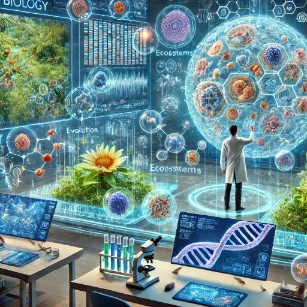
A futuristic laboratory where scientists analyze DNA structures, cellular processes, and ecological systems through holographic displays. The background highlights interconnected elements of biology, including ecosystems, microbiology, and human anatomy, symbolizing the diverse and interdisciplinary nature of biological sciences.
The IDEF0 functional boundary diagram below maps the core system transformations within biological processing, genetic regulation, and ecological interactions:
IDEF0 Functional Model: Biological System Regulation & Genetic Transformation
- Inputs (Left): Solar Radiation, Nutrient Monomers, Raw Nucleotides, Environmental Factors, Genetic Variant Signals.
- Controls (Top): Homeostatic Thresholds, Central Dogma Rules, Thermodynamic Laws, Evolutionary Selection Pressures.
- Outputs (Right): Synthesised Proteins, Cellular ATP, Adapted Population Traits, Ecological Energy Flow.
- Mechanisms (Bottom): Enzymatic Catalyst Complexes, Ribosomal Translation Assemblies, Gene Expression Regulatory Networks.
Biology: Living Systems, Organisation, and Life Processes
Biology is part of a broader scientific system where different disciplines explain the natural world from complementary perspectives. Exploring these related fields helps you understand how biological systems connect with physical, chemical, and environmental processes.
Science – Overview
Positions biology within the wider scientific framework, linking living systems with underlying physical and chemical principles.
Biology (Current Topic)
Investigates living systems from cellular organisation to ecosystems, focusing on how organisms function, interact, and evolve.
Chemistry
Provides the molecular foundation for biological processes, including metabolism, biochemical reactions, and genetic mechanisms.
Physics
Explains the physical forces and energy principles that influence biological structure, movement, and system behaviour.
Earth Science
Connects biological systems to planetary processes such as climate dynamics, geological change, and environmental conditions.
Environmental Science
Examines interactions between organisms and ecosystems, with emphasis on sustainability, ecological balance, and human impact.
Exploring Biology – From Molecules to Ecosystems and Human Movement
Biology is structured around levels of organisation—from molecular processes within cells to interactions across entire ecosystems. Understanding how these levels connect is essential for moving from school biology to university-level study.
This section introduces the major domains of biology as interconnected systems. Each area represents a different scale of life, showing how structure, function, variation, and interaction combine to explain living systems as a whole.
Core Sub-Fields of Biological Science
The study of biology spans multiple hierarchical sub-disciplines:
Cell Biology & Genetics: Investigates organelles, energy pathways, cellular division, and molecular mechanisms governing genetic inheritance.
Physiology & Kinesiology: Analyzes homeostasis, organ system mechanics, neuromuscular execution, and bioenergetics.
Evolutionary Biology & Ecology: Models population dynamics, speciation processes, natural selection, and ecosystem nutrient cycles.
Key Formula — Cellular Bioenergetics (Aerobic Respiration):
C6H12O6 + 6 O2 → 6 CO2 + 6 H2O + ~30-32 ATP
About This Interactive Simulator:
This interactive simulator models enzyme substrate binding kinetics, demonstrating how substrate concentration [S] and temperature impact reaction rate V under Michaelis-Menten dynamics.
- Substrate Concentration [S] Slider: Controls the density of substrate molecules available for active site binding.
- Temperature Slider: Modifies kinetic energy, showing thermal acceleration up to optimal denaturation thresholds.
- Solid Blue Line: Renders the active catalytic reaction rate V as a function of substrate concentration.
- Dashed Gray Line: Represents maximum theoretical enzymatic velocity Vmax baseline.
- Labeled X-Axis Ticks: Displays explicit substrate concentration values [S] to guide graph interpretation.
Enzyme Kinetics & Substrate Saturation Simulator
Applications of Biological Science
Biological research powers major clinical, agricultural, environmental, and industrial advancements.
Medicine, Genomics, and Clinical Diagnostics
Modern medicine utilizes molecular genetics and genomics to identify disease risk factors, develop targeted gene therapies, and formulate personalized treatments based on individual genetic profiles.
Biotechnology and Agricultural Innovations
Agricultural biotechnology employs DNA technology and genetic modification to cultivate high-yield, drought-resistant crops and engineered biological systems.
Environmental Conservation and Ecology
Ecological monitoring models biodiversity, tracks climate dynamics impact, and informs conservation strategies to preserve vulnerable ecosystems.
Emerging Trends in Biological Research
Biological science rapidly integrates computational and engineering frontiers:
1. CRISPR and Precision Gene Editing: Utilizing molecular scissors to perform targeted genomic modifications for disease treatment.
2. Synthetic Biology: Engineering artificial genetic pathways and synthetic organisms to produce clean biofuels and pharmaceuticals.
3. Bioinformatics & Computational Genomics: Leveraging machine learning algorithms to map protein folding structures and sequence multi-terabyte genomic databases.
How Biology Prepares You for University Study
Studying biology develops more than subject knowledge. It builds the ability to analyse complex systems, interpret evidence, and understand how ideas connect across different levels of organisation—skills essential for university-level learning.
Analytical and Problem-Solving Skills: Biology trains you to analyse data, design experiments, and interpret results. These skills support structured thinking and prepare you to engage with complex problems in academic and real-world contexts.
Scientific Thinking: The study of biology develops a mindset based on inquiry, evidence, and logical reasoning. Learning how to question assumptions and evaluate explanations is essential for university study across disciplines.
Interdisciplinary Understanding: Biology connects with chemistry, physics, and mathematics to explain living systems. This integrated approach prepares you to move across disciplines and understand how different fields contribute to scientific knowledge.
Practical and Experimental Skills: Laboratory work and field studies develop hands-on abilities such as observation, measurement, and data collection, supporting the transition to practical work in university courses.
Conceptual Foundations: Core topics such as genetics, physiology, and ecology form the basis for advanced study. Understanding these ideas makes it easier to engage with specialised areas at university.
Awareness of Real-World Challenges: Biology provides insight into issues such as health, environmental change, and biodiversity. This broader perspective helps you connect academic study with real-world applications.
Together, these capabilities prepare you to approach university study with greater clarity, independence, and confidence.
Conclusion
Biology is structured as a progression of interconnected systems, from molecular processes within cells to large-scale interactions across ecosystems. Understanding how these levels relate to one another is essential for moving beyond isolated facts toward a more integrated view of life.
By exploring areas such as cell biology, genetics, physiology, evolution, and ecology, you begin to see how biological knowledge is organised, developed, and applied. This perspective allows you to approach new topics with greater clarity and to recognise patterns that extend across different domains of life science.
As you continue your studies, these foundations support more advanced learning in fields such as medicine, biotechnology, environmental science, and research. Biology then becomes not just a subject to study, but a framework for understanding living systems in a systematic and meaningful way.
Frequently Asked Questions
What is biology in the context of university preparation?
Biology, in the context of university preparation, is the structured study of living systems across different levels of organisation—from molecules and cells to organisms and ecosystems. It explains how life is built, how it functions, and how it changes over time using observation, experiments, and scientific models.
Why is studying biology important for university studies and careers?
Biology prepares you for fields such as medicine, life sciences, environmental science, and biotechnology. It develops systems thinking, data interpretation, and the ability to connect molecular processes with real-world issues such as health, food systems, and biodiversity.
Which school subjects support university-level biology?
A strong foundation includes biology, chemistry, and mathematics. Chemistry supports understanding of biochemical processes, while mathematics and basic statistics are essential for analysing data, modelling populations, and interpreting experimental results.
What are the main areas of biology studied at university?
University biology typically includes cell and molecular biology, genetics, physiology, ecology, and evolution. Many programmes also introduce specialised fields such as immunology, neuroscience, microbiology, and conservation biology.
How is university biology different from school biology?
University biology focuses less on memorisation and more on mechanisms, evidence, and analysis. Students are expected to interpret data, evaluate research, and explain how processes across different levels of organisation are connected.
What skills does studying biology develop?
Biology develops laboratory skills, data analysis, and scientific reasoning. It also strengthens the ability to interpret graphs, evaluate evidence, and draw conclusions from experimental results.
How is biology connected to chemistry, physics, and environmental science?
Biology depends on chemistry to explain molecular interactions and on physics to describe processes such as energy transfer and movement. It connects to environmental science through the study of ecosystems, climate, and biodiversity, forming an integrated scientific framework.
What careers can a background in biology lead to?
A background in biology supports careers in healthcare, research, biotechnology, environmental management, agriculture, and science education. It also provides a foundation for roles in policy, sustainability, and public health.
Comprehensive Biology Practice & Assessment Module
Section 1: Foundational Review Questions
Aerobic vs Anaerobic Respiration: How does cellular respiration differ between aerobic and anaerobic conditions, and what does this mean for energy production?
Answer: Aerobic respiration uses oxygen and produces a high yield of ATP through the electron transport chain, while anaerobic pathways rely on fermentation and produce significantly less ATP. This difference explains why oxygen availability limits sustained energy output in cells.Enzyme Specificity Mechanics: Why are enzymes highly specific, and how does this affect biological reactions?
Answer: Enzyme specificity arises from the structure of the active site, which binds substrates through shape and chemical complementarity. This ensures that biochemical reactions occur in a controlled and efficient manner without unwanted side reactions.From DNA to Protein Synthesis: How is genetic information transferred from DNA to proteins, and what happens when errors occur?
Answer: Genetic information flows through transcription and translation. Errors in these processes can alter protein structure and function, sometimes leading to diseases, but also contributing to genetic variation and evolution.Horizontal Gene Transfer: How does horizontal gene transfer increase genetic diversity in microorganisms?
Answer: Unlike vertical inheritance, horizontal gene transfer allows organisms to acquire genes directly from others, enabling rapid adaptation such as antibiotic resistance and new metabolic capabilities.Antibiotic Resistance and Selection: How does natural selection contribute to the development of antibiotic resistance?
Answer: Antibiotics create selective pressure by eliminating susceptible bacteria while allowing resistant ones to survive and reproduce. Over time, resistant strains become dominant within the population.Photosynthesis Light Coupling: How do light-dependent and light-independent reactions work together in photosynthesis?
Answer: Light-dependent reactions capture energy to produce ATP and NADPH, while the Calvin cycle uses this energy to fix carbon dioxide into organic molecules, forming the base of energy flow in ecosystems.Central Dogma Molecular Flow: What is the Central Dogma of molecular biology?
Answer: The Central Dogma describes the directional flow of genetic information from DNA replication to transcription into RNA, and subsequent translation into functional proteins.Interactive Details & Summary: Toggle below to review self-assessment guidance on cell membrane transport.
Click to reveal self-assessment question on active vs passive cell transport
Question: How does active transport differ from passive diffusion across cell membranes?
Answer: Passive diffusion moves molecules down concentration gradients without metabolic energy input, whereas active transport utilizes ATP hydrolysis to pump substances against electrochemical gradients.
Section 2: Analytical & Scenario-Based Thought Questions
Thermoregulation and Homeostatic Control: How do biological feedback loops maintain physiological stability during physical exertion?
Answer: Negative feedback loops detect elevated core temperatures via hypothalamus thermal sensors, triggering cutaneous vasodilation and sweating to dissipate heat and restore baseline internal equilibrium.Ecological Trophic Cascade Dynamics: What occurs within an ecosystem when an apex predator is removed?
Answer: Apex predator removal releases herbivore populations from top-down suppression, leading to vegetation overgrazing, altered physical habitats, and severe biodiversity reduction across lower trophic levels.CRISPR Off-Target Mutations: Why is gRNA sequence specificity critical in CRISPR-Cas9 therapeutic applications?
Answer: Mismatched gRNA binding causes off-target Cas9 endonuclease cleavage, potentially inducing unintended double-stranded DNA breaks, oncogene activation, or essential gene disruption.Hardy-Weinberg Equilibrium Assumptions: Under what conditions does population allele frequency remain constant across generations?
Answer: Allele frequencies remain constant only in infinite populations undergoing random mating with zero mutation, zero migration (gene flow), and zero natural selection pressure.Symbiotic Endosymbiosis Theory: What structural evidence supports the endosymbiotic origin of mitochondria and chloroplasts?
Answer: Both organelles possess double membranes, circular bacterial-like DNA genomes, 70S ribosomes, and replicate via binary fission independent of eukaryotic nuclear division.
Section 3: Numerical Problems & Step-by-Step Solutions
Michaelis-Menten Enzymatic Velocity Calculation:
Question: An enzyme has maximum velocity Vmax = 100 μmol/min and Michaelis constant Km = 20 mM. Calculate reaction velocity V when substrate concentration [S] = 20 mM.
Solution:
Apply Michaelis-Menten Equation: V = (Vmax · [S]) / (Km + [S])
Substitute known values: V = (100 · 20) / (20 + 20)
Simplify numerator and denominator: V = 2000 / 40 = 50 μmol/min.
Hardy-Weinberg Allele Frequency Problem:
Question: In a population in Hardy-Weinberg equilibrium, 16% of individuals display a recessive trait ( homozygous recessive q2 = 0.16). Calculate the dominant allele frequency p and the percentage of heterozygous carriers (2pq).
Solution:
Given q2 = 0.16 ⇒ recessive allele frequency q = √0.16 = 0.40.
Calculate dominant allele frequency: p = 1 - q = 1 - 0.40 = 0.60.
Calculate heterozygous frequency: 2pq = 2(0.60)(0.40) = 0.48 or 48%.
Dilution & Bacterial Cell Density Calculation:
Question: A 0.1 mL sample from a 10-5 serial dilution yields 85 bacterial colonies on an agar plate. Calculate the original culture cell density (CFU/mL).
Solution:
Apply CFU formula: CFU/mL = (Number of Colonies · Dilution Factor) / Plated Volume (mL)
Dilution factor = 105, Plated volume = 0.1 mL.
Calculate density: CFU/mL = (85 · 105) / 0.1 = 85 · 106 = 8.5 × 10⁷ CFU/mL.
Monohybrid Genetic Cross Probability:
Question: Two heterozygous pea plants (Aa × Aa) are crossed. Calculate the probability that an offspring displays the dominant phenotype AND is homozygous dominant (AA).
Solution:
Punnett square genotypes: 1/4 AA, 2/4 Aa, 1/4 aa.
Dominant phenotypes = AA + Aa = 3/4.
Homozygous dominant probability within total offspring = 1/4 or 25%.
Ecological Energy Transfer Efficiency (10% Rule):
Question: Primary producers in an ecosystem capture 50,000 kJ/m2/yr of net primary productivity. Calculate the available energy at the tertiary consumer level assuming a standard 10% ecological transfer efficiency between trophic levels.
Solution:
Primary Producers = 50,000 kJ/m2/yr.
Primary Consumers (Herbivores) = 50,000 · 0.10 = 5,000 kJ/m2/yr.
Secondary Consumers = 5,000 · 0.10 = 500 kJ/m2/yr.
Tertiary Consumers = 500 · 0.10 = 50 kJ/m2/yr.