
What Is Physics and How Does It Define the Laws of Reality?
Physics is the foundational quantitative science that describes how matter, energy, space, and time interact through universal mathematical principles, constructing rigorous, predictive models that unify natural phenomena across scales ranging from subatomic elementary particles to the cosmic expansion of the observable universe.
Physics seeks to understand the fundamental laws that govern the universe, describing how matter, energy, motion, and forces interact across all scales. From the motion of everyday objects studied in mechanics to the behaviour of light and electromagnetic fields, physics provides a unified framework for explaining natural phenomena through mathematical models and precise measurement.
At its core, physics builds models that allow us to predict how systems behave. Classical ideas of motion and energy extend into deeper domains such as electricity and magnetism, thermodynamics, and modern physics, where concepts like quantum mechanics and relativity reshape our understanding of space, time, and matter. These frameworks extend and refine our ability to describe reality across different scales.
Physics also extends beyond the Earth through astrophysics, applying the same laws to stars, galaxies, and the evolution of the universe. By linking everyday phenomena with cosmic structures, physics reveals a consistent set of principles that govern both the smallest particles and the largest systems. It is not only a body of knowledge but a way of thinking—analytical, predictive, and grounded in the search for underlying laws.
Calculus-Driven Mathematical Rigor: The Fundamental Field Principles
To understand reality as a cohesive system, university physics moves past descriptive prose and relies on the language of vector calculus, differential equations, and conservation laws. At the macroscopic boundary, classical mechanics and field theories are unified by the Principle of Stationary Action.
The path taken by a physical system is always the one that minimizes (or renders stationary) the Action integral, \(S\), defined over the system’s Lagrangian (\(L = T – V\), where \(T\) is kinetic energy and \(V\) is potential energy):
$$S = \int_{t_1}^{t_2} L(q_i, \dot{q}_i, t) \, dt$$By applying the calculus of variations (\(\delta S = 0\)), we derive the universal Euler-Lagrange Equations which dictate the equations of motion for any classical system:
$$\frac{d}{dt}\left(\frac{\partial L}{\partial \dot{q}_i}\right) – \frac{\partial L}{\partial q_i} = 0$$Where \(q_i\) represents generalized coordinates and \(\dot{q}_i\) represents generalized velocities. When transitions are made to microscopic or high-velocity frameworks, this foundational modeling philosophy persists, scaling up into the relativistic field equations of spacetime curvature and the deterministic evolution of quantum state vectors via the time-dependent Schrödinger equation:
$$i\hbar\frac{\partial}{\partial t}|\Psi(t)\rangle = \hat{H}|\Psi(t)\rangle$$Here, \(\hbar\) is the reduced Planck constant, \(|\Psi(t)\rangle\) is the state vector of the system, and \(\hat{H}\) is the Hamiltonian operator representing the total energy of the system.
Core Domains of Physics
Physics is organised into major domains, each focusing on a different aspect of how the universe behaves—from motion and forces to energy, fields, light, and the structure of matter at fundamental scales.
Mechanics
Study motion, forces, energy, and equilibrium in systems ranging from particles to rigid bodies and fluids using Newtonian, Lagrangian, and Hamiltonian mechanics.Electricity and Magnetism
Explore electric charges, Maxwell’s field equations, circuits, magnetic fields, and electromagnetic interactions that govern modern technology.Light and Optics
Understand the behaviour of light, including geometric optics, wave properties (interference, diffraction, polarization), and advanced photonics systems.Thermodynamics
Examine heat, work, entropy, statistical mechanics distributions, and the fundamental laws governing macro-system equilibrium.Modern Physics
Investigate special and general relativity, quantum mechanics, wave-particle duality, atomic structure, and the standard model of particles.Astrophysics
Apply thermodynamic, quantum, and relativistic field equations to stellar environments, explore non-luminous matter and black hole singularities, and model the evolutionary timeline of the macro-cosmos.Why Study Physics
Physics provides the foundational framework for understanding how the universe behaves, from fundamental forces to complex systems. It develops both conceptual insight and practical skills that extend across science, engineering, and real-world problem solving.
Foundation of Scientific Understanding
Provides the fundamental laws and principles that underpin chemistry, biology, and earth sciences.Analytical and Problem-Solving Skills
Develops structural modeling, dimensional analysis, rigorous statistical interpretation, and advanced systematic quantitative thinking.Applications in Technology and Engineering
Supports innovations in areas such as biomedical electronics, telecommunications, and quantum computing.Energy and Environmental Solutions
Enables the development of renewable energy, energy storage, and solutions for climate and environmental challenges.Applications of Physics
Physics translates fundamental laws into practical applications that shape technology, healthcare, energy systems, and everyday life. Its principles enable both innovation and large-scale solutions across multiple domains.
Technological Systems
Drives the development of electronics, semiconductors, lasers, and communication systems such as fiber optics and wireless networks.Medical Technologies
Enables diagnostic and treatment tools including X-rays, MRI, PET scans, and radiation therapy.Space and Satellite Systems
Supports spacecraft motion, satellite operation, and global systems such as GPS, weather monitoring, and communication networks.Energy Generation and Storage
Advances renewable energy technologies, nuclear power, and efficient energy conversion systems.Everyday Technologies
Underpins transportation systems, consumer electronics, imaging devices, and modern infrastructure.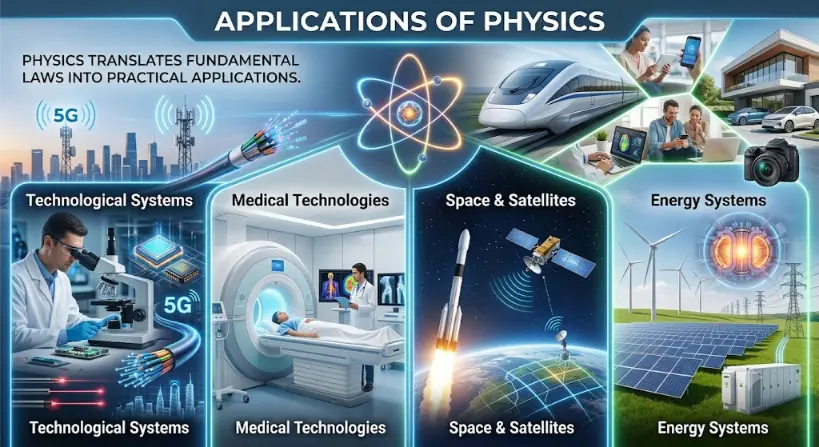
Infographic displaying the applications of physics across four key sectors: Technological Systems (fiber optics, microchips, 5G networks), Medical Technologies (an MRI machine scanning a patient), Space and Satellite Systems (a rocket launching and a satellite orbiting Earth), and Energy Systems (solar panels, wind turbines, and a fusion reactor core).
Frequently Asked Questions
What is physics?
Physics is the study of matter, energy, space, and time, and the laws that govern their behaviour. It explains how objects move, how forces act, how energy is transferred, and how phenomena from subatomic particles to galaxies can be understood through fundamental principles.
What are the main branches of physics?
Major branches include classical mechanics, electromagnetism, thermodynamics and statistical physics, waves and optics, and modern physics such as relativity and quantum mechanics. Applied areas include solid-state physics, nuclear physics, astrophysics, and plasma physics.
Why is physics important for understanding the natural world?
Physics provides the basic rules that explain natural phenomena, from motion and sound to electricity, planetary systems, and atomic structure. Its concepts unify understanding across chemistry, biology, Earth science, and engineering.
How does physics connect with technology and everyday life?
Physics underpins technologies such as power systems, communication networks, medical imaging, semiconductors, renewable energy, and transportation. It explains how these systems work and supports their improvement.
What kind of mathematics is used in physics?
Physics uses algebra, trigonometry, geometry, vectors, and functions at foundational levels, and extends to calculus and differential equations for advanced modelling. Mathematics provides the language for expressing laws and analysing systems.
How do experiments and models work together in physics?
Experiments provide observations and data, while models describe and predict system behaviour. Experiments test and refine models, and models guide further experimentation, forming a continuous cycle of understanding.
Why is physics important preparation for engineering and other STEM fields?
Physics develops quantitative reasoning, problem-solving, and modelling skills, along with understanding of forces, energy, and systems. These foundations are essential for engineering, physical sciences, and many technology-related fields.
What university courses and careers can a background in physics lead to?
Physics leads to studies in engineering, materials science, astronomy, data science, and interdisciplinary fields. Career paths include research, engineering design, data analytics, finance, education, scientific computing, and technology-driven industries.
Comprehensive 15-Problem End-of-Chapter Bank
Conceptual Problems (1–5)
1. The Principle of Dimensional Homogeneity
State why all terms added together in a physical algebraic equation must possess identical dimensions. Prove that if an equation is dimensionally correct, it is not necessarily physically valid, but if it is dimensionally incorrect, it is definitively invalid.Click to expand solution
Physical quantities can only be summed or subtracted if they map to identical combinations of base dimensions (e.g., length, time, mass) because addition represents the scaling of identical physical properties. Dimensional correctness is a necessary but insufficient condition for physical validity; it cannot verify dimensionless scalar constants (such as $\frac{1}{2}$ or $2\pi$) or transcendental function inputs, which must always be dimensionless. If an equation is dimensionally inhomogeneous, it violates the covariance of physical units under base scaling, rendering it immediately invalid.
2. The Epistemological Boundary of Models vs. Laws
Differentiate rigorously between a “Physical Model” and a “Fundamental Law.” Use the historical transition from the Bohr model of the atom to Quantum Electrodynamics (QED) to justify your analysis.Click to expand solution
A fundamental law (e.g., Maxwell’s Equations) represents an invariant principle that describes empirical reality without restriction across its verified domain. A physical model is an idealized, deliberate simplification designed to capture dominant mechanics within localized boundary conditions. The Bohr model treated electrons as discrete planetary particles orbiting a nucleus with quantized angular momentum; it successfully predicted the hydrogen emission spectrum but failed for multi-electron atoms. Quantum Electrodynamics (QED) replaced this model with quantized field excitations, resolving the fundamental law of electromagnetic interactions at all micro-scales.
3. Noether’s Theorem and Invariance Principles
State Noether’s Theorem conceptually. Identify the specific continuous symmetries of space and time that give rise to the global conservation laws of linear momentum, angular momentum, and energy.Click to expand solution
Noether’s Theorem states that every differentiable, continuous symmetry of the Action of a physical system corresponds to a unique, invariant conservation law. Specifically:
- Homogeneity of Time (translation invariance in time) yields the Conservation of Energy.
- Homogeneity of Space (translation invariance in space) yields the Conservation of Linear Momentum.
- Isotropy of Space (rotational invariance in space) yields the Conservation of Angular Momentum.
4. The Correspondence Principle
Explain the function of Bohr’s Correspondence Principle when evaluating modern structural frameworks like relativistic mechanics or quantum mechanics.Click to expand solution
The Correspondence Principle states that any new, advanced physical theory must reduce to the classic, established equations of classical physics when evaluated under macroscopic limits. For special relativity, the transformation equations must reduce to Galilean transformations when velocities approach zero ($v \ll c$). For quantum mechanics, quantum statistical distributions must converge to classical Maxwell-Boltzmann mechanics when the action scale is significantly larger than the Planck constant ($S \gg \hbar$).
5. Statistical Mechanics vs. Classical Thermodynamics
Contrast how macroscopic states are defined in classical thermodynamics versus how they are evaluated in statistical mechanics.Click to expand solution
Classical thermodynamics models macroscopic systems using empirical, bulk properties like temperature ($T$), pressure ($P$), and volume ($V$) without considering atomic components. Statistical mechanics builds these exact same macroscopic state functions up from the microstate distribution of $10^{23}$ individual particles, defining properties like entropy ($S$) statistically via the probability distribution of accessible phase space volumes using Boltzmann’s relationship $S = k_B \ln \Omega$.
Thought Questions (6–10)
6. The Ultimate Failure of Classical Electrodynamics
According to classical Maxwellian electrodynamics, an accelerating electric charge must continuously radiate electromagnetic energy. Analyze why this fundamental law predicted the immediate collapse of all planetary atomic models, necessitating quantum theory.Click to expand solution
In a planetary atomic model, electrons undergo uniform circular motion around the nucleus, which requires a continuous centripetal acceleration vector $\vec{a}$. Classical electrodynamics dictates that this accelerating charge must radiate energy at a rate given by the Larmor formula: $P = \frac{\mu_0 q^2 a^2}{6\pi c}$. As the electron radiates energy, its orbital radius must decay exponentially, spiraling into the positive nucleus within approximately $10^{-11}$ seconds. Because matter is stable, classical electrodynamics was shown to be fundamentally inapplicable to atomic scales, driving the creation of quantized orbital mechanics.
7. The Chaos Horizon of Deterministic Systems
A system is governed entirely by a set of coupled non-linear differential equations, making it perfectly deterministic. Explain how this system can become practically unpredictable over long timescales, and define the mathematical metric tracking this deviation.Click to expand solution
Non-linear dynamical systems can exhibit extreme sensitivity to initial conditions, a phenomenon known as deterministic chaos. Even though the system’s future state is uniquely fixed by its initial state, any real-world measurement contains a finite error margin $\delta x_0$. In chaotic regimes, this initial separation diverges exponentially over time according to $e^{\lambda t}$, where $\lambda$ is the positive Lyapunov Exponent. Once the error amplifies to the scale of the system’s phase space, deterministic prediction becomes impossible, defining the practical prediction horizon.
8. General Relativity and the Equivalence Principle
Formulate how Einstein used the conceptual behavior of a human observer inside an enclosed, accelerating elevator to eliminate the classical Newtonian interpretation of gravity as an attractive force.Click to expand solution
Einstein’s Weak Equivalence Principle asserts that the local effects of a uniform gravitational field are identical to the effects of a uniformly accelerating reference frame. An observer in an enclosed elevator cannot perform any mechanical or optical experiment to differentiate whether they are at rest on Earth experiencing a gravitational field $g$, or out in deep space accelerating uniformly at $a = g$. This led Einstein to conclude that gravity is not an external vector force pulling on masses, but rather an apparent force arising from the geometric curvature of 4D spacetime fabric ($G_{\mu\nu} = \frac{8\pi G}{c^4} T_{\mu\nu}$).
9. The Ultraviolet Catastrophe and Energy Quantization
Evaluate the mathematical failure of classical physics known as the “Ultraviolet Catastrophe.” Explain how Max Planck fixed this failure by altering the assumptions surrounding atomic oscillators.Click to expand solution
The classical Rayleigh-Jeans law assumed that blackbody radiation cavity modes could absorb and emit continuous energy values equally across all frequencies ($\bar{E} = k_B T$). This model predicted that the spectral radiance energy density must grow proportional to the square of the frequency ($\rho(\nu) \propto \nu^2$). Integrating across all frequencies meant a blackbody would radiate infinite energy at high frequencies (the ultraviolet spectrum). Planck solved this by forcing energy to be exchanged only in discrete packets called quanta: $E = nh\nu$. This introduced a statistical damping factor at high frequencies, matching empirical data perfectly.
10. The Non-Locality of Quantum Entanglement
Does the instantaneous collapse of an entangled two-particle wave function across interstellar distances violate the special relativistic constraint that no signal can travel faster than the speed of light c? Justify your answer using information theory.Click to expand solution
No, it does not violate special relativity. The No-Communication Theorem in quantum information theory proves that wave-function collapse cannot transmit usable information faster than light. When the state of particle A is measured, the state of entangled particle B updates instantly. However, the measurement outcome at A is completely random. To extract any meaning or verify the correlation, the observer at A must transmit their measurement history to B via a classical channel, which is strictly limited to the speed of light c.
Numerical Problems (11–15)
11. Dimensional Extraction of the Planck Length
11. Dimensional Extraction of the Planck Length
Use dimensional analysis to derive the fundamental expression for the Planck Length (\( \ell_P \)) using combinations of three universal constants: the speed of light (\( c \)), Newton’s gravitational constant (\( G \)), and the reduced Planck constant (\( \hbar \)).Click to expand solution
Express the dimensions of each base constant in terms of Mass (\( M \)), Length (\( L \)), and Time (\( T \)):
$$ [c] = L T^{-1} $$
$$ [G] = M^{-1} L^3 T^{-2} $$
$$ [\hbar] = M L^2 T^{-1} $$
Set up the dimensional product: \( \ell_P = c^x G^y \hbar^z \) and expand it into its fundamental primary units: \( L^1 = (L T^{-1})^x (M^{-1} L^3 T^{-2})^y (M L^2 T^{-1})^z \). Now, we equate the dimensional exponents across both sides to solve for our unknown powers:
Mass axis (M):
$$ -y + z = 0 \quad \text{which means} \quad z = y $$Time axis (T):
$$ -x – 2y – z = 0 \quad \text{which simplifies to} \quad -x – 3y = 0 \quad \text{or} \quad x = -3y $$Length axis (L):
$$ x + 3y + 2z = 1 \quad \text{substituting our terms gives} \quad -3y + 3y + 2y = 1 \quad \text{so} \quad 2y = 1 \quad \text{or} \quad y = \frac{1}{2} $$Substituting this result back into our baseline balances gives a final clean convergence of \( z = \frac{1}{2} \) and \( x = -\frac{3}{2} \).
Therefore, our grouped constants yield:
$$ \ell_P = c^{-3/2} G^{1/2} \hbar^{1/2} = \sqrt{\frac{\hbar G}{c^3}} $$12. Relativistic Kinetic Energy Constraints
A subatomic proton (\( m_p = 1.67 \times 10^{-27}\text{ kg} \)) is accelerated inside a particle collider up to a velocity of \( v = 0.95c \). Calculate its relativistic kinetic energy (\( K_{\text{rel}} \)) and find the percentage error that occurs if a researcher uses the classical equation \( K_{\text{class}} = \frac{1}{2}mv^2 \).Click to expand solution
First, evaluate the Lorentz factor \( \gamma \):
$$ \gamma = \frac{1}{\sqrt{1 – (v/c)^2}} = \frac{1}{\sqrt{1 – (0.95)^2}} = \frac{1}{\sqrt{1 – 0.9025}} = \frac{1}{\sqrt{0.0975}} \approx 3.2026 $$The relativistic kinetic energy is calculated as follows:
$$ K_{\text{rel}} = (\gamma – 1)m_p c^2 $$
$$ K_{\text{rel}} = (3.2026 – 1)(1.67 \times 10^{-27}\text{ kg})(3.00 \times 10^8\text{ m/s})^2 $$
$$ K_{\text{rel}} = 2.2026 \times (1.67 \times 10^{-27}) \times (9.00 \times 10^{16}) \approx 3.31 \times 10^{-10}\text{ Joules} $$Calculate the classical approximation:
$$ K_{\text{class}} = \frac{1}{2} m_p v^2 $$
$$ K_{\text{class}} = 0.5 \times (1.67 \times 10^{-27}\text{ kg}) \times (0.95 \times 3.00 \times 10^8\text{ m/s})^2 \approx 6.78 \times 10^{-11}\text{ Joules} $$Compute the total percentage error over the baseline value:
$$ \text{Percentage Error} = \frac{|K_{\text{rel}} – K_{\text{class}}|}{K_{\text{rel}}} \times 100 $$
$$ \text{Percentage Error} = \frac{3.31 \times 10^{-10} – 6.78 \times 10^{-11}}{3.31 \times 10^{-10}} \times 100 \approx 79.5\% $$
13. Order-of-Magnitude Estimation of Cosmic Scaling
Estimate the total number of protons contained within the boundaries of the observable universe. Assume the radius of the observable universe is roughly \( 4.4 \times 10^{26}\text{ m} \), the average critical density matches \( 10^{-26}\text{ kg/m}^3 \), and the matter composition is primarily hydrogen gas.Click to expand solution
Approximate the total space volume assuming spherical global symmetry:
$$ V = \frac{4}{3}\pi R^3 = \frac{4}{3}\pi (4.4 \times 10^{26}\text{ m})^3 \approx 3.57 \times 10^{80}\text{ m}^3 $$Calculate the total estimated mass of the observable universe:
$$ M = \rho \cdot V = (10^{-26}\text{ kg/m}^3) \times (3.57 \times 10^{80}\text{ m}^3) = 3.57 \times 10^{54}\text{ kg} $$Divide this mass value by the individual scale of a single proton (\( m_p \approx 1.67 \times 10^{-27}\text{ kg} \)):
$$ N = \frac{M}{m_p} = \frac{3.57 \times 10^{54}\text{ kg}}{1.67 \times 10^{-27}\text{ kg}} \approx 2.14 \times 10^{81} $$This means the observable universe contains an order of magnitude of roughly \( 10^{81} \) protons.
14. Thermodynamic Efficiency Limitations of Heat Engines
A high-efficiency industrial power station burns fuel at an internal core temperature of \( T_H = 850\text{ K} \) and discards waste heat directly into a nearby river environment at \( T_C = 295\text{ K} \). Calculate the theoretical maximum work output (\( W \)) achievable for every \( 5.0\text{ MW} \) of thermal energy extracted from the high-temperature reservoir.Click to expand solution
The maximum possible thermodynamic efficiency is bounded by the idealized Carnot cycle:
$$ \eta_{\text{Carnot}} = 1 – \frac{T_C}{T_H} = 1 – \frac{295}{850} = 1 – 0.347 = 0.653 \quad (65.3\%) $$Use the efficiency equation (\( \eta = \frac{W}{Q_H} \)) to isolate the maximum work output rate per second:
$$ P_{\text{work}} = \eta_{\text{Carnot}} \cdot P_{\text{thermal}} = 0.653 \times 5.0\text{ MW} = 3.265\text{ MW} $$The system can output a maximum of \( 3.27\text{ MW} \) of useful work, with the remaining \( 1.73\text{ MW} \) lost as irreversible entropy dump into the cold reservoir.
15. The Photon Flux of High-Powered Laser Systems
A monochromatic laboratory laser source emits a continuous beam of coherent ultraviolet light at a targeted wavelength of \( \lambda = 337\text{ nm} \) with a measured output power of \( 15.0\text{ mW} \). Compute the number of individual photons passing through a cross-section of the beam every second.Click to expand solution
First, calculate the discrete energy carried by a single photon at this wavelength:
$$ E_{\text{photon}} = \frac{hc}{\lambda} = \frac{(6.626 \times 10^{-34}\text{ J}\cdot\text{s}) \times (3.00 \times 10^8\text{ m/s})}{337 \times 10^{-9}\text{ m}} $$
$$ E_{\text{photon}} = \frac{1.9878 \times 10^{-25}}{3.37 \times 10^{-7}} \approx 5.898 \times 10^{-19}\text{ Joules} $$The laser system delivers a steady energy rate of \( 15.0\text{ mW} = 15.0 \times 10^{-3}\text{ J/s} \). Calculate the total photon emission flux (\( n \)):
$$ n = \frac{P}{E_{\text{photon}}} = \frac{15.0 \times 10^{-3}\text{ J/s}}{5.898 \times 10^{-19}\text{ J/photon}} \approx 2.54 \times 10^{16}\text{ photons/second} $$
Explore the Science Cluster
Science explores the natural world through different approaches, each focusing on distinct types of systems—from fundamental laws and matter to life, Earth systems, and environmental interactions. Together, these domains provide a complete framework for understanding how the world functions.
Science – Overview
Presents an integrated view of scientific inquiry, linking observation, experimentation, and modelling across disciplines.Physics
Examines fundamental laws governing motion, energy, forces, and interactions across all scales.Chemistry
Focuses on the composition, structure, and transformation of substances through atomic and molecular interactions.Biology
Studies living systems, from cellular processes to organisms and ecosystems.Earth Science
Investigates the structure, materials, and processes shaping the Earth and its systems.Environmental Science
Explores interactions between natural systems and human activity, including sustainability and environmental change.Summary
Physics provides a unified framework for understanding how the universe behaves, from the motion of everyday objects to the structure of matter and the evolution of the cosmos. By identifying fundamental laws and expressing them through mathematical models, physics allows us to describe, predict, and explain a wide range of natural phenomena with precision and consistency.
Across its domains, physics connects motion, energy, fields, and matter into a coherent system of ideas. Concepts developed in mechanics, electromagnetism, thermodynamics, and modern physics extend across scales, revealing that the same underlying principles govern both simple systems and complex structures. This ability to unify different phenomena distinguishes physics as a foundational discipline within science.
Beyond explanation, physics enables application. It underpins technologies in energy, communication, medicine, and infrastructure, shaping both modern industry and everyday life. Through experimentation, modelling, and quantitative reasoning, it equips learners with tools to analyse systems, design solutions, and engage with real-world challenges.
As scientific and technological demands continue to grow, physics remains central to innovation and discovery. It not only deepens our understanding of reality but also expands our ability to shape the future—linking fundamental knowledge with practical impact across disciplines and industries.