
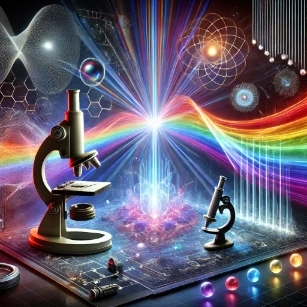
This conceptual illustration represents the field of light and optics, highlighting the visible spectrum, wave propagation, and scientific instruments such as microscopes. It symbolizes how light behaves as both a wave and a measurable phenomenon, connecting observation, imaging, and advanced technologies. The image reflects the role of optics in scientific discovery, communication systems, and the study of energy interactions in physical systems.
Explore Light & Optics
Physics – Overview **
Connects optical phenomena to the broader framework of physical laws governing waves, energy, and interactions across systems.Astrophysics *
Uses light as the primary tool for observing and understanding distant cosmic objects and phenomena.Electricity & Magnetism *
Defines light as an electromagnetic wave arising from oscillating electric and magnetic fields.Mechanics *
Relates wave motion and propagation to fundamental principles of oscillation, forces, and energy transfer.Modern Physics *
Explores quantum aspects of light, including photons, wave-particle duality, and relativistic effects.Thermodynamics *
Connects light to thermal radiation, emission spectra, and energy exchange processes.Light & Optics
Studies light as both wave and particle, explaining how it propagates, interacts with matter, and enables imaging and communication systems.Geometrical Optics
Analyzes light as rays to understand reflection, refraction, and image formation in optical systems.Wave Optics
Examines light as a wave, explaining interference, diffraction, and polarization phenomena.Quantum Optics
Studies light at the quantum level, focusing on photons and their interaction with matter.Nonlinear Optics
Explores how intense light alters material response, enabling frequency conversion and advanced optical effects.Fiber Optics
Investigates guided light transmission through fibers for communication, sensing, and signal processing.Photonics
Focuses on generating, controlling, and applying light in technologies such as optical circuits and communication systems.Visual Optics
Examines how light interacts with the human eye, enabling vision, perception, and imaging technologies.Atmospheric & Environmental Optics
Studies how light interacts with atmospheric particles, supporting climate analysis and remote sensing.Laser Optics
Explores coherent light generation and control for precision applications in science, medicine, and industry.Bio-Optics
Applies optical techniques to biological systems for imaging, diagnostics, and medical research.** Parent page in the Physics hierarchy
What Light & Optics Really Is
Modern Relevance of Light & Optics
Global Communication Infrastructure
Fiber optic systems transmit vast amounts of data using light signals, forming the backbone of the internet and enabling high-speed global connectivity.Imaging & Visualization Technologies
Optical systems such as microscopes, cameras, and telescopes allow us to observe structures across scales—from microscopic cells to distant galaxies.Medical Diagnostics & Treatment
Light-based technologies support non-invasive imaging, laser surgery, and precision diagnostics, improving healthcare outcomes and treatment methods.Laser Systems & Precision Engineering
Lasers provide highly controlled light for applications in manufacturing, surgery, measurement, and scientific experimentation.Renewable Energy & Solar Technologies
Optical principles govern how sunlight is captured, concentrated, and converted into usable energy in solar panels and advanced photovoltaic systems.Environmental Monitoring & Remote Sensing
Optical techniques are used to study atmospheric conditions, detect pollutants, and monitor climate systems through satellite and lidar technologies.Consumer Electronics & Display Systems
Screens, cameras, sensors, and optical components in everyday devices rely on controlled light behavior for image formation and data capture.Quantum & Photonic Technologies
Emerging fields such as quantum optics and photonics are enabling new forms of computing, communication, and ultra-sensitive measurement systems.Space Exploration & Astronomy
Nearly all knowledge of distant celestial objects is derived from light, making optics essential for understanding the universe.Why Study Light & Optics
Understanding How We See and Measure
Explore how light enables vision and measurement through processes such as reflection, refraction, and absorption. These principles explain how cameras form images, how microscopes reveal microscopic structures, and how sensors detect light in scientific instruments.Foundation for Imaging and Optical Systems
Learn how geometrical optics and wave behavior govern image formation in lenses, mirrors, and optical devices. Concepts such as focal length, magnification, and aberration correction are essential in designing telescopes, cameras, and medical imaging systems.Understanding Wave Behavior and Light Interactions
Study how light behaves as a wave through phenomena such as interference, diffraction, polarization, and dispersion. These effects explain patterns seen in thin films, diffraction gratings, and optical filters used in spectroscopy and imaging.Explaining Light–Matter Interaction
Understand how light interacts with materials through absorption, scattering, and transmission. These processes are key to applications such as atmospheric sensing, optical coatings, biomedical imaging, and environmental monitoring.Bridging Classical and Quantum Physics
Examine how light behaves as both a wave and a particle through photons, energy quantization, and quantum transitions. This prepares you for advanced topics such as quantum optics, spectroscopy, and photonic systems.Relevance to Communication Technologies
Explore how light carries information in systems such as fiber optics, where total internal reflection, signal modulation, and dispersion control enable high-speed global data transmission.Applications in Medicine and Biology
Understand how optical techniques such as laser surgery, fluorescence imaging, and optical coherence tomography enable non-invasive diagnostics and advanced medical treatments.Pathway to Photonics
Develop the foundation for photonics, where light is generated, controlled, and manipulated in devices such as LEDs, lasers, and integrated optical circuits used in communication and sensing technologies.Pathway to Emerging Technologies
Prepare for cutting-edge fields such as quantum communication, optical computing, and advanced sensing systems that rely on precise control of light and its interaction with matter.Enhancing Analytical Thinking
Strengthen your ability to analyse systems by understanding how variables such as wavelength, intensity, and medium properties affect light behavior in different conditions.Enhancing Visual and Spatial Thinking
Develop the ability to interpret ray diagrams, wave patterns, and optical systems, improving your capacity to visualise how light propagates and interacts in three-dimensional space.Connecting Science to Real-World Systems
See how principles such as polarization, dispersion, and scattering are applied in technologies ranging from solar panels and optical sensors to environmental monitoring and communication systems.Frequently Asked Questions: Light and Optics
In physics, light is a form of electromagnetic radiation that can be detected by the human eye. It behaves both as a wave and as a stream of particles called photons. Visible light is only a small part of the electromagnetic spectrum, which also includes radio waves, infrared, ultraviolet, X-rays, and gamma rays.
Wave–particle duality means that light shows properties of both waves and particles depending on the situation. Its wave nature explains interference, diffraction, and polarization, while its particle nature explains effects such as the photoelectric effect. Both perspectives are essential for understanding modern optical systems.
In a vacuum, light travels at about 3.0 × 10⁸ metres per second. This speed is a fundamental constant of nature and sets the maximum speed at which information can travel. It plays a key role in relativity, communication systems, and astronomical observations.
Reflection occurs when light bounces off a surface, with the angle of incidence equal to the angle of reflection. Refraction occurs when light passes between different media and changes speed, causing it to bend. These processes explain mirrors, lenses, and many optical devices.
The refractive index measures how much light slows down in a material compared to a vacuum. A higher refractive index means greater bending of light at boundaries. It is essential in lens design, optical fibres, and imaging systems.
Lenses change the direction of light rays through refraction so that they converge or diverge. Convex lenses can focus light to form real images, while concave lenses spread light to form virtual images. These principles are used in cameras, microscopes, and eyeglasses.
A concave mirror curves inward and can focus light to a point, producing real or magnified images depending on distance. A convex mirror curves outward and produces smaller, upright virtual images, making it useful for wide-angle viewing such as in rear-view mirrors.
Dispersion occurs because different wavelengths of light travel at slightly different speeds in a material. When white light enters a prism or raindrop, each colour bends differently, spreading into a spectrum. Rainbows form through a combination of refraction, internal reflection, and dispersion in water droplets.
Absorption occurs when light energy is taken in by a material. Scattering happens when light is redirected in different directions by particles or irregularities, such as in the atmosphere. Polarization describes the orientation of light waves and is used in technologies such as glare reduction and optical filtering.
Total internal reflection occurs when light travelling in a denser medium hits a boundary at an angle greater than the critical angle and is completely reflected back. This principle is used in optical fibres, prisms, and many sensing devices.
Optical fibres guide light through repeated total internal reflection. Information is encoded into light pulses, allowing large amounts of data to be transmitted over long distances with minimal loss. This forms the backbone of modern communication networks.
Both the eye and cameras use lenses to focus light and form images. The eye focuses light onto the retina, while cameras focus light onto sensors. Concepts such as focal length, aperture, and image formation apply to both systems.
Fields such as optical engineering, telecommunications, medical imaging, laser technology, photonics, and astronomy rely heavily on optics. These areas involve designing systems that control, detect, and use light for communication, measurement, and discovery.
Light & Optics — Summary
Reflection
Numerical Problems and Solutions
-
Light of wavelength 500 nm travels in vacuum. Calculate its frequency.
Solution:
\[ f = \frac{c}{\lambda} \]
\[ f = \frac{3.00 \times 10^{8}}{500 \times 10^{-9}} \]
\[ f = 6.00 \times 10^{14} \, \text{Hz} \]
-
A ray of light passes from air into glass with refractive index 1.5 at an angle of incidence of 30°. Find the angle of refraction.
Solution:
\[ n_1 \sin \theta_1 = n_2 \sin \theta_2 \]
\[ 1 \times \sin 30^\circ = 1.5 \sin \theta_2 \]
\[ 0.5 = 1.5 \sin \theta_2 \]
\[ \sin \theta_2 = \frac{0.5}{1.5} = 0.333 \]
\[ \theta_2 \approx 19.5^\circ \]
-
An object is placed 20 cm from a convex lens of focal length 10 cm. Find the image distance.
Solution:
\[ \frac{1}{f} = \frac{1}{v} + \frac{1}{u} \]
\[ \frac{1}{10} = \frac{1}{v} + \frac{1}{20} \]
\[ \frac{1}{v} = \frac{1}{10} - \frac{1}{20} = \frac{1}{20} \]
\[ v = 20 \, \text{cm} \]
-
In a double-slit experiment, slit separation is 0.5 mm and screen distance is 2 m. If the wavelength is 600 nm, find the fringe spacing.
Solution:
\[ y = \frac{\lambda D}{d} \]
\[ y = \frac{600 \times 10^{-9} \times 2}{0.5 \times 10^{-3}} \]
\[ y = 2.4 \times 10^{-3} \, \text{m} = 2.4 \, \text{mm} \]
-
Calculate the energy of a photon with wavelength 700 nm.
Solution:
\[ E = \frac{hc}{\lambda} \]
\[ E = \frac{6.626 \times 10^{-34} \times 3.00 \times 10^{8}}{700 \times 10^{-9}} \]
\[ E \approx 2.84 \times 10^{-19} \, \text{J} \]
-
A diffraction grating has 500 lines per mm. Calculate the angle for the first-order maximum for light of wavelength 500 nm.
Solution:
Grating spacing:
\[ d = \frac{1}{500 \times 10^{3}} = 2.0 \times 10^{-6} \, \text{m} \]
\[ d \sin \theta = n \lambda \]
\[ 2.0 \times 10^{-6} \sin \theta = 1 \times 500 \times 10^{-9} \]
\[ \sin \theta = 0.25 \]
\[ \theta \approx 14.5^\circ \]
-
A mirror forms an image at the same distance as the object (15 cm). Identify the type of mirror and its focal length.
Solution:
For mirrors:
\[ \frac{1}{f} = \frac{1}{v} + \frac{1}{u} \]
Here, \( v = u = 15 \, \text{cm} \)
\[ \frac{1}{f} = \frac{1}{15} + \frac{1}{15} = \frac{2}{15} \]
\[ f = 7.5 \, \text{cm} \]
This is a concave mirror.
-
A laser emits light with power 2 mW and wavelength 650 nm. Estimate the number of photons emitted per second.
Solution:
Energy per photon:
\[ E = \frac{hc}{\lambda} = \frac{6.626 \times 10^{-34} \times 3.00 \times 10^{8}}{650 \times 10^{-9}} \approx 3.06 \times 10^{-19} \, \text{J} \]
Number of photons:
\[ N = \frac{P}{E} = \frac{2 \times 10^{-3}}{3.06 \times 10^{-19}} \]
\[ N \approx 6.54 \times 10^{15} \, \text{photons/s} \]