
Particle physics asks a deceptively simple question: what is the universe ultimately made of, and how does it hold together? It moves beyond the familiar territory of atomic physics and nuclear physics, stepping into a realm where matter is described through particles, fields, symmetries, and interactions. At this scale, reality is no longer understood as continuous substance alone, but as a dynamic pattern of quantum entities that can be created, transformed, exchanged, and detected.
At the particle level, matter is built from fermions, while many interactions are mediated by bosons and governed by the fundamental forces. These are not merely smaller pieces of matter. They represent a new way of thinking about nature. Particles are not best imagined as tiny billiard balls; in modern theory, they are understood as excitations of underlying fields, described through the framework of quantum field theory.
This perspective reshapes ideas inherited from quantum mechanics. Concepts such as wave functions, superposition, and entanglement do not apply only to isolated particles. They become part of a larger relativistic framework in which interactions are shaped by fields, symmetries, conservation laws, and probabilities.
Evidence for this framework emerges not only from high-energy experiments, but also from familiar nuclear processes. Nuclear fission, nuclear fusion, and broader nuclear reactions show how particles rearrange and transform, often releasing enormous energy. Even radioactive decay, explored in radioactivity and isotopes, reflects deeper particle-level processes shaped by quantum laws and principles such as Heisenberg’s uncertainty principle.
At the same time, phenomena such as wave-particle duality and quantum tunneling remind us that particle behaviour cannot be separated from probability, measurement, and the limits of observation. What appears as a “particle” in an experiment is often a localized event within a wider quantum field, rather than a permanent classical object moving along a fixed path.
Historically, particle physics grew out of attempts to understand the structure of the atom and the rules governing quantum numbers and electron configuration. It later absorbed ideas from relativity and statistical mechanics, forming a powerful language for describing matter at extremely small scales and extremely high energies.
Today, particle physics stands at the frontier of discovery. Experiments at major research facilities, including CERN and the Large Hadron Collider, probe conditions that help scientists test the Standard Model and search for signs of new physics. At the same time, unanswered questions about dark matter, neutrino behaviour, matter-antimatter imbalance, and physics beyond the Standard Model remind us that the current picture is powerful but incomplete.
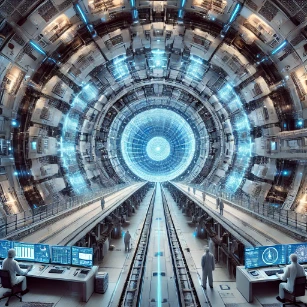
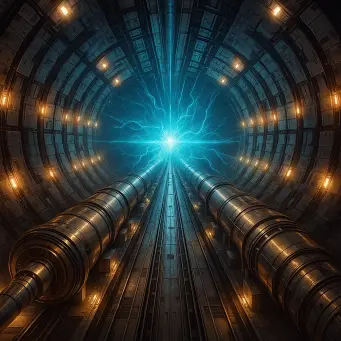
Artist's impression of the Future Circular Collider showcasing a next-generation particle accelerator.
    The image features a symmetrical underground tunnel lined with superconducting magnets and detector arrays.
    Scientists operate advanced control stations, symbolizing the human quest to explore deeper layers of matter.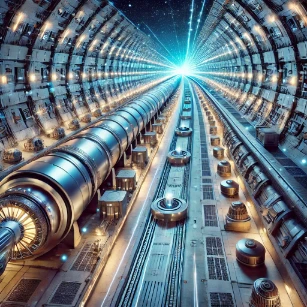
Conceptual rendering of the International Linear Collider engineered for precision particle collisions.
    The elongated design features straight opposing beamlines converging toward a radiant interaction point.
    Surrounding the beamline are superconducting modules engineered to probe the Higgs boson with unparalleled clarity.
Mini Concept Map: Matter, Forces, and Fields
Fermions: Matter particles, such as quarks and leptons.
Bosons: Particles associated with interactions, including force carriers such as photons, gluons, and W/Z bosons.
Fields: Underlying quantum structures whose excitations appear as particles.
Bosons: Particles associated with interactions, including force carriers such as photons, gluons, and W/Z bosons.
Fields: Underlying quantum structures whose excitations appear as particles.
1. Learning Pathway within Modern Physics
Particle physics investigates the smallest building blocks of nature and the rules that govern their behaviour. Instead of planets and stars, it studies quarks, leptons, and force carriers, all described by quantum field theory and the Standard Model.
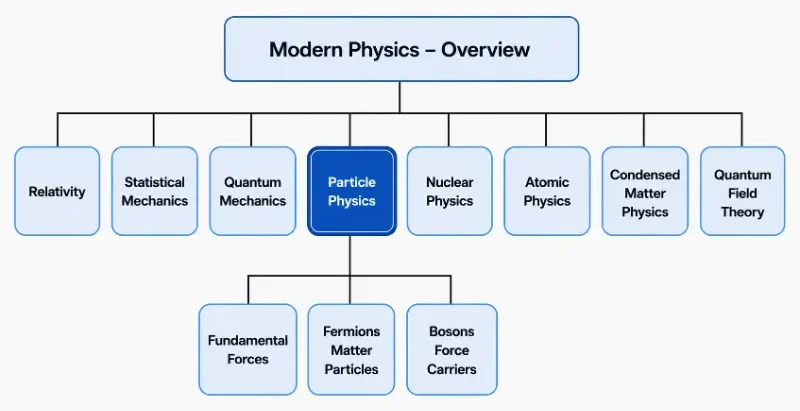
Structure chart placing Particle Physics within the wider Modern Physics domain.
    It branches into three primary subtopics: Fundamental Forces, Fermions (Matter Particles), and Bosons (Force Carriers).
    The chart helps students navigate how fundamental subatomic interactions connect to the broader universe.
Modern Physics – Overview
A unifying introduction to the key ideas that redefine classical physics, including relativity, quantum theory, and the structure of matter.Relativity
Explores how space and time are intertwined, revealing how motion and gravity reshape our understanding of the universe.Statistical Mechanics
Connects microscopic particle behaviour to macroscopic properties such as temperature, pressure, and entropy.Quantum Mechanics
Describes the probabilistic nature of matter and energy at small scales, where certainty gives way to wavefunctions and superposition.Particle Physics – Overview
Investigates the fundamental constituents of matter and the forces that govern their interactions at the smallest scales.Fundamental Forces
Focuses on the four known interactions: gravitational, electromagnetic, strong, and weak nuclear forces.Fermions – Matter Particles
Introduces the fundamental matter constituents: quarks and leptons, generations, flavor, and the Pauli exclusion principle.Bosons – Force Carriers
Examines integer-spin gauge bosons mediating interactions, symmetry breaking, and the Higgs mass generation mechanism.2. Theoretical Deep Dive: The Standard Model Framework
The Standard Model stands as one of the crowning achievements in modern science, providing a comprehensive and mathematically robust framework to explain the behavior and interactions of all known elementary particles—except gravity. This model categorizes particles into two main structural divisions: Fermions (spin-1/2 matter building blocks) and Bosons (integer-spin force carriers and field quanta).
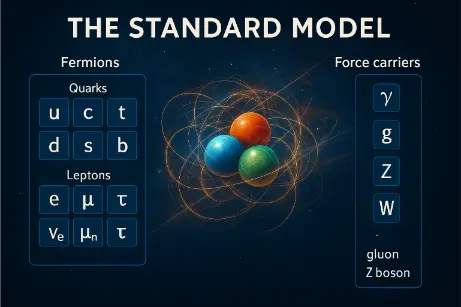
Standard Model classification layout.
    Fermions (Quarks and Leptons) are organized into three generations on the left.
    Gauge Bosons (Photon, Gluon, W/Z) and the scalar Higgs Boson are shown on the right.
    The center illustrates hadron compositeness with bound quark-gluon fields.
Learning Break: Scope of the Standard Model
Which statement best describes the boundaries of the Standard Model?
A. It explains all physical phenomena, including gravity and dark energy.
B. It organizes known elementary particles and describes electromagnetic, weak, and strong interactions.
C. It applies exclusively to cosmic galaxy structures.
D. It replaces quantum field theory completely.
B. It organizes known elementary particles and describes electromagnetic, weak, and strong interactions.
C. It applies exclusively to cosmic galaxy structures.
D. It replaces quantum field theory completely.
The correct answer is B. The Standard Model successfully organizes elementary fermions and gauge bosons for three forces, but excludes a quantum description of gravity and dark sector particles.
Fundamental Matter Particles: Fermions
Fermions obey the Pauli Exclusion Principle. They are divided into two distinct groups:
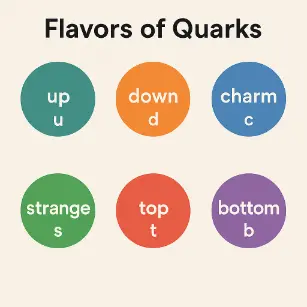
- Quarks: Interact via the strong force and possess fractional electric charge (+2/3 or −1/3). Six flavors exist across three generations: up, down, charm, strange, top, and bottom. Quarks carry “color charge” and are permanently bound inside hadrons (protons, neutrons, mesons) via color confinement.
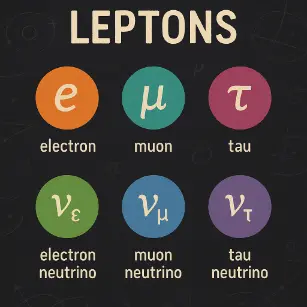
- Leptons: Particles that do not experience strong nuclear interactions. Includes three charged leptons (electron, muon, tau) and three corresponding neutral neutrinos (νe, νμ, ντ).
Learning Break: Fermion Classification
Which pairing correctly identifies the composition of matter?
A. Quarks combine to form composite hadrons like protons and neutrons.
B. Leptons are formed by combining three gluons.
C. Photons are fermions located inside atomic nuclei.
D. Neutrinos carry strong color charge.
B. Leptons are formed by combining three gluons.
C. Photons are fermions located inside atomic nuclei.
D. Neutrinos carry strong color charge.
The correct answer is A. Quarks bind via gluons to form hadrons, whereas leptons are elementary particles that do not experience the strong interaction.
Force Carriers: Bosons
Bosons possess integer spin and act as force mediators or field excitations:
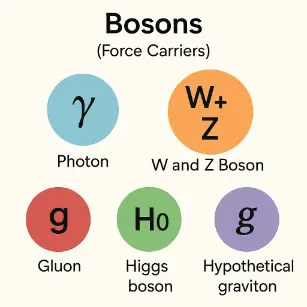
- Photon (γ): Massless mediator of the electromagnetic force.
- W+, W−, and Z0 Bosons: Massive mediators of the weak nuclear force (≈ 80–91 GeV/c2), causing short-range beta decay.
- Gluons (g): Eight massless carriers of the strong interaction, carrying color charges and interacting with each other.
- Higgs Boson (H0): Scalar particle (spin 0, mass ≈ 125 GeV/c2) giving mass to elementary particles through the Higgs mechanism.
3. Core Physics Principles: Fundamental Interactions
All natural interactions are governed by four fundamental forces, three of which are unified within quantum field theory:
- Strong Nuclear Force: Mediated by gluons; binds quarks into hadrons and holds atomic nuclei together against electrostatic repulsion. Described by Quantum Chromodynamics (QCD).
- Electromagnetic Force: Mediated by photons; acts on charged particles across infinite range. Described by Quantum Electrodynamics (QED).
- Weak Nuclear Force: Mediated by W and Z bosons; responsible for flavor transformations, radioactive beta decay, and stellar hydrogen fusion initiating steps.
- Gravity: Weakest force; acts universally across infinite range on mass-energy. Described classically by General Relativity; lacks a confirmed quantum mediator (graviton).
Learning Break: Standard Model Force Coverage
Which statement accurately represents force unification in the Standard Model?
A. It incorporates electromagnetism, weak, and strong forces, excluding gravity.
B. It completely unifies quantum gravity with electromagnetism.
C. It treats all forces as equal-strength interactions.
D. It excludes the strong interaction.
B. It completely unifies quantum gravity with electromagnetism.
C. It treats all forces as equal-strength interactions.
D. It excludes the strong interaction.
The correct answer is A. The Standard Model successfully incorporates the strong, weak, and electromagnetic forces, leaving quantum gravity as an active frontier.
4. Mathematical Foundations & Relativistic Kinematics
Particle physics unifies quantum mechanics with Special Relativity. The total energy E of a particle with rest mass m0 and momentum p is given by the relativistic energy-momentum dispersion relation:
$$ E^2 = (p c)^2 + (m_0 c^2)^2 $$
For massless particles (photons, gluons) where m0 = 0, energy simplifies to:
E = p c = h ν
In particle collisions, total invariant mass squared (s) determines the threshold energy available to produce new heavy particles:
$$ s = (p_1 + p_2)^2 = (E_1 + E_2)^2 – (\vec{p}_1 + \vec{p}_2)^2 c^2 $$
5. Three Transformative Experimental Discoveries
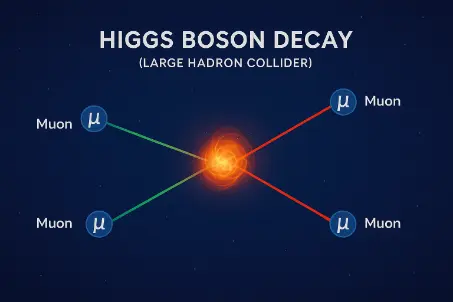
1. The Higgs Boson Discovery (2012)
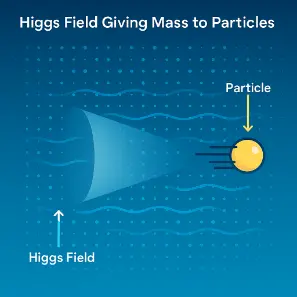
The Higgs field permeates space, generating mass for W/Z bosons and charged fermions via spontaneous symmetry breaking. On July 4, 2012, CERN’s ATLAS and CMS experiments announced the discovery of a scalar boson at approximately 125 GeV/c2, confirming the Higgs mechanism and completing the Standard Model particle predictions.
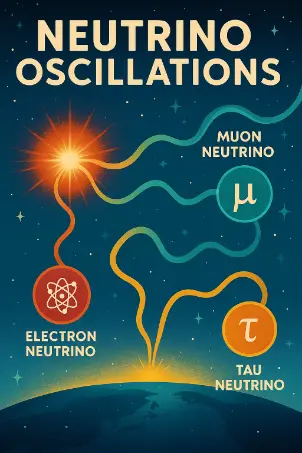
2. Neutrino Oscillations & Mass
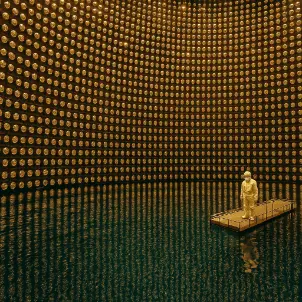
The Solar Neutrino Problem (Homestake) and atmospheric observations (Super-Kamiokande 1998, SNO 2001) proved that electron, muon, and tau neutrinos transform into one another during propagation. Because flavor states are quantum superpositions of mass eigenstates, oscillations strictly require neutrinos to possess non-zero mass differences (Δm2 ≠ 0), providing clear evidence of physics beyond the original massless-neutrino Standard Model.
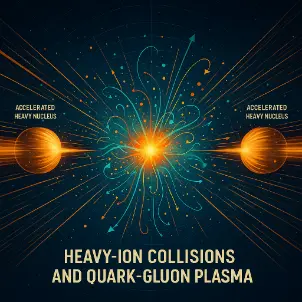
3. Quark Confinement & Quantum Chromodynamics (QCD)
Deep inelastic scattering at SLAC (1968) revealed point-like quark constituents inside protons. QCD explains the strong force through 3 color charges (red, green, blue) mediated by gluons. Due to gluon self-interactions, the strong force increases with separation distance (confinement), while exhibiting asymptotic freedom at extremely small distances or high collision energies, briefly creating quark-gluon plasma.
6. Key Terms Glossary
Standard Model
The theoretical framework describing fundamental fermions and gauge interactions (electromagnetic, weak, strong).Fermion
A spin-1/2 matter particle obeying Fermi-Dirac statistics and the Pauli Exclusion Principle (quarks and leptons).Boson
An integer-spin particle obeying Bose-Einstein statistics, serving as a force mediator (photon, gluon, W/Z) or field scalar (Higgs).Quark Confinement
The property of the strong interaction where color-charged particles cannot exist in isolation at low energy scales.Asymptotic Freedom
The property of QCD where strong force coupling weakens at high energy scales or short distances.Neutrino Oscillation
A quantum phenomenon where a neutrino created with a specific lepton flavor changes flavor during transit due to non-zero mass states.7. Frequently Asked Questions
What is particle physics?
Particle physics is the branch of physics studying fundamental elementary particles and the fundamental interactions governing them.
What are elementary particles and how are they classified?
Elementary particles are indivisible building blocks categorized into fermions (quarks, leptons) and bosons (force carriers, Higgs).
What is the role of the Standard Model?
It categorizes all known elementary particles and unifies electromagnetism, weak force, and strong nuclear interactions into a single quantum field theory framework.
What are antiparticles and annihilation?
Antiparticles possess identical mass but opposite electric/quantum charges. Matter-antimatter collisions result in total mass conversion into high-energy photons.
What are limitations of the Standard Model?
It excludes quantum gravity, does not identify dark matter or dark energy, and does not explain cosmic matter-antimatter asymmetry.
8. Assessment Exercises
Part 1: Review Questions
Q1. What are the two main classes of elementary particles in the Standard Model?
Answer: Fermions (spin-1/2 matter particles) and Bosons (integer-spin force carriers and scalar field quanta).
Q2. How do quarks differ from leptons?
Answer: Quarks carry color charge and experience the strong nuclear force; leptons do not carry color charge and interact only via weak, electromagnetic, and gravitational forces.
Q3. Why do neutrino oscillations imply non-zero neutrino mass?
Answer: Oscillation probabilities depend on phase differences evolving over time between mass eigenstates; if all mass states were zero, no relative quantum phase shift or flavor change could occur.
Q4. What is asymptotic freedom in QCD?
Answer: The phenomenon where strong coupling strength decreases at high energies or short distances, making quarks behave as nearly free particles during high-energy collisions.
Part 2: Applied & Thought-Provoking Scenarios
Q1. How do high-energy particle colliders serve as windows into early universe cosmology?
Answer: High center-of-mass collision energies recreate high energy densities that existed microseconds after the Big Bang, allowing study of deconfinement phase transitions like the Quark-Gluon Plasma.
Q2. Why is finding a quantum theory of gravity essential for physics beyond the Standard Model?
Answer: General Relativity breaks down at Planck scale distances where quantum fluctuations dominate; unifying gravity with gauge field theory is required to describe singularity centers in black holes and the initial Big Bang state.
Part 3: Numerical Problems with Step-by-Step Worked Solutions
Problem 1: Electron Rest Energy Calculation
Calculate the rest energy E0 of an electron in MeV (me = 9.109 × 10⁻³¹ kg, c = 3.0 × 10⁸ m/s).
Solution:
$$ E_0 = m_e c^2 = (9.109 \times 10^{-31} \text{ kg}) \times (3.0 \times 10^8 \text{ m/s})^2 \approx 8.198 \times 10^{-14} \text{ J} $$
Convert Joules to MeV (1 MeV = 1.602 × 10⁻¹³ J):
$$ E_0 = \frac{8.198 \times 10^{-14} \text{ J}}{1.602 \times 10^{-13} \text{ J/MeV}} \approx 0.511 \text{ MeV} $$
Answer: 0.511 MeV.
Problem 2: Energy Conversion (GeV to Joules)
Convert 1 GeV of energy into Joules.
Solution:
$$ 1 \text{ GeV} = 10^9 \text{ eV} = 10^9 \times (1.602 \times 10^{-19} \text{ J}) = 1.602 \times 10^{-10} \text{ J} $$
Answer: 1.602 × 10⁻¹⁰ Joules.
Problem 3: Total Relativistic Energy of a Proton
A proton (rest mass E0 ≈ 938 MeV) is accelerated to a kinetic energy of K = 1 GeV (1000 MeV). Calculate its total energy.
Solution:
$$ E_{\text{total}} = K + E_0 = 1000 \text{ MeV} + 938 \text{ MeV} = 1938 \text{ MeV} = 1.938 \text{ GeV} $$
Answer: 1938 MeV (1.938 GeV).
Problem 4: Photon Momentum from Wavelength
Calculate the momentum p of a photon with wavelength λ = 500 nm. (h = 6.626 × 10⁻³⁴ J·s).
Solution:
$$ p = \frac{h}{\lambda} = \frac{6.626 \times 10^{-34} \text{ J s}}{500 \times 10^{-9} \text{ m}} \approx 1.325 \times 10^{-27} \text{ kg}\cdot\text{m/s} $$
Answer: 1.325 × 10⁻²⁷ kg·m/s.
Problem 5: Electron-Positron Annihilation Energy
An electron and a positron, both essentially at rest, undergo mutual annihilation. Calculate the total energy released in MeV.
Solution:
Total energy equals the rest mass sum of both particles:
$$ E_{\text{total}} = 2 \times E_0 = 2 \times 0.511 \text{ MeV} = 1.022 \text{ MeV} $$
Answer: 1.022 MeV (typically emitted as two 0.511 MeV gamma photons).
Problem 6: Mass Creation from Collision Energy
A particle collision converts 2 GeV of pure kinetic energy into a particle-antiparticle rest mass. Estimate the total mass created in kg.
Solution:
Convert 2 GeV to Joules: 2 × 1.602 × 10−10 J = 3.204 × 10⁻¹⁰ J.
$$ m = \frac{E}{c^2} = \frac{3.204 \times 10^{-10} \text{ J}}{(3.0 \times 10^8 \text{ m/s})^2} = \frac{3.204 \times 10^{-10}}{9.0 \times 10^{16}} \approx 3.56 \times 10^{-27} \text{ kg} $$
Answer: 3.56 × 10⁻²⁷ kg.
History, Challenges, and Future Prospects
Particle physics emerged in the early 20th century, evolving from cosmic ray studies to global high-energy collider projects.
Historical Milestones: J.J. Thomson discovered the electron in 1897. Carl Anderson discovered antimatter (positron) in 1932. Murray Gell-Mann proposed the quark model in 1964. Glashow, Weinberg, and Salam unified the electroweak interaction in the 1960s. The W/Z bosons were discovered at CERN in 1983, and the Higgs boson was observed in 2012.
Current Challenges: Confirming dark matter candidates, determining the absolute neutrino mass hierarchy and CP-violating phase, and addressing the hierarchy problem regarding why the Higgs mass is far lighter than the Planck scale.
Future Frontiers: Upgrading the High-Luminosity LHC (HL-LHC), developing the proposed 100 km Future Circular Collider (FCC), constructing the Deep Underground Neutrino Experiment (DUNE), and testing quantum gravity frameworks.
Cluster Navigation & Academic References
Related Modern Physics Topics
- Modern Physics Hub — Primary portal for non-classical physics domains.
- Fundamental Forces — In-depth study of strong, weak, electromagnetic, and gravitational interactions.
- Fermions – Matter Particles — Quarks, leptons, spin statistics, and matter structure.
- Bosons – Force Carriers — Gauge bosons, field excitations, and the Higgs field.
- Quantum Field Theory — Relativistic quantum mechanics and field quantization.
External References & Data Sources
- The Standard Model – CERN — Official CERN guide to fundamental particles and interactions.
- The Higgs Boson Discovery – ATLAS Experiment — CERN ATLAS collaboration documentation.
- Neutrino Oscillations – Nobel Prize Physics 2015 — Nobel Foundation release on neutrino mass discoveries.
- Asymptotic Freedom & QCD – Nobel Prize Physics 2004 — Nobel explanation of strong interaction physics.
Archived version: This learning resource is archived on Zenodo at https://zenodo.org/records/20570351.
Suggested citation: Gan, J. (2026). Particle Physics: Standard Model, Fundamental Interactions, and High-Energy Discoveries. Prep4Uni.online. Zenodo. https://doi.org/10.5281/zenodo.20570351