
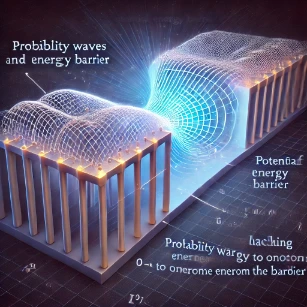
Illustration of quantum tunneling. The image depicts a particle wave approaching an energy barrier, with part of the wave function penetrating and continuing on the other side, illustrating the tunneling effect.
Study Pathways for Quantum Tunneling
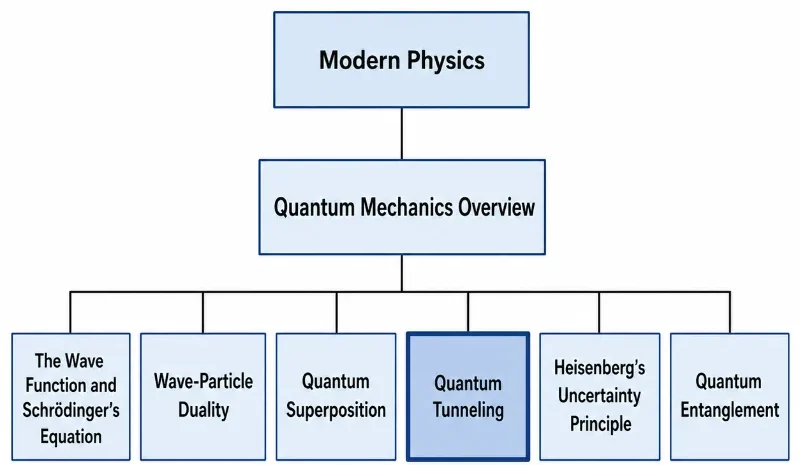
Quantum Tunneling within the Quantum Mechanics pathway: this structure chart shows how tunneling connects with wavefunctions, wave-particle duality, superposition, uncertainty, and entanglement.
Modern Physics
Establishes the wider physics framework where particles, waves, probability, energy, and measurement are studied beyond classical mechanics.Quantum Mechanics Overview
Places quantum tunneling within the broader framework of wavefunctions, probability, uncertainty, superposition, and measurement.Quantum Tunneling
Explains how particles can pass through potential barriers because their wavefunctions can extend into regions that are classically forbidden.The Wave Function and Schrödinger’s Equation
Provides the mathematical foundation for tunneling by showing how wavefunctions evolve and behave near potential barriers.Wave-Particle Duality
Explains why particles can show wave-like behaviour, allowing their probability waves to extend beyond classical boundaries.Quantum Superposition
Shows how quantum systems can be represented as combinations of possible states before measurement.Heisenberg’s Uncertainty Principle
Helps explain why particles cannot always be described by exact classical position and momentum at the same time.Quantum Entanglement
Extends the study of quantum behaviour into correlated systems, where the state of one particle may be linked with another.Quantum Tunneling: Concept and Definition
Quantum Tunneling: Mathematical Description
- ℏ is the reduced Planck constant.
- m is the mass of the particle.
- ψ(x) is the particle’s wavefunction.
- V(x) is the potential energy as a function of position.
- E is the total energy of the particle.
Wavefunction Inside the Barrier
Tunneling Probability
Key Idea
Quantum Tunneling: Physical Interpretation
- Quantum tunneling is a direct result of the wave-like nature of particles in quantum mechanics. It demonstrates that particles are not confined to well-defined paths but are described by probabilities. Even when a barrier seems impenetrable by classical standards, there is a non-zero chance that the particle will appear on the other side due to its probabilistic nature.
Real-World Applications of Quantum Tunneling
Semiconductors and Electronic Devices
- Tunnel Diodes: Tunnel diodes exploit quantum tunneling for high-speed switching. These devices operate based on the tunneling of electrons across a very thin depletion layer, allowing them to function at extremely high frequencies with low power consumption.

Tunnel Diode, highlighting its heavily doped p-n junction and quantum tunneling effect
- Transistors (MOSFETs): In modern transistors, especially in MOSFETs with nanometer-scale gate oxides, electrons can tunnel through thin insulating layers, leading to leakage currents. This effect must be carefully managed in the design of smaller, faster electronic devices.
- Flash Memory: Quantum tunneling is used in flash memory devices. Data is stored by moving electrons onto or off a floating gate through a thin insulating layer via tunneling, enabling non-volatile data storage.
- Quantum Dot Devices: Quantum dots exploit tunneling to confine and control electron movement at the quantum scale, promising advanced applications in quantum computing and display technologies.
Nuclear Fusion in Stars
- Electrostatic Repulsion: In the core of stars, positively charged hydrogen nuclei (protons) repel each other due to Coulombic (electrostatic) forces. Classically, these protons would require extremely high kinetic energy to overcome this repulsion.
- Tunneling Effect: Quantum tunneling allows protons to penetrate the Coulomb barrier and fuse, despite not having sufficient classical energy. This fusion releases massive amounts of energy in the form of light and heat, sustaining the star’s luminosity and stability.
Radioactive Decay
- Alpha Particles: In heavy nuclei, alpha particles (helium nuclei) are bound within the nucleus by the strong nuclear force. Classically, they do not have enough energy to escape the nucleus due to the potential barrier created by the nuclear and electrostatic forces.
- Tunneling Escape: Quantum tunneling allows alpha particles to “escape” through the nuclear potential barrier, resulting in radioactive decay.
Quantum Computing
- Quantum Annealing: Quantum tunneling is exploited in quantum annealing to find low-energy states in complex optimization problems. Devices like D-Wave systems use tunneling to overcome energy barriers and escape local minima.
- Josephson Junctions: These are superconducting circuits where electrons tunnel through thin insulators between superconductors. They are key components in superconducting qubits, used by companies like IBM and Google in their quantum computers.

A highly advanced supercomputer data center, featuring towering server racks and quantum processing units with glowing cooling systems.
Scanning Tunneling Microscopy (STM)

Scanning Tunneling Microscopy (STM), depicting a sharp conductive tip scanning a surface at the atomic level using quantum tunneling
Josephson Junctions and Superconductors

Superconducting Quantum Interference Device (SQUID) – Used for ultra-sensitive magnetic field detection
Experimental Evidence of Quantum Tunneling
- Scanning Tunneling Microscope (STM): The STM uses tunneling to image surfaces at the atomic level. A sharp tip is brought extremely close to a surface, and electrons tunnel between the tip and the sample, producing a measurable current that reveals atomic structures.
- Cold Emission of Electrons: Electrons can tunnel out of metal surfaces in the presence of strong electric fields, a phenomenon used in field electron emission devices.
Quantum Tunneling: Limitations and Challenges
- Leakage Current in Microelectronics: As electronic components shrink, tunneling leads to unwanted leakage currents, increasing power consumption and heat generation.
- Controlling Tunneling Probability: In devices where precise control is needed, managing the barrier width and height becomes technologically challenging.
Why Study Quantum Tunneling
Crossing Energy Barriers with Quantum Probability
Mathematical Description and Barrier Analysis
Applications in Electronics and Astrophysics
Role in Alpha Decay and Quantum Processes
Foundational Implications for Quantum Theory
Quantum Tunneling: Conclusion
Frequently Asked Questions: Quantum Tunnelling
1. What is quantum tunnelling?
Quantum tunnelling is a phenomenon where a particle has a non-zero probability of passing through an energy barrier that it would not be able to cross according to classical physics. Because the particle is described by a spread-out wavefunction, there is a chance of finding it on the other side of the barrier, as if it had “tunnelled” through.
2. Why is tunnelling impossible in classical physics but allowed in quantum mechanics?
In classical physics, if a particle does not have enough energy to climb over a barrier, it is completely reflected. In quantum mechanics, particles behave as waves, and their wavefunctions can extend into and beyond the barrier. This penetration gives a finite probability of transmission even when the particle’s energy is less than the barrier height.
3. How is quantum tunnelling described mathematically?
Mathematically, tunnelling is described by solving the Schrödinger equation for a potential barrier. The solution shows an exponentially decaying wavefunction inside the barrier and a smaller, but non-zero, transmitted wave on the far side. The square of the transmitted wave’s amplitude gives the tunnelling probability.
4. Which factors affect the probability of tunnelling through a barrier?
The tunnelling probability depends primarily on the barrier’s height, width, and shape, as well as the particle’s mass and energy. Higher or wider barriers and heavier particles generally reduce the probability exponentially, while particles with energy closer to the barrier height tunnel more easily.
5. What are some natural examples of quantum tunnelling?
Important natural examples include alpha decay, where an alpha particle tunnels out of an atomic nucleus, and nuclear fusion in stars, where protons tunnel through their mutual electrostatic repulsion to get close enough for the strong nuclear force to bind them. Without tunnelling, many nuclear processes in the universe would be extremely improbable.
6. How is quantum tunnelling used in modern technology?
Quantum tunnelling is exploited in devices such as tunnel diodes, Josephson junctions, and scanning tunnelling microscopes (STMs). In these devices, electrons tunnel across thin barriers, enabling ultra-fast switching, highly sensitive detectors, and imaging of surfaces with atomic-scale resolution.
7. Does a particle lose energy when it tunnels through a barrier?
In an ideal, time-independent potential, a particle that tunnels through a barrier emerges with the same energy it had before encountering the barrier. The process changes the probability of where the particle can be found, but it does not require the particle to “spend” energy to pass through.
8. How is quantum tunnelling related to the uncertainty principle?
Quantum tunnelling is consistent with the uncertainty principle because a particle’s position and momentum cannot both be known with arbitrary precision. The spread in momentum and energy implied by the uncertainty principle allows a non-zero chance that the particle is found on the far side of a barrier, even when its average energy is below the barrier height.
9. Can large or macroscopic objects tunnel through barriers?
In principle, quantum mechanics applies to all objects, but for macroscopic objects the tunnelling probability becomes unimaginably small because of their large mass and size. As a result, tunnelling of everyday objects is effectively impossible, and classical physics remains an excellent approximation at human scales.
10. How do physicists observe and study quantum tunnelling experimentally?
Physicists study tunnelling by measuring currents through thin insulating barriers, observing radioactive decays, or using techniques like scanning tunnelling microscopy. By varying barrier thickness, voltage, or other parameters and comparing data with theoretical predictions, they confirm the characteristic exponential dependence of tunnelling probability.
11. What is a tunnelling time, and is it meaningful to ask how long tunnelling takes?
The question of how long tunnelling takes is subtle in quantum mechanics because time is not an operator like position or momentum. Various definitions of tunnelling time exist, and experiments suggest that tunnelling does not involve travelling through the barrier in a classical sense. Instead, the theory focuses on probabilities rather than a simple transit time.
12. Why is learning about quantum tunnelling useful for students?
Learning about quantum tunnelling helps students see how quantum rules lead to phenomena with no classical counterpart, and how abstract ideas like wavefunctions and probability amplitudes have concrete consequences in nature and technology. It also provides a bridge between conceptual quantum ideas and practical applications in electronics, nuclear physics, and astrophysics.
Quantum Tunneling: Review Questions and Answers
1. What is quantum tunneling?
Answer: Quantum tunneling is a phenomenon in which a particle has a non-zero probability of passing through an energy barrier that it would not be able to cross according to classical physics.
2. How does the wavefunction contribute to quantum tunneling?
Answer: The wavefunction describes the probability amplitude of a particle’s position. Even in a region where the particle’s energy is lower than the barrier height, the wavefunction may still have a non-zero value, allowing a finite probability of tunneling.
3. What factors affect the probability of tunneling?
Answer: Tunneling probability depends on the barrier’s width, the barrier’s height, the particle’s mass, and the particle’s energy. Tunneling becomes more likely when the barrier is thinner, lower, or when the particle is lighter and has energy closer to the barrier height.
4. How is quantum tunneling used in modern electronics?
Answer: Quantum tunneling is used in devices such as tunnel diodes, flash memory, and nanoscale electronic components. In these systems, electrons tunnel through very thin barriers, allowing current flow or charge storage to be controlled.
5. What role does quantum tunneling play in nuclear fusion?
Answer: In nuclear fusion, tunneling allows atomic nuclei to get through the electrostatic repulsion barrier more often than classical physics would predict. This helps explain how fusion can occur in stars at temperatures lower than a purely classical calculation would require.
6. How can the tunneling effect be mathematically described?
Answer: Tunneling is described by solving the Schrödinger equation for a potential barrier. Inside the classically forbidden region, the wavefunction decays exponentially rather than immediately becoming zero.
7. What is the significance of the transmission coefficient in quantum tunneling?
Answer: The transmission coefficient represents the probability that a particle will pass through a barrier. It is used to quantify how likely tunneling is for a given particle and barrier.
8. How does quantum tunneling challenge classical mechanics?
Answer: Classical mechanics predicts that a particle without enough energy cannot cross a barrier. Quantum tunneling shows that microscopic particles can still have a probability of appearing on the other side because they are described by wavefunctions.
9. In what experimental contexts has quantum tunneling been observed?
Answer: Quantum tunneling appears in scanning tunneling microscopy, radioactive decay, semiconductor devices, tunnel diodes, Josephson junctions, and other quantum systems.
10. What are some potential future applications of quantum tunneling?
Answer: Future applications may include improved quantum devices, advanced sensors, lower-power electronics, nanoscale components, and quantum technologies that depend on controlled tunneling behaviour.
Quantum Tunneling: Thought-Provoking Questions and Answers
1. How might a deeper understanding of quantum tunneling reshape our approach to energy generation?
Answer: A better understanding of tunneling could improve models of nuclear fusion, materials design, and energy conversion. However, tunneling alone does not automatically make practical energy generation easy. It must be combined with engineering, plasma control, materials science, and efficient device design.
2. What implications does quantum tunneling have for our understanding of the limits of classical physics?
Answer: Quantum tunneling shows that classical ideas about barriers and motion are incomplete at microscopic scales. A particle is not simply a tiny classical object with a fixed path; it is described by a wavefunction that can extend into classically forbidden regions.
3. How could improvements in controlling tunneling rates impact semiconductor technology?
Answer: Better control of tunneling could improve transistors, memory devices, nanoscale circuits, and low-power electronic components. At very small scales, tunneling can be either useful or problematic, depending on whether engineers want to exploit it or suppress unwanted leakage.
4. In what ways might quantum tunneling influence the design of future quantum computers?
Answer: Some quantum computing platforms involve controlled tunneling between quantum states or across barriers. Understanding tunneling can help improve qubit control, stability, coherence, and device architecture.
5. Could quantum tunneling be exploited to create new types of sensors?
Answer: Yes. Tunneling-based sensors can detect extremely small changes in distance, current, field strength, or surface structure. Scanning tunneling microscopy is already a major example of tunneling used for high-resolution measurement.
6. How does quantum tunneling affect our theoretical understanding of chemical reactions?
Answer: Tunneling can allow particles such as electrons or protons to pass through energy barriers during reactions. This can affect reaction rates, especially at low temperatures, and is important in chemistry, catalysis, and molecular physics.
7. What are the potential consequences of quantum tunneling for matter in extreme environments?
Answer: In stars and other extreme environments, tunneling can influence nuclear reactions and the behaviour of dense matter. For example, tunneling helps fusion occur in stellar cores even when nuclei do not classically have enough energy to overcome repulsion directly.
8. How might quantum tunneling be applied to improve solar cells?
Answer: Tunneling can influence charge transport across thin layers and junctions in advanced solar-cell designs. If controlled well, it may help reduce losses or improve carrier movement, although practical improvements depend on materials and device structure.
9. In what ways does quantum tunneling contribute to radioactive decay?
Answer: In alpha decay, an alpha particle can escape the nucleus by tunneling through the nuclear potential barrier. This explains why decay can occur even when the alpha particle does not have enough classical energy to climb over the barrier.
10. How do researchers use tunneling phenomena to test quantum mechanics?
Answer: Researchers compare measured tunneling currents, decay rates, and transmission probabilities with predictions from quantum theory. Agreement between experiment and theory supports the quantum description of particles as wave-like systems.
11. What challenges do scientists face when trying to observe quantum tunneling in macroscopic systems?
Answer: Macroscopic systems interact strongly with their environment, causing decoherence. This makes it difficult to preserve the quantum behaviour needed to observe tunneling-like effects at larger scales.
12. How could simulation and computational modelling improve our understanding of tunneling?
Answer: Simulations can help estimate tunneling rates, model quantum barriers, design nanoscale devices, and study systems that are difficult to measure directly. Better modelling can support both theoretical understanding and practical device development.
Numerical Problems and Solutions
1. Calculate the energy of a photon with wavelength 450 nm.
2. Estimate the tunneling probability for an electron through a barrier of width 0.5 nm, with U − E = 2.0 eV.
3. An electron with energy 1.5 eV approaches a barrier of 3.0 eV. Calculate κ.
4. Find the barrier width if the tunneling probability is 0.1 and κ = 7.0 × 10⁸ m−1.
5. In an STM, estimate the reduction factor in current when distance increases from 0.4 nm to 0.5 nm, if κ = 1.0 × 10¹⁰ m−1.
6. Estimate the electron energy required for tunneling probability approximately 0.5 through a 4.0 eV barrier.
This problem cannot be solved uniquely from the barrier height alone. The tunneling probability also depends on the barrier width, the particle mass, and the detailed shape of the barrier.
For a simple barrier, the estimate depends on:
7. A particle has momentum uncertainty 1.0 × 10⁻²⁵ kg·m/s. Estimate the position uncertainty.
Using the uncertainty relation:
8. Calculate the tunneling probability for a barrier width of 0.8 nm and κ = 8.0 × 10⁸ m−1.
9. In an STM, the current drops by a factor of 20 when the distance increases by 0.2 nm. Estimate κ.
A drop by a factor of 20 means e−2κ ΔL = 1/20.
Taking natural logarithms:
10. If the tunneling probability is 0.01, determine the value of 2κL.
11. A semiconductor has effective electron mass 0.1m0 and barrier height 0.8 eV. Estimate κ.
12. If increasing the barrier width by 0.1 nm reduces current by 30%, estimate κ.
A 30% reduction means the current becomes 70% of its original value: