This conceptual image represents the interconnected ideas of modern physics, including quantum mechanics, relativity, and particle interactions. The visual blends microscopic and cosmic scales to reflect how modern physics links atoms, fields, and spacetime into a unified framework for understanding the universe.
Quick Check: The Big Picture of Modern Physics
Table of Contents
What Modern Physics REALLY Is
Quick Check: What Modern Physics REALLY Is
Quantum Theory and Relativistic Frameworks
Physics – Overview **
Builds the full map of physical understanding, from classical laws to modern theories that redefine reality.
Modern Physics
Explores how quantum mechanics and relativity reshape concepts of space, time, energy, and matter.
Light and Optics *
Shows how radiation behaves as both wave and particle, bridging classical optics and quantum physics.
Electricity and Magnetism *
Extends field theory into relativistic and quantum regimes, linking forces, particles, and radiation.
Mechanics *
Provides the classical description of motion, later refined by relativistic effects at high speeds.
Thermodynamics *
Connects energy, heat, and microscopic particle behaviour through statistical principles.
Astrophysics *
Applies modern physics to extreme cosmic systems such as black holes and high-energy environments.
* Sibling topics within the Physics cluster
** Parent page in the Physics hierarchy
Core Domains of Modern Physics
Quantum Mechanics
Describes microscopic systems where probability, superposition, and wave-particle duality replace classical certainty.
Atomic Physics
Explains the structure of atoms and electron behaviour, including energy levels and interactions with radiation.
Nuclear Physics
Investigates atomic nuclei, including radioactive decay, fission, and fusion processes.
Particle Physics
Explores fundamental particles and forces, revealing the basic building blocks of the universe.
Condensed Matter Physics
Studies how collective particle behaviour gives rise to material properties such as conductivity and superconductivity.
Quantum Field Theory
Unifies particles and forces by describing them as excitations of underlying fields.
Relativity
Explains how space and time are linked and how motion and gravity shape the structure of spacetime.
Statistical Mechanics
Links microscopic particle behaviour to macroscopic properties such as temperature and entropy.

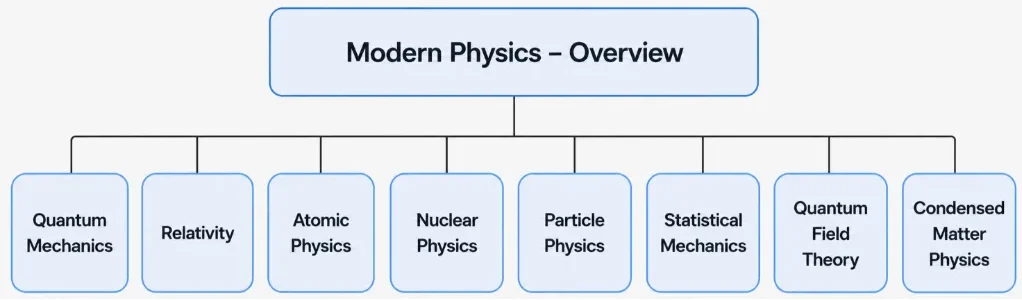
This chart provides a visual overview of the Modern Physics cluster on Prep4Uni.online. It presents Modern Physics as the parent topic and shows its major related pages: Quantum Mechanics, Relativity, Atomic Physics, Nuclear Physics, Particle Physics, Statistical Mechanics, Quantum Field Theory, and Condensed Matter Physics.
How the Branches of Modern Physics Connect
Applications and Impact of Modern Physics
Quantum Computing
Quantum computing uses quantum bits, or qubits, which can involve superposition and entanglement. These ideas allow researchers to explore new ways of solving problems in cryptography, optimisation, molecular simulation, materials design, and artificial intelligence. Some quantum systems use superconducting, trapped-ion, or photonic technologies to create and control fragile quantum states.Medical Imaging and Treatment
Modern physics supports non-invasive ways to see inside the human body and treat disease. MRI uses nuclear magnetic resonance, CT scans use X-ray absorption, PET scans detect radiation from particle interactions, and proton therapy uses charged particles to deliver energy more precisely to tumours. These methods help doctors diagnose illness, guide procedures, and design more targeted treatments.Nuclear Energy
Nuclear energy uses controlled nuclear reactions to release energy stored inside atomic nuclei. In nuclear fission, heavy nuclei split and release energy, while fusion research studies how light nuclei can combine under extreme conditions. These processes raise important questions about energy supply, safety, waste, sustainability, and future clean energy systems.Fundamental Research and Cosmology
Modern physics provides the language for studying the origin, structure, and evolution of the universe. Particle accelerators probe fundamental particles and forces, while telescopes and gravitational wave detectors reveal evidence about galaxies, black holes, cosmic expansion, dark matter, and dark energy. This research deepens our understanding of the laws that govern both the smallest particles and the largest structures.Semiconductors and Modern Electronics
Modern electronics depends on quantum behaviour inside solids. Band theory explains how electrons move through materials, while doping allows engineers to control conductivity in semiconductors. Transistors, integrated circuits, solar cells, sensors, flash memory, and many nanoscale devices depend on quantum principles such as energy bands, charge carriers, and tunnelling.Lasers and Photonics
Lasers rely on quantum transitions between energy levels. Through stimulated emission, they produce coherent and highly controlled light. This makes lasers important in fibre-optic communication, barcode scanning, surgery, industrial cutting, spectroscopy, precision measurement, and scientific research. Photonics extends these ideas by using light to transmit, process, and measure information.Relativity in Navigation and Timekeeping
Relativity is essential in high-precision navigation and timing systems. Satellite clocks experience both motion-related and gravity-related time effects, so GPS and other satellite systems must include relativistic corrections. Without these corrections, positioning errors would grow quickly. This shows that relativity is not only about black holes or distant galaxies; it is built into everyday navigation technology.Quick Check: Applications of Modern Physics
Why Study Modern Physics
Redefining Reality
Modern physics shows that space and time are not fixed, and that matter does not behave as solid, predictable objects. Concepts such as spacetime curvature, superposition, and uncertainty reveal a world that is far more dynamic and interconnected than classical physics suggests.Understanding the Technology Around You
From semiconductors in smartphones to lasers in communication systems and MRI scanners in hospitals, modern physics explains the principles behind technologies used every day. It connects abstract theory directly to real-world systems.Thinking Beyond Intuition
Modern physics develops the ability to reason beyond everyday experience. When particles behave like waves or clocks run differently at high speeds, students learn to rely on models, evidence, and mathematical reasoning rather than intuition alone.Mastering Powerful Concepts
Ideas such as wave-particle duality, quantum tunnelling, relativity, and energy quantisation provide tools for analysing systems across vastly different scales—from atoms to galaxies.Building Strong Analytical Skills
The subject requires the use of calculus, probability, and abstract models to describe physical systems. This develops precision, logical thinking, and the ability to handle complex, multi-layered problems.Opening Pathways to Advanced Fields
Modern physics forms the foundation for areas such as quantum technologies, particle physics, cosmology, nanotechnology, and advanced materials science. It prepares students for both research and high-impact industries.Frequently Asked Questions: Modern Physics
1. What is modern physics?
Modern physics explores how nature behaves under extreme conditions—at very small scales, very high speeds, or in strong gravitational fields. It includes quantum mechanics, relativity, nuclear physics, and particle physics, and focuses on how space, time, matter, and energy behave beyond everyday experience.
2. How is modern physics different from classical physics?
Classical physics describes motion, forces, and energy at everyday scales with high accuracy. Modern physics becomes necessary when dealing with atoms, subatomic particles, or objects moving close to the speed of light. In these situations, ideas such as quantisation, probability, and spacetime replace the deterministic and continuous models of classical theory.
3. What are the main pillars of modern physics?
The two central frameworks are relativity and quantum theory. Relativity explains how space and time behave at high speeds and under gravity, while quantum theory describes the probabilistic behaviour of particles at microscopic scales. Together, they form the foundation of modern scientific understanding.
4. Why does relativity matter in real life?
Relativity is essential in systems where precision and high speeds matter. For example, GPS satellites experience time differently due to both their speed and altitude. Without relativistic corrections, navigation systems would accumulate large errors within minutes.
5. How does quantum mechanics change our view of particles?
Quantum mechanics shows that particles do not have fixed positions and velocities in the classical sense. Instead, they are described by probability distributions, meaning their exact state can only be predicted statistically. This fundamentally changes how we understand measurement and prediction.
6. What is wave–particle duality?
Wave–particle duality means that entities such as electrons and photons can behave like both waves and particles. They can produce interference patterns like waves, yet also transfer energy in discrete packets like particles. This dual behaviour is a key feature of quantum systems.
7. What is the uncertainty principle?
The uncertainty principle states that certain pairs of properties, such as position and momentum, cannot be known precisely at the same time. This is not due to experimental limitations but is a fundamental property of nature, reflecting the probabilistic structure of quantum systems.
8. What areas are included in modern physics?
Modern physics includes quantum mechanics, atomic physics, nuclear physics, particle physics, condensed matter physics, relativity, and cosmology. These fields study everything from the structure of atoms to the evolution of the universe.
9. How does modern physics influence everyday technology?
Modern physics underpins technologies such as semiconductors, lasers, MRI scanners, nuclear power, and GPS systems. Many devices we use daily—computers, smartphones, and communication networks—depend on principles discovered through modern physics.
10. What mathematical background is needed?
A strong foundation in algebra and calculus is helpful, along with familiarity with vectors and basic probability. More advanced topics may involve differential equations, linear algebra, and specialised mathematical tools, but many core ideas can be understood conceptually before formal mathematics is introduced.
11. Why study modern physics before university?
Early exposure helps students build intuition for concepts that will appear in engineering, computing, and advanced science courses. It also develops the ability to think abstractly and adapt to ideas that challenge everyday experience, making the transition to university-level study much smoother.
Glossary of Key Modern Physics Terms
- Modern Physics
- The branch of physics that studies situations where classical physics is incomplete, especially at atomic, nuclear, particle, relativistic, and microscopic material scales.
- Classical Physics
- The older framework of physics that describes everyday motion, forces, energy, waves, heat, electricity, magnetism, and gravity very successfully at ordinary human scales.
- Quantum Mechanics
- The theory that describes matter and energy at very small scales, where probability, wave behaviour, quantisation, uncertainty, and measurement become central.
- Relativity
- The framework that explains how space, time, motion, gravity, mass, and energy are related, especially at high speeds or in strong gravitational fields.
- Quantisation
- The idea that certain physical quantities, such as energy in atoms, can occur only in specific discrete values rather than any continuous value.
- Photon
- A quantum of electromagnetic radiation. Light can be described as waves, but it also carries energy in particle-like packets called photons.
- Wave-Particle Duality
- The principle that microscopic objects such as electrons and photons can show both wave-like and particle-like behaviour, depending on how they are observed.
- Superposition
- A quantum condition in which a system can be described as a combination of possible states before measurement gives a definite observed outcome.
- Quantum Entanglement
- A quantum connection between systems where the state of one system is linked with the state of another, even when the systems are separated.
- Uncertainty Principle
- The principle that certain pairs of physical quantities, such as position and momentum, cannot both be known with unlimited precision at the same time.
- Atomic Physics
- The study of atoms, including electron energy levels, atomic spectra, and interactions between atoms and radiation.
- Nuclear Physics
- The study of atomic nuclei, including nuclear structure, radioactivity, nuclear reactions, fission, fusion, and nuclear energy.
- Particle Physics
- The study of fundamental particles and the forces that act between them, including quarks, leptons, bosons, and field-based interactions.
- Statistical Mechanics
- The branch of physics that connects the microscopic motion of many particles to large-scale properties such as temperature, pressure, entropy, and thermal equilibrium.
- Quantum Field Theory
- A framework that describes particles as excitations of underlying fields and provides a deeper way to understand forces and interactions.
- Condensed Matter Physics
- The study of solids, liquids, and other many-particle systems, especially how microscopic behaviour gives rise to material properties such as conductivity, magnetism, and superconductivity.
- Spacetime
- The four-dimensional structure that combines space and time. In relativity, motion and gravity affect how spacetime is measured and experienced.
- Mass-Energy Equivalence
- The principle that mass and energy are related, expressed by Einstein’s equation \(E = mc^2\). It helps explain why nuclear processes can release large amounts of energy.
- Radioactivity
- The spontaneous transformation of unstable atomic nuclei, often accompanied by the emission of particles or radiation.
- Semiconductor
- A material whose electrical conductivity can be controlled. Semiconductors rely on quantum behaviour of electrons in solids and are essential for modern electronics.
External References
Conclusion on Modern Physics
Reflection Question
Review Questions and Answers
- What is Modern Physics?Answer: Modern Physics is the branch of physics that explains nature in situations where classical physics is incomplete, especially at atomic scales, nuclear scales, particle scales, very high speeds, strong gravitational fields, and microscopic material structures.
- Why was Modern Physics needed?Answer: Modern Physics was needed because classical physics could not fully explain phenomena such as blackbody radiation, the photoelectric effect, atomic spectra, radioactive decay, high-speed motion, and the behaviour of particles at very small scales.
- What are the two major frameworks that transformed physics in the early twentieth century?Answer: The two major frameworks are quantum mechanics and relativity. Quantum mechanics explains matter and energy at microscopic scales, while relativity reshapes our understanding of space, time, motion, gravity, mass, and energy.
- How does quantum mechanics differ from classical physics?Answer: Classical physics often describes objects as having definite positions, paths, and properties. Quantum mechanics shows that microscopic systems are described by probability, wave behaviour, quantised energy, uncertainty, and measurement-dependent outcomes.
- What does relativity change about our understanding of space and time?Answer: Relativity shows that space and time are not separate, fixed backgrounds. They form spacetime, and measurements of time, distance, and motion can depend on the observer’s motion and gravitational environment.
- Why is atomic physics part of Modern Physics?Answer: Atomic physics studies atomic structure, electron energy levels, spectra, and interactions between atoms and radiation. These ideas require quantum principles because electrons in atoms do not behave like classical particles moving in ordinary orbits.
- Why is nuclear physics important?Answer: Nuclear physics explains the structure, stability, and transformation of atomic nuclei. It helps students understand radioactivity, nuclear reactions, fission, fusion, nuclear energy, medical isotopes, and the processes that power stars.
- What does particle physics study?Answer: Particle physics studies the fundamental particles and forces that make up matter and govern interactions. It explores particles such as quarks, leptons, bosons, and the forces described by modern field theories.
- What is the role of statistical mechanics in Modern Physics?Answer: Statistical mechanics connects the behaviour of many microscopic particles to large-scale properties such as temperature, pressure, entropy, and thermal equilibrium. It explains how macroscopic order emerges from microscopic motion.
- Why does Modern Physics matter in technology?Answer: Modern Physics supports technologies such as semiconductors, lasers, MRI, PET scans, nuclear energy, GPS, fibre optics, superconductors, quantum computers, particle accelerators, and advanced materials.
Thought-Provoking Questions and Answers
- If classical physics works so well in everyday life, why should students still study Modern Physics?Answer: Classical physics works well at human scales because quantum and relativistic effects are usually very small there. However, Modern Physics reveals the deeper principles beneath everyday behaviour. It explains why atoms are stable, why materials conduct electricity, why stars shine, why GPS needs time corrections, and why many advanced technologies work.
- Does Modern Physics make nature less understandable or more understandable?Answer: At first, Modern Physics may seem to make nature less intuitive because it challenges ordinary ideas about particles, waves, space, time, and certainty. But it also makes nature more understandable at a deeper level because it explains phenomena that classical physics could not explain.
- Why is probability not a weakness in quantum mechanics?Answer: Probability in quantum mechanics is not merely a sign of ignorance. It is part of how microscopic systems are described. Quantum theory does not always predict one fixed outcome, but it predicts patterns of possible outcomes with great accuracy.
- What does Modern Physics teach us about the limits of human intuition?Answer: Modern Physics shows that intuition is shaped by everyday experience. Since we do not directly experience atoms, particles, spacetime curvature, or quantum fields, intuition alone is not enough. Scientific understanding must be guided by experiment, mathematics, and careful reasoning.
- Why is it useful to know where classical physics breaks down?Answer: Knowing the limits of classical physics helps students choose the right model for the right situation. Classical physics is still powerful for many engineering and everyday problems, but modern theories are needed for microscopic systems, high-speed motion, strong gravity, nuclear reactions, and advanced materials.
- How can something as abstract as quantum mechanics lead to practical devices?Answer: Quantum mechanics may be abstract, but its effects are measurable and controllable. Semiconductors, lasers, atomic clocks, MRI systems, superconductors, and quantum computers all depend on quantum principles. Abstract theory becomes practical when it is used to design real systems.
- Why does Modern Physics connect the very small and the very large?Answer: The smallest particles and the largest cosmic structures are linked by common physical laws. Nuclear fusion powers stars, particle interactions shaped the early universe, quantum processes influence matter, and relativity explains gravity on cosmic scales.
- Is Modern Physics mainly about strange ideas, or is it about evidence?Answer: Modern Physics includes strange ideas, but it is not based on imagination alone. It is built on experimental evidence, mathematical consistency, and repeated testing. Its unusual concepts are accepted because they explain observations accurately and lead to successful technologies.
Numerical Problems with Worked Solutions
- Problem 1: Mass–energy equivalenceA small amount of mass, \(0.002 \, \text{kg}\), is converted completely into energy. Using \(E = mc^2\), where \(c = 3.0 \times 10^8 \, \text{m s}^{-1}\), calculate the energy released.Solution:Use \(E = mc^2\).\(E = 0.002 \times (3.0 \times 10^8)^2\)\(E = 0.002 \times 9.0 \times 10^{16}\)\(E = 1.8 \times 10^{14} \, \text{J}\)Answer: The energy released is \(1.8 \times 10^{14} \, \text{J}\).
- Problem 2: Photon energyA photon has a frequency of \(6.0 \times 10^{14} \, \text{Hz}\). Calculate its energy using \(E = hf\), where \(h = 6.63 \times 10^{-34} \, \text{J s}\).Solution:Use \(E = hf\).\(E = (6.63 \times 10^{-34})(6.0 \times 10^{14})\)\(E = 3.978 \times 10^{-19} \, \text{J}\)Answer: The photon energy is approximately \(3.98 \times 10^{-19} \, \text{J}\).
- Problem 3: Wavelength of lightA light wave has a frequency of \(5.0 \times 10^{14} \, \text{Hz}\). Calculate its wavelength using \(c = f\lambda\), where \(c = 3.0 \times 10^8 \, \text{m s}^{-1}\).Solution:Rearrange \(c = f\lambda\) to get \(\lambda = \frac{c}{f}\).\(\lambda = \frac{3.0 \times 10^8}{5.0 \times 10^{14}}\)\(\lambda = 6.0 \times 10^{-7} \, \text{m}\)Answer: The wavelength is \(6.0 \times 10^{-7} \, \text{m}\), or \(600 \, \text{nm}\).
- Problem 4: Energy of an electron transitionAn electron in an atom moves from a higher energy level to a lower energy level. The energy difference is \(3.2 \times 10^{-19} \, \text{J}\). What is the frequency of the photon emitted? Use \(E = hf\), where \(h = 6.63 \times 10^{-34} \, \text{J s}\).Solution:Rearrange \(E = hf\) to get \(f = \frac{E}{h}\).\(f = \frac{3.2 \times 10^{-19}}{6.63 \times 10^{-34}}\)\(f \approx 4.83 \times 10^{14} \, \text{Hz}\)Answer: The emitted photon has a frequency of approximately \(4.83 \times 10^{14} \, \text{Hz}\).
- Problem 5: Relativistic time dilationA spacecraft moves at \(0.60c\) relative to Earth. If \(10.0 \, \text{s}\) passes on the spacecraft, how much time passes according to an observer on Earth? Use \(\Delta t = \frac{\Delta t_0}{\sqrt{1 – v^2/c^2}}\).Solution:Here, \(\Delta t_0 = 10.0 \, \text{s}\) and \(v = 0.60c\).\(\Delta t = \frac{10.0}{\sqrt{1 – (0.60)^2}}\)\(\Delta t = \frac{10.0}{\sqrt{1 – 0.36}}\)\(\Delta t = \frac{10.0}{\sqrt{0.64}}\)\(\Delta t = \frac{10.0}{0.80}\)\(\Delta t = 12.5 \, \text{s}\)Answer: An observer on Earth measures \(12.5 \, \text{s}\).
- Problem 6: Half-life calculationA radioactive sample has an initial activity of \(800 \, \text{counts min}^{-1}\). After one half-life, what is its activity? After two half-lives, what is its activity?Solution:After each half-life, the activity is reduced by half.After one half-life: \(\frac{800}{2} = 400 \, \text{counts min}^{-1}\)After two half-lives: \(\frac{400}{2} = 200 \, \text{counts min}^{-1}\)Answer: The activity is \(400 \, \text{counts min}^{-1}\) after one half-life and \(200 \, \text{counts min}^{-1}\) after two half-lives.
- Problem 7: de Broglie wavelengthAn electron has a momentum of \(2.0 \times 10^{-24} \, \text{kg m s}^{-1}\). Calculate its de Broglie wavelength using \(\lambda = \frac{h}{p}\), where \(h = 6.63 \times 10^{-34} \, \text{J s}\).Solution:Use \(\lambda = \frac{h}{p}\).\(\lambda = \frac{6.63 \times 10^{-34}}{2.0 \times 10^{-24}}\)\(\lambda = 3.315 \times 10^{-10} \, \text{m}\)Answer: The de Broglie wavelength is approximately \(3.32 \times 10^{-10} \, \text{m}\).
- Problem 8: Band gap energy and photon wavelengthA semiconductor has a band gap energy of \(2.0 \, \text{eV}\). Estimate the wavelength of a photon with this energy using \(\lambda = \frac{1240}{E}\), where \(\lambda\) is in nanometres and \(E\) is in electronvolts.Solution:Use \(\lambda = \frac{1240}{E}\).\(\lambda = \frac{1240}{2.0}\)\(\lambda = 620 \, \text{nm}\)Answer: The photon wavelength is \(620 \, \text{nm}\), which lies in the visible region of the spectrum.