
The structure of the atom is a foundational topic in physics because it explains how matter is organised at one of its most important microscopic levels. An atom contains a compact nucleus made of protons and neutrons, surrounded by electrons that occupy quantised states rather than fixed classical orbits. This simple picture opens the door to deeper questions about charge, mass, energy levels, stability, spectra, and the behaviour of matter.
Within modern physics, atomic structure provides a bridge between early atomic models and the quantum description of matter. Earlier models helped scientists imagine atoms as structured systems, but quantum mechanics changed the picture profoundly. Electrons are now described using probability distributions, orbitals, energy levels, and quantum states, with ideas such as the wave function and Schrödinger’s equation providing the mathematical foundation.
The arrangement of electrons is described through quantum numbers and electron configuration. These ideas explain why atoms have discrete energy levels, why different elements produce different spectral lines, and why electron arrangement influences chemical properties, bonding behaviour, and material characteristics. They also connect naturally to atomic spectra and energy transitions, where light reveals the hidden structure of atoms.
The nucleus introduces another layer of structure. Protons and neutrons determine most of the atom’s mass and connect atomic structure to nuclear physics, including topics such as radioactivity and isotopes, nuclear fission, and nuclear fusion. At an even deeper level, electrons and quarks belong to the world of particle physics, where fermions, bosons, and fundamental forces explain why matter exists and how its parts interact.
By studying the structure of the atom, students gain a powerful starting point for understanding chemistry, materials, spectra, lasers, semiconductors, nuclear processes, and quantum technologies. The atom is not merely a tiny object; it is a meeting place where atomic physics, quantum mechanics, nuclear physics, and particle physics come together.
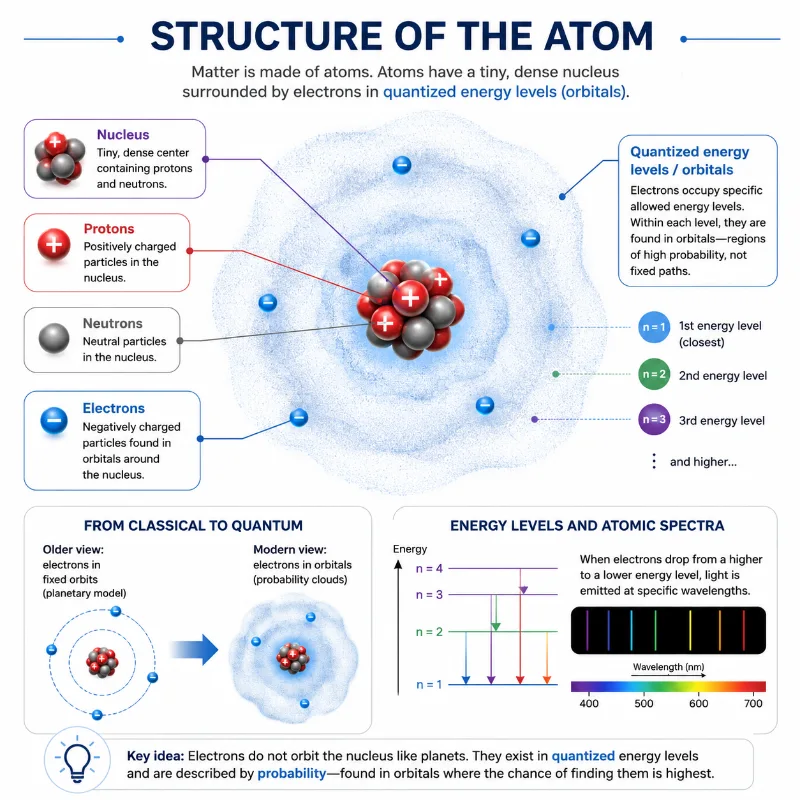
This diagram introduces the structure of the atom in a student-friendly way.
    It shows the tiny, dense nucleus at the centre, containing protons and neutrons, and the surrounding electrons that occupy quantised energy levels and orbitals.
    The image also contrasts the older classical picture of electrons moving in fixed orbits with the modern quantum view, where electrons are described by probability clouds rather than exact paths.
    The energy-level section shows how electron transitions can produce specific wavelengths of light, helping students connect atomic structure with atomic spectra.
Key Idea: The Atom Is Structured, Not Solid
An atom is not a tiny solid ball. Most of its mass is concentrated in a small nucleus, while electrons occupy quantum states around it. These electrons do not follow fixed planetary paths, but are described by probability distributions and energy levels.
This is why atomic structure is so important: it explains how matter can be stable, how atoms emit light, why elements differ, and how microscopic quantum rules shape the visible world.
1. Structure of the Atom within Atomic Physics
Structure of the Atom is one of the key pathways within Atomic Physics. It focuses on how atoms are organised, including the nucleus, protons, neutrons, electrons, orbitals, and energy levels. This topic provides the starting point for understanding quantum numbers, electron configuration, atomic spectra, and how atoms interact with radiation.
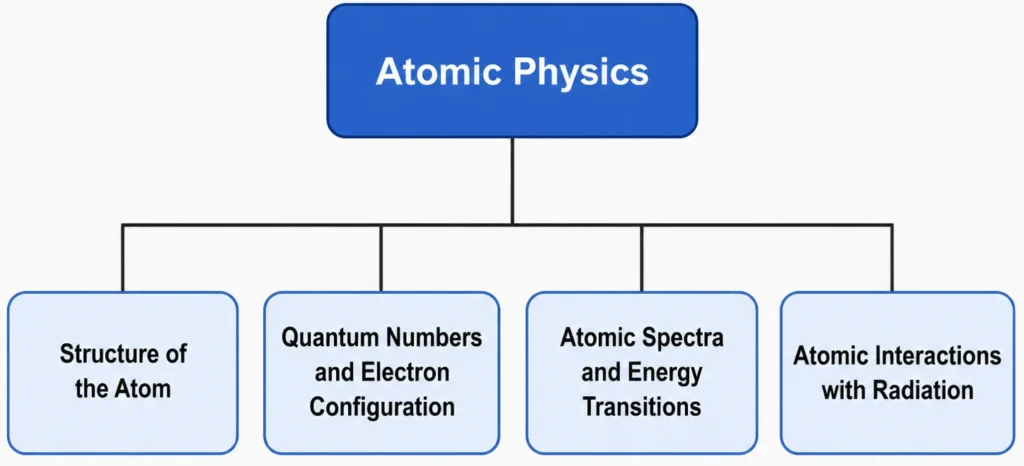
Atomic Physics
Provides the wider framework for understanding atomic structure, electron behaviour, energy levels, spectra, and interactions between atoms and radiation.Structure of the Atom
Explains how atoms are organised, including the nucleus, protons, neutrons, electrons, orbitals, and the shift from classical atomic models to quantum descriptions.Quantum Numbers and Electron Configuration
Describes how quantum numbers, shells, subshells, orbitals, and spin states determine the allowed electron arrangements within atoms.Atomic Spectra and Energy Transitions
Explores how electron transitions between quantised energy levels produce emission and absorption spectra that reveal atomic structure.Atomic Interactions with Radiation
Examines how atoms absorb, emit, scatter, and respond to photons through processes such as excitation, ionisation, fluorescence, and stimulated emission.2. Theoretical Deep Dive: Subatomic Components & Parameters
The Nucleus
The nucleus is the dense central core of an atom and accounts for most of its mass. It consists mainly of two types of subatomic particles: protons and neutrons.
- Protons: Positively charged particles. Each proton carries a charge of +e, where e ≈ 1.602 × 10⁻¹⁹ C. The number of protons in an atom’s nucleus defines its atomic number, Z, which determines the chemical identity of the element. For example, hydrogen has one proton (Z = 1), while carbon has six protons (Z = 6).
- Neutrons: Electrically neutral particles with no net charge. They help stabilise the nucleus by reducing the effect of electrostatic repulsion between positively charged protons. The number of neutrons (N), together with the number of protons, determines the mass number, A = Z + N.
- Forces in the Nucleus: The nucleus is held together by the strong nuclear force, which overcomes electrostatic repulsion between protons over extremely short distances (≈ 1–2 fm).
Key Idea: Most of the Atom’s Mass Is in the Nucleus
Although the nucleus is extremely small compared with the whole atom (roughly 1/100,000th of the atomic diameter), it contains nearly all of the atom’s mass because protons and neutrons are much heavier than electrons. An atom is mostly empty space, yet its tiny nucleus carries almost all of its mass.
The Electron Cloud
The electron cloud surrounds the nucleus and contains negatively charged electrons. In modern quantum theory, electrons do not travel in fixed circular paths; instead, they occupy orbitals describing regions of space where finding an electron is statistically probable.
- Electrons: Electrons are much lighter than nucleons, with a mass me ≈ 9.109 × 10⁻³¹ kg (approx. 1/1836 of a proton’s mass). They carry a charge of −e, balancing the positive charge of protons in a neutral atom.
- Energy Levels and Shells: Electrons are organised in discrete energy levels labelled by the principal quantum number n = 1, 2, 3, …. Each shell holds a maximum capacity of 2n2 electrons.
- Electron Transitions: Electrons move between allowed energy levels by absorbing or emitting photons with energy matching the precise level difference: ΔE = hν.
Quick Check: How Many Electrons Can the Second Shell Hold?
The maximum number of electrons in a shell is given by 2n2. For n = 2, what is the maximum number of electrons?
A. 2
B. 4
C. 8
D. 18
B. 4
C. 8
D. 18
The correct answer is C. For n = 2: 2n2 = 2(22) = 8 electrons.
Atomic Number Z and Mass Number A
The atomic number (Z) represents the total count of protons in the nucleus and uniquely establishes elemental identity. In a neutral atom, Z also equals the number of orbiting electrons.
The mass number (A) is the sum of protons and neutrons in the nucleus:
A = Z + N
Mass number distinguishes different isotopes of an element. For instance, carbon-12 has 6 protons and 6 neutrons (A = 12), whereas carbon-14 has 6 protons and 8 neutrons (A = 14).
Concept Check: Atomic Number vs Mass Number
Carbon-14 has Z = 6 and A = 14. How many neutrons does it have?
A. 6
B. 8
C. 14
D. 20
B. 8
C. 14
D. 20
The correct answer is B. Since A = Z + N, 14 = 6 + N ⇒ N = 8 neutrons.
3. Core Physics Principles: Evolution of Atomic Models
The Bohr Model (1913)
Proposed by Niels Bohr in 1913, this semi-classical model incorporated Planck’s quantum hypothesis into Rutherford’s nuclear picture:
- Key Features: Electrons orbit the nucleus in specific circular paths (shells) without radiating energy. Angular momentum is quantised in integer multiples of ℏ = h / (2π). Photon emission or absorption occurs strictly during transitions between orbits.
- Successes: Accurately calculated spectral line wavelengths for hydrogen and hydrogen-like single-electron ions; derived the Rydberg constant from fundamental physical constants.
- Limitations: Failed for multi-electron atoms; could not explain spectral line intensity, Zeeman splitting, or the wave-particle nature of electrons.
The Quantum Mechanical Model
Developed in the 1920s by Schrödinger, Heisenberg, de Broglie, and Born, the modern quantum mechanical model replaces fixed classical orbits with three-dimensional probability distributions:
- Orbitals & Wave Functions: Electron states are described by wave functions (Ψ) derived from Schrödinger’s wave equation. The square of the magnitude |Ψ|2 represents electron probability density.
- Uncertainty Principle: As established by Heisenberg, an electron’s position and linear momentum cannot be simultaneously measured with absolute precision (Δx · Δp ≥ ℏ / 2).
- Quantum Numbers: Four parameters (n, ℓ, mℓ, ms) uniquely define the quantum state, energy, subshell geometry, orbital orientation, and spin of each electron.
Key Distinction: Bohr Orbits vs Quantum Orbitals
The Bohr model pictures electrons moving along fixed 2D circular tracks. The quantum mechanical model replaces tracks with 3D orbitals—regions of probability density describing where an electron is most likely to be located.
4. Mathematical Foundations: Electrostatics & Quantum States
The classical electrostatic force holding an electron in orbit around a hydrogen nucleus (Z = 1) is governed by Coulomb’s Law:
$$ F_e = \frac{1}{4\pi\varepsilon_0} \frac{e^2}{r^2} $$
Bohr combined this centripetal attraction with angular momentum quantisation (mvr = nℏ) to derive the quantised radii and energy levels of hydrogen:
$$ r_n = n^2 a_0 \quad \left(a_0 = \frac{4\pi\varepsilon_0 \hbar^2}{m_e e^2} \approx 0.529 \text{ \AA}\right) $$
$$ E_n = -\frac{13.6 \text{ eV}}{n^2} $$
In quantum mechanics, the wave-particle duality relation relates an electron’s momentum to its de Broglie wavelength: λ = h / p.
5. Practical Applications & Modern Relevance
Understanding atomic structure provides the foundation for engineering matter across physics, chemistry, medicine, and technology.
Fundamental Building Blocks
Understanding how subatomic particles interact explains the physical stability of matter and underpins material properties in physics, chemistry, and engineering.Historical & Scientific Development
Tracing atomic theory from Dalton through Rutherford and Bohr to quantum mechanics illustrates how experimental evidence refines scientific models and drives technological innovation.Forces & Energy Dynamics
Balancing electromagnetic forces in the electron cloud with the strong nuclear force in the core explains atomic stability, radioactivity, nuclear energy, and photon emission.Applications in Science & Technology
Atomic energy levels enable essential modern technologies including semiconductor electronics, lasers, nuclear magnetic resonance imaging (MRI), optical sensors, and photovoltaics.Quantum & Particle Physics Bridge
The study of atomic structure leads directly into subatomic physics, explaining isotope stability, nuclear decay modes, quark composition, and quantum computing architectures.Pause and Think: Why Did Atomic Models Change?
Atomic models changed because new experimental evidence contradicted earlier predictions. Rutherford’s gold foil experiment proved Thomson’s solid model false. Hydrogen emission spectra forced Bohr to introduce quantised energy states. Wave-particle duality led to modern quantum mechanics.
Science progresses by continually testing and refining models against experimental data. Intermediate models like Bohr’s were incomplete, but provided critical stepping stones to modern quantum theory.
6. Key Terms Glossary
- Atom
- The fundamental unit of an element, consisting of a central nucleus surrounded by an electron cloud occupying quantised states.
- Proton
- A positively charged nucleon with mass mp ≈ 1.673 × 10⁻²⁷ kg and charge +e. The proton count equals the atomic number Z.
- Neutron
- An uncharged nucleon with mass mn ≈ 1.675 × 10⁻²⁷ kg that provides attractive strong nuclear forces to stabilize the nucleus.
- Electron
- A fundamental lepton carrying a negative charge −e and mass 1/1836th of a proton, occupying quantum orbitals surrounding the nucleus.
- Atomic Number (Z)
- The total number of protons in the nucleus, defining elemental identity and chemical properties.
- Mass Number (A)
- The total number of nucleons (protons + neutrons) in an atomic nucleus.
- Isotope
- Atoms of the same element containing equal proton counts (same Z) but different neutron counts (different A).
- Strong Nuclear Force
- The powerful short-range fundamental attractive force binding protons and neutrons together against electrostatic repulsion.
- Bohr Model
- The 1913 semi-classical atomic model postulating discrete, non-radiating circular electron orbits with quantised angular momentum.
- Quantum Mechanical Model
- The modern atomic framework describing electrons as wave functions and 3D probability clouds (orbitals) determined by Schrödinger’s equation.
7. Frequently Asked Questions
What is an atom in modern physics?
In modern physics, an atom is the smallest unit of an element that retains its chemical identity. It consists of a tiny, dense nucleus containing protons and neutrons, surrounded by electrons that occupy quantised energy levels. The atom as a whole is electrically neutral when the number of electrons equals the number of protons.
What are the main subatomic particles and their charges?
The main subatomic particles are protons, neutrons, and electrons. Protons carry a positive electric charge, neutrons are electrically neutral, and electrons carry a negative charge. Protons and neutrons reside in the nucleus, while electrons occupy regions of space around the nucleus. The balance between positive and negative charges determines the atom’s overall charge.
What is the atomic number Z and what does it tell you?
The atomic number Z is the number of protons in the nucleus of an atom. It uniquely identifies an element and determines its position in the periodic table. For a neutral atom, the atomic number also equals the number of electrons, which largely controls the atom’s chemical behaviour and bonding patterns.
What is the mass number A and how is it different from atomic mass?
The mass number A is the total number of protons and neutrons (nucleons) in the nucleus of a particular isotope. Atomic mass, on the other hand, is the actual mass of an atom and is often given as a weighted average over the naturally occurring isotopes of an element. Mass number is always an integer, while atomic mass is usually a decimal value measured in atomic mass units.
What are isotopes and how do they differ from each other?
Isotopes are atoms of the same element that have the same number of protons but different numbers of neutrons. This means they share the same atomic number but have different mass numbers. Isotopes have nearly identical chemical behaviour because their electron structures are the same, but they can have different physical properties and nuclear stability, leading to stable, radioactive, or short-lived forms.
How did models of the atom develop from Thomson to the quantum model?
Early models, such as Thomson’s “plum pudding” model, pictured electrons embedded in a positively charged sphere. Rutherford’s scattering experiments then revealed a small, dense nucleus with electrons outside it. Bohr introduced quantised orbits to explain hydrogen’s spectrum. Finally, the quantum mechanical model replaced fixed orbits with orbitals and wavefunctions, describing electrons as probability clouds rather than tiny planets in fixed paths.
What is the nucleus and what forces hold it together?
The nucleus is the central core of the atom, made of positively charged protons and neutral neutrons. Although protons repel each other electrically, they are held together at very short distances by the strong nuclear force, which is much stronger than the electromagnetic force over nuclear scales. The balance between these forces and the number of neutrons determines whether a nucleus is stable or radioactive.
What does it mean when we say an atom is mostly empty space?
Saying an atom is mostly empty space means that the nucleus is extremely small compared to the overall size of the atom, and the electrons are spread out over a relatively large volume. If the nucleus were the size of a tiny marble, the nearest electrons would be metres away. Most of the atom’s volume is therefore not filled with solid matter, even though quantum fields and forces extend throughout this region.
What are electron shells and orbitals in the structure of the atom?
Electron shells are groups of energy levels labelled by the principal quantum number n, while orbitals are more detailed regions within shells where an electron is likely to be found. Orbitals are defined by quantum numbers and come in shapes such as s, p, d, and f. The arrangement of electrons in these shells and orbitals determines an atom’s chemical properties and its place in the periodic table.
How does atomic structure explain the periodic table and chemical behaviour?
Atomic structure explains the periodic table through the way electrons fill shells and subshells. Elements in the same group have similar valence electron configurations, leading to similar bonding patterns and reactivity. Periodic trends in properties such as ionisation energy, atomic radius, and electronegativity arise from changes in nuclear charge and the way electrons are arranged around the nucleus.
What is nuclear stability and how is it related to binding energy?
Nuclear stability refers to how likely a nucleus is to remain unchanged over time. It is closely related to nuclear binding energy, which is the energy required to separate a nucleus into its individual protons and neutrons. A high binding energy per nucleon usually indicates a stable nucleus, while low binding energy or certain proton–neutron ratios can lead to radioactive decay as the nucleus seeks a more stable configuration.
Why is understanding the structure of the atom important for students?
Understanding atomic structure gives students a foundation for many areas of physics, chemistry, and materials science. It explains the periodic table, chemical bonding, spectra, radioactivity, and the behaviour of solids, liquids, and gases at a microscopic level. This knowledge also connects directly to technologies such as lasers, semiconductors, nuclear power, medical imaging, and emerging quantum devices.
8. Assessment Exercises
Part 1: Review Questions
Q1. What is the basic structure of an atom?
Answer: An atom consists of a dense central nucleus made of protons and neutrons, surrounded by a cloud of electrons that occupy quantised energy levels and probability orbitals.
Q2. How is the nucleus composed?
Answer: The nucleus is composed of positively charged protons and uncharged neutrons bound together by the strong nuclear force.
Q3. What are electron clouds and how do they differ from fixed electron orbits?
Answer: Electron clouds represent 3D statistical probability regions where an electron is likely to be found according to quantum mechanics. Fixed orbits in the Bohr model treated electrons as classical particles moving along deterministic 2D paths.
Q4. How did the Rutherford gold foil experiment contribute to our understanding of atomic structure?
Answer: By demonstrating that a tiny fraction of alpha particles deflected at large angles, Rutherford proved that an atom’s positive charge and nearly all its mass are concentrated in a dense central nucleus, disproving the plum pudding model.
Q5. What is the Bohr model of the atom and what are its limitations?
Answer: The Bohr model depicts electrons orbiting the nucleus in quantised, non-radiating circular tracks. Its limitations are that it fails for multi-electron atoms and ignores electron wave-particle duality and uncertainty.
Q6. How do quantum mechanics refine our understanding of atomic structure beyond the Bohr model?
Answer: Quantum mechanics replaces fixed circular tracks with wave functions and 3D probability density orbitals, incorporating the uncertainty principle and spin dynamics.
Q7. In what way do energy levels and electron transitions determine an atom’s spectral lines?
Answer: Photon emission or absorption occurs strictly when an electron drops or jumps between discrete energy levels. The energy of the photon matches the level gap (ΔE = hν = hc / λ), producing sharp spectral lines unique to each element.
Q8. How does electron configuration influence chemical properties?
Answer: The arrangement of electrons—particularly valence electrons in the outermost shell—determines atomic radius, bonding tendencies, ionisation energy, and overall chemical reactivity.
Q9. What role do quantum numbers play in describing the structure of the atom?
Answer: Four quantum numbers (n, ℓ, mℓ, ms) uniquely identify the main shell energy, orbital geometric shape, spatial orientation, and electron spin orientation for every electron in an atom.
Q10. Which modern experimental techniques are used to study atomic structure?
Answer: X-ray diffraction, photoelectron spectroscopy, scanning tunneling microscopy (STM), and transmission electron microscopy (TEM) allow researchers to probe electronic binding energies and image individual atomic structures.
Part 2: Applied & Thought-Provoking Scenarios
Q1. How can advanced imaging techniques further our understanding of the atom’s internal structure?
Answer: Advanced scanning probe techniques (like STM and AFM) allow direct visualization and manipulation of surface atoms, probing real-space probability densities and atomic-scale forces.
Q2. In what ways might the manipulation of atomic structures revolutionise materials science?
Answer: Atom-by-atom fabrication (atomic layer deposition) enables tailor-made metamaterials with engineered mechanical strength, thermal conductivity, optical response, and electronic band gaps.
Q3. Could a deeper understanding of electron probability clouds lead to innovations in quantum computing?
Answer: Yes. Understanding spatial probability densities and quantum coherence allows precise control over electron spin states and tunneling barriers for semiconductor qubits.
Q4. How does the uncertainty principle challenge our classical view of the atom?
Answer: It establishes a fundamental physical limit showing electrons cannot have well-defined trajectories; exact orbital paths are replaced by quantum probability distributions.
Q5. What are the potential implications of altering atomic structures for energy production and storage?
Answer: Engineering atomic defects and surface configurations enhances battery ion diffusion rates, catalyst efficiency for hydrogen fuel production, and solar cell light absorption.
Q6. How might the discovery of new subatomic particles influence our current models of atomic structure?
Answer: While standard chemistry relies on protons, neutrons, and electrons, exotic subatomic particles probe fundamental forces, dark matter interactions, and precision nuclear structure models.
Q7. In what ways do electron correlations challenge current atomic models?
Answer: Electron-electron repulsions in multi-electron atoms create complex multi-body correlations that require advanced numerical approximations beyond single-particle wave functions.
Q8. How can the study of atomic structure contribute to the development of novel pharmaceuticals?
Answer: Understanding electronic charge distributions and molecular orbital geometries allows computational drug design tailored to lock into specific biological receptor sites.
Q9. What role do relativistic effects play in the structure of heavy atoms?
Answer: In high-Z elements, inner s electrons move at relativistic speeds, increasing their effective mass. This contracts s and p orbitals while shielding and expanding d and f orbitals, giving gold its yellow color and mercury its liquid state.
Q10. How might ultrafast lasers shed light on dynamic processes within the atom?
Answer: Attosecond and femtosecond laser pulses allow real-time observation of electron motion, ionization dynamics, and energy transitions as they happen.
Q11. In what ways could future research on atomic structure influence our understanding of cosmic matter?
Answer: Spectroscopic analysis of atomic absorption lines from stellar light reveals stellar composition, age, temperature, expansion rates, and nucleosynthesis history in the universe.
Q12. What ethical considerations arise from manipulating matter at atomic scales?
Answer: Nanotechnology safety, environmental bioaccumulation of engineered nanoparticles, molecular manufacturing dual-use risks, and regulatory oversight require ethical frameworks.
Part 3: Numerical Problems with Step-by-Step Worked Solutions
Problem 1: Unit Conversion of Bohr Radius
Convert the Bohr radius (a0 = 0.529 Å) into metres.
Solution:
Since 1 Å = 1 × 10⁻¹⁰ m:
$$ a_0 = 0.529 \times 10^{-10} \text{ m} = 5.29 \times 10^{-11} \text{ m} $$
Answer: 5.29 × 10⁻¹¹ m.
Problem 2: Energy of Electron in n = 2 Hydrogen Level
Determine the energy of an electron in the n = 2 level of hydrogen.
Solution:
$$ E_n = -\frac{13.6}{n^2} \text{ eV} \implies E_2 = -\frac{13.6}{2^2} = -\frac{13.6}{4} = -3.40 \text{ eV} $$
Answer: −3.40 eV.
Problem 3: Energy Difference Between n = 2 and n = 3
Calculate the energy difference between the n = 2 and n = 3 energy levels in hydrogen.
Solution:
E2 = −3.40 eV; E3 = −13.6 / 32 = −1.51 eV.
$$ \Delta E = E_3 – E_2 = (-1.51) – (-3.40) = 1.89 \text{ eV} $$
Answer: 1.89 eV.
Problem 4: Wavelength of Emitted Photon (n = 3 → n = 2)
Using the energy difference ΔE = 1.89 eV, calculate the emitted wavelength in nm. Use hc = 1240 eV·nm.
Solution:
$$ \lambda = \frac{hc}{\Delta E} = \frac{1240}{1.89} \approx 656 \text{ nm} $$
Answer: 656 nm (H-alpha line).
Problem 5: Ionisation Energy Conversion to Joules
Convert the hydrogen ground-state ionisation energy (13.6 eV) into Joules.
Solution:
Since 1 eV = 1.602 × 10⁻¹⁹ J:
$$ E = 13.6 \times 1.602 \times 10^{-19} \text{ J} \approx 2.18 \times 10^{-18} \text{ J} $$
Answer: 2.18 × 10⁻¹⁸ J.
Problem 6: Wavelength of Lyman-Alpha Line
Using the Rydberg formula (R = 1.097 × 10⁷ m−1), calculate the wavelength for the Lyman-alpha transition (n = 2 → n = 1).
Solution:
$$ \frac{1}{\lambda} = R \left(\frac{1}{1^2} – \frac{1}{2^2}\right) = (1.097 \times 10^7) \times \left(1 – \frac{1}{4}\right) = (1.097 \times 10^7) \times 0.75 \approx 8.2275 \times 10^6 \text{ m}^{-1} $$
$$ \lambda = \frac{1}{8.2275 \times 10^6} \approx 1.215 \times 10^{-7} \text{ m} = 121.5 \text{ nm} $$
Answer: 121.5 nm (Ultraviolet region).
Problem 7: Absorbed Energy for n = 1 → n = 3 Transition
An electron in hydrogen jumps from n = 1 to n = 3. Calculate the absorbed photon energy in eV.
Solution:
E1 = −13.6 eV; E3 = −1.51 eV.
$$ \Delta E = E_3 – E_1 = (-1.51) – (-13.6) = 12.09 \text{ eV} $$
Answer: 12.09 eV.
Problem 8: Frequency of Light from Wavelength
Calculate the frequency of light with wavelength λ = 486 nm. Use c = 3.0 × 10⁸ m/s.
Solution:
$$ \nu = \frac{c}{\lambda} = \frac{3.0 \times 10^8}{486 \times 10^{-9}} \approx 6.17 \times 10^{14} \text{ Hz} $$
Answer: 6.17 × 10¹⁴ Hz.
Problem 9: Wavelength of n = 4 → n = 2 Transition
Calculate the emitted wavelength for the hydrogen transition n = 4 → n = 2 using the Rydberg formula.
Solution:
$$ \frac{1}{\lambda} = R \left(\frac{1}{2^2} – \frac{1}{4^2}\right) = (1.097 \times 10^7) \times \left(\frac{1}{4} – \frac{1}{16}\right) = (1.097 \times 10^7) \times 0.1875 \approx 2.05688 \times 10^6 \text{ m}^{-1} $$
$$ \lambda = \frac{1}{2.05688 \times 10^6} \approx 4.86 \times 10^{-7} \text{ m} = 486 \text{ nm} $$
Answer: 486 nm (Blue-green H-beta line).
Problem 10: Electrostatic Force in Ground-State Hydrogen
Estimate the electrostatic attraction force between a proton and electron at the Bohr radius (r = 5.29 × 10⁻¹¹ m).
Solution:
$$ F = \frac{k e^2}{r^2} = \frac{(8.99 \times 10^9) \times (1.602 \times 10^{-19})^2}{(5.29 \times 10^{-11})^2} \approx \frac{2.307 \times 10^{-28}}{2.798 \times 10^{-21}} \approx 8.24 \times 10^{-8} \text{ N} $$
Answer: 8.24 × 10⁻⁸ N.
Problem 11: De Broglie Wavelength of an Electron
Calculate the de Broglie wavelength of an electron moving at v = 2.2 × 10⁶ m/s. Use me = 9.11 × 10⁻³¹ kg and h = 6.626 × 10⁻³⁴ J·s.
Solution:
$$ \lambda = \frac{h}{m_e v} = \frac{6.626 \times 10^{-34}}{(9.11 \times 10^{-31}) \times (2.2 \times 10^6)} = \frac{6.626 \times 10^{-34}}{2.004 \times 10^{-24}} \approx 3.31 \times 10^{-10} \text{ m} $$
Answer: 3.31 × 10⁻¹⁰ m (0.331 nm).
Problem 12: Ground-State Energy of a Hydrogen-like Ion (Z = 3)
For a hydrogen-like ion with Z = 3 (Lithium-2+), calculate its ground-state energy (n = 1).
Solution:
$$ E_n = -\frac{13.6 Z^2}{n^2} \text{ eV} \implies E_1 = -13.6 \times \frac{3^2}{1^2} = -13.6 \times 9 = -122.4 \text{ eV} $$
Answer: −122.4 eV.
History, Challenges, and Future Prospects
The study of atomic structure has driven the shift from classical deterministic physics to modern quantum mechanics over the past century.
Historical Milestones: J.J. Thomson discovered the electron in 1897 and proposed the “plum pudding” model. In 1911, Ernest Rutherford disproved this model using his alpha-particle gold foil scattering experiment, establishing the existence of a small, dense nucleus containing most of the atom’s mass. Niels Bohr refined this in 1913 by introducing quantised energy orbits for hydrogen. The framework reached maturity in the late 1920s when Erwin Schrödinger, Werner Heisenberg, and Max Born replaced classical orbits with wavefunctions, probability density clouds, and quantum states.
Current Challenges: Modeling multi-electron atoms and superheavy transuranic elements remains computationally demanding. Electron correlation effects—where the instantaneous motion of one electron influences all others—cannot be solved analytically and require high-performance numerical approximations. Furthermore, accounting for quantum electrodynamic (QED) and relativistic corrections in high-Z elements presents ongoing theoretical challenges.
Future Prospects: Precise manipulation of atomic structures enables breakthrough applications. Ultrafast attosecond spectroscopy allows scientists to film electron dynamics in real time. Single-atom trapping and optical lattices provide precise architectures for quantum simulators, while atomic-scale engineering (nanofabrication) continues to push the limits of semiconductor technology and quantum computing.
Cluster Navigation & Academic References
Related Prep4Uni.online Learning Pages
Structure of the Atom connects naturally with other pages across the Atomic, Nuclear, and Quantum Physics clusters:
- Modern Physics Hub — Overview of 20th-century physics transitions.
- Atomic Physics Sub-Hub — Cluster overview for atomic structure, energy levels, and radiation.
- Quantum Numbers and Electron Configuration — Shells, subshells, orbitals, and spin rules.
- Atomic Spectra and Energy Transitions — Photon emission, absorption, and spectral lines.
- Atomic Interactions with Radiation — Excitation, ionisation, fluorescence, and lasers.
- Nuclear Physics Hub — Deep dive into nuclear forces, radioactivity, fission, and fusion.
External References & Data Sources
- NIST Atomic Spectra Database — Evaluation of atomic energy levels, wavelengths, and spectra data.
- OpenStax College Physics 2e – Discovery of the Atom — Open physics textbook chapter covering historical atomic models and experiments.
- HyperPhysics: Atomic Models — Georgia State University conceptual guide on Thomson, Rutherford, Bohr, and Quantum atomic models.
Archived version: This learning resource is archived on Zenodo at https://zenodo.org/records/20570351.
Suggested citation: Gan, J. (2026). Structure of the Atom: Nucleus, Electrons, and Quantum Orbitals. Prep4Uni.online. Zenodo. https://doi.org/10.5281/zenodo.20570351