
STEM education is not simply an aggregation of four isolated subjects—it is a structured, cyber-physical, and empirical system designed to convert observational curiosity into disciplined, reproducible understanding. By uniting scientific inquiry, mathematical rigor, technological tools, and engineering design, learners build the cognitive architecture required to model, evaluate, and solve high-dimensional challenges in modern society.
Answer: By coupling empirical scientific observation with mathematical abstractions, testing hypotheses through engineering design under physical and economic constraints, and leveraging computational systems to automate, scale, and monitor solutions in dynamic environments.
Rather than functioning as separate silos, the four STEM disciplines operate as an interdependent continuum. At the input level, learners bring qualitative inquiries, natural observations, and baseline domain facts. These inputs are governed by epistemological controls: the scientific method, evidentiary verification, dimensional analysis, error bounds, and logical deduction. Enabled by mechanisms such as educators, computational clusters, laboratory equipment, and rapid prototyping tools, raw concepts are iteratively refined into robust, verified technical systems.
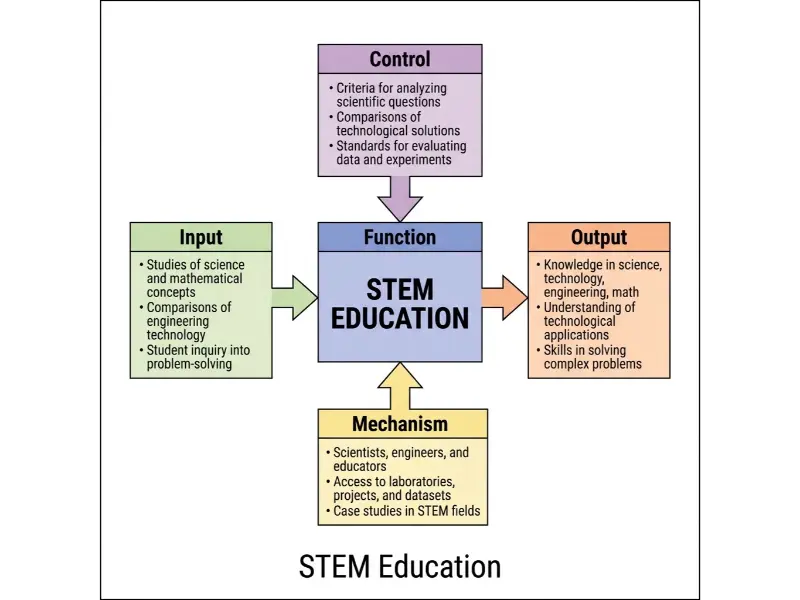
Systems-engineering representation of STEM: qualitative curiosity enters as an input, passes through empirical and mathematical controls, and is transformed by computational and experimental mechanisms into verified engineering outcomes.
The Interconnected STEM Continuum
Understanding STEM requires recognizing how each discipline supports the others. At its foundation, mathematics and statistics establish the language of formal proof, continuous optimization, and stochastic uncertainty. The natural sciences provide empirical laws governing energy, matter, and biological life, while engineering applies these principles within safety margins, operational tolerances, and material constraints. Simultaneously, modern Information Technology provides the computational infrastructure that simulates, automates, and deploys these solutions across global networks.

Disciplinary Directory: Subfields and Academic Modules
This directory serves as the master gateway to all specialized learning modules within the Prep4Uni STEM cluster. Explore each domain to examine foundational theories, laboratory methodologies, and applied research:
1. Natural and Physical Sciences Hub →
Investigates the laws governing the universe through empirical observation, hypothesis testing, and controlled experimentation. Science establishes the physical parameters within which all technology and engineering must operate.
- Physics — Classical Newtonian mechanics, thermodynamics, electromagnetism, special relativity, and quantum mechanics.
- Chemistry — Molecular bonding kinetics, reaction thermodynamics, organic synthesis, and solid-state materials chemistry.
- Biology — Cellular metabolism, molecular genetics, evolutionary mechanics, and ecological regulatory loops.
- Earth Science — Plate tectonics, geophysics, atmospheric circulation, oceanography, and planetary geology.
- Environmental Science — Biogeochemical cycles, ecosystem dynamics, toxicological tracking, and global climate modeling.
2. Mathematical & Statistical Sciences Hub →
Provides the formal framework for modeling relationships, quantifying change, and reasoning under uncertainty. Mathematics transforms qualitative scientific ideas into rigorous, computable formulas.
- Pure Mathematics — Axiomatic logic, number theory, abstract algebra (groups, rings, fields), and real/complex analysis.
- Applied Mathematics — Differential equations, dynamical systems, linear algebra, numerical analysis, and mathematical physics.
- Statistics — Probability distributions, Bayesian parameter estimation, hypothesis testing, and stochastic processes.
- Actuarial Science — Financial mathematics, life contingencies, ruin theory, and quantitative risk modeling.
3. Information Technology & Computing Hub →
Focuses on computational architecture, software engineering, distributed networks, and intelligent algorithms. IT turns mathematical models into functional digital infrastructure that processes data and automates complex operations.
- Artificial Intelligence & Robotics — Machine learning, deep neural networks, computer vision, natural language processing, and autonomous robotic control.
- Data Science & Analytics — High-dimensional data pipelines, statistical learning, data visualization, and predictive modeling.
- Software Development — Data structures, algorithmic complexity (\(\mathcal{O}(n)\)), design patterns, and systems engineering.
- Cybersecurity — Cryptography, network penetration testing, zero-trust architectures, security governance, and memory safety.
- Cloud Computing — Virtualization, container orchestration (Kubernetes), distributed databases, and serverless architectures.
- Networking & Telecommunications — OSI model layers, packet routing protocols, wireless infrastructure, and fiber optics.
- Web Technologies — Distributed client-server systems, reactive front-end architectures, and asynchronous APIs.
- Interactive Simulation & Game Tech — Real-time rendering pipelines, physical simulation engines, and spatial computing.
4. Engineering & Physical Technologies Hub →
Translates scientific principles and mathematical calculations into tangible, operational structures, machines, and processes. Engineering emphasizes safety factors, durability, material selection, and cost efficiency under physical constraints.
- Mechanical Engineering — Solid mechanics, thermodynamics, fluid dynamics, heat transfer, and mechanical kinematics.
- Electrical & Electronic Engineering — Circuit analysis, semiconductor device physics, power grids, and digital signal processing (DSP).
- Civil Engineering — Structural mechanics, geotechnical foundation design, hydrology, and transportation systems.
- Chemical Engineering — Unit operations, transport phenomena, chemical reactor design, and industrial separation processes.
- Aerospace Engineering — Subsonic/supersonic aerodynamics, orbital mechanics, propulsion systems, and flight dynamics.
- Biomedical Engineering — Biocompatible materials, orthopedic biomechanics, physiological sensors, and medical imaging systems.
- Environmental Engineering — Industrial wastewater treatment, emissions remediation, hazardous waste management, and sustainable design.
- Industrial & Manufacturing Systems — Production planning, operations research, quality engineering, and supply-chain logistics.
5. Emerging Technologies & Frontier Research Hub →
Examines interdisciplinary frontiers where multiple fields converge to create new technical capabilities. Frontier engineering combines advanced computation with physical systems to address complex global problems.
- Quantum Information Science — Quantum superposition, entanglement gates, decoherence mitigation, and quantum algorithms (Shor, Grover).
- Synthetic Biology & Biotech — CRISPR-Cas gene editing, metabolic engineering, and synthetic genomic circuits.
- Renewable Energy Systems — Solid-state photovoltaics, wind turbine aerodynamics, battery chemistry, and smart grids.
- Nanotechnology & Advanced Materials — 2D graphene sheets, carbon nanotubes, self-assembling monolayers, and quantum dot displays.
- Space Exploration Systems — Deep-space trajectories, in-situ resource utilization (ISRU), and life support systems.
- Autonomous Swarms & Soft Robotics — Hyperelastic actuators, graph Laplacian swarm consensus, and distributed bio-inspired locomotion.
The Engineering V-Model & Systems Development Lifecycle in STEM
A central reason students struggle when transitioning from high school science to university-level engineering is the absence of a structured development methodology. In academic environments, problems often arrive pre-packaged with clear variables and single answers. In professional practice, technical challenges are ambiguous, open-ended, and tightly constrained.
To connect scientific theory with physical implementation, engineers use the Systems Engineering V-Model. The left-hand downward path represents decomposition and design elaboration, while the right-hand upward path represents component integration and verification:
By framing STEM challenges through this lifecycle, students learn that writing a software script or building an electronic circuit is not an isolated task—it is part of an integrated, traceable verification chain.
Core Competencies Cultivated Through STEM Training
STEM education develops durable, transferable technical competencies that extend well beyond specific programming languages or laboratory techniques:
- Algorithmic & Computational Thinking: Decomposing large, unstructured problems into deterministic, step-by-step procedures. This includes analyzing time-and-space complexity, evaluating recursion, and designing modular data flows.
- Dimensional Analysis & Order-of-Magnitude Estimation (Fermi Estimation): Verifying physical calculations using consistent units and bounding problems with rapid order-of-magnitude approximations before committing to complex numerical simulations.
- Stochastic Modeling & Risk Quantification: Evaluating real-world systems not as deterministic certainty, but as probability density functions subject to noise, manufacturing variances, and environmental disturbances.
- Root-Cause Analysis & Systematic Debugging: Isolating failure modes in hardware and software through hypothesis elimination, instrumented telemetry, and controlled regression testing.
- Technical Documentation & Evidentiary Justification: Communicating complex system architectures, test results, and safety considerations using standardized mathematical notations, block diagrams, and reproducible documentation.
Common Misconceptions in STEM Education
Clarifying common misconceptions helps remove artificial barriers for students considering STEM studies:
1. "STEM aptitude is an innate talent reserved for 'geniuses'"
2. "Mathematics is merely arithmetic calculation"
3. "The scientific method yields absolute, immutable certainty"
4. "Engineering is simply applied science"
5. "Computer science and IT are strictly about writing code"
Applied Cross-Disciplinary Case Studies: Exploratory Mini-Projects
Concepts become concrete when tested against physical constraints. Students can build practical experience through these focused mini-projects:
- Wireless RF Path Loss Mapping: Measure signal strength attenuation across walls at 2.4 GHz and 5.0 GHz; calculate empirical path loss exponents (\(\alpha\)) to identify wireless dead zones.
- Energy Telemetry Dashboard: Ingest real-time electrical grid data via public APIs; perform multivariate regressions in Python or R to analyze how temperature spikes drive peak electrical consumption.
- Sensor Noise & IMU Calibration: Interface an accelerometer and gyroscope to a microcontroller; calculate the Allan variance to separate drift from white Gaussian noise.
- Nonlinear Damped Pendulum Kinematics: Record high-speed video of a swinging pendulum; extract coordinate data to plot phase-space trajectories and determine non-linear damping coefficients.
- Quantized Vision Model Profiling: Deploy a quantized neural network to an edge device (e.g., Raspberry Pi); evaluate inference latency, memory draw, and classification accuracy across different lighting conditions.
From Academic Disciplines to Professional Roles
STEM training provides the analytical and quantitative foundation for a wide range of technical careers:
| Disciplinary Cluster | Core Methodological Focus | Entry-Level Roles | Advanced / Senior Roles |
|---|---|---|---|
| IT, Computing & Networks | Distributed protocols, microservices, operating system kernels, cryptographic protocols | Associate DevOps Engineer, Junior Full-Stack Developer, NOC Analyst | Principal Systems Architect, SRE Director, Chief Information Security Officer (CISO) |
| AI, Robotics & Data | Tensor calculus, deep neural networks, graph algorithms, kinematic state estimation | Machine Learning Associate, Computer Vision Engineer, Robotics Software Intern | Staff AI Researcher, Principal Autonomous Systems Engineer, Head of Autonomy |
| Physical Engineering | Finite element analysis, Navier-Stokes dynamics, circuit design, control feedback | Field Test Engineer, Structural Analyst Intern, Hardware Validation Engineer | Chief Mechanical Engineer, Power Systems Director, VP of Hardware Engineering |
| Biological & Life Sciences | Cellular kinetics, genomic sequencing, mass spectrometry, bioprocess scale-up | Laboratory Assay Analyst, QC Biochemist, Clinical Data Coordinator | Principal Research Scientist, Director of Bioprocess R&D, VP of Regulatory Affairs |
| Mathematical & Actuarial | Stochastic calculus, non-convex optimization, graph theory, ruin theory | Actuarial Analyst, Quantitative Trading Associate, Operations Research Analyst | Head of Quantitative Strategy, Chief Risk Officer (CRO), Portfolio Optimization Lead |
Key Analytical Concepts: Foundational STEM Glossary
These core concepts appear throughout advanced science, mathematics, and engineering coursework:
Mathematical / Physical Model
Engineering Trade-Off (Pareto Frontier)
Signal-to-Noise Ratio (SNR)
Reproducibility & Falsifiability
Systems Dynamics & Feedback Loops
Frequently Asked Questions About STEM Education
How do the four distinct STEM disciplines collaborate in real-world systems?
Science identifies natural laws and materials behaviors; mathematics provides the language of formal modeling and optimization; engineering designs physical devices that safely operate within these laws; and technology provides the computational networks, sensors, and software that coordinate and scale the system.
Does university STEM study require advanced mathematics before enrollment?
While strong foundations in algebra, trigonometry, and single-variable calculus are beneficial, university programs structure early courses to build advanced mathematical tools—such as linear algebra, differential equations, and multivariate calculus—alongside introductory engineering and computing modules.
Why do students often struggle during their first year of university STEM?
The challenge usually stems from a shift in academic expectations: moving from memorizing pre-solved problem sets to managing open-ended systems, abstract models, and iterative debugging under ambiguous constraints.
How does STEM preparation support non-technical careers?
STEM graduates develop durable competencies in quantitative reasoning, root-cause analysis, data interpretation, and risk modeling—skills highly valued in quantitative finance, management consulting, corporate strategy, and patent law.
End-of-Module Verification Exercises: Analytical Review & Synthesis
Part I: Conceptual Review & Synthesis
1. Deconstruct an autonomous mobile robot (AMR) into its four STEM component domains.
- Science: Semiconductor physics for LiDAR photodiodes, battery electrochemistry, and friction mechanics between wheels and warehouse flooring.
- Mathematics: Graph Laplacian consensus for fleet synchronization, Lie algebra for spatial rotations, and probabilistic Bayesian filtering for SLAM localization.
- Engineering: Non-holonomic differential-drive kinematics, torsional shaft sizing, thermal heat sinks for onboard computing, and safety bumpers.
- Technology: Real-Time Operating System (RTOS) scheduling, ROS 2 inter-process communication nodes, Wi-Fi telemetry pipelines, and cloud fleet dispatchers.
2. Outline the stages required to translate a scientific discovery into an engineered commercial product.
3. Why are multidisciplinary engineering teams necessary for modern technology projects?
Part II: Thought-Provoking Frontier Challenges
1. How do Physics-Informed Neural Networks (PINNs) bridge scientific principles with machine learning?
2. What failure modes emerge when software systems are decoupled from physical hardware limits?
3. How do international engineering standards bodies support global technical interoperability?
STEM Disciplinary Hub — Summary & Learning Wrap-Up
STEM education provides an enduring framework for deconstructing, understanding, and shaping complex natural and technological systems. By integrating empirical science, mathematical modeling, disciplined engineering, and computational platforms, students move beyond rote memorization to develop adaptable problem-solving skills. Whether pursuing advanced university research or technical leadership, mastering this systems approach equips students to navigate emerging frontiers and contribute meaningfully to global engineering and scientific progress.