
In Physics, the classification of particles into fermions and bosons marks one of the deepest distinctions in the subatomic world. Fermions form matter, while many bosons act as the carriers or mediators of interactions between particles. Within Modern Physics, the study of bosons helps explain how forces operate, how particles exchange energy and momentum, and how quantum fields shape the behaviour of matter.
Bosons differ sharply from fermions because they are not restricted by the Pauli exclusion principle. Multiple bosons can occupy the same quantum state, a property that leads to important phenomena such as laser light, Bose-Einstein condensation, and collective quantum behaviour. This ability to share states gives bosons a special place in both particle physics and many-particle quantum systems.
Understanding bosons begins with ideas introduced in Atomic Physics and developed further through topics such as Quantum Numbers and Electron Configuration and the Structure of the Atom. These topics help students see how particles, fields, and energy levels are organised at microscopic scales. Bosons are especially important in Particle Physics, where they are studied alongside Fermions (Matter Particles).
In the Standard Model, several important bosons are associated with the Fundamental Forces. Photons mediate electromagnetic interactions, gluons mediate the strong interaction between quarks, and W and Z bosons mediate weak interactions. The Higgs boson is different: it is not simply a force carrier in the same sense, but is associated with the Higgs field, which helps explain why many elementary particles have mass.
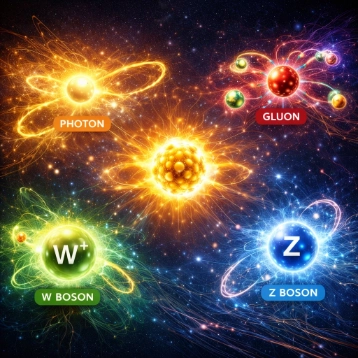
This vibrant space-themed image depicts bosons as luminous, color-coded energy nodes connected by flowing ribbons of light.
    A bright golden sphere at the center radiates outward like a field disturbance, while four surrounding orbs glow with distinct halos.
    The overall composition suggests how bosons act as field excitations, mediating interactions and organizing subatomic matter.
Quick Check: What Makes Bosons Different?
Bosons differ from fermions in an important quantum way. Fermions obey the Pauli exclusion principle, but bosons can share the same quantum state.
Which statement best describes bosons?
A. Bosons are matter particles that must all occupy different quantum states.
B. Bosons have integer spin and can occupy the same quantum state.
C. Bosons are always made of three quarks.
D. Bosons cannot participate in quantum interactions.
B. Bosons have integer spin and can occupy the same quantum state.
C. Bosons are always made of three quarks.
D. Bosons cannot participate in quantum interactions.
The correct answer is B. Bosons have integer spin and can share the same quantum state. This property helps explain phenomena such as laser light, Bose-Einstein condensation, and the role of bosons in force mediation.
1. Particle Physics Learning Pathway
Explore how bosons function within the broader framework of modern physics. These connected topics show how forces arise, how matter responds, and how particle interactions are organised into a unified theoretical structure.
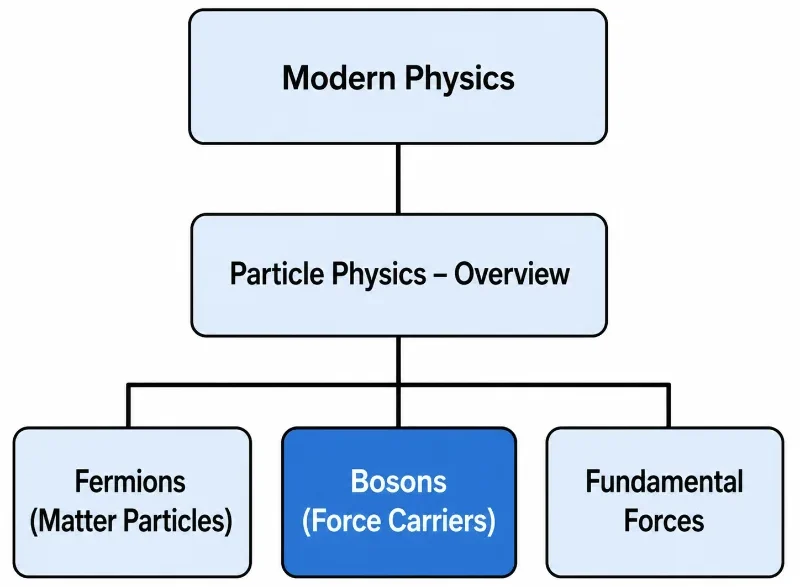
Structural navigation breakdown for Particle Physics.
    Framework → Modern Physics broad quantum field theory.
    Carrier → Bosons as force mediators.
    Interaction → Fundamental Forces.
    Matter → Fermions.
    System → Full Standard Model integration.
Modern Physics
Provides the field-based perspective where forces emerge from interactions, and particles are understood as excitations of underlying quantum fields.Bosons (Force Carriers)
Describes particles that transmit forces by mediating interactions between matter through exchange mechanisms.Fundamental Forces
Explains the four interaction types and how each force corresponds to specific carrier particles.Fermions (Matter Particles)
Shows how matter particles interact through bosons, forming structures and processes that define the physical world.Particle Physics – Overview
Integrates bosons and fermions into a unified framework describing particle interactions and field behavior.2. Fundamental Bosons and Their Roles
1. Photon (γ) – Mediator of the Electromagnetic Force
- Properties: Spin = 1, Mass = 0, Electric Charge = 0, Speed = c (3.0 × 10⁸ m/s).
- Function: Force carrier for the electromagnetic force acting on electrically charged particles, responsible for light, electricity, magnetism, and chemical bonding.
- Range: Infinite range due to zero rest mass.
- Key Domains: Light and Optics, Electricity and Magnetism, and Quantum Electrodynamics (QED).
2. W and Z Bosons – Mediators of the Weak Nuclear Force
- Properties: Spin = 1, Mass: W ≈ 80.4 GeV/c2, Z ≈ 91.2 GeV/c2. Charges: W+, W−, and neutral Z0.
- Function: Governs radioactive beta decay, quark flavor transitions, and stellar hydrogen fusion steps.
- Range: Extremely short-range (≈ 10−18 meters) owing to large boson masses.
3. Gluons (g) – Mediators of the Strong Nuclear Force
- Properties: Spin = 1, Mass = 0, Electric Charge = 0, carries Color Charge (8 varieties).
- Function: Binds quarks into hadrons (protons, neutrons) via Quantum Chromodynamics (QCD).
- Unique Behavior: Self-interacting gauge bosons leading to color confinement and asymptotic freedom.
4. Higgs Boson (H0) – Scalar Field & Mass Generation
- Properties: Spin = 0 (scalar), Mass ≈ 125 GeV/c2, Electric Charge = 0.
- Function: Excitation of the omnipresent scalar Higgs field. Elementary fermions and electroweak gauge bosons acquire rest mass through spontaneous symmetry breaking upon interacting with this field.
5. Graviton (Hypothetical) – Quantum Carrier of Gravity
- Properties (Theoretical): Spin = 2 (tensor), Mass = 0, Electric Charge = 0.
- Function: Hypothesized force carrier mediating quantum gravity in string theory and loop quantum gravity models. Gravity is currently best described classically by Einstein’s General Relativity.
Concept Checks: Boson Interactions
Match the Boson to Its Primary Function:
1. Photon | 2. W/Z Bosons | 3. Gluon | 4. Higgs Boson
Photon = Electromagnetic mediation; W/Z = Weak interaction / beta decay; Gluon = Strong interaction / quark binding; Higgs = Scalar mass generation mechanism.
Why does the weak interaction have an extremely short range compared to electromagnetism?
W and Z bosons possess large rest masses (≈ 80–91 GeV/c2), restricting virtual exchange ranges via the uncertainty principle to ≈ 10−18 meters, whereas massless photons travel across infinite ranges.
3. Core Physics Principles: Bosons vs Fermions
Particles in physics are categorized into two fundamental statistical classes:
- Fermions (Half-Integer Spin 1/2, 3/2…): Matter constituents (quarks, electrons, neutrinos) that obey Fermi-Dirac statistics and the Pauli Exclusion Principle. No two identical fermions can occupy the same quantum state simultaneously, creating stable atomic shell structures.
- Bosons (Integer Spin 0, 1, 2…): Force mediators and scalar/tensor field quanta obeying Bose-Einstein statistics. Unrestricted by the exclusion principle, an arbitrary number of identical bosons can occupy the exact same quantum ground state, making laser coherence, superconductivity, and Bose-Einstein Condensates (BEC) possible.
Check Your Understanding: Carrier Identification
Which particle is the force carrier for electromagnetic interactions?
A. Photon
B. Gluon
C. W Boson
D. Graviton
B. Gluon
C. W Boson
D. Graviton
The correct answer is A. Photons are massless spin-1 gauge bosons that mediate electromagnetic forces between charged particles.
4. Mathematical Foundations: Quantum Exchange Mechanics
In Quantum Field Theory (QFT), static classical potential forces are described as dynamic exchanges of virtual gauge bosons between particles. The range R of an interaction mediated by a particle of rest mass m is estimated via Heisenberg’s uncertainty relation (ΔE · Δt ≥ ℏ / 2):
$$ R \approx \frac{\hbar}{m c} $$
For massless photons and gluons (m = 0), theoretical interaction potential range is infinite. For massive W/Z bosons (m ≈ 80–91 GeV/c2):
$$ R_{\text{weak}} \approx \frac{1.97 \times 10^{-17} \text{ eV}\cdot\text{m}}{80 \times 10^9 \text{ eV}} \approx 2.5 \times 10^{-18} \text{ m} $$
5. Practical Applications & Material Significance
Photon Applications
Enables optics, lasers, photovoltaic solar cells, fiber-optic telecommunications, wireless signal transmission, and medical diagnostic radiology.Gluon Mechanics & Energy
Binds nuclear matter; forms the fundamental energy source liberated during nuclear fission power generation and stellar nuclear fusion.Weak Bosons in Medicine
W/Z-mediated beta decays produce short-lived positron emitters (e.g., Fluorine-18) required for clinical PET cancer imaging.Bose-Einstein Condensates (BEC)
Exploits the state-sharing property of composite bosons at microkelvin temperatures to engineer ultra-precise atomic clocks and quantum sensors.6. Key Terms Glossary
- Boson
- A particle with integer spin (0, 1, 2…) that obeys Bose-Einstein statistics and does not conform to the Pauli Exclusion Principle.
- Gauge Boson
- Vector bosons (spin-1) arising from gauge symmetries in quantum field theories that mediate fundamental physical interactions.
- Photon
- The massless spin-1 gauge boson mediating the electromagnetic force.
- Gluon
- The massless spin-1 force carrier of the strong interaction in QCD, carrying color charge.
- Higgs Field
- A universal scalar quantum field whose vacuum expectation value generates rest mass for fundamental particles.
- Virtual Particle
- A transient field excitation occurring during interaction vertex exchanges, existing off rest-mass shell within limits permitted by energy-time uncertainty.
7. Frequently Asked Questions
What are bosons in particle physics?
In particle physics, bosons are particles with integer spin (0, 1, 2, …) that follow Bose–Einstein statistics. Many bosons act as force carriers, mediating fundamental interactions between matter particles.
How do bosons differ from fermions?
Fermions have half-integer spin and obey the Pauli exclusion principle, prohibiting state sharing. Bosons have integer spin and do not obey exclusion, allowing multiple bosons to share identical quantum states.
What does it mean to call a boson a “force carrier”?
Calling a boson a force carrier means it mediates momentum and energy exchange between matter fields, creating what is macroscopically perceived as a force.
Which bosons carry the electromagnetic, weak, and strong forces?
The electromagnetic force is carried by photons, the weak force by W+, W−, and Z0 bosons, and the strong force by eight gluon species.
What is the Higgs boson and what role does it play?
The Higgs boson is a scalar particle associated with the scalar Higgs field. Interaction with this field generates non-zero rest mass for electroweak bosons and charged fermions.
8. Assessment Exercises
Part 1: Review Questions
Q1. What quantum statistical rules govern bosons?
Answer: Bosons obey Bose-Einstein statistics, allowing an arbitrary count of identical integer-spin particles to occupy the same quantum energy state.
Q2. How do W and Z bosons differ from photons and gluons?
Answer: W and Z bosons have large rest masses (≈ 80–91 GeV/c2) and mediate short-range weak forces, whereas photons and gluons are rest-massless.
Q3. What property prevents gluons from mediating long-range forces despite being massless?
Answer: Gluons carry color charge themselves and undergo self-interactions, leading to color confinement that restricts strong interactions to hadronic dimensions (≈ 1 fm).
Part 2: Applied & Thought-Provoking Scenarios
Q1. What implications would the confirmed detection of a spin-2 graviton have for theoretical physics?
Answer: Confirming a spin-2 massless graviton would validate the quantization of spacetime, bridging General Relativity and QFT into a unified quantum gravity model.
Q2. How does boson state-sharing enable practical technologies like lasers?
Answer: Stimulated photon emission forces macroscopic counts of photons into identical energy, phase, and polarization quantum states, producing monochromatic coherent laser beams.
Part 3: Numerical Problems with Step-by-Step Worked Solutions
Problem 1: Photon Energy Calculation
Calculate the energy in eV of an optical photon with wavelength λ = 500 nm. (Use hc = 1240 eV·nm).
Solution:
$$ E = \frac{hc}{\lambda} = \frac{1240 \text{ eV nm}}{500 \text{ nm}} = 2.48 \text{ eV} $$
Answer: 2.48 eV.
Problem 2: W Boson Mass Conversion to Kilograms
Convert the mass of a W boson (mW = 80.379 GeV/c2) into kilograms. (1 GeV/c2 = 1.783 × 10⁻²⁷ kg).
Solution:
$$ m = 80.379 \times (1.783 \times 10^{-27} \text{ kg}) \approx 1.433 \times 10^{-25} \text{ kg} $$
Answer: 1.433 × 10⁻²⁵ kg.
Problem 3: Relativistic Energy of a Moving Boson
Calculate the total relativistic energy in GeV of a Higgs boson (rest mass 125 GeV/c2) moving at speed v = 0.9c.
Solution:
Calculate Lorentz factor γ:
$$ \gamma = \frac{1}{\sqrt{1 – (v/c)^2}} = \frac{1}{\sqrt{1 – 0.81}} = \frac{1}{\sqrt{0.19}} \approx 2.294 $$
Calculate total energy E:
$$ E = \gamma m_0 c^2 = 2.294 \times 125 \text{ GeV} \approx 286.8 \text{ GeV} $$
Answer: 286.8 GeV.
Problem 4: Decay Width from Lifetime
A short-lived heavy gauge boson has a mean lifetime τ = 3.3 × 10⁻²⁵ s. Estimate its decay energy width ΔE in GeV using ℏ = 6.582 × 10⁻¹⁶ eV·s.
Solution:
$$ \Delta E \approx \frac{\hbar}{\tau} = \frac{6.582 \times 10^{-16} \text{ eV s}}{3.3 \times 10^{-25} \text{ s}} \approx 1.994 \times 10^9 \text{ eV} \approx 2.0 \text{ GeV} $$
Answer: 2.0 GeV.
History, Challenges, and Future Prospects
The discovery of force-carrying bosons validated quantum field theory during the 20th and 21st centuries.
Historical Milestones: Albert Einstein postulated the light quantum (photon) in 1905. Satoshi Watanabe and Satyendra Nath Bose formulated Bose statistics in 1924. Sheldon Glashow, Steven Weinberg, and Abdus Salam predicted electroweak W/Z gauge bosons in the 1960s, discovered at CERN’s SppS collider by Carlo Rubbia and Simon van der Meer in 1983. The Higgs boson was confirmed by LHC ATLAS and CMS in 2012.
Current Challenges: Detecting hypothetical Dark Photon candidate states, probing Higgs self-coupling ratios to establish electroweak vacuum stability, and observing a quantized graviton signal.
Future Frontiers: High-Luminosity LHC precision Higgs factories, search for heavy Z’ gauge bosons at the proposed 100 km Future Circular Collider (FCC), and testing axion-like scalar boson dark matter couplings.
Cluster Navigation & Academic References
Related Modern Physics Topics
- Modern Physics Hub — Primary portal for non-classical physics domains.
- Particle Physics Overview — Standard Model structure, elementary particles, and colliders.
- Fundamental Forces — Strong, weak, electromagnetic, and gravitational interactions.
- Fermions – Matter Particles — Quarks, leptons, spin-statistics, and Pauli exclusion.
- Quantum Field Theory — Quantized gauge fields and operator formalism.
External References & Recommended Reading
- The Standard Model – CERN — Official guide to fundamental particles and interactions.
- ATLAS Experiment: The Higgs Boson Discovery — Documentation of scalar boson discovery at CERN.
- Nobel Prize in Physics 1984 – Discovery of W and Z Bosons — Nobel Foundation release.
Archived version: This learning resource is archived on Zenodo at https://zenodo.org/records/20570351.
Suggested citation: Gan, J. (2026). Bosons (Force Carriers): Gauge Particles, Field Interactions, and Mass Generation. Prep4Uni.online. Zenodo. https://doi.org/10.5281/zenodo.20570351