

Key Idea: Atoms Are Not Tiny Solar Systems
What Atomic Physics Really Is
Key Idea: Atoms Speak Through Light
Why Study Atomic Physics
Exploring the Structure and Behaviour of Atoms
Atomic physics helps students understand how atoms are organised and why their internal structure matters. It focuses especially on the behaviour of electrons around the nucleus, the development of atomic models, and the way atoms move between energy states. By studying these ideas, students gain a clearer picture of how matter is built at the microscopic level. This foundation is essential for later study in quantum mechanics, chemistry, materials science, and modern technology.
Understanding Quantum Models and Spectral Analysis
Atomic physics introduces students to Bohr’s model, quantum energy levels, electron transitions, and the formation of spectral lines. These concepts show that atoms absorb and emit energy in precise amounts, rather than in a continuous way. Spectral analysis is especially important because it allows scientists to identify elements, study stars, analyse materials, and investigate physical conditions that cannot be observed directly. In this way, atomic spectra become a kind of hidden language through which atoms reveal their structure.
Developing Experimental and Measurement Skills
Atomic physics also gives students practical insight into how scientists investigate very small systems. Techniques such as spectroscopy, laser-based measurement, electron-beam experiments, and precision timing are used to probe atomic structure and behaviour. These methods strengthen a student’s ability to connect theory with evidence, which is one of the most important habits in science. They also prepare students for laboratory work, research, engineering applications, and technology development.
Connecting Atomic Physics to Modern Technology
Many modern technologies depend on atomic physics. Lasers, atomic clocks, spectroscopy, quantum sensors, semiconductors, medical imaging systems, and precision instruments all rely on atomic-level behaviour. For example, atomic clocks support accurate GPS timing, while lasers are used in communication, medicine, manufacturing, and scientific research. Studying atomic physics therefore helps students see how abstract quantum ideas become practical tools that shape everyday life.
Building a Bridge to Quantum and Molecular Science
Atomic physics provides a natural bridge to quantum mechanics, molecular physics, condensed matter physics, chemistry, and materials science. Once students understand how electrons occupy energy levels and interact with radiation, they are better prepared to understand bonding, molecular structure, solids, semiconductors, and quantum technologies. This makes atomic physics a powerful gateway subject for students who want to enter science, engineering, medicine, computing, or advanced technology fields.
Quick Check: Why Is Atomic Physics a Gateway Subject?
Core Topics in Atomic Physics
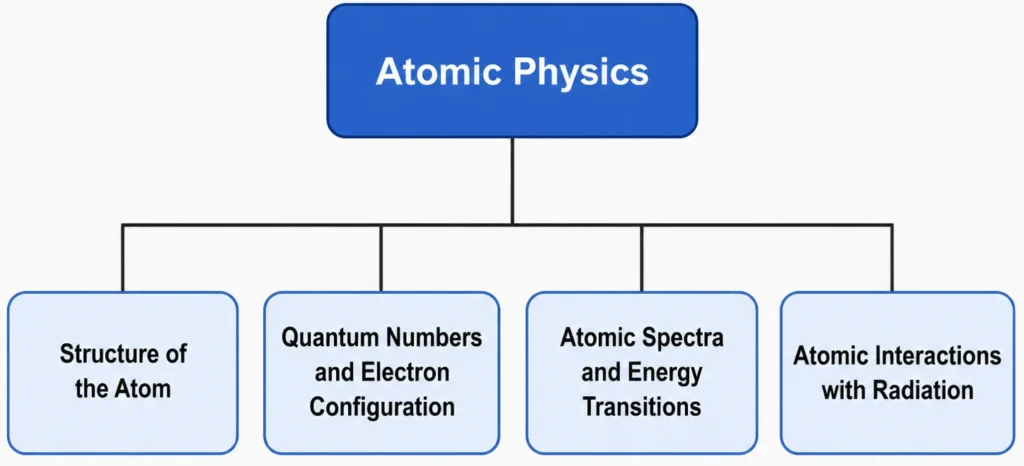
Atomic Physics
Provides the framework for understanding atomic structure, electron behaviour, and interactions with radiation.Structure of the Atom
Explains how atoms are organised, including the nucleus, electron orbitals, and the evolution from classical to quantum models.Quantum Numbers and Electron Configuration
Describes how electrons are arranged within atoms using quantum numbers and how this determines chemical and physical properties.Atomic Spectra and Energy Transitions
Explores how electrons move between energy levels, producing emission and absorption spectra that reveal atomic structure.Atomic Interactions with Radiation
Examines how atoms absorb, emit, and interact with photons through processes such as excitation, ionisation, and stimulated emission.Quick Check: What Holds the Atomic Physics Cluster Together?
Atomic Physics within Modern Physics
Understanding Matter at Its Core
Explains how atomic structure determines the behaviour of materials and elements.Linking Theory to Observation
Shows how quantum ideas produce measurable effects such as spectral lines and energy transitions.Foundation for Advanced Topics
Prepares students for quantum mechanics, condensed matter physics, and photonics.Relevance to Real Technologies
Connects directly to lasers, spectroscopy, and electronic devices used in everyday life.Fundamental Concepts in Atomic Physics
Structure of the Atom
- Nucleus: Dense core composed of protons with positive charge and neutrons with neutral charge.
- Electron Cloud: Surrounds the nucleus and contains negatively charged electrons occupying discrete energy levels.
- Atomic Number: Z, the number of protons, which defines the chemical element.
- Mass Number: A, the total number of protons and neutrons.
- Introduced quantised energy levels for electrons, helping to explain atomic spectra.
- Electrons were treated as occupying fixed orbits around the nucleus without continuously radiating energy.
- Electrons could move between orbits by absorbing or emitting photons with specific energies.
- Replaced Bohr’s fixed-orbit picture with a probabilistic framework.
- Electrons occupy orbitals, which describe regions of high probability rather than exact paths.
- These orbitals are described using quantum numbers rather than classical circular orbits.

Quantum Numbers and Electron Configuration
- Principal Quantum Number: n, which indicates the main energy level or shell, where n = 1, 2, 3, …
- Angular Momentum Quantum Number: l, which indicates the subshell and helps determine the shape of the orbital. Common subshells are s, p, d, and f.
- Magnetic Quantum Number: ml, which indicates the orientation of the orbital in space.
- Spin Quantum Number: ms, which indicates the direction of the electron’s spin, where ms = +0.5 or ms = −0.5.
- Electron configuration describes how electrons are distributed among orbitals.
- For example, the electron configuration of oxygen is:
Key Distinction: Atomic Physics vs Nuclear Physics
Key Topics in Atomic Physics
Atomic Spectra and Energy Levels
- Atomic Spectra: Unique patterns of light emitted or absorbed by atoms when electrons transition between energy levels.
- Emission Spectrum: Produced when electrons drop from higher to lower energy levels, emitting photons.
- Absorption Spectrum: Occurs when electrons absorb specific photon energies to jump to higher energy states.
- The hydrogen atom has the simplest atomic spectrum, with distinct spectral series such as the Lyman series in the ultraviolet region, the Balmer series in the visible region, and the Paschen series in the infrared region.
- The wavelengths of hydrogen spectral lines can be explained using the Rydberg formula:
Electron Transitions and Photon Emission
- Absorption: Electrons absorb photons when the photon energy matches the difference between two atomic energy levels:
- Emission: Electrons release energy as photons when dropping from higher energy levels to lower energy levels.
- Photon Energy: The energy of the emitted or absorbed photon is given by:
- Spontaneous Emission: Occurs naturally when an excited electron falls to a lower energy level without external stimulation.
- Stimulated Emission: Occurs when an incoming photon triggers an excited electron to fall to a lower energy level, emitting a second photon. This process is central to laser operation.
Ionisation and Atomic Collisions
- Ionisation: Removal of one or more electrons from an atom, forming an ion.
- First Ionisation Energy: Energy required to remove the first electron from an atom.
- Multiple Ionisations: Higher energies are usually required to remove subsequent electrons.
- Atomic Collisions: Interactions between atoms and particles, such as electrons, photons, or ions.
- Elastic Collisions: Kinetic energy is conserved.
- Inelastic Collisions: Energy is transferred, causing excitation or ionisation.
Zeeman and Stark Effects
- Zeeman Effect: Splitting of atomic spectral lines in a magnetic field due to interactions between the magnetic field and the magnetic properties of electrons.
- Stark Effect: Splitting of atomic spectral lines in an electric field due to the distortion of atomic energy levels and electron orbitals.
Modern Relevance of Atomic Physics
Spectroscopy and Material Identification
Atomic spectra allow scientists to identify elements in stars, gases, and materials by analysing their characteristic emission and absorption lines.Laser Technology
Stimulated emission in atoms enables lasers, which are used in communication, medicine, manufacturing, and scientific research.Quantum-Based Sensors
Atomic transitions provide highly precise measurements used in atomic clocks, navigation systems, and advanced sensing technologies.Electronics and Materials
Understanding electron behaviour in atoms underpins semiconductors, enabling modern computing and electronic devices.Applications of Atomic Physics
Spectroscopy and Element Identification
- Concept: Each element has unique energy levels, producing characteristic emission and absorption spectra when electrons transition between states.
- Key Mechanisms:
- Electron transitions between quantised energy levels.
- Emission and absorption of photons with specific wavelengths.
- Formation of discrete spectral lines, such as the hydrogen Balmer series.
- Applications:
- Identifying elements in stars and galaxies through astronomical spectroscopy.
- Analysing substances using absorption, emission, and fluorescence spectroscopy.
- Detecting pollutants and trace elements in air, water, and environmental samples.
- Studying biological samples in medical and biochemical analysis.
Laser Technology
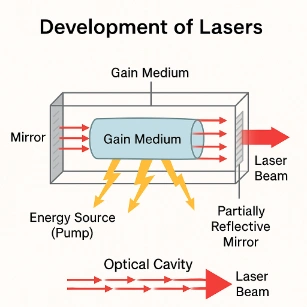
- Concept: Lasers are based on controlled atomic or electronic transitions, where stimulated emission produces coherent light.
- Meaning of Laser: Laser stands for Light Amplification by Stimulated Emission of Radiation.
- Key Mechanisms:
- Population inversion, where more particles occupy excited states than lower energy states.
- Stimulated emission, where incoming photons trigger the emission of additional photons with the same phase, frequency, and direction.
- Optical amplification within a resonant cavity.
- Main Components:
- Gain Medium: Provides the atomic, molecular, or solid-state system where light amplification occurs, such as ruby, gas, or semiconductor materials.
- Energy Source or Pump: Supplies energy to excite particles into higher energy states.
- Optical Cavity: Uses mirrors to reflect photons back and forth, stimulating further emission and producing an amplified beam.
- Applications:
- Fibre-optic communication systems for high-speed data transmission.
- Laser surgery, including eye surgery and precision medical treatments.
- Industrial cutting, welding, 3D printing, and material processing.
- Scientific instruments such as interferometers, spectrometers, and precision measurement systems.
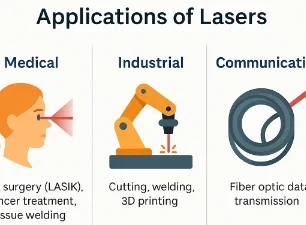 Applications of Lasers: Precision Tools in Medicine, Industry, and Communication[/caption>
Atomic Clocks and Precision Timekeeping
- Concept: Atomic clocks use highly stable atomic transitions as frequency standards.
- Key Mechanisms:
- Microwave or optical transitions between atomic energy levels, such as those in cesium or rubidium atoms.
- Resonance frequencies that remain extremely stable under controlled conditions.
- Precise comparison between the atomic transition frequency and an electronic oscillator.
- Applications:
- Global Positioning System (GPS), which requires extremely precise timing.
- Telecommunication network synchronisation.
- Scientific measurements of fundamental constants and relativistic effects.
- Precision navigation and timing systems used in research, engineering, and defence technologies.
Quantum Sensors and Precision Measurement
- Concept: Atomic systems respond sensitively to electric fields, magnetic fields, gravity, acceleration, and radiation, making them powerful tools for precise measurement.
- Key Mechanisms:
- Changes in atomic energy levels caused by electric and magnetic fields, including the Stark and Zeeman effects.
- Interactions between atoms and electromagnetic radiation.
- Use of atomic coherence, interference, and resonance for highly sensitive detection.
- Applications:
- Magnetometers for detecting weak magnetic fields.
- Gravitational sensors for geophysical exploration.
- Precision navigation systems beyond traditional GPS.
- Scientific instruments used in fundamental physics experiments.
Medical Diagnostics and Imaging
- Concept: Atomic and molecular interactions with radiation allow scientists and doctors to probe matter without direct contact.
- Key Mechanisms:
- Absorption and emission of electromagnetic radiation by atoms and molecules in tissues.
- Resonance effects used in imaging and diagnostic systems.
- Spectroscopic analysis of biological samples.
- Applications:
- Medical imaging techniques that rely on controlled interactions between matter and radiation.
- Spectroscopic methods for analysing blood, tissue, and biochemical samples.
- Laser-based diagnostic and treatment tools.
- Radiation-based diagnostic techniques used in modern healthcare.
Lighting and Display Technologies
- Concept: Light emission in many devices arises from atomic, molecular, or electronic transitions.
- Key Mechanisms:
- Electron excitation and photon emission in gases, solids, and semiconductor materials.
- Discrete energy transitions producing characteristic colours.
- Control of energy gaps and emission wavelengths in modern lighting materials.
- Applications:
- Fluorescent lighting systems.
- LED lighting and display technologies.
- Gas discharge lamps and neon lighting.
- Display screens, monitors, and optical indicators.
Quantum Computing and Quantum Information
- Concept: Atomic physics provides some of the most precise platforms for controlling quantum states, making it important for quantum computing and quantum information science.
- Key Mechanisms:
- Use of superposition and entanglement in carefully controlled atomic systems.
- Trapped ions and neutral atoms used as quantum bits, or qubits.
- Laser control of atomic states for quantum gates, measurement, and information processing.
- Applications:
- Quantum computing platforms based on trapped ions and neutral atoms.
- Quantum simulation of complex physical systems.
- Quantum communication and information processing.
- Future technologies requiring precise control of individual atoms and quantum states.
Case Studies in Atomic Physics
Case Study 1: Identifying Elements in Stars Using Atomic Spectra
Case Study 2: Laser Communication and Fibre Optics
Case Study 3: Atomic Clocks and GPS Accuracy
Pause and Think: What Can Light Reveal?
Exploring Further in Atomic Physics
Fine and Hyperfine Structure
Explores subtle splitting of atomic energy levels caused by electron spin, orbital motion, magnetic interactions, and nuclear effects. These small shifts help explain detailed spectral patterns and support precision spectroscopy.Ultra-Cold Atomic Systems
Studies atoms cooled close to absolute zero, where quantum behaviour becomes visible on larger scales. These systems are used to investigate Bose-Einstein condensation, quantum gases, and collective atomic behaviour.Rydberg Atoms
Examines highly excited atoms whose outer electrons occupy very large orbits. Rydberg atoms are useful for studying strong atomic interactions, quantum control, and possible quantum information applications.Atomic Interferometry
Uses the wave-like nature of atoms to make extremely sensitive measurements of acceleration, gravity, rotation, and fundamental constants. It shows how atoms can behave like precision measuring instruments.Precision Spectroscopy
Investigates atomic transitions with extremely high accuracy. Precision spectroscopy helps test quantum theory, measure constants, improve atomic clocks, and search for tiny deviations from established physics.Atom-Light Interaction
Studies how atoms absorb, emit, scatter, and respond to light. This topic supports lasers, optical trapping, quantum optics, cloud cooling techniques, and many modern experimental methods.Concept Integration: From Atoms to Quantum Technologies
Frequently Asked Questions: Atomic Physics
1. What is atomic physics?
Atomic physics is the branch of modern physics that studies the structure and behaviour of isolated atoms, especially the arrangement and motion of electrons around the nucleus. It focuses on topics such as energy levels, spectra, ionisation, and how atoms interact with light and external fields.2. How is atomic physics different from nuclear physics?
Atomic physics concentrates on the electrons bound to an atomic nucleus and how they determine the atom’s energy levels, spectra, and chemical behaviour. Nuclear physics, by contrast, studies the protons and neutrons inside the nucleus itself, along with nuclear forces, radioactivity, and nuclear reactions. In short, atomic physics is mainly about electrons, while nuclear physics is mainly about the nucleus.3. What is meant by atomic energy levels and electron shells?
Atomic energy levels are the discrete allowed energies that an electron can have when it is bound to an atom. Electrons occupy shells and subshells associated with these levels, rather than having a continuous range of energies. When an electron moves between energy levels, the atom must absorb or emit a photon with an energy equal to the difference between the levels.4. What is an atomic spectrum and why is it discrete?
An atomic spectrum is the set of wavelengths of light that an atom emits or absorbs when electrons make transitions between quantised energy levels. Because these levels are discrete rather than continuous, only certain photon energies are allowed, leading to a series of sharp lines in the spectrum rather than a smooth band. Each element has a unique line spectrum that acts like a fingerprint.5. How did the Bohr model contribute to atomic physics?
The Bohr model proposed that electrons orbit the nucleus in specific allowed orbits with quantised angular momentum, and that radiation is emitted or absorbed only when an electron jumps between these orbits. It successfully explained the main spectral lines of hydrogen and introduced the idea of quantised energy levels, paving the way for modern quantum mechanics, even though later models replaced its planetary picture.6. How does quantum mechanics describe electrons in atoms?
Quantum mechanics describes electrons in atoms using wavefunctions and probability distributions rather than fixed orbits. Solutions of the Schrödinger equation for the hydrogen atom lead to orbitals, which are regions of space where an electron is likely to be found. Quantum numbers label these orbitals and determine properties such as energy, angular momentum, and spin orientation.7. What are quantum numbers and what do they represent in atomic physics?
Quantum numbers are a set of integers and half-integers that label the allowed quantum states of an electron in an atom. The principal quantum number relates to energy and shell, the orbital quantum number to the shape of the orbital, the magnetic quantum number to orientation, and the spin quantum number to the electron’s intrinsic spin. Together, they specify the electron configuration and help explain the structure of the periodic table.8. What is ionisation energy and why is it important?
Ionisation energy is the minimum energy required to remove an electron completely from a gaseous atom in its ground state. It reflects how strongly the electron is bound to the nucleus and varies systematically across the periodic table. Ionisation energies are crucial for understanding chemical reactivity, plasma formation, and the conditions in stellar atmospheres and laboratory plasmas.9. How do external electric and magnetic fields affect atomic energy levels?
External electric fields (Stark effect) and magnetic fields (Zeeman effect) can shift and split atomic energy levels. These perturbations change the energies of the electron states, leading to small shifts or splittings in spectral lines. Studying these effects allows physicists to probe fine details of atomic structure, measure field strengths, and test quantum theories with high precision.10. What is fine structure and hyperfine structure in atomic spectra?
Fine structure refers to small splittings of atomic energy levels caused by relativistic corrections and spin–orbit coupling, where the electron’s spin interacts with its orbital motion. Hyperfine structure arises from interactions between the magnetic moments of the nucleus and the electrons. These subtle effects produce additional closely spaced lines in atomic spectra and are important in precision spectroscopy and atomic clocks.11. Where is atomic physics applied in modern technology?
Atomic physics underlies technologies such as gas discharge lamps, lasers, atomic clocks, and many types of sensors. It is central to spectroscopy used in chemical analysis, astronomy, and environmental monitoring. Atomic physics principles are also vital in plasma devices, fusion research, semiconductor processing, and emerging quantum technologies based on trapped ions and neutral atoms.12. Why should students learn atomic physics before university?
Learning atomic physics before university introduces students to the quantum picture of matter in a concrete, visual way. It connects the periodic table, chemical bonding, and spectral lines to underlying physical principles, and prepares students for more advanced courses in quantum mechanics, solid-state physics, and spectroscopy. It also shows how abstract quantum ideas translate into real devices and measurements.Conclusion on Atomic Physics
Reflection Question
Atomic Physics: Review Questions and Answers
1. What is atomic physics and why is it a crucial branch of modern physics?
2. What are the key models used to describe atomic structure?
3. How does the Bohr model explain electron transitions and spectral lines?
4. What is an emission spectrum and how does it relate to atomic structure?
5. How does spectroscopy help scientists study atoms?
6. What role did Rutherford’s experiment play in atomic physics?
7. Why is energy quantisation important in atomic physics?
8. What is the significance of electron wavefunctions in the quantum mechanical model?
9. How does atomic physics contribute to modern technology?
10. What are some current challenges or open questions in atomic physics?
Atomic Physics: Thought-Provoking Questions and Answers
1. How might advances in quantum computing transform the study of atomic physics?
2. How could a deeper understanding of electron correlation improve atomic models?
3. How can modern spectroscopic techniques explore exotic atomic states?
4. Why are relativistic effects important in some areas of atomic physics?
5. How might emerging experimental techniques reshape our understanding of electron dynamics?
6. How can atomic physics contribute to future precision technologies?
7. How might atomic physics contribute to medical imaging and treatment?
8. What role does atomic physics play in understanding the universe?
9. How could control of atomic states improve data storage and information processing?
10. What challenges arise when measuring electron positions and energies with high precision?
11. How might new discoveries in atomic physics alter our understanding of chemical bonding?
12. How can interdisciplinary research involving atomic physics lead to new technologies?
Comprehensive Numerical Problems with Solutions
Hydrogen Energy Transition \((n=3 \to n=2)\)
Question: In a hydrogen atom, the energy difference between the \(n=3\) and \(n=2\) levels is approximately 1.89 eV. Calculate the wavelength of the photon emitted during this transition.Solution:Use the photon energy-to-wavelength expression:$$E = \frac{hc}{\lambda} \Rightarrow \lambda = \frac{hc}{E}$$Convert the initial photon energy level from electronvolts to standard Joules:$$E = 1.89 \times 1.602 \times 10^{-19}\,\text{J/eV} \approx 3.0278 \times 10^{-19}\,\text{J}$$Substitute constants (\(h = 6.626 \times 10^{-34}\,\text{J}\cdot\text{s}\), \(c = 3.00 \times 10^8\,\text{m/s}\)):$$\lambda = \frac{(6.626 \times 10^{-34}\,\text{J}\cdot\text{s}) \times (3.00 \times 10^8\,\text{m/s})}{3.0278 \times 10^{-19}\,\text{J}} \approx 6.5652 \times 10^{-7}\,\text{m}$$Scale meters into nanometers (\(\text{nm}\)):$$6.5652 \times 10^{-7}\,\text{m} \times 10^9\,\text{nm/m} \approx 656.5\,\text{nm}$$Answer: The emitted photon wavelength is approximately 656 nm.Bohr Radius for \(n=2\)
Question: Using the Bohr model, calculate the radius of the \(n=2\) orbit if the ground state radius evaluates precisely to \(r_1 = 0.0529\,\text{nm}\).Solution:The structural radius of atomic orbits scales directly with the square of the principal quantum integer:$$r_n = n^2 r_1$$For the second orbital track layer, substitute \(n=2\):$$r_2 = 2^2 \times 0.0529\,\text{nm} = 4 \times 0.0529\,\text{nm} = 0.2116\,\text{nm}$$Answer: The second orbit radius is exactly 0.2116 nm.Ionisation Energy of Hydrogen
Question: Determine the absolute work energy required to trigger total atomic ionisation for a ground-state hydrogen system.Solution:Ionisation measures the required boundary energy to lift a bound electron out of its ground containment shell (\(n=1\)) to an un-bound reference state at infinity (\(n=\infty\)), where trailing potential energy reaches zero.The structural energy function defines the ground track state as:$$E_1 = -13.6\,\text{eV}$$$$\text{Ionisation Energy} = E_{\infty} – E_1 = 0 – (-13.6\,\text{eV}) = +13.6\,\text{eV}$$Answer: The required ground ionisation energy is exactly 13.6 eV.Balmer Line Transition Analysis
Question: A hydrogen atomic light emission track registers a sharp spectral line at 486 nm. Identify the initial and final principal quantum levels driving this transformation.Solution:1. Spectral emissions landing within the visible band form the Balmer series, fixing the lower ground transition terminal at \(n_1 = 2\).2. Deploy the foundational inverse Rydberg wave expression:$$\frac{1}{\lambda} = R_H \left(\frac{1}{2^2} – \frac{1}{n_2^2}\right)$$A recorded wavelength of 486 nm maps strictly to the Balmer H-\(\beta\) spectral line profile, which originates from an initial high state:$$n_2 = 4 \to n_1 = 2$$Answer: The line represents a transition from \(n=4\) to \(n=2\).Energy of a High-Frequency Ultraviolet Photon
Question: Calculate the total quantum energy value carried by a single Lyman-series photon tracking at a wavelength of 121.6 nm.Solution:Apply the standard electromagnetic energy mapping formula:$$E = \frac{hc}{\lambda}$$Convert wavelength metrics into standard meters (\(121.6\,\text{nm} = 121.6 \times 10^{-9}\,\text{m}\)):$$E = \frac{(6.626 \times 10^{-34}\,\text{J}\cdot\text{s}) \times (3.00 \times 10^8\,\text{m/s})}{121.6 \times 10^{-9}\,\text{m}} \approx 1.6347 \times 10^{-18}\,\text{J}$$Convert the absolute Joules parameter back to electronvolts:$$E = \frac{1.6347 \times 10^{-18}\,\text{J}}{1.602 \times 10^{-19}\,\text{J/eV}} \approx 10.204\,\text{eV}$$Answer: The total photon energy carries a value of approximately 10.2 eV.Ground-State Energy of a Hydrogen-Like Lithium Ion \((Z=3)\)
Question: Find the absolute ground-state bound energy level for a hydrogen-like ion holding an atomic number parameter of \(Z=3\).Solution:The energy matrix equation for single-electron ions scales with the square of the proton count core charge:$$E_n = -13.6 \times \frac{Z^2}{n^2}\text{ eV}$$For the absolute ground state layer, substitute \(n=1\) and \(Z=3\):$$E_1 = -13.6 \times \frac{3^2}{1^2} = -13.6 \times 9 = -122.4\,\text{eV}$$Answer: The net ground-state configuration energy measures exactly −122.4 eV.Energy Released During Higher Shell Transitions
Question: An electron drops down from quantum shell \(n=5\) straight to level \(n=3\). Calculate the net energy released.Solution:1. Compute the separate energy parameters for both quantum coordinates:$$E_5 = \frac{-13.6}{5^2} = \frac{-13.6}{25} = -0.544\,\text{eV}$$$$E_3 = \frac{-13.6}{3^2} = \frac{-13.6}{9} \approx -1.511\,\text{eV}$$2. Determine the net energy difference parameter freed via radiation discharge:$$\Delta E = E_5 – E_3 = -0.544\,\text{eV} – (-1.511\,\text{eV}) = 0.967\,\text{eV}$$Answer: The total energy released during the drop measures approximately 0.97 eV.Photon Absorption and Over-Excitation Evaluation
Question: A hydrogen atom sitting in excited state \(n=2\) absorbs an incoming high-energy photon tracking at 12.09 eV. Evaluate the final state of the electron.Solution:1. Identify the baseline energy capacity at the starting layer (\(n=2\)):$$E_2 = \frac{-13.6}{2^2} = -3.40\,\text{eV}$$2. Combine the base energy with the incoming tracking photon absorption value:$$E_{\text{final}} = E_2 + E_{\text{photon}} = -3.40\,\text{eV} + 12.09\,\text{eV} = +8.69\,\text{eV}$$3. Because the resulting energy profile crosses past zero into a positive net state, the electron breaks free from structural electrostatic containment. Ionisation is achieved, and the positive residue tracks as free kinetic energy:$$K_e = 8.69\,\text{eV}$$Answer: Structural ionisation occurs, freeing the electron with 8.69 eV of kinetic energy.Photon Oscillation Frequency Calculation
Question: An emission transition releases a net quantum energy package measuring 1.89 eV. Calculate the wave oscillation frequency.Solution:1. Convert the input transition value into SI standard energy units:$$E = 1.89 \times 1.602 \times 10^{-19}\,\text{J/eV} \approx 3.0278 \times 10^{-19}\,\text{J}$$2. Apply the foundational Planck relationship to isolate the frequency variable (\(\nu\)):$$E = h\nu \Rightarrow \nu = \frac{E}{h}$$$$\nu = \frac{3.0278 \times 10^{-19}\,\text{J}}{6.626 \times 10^{-34}\,\text{J}\cdot\text{s}} \approx 4.5696 \times 10^{14}\,\text{Hz}$$Answer: The wave oscillation frequency indexes at approximately 4.57 × 10¹⁴ Hz.Balmer Wave Series Limit Analysis
Question: Calculate the theoretical minimum wavelength threshold tracking inside the visible Balmer emission series (\(n_1 = 2\)), matching an initial drop originating from infinity (\(n_2 \to \infty\)).Solution:1. Deploy the series limit constraint inside the Rydberg expression, forcing the higher reciprocal boundary to zero:$$\frac{1}{\lambda_{\text{limit}}} = R_H \left(\frac{1}{2^2} – \frac{1}{\infty^2}\right) = R_H \left(\frac{1}{4} – 0\right) = \frac{R_H}{4}$$2. Isolate the tracking wavelength parameter using the baseline constant (\(R_H \approx 1.097 \times 10^7\,\text{m}^{-1}\)):$$\lambda_{\text{limit}} = \frac{4}{R_H} = \frac{4}{1.097 \times 10^7\,\text{m}^{-1}} \approx 3.6463 \times 10^{-7}\,\text{m}$$$$\lambda_{\text{limit}} = 3.6463 \times 10^{-7}\,\text{m} \times 10^9\,\text{nm/m} \approx 364.6\,\text{nm}$$Answer: The series series-limit wavelength floor truncates precisely at 364.6 nm.Cascade Transition Array Pathway Verification
Question: An excited high-level electron drops down via a multi-step cascade line, emitting two unique photons sequentially to rest at terminal level \(n=2\). If the initial step releases a long infrared wave photon tracking at 1875 nm, resolve the step-by-step path coordinates.Solution:1. A wavelength parameter measuring 1875 nm maps directly to the first tracking line inside the Paschen infrared series, fixing its terminal lower layer index at \(n = 3\). This confirms the first cascade branch must follow a \(n=4 \to n=3\) path layout.2. To finish the array requirements and rest at the targeted endpoint (\(n=2\)), the remaining drop must trace directly from the intermediate coordinate:$$\text{Step 1:} \quad n=4 \to n=3 \qquad \text{Step 2:} \quad n=3 \to n=2$$Answer: The cascading transitions trace exactly through the path array \(4 \to 3 \to 2\).Helium Ion Emission Transition \((Z=2,\; n=3 \to n=2)\)
Question: Calculate the emitted light wavelength generated by an electron dropping along the \(n=3 \to n=2\) orbital tracks inside a single-electron Helium ion holding core metric \(Z=2\).Solution:1. Set up the custom scaling factor expression for hydrogen-like ions:$$\Delta E = 13.6 \times Z^2 \times \left(\frac{1}{2^2} – \frac{1}{3^2}\right)\text{ eV}$$Substitute the Helium charge metric (\(Z=2\)):$$\Delta E = 13.6 \times 4 \times \left(\frac{1}{4} – \frac{1}{9}\right) = 54.4 \times \frac{5}{36} \approx 7.5556\,\text{eV}$$2. Map the calculated energy packet to a localized tracking wavelength using conversion constant inputs (\(hc \approx 1240\,\text{eV}\cdot\text{nm}\)):$$\lambda = \frac{hc}{\Delta E} \approx \frac{1240\,\text{eV}\cdot\text{nm}}{7.5556\,\text{eV}} \approx 164.11\,\text{nm}$$Answer: The emitted light wavelength measures approximately 164.1 nm.
External References for Further Reading
- OpenStax Modern Physics: Atomic Frameworks — A comprehensive classroom look at the mathematical limits of the Bohr model and quantum configurations.
- NIST Atomic Spectroscopy Databases — Precision institutional data tracking tables for elemental emission spectra line coordinates.
- NASA Space Science: Star Specks and Signatures — Operational context detailing how satellite telescope sensors decrypt atomic absorption spectra.