Prepare for University Studies & Career Advancement
Quantum Field Theory
Quantum Field Theory, or QFT, is one of the deepest frameworks in Modern Physics. It brings together Quantum Mechanics and Relativity to explain particles, fields, and interactions at the most fundamental level. In this view, particles are not tiny solid objects moving through empty space. They are excitations of underlying fields that exist throughout spacetime.
This is a major shift in perspective. In earlier physics, a particle may be imagined as a small object with a position, mass, and motion. In QFT, the field comes first. An electron is an excitation of the electron field, a photon is an excitation of the electromagnetic field, and other particles arise from their own fields. What we call a “particle” is therefore a localised expression of something more continuous and widespread.
QFT builds on ideas students first meet in Atomic Physics and quantum mechanics, such as energy levels, Wave-Particle Duality, Quantum Superposition, and the Heisenberg Uncertainty Principle. However, it goes further by allowing particles to be created, destroyed, and exchanged during interactions. This makes it essential for understanding high-energy processes where ordinary quantum mechanics is no longer enough.
The most important application of QFT is the Standard Model of Particle Physics. This framework describes Fermions as matter particles and Bosons as force carriers. It also explains how several Fundamental Forces operate through fields and exchanged quanta, such as photons in electromagnetic interactions and gluons in the strong interaction.
QFT also reaches beyond particle physics. Its ideas appear in Nuclear Physics, where quantum fields help describe interactions inside and between nuclei. They also appear in Condensed Matter Physics, where field-based methods help explain superconductivity, collective behaviour, and quantum phase transitions. Even Statistical Mechanics becomes important when many quantum particles or fields are studied together.
For students, Quantum Field Theory should not be seen only as difficult mathematics. It is a powerful way of thinking about nature. It teaches that the universe is not built merely from separate particles, but from fields whose excitations, interactions, and symmetries give rise to the particles and forces we observe. This page introduces QFT as a conceptual bridge between quantum theory, relativity, particle physics, nuclear physics, and the wider structure of the physical universe.
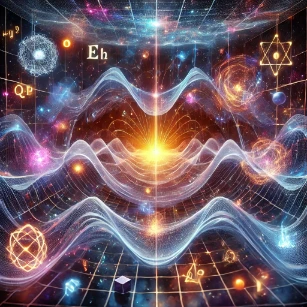
Quantum Field Theory shows particles as excitations of underlying fields that fill spacetime.
Quick Check: First Ideas in Quantum Field Theory
Before going deeper into Quantum Field Theory, check whether you understand the basic idea behind fields, particles, and interactions.
1. What is the central idea of Quantum Field Theory?
A. Particles are tiny solid balls moving through empty spaceB. Particles are excitations of underlying fields that exist throughout spacetimeC. Fields exist only inside atomsD. Quantum theory applies only to light, not matter
Answer: B. In QFT, fields are fundamental, and what we call particles are localised excitations of those fields.
2. Which two major areas of physics are brought together in Quantum Field Theory?
A. Fluid mechanics and acousticsB. Quantum mechanics and special relativityC. Thermodynamics and optics onlyD. Statics and simple machines
Answer: B. QFT combines quantum mechanics with special relativity so that particles, fields, and high-energy interactions can be described consistently.
3. In QFT, how should an electron be understood?
A. As a small planet orbiting inside empty spaceB. As an excitation of the electron fieldC. As a sound wave in airD. As a classical object with no quantum behaviour
Answer: B. In QFT, the electron field is more fundamental, and an electron is a particle-like excitation of that field.
4. Why is QFT important for particle physics?
A. It explains particles and forces using fields and exchanged quantaB. It avoids the need to study interactionsC. It applies only to slow-moving everyday objectsD. It replaces all experimental evidence with imagination
Answer: A. QFT provides the language used in the Standard Model, where particles and forces are described through quantum fields and exchanged field quanta.
5. Why is QFT more advanced than ordinary introductory quantum mechanics?
A. It ignores relativityB. It allows particles to be created, destroyed, and exchanged during interactionsC. It studies only classical wavesD. It applies only to chemical bonding
Answer: B. QFT is needed when particle number can change, especially in high-energy interactions where particles may be created or destroyed.
Key takeaway: Quantum Field Theory teaches that fields are the deeper foundation, while particles appear as excitations, interactions, and measurable effects of those fields.
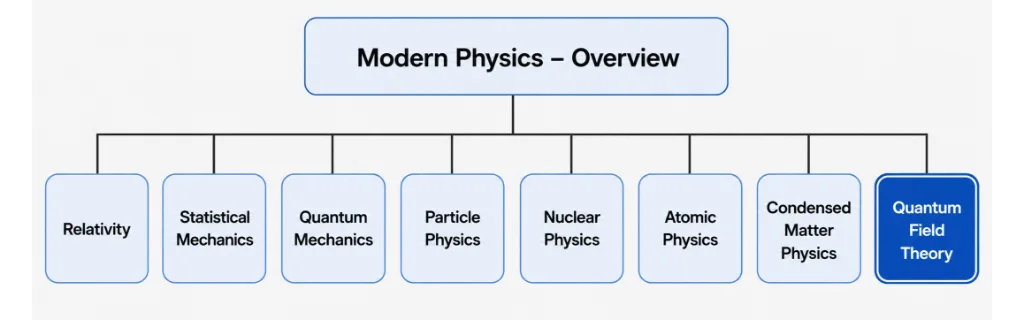
This chart shows where Quantum Field Theory fits within the wider Modern Physics cluster, alongside relativity, statistical mechanics, quantum mechanics, particle physics, nuclear physics, atomic physics, and condensed matter physics.
This image presents a visual structure chart for the Modern Physics cluster on Prep4Uni.online. Modern Physics appears as the parent topic, linked to eight major branches: Relativity, Statistical Mechanics, Quantum Mechanics, Particle Physics, Nuclear Physics, Atomic Physics, Condensed Matter Physics, and Quantum Field Theory. Quantum Field Theory is highlighted to show its position as the current focus page, helping students understand how it connects to the broader study of modern physics.
Historical Context
Quantum Field Theory developed because physicists needed a deeper framework than early quantum mechanics alone could provide. Quantum mechanics successfully explained atoms, energy levels, spectra, and wave-particle behaviour. However, it was not enough for situations where particles move at speeds close to the speed of light, or where particles can be created and destroyed during high-energy interactions.
The key challenge was to combine quantum theory with Einstein’s Special Theory of Relativity. Special relativity showed that space and time are linked, and that no signal can travel faster than light. A theory of fundamental particles therefore had to respect both quantum uncertainty and relativistic limits. This was not a small adjustment. It required a new way of describing particles, fields, and interactions.
One of the first great successes was Quantum Electrodynamics (QED). QED describes how light and charged particles interact. In this framework, electromagnetic interactions are explained through the exchange of photons, which are quanta of the electromagnetic field. QED became one of the most accurate theories in physics and showed that the field-based approach could describe nature with extraordinary precision.
Over time, QFT became the language of the Standard Model of Particle Physics. It provided a framework for describing matter particles, force-carrying particles, and most known fundamental forces. The electromagnetic, weak, and strong interactions can all be described using quantum fields. Gravity, however, remains the great exception, because a complete and experimentally confirmed quantum theory of gravity has not yet been achieved.
This unresolved problem continues to shape modern theoretical physics. Researchers still seek a deeper framework that can connect QFT with gravity, especially in extreme situations such as black holes, the early universe, and spacetime at very small scales. Ideas such as quantum gravity and string theory are part of this continuing search. In this sense, QFT is both a major achievement and an open doorway to some of the deepest unanswered questions in physics.
Quick Check: Historical Development of Quantum Field Theory
Use these questions to check whether you understand why Quantum Field Theory was developed and what problem it helped solve.
1. Why was Quantum Field Theory needed?
A. Ordinary quantum mechanics could not fully handle relativistic particles and particle creation or destructionB. Classical physics already explained all particle interactions perfectlyC. QFT was created only to describe slow-moving everyday objectsD. QFT removed the need for experimental evidence
Answer: A. QFT was needed because high-energy particle processes require both quantum theory and special relativity, especially when particles can be created or destroyed.
2. Which two major theories did QFT bring together?
A. Fluid mechanics and thermodynamicsB. Quantum mechanics and special relativityC. Classical mechanics and geologyD. Optics and acoustics only
Answer: B. QFT combines quantum mechanics with special relativity so that particles, fields, and interactions can be described consistently.
3. Why was Quantum Electrodynamics important in the history of QFT?
A. It showed how light and charged particles could be described using quantum fieldsB. It proved that fields do not existC. It explained only planetary motionD. It replaced all mathematics with pictures
Answer: A. Quantum Electrodynamics was one of the first highly successful quantum field theories, explaining electromagnetic interactions through the quantum behaviour of fields.
Key takeaway: QFT arose because physicists needed a theory that could treat particles, fields, relativity, and high-energy interactions within one consistent framework.
Core Concepts in Quantum Field Theory
Quantum Field Theory can look difficult because it uses advanced mathematics. However, its basic ideas can be introduced gently. The main idea is simple: fields are spread throughout space and time, and particles appear as small packets, ripples, or excitations of those fields. The equations then give physicists a careful way to describe how these fields move, interact, and produce measurable particles.
1. Fields and Particles
In ordinary thinking, a particle may be imagined as a tiny object moving through space. Quantum Field Theory changes this picture. It says that the field is more fundamental than the particle. A particle is what we observe when a field becomes excited in a particular way.
A simple analogy is a calm water surface. The water is spread everywhere across the pond, but a ripple can appear at one place. The ripple is not separate from the water; it is a local disturbance of the water. In a similar way, an electron can be understood as an excitation of the electron field, while a photon can be understood as an excitation of the electromagnetic field.
Matter particles, or fermions: arise from matter fields, such as the electron field and quark fields.
Force carriers, or bosons: arise from force fields, such as the photon field for electromagnetism and the gluon field for the strong nuclear force.
The key idea is therefore:
particle = local excitation of a field
This simple statement is one of the most important conceptual shifts in Quantum Field Theory.
2. Field Quantisation: Turning a Field into an Operator
In classical physics, a field has a definite value at each point. For example, a temperature field tells us the temperature at each location, and an electromagnetic field tells us the electric and magnetic influence at each point in space.
In Quantum Field Theory, the field is no longer treated as an ordinary number. It becomes a quantum operator. This means the field can create, remove, or change particles. This sounds abstract, but the basic idea can be stated simply:
classical field → quantum field operator
For a simple scalar field, often written as φ, physicists may write the quantum field as φ̂(x). The small hat reminds us that this is now an operator, not just an ordinary value:
φ(x) → φ̂(x)
A useful simplified way to understand the operator is this:
φ̂(x) ~ (operator that removes a particle) + (operator that creates a particle)
In more formal notation, this idea is often represented using annihilation and creation operators:
φ̂(x) ~ a + a†
Here, a is an annihilation operator, which represents the removal of a particle-like excitation, while a† is a creation operator, which represents the creation of a particle-like excitation.
A more complete expression for a free scalar field looks like this:
Students do not need to master every symbol immediately. The main message is that the field is written as a mixture of possible waves, and each wave mode can be associated with creating or removing a quantum of the field.
3. Lagrangian: The Rulebook of a Field
The Lagrangian is one of the most important tools in field theory. A simple way to describe it is this: the Lagrangian is the rulebook that tells a field how to behave. It contains information about motion, mass, and interaction.
In introductory mechanics, students may meet the idea:
L = T − V
Here, T represents kinetic energy and V represents potential energy. The Lagrangian compares what is associated with motion and what is associated with stored energy.
In field theory, we use a Lagrangian density, written as L, because the field exists throughout space and time:
L = (motion part) − (mass or energy part)
For a free scalar field, the Lagrangian density is:
L = (1/2) (∂μφ) (∂μφ) − (1/2) m2φ2
This may look complicated, but its structure is simple. The first term describes how the field changes across space and time. The second term describes the mass-energy associated with the field.
(1/2) (∂μφ) (∂μφ) describes how the field varies or “moves” through spacetime.
(1/2) m2φ2 describes the mass-related part of the field.
So, at a beginner-friendly level:
free field Lagrangian = field motion − field mass
4. Euler-Lagrange Equation: How the Field Learns to Move
Once the Lagrangian is known, physicists can derive the equation of motion for the field. This is similar to how Newton’s laws describe motion in classical physics, but here the object being described is a field spread across spacetime.
The field version of the Euler-Lagrange equation is:
(∂L / ∂φ) − ∂μ [ ∂L / ∂(∂μφ) ] = 0
This formula can be read in a simple way:
the Lagrangian tells the field how it must change
For students, the important point is not to memorise the full equation immediately, but to understand its purpose. It turns the Lagrangian into the field’s equation of motion.
5. Interactions: Adding a Conversation Between Fields
A free field is like a field that exists by itself without interacting with anything else. Real physics is more interesting because fields interact. Particles can scatter, decay, combine, or exchange force-carrying particles. In QFT, these interactions are described by adding interaction terms to the Lagrangian.
At a simple level:
Ltotal = Lfree + Linteraction
One example of an interaction term is:
Lint = gψ̄ψφ
This expression says that a fermion field, represented by ψ, can interact with a scalar field, represented by φ. The symbol g is the coupling constant. It tells us how strong the interaction is.
ψ represents a fermion field.
ψ̄ is related to the corresponding mathematical form of that fermion field.
φ represents a scalar field.
g controls the strength of the interaction.
A useful beginner interpretation is:
interaction term = (which fields interact) × (how strongly they interact)
6. Feynman Diagrams: Pictures of Field Interactions
Feynman diagrams are not just drawings of particles travelling along visible paths. They are compact visual summaries of mathematical terms in QFT. Each line and vertex represents part of a calculation.
A simple way to think about them is:
Feynman diagram ↔ mathematical contribution to an interaction
For example, when two charged particles repel or attract, QFT may describe the interaction as an exchange of photons. A Feynman diagram helps physicists organise that process and calculate the probability amplitude for the event.
The key point is that Feynman diagrams are not ordinary photographs of what happens. They are visual tools for organising the mathematics of possible interactions.
7. Symmetries and Conservation Laws
Symmetry is one of the most beautiful ideas in Quantum Field Theory. A symmetry means that something can change in one way while the physical laws remain the same. For example, if an experiment gives the same laws today and tomorrow, time symmetry is connected with conservation of energy.
Noether’s Theorem expresses a deep connection:
continuous symmetry → conservation law
Gauge symmetry: helps explain charge conservation and the structure of force-carrying fields.
Lorentz symmetry: ensures that the laws of physics are consistent with special relativity.
Spacetime symmetries: are connected with conservation of energy, momentum, and angular momentum.
This means that QFT is not just a collection of formulas. Its structure is guided by deep patterns in nature. Symmetry tells physicists what kinds of interactions are allowed, what quantities are conserved, and how fields should behave.
Key idea: Quantum Field Theory becomes less frightening when its mathematics is read as a story: fields exist, fields are quantised, particles appear as excitations, the Lagrangian gives the rulebook, interactions are added through extra terms, and symmetries reveal what nature conserves.
Quick Check: Core Ideas in Quantum Field Theory
Use these simple questions to check the main ideas before moving deeper into Quantum Field Theory.
1. In Quantum Field Theory, what is a particle?
A. A tiny solid ball moving through empty spaceB. A local excitation of a fieldC. A small planet inside an atomD. A force that has no field
Answer: B. In QFT, a particle is understood as a local excitation, or ripple, of an underlying field.
2. What does the symbol a† usually represent in a simple field expression?
A. A creation operatorB. A rulerC. A classical forceD. A temperature reading
Answer: A. The operator a† is commonly called a creation operator because it represents the creation of a particle-like excitation.
3. What is a simple way to think about the Lagrangian?
A. A rulebook that tells a field how to behaveB. A list of planet namesC. A picture of a laboratoryD. A type of electrical wire
Answer: A. The Lagrangian contains the information needed to describe how a field moves, has mass, and interacts.
4. What does an interaction term in the Lagrangian describe?
A. Which fields interact and how strongly they interactB. The colour of a diagramC. The shape of a planet’s orbit onlyD. The speed of sound in air only
Answer: A. An interaction term shows which fields are connected in an interaction, while the coupling constant tells how strong that interaction is.
5. What is a Feynman diagram mainly used for?
A. Organising calculations about particle interactionsB. Showing a photograph of particlesC. Drawing maps of countriesD. Measuring room temperature
Answer: A. A Feynman diagram is a visual tool that helps physicists organise the mathematical calculation of particle interactions.
6. According to Noether’s Theorem, what does a continuous symmetry lead to?
A. A conservation lawB. A random result with no patternC. A broken equationD. A larger atom
Answer: A. Noether’s Theorem connects continuous symmetries with conservation laws, such as conservation of energy, momentum, or charge.
Key takeaway: QFT becomes easier when we see it as a story: fields exist, particles are field excitations, operators create or remove excitations, the Lagrangian gives the rules, and symmetries reveal what nature conserves.
The Lagrangian Formalism and Second Quantization Mechanics
To advance from a discrete particle wave function model into a continuous field framework, QFT transitions from Hamiltonian mechanics to the relativistic Lagrangian density formalism, denoted by L. Instead of tracking independent spatial coordinates over time, the system defines the state using continuous field operators, φ(x, y, z, t), and their corresponding spacetime derivatives. For a non-interacting, massive scalar field, the dynamics are governed by the classical Klein-Gordon Lagrangian density framework:
L = (1/2) (∂μφ) (∂μφ) − (1/2) m2φ2
The transition to true quantum behavior requires applying the protocol of second quantization. Unlike first quantization—which elevates localized physical observables like position and momentum to operator status—second quantization treats the entire field configuration as an operator distribution. By enforcing canonical commutation relations between the field operator φ(x) and its conjugate momentum field π(y), the smooth field continuum breaks down mathematically into discrete, countable excitations. These field excitations are precisely what we observe in the laboratory as elementary physical particles, naturally explaining how matter is created and annihilated during high-energy subatomic scattering events.
Fundamental Quantum Field Theories
Quantum Field Theory is not one single theory used for every situation. Instead, it is a broad framework used to build several more specific theories. Each theory describes a particular type of field, particle, or force. For students, it is helpful to see these theories as parts of a larger map: some explain light and electricity, some explain the strong force inside matter, some explain weak nuclear processes, and some point toward unsolved questions about gravity.
The most important idea is simple: different forces are described by different fields, and interactions often appear as exchanges of force-carrying particles. This is the field-based language behind much of modern Particle Physics.
Quantum Electrodynamics describes how charged particles, such as electrons, interact with the electromagnetic field. The force carrier is the photon. QED is one of the most successful theories in physics because it predicts some electromagnetic effects with extraordinary accuracy. At a beginner level, QED can be understood as the quantum field theory of light, charge, and electromagnetic interaction.
Quantum Chromodynamics (QCD)
Quantum Chromodynamics describes the strong force that acts between quarks. This force is carried by gluons. QCD explains why quarks are bound inside particles such as protons and neutrons, and why isolated quarks are not normally observed. Two important ideas in QCD are colour confinement, where quarks remain trapped inside composite particles, and asymptotic freedom, where the strong force becomes weaker at extremely short distances.
Electroweak Theory
Electroweak theory shows that the electromagnetic force and the weak nuclear force are connected at a deeper level. The electromagnetic interaction is associated with the photon, while the weak interaction is associated with the W and Z bosons. This theory also connects with the Higgs field, which helps explain how some particles acquire mass through the Higgs mechanism.
The Standard Model brings together QED, QCD, and electroweak theory into one powerful framework. It describes fermions, which are matter particles such as quarks and leptons, and gauge bosons, which act as force carriers. It also includes the Higgs boson, linked to the field that helps explain particle mass.
Quantum Gravity and Beyond
Current quantum field theories describe electromagnetic, weak, and strong interactions very successfully, but gravity remains difficult to include in the same framework. Quantum gravity is the search for a theory that treats gravity according to quantum principles. Ideas such as string theory and loop quantum gravity are attempts to explore this frontier, but a complete experimentally confirmed quantum theory of gravity remains an open problem.
A simple way to remember the structure is this: QED explains charged particles and light, QCD explains quarks and the strong force, electroweak theory connects electromagnetism with the weak force, the Standard Model brings these ideas together, and quantum gravity points to what physicists are still trying to understand.
Quick Check: Fundamental Quantum Field Theories
Use these simple questions to check the main purpose of each major quantum field theory.
1. Which theory describes the interaction between charged particles and light?
A. Quantum ElectrodynamicsB. Plate tectonicsC. Classical staticsD. Fluid buoyancy
Answer: A. Quantum Electrodynamics, or QED, describes how charged particles interact with the electromagnetic field through photons.
2. Which theory describes the strong force between quarks?
A. Quantum ChromodynamicsB. Special relativity onlyC. Simple harmonic motionD. Thermometer theory
Answer: A. Quantum Chromodynamics, or QCD, describes the strong force between quarks, with gluons acting as force carriers.
3. What does electroweak theory connect?
A. The electromagnetic force and the weak nuclear forceB. Sound and water pressureC. Friction and buoyancyD. Weather and climate only
Answer: A. Electroweak theory shows that electromagnetism and the weak nuclear force are connected at a deeper level.
4. What does the Standard Model describe?
A. Known fundamental particles and most known fundamental forces, except gravityB. Only planets and moonsC. Only ordinary machinesD. Only chemical names
Answer: A. The Standard Model describes known fundamental particles and the electromagnetic, weak, and strong interactions, but it does not yet fully include gravity.
5. Why is quantum gravity still an open problem?
A. Gravity has not yet been fully explained by an experimentally confirmed quantum field theoryB. Gravity does not existC. QED already explains gravity completelyD. Gravity applies only to atoms
Answer: A. Gravity has not yet been successfully unified with quantum field theory in a complete and experimentally confirmed way.
Key takeaway: Fundamental quantum field theories help organise the forces of nature: QED for electromagnetism, QCD for the strong force, electroweak theory for electromagnetic and weak interactions, the Standard Model for known particles and forces, and quantum gravity for the frontier still being explored.
Challenges in Quantum Field Theory
Quantum Field Theory is one of the most successful frameworks in modern science, but it is not a finished story. It explains many particle interactions with remarkable precision, yet it also leads to deep mathematical and conceptual challenges. These challenges do not mean that QFT is weak. Instead, they show where the theory reaches the edge of current understanding.
Renormalization: Handling Infinities
Some QFT calculations produce infinite values. In physics, an infinite answer usually signals that the calculation needs to be handled more carefully. Renormalization is the method used to reorganise the calculation so that measurable quantities become finite and match experimental results. A simple way to think of it is this: the raw mathematical expression may be too idealised, but renormalization helps connect the theory to what can actually be measured.
Non-Renormalizable Theories
Some theories become harder to control using ordinary renormalization methods. Gravity is the most important example. General Relativity describes gravity extremely well at large scales, but when physicists try to treat gravity as an ordinary quantum field theory, the mathematics becomes difficult to manage. This is one reason why quantum gravity remains an unresolved problem.
The Problem of Unification
QFT describes the electromagnetic, weak, and strong interactions very successfully through the Standard Model. However, gravity is not yet fully included in the same quantum framework. Physicists continue to search for a deeper theory that can bring quantum mechanics, field theory, and gravity together in a consistent way.
Vacuum Energy and the Cosmological Constant Problem
In QFT, the vacuum is not simply empty space. It can contain fluctuations and field activity even when no ordinary particles are present. However, calculations of vacuum energy appear to differ enormously from the observed effect associated with dark energy in cosmology. This mismatch is known as the cosmological constant problem, and it remains one of the deepest puzzles in theoretical physics.
These challenges show that Quantum Field Theory is both powerful and incomplete. It gives some of the most accurate predictions in science, but it also points toward unanswered questions about gravity, spacetime, the vacuum, and the deeper structure of the universe.
Quick Check: Challenges in Quantum Field Theory
Use these simple questions to check the main difficulties that physicists face when working with Quantum Field Theory.
1. What problem does renormalization help solve in QFT?
A. It helps deal with infinities in calculationsB. It removes all particles from physicsC. It proves gravity does not existD. It replaces experiments with guesses
Answer: A. Renormalization helps physicists reorganise calculations so that the final measurable predictions are finite and useful.
2. Why is gravity difficult to include in ordinary QFT?
A. Gravity is hard to treat as a normal renormalizable quantum field theoryB. Gravity only works inside atomsC. Gravity has already been fully solved by QEDD. Gravity is unrelated to spacetime
Answer: A. General Relativity works very well for gravity at large scales, but combining it with quantum field methods remains mathematically and conceptually difficult.
3. What does unification mean in this context?
A. Combining quantum theory, field theory, and gravity into one consistent frameworkB. Making all particles identicalC. Removing mathematics from physicsD. Studying only classical mechanics
Answer: A. Unification means finding a deeper framework that can describe quantum fields and gravity together.
4. What is unusual about the vacuum in QFT?
A. It is not simply empty; it can contain field fluctuationsB. It contains ordinary airC. It has no connection to fieldsD. It only exists inside laboratories
Answer: A. In QFT, the vacuum can still have quantum field activity, even when no ordinary particles are present.
Key takeaway: QFT is powerful because it explains many interactions with great accuracy, but its challenges show that physics still has deep questions about gravity, spacetime, and the vacuum.
The S-Matrix Framework and Feynman Diagram Perturbation
Because calculating explicit exact solutions within interacting quantum field theories is often analytically impossible, physicists evaluate particle interactions using perturbation theory. The mathematical bridge connecting asymptotic initial states before an impact to final scattered states after an impact is governed by the scattering matrix, or S-matrix. Calculating these transition probabilities requires evaluating a complex multi-dimensional time-ordered exponential expansion series, formally known as the Dyson series.
To simplify these staggering mathematical expansions, Richard Feynman introduced a historic diagrammatic system that maps terms in the perturbative series directly to intuitive visual layouts. Each structural component of a Feynman diagram corresponds to an explicit term inside the underlying path integral calculation:
M = ∫ [ d4k / (2π)4 ] · DF(p) gγμDF(k)
Within this operational framework, internal straight or wavy lines represent mathematical Feynman propagators tracking virtual particles transferring momentum through the vacuum space, while intersection nodes dictate localized coupling constants (g) or vertex interaction metrics. By systematically constructing these diagrams order by order—progressing from simple tree-level transitions up to complex multi-loop radiative corrections—students can derive the scattering cross-sections and decay widths verified daily inside massive high-energy particle colliders.
Three Numerical Examples in Quantum Field Theory
Quantum Field Theory is mathematically advanced, but students do not need to begin with the full machinery of field operators and Feynman diagrams. A useful first step is to look at simple numerical examples that show how QFT connects to measurable physical quantities.
The following examples are not intended to teach the whole of QFT. Instead, they show three important ideas in a gentle way: photons carry quantised energy, particles have characteristic quantum length scales, and interactions can be described by coupling strengths.
Example 1: Photon Energy in Quantum Electrodynamics
In Quantum Electrodynamics, or QED, light is treated as a quantum field, and a photon is one quantum of that electromagnetic field. Calculating photon energy helps students connect wavelength, frequency, and quantum energy.
Problem: Calculate the energy of a photon with a wavelength of 500 nm.
Idea: A shorter wavelength means a higher photon energy. We use:
E = (hc) / λ
where h = 6.626 × 10⁻³⁴ J·s, c = 3.00 × 10⁸ m/s, and λ = 500 × 10−9 m.
Meaning: This small energy belongs to one photon. In ordinary light, there are huge numbers of photons, so the total energy becomes noticeable.
Example 2: Compton Wavelength of an Electron
The Compton wavelength gives a characteristic quantum-relativistic length scale for a particle. For an electron, it tells us roughly when quantum mechanics and relativity begin to meet in an important way.
Problem: Find the Compton wavelength of an electron, where me = 9.11 × 10⁻³¹ kg.
Idea: The Compton wavelength is given by:
λC = h / (mec)
where h = 6.626 × 10⁻³⁴ J·s, me = 9.11 × 10⁻³¹ kg, and c = 3.00 × 10⁸ m/s.
Answer: The Compton wavelength of the electron is λC ≈ 2.43 × 10⁻¹² m.
Meaning: This length is far smaller than an atom. It reminds students that QFT becomes important at extremely small scales where quantum and relativistic effects cannot be separated.
Example 3: Strong Force Coupling in QCD
In Quantum Chromodynamics, or QCD, the strong interaction between quarks is described using a coupling strength. The coupling tells us how strongly particles interact through the field. This example uses a simplified relation between the strong coupling parameter αs and the strong coupling strength gs.
Problem: Given the QCD coupling parameter αs = 0.1, find the corresponding strong coupling strength gs, using:
gs = √(4π αs)
Solution:
gs = √[ 4π (0.1) ] = √(1.2566) ≈ 1.12
Answer: The strong coupling strength is gs ≈ 1.12.
Meaning: A coupling strength tells us how strongly a field interaction behaves. In QCD, the strong interaction is much more complex than this simple calculation suggests, but this example gives students a first numerical feel for the idea of coupling.
Key takeaway: These examples show that Quantum Field Theory connects abstract ideas to measurable quantities: photon energy, particle length scales, and interaction strength.
Why Study Quantum Field Theory
The Unifying Language of Particle Physics
Quantum field theory (QFT) describes how particles arise from underlying quantum fields. Students learn how this framework unites special relativity and quantum mechanics. It forms the basis for the Standard Model and describes interactions between fields and particles. Mastering QFT provides access to the deepest levels of theoretical physics.
Field Quantization and Particle Creation
Students study how quantizing fields leads to creation and annihilation operators. This explains how particles can be created or destroyed during interactions. Understanding this formalism helps explain vacuum fluctuations, virtual particles, and scattering amplitudes. It builds the mathematical foundation for high-energy physics calculations.
Feynman Diagrams and Perturbation Theory
Feynman diagrams visualize particle interactions and simplify complex integrals in perturbation theory. Students learn how to interpret these diagrams and apply conservation laws at each vertex. This tool enhances comprehension of processes in quantum electrodynamics and beyond. It supports analytical reasoning and theoretical modeling.
Renormalization and Predictive Power
QFT includes techniques like renormalization to remove infinities and yield finite, testable predictions. Students explore how these methods ensure internal consistency in field theories. This leads to extremely accurate predictions, such as in the magnetic moment of the electron. It illustrates the precision and robustness of quantum theories.
Gateway to Advanced Physics and Quantum Technologies
QFT underpins many areas including quantum chromodynamics, electroweak theory, and quantum gravity proposals. Students who master this subject are prepared for cutting-edge research and development. It supports progress in quantum computing, condensed matter physics, and theoretical cosmology. It equips students to contribute meaningfully to foundational science.
Frequently Asked Questions: Quantum Field Theory
1. What is Quantum Field Theory?
Quantum Field Theory, or QFT, is a framework in modern physics that describes particles as excitations of fields. Instead of treating particles as tiny solid objects moving through empty space, QFT says that fields exist throughout spacetime, and particles appear when these fields are excited in specific ways.
2. Why is Quantum Field Theory important?
QFT is important because it provides the language used to describe fundamental particles and forces. It helps explain how electrons, photons, quarks, gluons, and other particles behave and interact. It is also the foundation of the Standard Model of particle physics.
3. Why was QFT needed when quantum mechanics already existed?
Ordinary quantum mechanics works very well for many atomic systems, but it is not enough for high-energy situations where particles can be created or destroyed. QFT combines quantum mechanics with special relativity, making it suitable for particle interactions, scattering, and field-based descriptions of nature.
4. What does it mean to say that particles are field excitations?
A simple analogy is a ripple on water. The ripple is not separate from the water; it is a disturbance of the water surface. In QFT, a particle is like a local ripple or excitation of a field. An electron is an excitation of the electron field, while a photon is an excitation of the electromagnetic field.
5. What is field quantisation?
Field quantisation means applying the rules of quantum mechanics to fields. A classical field has values, but a quantum field is treated as an operator. This allows the field to create or remove particle-like excitations. In simple terms, field quantisation turns fields into objects that can produce particles.
6. What are creation and annihilation operators?
Creation and annihilation operators are mathematical tools used in QFT. A creation operator represents the creation of a particle-like excitation, while an annihilation operator represents its removal. They help physicists describe processes where particles appear, disappear, or change during interactions.
7. What is a Lagrangian in Quantum Field Theory?
A Lagrangian is like a rulebook for a field. It contains information about how the field moves, whether it has mass, and how it interacts with other fields. Once the Lagrangian is known, physicists can derive equations that describe the behaviour of the field.
8. What are Feynman diagrams?
Feynman diagrams are visual tools used to organise calculations in QFT. They are not literal photographs of particles moving through space. Instead, they represent possible interaction processes. Lines usually represent particles or fields, while meeting points show where interactions occur.
9. What is Quantum Electrodynamics?
Quantum Electrodynamics, or QED, is a quantum field theory of electromagnetic interaction. It describes how charged particles, such as electrons, interact with the electromagnetic field. The photon is the force-carrying particle in QED.
10. What is Quantum Chromodynamics?
Quantum Chromodynamics, or QCD, is the quantum field theory of the strong force. It describes how quarks interact through gluons. QCD helps explain why quarks are bound inside particles such as protons and neutrons.
11. How does QFT relate to the Standard Model?
The Standard Model is built using the language of Quantum Field Theory. It describes matter particles, force-carrying particles, and the electromagnetic, weak, and strong interactions. It does not yet fully include gravity.
12. What is gauge symmetry in simple terms?
Gauge symmetry is a rule that says the physical predictions of a theory should stay the same even when certain mathematical descriptions are changed. In QFT, gauge symmetries help determine the structure of forces and the existence of force-carrying particles.
13. What is renormalisation?
Renormalisation is a method used to handle infinities that can appear in QFT calculations. It allows physicists to connect the theory with measured quantities, such as mass and charge, so that the final predictions become finite and useful.
14. Why is gravity difficult to include in QFT?
Gravity is described very successfully by General Relativity, but it does not fit easily into the same quantum field framework as the other forces. A complete and experimentally confirmed quantum theory of gravity remains one of the major open problems in physics.
15. Why should students learn the basic ideas of QFT?
Students do not need to master advanced QFT mathematics at the beginning. However, learning the basic ideas helps them understand how modern physics connects particles, fields, forces, symmetry, and the structure of matter. It also prepares them for later studies in particle physics, nuclear physics, condensed matter physics, and cosmology.
Glossary of Key Quantum Field Theory Terms
This glossary explains important terms used in Quantum Field Theory. The aim is not to make students memorise advanced mathematics, but to help them recognise the main ideas behind fields, particles, interactions, symmetries, and the Standard Model.
Quantum Field Theory
A framework in modern physics that describes particles as excitations of underlying fields. It combines quantum mechanics with special relativity and is central to modern particle physics.
Field
A physical quantity that exists throughout space and time. In QFT, fields are treated as fundamental, and particles appear as localised excitations of these fields.
Quantum Field
A field that follows the rules of quantum mechanics. A quantum field can produce particle-like excitations and is described using operators rather than ordinary fixed values.
Field Excitation
A local disturbance or ripple in a quantum field. In QFT, what we call a particle is understood as one such excitation.
Quantum
A discrete packet of energy or field excitation. For example, a photon is a quantum of the electromagnetic field.
Photon
The quantum of the electromagnetic field. In QED, photons act as the force carriers of electromagnetic interactions.
Fermion
A matter particle, such as an electron, quark, or neutrino. Fermions form the matter content of the Standard Model.
Boson
A particle associated with force-carrying fields or other field excitations. Examples include photons, gluons, W and Z bosons, and the Higgs boson.
Creation Operator
A mathematical operator used in QFT to represent the creation of a particle-like excitation in a quantum field.
Annihilation Operator
A mathematical operator used in QFT to represent the removal of a particle-like excitation from a quantum field.
Lagrangian
A mathematical expression that acts like a rulebook for a field. It describes how the field moves, whether it has mass, and how it interacts with other fields.
Interaction Term
A part of the Lagrangian that shows which fields interact with one another and how strongly the interaction takes place.
Coupling Constant
A number that measures the strength of an interaction between fields. A larger coupling usually means a stronger interaction.
Feynman Diagram
A visual tool used to organise QFT calculations. It represents possible particle interactions and corresponds to mathematical terms in a probability calculation.
Quantum Electrodynamics
The quantum field theory of electromagnetic interaction. It describes how charged particles interact with the electromagnetic field through photons.
Quantum Chromodynamics
The quantum field theory of the strong interaction. It describes how quarks interact through gluons.
Electroweak Theory
A theory that connects the electromagnetic force and weak nuclear force within a common framework.
Gauge Symmetry
A type of symmetry that helps determine the structure of interactions in QFT. Gauge symmetry is central to QED, QCD, and electroweak theory.
Renormalisation
A method used to handle infinities that appear in some QFT calculations, allowing physicists to produce finite predictions that can be compared with experiments.
Standard Model
The current framework that describes known fundamental particles and the electromagnetic, weak, and strong interactions. It is built using quantum field theory, but it does not fully include gravity.
Quantum Gravity
The search for a theory that describes gravity according to quantum principles. A complete and experimentally confirmed quantum theory of gravity remains an open problem.
External References
These references provide reliable background reading on Quantum Field Theory, the Standard Model, quantum electrodynamics, and related particle physics concepts.
Quantum Field Theory is the cornerstone of modern physics, providing a unified framework for understanding the behavior of particles and forces at the quantum level. QFT successfully explains electromagnetic, weak, and strong interactions within the Standard Model, but the quest to unify it with gravity and discover new physics continues. Through QFT, we have deepened our understanding of the universe at its most fundamental level.
Quantum Field Theory: Review Questions and Answers
1. What is quantum field theory (QFT) and what does it aim to describe? Answer: QFT is the theoretical framework that combines quantum mechanics with special relativity to describe the behavior and interactions of particles as excitations of underlying fields, unifying particle physics with field theory.
2. How are particles represented in quantum field theory? Answer: In QFT, particles are viewed as quantized excitations or “quanta” of their corresponding fields. For instance, an electron is an excitation of the electron field, and a photon is an excitation of the electromagnetic field.
3. What role do Feynman diagrams play in QFT? Answer: Feynman diagrams are graphical tools used in QFT to represent and calculate interactions between particles. They depict the exchange of force carriers and help simplify complex integrals in perturbative calculations.
4. How does QFT incorporate the concept of gauge symmetry? Answer: QFT incorporates gauge symmetry by requiring that the underlying equations remain invariant under local transformations of the field phases. This invariance leads to the introduction of gauge bosons, which mediate the fundamental forces.
5. What is the significance of renormalization in quantum field theory? Answer: Renormalization is a procedure used to remove infinities that arise in QFT calculations. It redefines parameters such as mass and charge so that the predictions of the theory match observed physical quantities.
6. How does quantum field theory explain the creation and annihilation of particles? Answer: QFT naturally allows for the creation and annihilation of particles through its formalism. Field operators act on the vacuum state to create or destroy particle excitations, enabling the description of processes like pair production.
7. What is the vacuum state in quantum field theory, and why is it non-trivial? Answer: The vacuum state in QFT is the lowest energy state of a field, but due to quantum fluctuations, it is not empty. Virtual particles constantly pop in and out of existence, giving the vacuum a rich and dynamic structure.
8. How does QFT address the unification of forces? Answer: QFT provides a common language to describe different forces by modeling them as interactions mediated by gauge bosons. This approach has led to the successful unification of the electromagnetic and weak forces into the electroweak theory.
9. What are anomalies in quantum field theory, and why are they important? Answer: Anomalies are inconsistencies that arise when a symmetry present at the classical level is broken by quantum effects. They are important because they can signal the need for new physics or constraints on the structure of a consistent theory.
10. How has quantum field theory contributed to our understanding of particle physics? Answer: QFT has been essential in formulating the Standard Model, predicting the existence of particles like the Higgs boson, and providing a framework for understanding interactions at the most fundamental level, influencing both theory and experiment.
Quantum Field Theory: Thought-Provoking Questions and Answers
1. How might future developments in QFT lead to a unified theory of all fundamental interactions? Answer: Future advances in QFT could merge gravity with the other three forces by incorporating quantum gravitational effects. Approaches like string theory or loop quantum gravity might emerge from QFT insights, potentially leading to a “Theory of Everything” that unifies all interactions under a single theoretical framework.
2. What challenges arise from the infinities encountered in QFT calculations, and how might new techniques overcome them? Answer: Infinities in QFT arise during perturbative expansions, requiring renormalization to yield finite predictions. New mathematical techniques, non-perturbative methods, or alternative formulations such as lattice QFT could offer deeper insights and more rigorous solutions to the problem of divergences.
3. In what ways could improved computational power and algorithms transform our ability to simulate quantum field theories? Answer: Enhanced computational power and sophisticated algorithms, including those based on quantum computing, could enable high-precision simulations of QFT phenomena. This would allow for detailed studies of strong interactions, phase transitions, and emergent phenomena that are currently beyond the reach of traditional methods.
4. How might experimental discoveries challenge or refine the current framework of quantum field theory? Answer: New experimental data—such as unexpected particle interactions, deviations from predicted decay rates, or the discovery of new particles—could challenge existing QFT models and prompt refinements or entirely new theoretical frameworks, driving the evolution of our understanding of fundamental physics.
5. What implications does the concept of virtual particles in the QFT vacuum have for our understanding of the universe? Answer: Virtual particles in the QFT vacuum suggest that the vacuum is a dynamic, fluctuating medium that can influence observable phenomena such as the Casimir effect and vacuum polarization. This concept challenges the classical idea of empty space and has profound implications for cosmology and the understanding of dark energy.
6. How do gauge symmetries constrain the form of interactions in QFT, and what might happen if these symmetries are broken? Answer: Gauge symmetries dictate the allowed interactions and ensure conservation laws in QFT. If these symmetries are broken—either spontaneously or explicitly—it can lead to phenomena such as mass generation (via the Higgs mechanism) or the emergence of anomalies, potentially requiring new physics to restore consistency.
7. In what ways does QFT provide insights into the early universe and the conditions just after the Big Bang? Answer: QFT describes high-energy particle interactions that dominated the early universe. By modeling these interactions, QFT helps explain processes such as baryogenesis, cosmic inflation, and the formation of the primordial plasma, thereby shedding light on the evolution of the cosmos.
8. How might advancements in quantum field theory influence the development of new materials with exotic properties? Answer: Understanding the quantum fields governing particle interactions can lead to the discovery of novel phases of matter and exotic materials, such as topological insulators and superconductors. These materials, with unique electronic and magnetic properties, have the potential to revolutionize technology in computing, energy, and electronics.
9. What role do symmetries play in determining the particle spectrum predicted by QFT, and how could new symmetries change this spectrum? Answer: Symmetries in QFT, such as Lorentz invariance and gauge symmetries, determine the properties and masses of particles. The discovery of new symmetries or the extension of existing ones (for instance, supersymmetry) could predict the existence of additional particles, thereby expanding our understanding of the particle spectrum and the fundamental structure of matter.
10. How can the study of anomalies in QFT lead to breakthroughs in our understanding of fundamental interactions? Answer: Anomalies, which indicate the breakdown of classical symmetries at the quantum level, can provide clues about missing pieces in our theoretical models. Studying anomalies may reveal inconsistencies that point to new physics, guiding the development of more complete theories that reconcile these discrepancies.
11. What impact could the integration of quantum field theory with quantum information science have on future technologies? Answer: Integrating QFT with quantum information science could lead to the development of quantum computers that simulate field theories, improved cryptographic protocols, and enhanced understanding of entanglement in many-body systems. This cross-disciplinary approach could drive innovations in computing, secure communications, and data processing.
12. How might interdisciplinary research between QFT and other areas of physics contribute to solving unsolved problems in the Standard Model? Answer: Interdisciplinary research can combine insights from QFT, astrophysics, condensed matter physics, and mathematics to address unresolved issues such as the hierarchy problem, dark matter, and neutrino masses. This collaborative effort could lead to unified models that explain diverse phenomena across different energy scales and experimental settings.
Numerical Problems and Solutions
1. Calculate the energy of a photon with wavelength 400 nm.
Solution:
E = (hc) / λ
E = (4.1357 × 10⁻¹⁵ eV·s × 3.0 × 10⁸ m/s) / (400 × 10−9 m) ≈ 3.10 eV
2. A particle has momentum 2.0 × 10⁻²² kg·m/s. Calculate its de Broglie wavelength.