
Quantum numbers and electron configuration provide the “address system” for electrons inside atoms. They explain which energy level an electron occupies, what type of orbital it belongs to, how that orbital is oriented, and how the electron’s spin is described. Within physics and modern physics, these ideas help students move from a simple picture of atomic structure to a more precise quantum description of matter.
This topic belongs naturally within atomic physics, because it explains how electrons are arranged around the nucleus and why that arrangement matters. The structure of the atom tells us that atoms contain a nucleus surrounded by electrons, but quantum numbers tell us how those electrons are organised into shells, subshells, orbitals, and spin states.
The four quantum numbers describe different aspects of an electron’s state: its main energy level, orbital shape, orbital orientation, and spin. Together, they form the basis of electron configuration. This framework explains why electrons fill orbitals in particular patterns, why elements are arranged as they are in the periodic table, and why atoms differ in chemical reactivity, bonding behaviour, magnetic properties, and spectral patterns.
The deeper foundation comes from quantum mechanics. Electrons are not described as tiny particles travelling in fixed circular paths. Instead, their behaviour is described using probability distributions, orbitals, and wavefunctions. Ideas such as the wave function and Schrödinger’s equation, Heisenberg’s uncertainty principle, and wave-particle duality help explain why electron configuration must be understood quantum mechanically rather than classically.
Electron configuration also connects atomic physics to wider scientific fields. It helps explain spectral lines, chemical bonding, semiconductor behaviour, magnetism, materials properties, and many ideas in condensed matter physics. For students preparing for university, mastering quantum numbers and electron configuration provides a strong foundation for chemistry, materials science, quantum physics, electronics, and modern technology.

Key Idea: Quantum Numbers Give Electrons an Address
    An electron in an atom is not described simply by saying "it is near the nucleus."
    Quantum numbers give a more precise description of its allowed state.
    They tell us the electron's energy level, orbital type, orbital orientation, and spin.
    In this sense, quantum numbers act like an address system for electrons inside atoms.
1. Quantum Numbers and Electron Configuration within Atomic Physics
Quantum Numbers and Electron Configuration is one of the key pathways within Atomic Physics. It focuses on how electrons are described by quantum numbers, how they occupy shells, subshells, and orbitals, and how these arrangements determine atomic behaviour. This topic connects atomic structure to chemical properties, spectral patterns, bonding tendencies, and the wider quantum description of matter.
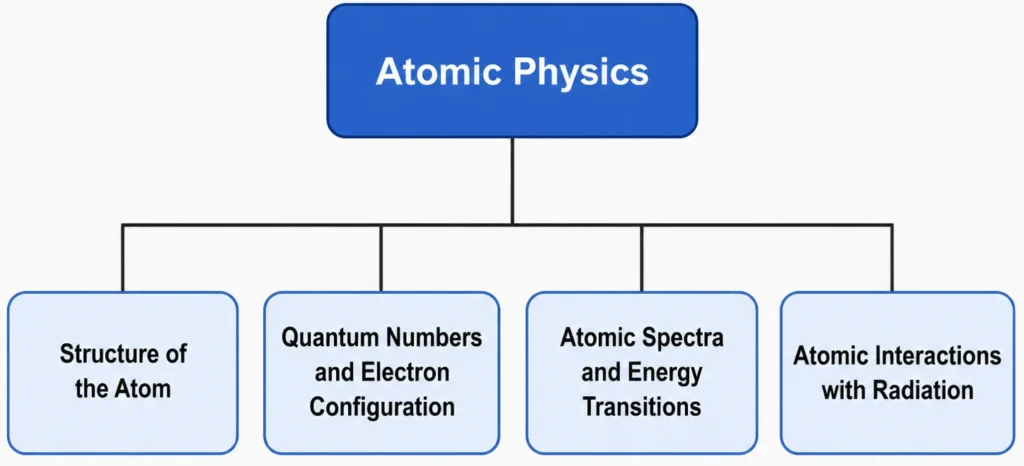
Atomic Physics
Provides the wider framework for understanding atomic structure, electron behaviour, energy levels, spectra, and interactions between atoms and radiation.Structure of the Atom
Explains how atoms are organised, including the nucleus, electron orbitals, and the shift from classical atomic models to quantum descriptions.Quantum Numbers and Electron Configuration
Describes how quantum numbers, shells, subshells, orbitals, and spin states determine the allowed electron arrangements within atoms.Atomic Spectra and Energy Transitions
Explores how electron transitions between quantised energy levels produce emission and absorption spectra that reveal atomic structure.Atomic Interactions with Radiation
Examines how atoms absorb, emit, scatter, and respond to photons through processes such as excitation, ionisation, fluorescence, and stimulated emission.2. Theoretical Deep Dive: The Four Quantum Numbers
Principal Quantum Number n
The principal quantum number, n, defines the main energy level or shell where an electron is located. It is always a positive integer:
n = 1, 2, 3, …
Higher values of n generally indicate greater energy and a larger average distance from the nucleus. Each main energy level can hold a maximum number of electrons given by 2n2.
For example:
- When n = 1, the shell can hold up to 2 electrons.
- When n = 2, the shell can hold up to 8 electrons.
- When n = 3, the shell can hold up to 18 electrons.
These energy levels are also labelled as K, L, M, N, and so on, corresponding to n = 1, 2, 3, 4, ….
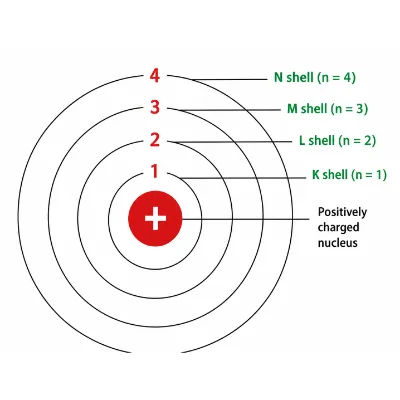
This diagram explains the principal quantum number n, which identifies the main energy level or shell occupied by an electron in an atom.
    The K, L, M, and N shells correspond to n = 1, n = 2, n = 3, and n = 4, respectively.
    As n increases, the shell is generally farther from the nucleus and has a higher energy.
    The diagram also shows the maximum electron capacity of each shell using the formula 2n2, helping students connect shell labels, quantum numbers, energy levels, and electron arrangement in a clear visual way.
Azimuthal (Angular Momentum) Quantum Number ℓ
The angular momentum quantum number, ℓ, determines the shape of the electron’s orbital. Its allowed values depend on the value of n. For a given principal quantum number, ℓ can take the values:
ℓ = 0, 1, 2, …, n − 1
Each value of ℓ corresponds to a particular type of subshell:
- ℓ = 0 → s-orbital, usually represented as spherical.
- ℓ = 1 → p-orbital, often represented as dumbbell-shaped.
- ℓ = 2 → d-orbital, with more complex shapes.
- ℓ = 3 → f-orbital, with even more intricate structures.
Each combination of n and ℓ identifies a subshell. For example, 2s means n = 2 and ℓ = 0, while 3d means n = 3 and ℓ = 2.
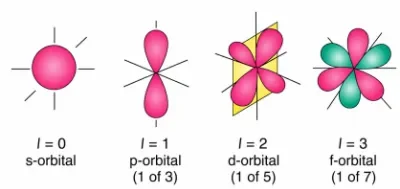
This diagram illustrates the meaning of the azimuthal quantum number l by linking each value to a characteristic orbital type and shape.
    The s-orbital (l = 0) is spherical, the p-orbital (l = 1) has a dumbbell shape, the d-orbital (l = 2) has a more complex clover-like form, and the f-orbital (l = 3) has an even more intricate multi-lobed structure.
    The labels also show that the figure represents one example orbital from each subshell, helping students see how the azimuthal quantum number determines orbital shape.
Magnetic Quantum Number mℓ
The magnetic quantum number, mℓ, specifies the orientation of an orbital in three-dimensional space. For a given value of ℓ, the allowed values of mℓ range from −ℓ to +ℓ, including zero:
mℓ = −ℓ, …, 0, …, +ℓ
For example:
- If ℓ = 0, then mℓ = 0. This gives one s-orbital.
- If ℓ = 1, then mℓ = −1, 0, +1. This gives three p-orbitals.
- If ℓ = 2, then mℓ = −2, −1, 0, +1, +2. This gives five d-orbitals.
The number of possible mℓ values tells us how many orbitals exist in a subshell. This is why a p-subshell contains three orbitals, while a d-subshell contains five orbitals.
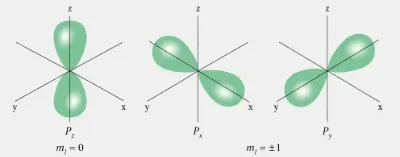
This diagram illustrates how the magnetic quantum number ml relates to orbital orientation in space.
    For a p-subshell, the angular momentum quantum number is l = 1, giving three possible orientations.
    These are commonly represented as pz, px, and py, showing how orbitals of the same shape can point along different spatial axes.
    The diagram helps students distinguish orbital shape from orbital orientation: l describes the type of orbital, while ml describes its orientation.
Spin Quantum Number ms
The spin quantum number, ms, describes the intrinsic spin state of an electron. It can have only two possible values:
ms = +½ or ms = −½
These are often described as spin-up and spin-down. The spin quantum number is important because each orbital can hold a maximum of two electrons, and those two electrons must have opposite spins.
- Each orbital can hold up to two electrons with opposite spin values.
- Unpaired electrons can contribute to magnetism, especially paramagnetism.
- Fully paired electrons often lead to diamagnetic behaviour.
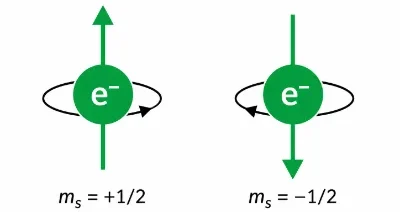
This diagram illustrates the electron spin quantum number, ms, using the common symbolic representation of spin-up and spin-down states.
    The upward arrow represents ms = +1/2, while the downward arrow represents ms = -1/2.
    The circular arrows are visual aids only; electron spin should not be interpreted as a tiny electron physically rotating like a ball.
    In quantum mechanics, spin is an intrinsic property of the electron and is important for explaining electron pairing, orbital filling, magnetism, and the Pauli exclusion principle.
Concept Check: Which Quantum Number Describes Orbital Shape?
The four quantum numbers describe different parts of an electron’s state: energy level, orbital shape, orbital orientation, and spin.
Which quantum number describes the shape of an orbital?
A. n
B. ℓ
C. mℓ
D. ms
B. ℓ
C. mℓ
D. ms
The correct answer is B. The angular momentum quantum number, ℓ, describes the shape of the orbital. For example, ℓ = 0 corresponds to an s-orbital, while ℓ = 1 corresponds to a p-orbital.
3. Core Physics Principles: Electron Configuration Rules
The arrangement of electrons in an atom follows specific rules:
- Aufbau Principle: Electrons fill the lowest available energy orbitals first.
- Pauli Exclusion Principle: No two electrons in an atom can have identical sets of four quantum numbers.
- Hund’s Rule: Within a subshell, electrons occupy separate orbitals singly before pairing up, minimizing electron repulsion.
The general order of orbital filling is:
1s → 2s → 2p → 3s → 3p → 4s → 3d → 4p → 5s → 4d → 5p → 6s → 4f → 5d → 6p → 7s
Example – Oxygen (Atomic Number 8)
Oxygen has 8 electrons, filling orbitals as follows:
- 1s2: 2 electrons in the first shell’s s-orbital
- 2s2: 2 electrons in the second shell’s s-orbital
- 2p4: 4 electrons in the second shell’s p-orbitals
Full Electron Configuration: 1s2 2s2 2p4
This means oxygen has two electrons in the 1s orbital, two in the 2s orbital, and four in the 2p orbitals, with two of them remaining unpaired. These unpaired electrons make oxygen highly reactive, leading to its strong tendency to form bonds.
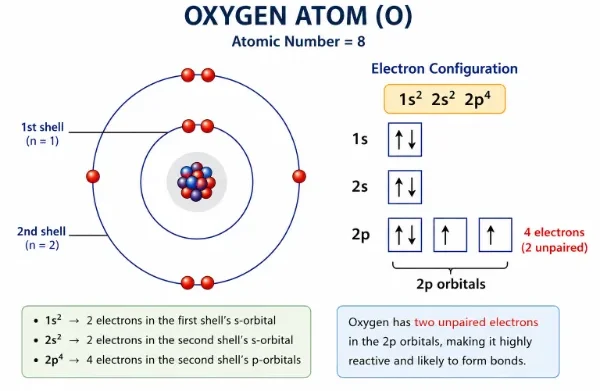
This diagram shows how the 8 electrons of an oxygen atom are arranged in shells and orbitals.
    Two electrons occupy the first shell in the 1s orbital.
    The remaining six electrons occupy the second shell, with two in the 2s orbital and four in the 2p orbitals.
    The orbital diagram shows that oxygen has two unpaired electrons in the 2p orbitals, helping explain why oxygen is chemically reactive and readily forms bonds.
Noble Gas Notation
To simplify electron configurations, noble gas notation is used. For oxygen: [He] 2s2 2p4
Here, [He] represents the electron configuration of helium (1s2), simplifying notation while retaining all essential electron placement details.
Concept Check: Why Does Oxygen Have Two Unpaired Electrons?
Electron configuration is not only about counting electrons. It also shows how electrons fill orbitals. In oxygen, the configuration is 1s2 2s2 2p4.
The 1s and 2s orbitals are filled with paired electrons. The 2p subshell has three orbitals. According to Hund’s rule, electrons occupy separate orbitals first before pairing up when orbitals of the same energy are available.
For oxygen, how many unpaired electrons are found in the 2p orbitals?
A. 0
B. 1
C. 2
D. 4
B. 1
C. 2
D. 4
The correct answer is C. Oxygen has four electrons in the 2p subshell. The first three occupy the three 2p orbitals separately, and the fourth pairs with one of them. This leaves two 2p electrons unpaired.
These unpaired electrons help explain why oxygen is reactive and why electron configuration is important for understanding bonding, magnetism, and chemical behaviour.
4. Mathematical Foundations & Quantum Counting Rules
Quantum numbers define strict mathematical bounds on how many quantum states exist within any given energy shell or subshell:
- For a given principal quantum number n, there are n subshells with ℓ ranging from 0 to n − 1.
- For a given azimuthal quantum number ℓ, there are 2ℓ + 1 orbitals with mℓ ranging from −ℓ to +ℓ.
- The total number of orbitals in a shell n is n2.
- The maximum electron capacity of a shell n is 2n2, accounting for the 2 spin states (ms = ±½) per orbital.
5. Practical Applications & Material Significance
Quantum numbers and electron configuration are fundamental tools for explaining how atoms behave. They show how electrons are arranged in shells, subshells, orbitals, and spin states, helping students understand why different elements have different chemical and physical properties.
Organizing Electrons in Atomic Orbitals
Quantum numbers describe the allowed energy levels and spatial distribution of electrons in atoms. These values govern the behavior and arrangement of electrons in orbitals. Mastery of these concepts is essential for understanding atomic and molecular structure.Periodic Table and Chemical Properties
Electron configuration explains the structure of the periodic table and the trends in atomic behavior. Students explore how elements’ reactivity, bonding, and ionization energies relate to electron arrangements. This builds connections between physics and chemistry.Rules and Principles in Electron Filling
Students study the Pauli Exclusion Principle, Hund’s Rule, and the Aufbau Principle. These rules dictate how electrons fill orbitals in multi-electron atoms. Understanding these principles allows students to predict stable configurations and enhances problem-solving skills.Applications in Spectroscopy and Material Science
Electron configurations determine the absorption and emission spectra of atoms. Students learn how these properties are used in identifying elements and studying materials. This supports research in astrophysics, nanotechnology, and quantum chemistry.Foundation for Advanced Theory
Quantum numbers and electron configuration provide a stepping stone to quantum mechanics and molecular modeling. Students gain the tools needed for analyzing atomic interactions, chemical bonding, and molecular orbitals in advanced science and engineering.Physical Behavior and Magnetism
Beyond chemistry, these principles help explain physical phenomena such as magnetism, electrical conductivity, and energy bands in solids. Unpaired electrons contribute to magnetic moments, while band structure governs conductivity in materials science.Concept Integration: From Electron Arrangement to Material Behaviour
Quantum numbers and electron configuration may look abstract at first, but they help explain why elements behave differently. The arrangement of electrons affects bonding, reactivity, magnetism, conductivity, and many material properties.
Which statement best explains why electron configuration is important?
A. It tells us only the size of the nucleus.
B. It shows how electrons are arranged, helping explain bonding, periodic trends, and material behaviour.
C. It applies only to gases and not to solids.
D. It replaces the need to study atoms, molecules, and materials.
B. It shows how electrons are arranged, helping explain bonding, periodic trends, and material behaviour.
C. It applies only to gases and not to solids.
D. It replaces the need to study atoms, molecules, and materials.
The correct answer is B. Electron configuration shows how electrons occupy shells, subshells, and orbitals. This helps explain why elements bond in particular ways, why periodic trends occur, and why materials may behave as conductors, semiconductors, insulators, or magnetic substances.
6. Key Terms Glossary
- Quantum Number
- A value used to describe a specific property of an electron in an atom, such as its energy level, orbital shape, orbital orientation, or spin.
- Principal Quantum Number, n
- Describes the main energy level or shell of an electron. Higher values of n generally mean the electron is farther from the nucleus and has higher energy.
- Angular Momentum Quantum Number, ℓ
- Describes the shape of an orbital. Values of ℓ = 0, 1, 2, 3 correspond to s, p, d, and f orbitals.
- Magnetic Quantum Number, mℓ
- Describes the orientation of an orbital in space. It explains why a p-subshell has three orbitals and a d-subshell has five orbitals.
- Spin Quantum Number, ms
- Describes the spin state of an electron, usually written as +½ or −½.
- Orbital
- A region of space around the nucleus where an electron is likely to be found. Orbitals are probability regions, not fixed circular paths.
- Electron Configuration
- The notation used to show how electrons are arranged in shells, subshells, and orbitals, such as 1s2 2s2 2p4 for oxygen.
- Pauli Exclusion Principle
- The rule that no two electrons in the same atom can have the same set of four quantum numbers.
- Hund’s Rule
- The rule that electrons occupy equal-energy orbitals singly before pairing, helping explain unpaired electrons in atoms such as oxygen.
- Aufbau Principle
- The principle that electrons generally fill lower-energy orbitals before higher-energy orbitals.
7. Frequently Asked Questions
What are quantum numbers in atomic physics?
Quantum numbers are a set of values that label the allowed quantum states of an electron in an atom. They arise from solving the Schrödinger equation for the hydrogen atom and describe properties such as the electron’s energy, angular momentum, orientation in space, and spin. Together, quantum numbers tell us which orbital an electron occupies and how electrons are arranged around the nucleus.
What does the principal quantum number n represent?
The principal quantum number n takes positive integer values (n = 1, 2, 3, …) and mainly determines the energy level and approximate size of the electron’s orbital. Larger n values correspond to shells that are, on average, further from the nucleus and higher in energy. In electron configurations, n labels the main shells (such as 1s, 2p, 3d) and helps organise electrons into energy levels.
What is the orbital (azimuthal) quantum number l and how is it related to subshells?
The orbital, or azimuthal, quantum number l determines the shape of the electron’s orbital and is linked to its orbital angular momentum. For a given principal quantum number n, l can take integer values from 0 up to n – 1. Each value of l corresponds to a subshell type: l = 0 is s, l = 1 is p, l = 2 is d, and l = 3 is f. These subshells appear in electron configurations as 2p, 3d, 4f, and so on.
What is the magnetic quantum number ml and what does it describe?
The magnetic quantum number ml describes the orientation of an orbital in space relative to an external magnetic field. For a given l, ml can take integer values from –l to +l, including zero. For example, if l = 1, then ml can be –1, 0, or +1, giving three p orbitals with the same energy but different orientations. These different orientations become important in magnetic fields and in bonding.
What is the spin quantum number ms and why is electron spin important?
The spin quantum number ms describes the intrinsic spin of the electron and can take only two values: +1/2 or –1/2. Spin is a purely quantum property that has no exact classical analogue but behaves like a tiny magnetic moment. The two spin states allow two electrons to occupy the same orbital with opposite spins, and spin plays a key role in magnetism, spectroscopy, and the Pauli exclusion principle.
What is the Pauli exclusion principle and how does it restrict quantum numbers?
The Pauli exclusion principle states that no two electrons in a single atom can have the same set of four quantum numbers (n, l, ml, ms). This means that at most two electrons can occupy a given orbital, and if they do, they must have opposite spins. The exclusion principle explains the structure of electron shells, the pattern of the periodic table, and many properties of matter such as the stability of atoms and the behaviour of electrons in solids.
What is an electron configuration?
An electron configuration is a compact way of showing how electrons are distributed among the available atomic orbitals in an atom. It lists the occupied shells and subshells using symbols like 1s2 2s2 2p6, where the superscript gives the number of electrons in each subshell. Electron configurations are built using quantum numbers, the Pauli exclusion principle, and rules about the order in which orbitals are filled.
What is the Aufbau principle and how does it guide electron configurations?
The Aufbau principle is a guideline for building up electron configurations by adding electrons to the lowest available energy orbitals first. In practice, this leads to a characteristic filling order such as 1s, 2s, 2p, 3s, 3p, 4s, then 3d, and so on. The principle reflects the tendency of electrons to occupy lower-energy states when possible, although there are some well-known exceptions for certain elements.
What is Hund’s rule and how does it affect electron filling in subshells?
Hund’s rule states that when electrons occupy orbitals of the same energy (degenerate orbitals), they first fill them singly with parallel spins before any pairing occurs. For example, in a p subshell with three orbitals, one electron will go into each orbital with the same spin direction before any orbital receives a second electron. This arrangement minimises electron repulsion and often leads to a lower-energy configuration.
How is noble gas (shorthand) notation used in electron configurations?
Noble gas notation is a shorthand method that uses the electron configuration of the nearest preceding noble gas to simplify long configurations. The core electrons are represented by the noble gas symbol in square brackets, followed by the remaining valence electrons. For example, instead of writing out 1s2 2s2 2p6 3s2 3p6 4s2, we can write [Ar] 4s2. This highlights the outermost electrons that are most important for chemical behaviour.
Why do some elements show exceptions to the simple Aufbau order?
Some elements, such as chromium and copper, show electron configurations that differ slightly from the simple Aufbau prediction. These exceptions occur because half-filled and fully filled subshells can be slightly more stable, and small energy differences between orbitals can favour arrangements that maximise stability. Atomic physics and quantum chemistry refine the basic filling rules by considering electron–electron interactions and subtle energy shifts.
Why are quantum numbers and electron configurations important for physics and chemistry students?
Quantum numbers and electron configurations link the abstract mathematics of quantum mechanics to concrete patterns in the periodic table and chemical bonding. They help explain why elements form certain ions and molecules, why spectral lines appear where they do, and why materials have particular optical, electrical, or magnetic properties. For students, mastering these ideas provides a foundation for more advanced topics in atomic physics, chemistry, solid-state physics, and materials science.
8. Assessment Exercises
Part 1: Review Questions
Q1. What are quantum numbers and what role do they play in atomic physics?
Answer: Quantum numbers are sets of numerical values that describe the energy, shape, orientation, and spin of an electron’s orbital in an atom. They define the unique quantum state of each electron, determining its position and behaviour within the atom.
Q2. What does the principal quantum number n represent?
Answer: The principal quantum number, n, indicates the energy level or shell of an electron and is related to the size of the orbital. Higher n values correspond to orbitals that are generally farther from the nucleus and have higher energy.
Q3. How does the angular momentum quantum number ℓ influence the shape of an orbital?
Answer: The angular momentum quantum number, ℓ, determines the orbital’s shape and is associated with the subshells s, p, d, and f. For a given n, ℓ can take values from 0 to n − 1. For example, ℓ = 0 corresponds to an s-orbital (spherical), while ℓ = 1 corresponds to a p-orbital (dumbbell-shaped).
Q4. What information does the magnetic quantum number mℓ provide?
Answer: The magnetic quantum number, mℓ, indicates the orientation of an orbital in space. Its possible values range from −ℓ to +ℓ, including zero. These values determine the number of orbitals within a subshell and their spatial orientations.
Q5. What is the spin quantum number ms, and why is it important?
Answer: The spin quantum number, ms, describes the intrinsic spin state of an electron, with possible values of +½ or −½. It is important because it helps explain electron pairing, magnetic behaviour, and the Pauli exclusion principle, which states that no two electrons in the same atom can have the same set of four quantum numbers.
Q6. How do quantum numbers determine the electron configuration of an atom?
Answer: Electron configuration is determined by filling orbitals in order of increasing energy while obeying the Pauli exclusion principle and Hund’s rule. The set of quantum numbers for each electron specifies its energy level, subshell, orbital orientation, and spin.
Q7. What is the Aufbau principle and how does it relate to electron configuration?
Answer: The Aufbau principle states that electrons occupy the lowest available energy orbitals first before filling higher energy orbitals. This principle guides the order in which orbitals are populated.
Q8. How does Hund’s rule affect the way electrons are arranged in degenerate orbitals?
Answer: Hund’s rule states that electrons fill degenerate orbitals (orbitals of equal energy) singly with parallel spins before pairing up. This arrangement reduces electron-electron repulsion and gives a more stable electron configuration.
Q9. In what way do quantum numbers help predict the chemical properties of elements?
Answer: Quantum numbers determine the electron configuration of an atom, which influences chemical reactivity, bonding behaviour, and placement in the periodic table. The arrangement of electrons in the outermost shell largely governs chemical properties.
Q10. How can the study of electron configuration help us understand periodic trends?
Answer: Electron configuration reveals patterns in how electrons are distributed among orbitals. These patterns help explain periodic trends such as atomic size, ionisation energy, electron affinity, and electronegativity across the periodic table.
Part 2: Applied & Thought-Provoking Scenarios
Q1. How do quantum numbers illustrate the dual wave-particle nature of electrons?
Answer: Quantum numbers emerge from solutions to the Schrödinger equation, which treats electrons as wavefunctions with probabilistic distributions. This description captures both wave-like behaviour (probability patterns and orbital shapes) and particle-like behaviour (discrete energy levels).
Q2. Can the principles of quantum numbers and electron configuration be applied to exotic atoms or ions?
Answer: Yes. Quantum mechanical principles can be extended to unusual systems such as highly charged ions, hydrogen-like ions, and exotic atoms where another particle (like a muon) replaces an electron. These systems help scientists test atomic theory under extreme conditions.
Q3. In what ways might computational quantum chemistry refine our understanding of electron configurations in complex molecules?
Answer: Computational quantum chemistry uses mathematical models and computer simulations to approximate the behaviour of electrons in complex molecules. As computing power improves, these methods produce more accurate predictions of electron configurations, bonding patterns, and chemical reactivity.
Q4. How does electron configuration challenge our classical intuition about electron movement and position?
Answer: In classical thinking, particles have definite trajectories. Electrons in atoms do not behave this way; they are described by probability clouds rather than fixed orbits. Electron configuration replaces classical paths with a quantum picture based on orbitals and allowed states.
Q5. What implications does the Pauli exclusion principle have for the structure and stability of matter?
Answer: The Pauli exclusion principle prevents two electrons in the same atom from having identical sets of four quantum numbers. This forces electrons to occupy different states, producing the layered structure of electron shells. Without this principle, all electrons would collapse into the lowest energy state, preventing complex chemistry.
Q6. How might an improved understanding of electron configuration contribute to nanotechnology?
Answer: At nanoscale dimensions, the arrangement of electrons strongly affects how materials conduct electricity, absorb light, emit light, or respond to magnetic fields. Controlling electron configurations supports applications in nanoelectronics, quantum dots, and advanced sensors.
Q7. Could the manipulation of electron configurations lead to breakthroughs in quantum computing?
Answer: Yes. Quantum computing depends on the controlled manipulation of quantum states. Electron spin states, orbital states, and energy-level structures can be used to create or control qubits for quantum information processing.
Q8. In what ways do electron configurations influence the magnetic properties of materials?
Answer: Magnetic properties are strongly influenced by electron spin and orbital arrangements. Materials with unpaired electrons exhibit paramagnetism or ferromagnetism, as alignment of electron spins determines total magnetic moment.
Q9. How might relativistic effects alter expected quantum numbers and electron configurations in heavy elements?
Answer: In heavy elements, inner electrons experience strong nuclear attraction and move at near-light speeds. Relativistic mass increases contract s and p orbitals, altering subshell energy levels and causing unexpected electron configurations (e.g., in gold or mercury).
Q10. What role does electron configuration play in determining an element’s placement and trends within the periodic table?
Answer: Elements in the same group share valence electron configurations, leading to similar chemical behaviour. Sequential filling of orbitals across periods explains systemic trends in atomic radius, ionisation energy, and electronegativity.
Q11. How can experimental techniques such as photoelectron spectroscopy enhance our understanding of electron configurations?
Answer: Photoelectron spectroscopy measures the kinetic energy of electrons ejected by photon absorption. This reveals precise binding energies for each shell and subshell, providing direct empirical proof of electron configurations.
Q12. In what ways might the study of electron configuration contribute to new materials with tailored properties?
Answer: Understanding electron arrangements enables intentional material synthesis for semiconductors, high-temperature superconductors, catalysts, and solar energy materials tailored at the subatomic level.
Part 3: Numerical Problems with Step-by-Step Worked Solutions
Problem 1: Maximum Electrons in Energy Level n = 3
Calculate the maximum number of electrons that can occupy the n = 3 energy level.
Solution:
The total capacity of a shell is given by:
N = 2n2
Substitute n = 3:
N = 2 × 32 = 2 × 9 = 18
Answer: 18 electrons.
Problem 2: Maximum Electrons in a p Subshell
Determine the maximum number of electrons in a p subshell.
Solution:
For a p subshell, ℓ = 1. Number of orbitals = 2ℓ + 1 = 2(1) + 1 = 3. Each orbital holds up to 2 electrons:
Maximum electrons = 3 × 2 = 6
Answer: 6 electrons.
Problem 3: Maximum Electrons in a d Subshell
Find the maximum number of electrons in a d subshell.
Solution:
For a d subshell, ℓ = 2. Number of orbitals = 2ℓ + 1 = 2(2) + 1 = 5. Each orbital holds up to 2 electrons:
Maximum electrons = 5 × 2 = 10
Answer: 10 electrons.
Problem 4: Valid Set of Quantum Numbers for a 4p Electron
For an electron in the 4p subshell, list a valid set of quantum numbers (n, ℓ, mℓ, ms).
Solution:
For 4p: n = 4, ℓ = 1. Allowed values for mℓ are −1, 0, +1. Allowed values for ms are +½ or −½.
Answer: A valid set is (4, 1, 0, +½).
Problem 5: Electron Configuration and Quantum Numbers for Oxygen (Z = 8)
Write the electron configuration for oxygen (Z = 8) and give a set of quantum numbers for the last electron added.
Solution:
Oxygen configuration: 1s2 2s2 2p4.
For the fourth 2p electron (which pairs up in one of the 2p orbitals):
n = 2, ℓ = 1, mℓ = −1 (or 0, +1), ms = −½
Answer: Configuration is 1s2 2s2 2p4; quantum numbers: (2, 1, −1, −½).
Problem 6: Total Orbitals in Shell n = 4
Calculate the total number of orbitals in the n = 4 shell.
Solution:
The total number of orbitals in shell n is given by:
Orbitals = n2 = 42 = 16
(Breakdown: 1 s-orbital, 3 p-orbitals, 5 d-orbitals, 7 f-orbitals = 16 total).
Answer: 16 orbitals.
Problem 7: Maximum Electrons in an f Subshell
Determine the maximum number of electrons in an f subshell.
Solution:
For an f subshell, ℓ = 3. Number of orbitals = 2(3) + 1 = 7. Maximum electrons = 7 × 2 = 14.
Answer: 14 electrons.
Problem 8: Orbitals in a d Subshell with |mℓ| = 2
How many orbitals in a d subshell have |mℓ| = 2?
Solution:
For d subshell (ℓ = 2), mℓ = −2, −1, 0, +1, +2. The values satisfying |mℓ| = 2 are mℓ = −2 and mℓ = +2.
Answer: 2 orbitals.
Problem 9: Electron Configuration of Nitrogen (Z = 7) and 2p Spins
Write the electron configuration of nitrogen (Z = 7) and describe the spin states of the 2p electrons.
Solution:
Nitrogen configuration: 1s2 2s2 2p3. By Hund’s rule, the 3 electrons in 2p occupy three separate orbitals with parallel spins (ms = +½ for each).
Answer: 1s2 2s2 2p3; all three 2p electrons are unpaired with parallel spins.
Problem 10: Total p Orbitals for Shells n = 2 and n = 3
Calculate the total number of p orbitals for shells n = 2 and n = 3.
Solution:
Each p subshell (ℓ = 1) contains 3 orbitals. n = 2 has a 2p subshell (3 orbitals); n = 3 has a 3p subshell (3 orbitals). Total = 3 + 3 = 6.
Answer: 6 orbitals.
Problem 11: Unpaired Electrons in Configuration Ending in 3d5 4s1
An atom has an electron configuration ending in 3d5 4s1 (Chromium). Determine the total number of unpaired electrons.
Solution:
In 3d5, all 5 d-orbitals are singly occupied → 5 unpaired electrons. In 4s1, the s-orbital is singly occupied → 1 unpaired electron. Total = 5 + 1 = 6.
Answer: 6 unpaired electrons.
Problem 12: Total Electron Capacity of 2p and 3p Subshells
Determine the total number of electrons that can occupy the 2p and 3p subshells combined.
Solution:
Each p subshell holds a maximum of 6 electrons. Combined capacity = 6 + 6 = 12 electrons.
Answer: 12 electrons.
History, Challenges, and Future Prospects
The development of quantum numbers and electron configuration represents one of the greatest triumphs of twentieth-century physics, transitioning chemistry from empirical observations to fundamental quantum mechanics.
Historical Milestones: Niels Bohr’s 1913 planetary model introduced the principal quantum number n to explain quantised atomic orbits. Arnold Sommerfeld expanded this in 1916 by adding elliptical orbits, introducing the azimuthal quantum number ℓ and magnetic quantum number mℓ. In 1925, Wolfgang Pauli proposed his Exclusion Principle, and shortly after, George Uhlenbeck and Samuel Goudsmit introduced electron spin (ms), completing the four-quantum-number framework. Schrödinger’s wave equation formally unified these numbers as spatial eigenvalues.
Current Challenges: For light atoms, simple rules work extraordinarily well. However, in heavy and superheavy elements (such as transuranic elements), relativistic effects cause inner electrons to move near the speed of light. This contracts s and p orbitals while expanding d and f orbitals, creating severe deviations from standard Aufbau filling orders and complicating computational quantum predictions.
Future Prospects: Precise control of electron configurations is driving the development of quantum technology. Artificial atoms (quantum dots) use tailored electron confinement to engineer customized energy levels for lasers and solar cells. Furthermore, manipulating single electron spin states in semiconductor lattices forms the cornerstone of spintronics and spin-based qubit architectures in quantum computing.
Cluster Navigation & Academic References
Related Prep4Uni.online Learning Pages
Quantum Numbers and Electron Configuration connects naturally with other pages in the Atomic Physics, Quantum Mechanics, and Modern Physics clusters:
- Modern Physics Hub — Overview of modern physics, quantum mechanics, and relativity.
- Atomic Physics Sub-Hub — Primary cluster navigation and foundational principles of atomic structure.
- Structure of the Atom — Explains how atoms are organised, including the nucleus, orbitals, and classical vs quantum pictures.
- Atomic Spectra and Energy Transitions — Shows how electron transitions between energy levels emit and absorb light.
- Atomic Interactions with Radiation — Examines photon interactions including excitation, ionisation, and stimulated emission.
- Quantum Mechanics Hub — Conceptual and mathematical foundations of quantum systems.
External References & Data Sources
- OpenStax Chemistry 2e – Electronic Structure of Atoms: Electron Configurations — Open textbook section explaining orbital filling and electron rules.
- OpenStax College Physics 2e – Quantum Numbers and Rules — Physics-based explanation of quantum rules and atomic structure.
- Chemistry LibreTexts – Quantum-Mechanical Orbitals — Comprehensive guide to orbitals and the Pauli exclusion principle.
- NIST Atomic Spectra Database — Authoritative database of evaluated atomic energy levels and transition probabilities.
Archived version: This learning resource is archived on Zenodo at https://zenodo.org/records/20570351.
Suggested citation: Gan, J. (2026). Quantum Numbers and Electron Configuration: Shells, Orbitals and Spin States. Prep4Uni.online. Zenodo. https://doi.org/10.5281/zenodo.20570351