
Radioactivity and isotopes lie at the heart of understanding unstable nuclei and how they transform into more stable configurations. These processes, first observed through natural emissions from radioactive elements, reveal that atomic nuclei are not always permanent structures, but systems capable of spontaneous change.
While atomic physics explains the arrangement of electrons around the nucleus, radioactivity focuses on changes within the nucleus itself. Isotopes—atoms with the same number of protons but different numbers of neutrons—play a central role in this behaviour, as variations in neutron number directly affect nuclear stability.
Within nuclear physics, radioactive decay occurs through processes such as alpha, beta, and gamma emission. These transformations allow unstable nuclei to release energy and move toward more stable states. Understanding these processes also connects to broader phenomena such as nuclear reactions, fission, and fusion.
The behaviour of radioactive decay is inherently probabilistic. Each nucleus has a certain likelihood of decay over time, described through concepts such as half-life. These ideas are grounded in quantum mechanics, where processes such as quantum tunneling explain how particles can escape the nucleus.
Beyond theory, radioactivity has profound applications. It enables medical imaging and cancer treatment, supports radiometric dating in archaeology, and plays a role in energy production and scientific research. By studying radioactivity and isotopes, we gain insight into both the instability of matter and the controlled use of nuclear processes in modern society.
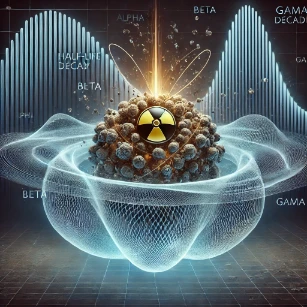
This illustration represents radioactive decay as a transformation process within the nucleus.
    An unstable nucleus emits alpha particles, beta particles, or gamma radiation to reduce excess energy and reach a more stable configuration.
    The surrounding wave patterns symbolise the probabilistic nature of decay and the different pathways through which nuclear transformations occur.
Pause and Think: Why Do Isotopes Matter?
Two atoms of the same element always have the same number of protons. That is why they belong to the same element. But they may have different numbers of neutrons. This difference can change the stability of the nucleus, even though the chemical identity of the atom remains the same.
For example, two carbon atoms may both have 6 protons, but one may have 6 neutrons while another has 8 neutrons. They are both carbon, but their nuclei do not behave in exactly the same way.
Isotopes matter because neutron number affects nuclear stability. Some isotopes are stable, while others are radioactive and decay over time. This is why radioactivity is closely linked to the study of isotopes: the identity of the element depends on proton number, but the stability of the nucleus depends strongly on the balance between protons and neutrons.
1. Nuclear Stability, Decay, and Variation
This section explores how nuclear stability is maintained or disrupted, leading to radioactive decay, induced reactions, and energy transformations across different nuclear processes.
Modern Physics
Provides the theoretical foundation for understanding unstable nuclei, quantum-driven decay processes, and the behaviour of matter at subatomic scales.Radioactivity and Isotopes
Explains how unstable nuclei emit radiation and how differences in neutron number influence nuclear stability, decay pathways, and practical applications.Nuclear Physics – Overview
Connects radioactive decay to broader concepts of nuclear structure, binding energy, and large-scale energy transformations.Nuclear Reactions
Examines how nuclei can be transformed through induced interactions, extending beyond spontaneous decay to controlled and high-energy processes.Nuclear Fission
Describes how heavy nuclei split into smaller fragments, initiating chain reactions that release energy in reactors and other systems.Nuclear Fusion
Explores how light nuclei combine under extreme conditions, contrasting decay processes with energy generation in stars and future technologies.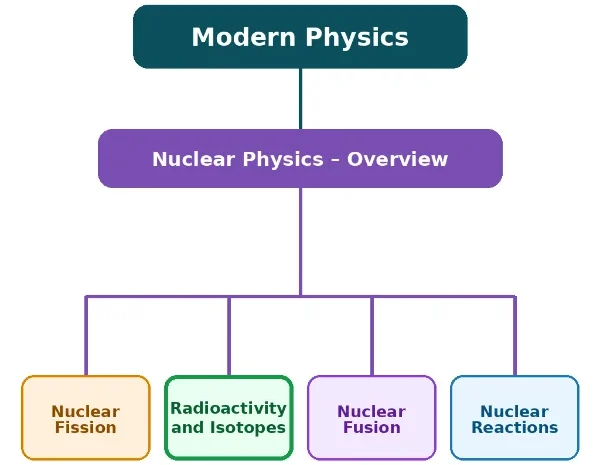
This structure chart places Radioactivity and Isotopes within the wider Nuclear Physics cluster under Modern Physics.
    It shows Radioactivity and Isotopes as one of four related subtopics, alongside Nuclear Fission, Nuclear Fusion, and Nuclear Reactions.
    The chart helps students see how spontaneous decay connects with broader nuclear phenomena.
2. Theoretical Deep Dive: Types of Radioactive Decay
Radioactive decay occurs when an unstable nucleus releases particles or energy in order to move toward a more stable arrangement. The three primary forms are alpha decay, beta decay, and gamma decay. Each type alters the nucleus differently, shifting the atomic number, mass number, or internal quantum energy state.
Alpha Decay (α)
A heavy nucleus emits an alpha particle (two protons and two neutrons, helium nucleus). This reduces the atomic number by 2 and the mass number by 4, reducing size and Coulomb repulsion in massive nuclei.Beta Decay (β)
Alters the neutron-to-proton balance via the weak force. In beta-minus decay, a neutron transforms into a proton, emitting an electron and antineutrino. In beta-plus decay, a proton transforms into a neutron, emitting a positron and neutrino.Gamma Decay (γ)
Occurs when a nucleus in an excited state drops to a lower energy state by emitting a high-energy gamma photon. Neither the atomic number nor the mass number changes.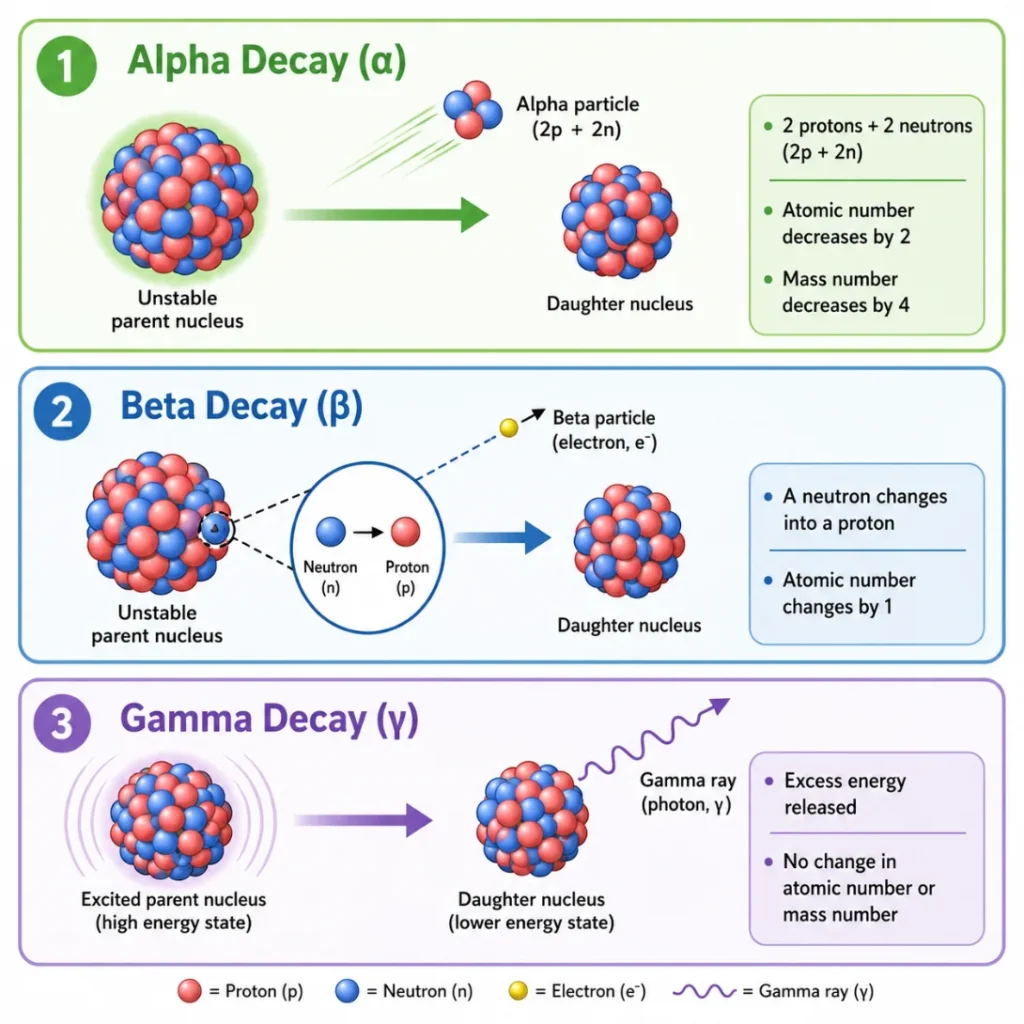
This illustration compares the three main types of radioactive decay.
    In alpha decay, a heavy unstable nucleus emits an alpha particle made of two protons and two neutrons.
    In beta decay, a neutron may change into a proton while emitting a beta particle.
    In gamma decay, an excited nucleus releases excess energy as a gamma ray without changing its atomic number or mass number.
Example Nuclear Transformation Equations
23892U → 23490Th + α (Alpha Decay)
n → p + e− + ν̄e (Free Neutron Beta-Minus Decay)
146C → 147N + e− + ν̄e (Carbon-14 Decay)
p → n + e+ + νe (Beta-Plus Decay)
6027Co → 6028Ni* → 6028Ni + γ (Gamma De-excitation)
Concept Check: What Changes During Radioactive Decay?
What must stay strictly balanced across both sides of a nuclear decay equation?
Both the total mass number (sum of nucleons) and the total electric charge (sum of atomic numbers) must remain conserved. Alpha decay decreases mass number by 4 and atomic number by 2; beta decay changes atomic number by ±1 while keeping mass number constant; gamma decay changes neither.
3. Core Physics Principles: Half-Life & Exponential Kinetics
Radioactive decay is a stochastic, quantum-mechanical process. While individual nuclear decay events cannot be predicted, a large ensemble of unstable nuclei decays according to an exponential law governed by the decay constant λ:
$$ N(t) = N_0 e^{-\lambda t} $$
The half-life (t1/2) is the time required for half of the radioactive parent nuclei in a sample to decay:
$$ t_{1/2} = \frac{\ln 2}{\lambda} \approx \frac{0.693}{\lambda} $$
Activity (A) represents the rate of decay, measured in Becquerels (1 Bq = 1 decay per second):
A(t) = λ N(t)
4. Real-World Applications & Case Studies
Radiocarbon Dating
Carbon-14 (half-life ≈ 5,730 years) measures the elapsed time since the death of organic materials by tracking the decay of atmospheric C-14 absorbed during life.Targeted Radiotherapy
Cobalt-60 emits high-energy gamma rays directed precisely at malignant tumor sites to destroy cancer cell DNA while preserving surrounding tissue.Diagnostic Medical Imaging
Technetium-99m (half-life ≈ 6 hours) acts as a gamma-emitting radiotracer in single-photon emission computed tomography (SPECT) to monitor organ function.Industrial Radiography & Sterilization
Iridium-192 provides non-destructive testing of structural welds, while Cobalt-60 gamma irradiators sterilize medical supplies and food products without heat.Ionization Smoke Detectors
Americium-241 emits alpha particles that ionize air molecules between electrodes; smoke particles disrupt the current flow, triggering the alarm.Mini Case Study: Carbon-14 Dating Mechanics
Carbon-14 is continuously produced in the upper atmosphere when cosmic-ray neutrons strike Nitrogen-14:
147N + 10n → 146C + 11p
Living organisms ingest C-14 alongside stable C-12, maintaining a fixed environmental isotopic ratio. At death, uptake stops and C-14 decays back into Nitrogen-14 via beta-minus emission. By measuring the remaining activity ratio, archeologists accurately date organic artifacts up to 50,000 years old.
Concept Check: Isotope Utility Criteria
What determines whether a radioisotope is suitable for a specific real-world application?
Suitability depends on matching the decay mode (alpha, beta, gamma), energy emission level, penetrating power, and half-life to the task requirements to maximize precision while ensuring safety.
5. Safety, Environmental Considerations & Common Misconceptions
Radiation Health Hazards
High ionising radiation doses cause tissue ionization, cellular damage, radiation sickness, or DNA mutations. Exposure is managed via time, distance, and shielding (ALARA principle).Nuclear Waste Containment
Spent nuclear fuel and high-level waste containing long-lived radioisotopes require deep geological repositories to isolate radioactivity from biosphere water tables.Environmental Dispersion
Accidental releases during facility failures (e.g., Chernobyl, Fukushima) distribute volatile radioisotopes (Iodine-131, Cesium-137) requiring environmental monitoring.Common Misconceptions About Radioactivity
“Radioactivity Is Always Harmful”
Controlled low-level radiation is vital in diagnostic medicine, life-saving cancer therapies, smoke detectors, and archaeological research.“Radioactive Materials Glow”
Radioactivity is completely invisible. Luminescence only occurs if secondary phosphor materials are added or via Cherenkov radiation in high-power reactors.“Decay Rates Can Be Accelerated or Altered”
Radioactive decay constants are fundamental nuclear parameters unaffected by chemical reactions, temperature, extreme pressure, or magnetic fields.“Half-Life Means Complete Decay”
Half-life is the duration required for half the sample to decay. After two half-lives, 25% remains; after three, 12.5% remains exponentially.6. Key Terms Glossary
- Radioactivity
- The spontaneous breakdown of an unstable atomic nucleus via particle or electromagnetic radiation emission.
- Isotope
- Nuclides of the same chemical element possessing equal numbers of protons (same Z) but differing numbers of neutrons (different A).
- Half-Life (t1/2)
- The time required for half the radioactive parent nuclei in a sample to undergo decay.
- Activity (A)
- The decay rate of a radioactive source, measured in Becquerels (1 Bq = 1 decay/second) or Curies (1 Ci = 3.7 × 10¹⁰ Bq).
- Parent & Daughter Nuclei
- The initial decaying unstable nucleus is the parent; the resulting transformed nucleus is the daughter.
- Ionising Radiation
- High-energy particles or waves capable of removing bound electrons from atoms to create ions.
7. Frequently Asked Questions
What is radioactivity?
Radioactivity is the spontaneous emission of particles or energy from an unstable nucleus as it transforms into a more stable nuclear state.
What are isotopes?
Isotopes are atoms of the same element with identical proton counts but different neutron counts, leading to different physical stability and mass numbers.
Why is radioactive decay random?
Decay is governed by quantum barrier tunneling probabilities, making individual decay events unpredictable while establishing steady exponential averages across large populations.
What is half-life?
Half-life is the time required for exactly 50% of the active parent radioisotopes in a given sample to decay.
Where is radioactivity used?
Key applications include medical organ imaging, cancer radiotherapy, industrial material weld radiography, smoke detection, radiocarbon archaeological dating, and nuclear power generation.
8. Assessment Exercises
Part 1: Review Questions & Exam Tips
Q1. What defines radioactivity?
Answer: Radioactivity is the spontaneous emission of particles or energy from an unstable nucleus as it transitions toward lower potential energy. (Exam Tip: Always state “spontaneous” and “unstable nucleus”).
Q2. What defines isotopes?
Answer: Atoms with identical proton numbers (same chemical element) but differing neutron numbers. (Common Mistake: Saying isotopes differ in electron count).
Q3. What determines nuclear stability?
Answer: The neutron-to-proton ratio (N/Z) and binding energy per nucleon. Unbalanced ratios fall outside the belt of stability and decay.
Q4. How is nuclear activity measured?
Answer: In Becquerels (Bq), representing one nuclear disintegration per second, or Curies (1 Ci = 3.7 × 10¹⁰ Bq).
Part 2: Applied & Thought-Provoking Scenarios
Q1. How does understanding decay chains aid nuclear waste management?
Answer: Radioactive waste contains parent isotopes decaying into radioactive daughters; modeling decay chains predicts long-term heat generation and biological hazards across millennia.
Q2. How are radioisotopes applied in climate and environmental science?
Answer: Isotope ratios (e.g., Oxygen-18/Oxygen-16 in ice cores) act as paleoclimate thermometers, while radiotracers track global ocean currents and carbon cycle flux.
Part 3: Numerical Problems with Step-by-Step Worked Solutions
Problem 1: Half-Life Calculation from Decay Constant
Calculate the half-life of an isotope with decay constant λ = 2.5 × 10⁻⁷ s−1.
Solution:
$$ t_{1/2} = \frac{\ln 2}{\lambda} = \frac{0.69315}{2.5 \times 10^{-7} \text{ s}^{-1}} \approx 2.77 \times 10^6 \text{ s} $$
Answer: 2.77 × 10⁶ seconds (≈ 32 days).
Problem 2: Number of Atoms from Activity
A radioactive sample has an activity A = 1.0 × 10⁶ Bq and a decay constant λ = 1.0 × 10⁻⁵ s−1. Calculate the total number of active parent atoms present.
Solution:
$$ N = \frac{A}{\lambda} = \frac{1.0 \times 10^6 \text{ decays/s}}{1.0 \times 10^{-5} \text{ s}^{-1}} = 1.0 \times 10^{11} \text{ atoms} $$
Answer: 1.0 × 10¹¹ atoms.
Problem 3: Activity Unit Conversion (Curie to Becquerel)
Convert an activity of 150 Ci into Becquerels (Bq). (1 Ci = 3.7 × 10¹⁰ Bq).
Solution:
$$ A = 150 \times (3.7 \times 10^{10} \text{ Bq}) = 5.55 \times 10^{12} \text{ Bq} $$
Answer: 5.55 × 10¹² Bq.
Problem 4: Decay Constant from Fraction Remaining
A radioactive sample decreases to 25% of its original activity after 10 days (864,000 seconds). Calculate the decay constant λ.
Solution:
Since 25% remaining represents 2 half-lives (0.5 × 0.5 = 0.25), 2 t1/2 = 10 days ⇒ t1/2 = 5 days = 432,000 s.
$$ \lambda = \frac{\ln 2}{432000 \text{ s}} \approx 1.60 \times 10^{-6} \text{ s}^{-1} $$
Answer: 1.60 × 10⁻⁶ s−1.
Problem 5: Gamma Photon Energy
Calculate the energy in Joules of a gamma-ray photon with frequency ν = 2.0 × 10²⁰ Hz. (Use h = 6.626 × 10⁻³⁴ J·s).
Solution:
$$ E = h \nu = (6.626 \times 10^{-34} \text{ J s}) \times (2.0 \times 10^{20} \text{ s}^{-1}) \approx 1.33 \times 10^{-13} \text{ J} $$
Answer: 1.33 × 10⁻¹³ Joules (≈ 0.828 MeV).
Problem 6: Remaining Sample Fraction After 3 Half-Lives
An isotope has a half-life of 20 years. What fraction of the original sample remains after 60 years?
Solution:
Number of half-lives n = 60 / 20 = 3.
$$ \text{Fraction remaining} = \left(\frac{1}{2}\right)^3 = \frac{1}{8} = 0.125 $$
Answer: 0.125 (12.5%).
History, Challenges, and Future Prospects
The discovery of natural radioactivity inaugurated modern nuclear physics at the turn of the 20th century.
Historical Milestones: In 1896, Henri Becquerel discovered uranium radioactivity via photographic plates. Marie and Pierre Curie isolated polonium and radium in 1898. Ernest Rutherford categorized alpha, beta, and gamma radiation in 1899 and proved radioactive transmutation in 1902. Willard Libby developed radiocarbon dating in 1949.
Current Challenges: Secure long-term disposal of long-lived high-level radioisotopes, synthesizing medical radioisotopes without highly enriched uranium proliferation risks, and managing low-dose radiation safety standards.
Future Frontiers: Targeted Alpha Therapy (TAT) using short-lived alpha emitters to destroy microscopic cancer metastases, advanced radiotracer development for neurodegenerative disease imaging, and ultra-precise radiometric dating using accelerator mass spectrometry.
Cluster Navigation & Academic References
Related Modern Physics Topics
- Modern Physics Hub — Primary portal for non-classical physics domains.
- Nuclear Physics Overview — Nuclear structure, binding energy, and forces.
- Nuclear Reactions — Transmutation, cross-sections, and Q-values.
- Nuclear Fusion — Stellar nucleosynthesis and plasma confinement.
- Nuclear Fission — Fissile isotopes, chain reactions, and power reactors.
External References & Data Sources
- U.S. Nuclear Regulatory Commission: Radiation Basics — Radiation standards and biological health effects.
- IAEA: Radioisotopes in Science and Medicine — International guide on isotope production and application.
- Oxford Radiocarbon Accelerator Unit: Radiocarbon Dating — Technical methodologies for C-14 analysis.
- World Nuclear Association: Radioisotopes in Medicine — Comprehensive overview of radiopharmaceuticals.
Archived version: This learning resource is archived on Zenodo at https://zenodo.org/records/20570351.
Suggested citation: Gan, J. (2026). Radioactivity and Isotopes: Decay Modes, Half-Life Kinetics, and Practical Applications. Prep4Uni.online. Zenodo. https://doi.org/10.5281/zenodo.20570351