
At the deepest level of reality, everything that happens—from the motion of galaxies to the stability of atoms—is governed not by objects alone, but by interactions. These interactions are known as the fundamental forces, and they form the invisible framework that holds the universe together. Rather than acting as simple pushes or pulls, these forces define how particles influence one another, shaping both matter and the structure of space itself.
In physics, the fundamental forces are classified into four types: gravitational, electromagnetic, strong nuclear, and weak nuclear. Each operates over different scales and strengths, yet together they account for every observable phenomenon. From the binding of quarks inside protons to the expansion of the universe, these forces provide a unified way of understanding systems that would otherwise appear completely unrelated. The study of modern physics offers the conceptual tools needed to explore these interactions with precision and depth.
What makes this topic particularly profound is that forces are no longer viewed as mysterious actions at a distance. Within particle physics, interactions are understood as exchanges mediated by particles known as bosons, acting between fermions, the building blocks of matter. This perspective transforms forces from abstract concepts into dynamic processes, where particles continuously interact, exchange energy, and even change identity.
These ideas are deeply connected to quantum field theory, which provides the most complete framework for describing how forces operate at fundamental levels. At the same time, principles from quantum mechanics—such as superposition, uncertainty, and wave–particle duality—govern how these interactions unfold in practice, often defying classical intuition.
As a sub-hub, this page provides a structured pathway to understand how the four forces differ, how they are connected, and why they remain central to some of the deepest unanswered questions in physics. From the stability of matter to the evolution of the cosmos, the fundamental forces reveal that the universe is not just built from particles—but from relationships between them.
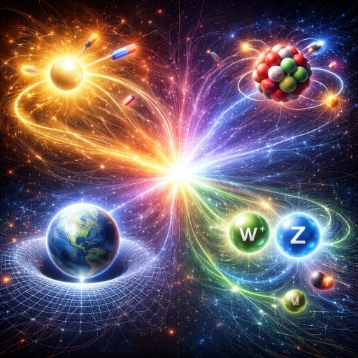
This vibrant space-themed image visualizes the four fundamental forces as distinct motifs connected to a brilliant central convergence.
    In one area, Earth rests on a curved grid, suggesting gravity and the bending of spacetime.
    Another region shows a radiant sphere with magnet-like elements and swirling field lines, evoking electromagnetism.
    A tightly packed cluster of multicolored spheres represents the strong force binding particles in the nucleus.
    Nearby, glowing particles and interaction-like orbs suggest the weak force associated with particle transformations and decay.
    Flowing, multicolored light trails connect the four regions, emphasizing that these forces act together across scales to govern the behavior of matter and energy.
1. Interaction Laws and Force Dynamics
Explore how forces are understood as interactions within modern physics. These connections link fundamental theories, particles, and the mechanisms through which the universe evolves and maintains structure.
Modern Physics
Establishes the theoretical foundation for describing forces as interactions mediated through quantum fields and exchange particles.Particle Physics – Overview
Connects force interactions to the broader framework of particles and fields that define subatomic structure and behaviour.Fermions (Matter Particles)
Shows how matter particles respond to forces through interactions that determine structure, motion, and stability.Bosons (Force Carriers)
Demonstrates how forces are transmitted through exchange particles that link interacting matter systems.2. Theoretical Deep Dive: The Four Fundamental Forces
All interactions in the universe can be traced back to four fundamental forces. Rather than viewing them as abstract concepts, think of each force as a distinct way nature allows particles to influence one another—shaping everything from atomic structure to cosmic evolution.
Strong Nuclear Force
This force binds quarks together to form protons and neutrons, and holds these particles within atomic nuclei. It is the reason matter can exist in a stable form.Electromagnetic Force
Responsible for interactions between charged particles, this force governs electricity, magnetism, light, and chemical bonding—making it the most visible force in everyday life.Weak Nuclear Force
This force enables particles to transform into one another, playing a key role in radioactive decay and the processes that power stars.Gravitational Force
Although extremely weak at small scales, gravity dominates at large scales, shaping the motion of planets, stars, and galaxies.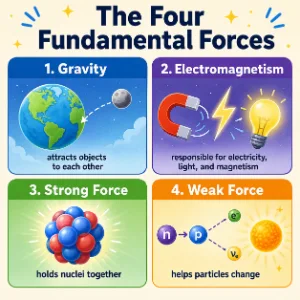
This illustration presents the four fundamental forces of nature in a simple, student-friendly way.
    Gravity is shown as the force that attracts objects such as planets and moons.
    Electromagnetism is represented through magnets, electricity, and light, reminding students that many everyday forces come from electric charges.
    The strong force is shown holding the atomic nucleus together, while the weak force is linked to particle transformation and processes inside stars.
    Together, these four forces explain how matter forms, how energy moves, and how the universe holds together from the smallest particles to the largest cosmic structures.
3. Core Physics Principles: Force Mechanics & Behavior
Strong Nuclear Force: Confinement and Binding
Unlike most forces, the strong force becomes stronger as quarks are pulled apart. This property, known as confinement, ensures that quarks are never found in isolation. Instead of separating, energy is converted into new particles, maintaining bound systems.Electromagnetic Force: Attraction and Repulsion
The electromagnetic force allows both attraction and repulsion depending on charge. This dual nature enables stable atomic structures, as electrons are bound to nuclei while maintaining dynamic motion.Weak Nuclear Force: Transformation of Particles
The weak force enables particles to change identity, such as when a neutron transforms into a proton. This makes it essential for processes involving change, including radioactive decay and element formation in stars.Gravitational Force: Geometry of Spacetime
Gravity is best understood not as a force but as the curvature of spacetime caused by mass and energy. Objects follow curved paths within this geometry, producing what we observe as gravitational attraction.Concept Checks: Fundamental Interaction Mechanisms
Q1. Which fundamental force is responsible for holding atomic nuclei together?
A. Electromagnetic Force
B. Gravitational Force
C. Strong Nuclear Force
D. Weak Nuclear Force
B. Gravitational Force
C. Strong Nuclear Force
D. Weak Nuclear Force
Correct Answer: Strong Nuclear Force.
Reason: This force binds quarks into protons and neutrons and holds atomic nuclei together against electrostatic repulsion.
Reason: This force binds quarks into protons and neutrons and holds atomic nuclei together against electrostatic repulsion.
Q2. Why does gravity dominate at large scales despite being the weakest force?
A. Because it is stronger at long distances
B. Because it only acts on large objects
C. Because it always attracts and accumulates over large masses
D. Because other forces disappear in space
B. Because it only acts on large objects
C. Because it always attracts and accumulates over large masses
D. Because other forces disappear in space
Correct Answer: Because it always attracts and accumulates over large masses.
Reason: Gravity is always attractive, so its effects accumulate rather than cancel out, allowing it to dominate at cosmic scales.
Reason: Gravity is always attractive, so its effects accumulate rather than cancel out, allowing it to dominate at cosmic scales.
4. Mathematical Foundations & Comparison Parameters
Each force operates under distinct coupling strengths, spatial ranges, and mediation mechanisms. In quantum field theory, static potentials are expressed via Yukawa or Coulomb relations, where particle exchange mass dictates interaction range:
Strong Nuclear Force
- Relative Strength: 1 (Strongest)
- Range: Subatomic (≈ 10−15 m)
- Mediator: Gluon (massless, 8 color varieties)
- Acts on: Quarks, gluons, hadrons
Electromagnetic Force
- Relative Strength: ≈ 10−2
- Range: Infinite (1/r2 potential)
- Mediator: Photon (γ, massless)
- Acts on: Electrically charged particles
Weak Nuclear Force
- Relative Strength: ≈ 10−6 to 10−7
- Range: Subnuclear (≈ 10−18 m)
- Mediator: W+, W−, Z0 bosons (≈ 80–91 GeV/c2)
- Acts on: Quarks and leptons
Gravitational Force
- Relative Strength: ≈ 10−38 (Weakest)
- Range: Infinite (1/r2 potential)
- Mediator: Graviton (hypothetical spin-2)
- Acts on: All mass-energy
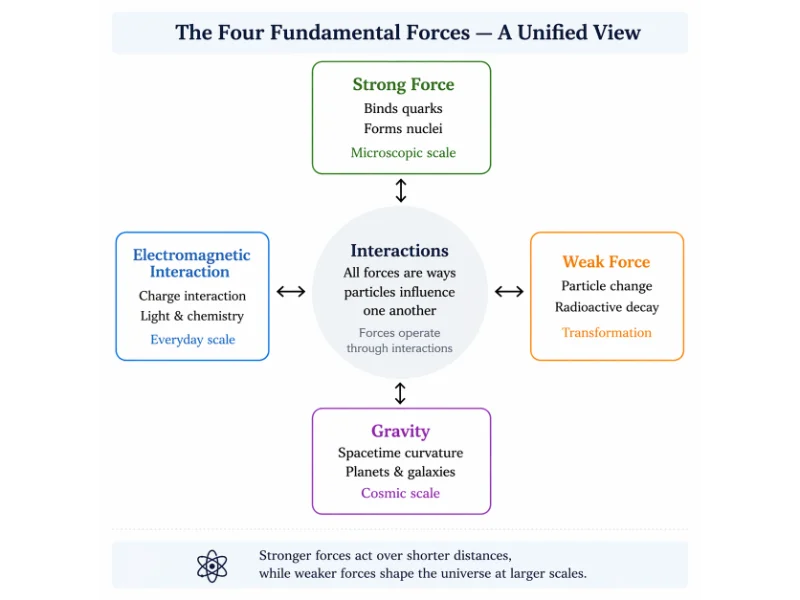
This infographic presents a unified view of the four fundamental forces of nature: strong nuclear force, electromagnetic force, weak nuclear force, and gravitational force.
    Each force is shown with its key role, scale of influence, and physical significance.
    The central concept of interactions highlights how all forces represent ways particles influence one another.
    The diagram emphasizes that stronger forces act over shorter distances, while weaker forces govern behavior at larger scales.
5. Practical Applications & Force Unification
Unification of Fundamental Forces
One of the central goals of modern physics is to determine whether the four fundamental forces are different manifestations of a deeper, unified interaction. In the 1960s, Sheldon Glashow, Steven Weinberg, and Abdus Salam successfully unified the electromagnetic and weak nuclear forces into the electroweak interaction. At energy scales above ≈ 100 GeV, these two interactions behave as a single gauge symmetric force.
Grand Unified Theories (GUTs) attempt to merge the strong force with the electroweak interaction at extreme energies (≈ 1016 GeV). The ultimate goal—a Theory of Everything (TOE)—aims to unify quantum mechanics and general relativity, incorporating gravity into a single quantum framework (such as string theory or loop quantum gravity).
Practical Real-World Applications
Strong Nuclear Force Applications
Underpins nuclear binding energy, driving nuclear fission reactors, stellar fusion, and high-energy particle accelerator target physics.Electromagnetic Force Applications
Powers modern civilization: electric power distribution, telecommunications, semiconductor microchips, lasers, optical computing, and MRI diagnostic machines.Weak Nuclear Force Applications
Governs beta-minus decay for radiocarbon dating and beta-plus decay emitting positrons used in clinical PET cancer imaging scans.Gravitational Force Applications
Determines planetary orbits, satellite trajectory mechanics, atmospheric retention, ocean tides, and relativistic clock corrections in GPS satellite navigation.6. Key Terms Glossary
- Fundamental Forces
- The four basic interactions (strong, electromagnetic, weak, gravity) governing all physical phenomena in the universe.
- Gauge Boson
- A force-mediating vector particle exchanged between interacting matter particles (e.g., photon, gluon, W/Z bosons).
- Color Confinement
- The property of the strong force whereby quarks cannot be isolated individually; attempting to separate them creates new quark-antiquark pairs.
- Electroweak Unification
- The theoretical framework combining electromagnetism and the weak force into a single unified gauge theory at high energy scales.
- Grand Unified Theory (GUT)
- A class of theoretical models seeking to merge the strong, weak, and electromagnetic interactions into a single gauge symmetry.
- Theory of Everything (TOE)
- A hypothetical overarching framework that completely unifies all four fundamental interactions, including quantum gravity.
7. Frequently Asked Questions
What are the four fundamental forces in physics?
The four fundamental forces in physics are gravity, electromagnetism, the weak nuclear force, and the strong nuclear force. These interactions govern how particles and objects interact at all scales, from subatomic particles to galaxies.
How does the electromagnetic force act between particles?
The electromagnetic force acts between particles carrying electric charge. Described by quantum electrodynamics (QED), charged particles interact through the exchange of virtual photons, operating across an infinite range.
What is the strong nuclear force and what does it do?
The strong nuclear force binds quarks together to form hadrons (protons and neutrons) via gluons, and overcomes electrostatic proton repulsion to hold atomic nuclei together across femtometer ranges.
What is the weak nuclear force and where does it appear?
The weak nuclear force mediates particle flavor transformations, such as neutron-to-proton conversion in radioactive beta decay and initiating proton-proton fusion in the Sun. It is mediated by massive W and Z bosons.
How does gravity fit into the picture of fundamental forces?
Gravity is the universal attraction between objects with mass-energy. While dominating astronomical scales, it is by far the weakest force at subatomic levels and currently lacks a verified quantum description (graviton).
What is the electroweak interaction?
The electroweak interaction is the unified description of electromagnetism and the weak force, which behave as a single force at high energy levels (> 100 GeV) before symmetry breaking occurs.
8. Assessment Exercises
Part 1: Review Questions
Q1. List the four fundamental forces in order of decreasing relative strength.
Answer: Strong Nuclear Force (1), Electromagnetic Force (≈ 10−2), Weak Nuclear Force (≈ 10−6), Gravitational Force (≈ 10−38).
Q2. Which gauge bosons mediate the strong, electromagnetic, and weak forces respectively?
Answer: Strong force = Gluons; Electromagnetic force = Photons; Weak force = W+, W−, and Z0 bosons.
Q3. Why is the weak force range restricted to subnuclear distances (≈ 10−18 m)?
Answer: Because its force carriers (W and Z bosons) are extremely massive (≈ 80–91 GeV/c2), limiting their virtual propagation distance according to Heisenberg’s energy-time uncertainty relation.
Part 2: Applied & Thought-Provoking Scenarios
Q1. How does electroweak symmetry breaking explain the difference between photons and W/Z bosons?
Answer: At high temperatures in the early universe, electroweak symmetry was unbroken and all carriers were massless. As the universe cooled, interaction with the Higgs field broke symmetry, giving mass to W/Z bosons while leaving photons massless.
Q2. Why does the electromagnetic force not overwhelm gravity at planetary or galactic scales?
Answer: Large astronomical bodies contain nearly equal counts of positive protons and negative electrons, causing macroscopic electric charges to cancel out to near zero, leaving un-cancelled gravitational attraction to dominate.
Part 3: Numerical Problems with Step-by-Step Worked Solutions
Problem 1: Gravitational Attraction Between Two Masses
Calculate the gravitational force between two 1.0 kg masses separated by a distance r = 1.0 m. (G = 6.674 × 10⁻¹¹ N·m2/kg2).
Solution:
$$ F = \frac{G m_1 m_2}{r^2} = \frac{(6.674 \times 10^{-11}) \times 1.0 \times 1.0}{1.0^2} = 6.674 \times 10^{-11} \text{ N} $$
Answer: 6.674 × 10⁻¹¹ N.
Problem 2: Coulomb Repulsion Between Two Protons in a Nucleus
Calculate the electrostatic Coulomb repulsion force between two protons separated by r = 2.0 × 10⁻¹⁵ m in an atomic nucleus. (k = 8.988 × 10⁹ N·m2/C2, e = 1.602 × 10⁻¹⁹ C).
Solution:
$$ F = \frac{k e^2}{r^2} = \frac{(8.988 \times 10^9) \times (1.602 \times 10^{-19})^2}{(2.0 \times 10^{-15})^2} = \frac{2.3068 \times 10^{-28}}{4.0 \times 10^{-30}} \approx 57.67 \text{ N} $$
Answer: 57.67 N.
Problem 3: W Boson Mass Conversion to Kilograms
Convert the rest mass of a W boson (m = 80 GeV/c2) into kilograms. (1 GeV/c2 = 1.783 × 10⁻²⁷ kg).
Solution:
$$ m = 80 \times (1.783 \times 10^{-27} \text{ kg}) \approx 1.426 \times 10^{-25} \text{ kg} $$
Answer: 1.426 × 10⁻²⁵ kg.
Problem 4: Weak Force Range Estimation
Estimate the range λ of the weak force using λ ≈ ℏc / (mc2) for a W boson mass of 80,000 MeV/c2 (ℏc ≈ 197 MeV·fm).
Solution:
$$ \lambda \approx \frac{197 \text{ MeV fm}}{80000 \text{ MeV}} \approx 2.46 \times 10^{-3} \text{ fm} = 2.46 \times 10^{-18} \text{ m} $$
Answer: 2.46 × 10⁻¹⁸ m.
Problem 5: Ratio of Electromagnetic to Gravitational Force for Protons
Compare the electrostatic force Fe and gravitational force Fg between two protons (mp = 1.673 × 10⁻²⁷ kg).
Solution:
$$ \frac{F_e}{F_g} = \frac{k e^2}{G m_p^2} = \frac{(8.988 \times 10^9) \times (1.602 \times 10^{-19})^2}{(6.674 \times 10^{-11}) \times (1.673 \times 10^{-27})^2} \approx \frac{2.3068 \times 10^{-28}}{1.868 \times 10^{-64}} \approx 1.23 \times 10^{36} $$
Answer: Electromagnetism is ≈ 1.23 × 1036 times stronger than gravity.
History, Challenges, and Future Prospects
The conceptualization of forces has evolved from classical contact mechanics to quantized field interactions.
Historical Milestones: Isaac Newton formulated universal gravitation in 1687. James Clerk Maxwell unified electricity and magnetism into electromagnetism in 1865. Hideki Yukawa proposed meson exchange for strong nuclear forces in 1935. Glashow, Weinberg, and Salam developed Electroweak Unification in 1967. David Gross, Frank Wilczek, and David Politzer formulated Quantum Chromodynamics in 1973.
Current Challenges: Formulating a renormalizable quantum theory of gravity, solving the hierarchy problem (why gravity is 36 orders of magnitude weaker than electromagnetism), and identifying the gauge nature of dark matter interactions.
Future Frontiers: Testing Grand Unified Theories (GUTs) via proton decay experiments (Hyper-Kamiokande), detecting primordial gravitational waves, and probing fifth-force hypotheses through ultra-precise atomic interferometry.
Cluster Navigation & Academic References
Related Modern Physics Topics
- Modern Physics Hub — Primary portal for non-classical physical principles.
- Particle Physics Overview — Standard Model structure, field theories, and particle colliders.
- Fermions – Matter Particles — Quarks, leptons, and spin statistics.
- Bosons – Force Carriers — Gauge vector bosons, scalar field excitations, and mass generation.
- Quantum Field Theory — Relativistic field quantization and gauge theories.
External References & Recommended Reading
- Carroll, S. (2012). The Particle at the End of the Universe. Dutton.
- Rovelli, C. (2015). Seven Brief Lessons on Physics. Allen Lane.
- Griffiths, D. J. (2008). Introduction to Elementary Particles (2nd ed.). Wiley-VCH.
- Weinberg, S. (1967). “A Model of Leptons.” Physical Review Letters, 19(21), 1264–1266.
- Gross, D. J., & Wilczek, F. (1973). “Ultraviolet Behavior of Non-Abelian Gauge Theories.” Physical Review Letters, 30(26), 1343–1346.
Archived version: This learning resource is archived on Zenodo at https://zenodo.org/records/20570351.
Suggested citation: Gan, J. (2026). Fundamental Forces: Interactions, Gauge Mediators, and Unification Theories. Prep4Uni.online. Zenodo. https://doi.org/10.5281/zenodo.20570351