
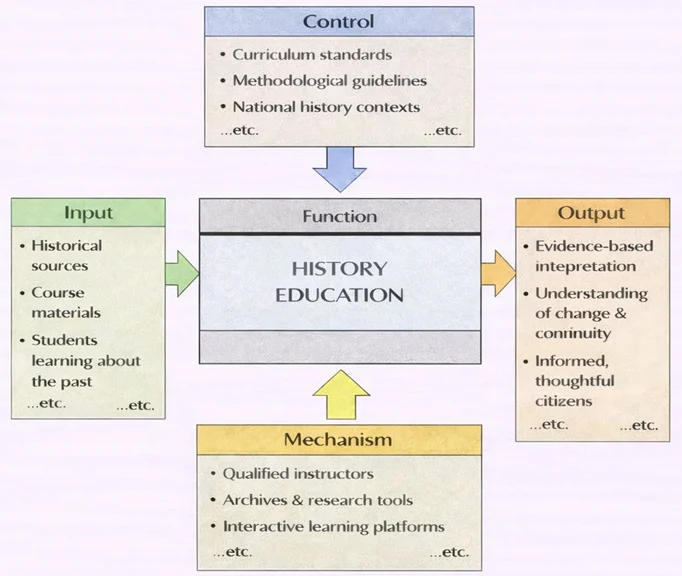
History Education can be understood as a learning function that turns “the past” into a disciplined way of thinking. The main inputs are historical sources (documents, artifacts, records, testimonies), course materials that organize those sources into learning pathways, and students who are learning to ask better questions about what happened and why. The process is guided by controls such as curriculum standards, methodological guidelines, and national history contexts, which shape what topics are emphasized, how evidence should be handled, and how local narratives connect to wider world history. The function is enabled by mechanisms: qualified instructors who model careful reasoning, archives and research tools that make evidence accessible, and interactive learning platforms that support discussion, practice, and feedback. When these elements work together, the outputs are more than memorized dates: students develop evidence-based interpretation, a sharper understanding of change and continuity, and the habits of informed, thoughtful citizens who can evaluate claims about the past with clarity and care.
History examines the ideas, events, systems, and personalities that have shaped human society. It goes beyond timelines and dates to examine structures of power, economic change, and the development of cultural norms. For instance, exploring the history of ideas reveals how philosophies and ideologies have transformed societies and institutions over time. These ideas are often at the heart of major shifts in political systems and are closely tied to movements that demand reform or revolution.
Understanding political economy through its historical development provides crucial insights into how states balance governance and markets. This is especially relevant in today’s context, where economic history and financial history continue to shape global inequality, trade relations, and fiscal policy. The rise and transformation of economic thought can be traced through the history of economic thought, illuminating how theories evolve in response to crises and innovations.
Social forces drive much of the change visible in historical study. The history of social movements helps us understand how citizens challenge structures of power, while education history sheds light on how knowledge has been controlled and democratized. These threads are essential for interpreting revolutions, reforms, and institutional change.
Diplomacy and war have also played a central role in shaping modern nation-states. Diplomatic history highlights the subtle negotiations and bold initiatives that have influenced peace treaties and global alignments. It is through this lens that figures from diplomatic personalities to architects of economic diplomacy emerge as central to global transformation.
War has repeatedly altered the course of history. Through the lens of economic history of warfare and the study of guerrilla warfare and insurgency, students learn how economies mobilize for conflict, and how non-state actors reshape political destinies. The economic consequences of war, in turn, affect everything from public finance to postwar recovery.
Electoral processes and legitimacy are also integral to historical inquiry. The development of electoral history, debates over electoral fraud and integrity, and the design of electoral systems and political parties offer a view into how power is distributed and challenged in democratic and authoritarian contexts alike.
History is not only political or economic; it is also deeply cultural. Fields like gender and cultural history encourage critical reflection on identity, power, and representation, while cultural diplomacy shows how art, language, and tradition serve as tools of influence. Broader analyses of global political thought connect these cultural dimensions to transnational debates.
In more recent decades, the impact of industrialization and consumption on nature has led to growing interest in environmental economic history, which ties together ecological change, economic systems, and policy decisions.
History is constantly revisited and reinterpreted as new evidence emerges and present concerns shift. From exploring alliances and institutional collaborations to refining economic theory based on past missteps, the study of history builds the analytical habits needed to evaluate evidence, recognise patterns, and reason carefully about the present.
Tracing Change, Continuity, and Human Experience Across Time
History (Current Domain)
Investigates how events, ideas, and movements unfold over time, revealing structural patterns that directly shape present realities and future trajectories within the broader humanities curriculum.
Anthropology
Extends historical inquiry by comparing cultural evolution, human adaptation, and social practices across diverse global societies over long archaeological and ethnographic time spans.
Cultural Studies
Interprets how cultural meanings, popular media, and power dynamics evolve, building directly on historical contexts of identity, hegemony, and representation.
Literature
Preserves, reflects, and critiques human experience across historical eras through narrative forms, poetry, and dramatic texts deeply embedded in their temporal context.
Philosophy
Provides rigorous conceptual frameworks to evaluate historical ideas, ethical paradigms, logic, and epistemological shifts that drive intellectual revolutions.
Political Science
Analyses how historical developments, constitutional crises, and institutional shifts inform modern governance structures, state behavior, and power distribution.
International Relations
Leverages diplomatic and military history to explain contemporary geopolitical alliances, conflict resolution models, foreign policy, and global governance.
Religious Studies
Examines how theological belief systems, sacred texts, and institutional faiths develop historically to influence societal values, art, and law over millennia.
Sociology
Connects long-term historical transformations to demographic shifts, class stratification, institutional changes, and evolving social structures.
Linguistics
Traces the historical evolution, phonetic shifts, and migration patterns of human languages, illustrating broad cultural contacts and intellectual transmissions.
Psychology
Explores how historical contexts, cultural paradigms, and major social disruptions shape human cognition, collective trauma, and psychological resilience.
Humanities Overview Hub
Places history within the macro-framework of the broader humanities, connecting all interdisciplinary pathways that systematically analyze human culture and society.
The Scope and Significance of Studying the Past
Understanding Change Over Time
- Studying earlier periods shows that societies, institutions, and belief systems are not static — they change constantly. Examining how transformations unfold over generations allows learners to grasp the fluid nature of governance, economics, culture, and technology.
- Transitions from one dominant structure to another — such as the gradual shift from feudalism to capitalism in post-medieval Europe — provide case studies in how new systems emerge in response to demographic pressures, technological innovations, and changing values. These transformations, in turn, explain many of the underlying forces shaping the modern world.
- Analyzing such changes can also uncover deep-rooted links between current systems and their historical precursors. For instance, by tracing the lineage of today’s corporate structures and trade networks, we develop a richer understanding of industrialization, globalization, and financial regulation.
- This perspective helps explain the rise and fall of civilisations, the formation of national identities, and shifts in political ideology.
- Additionally, interdisciplinary approaches — incorporating economics, sociology, political theory, and environmental science — help students trace how societies change over long periods. For example, the study of agrarian economies transitioning into industrial systems provides a backdrop to modern frameworks like industrial ecology and the circular economy.
Preserving Cultural Heritage
- Civilizations pass on their values, beliefs, knowledge, and artistry through both tangible and intangible forms. Understanding and documenting these aspects ensures that future generations retain access to their collective roots, even as societies continue to evolve.
- Language preservation, traditional performing arts, architectural practices, culinary rituals, and religious customs are all key elements of cultural continuity. These inherited forms of expression act as bridges across time, linking individuals to their ancestors and anchoring communities in shared meaning.
- Educational efforts that focus on documenting and curating artistic and cultural practices — such as oral epics, ceremonial dances, or visual symbols — serve not only to honor past achievements but also to inspire innovation in the present.
- Institutions such as UNESCO’s World Heritage program highlight and protect places of outstanding universal value, ensuring that monuments, urban layouts, and sacred sites remain accessible to humanity as repositories of wisdom and identity.
- Platforms like arts, design, and media studies offer modern tools to reinterpret and re-present these legacies, while cultural studies frameworks provide the critical lens to examine power, appropriation, and authenticity in heritage work.
- Preserving cultural memory helps communities maintain a sense of identity and draw on accumulated knowledge when facing new challenges.
Learning from the Past
- Insights from earlier eras help policymakers, scientists, and educators craft solutions that account for human behaviour, societal complexity, and unintended consequences. By reviewing both successes and failures, communities can make more informed choices in the present.
- Past responses to crisis, conflict, and disruption offer concrete examples that remain relevant today. Whether the challenge involves technological change, social inequality, or public health, historical precedents provide a useful starting point.
- For instance, the comparative study of pandemics — ranging from the Black Death to the 1918 influenza and COVID-19 — shows how public health infrastructure, scientific understanding, and government responses have developed over time.
- Similarly, the outcomes of past policy interventions shed light on long-term effects in areas such as taxation, welfare systems, education reform, and urban planning. Tools like policy analysis build on these lessons to develop more considered frameworks for the future.
- Studying conflict resolution efforts, civil rights movements, and diplomatic strategies helps individuals approach modern challenges with both moral clarity and analytical rigour. Examining what worked, what failed, and why builds the capacity to reason carefully about complex problems and evaluate competing claims.
- Examining what earlier generations attempted, achieved, and got wrong gives the present something concrete to build on — not as a set of fixed answers, but as a record of how different societies have navigated difficult conditions and what those experiences cost them.
Approaches to Studying History
Chronological Approach
- Organizing historical events in sequential order to analyze cause-and-effect relationships over defined timelines.
- Example: Examining the sequential developments across major 20th-century geopolitical conflicts.

This illustration shows a timeline of major twentieth-century conflicts — World War I (1914–1918), World War II (1939–1945), and a projected future war — arranged along an arrow representing the passage of time. The imagery moves from a biplane to a tank to a mushroom cloud, tracing how the technology of warfare grew more destructive with each generation. The chronological approach encourages students to ask not just what happened, but why one event followed from another — and what patterns that sequence reveals.
Thematic Approach
- Exploring specific themes, such as gender, religion, or technology, across different historical epochs.
- Example: Analyzing the influence of religious institutions in political revolutions across continents.

Comparative History
- Comparing distinct societies, economies, or eras to isolate causal variables, identify common patterns, and highlight unique structural contrasts.
- Example: Comparing the structural trajectories of the Industrial Revolution in Britain and Japan.

This illustration contrasts two paths through industrialisation. Britain’s side shows steam-powered factories and smokestacks, representing an economy reshaped by mechanisation from the late eighteenth century onward. Japan’s side draws on traditional architecture and military imagery, reflecting a society that industrialised rapidly in the late nineteenth century under very different political and cultural conditions. Placing the two side by side is the essence of comparative history — rather than studying each society in isolation, the approach looks for patterns, contrasts, and explanations that only become visible when different cases are examined together. The Industrial Revolution is one of the most studied examples of this method because it unfolded differently across regions, making cross-cultural historical analysis essential to understanding it fully.
Microhistory
- Focusing on specific individuals, isolated communities, or micro-events to uncover nuanced social dynamics lost in macro-narratives.
- Example: Reconstructing the worldview of a single medieval peasant or tracing legal records within a Renaissance village.

This illustration places a medieval peasant at the centre — a single individual standing before a small village of rustic homes and a chapel. It is a deliberately narrow frame, and that is the point. Microhistory works by zooming in on one person, one community, or one event, and asking what that close focus reveals about the wider world. The daily life of a villager in the Renaissance was shaped by cultural expectations, economic pressures, and social hierarchies that broader historical narratives often pass over. By examining the specific and the local, microhistory surfaces patterns and tensions that large-scale accounts tend to obscure.
Key Fields in History
Political History
- Examines governance, constitutional development, power structures, and political ideologies over time.
- Focus Areas:
- Evolution of state apparatuses, from feudal monarchies to modern representative democracies.
- Structural analysis of revolutions and legal reforms, such as the French Revolution or the Civil Rights Movement.
- Applications: Informing modern constitutional design, public administration, and international relations.
Military History
- Focuses on armed conflicts, operational strategies, logistics, and the societal impact of military forces.
- Key Topics:
- Global total wars (WWI and WWII) and asymmetric warfare dynamics.
- Technological advancements in warfare, including ballistic weaponry and nuclear deterrence.
- Applications: Analyzing national security frameworks, tactical logistics, and post-conflict peacekeeping.
Economic History
- Analyzes the evolution of commercial systems, labor markets, market integration, and capital formation across centuries.
- Focus Areas:
- The macroeconomic consequences of the Industrial Revolution on living standards and trade.
- The growth, crisis, and collapse of global trade networks and mercantilist empires.
- Applications: Crafting resilient economic policies, financial regulations, and models for globalization.
Social History
- Explores the lived experience of non-elite populations, focusing on social stratification, demographic shifts, labor unions, and family structures.
- Key Topics:
- The feminist movement and changing legal frameworks around gender rights.
- Social upheaval and living condition transformations during 19th-century rapid urbanization.
- Applications: Developing social welfare policy, addressing economic inequality, and preserving community heritage.
Cultural History
- Investigates the evolution of ideas, artistic movements, popular culture, and collective consciousness.
- Focus Areas:
- The European Renaissance as a foundational shift in art, science, and humanism.
- The influence of mass media and communication in moulding modern political discourse.
- Applications: Enhancing cross-cultural communication, managing cultural diplomacy, and curating museum exhibitions.
Approaches to Researching the Past
- Primary Source Investigation
At the heart of all inquiry into earlier times is the close examination of original records created during the period under study. These firsthand materials serve as direct evidence of social, political, cultural, and economic developments. Examples include personal letters, court transcripts, legal decrees, newspapers, and physical artifacts. Researchers assess authorship, provenance, and contextual bias to establish authenticity.
- Interpretive Analysis Through Secondary Material
Reviewing peer-reviewed literature, scholarly monographs, and thematic syntheses produced by prior historians provides contextual grounding. Engaging secondary literature helps researchers identify historiographical debates, locate gaps in knowledge, and situate new primary findings within established scholarly frameworks.
- Preserving and Recording Living Memory
Oral history methodologies capture spoken testimony from individuals who lived through significant events. This is especially vital for recovering the experiences of marginalized groups underrepresented in written archives. Rigorous ethical protocols, active listening, and meticulous transcription preserve emotional nuances and community narratives.
- Technology-Enhanced Inquiry into the Past
Digital tools allow historians to process vast archival datasets. Geographic Information Systems (GIS) map historical trade routes and urban growth, while text-mining algorithms identify linguistic shifts across centuries of digitized manuscripts, opening brand-new quantitative research avenues.
Challenges in Exploring the Past
- Bias and Subjectivity
Every historical document reflects the conscious or unconscious biases of its creator, often reinforcing existing power dynamics. Colonial records, for example, often minimize indigenous perspectives. Historians must critically cross-examine sources against alternative testimonies, including oral traditions, to reconstruct balanced narratives. Exploring colonial and post-colonial systems demands this multi-perspectival scrutiny.
- Incomplete Records and Lost Narratives
Historical survival is selective; natural disasters, war, decay, and deliberate censorship destroy vast portions of the archival record. Working-class populations, enslaved communities, and minority groups rarely left extensive written records. Historians employ interdisciplinary techniques — integrating archaeology, material culture, and linguistics — to fill these structural gaps.
- Interpretation, Change, and the Politics of Memory
Historical understanding changes as new evidence surfaces or contemporary theoretical lenses evolve. Re-evaluating past events often triggers public debate over monuments, national identity, and school curricula. Recent scholarship on women’s contributions to political and social movements illustrates how re-interpretation enriches collective memory.
Practical Applications of Studying the Past
- Education and Lifelong Learning
Studying history trains individuals to evaluate source credibility, spot logical fallacies, and synthesize complex evidence — critical skills for media literacy and active civic participation in modern democratic societies.
- Policy Development and International Diplomacy
Governments rely on historical precedents when negotiating treaties, designing public health programs, or restructuring economic systems. Understanding prior institutional successes and failures prevents repetitive policy missteps in foreign and domestic affairs.
- Cultural Preservation and Identity Formation
Documenting indigenous customs, preserving historic architecture, and archiving endangered languages fosters community identity and continuity amidst rapid global modernization and urban expansion.
- Public Awareness and Civic Engagement
Museums, heritage sites, historical documentaries, and digital exhibits make scholarly research accessible, sparking public discourse around shared heritage, civil rights, and moral responsibility.
Is History Right For You?
Explore career pathways, check your fit, and assess your skills — before you commit to a degree.
Emerging Frontiers in the Study of the Past
- Interdisciplinary Approaches to Understanding Human Experience
Modern history blends traditional text analysis with methodologies from anthropology, genetics, and paleoclimatology to build comprehensive models of ancient human migration, settlement collapse, and social adaptation.
- Global Perspectives and Decolonizing Knowledge
Historians are actively dismantling Eurocentric frameworks by centering non-Western archives, oral traditions, and epistemologies, providing a multi-polar, globally balanced account of world history.
- Digital Humanities and Computational Discovery
Integrating artificial intelligence and data science allows scholars to analyze massive text corpora, run network analyses on historical political groups, and model historic urban spaces in 3D environments.
- Environmental Dimensions of the Past
Examining climate proxy data alongside historical records exposes how past societies reacted to environmental crises, droughts, and resource depletion — offering vital lessons for modern climate resilience.
From Empires to Revolutions: Why the Past Still Shapes Us
Understanding How the Past Shapes the Present
History is the study of past events, people, and societies — and how they influence the present and future. For students preparing for university, studying history offers the opportunity to understand the roots of modern institutions, conflicts, cultures, and ideas. It reveals the patterns and turning points that have shaped civilizations and helps explain the complexities of the contemporary world through a deeper historical lens.
Developing Critical Thinking and Analytical Skills
Historians do more than memorize dates — they interpret evidence, evaluate sources, and construct arguments based on reasoned analysis. Students of history learn to distinguish fact from opinion, detect bias, and synthesize information from multiple perspectives. These skills are vital for academic success at university and highly transferable to a wide range of careers that require logical reasoning and informed decision-making.
Exploring Diverse Cultures, Ideas, and Perspectives
Studying history introduces students to a wide array of human experiences — from ancient civilizations and revolutionary movements to global conflicts and cultural renaissances. It fosters curiosity about different societies and an appreciation for cultural diversity. This global and inclusive perspective prepares students to engage thoughtfully with contemporary issues and promotes empathy, open-mindedness, and intellectual maturity.
Learning to Research, Write, and Communicate Effectively
History students become skilled researchers and communicators. They learn to gather and evaluate information, craft coherent essays, and present arguments clearly and persuasively. These abilities are essential for university assignments, public speaking, and any career involving analysis, storytelling, or policy development. Strong writing and presentation skills developed through history are especially valued in both academic and professional settings.
Preparing for Versatile and Meaningful Career Opportunities
A background in history prepares students for careers in education, law, journalism, public policy, museum and archival work, international relations, and more. It also provides an excellent foundation for postgraduate studies in the humanities and social sciences. For students entering university, history offers a rich, challenging, and rewarding path that deepens their understanding of the world and equips them to make thoughtful contributions to society.
Interactive Tool: Historical Source Reliability Evaluator
Adjust bias levels, temporal distance from the event, and cross-referencing strength to simulate the net reliability score of a historical source. The graph models source validity over time with explicit visible axes.
Interactive Review: Thinking Like a Historian
Scenario 1: Evaluating Official Court Records vs. Private Letters
Explanation: Official records reflect public political positioning, institutional compliance, and deliberate rhetoric meant for public consumption and posterity. Private letters, however, often reveal candid personal reservations, political pressures, unvarnished motives, or unofficial negotiations not captured in formal proceedings.
Scenario 2: Analyzing Methodological Limits in Microhistory
Explanation: The primary danger is overgeneralization. A single village, peasant, or court case may represent an anomaly rather than a widespread social norm. Microhistory must be carefully contextualized alongside macro-historical demographic and economic data.
Frequently Asked Questions
What is History as a field of study, and how is it different from simply learning dates and events?
History as a field of study is the critical investigation of past societies, ideas, conflicts, and everyday lives using evidence from documents, artefacts, images, and oral accounts. It goes far beyond memorising dates: historians ask why things happened, how different causes interact, and what long-term patterns emerge.
What are the main branches or subfields of History I might encounter at university?
At university, subfields include political history, social history, economic history, cultural history, intellectual history, religious history, gender history, diplomatic history, military history, environmental history, and global/transnational history.
What kinds of skills does studying History develop?
History develops critical source analysis, evidence evaluation, structured argumentative writing, research synthesis, bias detection, and complex information management highly valued in law, policy, and management.
How does the History hub on Prep4Uni.online help me prepare for university study?
The hub acts as a bridge connecting foundational concepts to specialized university pathways, offering analytical tools, historiographical case studies, and structured practice modules.
What types of sources do historians use, and how are they evaluated?
Historians use primary sources (letters, legal deeds, artifacts) and secondary sources (scholarly books, peer-reviewed journals). Sources are evaluated by scrutinizing authorship, temporal context, intent, bias, and cross-evidence corroboration.
How is university-level History assessed?
Assessment relies heavily on historiographical essays, primary source document commentaries (goblets), historiographical debates, group seminars, unseen examinations, and an independent research dissertation.
What careers can a History background lead to?
Career outcomes include law, civil service, foreign diplomacy, journalism, intelligence analysis, heritage consulting, publishing, strategic corporate research, and academia.
How does History connect with other Humanities and Social Sciences subjects?
It provides necessary chronological and structural context to political science, economics, sociology, literature, law, and anthropology, forming the temporal spine of social sciences.
Is History mainly focused on Western or European topics?
Modern curricula emphasize global history, decolonial perspectives, Asian, African, and Latin American studies, and interconnected transnational networks.
What can I do now to strengthen my preparation for a History degree?
Read widely outside set school texts, practice evaluating opposing historiographical claims, visit digital archives, and refine analytical essay writing skills.
How does studying History help me understand current events and public debates?
It illuminates institutional lineages, recurring systemic patterns, historical legal precedents, and structural causes behind modern geopolitical and economic crises.
Do I need to be good at memorising dates to succeed in History?
No. Memorization is secondary to understanding cause-and-effect relationships, structural continuity, critical evidence evaluation, and historiographical argumentation.
Comprehensive History Mastery Exercises
Section 1: Foundational Review Module
- What is history and why is it important to study it?
Answer: History is the disciplined study of past events, cultures, and societies. Studying it illuminates how earlier decisions, conflicts, and innovations created contemporary political, economic, and social structures. - How do historians gather and interpret evidence?
Answer: Historians collect primary documents, oral testimonies, material artifacts, and digital records, systematically testing each for bias, provenance, and contextual reliability through cross-referencing. - What methodologies are commonly used in historical research?
Answer: Common methodologies include primary archival research, comparative cross-societal analysis, microhistory, and interdisciplinary integration with archaeology, economics, and linguistics. - How does the study of history contribute to critical thinking?
Answer: It trains scholars to dissect competing accounts, detect authorial bias, distinguish correlation from causation, and construct logically rigorous arguments supported by verified empirical evidence. - In what ways can historical events influence modern society?
Answer: Past events establish state borders, legal constitutions, financial systems, cultural paradigms, and long-standing geopolitical alliances or rivalries that govern present international order. - What challenges do historians face in reconstructing the past?
Answer: Key challenges include incomplete or destroyed records, partisan source bias, silent archives missing marginalized voices, and the distortion of historical facts for modern political agendas. - How does understanding history help in shaping public policy?
Answer: It offers policy-makers concrete empirical precedent, highlighting the long-term unintended consequences of social, tax, public health, or foreign intervention policies enacted in prior eras. - What is the significance of primary sources in historical research?
Answer: Primary sources provide unmediated firsthand evidence created during the historical period under examination, serving as the empirical bedrock for all subsequent historical interpretation. - How do historians address bias in historical narratives?
Answer: They evaluate source authorship, interrogate the original target audience, compare multiple independent accounts, and transparently acknowledge theoretical frameworks to minimize subjective distortion. - How does interdisciplinary research enhance the study of history?
Answer: Integrating methods from anthropology, economics, climate science, and data analytics resolves gaps in written archives and yields multi-dimensional explanations of complex social phenomena.
Section 2: Analytical & Historiographical Inquiries
- How might digital archives and online databases transform historical research in the 21st century?
Answer: Digital databases democratize source access globally and allow computational text-mining across millions of pages simultaneously. However, they raise concerns regarding algorithmic search bias, digital preservation fragility, and variable access quality. - In what ways can the study of history inform our understanding of contemporary social and political issues?
Answer: Modern institutional inequality, civil unrest, and border disputes have specific historical origins. Uncovering these historical roots demonstrates that current structures are not natural or inevitable, but human choices subject to alteration. - How might globalization impact the interpretation and teaching of history in multicultural societies?
Answer: Globalization forces curricula to abandon nationalist, Eurocentric frameworks in favor of comparative, transnational histories that reflect diverse student backgrounds and globally interconnected historical networks. - What challenges do historians face when reconciling conflicting narratives from diverse cultural perspectives?
Answer: Opposing groups often maintain radically different memories of the same conflict. Historians must present these divergent views rigorously without treating discredited or unevidenced claims as factual equivalents. - How can historical research contribute to social justice and the empowerment of marginalized communities?
Answer: Uncovering silenced histories of resistance, disenfranchisement, and contribution validates marginalized identity claims, refutes exclusionary state narratives, and provides historical grounding for legal restitution. - What role does memory play in shaping collective historical narratives and national identities?
Answer: Collective memory is a selective societal construction — choosing what to memorialize or forget to foster political unity, build national myths, or project specific ideological values. - What are the potential consequences of historical revisionism in contemporary society?
Answer: Legitimate scholarly revisionism refines accuracy using new evidence. Conversely, politically motivated revisionism distorts factual records to justify authoritarianism, ethnic nationalism, or hate speech. - How can oral histories contribute to our understanding of historical events and cultural change?
Answer: Oral histories capture lived emotional experiences, subtle cultural shifts, and non-elite perspectives that written state bureaucratic records systematically ignore or suppress.
Section 3: Quantitative History & Cliometrics Problems
- Problem 1: Historical Inflation & Purchasing Power Calculation
An archival ledger records that a master carpenter in London in 1750 earned 15 shillings per week. If the historical consumer price index (CPI) was 12.5 in 1750 and rose to 250.0 in 1850, calculate the equivalent weekly wage in 1850 shillings required to maintain constant real purchasing power.
Solution & Step-by-Step Calculation:
1. Identify the real wage formula: Real Wage = Nominal Wage × (Target CPI / Base CPI).
2. Base Wage = 15 shillings; Base CPI (1750) = 12.5; Target CPI (1850) = 250.0.
3. Compute index ratio: 250.0 / 12.5 = 20.
4. Calculate target nominal wage: 15 shillings × 20 = 300 shillings per week.
Conclusion: The carpenter would need to earn 300 shillings per week in 1850 to retain identical real purchasing power. - Problem 2: Demographic Impact of Historical Pandemics
A European town had a pre-plague population of 12,000 residents in 1347. Over a three-year period during the Black Death, the town suffered a mortality rate of 35%. In the subsequent 10 years, the surviving population experienced a net natural growth rate of 1.5% per annum (compounded annually). Calculate the total population 10 years after the plague ended.
Solution & Step-by-Step Calculation:
1. Calculate survivors after plague mortality: 12,000 × (1 - 0.35) = 12,000 × 0.65 = 7,800 survivors.
2. Apply compound population growth formula: P10 = P0 × (1 + r)n.
3. Insert parameters: P0 = 7,800, r = 0.015, n = 10.
4. Compute growth multiplier: (1.015)10 ≈ 1.16054.
5. Calculate final population: 7,800 × 1.16054 = 9,052.2 ≈ 9,052 residents.
Conclusion: The town population reached approximately 9,052 residents 10 years after the epidemic. - Problem 3: Cliometric Analysis of Enclosure Act Land Reallocation
Under a 19th-century parliamentary enclosure act, a communal agricultural parish of 4,500 hectares was redistributed. Smallholders initially controlled 40% of the land, while large estates held 60%. Post-enclosure, smallholder land share decreased by 25% (relative loss), and the remaining land was acquired by large estates. Calculate the final hectarage owned by large estates.
Solution & Step-by-Step Calculation:
1. Compute initial smallholder land: 4,500 ha × 0.40 = 1,800 hectares.
2. Compute initial large estate land: 4,500 ha × 0.60 = 2,700 hectares.
3. Calculate land lost by smallholders: 1,800 ha × 0.25 = 450 hectares lost.
4. Reallocate lost land to large estates: 2,700 ha + 450 ha = 3,150 hectares.
Conclusion: Large estates controlled 3,150 hectares post-enclosure (70% of total parish land). - Problem 4: Radiocarbon Dating Calibration for Archaeological Artifacts
An organic artifact discovered in an ancient burial site retains 25% of its initial atmospheric Carbon-14 (14C). Given that the half-life (t1/2) of Carbon-14 is 5,730 years, calculate the age of the artifact.
Solution & Step-by-Step Calculation:
1. State the exponential decay decay equation: N(t) = N0 × (1/2)(t / t1/2).
2. Express remaining fraction: N(t) / N0 = 0.25 = (1/2)2.
3. Equate exponents: t / t1/2 = 2.
4. Solve for time (t): t = 2 × 5,730 years = 11,460 years.
Conclusion: The artifact is approximately 11,460 years old. - Problem 5: Cliometric Trade Volume Index Analysis
In 1800, a port exported 50,000 tons of goods valued at £200,000. By 1850, exports grew to 180,000 tons valued at £540,000. Calculate the percentage increase in total tonnage exported and the percentage change in average value per ton between 1800 and 1850.
Solution & Step-by-Step Calculation:
1. Calculate tonnage percentage increase: ((180,000 - 50,000) / 50,000) × 100 = (130,000 / 50,000) × 100 = 260% increase.
2. Compute 1800 value per ton: £200,000 / 50,000 tons = £4.00 per ton.
3. Compute 1850 value per ton: £540,000 / 180,000 tons = £3.00 per ton.
4. Calculate value per ton percentage change: ((3.00 - 4.00) / 4.00) × 100 = (-1.00 / 4.00) × 100 = -25%.
Conclusion: Export tonnage increased by 260%, while average value per ton decreased by 25% due to industrial production efficiencies. - Problem 6: Historical Voter Turnout Shift Analysis
Following an electoral reform act, the total eligible voter pool in a constituency expanded from 8,000 to 24,000 citizens. In the election preceding the reform, 6,000 votes were cast. In the post-reform election, 15,600 votes were cast. Calculate the voter turnout percentage before and after the reform, and specify the net percentage point change.
Solution & Step-by-Step Calculation:
1. Calculate pre-reform turnout: (6,000 / 8,000) × 100 = 75.0%.
2. Calculate post-reform turnout: (15,600 / 24,000) × 100 = 65.0%.
3. Compute net percentage point change: 65.0% - 75.0% = -10.0 percentage points.
Conclusion: Although total votes cast rose from 6,000 to 15,600, overall voter turnout rate dropped by 10.0 percentage points. - Problem 7: Urbanization Growth Rate Computation
In 1810, an industrial city had an urban population of 45,000. By 1860, due to factory migration, the population expanded to 225,000. Compute the simple annualized population growth rate over this 50-year interval.
Solution & Step-by-Step Calculation:
1. Calculate total population increase: 225,000 - 45,000 = 180,000.
2. Compute total relative percentage growth: (180,000 / 45,000) × 100 = 400%.
3. Divide by total years (50 years): 400% / 50 years = 8.0% per annum simple growth.
Conclusion: The city expanded at a simple annualized growth rate of 8.0% over the 50-year period.