
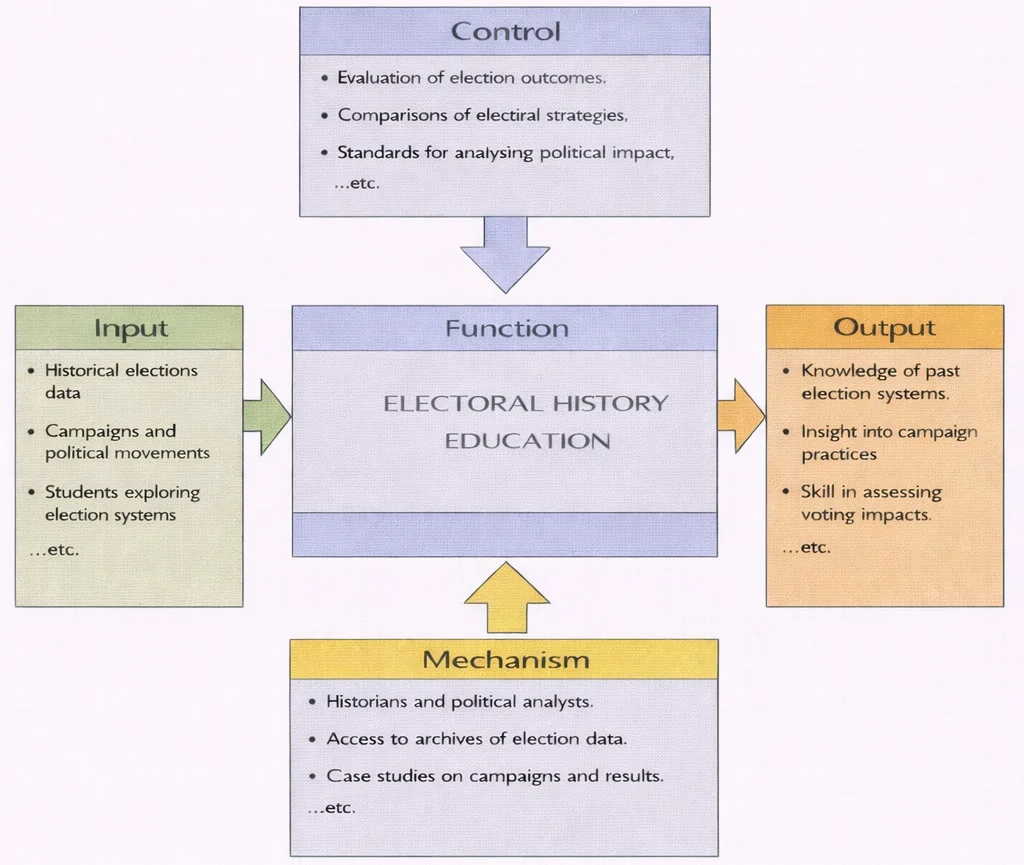
Historical Context: This image depicts a 19th-century civic gathering where rows of men watch a central group as a vote is announced, debated, or counted. Banners overhead and scattered papers on the floor evoke early ballot tallies under public scrutiny—symbolizing the shift toward transparent procedural governance.
Counting Voices: The Evolution of Elections and Political Power
Suffrage & Civil Rights Movements
Curriculum Roadmap: Tracks the legal, social, and activist battles to expand the franchise across property, gender, racial, and age divides, transforming restricted oligarchies into inclusive mass democracies.
Role of Technology in Elections
Curriculum Roadmap: Analyzes how mechanical voting machines, mass communications (print, radio, TV), electronic voting systems, and digital micro-targeting altered voter turnout and election security.
Political Campaigns
Curriculum Roadmap: Investigates how political parties and candidates organize, raise capital, craft ideological messages, and mobilize voters to secure power across different historical eras.
Electoral Fraud & Integrity
Curriculum Roadmap: Examines historic threats to election legitimacy—such as voter suppression, ballot stuffing, and gerrymandering—alongside institutional safeguards like independent monitoring and secret ballots.
Comparative Electoral Systems
Curriculum Roadmap: Evaluates structural voting mechanics—First-Past-The-Post, Proportional Representation, Ranked-Choice, and Mixed Models—to understand their mathematical and governance consequences.
Milestones in the Making of Electoral History
Development of Voting Systems
Electoral history traces the development of mechanisms used to collect and count votes and how these systems evolved to ensure fairness and representation.
Types of Voting Systems
- Plurality or First-Past-the-Post (FPTP): The candidate with the most votes wins. Common in countries like the United States and the United Kingdom.
- Proportional Representation (PR): Seats are allocated based on the percentage of votes received by each party. Common in European countries like Germany and the Netherlands.
- Ranked-Choice Voting (RCV / Alternative Vote): Voters rank candidates in order of preference. Candidates are eliminated sequentially until a majority winner emerges. Used in Australia and various municipal/state elections globally.
- Mixed Systems: Combine aspects of plurality and proportional representation, such as Germany’s Mixed-Member Proportional (MMP) Bundestag elections.
Evolution of Suffrage Movements
One of the most significant areas in electoral history is the struggle to expand voting rights to marginalized groups.
Key Milestones in Suffrage Movements
- Abolition of Property Requirements: Early elections restricted voting to wealthy male landowners. Universal male suffrage was gradually adopted across Western nations during the 19th century.
- Women’s Suffrage: Pioneering nations like New Zealand (1893) granted women full voting rights, triggering global constitutional amendments throughout the 20th century.
- Civil Rights Movements: Focused on eliminating racial barriers to voting, culminating in landmark legislation like the U.S. Voting Rights Act of 1965.
- Youth Voting Rights: Movements to lower the voting age to 18 gained international momentum in the late 1960s and 1970s (e.g., the 26th Amendment in the US).
Development of Political Parties
Political parties have played a central role in electoral systems, organizing candidates, platforms, and voter mobilization.
Key Developments
- Emergence of Early Parties: In the 18th century, loose political factions transformed into organized parties to contest elections (e.g., Federalists vs. Democratic-Republicans in early U.S. history).
- 19th-Century European Parliamentary Development: Institutionalization of formal party caucuses, such as the British Conservative, Liberal, and later Labour Parties.
- Mass Party Systems: Industrialization and urbanization spurred mass political parties supported by labor unions, agrarian leagues, and organized grassroots bases.
Electoral Reform Movements
Electoral history includes the study of reforms aimed at improving the fairness, secrecy, and inclusiveness of voting systems.
Key Structural Reforms
- The Secret Ballot: First adopted in South Australia (1856) and known as the “Australian Ballot,” it eliminated voter intimidation and bribery by providing government-printed, standardized ballot papers marked in private.
- Gerrymandering & Boundary Reforms: Historical and ongoing efforts to establish independent redistricting commissions to prevent political cartels from drawing biased electoral boundaries.
- Modern Technology & Electronic Voting: Technological advances introduced optical scanners and direct-recording electronic (DRE) voting, introducing new speed efficiency alongside cybersecurity auditing protocols.
Interactive Simulator: Plurality (FPTP) vs. Proportional Representation (D’Hondt Method)
Adjust the population vote percentages for 4 political parties across 10 parliamentary districts (or 10 total available seats) to see how electoral mechanics convert raw votes into legislative seats under First-Past-The-Post versus Proportional Representation.
FPTP System (Winner Take All)
Assumes uniform district voting distribution across 10 single-member districts:
Proportional System (D’Hondt)
Allocates 10 legislative seats proportional to national vote totals:
Turning Points at the Polls: Historic Electoral Milestones
The British Reform Acts (1832, 1867, 1884)
- Context: A series of parliamentary acts designed to dismantle feudal voting structures in Great Britain.
- Impact:
- Abolished “rotten boroughs” (depopulated parliamentary constituencies controlled by landowners) and reallocated seats to rapidly growing industrial cities like Manchester and Birmingham.
- Progressively extended voting rights to urban shopkeepers, agricultural laborers, and working-class men.
The U.S. Voting Rights Act (1965)
- Context: Landmark federal civil rights legislation enacted to overcome state and local legal barriers that prevented Black Americans from exercising their 15th Amendment rights.
- Impact:
- Outlawed literacy tests, poll taxes, and intimidation tactics at polling places.
- Established federal oversight (preclearance) for jurisdictions with documented histories of voter disenfranchisement, resulting in dramatic increases in minority political participation.
Women’s Suffrage in New Zealand (1893)
- Context: Led by Kate Sheppard and the Women’s Christian Temperance Union, a massive petition campaign pushed Parliament to grant women full voting rights.
- Impact:
- Made New Zealand the first self-governing nation in the world to establish universal female suffrage, setting an international precedent.
Blueprints for Today: Electoral History in Practice
Informing Modern Electoral Reforms
By evaluating historical implementations of voting rules—such as comparing runoff elections with preferential voting—policy planners design institutional frameworks that minimize polarization and maximize legislative stability.
Promoting Political Participation & Civic Duty
Understanding the multi-generational struggles required to secure the franchise emphasizes the value of the vote, encouraging higher voter turnout and active civic engagement among modern populations.
Analyzing Party Realignments & Coalitions
Historical analysis helps scholars trace critical realignments (such as the U.S. presidential election of 1932 or post-colonial African elections) to forecast how changing demographics alter political power structures.
Interactive Review: Key Concepts in Electoral Evolution
Click on each section below to test your understanding of foundational electoral mechanisms:
Why was the introduction of the secret ballot considered a democratic breakthrough?
What is the primary trade-off between First-Past-The-Post (FPTP) and Proportional Representation (PR)?
PR ensures that legislative seats reflect popular vote percentages accurately, but it frequently leads to fragmented parliaments requiring complex multi-party coalitions that may experience governance instability.
How do rotten boroughs illustrate the need for periodic electoral redistricting?
Frequently Asked Questions
What is electoral history?
Electoral history studies how elections, voting systems, and political competition have developed over time. It looks at who could vote, how votes were cast and counted, how parties organized campaigns, and how outcomes shaped political legitimacy.
Why is electoral history important for understanding democracy?
It demonstrates that democratic rights were not granted automatically, but earned through long struggles. It reveals how changing voting rules directly alters who holds political power and how responsive governments are to citizens.
What primary sources do electoral historians rely on?
Historians analyze official voting tallies, electoral rolls, constituency boundary maps, party campaign pamphlets, legislative debates, newspaper reports, political cartoons, personal diaries, and polling data.
How have voting qualifications shifted over the centuries?
Voting historically progressed from an exclusive privilege tied to property ownership, wealth, race, and gender toward universal adult franchise based on citizenship and age qualifications.
What is the origin of the term “Australian Ballot”?
It refers to the government-printed secret ballot system first adopted in Victoria and South Australia in 1856, which was subsequently adopted worldwide to prevent voter bribery and intimidation.
How do different electoral rules shape party systems?
According to Duverger’s Law, single-member plurality systems (FPTP) favor a two-party system, whereas proportional representation systems encourage multi-party coalitions.
What role have social movements played in expanding electoral access?
Grassroots organizations, such as suffragettes, labor unions, and civil rights marchers, forced political elites to enact constitutional and legal reforms by mobilizing public demand and protest.
How did industrialization impact political party structure?
Industrialization concentrated workers in cities, enabling the growth of mass-membership political parties focused on labor rights, social policy, and structured party discipline.
What is gerrymandering and when did it originate?
Gerrymandering is the manipulation of electoral district boundaries to favor one party. The term originated in Massachusetts in 1812 under Governor Elbridge Gerry, whose redistricting map resembled a salamander.
How has technology changed campaign strategies over time?
Campaigns evolved from local stump speeches and printed pamphlets to broadcast radio, televised debates (starting in 1960), and modern digital micro-targeting and social media mobilization.
What skills do students gain from studying electoral history?
Students develop analytical skills in historical data interpretation, comparative political analysis, critical evaluation of primary sources, and institutional system evaluation.
How does electoral history inform modern policy debates?
It provides vital historical context for ongoing debates around mail-in voting, voter identification laws, campaign finance regulations, independent redistricting, and election security.
End-of-Page Practice Modules
Module 1: Foundational Review Questions
-
What is electoral history and why is it significant in political science?
Answer: Electoral history is the study of how voting systems, electoral processes, and political representation have evolved over time. It is significant because it reveals how societies have organized collective decision-making, allocated political power, and expanded citizenship rights. -
How did ancient electoral practices in Greece and Rome influence modern democratic systems?
Answer: Ancient practices established the foundational principle that political legitimacy derives from citizen participation and public voting, even though participation was restricted to a narrow class of free male citizens. -
What were the primary restrictions on voter eligibility during the 18th and early 19th centuries?
Answer: Voting was primarily restricted by property ownership, tax qualifications, gender, race, religious affiliation, and age. -
How did electoral reforms improve the fairness and integrity of democratic governance?
Answer: Reforms such as the secret ballot, independent electoral commissions, standardized voter registries, and anti-corruption laws reduced voter coercion, bribery, and systemic fraud. -
What impact did the secret ballot have on election outcomes after its 19th-century adoption?
Answer: It protected voters from employer intimidation, landlord pressure, and political boss bribery, leading to freer expression of voter preference and shifts in party support. -
What was the historic significance of New Zealand granting women the vote in 1893?
Answer: New Zealand became the first self-governing nation to establish universal adult female suffrage, inspiring international suffrage movements across Europe, North America, and beyond. -
How do electoral systems shape party structures according to political science theory?
Answer: Single-member plurality systems tend to consolidate political power into two major parties (Duverger’s Law), whereas proportional representation systems encourage multi-party landscapes. -
What role did the Voting Rights Act of 1965 play in United States electoral history?
Answer: It eliminated discriminatory voting barriers such as literacy tests and poll taxes, providing federal oversight to guarantee racial minorities equal access to the ballot. -
How did mass urbanization during the Industrial Revolution alter political campaigning?
Answer: Urbanization concentrated large populations, facilitating the rise of mass-membership political parties, organized labor movements, trade union voting blocs, and high-volume newspaper campaigning. -
What is the main objective of independent redistricting commissions?
Answer: To draw neutral electoral district boundaries based on population and geography, preventing partisan gerrymandering by incumbent politicians.
Module 2: Analytical & Scenario-Based Inquiry
-
How might digital voting innovations transform voter turnout while introducing new security risks?
Answer: Online voting lowers transactional barriers to participation (boosting turnout among young or remote voters), but it exposes election infrastructure to foreign cyber interference, hacking, and difficulties in providing paper-auditable paper trails. -
Analyze how historical struggles against disenfranchisement inform modern voting rights debates.
Answer: Past campaigns highlight that subtle administrative barriers (such as strict ID requirements, limited polling locations, or voter roll purges) can function like historic literacy tests or poll taxes, prompting modern calls for federal voting standards. -
Evaluate the structural consequences of adopting Proportional Representation (PR) in a nation accustomed to First-Past-The-Post (FPTP).
Answer: Adopting PR would increase minority party representation and reduce wasted votes, but it would likely dismantle two-party dominance, requiring coalition governments that demand ongoing legislative compromise. -
How can historical data on voter behavior predict future democratic participation trends?
Answer: Historical patterns show that participation correlates strongly with education, economic stability, civic education, and perceived efficacy. Trends indicate that changing demographics and digital outreach heavily influence future youth turnout. -
In what ways do algorithmic micro-targeting on social media challenge traditional campaign ethics?
Answer: Unlike televised broadcast debates where all voters see the same platform, micro-targeting delivers tailored, sometimes contradictory or misleading messages to hyper-specific demographics without public oversight. -
Why do comparative international electoral studies assist reformers in building stable democracies?
Answer: Studying varied global outcomes allows reformers to adopt electoral rules (such as ranked choice or mixed-member proportional) that suit their specific social, ethnic, or regional dynamics while avoiding institutional pitfalls. -
How does political polarization influence electoral system design and reform efforts?
Answer: Extreme polarization increases public demand for reform (e.g., Ranked-Choice Voting to encourage moderate candidates), but simultaneously creates legislative deadlock because ruling parties fear losing political advantages. -
Assess the impact of political campaign finance laws on democratic equality.
Answer: Unregulated campaign spending allows wealthy donors and corporations disproportionate influence over candidate visibility and policy agendas, leading to calls for public campaign financing. -
How do historical post-conflict elections contribute to national reconciliation?
Answer: Post-conflict elections (such as South Africa in 1994) establish a recognized framework for peaceful power transfer, transforming military struggles into institutional political debates. -
Why is electoral integrity vital to the broader concept of state legitimacy?
Answer: If citizens believe elections are rigged or fraudulent, they withdraw consent to be governed, potentially leading to civil unrest, non-compliance with laws, or systemic regime instability.
Module 3: Step-by-Step Numerical Problems & Electoral Formulas
-
In an election under First-Past-The-Post (FPTP) across 5 single-member districts, Candidate X receives 45% of the vote in all 5 districts, while Candidate Y receives 40% and Candidate Z receives 15%. Determine the percentage of parliamentary seats won by Candidate X.
Answer: Step 1: In an FPTP system, the candidate with the plurality in a district wins 100% of that district’s seat.
Step 2: Candidate X has the highest vote share (45%) in each of the 5 districts.
Step 3: Candidate X wins all 5 seats.
Calculation: (5 seats / 5 total seats) × 100 = 100% of seats. -
A constituency has 100,000 valid votes cast for a 5-seat legislature using the Hare Quota proportional system. Calculate the quota required for a party to automatically win a seat.
Answer: Step 1: Formula for Hare Quota = Total Valid Votes / Total Seats.
Step 2: Hare Quota = 100,000 / 5.
Calculation: Quota = 20,000 votes per seat. -
Using the Droop Quota formula Q = [Total Votes / (Seats + 1)] + 1, calculate the required threshold for a 4-seat district with 60,000 valid votes.
Answer: Step 1: Apply formula: Q = [60,000 / (4 + 1)] + 1.
Step 2: 60,000 / 5 = 12,000.
Step 3: 12,000 + 1 = 12,001.
Calculation: Droop Quota = 12,001 votes. -
A parliament allocates 10 seats proportionally using the D’Hondt method. Party A has 40,000 votes and Party B has 25,000 votes. Calculate the quotient for Party A for seat 1 versus seat 2 allocation.
Answer: Step 1: Quotient formula V / (s + 1), where s is seats already won.
Step 2: For Seat 1 (s = 0): Party A Quotient = 40,000 / (0 + 1) = 40,000.
Step 3: After winning Seat 1 (s = 1): Party A Quotient for Seat 2 = 40,000 / (1 + 1) = 20,000. -
In a country with 12,000,000 eligible voters, voter turnout in Election 1 is 65%. In Election 2, the eligible voting population grows to 14,000,000 and turnout drops to 60%. Calculate the absolute change in total votes cast between Election 1 and Election 2.
Answer: Step 1: Votes in Election 1 = 12,000,000 × 0.65 = 7,800,000 votes.
Step 2: Votes in Election 2 = 14,000,000 × 0.60 = 8,400,000 votes.
Step 3: Difference = 8,400,000 – 7,800,000 = +600,000 votes.
Result: Total votes cast increased by 600,000 votes despite a 5% drop in turnout percentage. -
Prior to the Reform Act of 1832, Borough A had 15 eligible voters and elected 2 MPs. City B had 120,000 residents, 0 MPs, and 0 eligible voters. Calculate the ratio of MPs per voter in Borough A versus City B.
Answer: Step 1: Borough A ratio = 2 MPs / 15 voters = 0.133 MPs per voter (or 1 MP per 7.5 voters).
Step 2: City B ratio = 0 MPs / 120,000 residents = 0 MPs per voter.
Result: Represents extreme voter inequality characteristic of “rotten boroughs.” -
In a ranked-choice voting election with 1,000 total ballots cast, the majority threshold to win is 50% + 1 vote. If Candidate A receives 420 first-preference votes, Candidate B receives 380, and Candidate C receives 200, does Candidate A win in Round 1? What is the majority threshold?
Answer: Step 1: Calculate threshold = (1,000 / 2) + 1 = 501 votes.
Step 2: Check Candidate A’s total: 420 votes.
Step 3: Compare: 420 < 501. Candidate A does not achieve an absolute majority in Round 1. Candidate C is eliminated, and their second-preference votes are redistributed. -
An election monitoring group checks a sample of 2,500 ballots from a district with 50,000 total cast votes. If 75 spoiled/invalid ballots are found in the sample, estimate the total expected number of spoiled ballots in the entire district.
Answer: Step 1: Sample spoilage rate = 75 / 2,500 = 0.03 (or 3%).
Step 2: Apply rate to total votes: 50,000 × 0.03 = 1,500 ballots.
Result: Estimated 1,500 spoiled ballots district-wide. -
A party receives 35% of the national vote in a 200-seat PR parliament with a 5% electoral threshold requirement. If 15% of the total national vote went to parties below the 5% threshold, calculate the adjusted effective vote pool and the expected seat count for the party.
Answer: Step 1: Valid vote share eligible for seats = 100% – 15% = 85%.
Step 2: Party’s adjusted proportion = 35% / 85% = 0.41176 (41.18%).
Step 3: Calculate seats = 200 × 0.41176 = 82.35 seats.
Result: The party receives approximately 82 seats.