
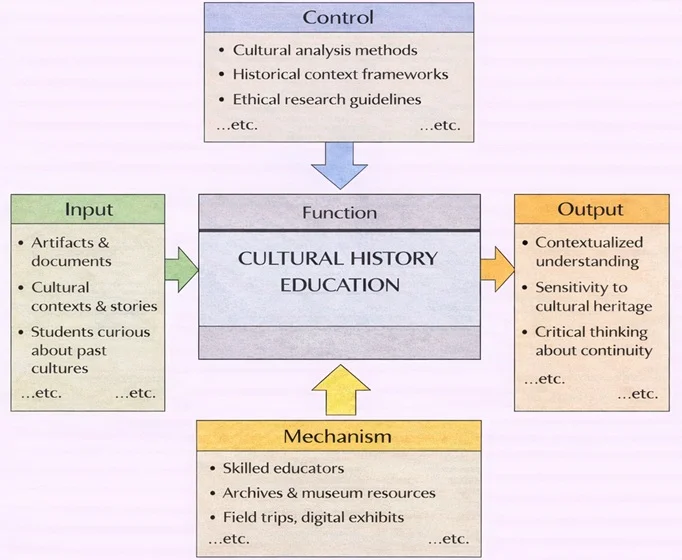
Cultural History Education takes traces of the past — artifacts, documents, stories, and everyday objects — and turns them into structured understanding of how people lived, believed, celebrated, and made sense of their world. The inputs shown in the diagram reflect this: physical and written evidence that carries historical information, cultural contexts and narratives that give that evidence human texture, and students who bring curiosity about past cultures and their everyday realities.
The process does not happen without discipline. Controls such as cultural analysis methods, historical context frameworks, and ethical research guidelines ensure that interpretation is a careful, accountable practice — one that respects heritage, avoids distortion, and remains honest about whose voices are present in the record and whose are missing.
What makes the function work are its mechanisms: skilled educators who model thoughtful inquiry rather than simply transmitting facts, archives and museum resources that preserve and organise cultural materials, and experiences such as field trips and digital exhibits that help students connect evidence to real places, crafts, and communities.
When these elements work together, the outputs are specific and measurable. Students develop a contextualised understanding of cultural life across different times and places. They grow more attentive to cultural heritage — what it is, why it matters, and how it can be lost. And they strengthen their ability to think critically about continuity: what endures across generations, what changes, and why those patterns still matter today.
Cultural history examines how societies shape — and are shaped by — beliefs, rituals, identities, and shared meanings. Where political history focuses on institutions and economic history on material conditions, cultural history centres on meaning: how people interpreted their world, expressed their values, and passed those expressions on to the next generation. Exploring the history of ideas is one way into this — tracing how philosophical and intellectual movements have reshaped cultural norms and institutional life over time.
Cultural narratives do not develop in isolation. They are embedded in political and economic systems that shape what can be said, believed, and represented. The study of political systems helps explain how dominant ideologies are maintained and contested through law, media, and institutions, while economic history shows how material conditions — patterns of labour, consumption, and wealth — leave their mark on cultural attitudes and everyday life.
Identity is another central concern. Gender and cultural history examines how expectations around gender have been constructed, reinforced, and challenged across time. The history of social movements shows how cultural narratives can become drivers of political change — and how political change, in turn, reshapes culture.
Culture also operates in contexts that might seem distant from everyday life. Cultural diplomacy reveals how art, language, and tradition have been used as instruments of international influence. The history of education shows how institutions have transmitted — and sometimes imposed — particular values across generations. Even electoral processes carry cultural weight: the rituals through which societies legitimise leadership reveal deeply held assumptions about authority, trust, and belonging.
The cultural perspective adds something to historical study that political and economic narratives alone cannot provide. It keeps asking what events and structures meant to the people who lived through them — and why that question matters for understanding the present.
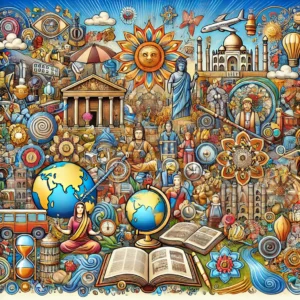
This illustration weaves together symbols of knowledge, belief, creativity, and civilisation from across the world — open books, ancient monuments, religious icons, artistic motifs, scientific instruments, and global maps. The diversity of references is deliberate. Cultural history does not study a single tradition or a single kind of evidence; it draws on whatever traces a society has left behind to ask how people understood themselves and the world around them. The connections between the symbols reflect the central argument of the field — that ideas, beliefs, and cultural practices do not develop in isolation but through contact, exchange, conflict, and inheritance across time and place.
Exploring Culture Through Ideas, Identity, and Media
Cultural History – Overview
Frames how cultural practices, symbols, and shared meanings evolve across societies and historical periods.
History of Ideas
Tracks how influential concepts circulate and reshape cultural understanding across time and contexts.
Gender & Cultural History
Reveals how identities and roles are constructed, negotiated, and transformed within cultural systems.
Postcolonial Cultural Studies
Examines how colonial legacies shape cultural narratives and how they are challenged and reinterpreted.
Media & Communication History
Explores how communication systems transform cultural exchange, influence, and public discourse.
Popular Culture
Interprets everyday media and entertainment as dynamic sites where meaning and identity are negotiated.
Art History
Shows how visual expression reflects shifting values, power structures, and cultural imagination.
Religious & Spiritual History
Connects belief systems to cultural organization, identity formation, and historical transformation.
Cultural Geography
Links place and space with cultural memory, showing how environments shape and reflect human experience.
Key Focus Areas in Cultural History
Intellectual Movements
Cultural history investigates the rise and influence of intellectual movements that have shaped societies.
- The Renaissance:
- The Renaissance was a period of cultural rebirth in Europe (14th–17th century).
- Key Features: Revival of classical learning, humanism, and advancements in art and science.
- Impact: Fostered individualism, scientific inquiry, and artistic innovation.
- The Enlightenment:
- An 18th-century intellectual movement emphasizing reason, liberty, and scientific progress.
- Impact: Influenced democratic revolutions, modern governance, and education systems.
Art and Aesthetics
Art and aesthetics serve as reflections of cultural values and ideologies.
- Classical Art: Rooted in ancient Greek and Roman traditions, emphasizing harmony, proportion, and realism.
- Modernism: A 20th-century movement challenging traditional forms and exploring abstraction and experimentation.
- Cultural Symbolism: Art as a medium for political, social, and religious expression, such as protest art during the Civil Rights Movement.
Evolution of Media
Cultural history examines how media shapes and reflects societal values and opinions.
- The Printing Press: Revolutionized communication in the 15th century, spreading ideas widely and fostering the Reformation and the Enlightenment.
- Television and Film: Became powerful tools for shaping public opinion, especially during the 20th century.
- Digital Media: Social media platforms and digital content have transformed cultural consumption and interaction, creating new avenues for activism and global connectivity.
Religion and Rituals
Cultural history explores how religious beliefs and practices evolve and influence societies.
- Religious Reformations: Such as the Protestant Reformation, reshaping Christian beliefs and European politics.
- Ritual Practices: Investigating ceremonies, festivals, and rites of passage as expressions of cultural identity.
- Secularization: The gradual shift in some societies toward secular ideologies and diminishing influence of organized religion.
Globalization and Cultural Exchange
Cultural history traces the exchange of ideas, traditions, and artifacts between civilizations.
- The Silk Road: A vital trade network that facilitated cultural exchange between Asia, the Middle East, and Europe.
- Colonial Encounters: Examining the cultural impact of colonization on both colonizers and colonized societies.
- Modern Globalization: How cultural products like music, films, and fashion transcend national borders, creating hybrid identities.
Cultural Memory and Identity
Cultural history examines how societies remember and interpret their past to construct collective identities.
- Monuments and Memorials: Sites like the Vietnam Veterans Memorial serve as focal points for collective memory.
- Oral Histories: Preserving the experiences of marginalized groups often excluded from written records.
- Nationalism: Exploring how shared cultural symbols and myths forge a sense of national identity.
This illustration brings together the major themes of cultural history in a single frame. An open book at the centre represents the act of historical inquiry — the idea that understanding culture requires reading its traces carefully. Around it, distinct scenes correspond to the key areas covered on this page: the intellectual transformations of the Renaissance and Enlightenment, the changing forms of art and aesthetic expression, the shift from the printing press to digital media, the role of religion and ritual in structuring social life, the movement of ideas across regions through trade and exchange, and the ways communities build and contest collective memory. The image is a reminder that culture is not a background to history — it is one of the primary ways history happens.
Applications of Cultural History
Cross-Cultural Understanding
By studying diverse cultures, cultural history fosters empathy and appreciation for different worldviews, essential in a globalized world.
Policy Development
Insights from cultural history inform policies on multiculturalism, education, and heritage preservation.
Preservation of Heritage
Cultural history aids in the documentation and preservation of traditions, languages, and artifacts.
Interactive Analyzer: Cultural Diffusion & Transmission Simulator
Simulate how cultural artifacts, ideas, or language traits radiate across geographical regions and societal tiers over time based on trade networks, communication tech, and institutional controls.
Level 3 (Print Era)
20% Resistance
Case Studies in Cultural History
The Renaissance
- Historical Context:
The Renaissance was a profound cultural rebirth in Europe spanning roughly the 14th to the 17th century. Emerging first in Italian city-states such as Florence and Venice, it developed in response to renewed interest in the intellectual and artistic achievements of ancient Greece and Rome. - Innovations and Cultural Shifts:
This period transformed the way people understood humanity, nature, and knowledge. Artists developed linear perspective to create realistic depth in paintings. Writers explored secular themes and human emotion in literature, moving beyond purely religious subjects. Scholars pursued scientific inquiry, observation, and experimentation rather than relying solely on inherited authority. - Key Figures:
Leonardo da Vinci embodied the ideal of the “Renaissance man,” blending art, anatomy, engineering, and philosophy. Michelangelo reshaped sculpture and architecture with works such as the Sistine Chapel ceiling. Galileo advanced astronomy and physics, helping to shift European thought toward evidence-based science. - Long-Term Impact:
The Renaissance laid the foundations for modern science, modern education, and individual creativity. Its emphasis on critical thinking, human dignity, and intellectual freedom continues to shape Western culture today.
This illustration places three figures at its centre — an artist, an anatomist, and an astronomer — representing the convergence of art, science, and philosophy that defined the Renaissance. Classical architecture frames the scene, while anatomical sketches, celestial diagrams, and sculpting tools fill the surrounding space. The combination is deliberate: the Renaissance was not simply a revival of ancient knowledge but a reordering of how that knowledge was pursued. Where medieval scholarship had largely deferred to inherited authority, Renaissance thinkers like Leonardo da Vinci, Michelangelo, and Galileo insisted on observation, experiment, and direct engagement with the world. That shift in attitude — more than any single discovery or artwork — is what made the Renaissance a turning point.
The Harlem Renaissance
- Historical Context:
The Harlem Renaissance was a powerful cultural movement that flourished during the 1920s and early 1930s, centered in the Harlem neighborhood of New York City. It emerged during the Great Migration, when millions of African Americans moved from the rural South to urban centers in search of opportunity and dignity. - Artistic and Intellectual Contributions:
Writers such as Langston Hughes used poetry and essays to capture the everyday struggles and hopes of Black Americans. Jazz musicians transformed global music culture through innovation and improvisation. Visual artists like Aaron Douglas developed a distinctive style that blended African symbolism with modern aesthetics. - Cultural Significance:
The movement challenged racist stereotypes and asserted African-American identity, pride, and intellectual legitimacy. It demonstrated that cultural expression could become a form of resistance and empowerment. - Enduring Influence:
The Harlem Renaissance continues to influence literature, music, activism, and identity politics. Its legacy can be seen in later movements for civil rights, cultural representation, and social justice.
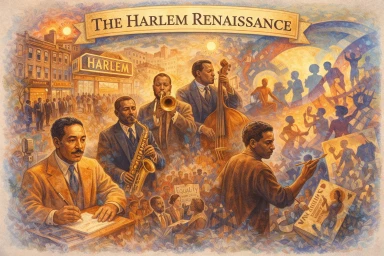
This illustration depicts writers, musicians, and visual artists at work in 1920s Harlem — figures who used poetry, jazz, and visual imagery not simply as creative outlets but as deliberate assertions of intellectual and cultural identity. The Harlem Renaissance emerged during the Great Migration, when large numbers of African Americans moved north in search of opportunity and dignity. What developed in Harlem was more than an artistic movement — it was a sustained argument, made through culture, against the stereotypes and exclusions that defined American racial life at the time. Langston Hughes, Aaron Douglas, and the jazz musicians who transformed global music were not working in isolation; they were part of a community that understood creative expression as a form of serious intellectual and political work. That understanding is what gave the movement its lasting influence on civil rights, literature, and identity politics.
The Digital Revolution
- Historical Context:
The Digital Revolution emerged in the late 20th century with the rise of computers, the internet, and mobile technologies. It represents one of the most rapid and far-reaching transformations in human communication since the invention of writing and printing. - Cultural Transformations:
Society experienced a shift from analog to digital communication. Social media platforms changed how people form identities, express opinions, and build communities. Cultural production became globalized, as ideas, videos, music, and art circulate instantly across borders, accelerating globalization of culture. - Democratization of Culture:
Ordinary individuals now have the tools to publish, broadcast, and influence global audiences. Bloggers, YouTubers, podcasters, and independent creators can shape public discourse in ways once reserved for major institutions. - New Challenges:
Alongside opportunity, the digital age raises serious concerns: misinformation, echo chambers, digital surveillance, algorithmic manipulation, and unequal access to technology. These challenges make digital literacy and critical cultural awareness more essential than ever.
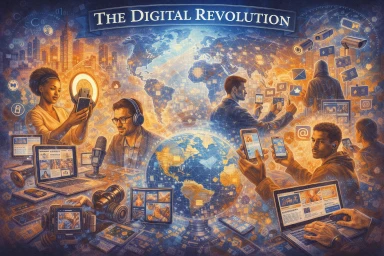
This illustration shows ordinary individuals — not institutions or governments — as the primary actors in the Digital Revolution. Smartphones, laptops, podcasts, and social platforms have made it possible for anyone to create, publish, and influence at a scale that would have been unimaginable a generation ago. The interconnected world map reflects how ideas, images, and cultural products now cross borders almost instantly, producing new forms of identity and community that do not map neatly onto national or geographic boundaries. But the illustration does not present this transformation as straightforwardly positive. Surveillance icons and fractured information streams are also present, pointing to the challenges that come with the same technologies — misinformation, algorithmic manipulation, erosion of privacy, and unequal access. The Digital Revolution is still unfolding, and how societies respond to both its possibilities and its risks will itself become part of the cultural history that future historians study.
What Students Can Learn From These Case Studies
- Historical Awareness:
Students learn that culture is never static. From the Renaissance to the Digital Age, ideas, values, and identities evolve in response to social, political, and technological change. - Critical Interpretation:
These examples encourage students to ask deeper questions: Who shapes culture? Whose voices are amplified or silenced? How do power and creativity interact across time? - Connection to Contemporary Life:
By recognizing patterns between past movements and present issues, students gain tools to interpret modern media, politics, identity debates, and technological change more thoughtfully. - Intellectual Confidence:
Studying real cultural transformations helps students see that ideas matter—and that informed individuals can contribute meaningfully to cultural change in their own communities and future careers.
- Which cultural movement resonates most with your own experiences or identity?
- How might today’s digital culture be viewed by historians a hundred years from now?
- What cultural voices do you think deserve greater visibility in society?
Challenges in Cultural History
- Subjectivity: Interpretation of cultural artifacts and symbols can vary widely.
- Representation: Ensuring diverse voices and perspectives are included in historical narratives.
- Globalization: Balancing the preservation of local cultures with the influences of global culture.
Future Directions in Cultural History
- Digital Humanities: Leveraging big data and AI to analyze cultural trends and artifacts.
- Global Perspectives: Expanding research to include non-Western cultures and histories.
- Intersectionality: Exploring the intersections of race, class, gender, and culture in shaping historical narratives.
- Climate Change: Studying how environmental changes impact cultural practices and heritage.
Why Study Cultural History
Exploring the Everyday Lives, Beliefs, and Expressions of the Past
Understanding How Culture Influences Social Change
Engaging with Art, Literature, and Popular Culture
Developing Empathy, Perspective, and Analytical Skills
Preparing for Careers in Education, Media, and Cultural Institutions
Cultural History: Conclusion
Cultural history keeps asking questions that other historical approaches can overlook — what did people believe, how did they express it, and what did their daily lives actually look like? By drawing on art, media, religion, language, and material culture, it produces accounts of the past that are harder to reduce to simple timelines or economic cycles. For students moving into university study, it offers both a distinctive set of analytical tools and a reminder that history is ultimately about how people made sense of the world they lived in.
Interactive Concept Explorations
How does cultural history treat material artifacts differently than archaeology or anthropology?
What is the significance of the shift from “high culture” to “everyday culture” in 20th-century historiography?
How does postcolonial theory reframe traditional cultural history narratives?
Cultural History – Frequently Asked Questions
What is Cultural History, and how does it differ from traditional political or economic history?
Cultural History focuses on how people in the past experienced and made sense of the world through symbols, stories, rituals, images, beliefs, and everyday practices. It differs from traditional political or economic history by paying closer attention to meanings, identities, and representations rather than only institutions, leaders, or markets. Cultural historians ask how culture both reflects and shapes power, social hierarchies, and historical change.
What kinds of questions do cultural historians ask?
Cultural historians ask questions like: How did different groups imagine the nation, family, or gender roles? How were race, class, and religion represented in art, literature, and media? How did festivals, fashion, music, or architecture express changing values? They often study how meanings are contested, who controls cultural production, and how ordinary people adapt or resist dominant narratives.
What types of sources are used in Cultural History?
Cultural historians use a very wide range of sources: novels, films, paintings, advertisements, newspapers, songs, social media, diaries, pamphlets, photographs, architecture, museum collections, and even everyday objects. They treat these materials not just as neutral records, but as texts that encode particular values, emotions, and power relations, and they analyse them using methods drawn from history, literary studies, anthropology, and cultural studies.
How does Cultural History relate to identity, gender, race, and class?
Cultural History is closely linked to questions of identity. It explores how categories like gender, race, class, ethnicity, and nation are historically constructed and represented, rather than fixed natural facts. Cultural historians show how identities are negotiated through language, images, and everyday practices, and how those identities can change over time or differ across regions and communities.
Why is Cultural History important for understanding the modern world?
Cultural History helps us understand why people disagree about values, symbols, traditions, and collective memory. It reveals how today’s debates over heritage, monuments, media, and identity politics are rooted in longer histories of representation and power. By studying how cultures have changed and interacted, you gain tools for interpreting contemporary conflicts, globalisation, popular culture, and digital communication.
What skills can I develop by studying Cultural History?
Studying Cultural History trains you to interpret complex texts and images, recognise hidden assumptions, and analyse how meaning is created and contested. You will practise close reading, visual analysis, comparative case studies, and critical writing. These skills are valuable for any path that requires media literacy, cultural sensitivity, and the ability to understand diverse perspectives.
How does Cultural History connect with other Humanities and Social Sciences subjects?
Cultural History connects naturally with literature, cultural studies, anthropology, sociology, media and communication studies, religious studies, and art history. It also overlaps with political history, economic history, and intellectual history whenever culture interacts with power, institutions, or ideas. Prep4Uni.online is designed to help you trace these connections across different hub pages and topics.
What kinds of topics might I study in a Cultural History module at university?
University modules in Cultural History might cover topics such as urban culture and modernity, colonial and postcolonial cultures, popular culture and mass media, religious rituals and symbolism, memory and trauma, youth cultures and subcultures, histories of sexuality and gender, visual culture and photography, or the cultural politics of empire, race, and nationalism.
How is Cultural History assessed at university level?
Cultural History is typically assessed through essays, source commentaries, seminar presentations, and sometimes creative or digital projects that analyse cultural materials. You will be asked to combine close analysis of specific sources with broader historical context and theoretical reflection. Preparatory exercises on Prep4Uni.online can help you practise these forms gradually before entering a degree programme.
What careers can Cultural History support?
A background in Cultural History supports careers that require strong analytical, interpretive, and communication skills. Graduates may work in education, museums and heritage, archives, publishing, journalism, cultural policy, arts administration, advertising and media, NGOs, or international organisations. Many employers value the ability to understand cultural difference and to interpret complex symbolic environments.
How can I prepare in advance for studying Cultural History at university?
You can prepare by reading accessible cultural histories, biographies, and case studies; watching documentaries and films with a critical eye; and exploring museum collections or digital archives. Try to reflect on the cultural messages around you in everyday life. Use the Cultural History page and related topics on Prep4Uni.online to practise asking historical questions about images, texts, and rituals rather than simply consuming them.
What is the difference between Cultural History and Cultural Studies?
Cultural History and Cultural Studies share many interests, such as popular culture, identity, and power, but they emphasise different things. Cultural History is anchored in historical methods and evidence, focusing on change over time and specific contexts. Cultural Studies often has a stronger theoretical emphasis and may focus more on contemporary media and critique. In practice, many university courses draw on both approaches, and Prep4Uni.online encourages you to move comfortably between them.
Comprehensive Practice Module: Cultural History Mastery
Section 1: Foundational Review Questions
- What is cultural history?
Answer: Cultural history studies past societies through their cultural expressions — art, literature, rituals, language, and everyday practices. Rather than focusing primarily on political events or economic structures, it asks what people believed, how they communicated meaning, and how those meanings shaped and were shaped by the societies they lived in. - How does cultural history differ from other historical disciplines?
Answer: Where political history focuses on power and institutions, and economic history on markets and material conditions, cultural history centres on meaning — how people interpreted their world, expressed their identities, and transmitted values across generations. It treats symbols, images, and everyday practices as serious historical evidence rather than background detail. - What methodologies are used in cultural history research?
Answer: Cultural historians use textual analysis, iconography, ethnography, and close reading of primary sources including artworks, literature, photographs, and oral traditions. They frequently draw on methods from anthropology, sociology, and literary theory, treating each source not just as a record of events but as evidence of how people made sense of their world. - How do cultural historians interpret artifacts and cultural expressions?
Answer: Artifacts and cultural expressions are interpreted within their historical and social contexts. A painting, a piece of clothing, or a public ceremony is examined for what it reveals about the values, hierarchies, and tensions of its time. Comparing multiple sources and perspectives helps historians assess the significance of what they are analysing and avoid imposing present-day assumptions onto the past. - What role does memory play in cultural history?
Answer: Collective memory — what a society chooses to commemorate, teach, and retell — is itself a cultural artefact. Cultural historians study how memories are constructed, maintained, and sometimes deliberately shaped or suppressed. What a community remembers, and how it remembers it, reveals as much about the present as about the past. - How does cultural history contribute to understanding social change?
Answer: Cultural history tracks how shifts in beliefs, practices, and representations accompany broader social transformations. Changes in art, language, religion, or media often signal deeper changes in how people understand authority, identity, and belonging. Tracing these cultural shifts helps explain why societies change in the ways they do, and why some changes meet resistance while others do not. - What challenges do cultural historians face in reconstructing the past?
Answer: Sources are often fragmentary, and many cultural artefacts have been lost, damaged, or altered. The perspectives of marginalised groups are frequently absent from official records. Interpretation is inherently subjective, and scholars must be transparent about what their evidence can and cannot support. Careful source criticism and a willingness to acknowledge gaps are essential parts of the work. - How do interdisciplinary approaches enhance the study of cultural history?
Answer: Drawing on anthropology, literary studies, sociology, and art history allows cultural historians to ask questions that a single discipline cannot answer alone. Archaeological evidence fills gaps left by written records. Literary analysis reveals how language constructs meaning. Sociological frameworks help explain how cultural practices relate to social structures. The combination produces richer and more accurate accounts. - How has globalization influenced cultural history narratives?
Answer: Globalization has made it harder to study any culture in isolation. The exchange and mixing of traditions, the emergence of hybrid identities, and the global circulation of cultural products all require historians to think across national and regional boundaries. It has also prompted a reassessment of earlier narratives that treated Western European experience as the default framework for historical analysis. - What is the significance of studying cultural history in today’s society?
Answer: Many contemporary debates — over heritage, monuments, media representation, and cultural identity — have deep historical roots that are not immediately visible. Cultural history makes those roots visible, helping people understand why certain symbols and narratives matter so intensely to different communities. That understanding is a practical tool for anyone trying to make sense of cultural conflict in the present.
Section 2: Analytical & Scenario-Based Thought Exercises
- How might digital archives and virtual museums transform the way we study and preserve cultural history?
Answer: Digital archives have made primary sources accessible to researchers who previously needed to travel to specific institutions, and virtual museums allow public engagement with collections that were once confined to single locations. Text analysis and data mining tools can now detect patterns across large bodies of material simultaneously. The challenges are real — questions of digital preservation, data integrity, and unequal access remain unresolved — but the overall effect has been to widen participation in cultural history research and to open up new kinds of questions that would have been impractical to pursue with analogue methods alone. - In what ways can cultural history inform our understanding of modern social conflicts?
Answer: Most modern social conflicts have cultural dimensions that cannot be understood without historical context. Disputes over symbols, narratives, and collective memory — which statues stand in public squares, whose history is taught in schools, which languages receive official recognition — are rooted in longer histories of representation and exclusion. Cultural history makes those roots visible, showing how current tensions developed and why they are experienced so differently by different communities. That historical perspective does not resolve conflicts, but it makes it harder to misread them. - How can studying cultural history help us understand the impact of technology on society?
Answer: Every major communication technology — the printing press, the telegraph, radio, television, the internet — has reshaped cultural practices, social organisation, and the distribution of power. Cultural history provides case studies in how these transformations unfolded, what they disrupted, and how societies adapted or resisted. Comparing the social anxieties around earlier technologies with those surrounding digital media today reveals recurring patterns — and important differences — that make the current moment easier to analyse critically rather than simply react to. - What challenges does cultural heritage preservation face in a rapidly changing world, and how can they be addressed?
Answer: Urbanisation, climate change, armed conflict, and digital obsolescence all threaten cultural heritage. Physical sites deteriorate or are destroyed; digital records become inaccessible as formats change. Effective preservation requires sustained funding, clear legal frameworks, community involvement, and international cooperation — particularly where heritage crosses borders or has been displaced by colonial history. No single strategy is sufficient. The most durable approaches combine technical conservation with genuine engagement from the communities whose heritage is at stake. - How might the concept of cultural hybridity reshape our understanding of identity in a globalized world?
Answer: Cultural hybridity challenges the idea that identities are fixed, bounded, or rooted in a single tradition. In practice, individuals and communities have always drawn on multiple cultural influences — through migration, trade, conquest, and exchange. Globalisation has accelerated this process and made it more visible. Recognising hybridity as normal rather than exceptional shifts the analytical focus from cultural purity to cultural interaction, which produces more accurate accounts of how identities actually form, change, and sometimes conflict. - How can anthropological studies of cultural rituals provide insights into contemporary social practices?
Answer: Rituals — ceremonies, festivals, commemorations, and everyday customs — are not simply decorative. They encode values, reinforce social hierarchies, mark transitions, and give communities a shared framework for interpreting experience. Anthropological analysis of how rituals function and how they change over time reveals the social work that culture does beneath the surface of everyday life. Applied to contemporary practices, this approach helps explain why certain traditions persist, how they adapt to new contexts, and what their modification or disappearance signals about broader social change. - In what ways can cultural studies contribute to the decolonization of historical narratives?
Answer: Decolonising historical narratives means more than adding previously excluded groups to existing frameworks — it means questioning the frameworks themselves. Cultural studies contributes by examining whose knowledge systems, aesthetic traditions, and ways of interpreting the world have been treated as universal, and whose have been marginalised or dismissed. Engaging seriously with oral traditions, indigenous knowledge systems, and non-Western cultural production does not simply broaden the narrative — it changes what questions historians think to ask and what counts as valid evidence. - How might digital media transform the way cultural history is researched and taught?
Answer: Digital media has expanded access to sources, enabled new analytical methods, and created more interactive teaching environments. Historians can now work with digitised collections that were previously inaccessible, apply computational tools to large bodies of text or image data, and share findings through platforms that reach beyond academic publishing. In teaching, virtual museum tours, digital timelines, and open-access archives give students direct contact with primary material. The risk is that the volume and speed of digital information can encourage surface-level engagement — the challenge is to use these tools in ways that deepen rather than replace careful analysis. - What challenges arise in preserving intangible cultural heritage, and how can they be overcome?
Answer: Intangible heritage — oral traditions, ritual practices, traditional crafts, performance forms — cannot simply be stored in an archive. It exists in practice and in the communities that maintain it. When those communities are dispersed, marginalised, or disrupted by economic change, the heritage itself is at risk. Documentation through audio, video, and written record helps, but it captures a version of the practice rather than the living tradition. The most effective preservation strategies involve supporting the communities themselves — through language programmes, cultural education, and economic conditions that make transmission across generations possible. - How can cultural studies help in understanding the role of art in shaping societal values?
Answer: Art is not simply a reflection of the values a society already holds — it actively participates in forming them. Paintings, novels, films, and music propose ways of seeing, feeling, and judging that audiences absorb, debate, and sometimes reject. Cultural studies examines this process critically, asking who produces art, under what conditions, for which audiences, and with what effects. It also tracks how artistic movements have challenged dominant ideologies — and how those challenges have been absorbed, co-opted, or suppressed — giving students tools to analyse the relationship between creative expression and social power. - How might emerging global trends influence the interpretation of cultural heritage in historical studies?
Answer: Increased migration, digital connectivity, and the global circulation of cultural products are making it harder to treat any heritage as purely local or national. Historians are increasingly required to think about how traditions have always been formed through contact and exchange rather than in isolation. At the same time, globalisation raises urgent questions about whose heritage receives institutional protection and international attention, and whose does not. These questions push cultural heritage studies toward more comparative, politically aware, and genuinely global frameworks. - How can cultural studies inform the development of policies aimed at preserving and promoting cultural diversity?
Answer: Cultural studies research documents how cultural identities are constructed, contested, and threatened — providing an evidence base for policy that goes beyond generic statements about diversity. It can identify which communities face the greatest risk of cultural loss, what forms of support are most effective, and where official preservation efforts have inadvertently distorted or commodified the traditions they claimed to protect. Translating these findings into policy requires genuine dialogue with affected communities, not just institutional decisions made on their behalf.
Section 3: Quantitative & Analytical Method Calculations
- Print Production & Literacy Spread Analysis: A 16th-century print shop produces N0 = 1,200 pamphlet copies in Year 0. Production grows exponentially at a rate of r = 8% per annum (0.08). Calculate the expected total annual print output after t = 15 years using N(t) = N0 × er×t.
Solution:
1. Substitute given values into equation: N(15) = 1200 × e0.08 × 15
2. Compute exponent: 0.08 × 15 = 1.2
3. Calculate exponential factor: e1.2 ≈ 3.3201
4. Final output calculation: N(15) = 1200 × 3.3201 = 3,984.14
Answer: Approximately 3,984 pamphlet copies per year. - Cultural Transmission Half-Life: A traditional oral dialect has P0 = 50,000 fluent speakers in a region experiencing rapid urbanization. The retention follows exponential decay P(t) = P0 × (0.5)t / h, where the decay half-life h = 25 years. Calculate the remaining speaker population after t = 75 years.
Solution:
1. Determine time-to-half-life ratio: t / h = 75 / 25 = 3 half-lives
2. Apply decay multiplier: (0.5)3 = 0.125
3. Calculate population: P(75) = 50,000 × 0.125 = 6,250
Answer: 6,250 fluent speakers remaining. - Museum Collection Artifact Preservation Index: An archive conserves Atot = 15,000 cultural artifacts. Currently, Adeg = 3,300 show active signs of environmental degradation. Calculate the Percentage Preservation Risk Rate (Rp = (Adeg / Atot) × 100%) and the safe preservation proportion (Sp = 100% − Rp).
Solution:
1. Risk Rate: Rp = (3,300 / 15,000) × 100% = 0.22 × 100% = 22%
2. Safe Proportion: Sp = 100% − 22% = 78%
Answer: Preservation Risk Rate = 22%; Safe Preservation Proportion = 78%. - Media Reach Scale Ratio: In 1925, a newspaper reaches M1 = 45,000 readers. By 1955, television broadcasting expands the same cultural message’s reach to M2 = 1,350,000 viewers. Calculate the expansion factor (F = M2 / M1) and percentage increase (ΔM% = [(M2 − M1) / M1] × 100%).
Solution:
1. Expansion Factor: F = 1,350,000 / 45,000 = 30
2. Difference: ΔM = 1,350,000 − 45,000 = 1,305,000
3. Percentage Increase: ΔM% = (1,305,000 / 45,000) × 100% = 2,900%
Answer: Reach expanded by a factor of 30 (a 2,900% increase). - Architectural Symmetry & Golden Ratio (Classical Art): A Renaissance facade is designed with height H = 18.5 metres following the classical proportion standard (φ ≈ 1.618). Calculate the ideal architectural width W using W = H × φ.
Solution:
1. Formula: W = 18.5 × 1.618
2. Arithmetic: W = 29.933 metres
Answer: Ideal width W = 29.93 metres. - Lexicographical Shift Rate: A computational linguistic study tracks loanword adoption in historical manuscripts. Year 0 has W0 = 15 foreign terms per 10,000 words. At Year 50, the rate rises to W50 = 65 terms per 10,000 words. Calculate the average linear adoption rate per decade (ΔWdec).
Solution:
1. Total change: ΔW = 65 − 15 = 50 terms per 10,000 words
2. Total elapsed time: 50 years = 5 decades
3. Rate per decade: ΔWdec = 50 / 5 = 10 terms per 10,000 words per decade
Answer: 10 loanwords per 10,000 words per decade. - Digital Humanities Text-Mining Corpus Weighting: In a corpus of Twords = 2,500,000 total words from Enlightenment journals, the term “reason” appears freason = 8,750 times, while “superstition” appears fsuper = 1,250 times. Calculate the relative frequency per 100,000 words for each term and the dominance ratio (D = freason / fsuper).
Solution:
1. Relative freq “reason”: (8,750 / 2,500,000) × 100,000 = 350 per 100k words
2. Relative freq “superstition”: (1,250 / 2,500,000) × 100,000 = 50 per 100k words
3. Dominance ratio: D = 8,750 / 1,250 = 7.0
Answer: “Reason” = 350 per 100k words; “Superstition” = 50 per 100k words; Dominance Ratio = 7.0 : 1.