
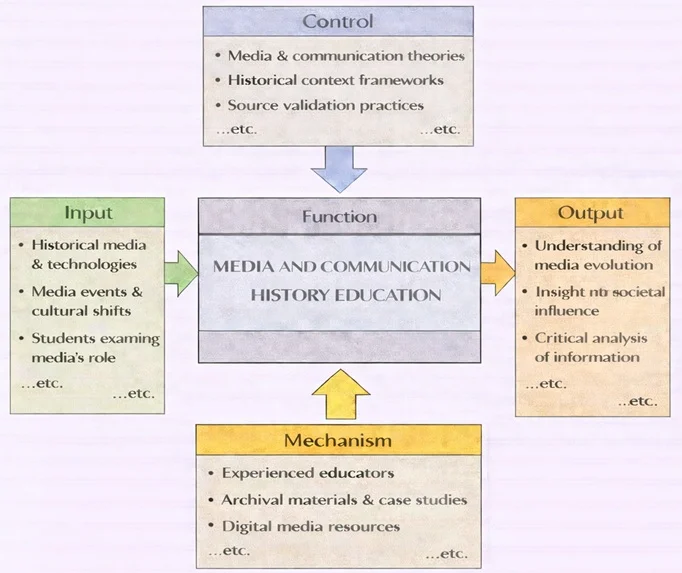
Media and Communication History Education teaches students to watch the past “speak” through its tools. It traces how messages moved—from print and telegraph to radio, television, and digital networks—and asks what each shift changed in politics, culture, and everyday life. The inputs include historical media and technologies that provide concrete artifacts to study, media events and cultural shifts that reveal turning points in public communication, and students who are examining media’s role in shaping society. The learning process is guided by controls such as media and communication theories, historical context frameworks, and source validation practices, ensuring that students connect media developments to their wider circumstances and evaluate evidence carefully rather than accepting narratives at face value. The function is enabled by mechanisms like experienced educators, archival materials and case studies that ground discussion in real examples, and digital media resources that broaden access to collections across time and place. When these elements work together, the outputs are substantial: students gain a clearer understanding of media evolution, deeper insight into how media influences societies, and stronger critical analysis of information—skills that help them interpret both historical records and the media landscapes they live in today.
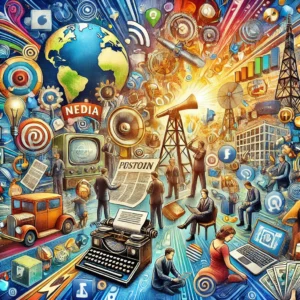
Media and communication history offers a vital lens through which we can understand not only the evolution of technology and information but also the shifting social, cultural, and political dynamics of human civilization. The trajectory of communication—from oral storytelling to the printing press, radio, television, and the internet—has influenced how ideas are shared, authority is exercised, and culture is transmitted. This field overlaps with inquiries into history of ideas, where media serves as the carrier of philosophical, political, and aesthetic thought across generations.
The role of communication in shaping governance and collective behavior becomes clear when examining the history of political systems and how these systems depended on and were reshaped by advances in communication. Just as the Enlightenment relied on pamphlets and books to spread reformist ideals, modern political movements have leveraged mass media and social platforms. The evolution of communication closely ties to the spread of social movements and the formation of ideological coalitions seen in the diplomatic history of nation-states.
The media has historically reinforced or challenged dominant cultural narratives. This is evident in the study of popular culture and postcolonial cultural studies, which explore how imagery, language, and storytelling have contributed to both the maintenance of power and its resistance. Understanding the dissemination of belief systems is also central to religious and spiritual history, where sacred texts and oral traditions shaped societies long before the digital age.
The economic underpinnings of media are explored through fields like economic history and financial history, which examine the funding models, ownership structures, and regulatory regimes that influence content production. Additionally, insights from economic thought and theory help explain the commodification of information. The reach and role of communication in shaping conflict is evident in economic history of warfare and guerrilla warfare and insurgency studies, where propaganda and psychological operations were pivotal tools.
Electoral processes too have been transformed by communication strategies, as seen in electoral history, electoral fraud and integrity, and electoral systems and political parties. These areas highlight how the press, radio, and digital media have become central to campaigns, voter education, and manipulation alike. Communication has also played a decisive role in shaping revolutionary constitutions and post-colonial constitutionalism, where public discourse shaped new political identities.
In parallel, the figures chronicled in diplomatic personalities and economic diplomacy reflect how the mastery of rhetoric, persuasion, and mass communication were essential to international negotiations. These threads come together within the broader umbrella of history, illuminating the multidisciplinary nature of communication studies. Finally, disciplines such as education history and history of political economy show how educational systems and public institutions leveraged communication as a tool for social control and empowerment.
Interactive Media Lab: Communication Network & Public Sphere Modeler
Select a communication technology era, revenue model, and public sphere mechanism to simulate real-time message velocity, audience reach, and gatekeeping dynamics.
Simulated System Dynamics Output
Key Focus Areas in Media and Communication History
1. Evolution of Media Technologies
The history of media unfolds as overlapping waves—not a simple replacement. New tools sit atop older ones, creating hybrid “media ecologies.”
Orality & Writing
- Oral cultures: Epics, performance, and memory techniques (bards, griots) maintain law and identity.
- Writing systems: Cuneiform, papyrus, parchment, paper; the codex reorganizes reading into pages, indexes, and citation.
Print & Postal Networks
- Movable type: Gutenberg enables cheap duplication; vernacular Bibles, pamphlets, newspapers.
- Print capitalism: Standardized languages and markets; postal routes and newsbooks create early information infrastructures.
Telegraph, Telephone & Photography
- Telegraph (1840s): Separates message from messenger; news agencies (Reuters, AP) globalize information.
- Telephone (1870s): Synchronous voice at distance; switchboards and operator labor.
- Photography: New evidentiary claims (crime, science, war reporting).
Film, Radio & Phonograph
- Film: From actualités to feature narratives; star system; national cinemas and propaganda newsreels.
- Radio: Live voice/music; public-service vs. commercial models; wartime leadership and morale.
- Recorded sound: Music industries, formats (shellac → vinyl → cassette → digital).
Television & Satellites
- Broadcast TV: Domestic screens; network era programming; event television (moon landing, Olympics).
- Satellite links: Live global feeds, 24-hour news channels.
Digital Networks & Platforms
- Internet & Web: From ARPANET to browsers; search engines; email and forums.
- Social media & mobile: Participatory culture, creator economies, messaging apps.
- Streaming & cloud: On-demand audio/video; binge viewing; recommendation systems.
- AI & synthetic media: Generative images/text, deepfakes, and watermarking standards.
2. Media’s Role in Shaping Cultural Dynamics
Media narrate who “we” are by selecting voices, images, and rhythms that become shared memory.
- Press, Publics & Counterpublics: Newspapers expand debate; abolitionist, labor, and diasporic presses create counterpublics.
- Nation & Identity: Synchronized reading/listening builds national time and “imagined communities” (Benedict Anderson).
- Regulation & Censorship: Licensing, obscenity laws, ratings systems, platform policies, and chilling effects.
3. Political and Social Impact of Media
- Revolution & Reform: Pamphlets in Atlantic revolutions; samizdat in late-Soviet contexts; hashtag activism.
- Journalism & Democracy: Watchdog investigations, FOI laws, dis/misinformation, filter bubbles, and OSINT verification.
- Propaganda & Persuasion: State and corporate persuasion across posters, newsreels, radio, TV, and micro-targeted ads.
4. The Business of Media
- Legacy Models: Advertising-supported newspapers/TV, public service license fees, patronage.
- Digital Monetization: Subscriptions, paywalls, platform creator funds, programmatic ad auctions, behavioral targeting.
5. The Role of Technology in Transforming Media
- Rotary presses, fiber optics, satellite constellations, media compression codecs (MP3, H.264), and algorithmic recommendation pipelines.
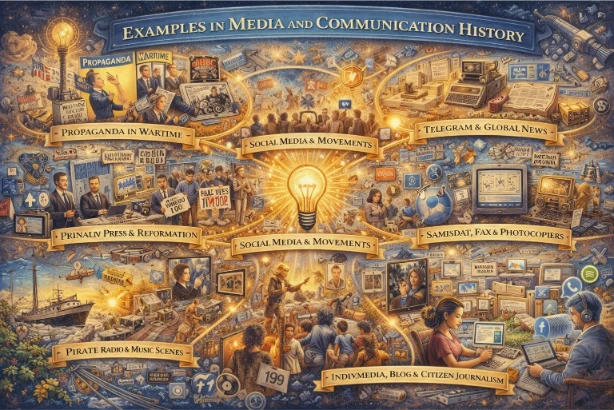
Exemplars & Case Studies in Media History
1) Propaganda in Wartime
Total war mobilization across posters, newsreels, radio addresses (Churchill, Goebbels), and TV. Key lesson: Persuasion seeks emotional alignment and behavioral compliance.
2) The Printing Press & the Reformation
Movable type, vernacular pamphlets, and postal routes decentralized religious interpretation (Luther’s 95 Theses), creating a reading public.
3) Television & the Public Event
Domestic screens synchronize national attention (1960 Kennedy–Nixon debate, Apollo 11, 1991 Gulf War live CNN effect).
4) Social Media & Movements
Networked publics coordinate activism (Arab Spring, #MeToo, #BLM), enabling rapid agenda-setting alongside digital counter-mobilization.
5) Telegraph & Global News Agencies
19th-century undersea cables separated information speed from physical transport, giving rise to wire services (Reuters, AP) and the inverted-pyramid news style.
Applications of Media and Communication History
Informing Media Literacy
Provides critical skills for source evaluation, provenance verification, and recognizing interface affordances (infinite scroll, dark patterns).
Shaping Policy & Regulation
Informs debates on free speech, platform transparency, antitrust, algorithmic auditing, data privacy, and public interest obligations.
Design & Product Safeguards
Helps UX designers translate historical media harms (radio panics, yellow journalism) into safety requirements and friction controls.
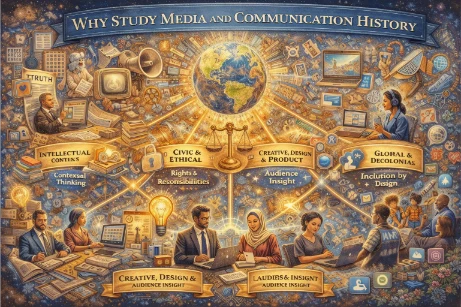
Why Study Media and Communication History
Media history is a toolkit for understanding how power, culture, and technology shape what can be said, who can speak, and what publics can hear.
Career Skill Transferability
| Skill | Practice Domain | Career Roles |
|---|---|---|
| Evidence assessment | Provenance checks, bias auditing, contextualization | Journalism, policy analysis, trust & safety, research |
| Narrative design | Serial structure, arc planning, visual rhetoric | Content strategy, documentary, marketing, education |
| Data literacy | Metrics critique, dashboards, sampling limits | Analytics, product management, audience development |
| Design ethics | Risk mapping, safety requirements, consent by design | UX design, policy, civic tech, platform governance |
| Cross-cultural fluency | Localization, translation histories, comparative media | Global communications, diplomacy, NGOs, entertainment |
Conclusion
Studying media and communication history demonstrates that new media rarely erase predecessors—they layer on top of them, carrying forward genres, habits, and biases. Democratic resilience depends on verifiable provenance, plural voices, and accountable institutions across every medium.
Frequently Asked Questions
What is Media and Communication History?
Media and Communication History studies how different media technologies and communication practices have developed over time, and how they have shaped culture, politics, and everyday life. It traces the evolution from oral traditions, manuscripts, and print to radio, film, television, digital platforms, and social media, asking how each medium reorganises who can speak, who can be heard, and what counts as public knowledge.
How does Media and Communication History differ from general Media Studies?
Media Studies often focuses on analysing contemporary content, audiences, and industries. Media and Communication History places stronger emphasis on long-term change. It asks how earlier media systems worked, how people responded to “new” technologies in their own time, and how past debates about censorship, propaganda, entertainment, or privacy anticipate current concerns about digital platforms and algorithms.
What kinds of media are examined in Media and Communication History?
The field covers a wide range of media: oral storytelling, handwritten manuscripts, printing presses, newspapers, magazines, photography, telegraphy, radio, cinema, television, telephony, the internet, and social media. It also considers communication infrastructures such as postal systems, satellites, undersea cables, and data centres, treating them as part of the history of communication.
What key questions are asked in Media and Communication History?
Key questions include: How did a new medium emerge and who controlled it? How did it change the speed and reach of communication? How did it affect power relations between governments, corporations, and citizens? Which voices were amplified or silenced? How did media shape identities, emotions, and everyday routines? And how did audiences interpret and sometimes resist media messages?
What sources are used to study Media and Communication History?
Historians draw on newspapers and magazines, broadcasting archives, advertising, films, radio and television programmes, corporate records, government documents, audience letters, fan communities, photographs, diaries, oral histories, and, increasingly, born-digital sources such as websites, blogs, and social media posts. They also use trade journals, technical manuals, and policy reports to understand how media systems were built and regulated.
How does technological change feature in Media and Communication History?
Technological change is important, but it is never treated as the only driver. Media and Communication History examines how new technologies interact with existing social structures, economic interests, cultural expectations, and political struggles. Rather than assuming that a device automatically transforms society, it asks who uses it, under what conditions, and with what consequences for access, inequality, and control over information.
What is the role of power and ideology in Media and Communication History?
Media and Communication History investigates how media have been used to legitimise authority, promote nation-building, support or challenge colonial rule, spread consumer culture, and mobilise social movements. It examines propaganda, public relations, news framing, and cultural stereotypes, while also highlighting alternative voices, underground media, and community communication that resist dominant narratives.
How does Media and Communication History connect to Cultural History?
Media and Communication History is closely linked to Cultural History because media are key spaces where meanings are negotiated. It explores how stories, images, and sounds shape collective memories, identities, and everyday practices. By situating media within broader cultural shifts—such as changing ideas of gender, race, class, youth, or nation—it shows how communication helps to organise how societies imagine themselves.
Why is Media and Communication History relevant in a digital age?
Digital media can seem entirely new, but many of today’s issues—misinformation, surveillance, media monopolies, echo chambers, moral panics—have earlier parallels. Media and Communication History provides perspective on these debates by showing how previous generations dealt with disruptive technologies and contested who should control communication, helping students think critically about continuity and change.
What skills do students develop when studying Media and Communication History?
Students learn to interpret diverse kinds of sources, from newspaper articles and broadcasts to adverts and social media campaigns. They practise close reading of images and narratives, contextual analysis, critical thinking about bias and perspective, and clear written and oral communication. They also gain experience in tracing long-term trends and synthesising complex information.
What topics might be covered in a Media and Communication History course?
Topics may include the history of the printing press and the public sphere, the rise of mass newspapers, radio in wartime, cinema and national identity, television and domestic life, advertising and consumer culture, Cold War propaganda, postcolonial media landscapes, the emergence of global news networks, and the historical roots of today’s digital platforms and influencer cultures.
What kinds of careers can Media and Communication History support?
Media and Communication History builds strong foundations for careers in journalism, broadcasting, publishing, cultural and heritage sectors, digital content creation, communications and public relations, policy analysis, NGOs, and education. Employers value graduates who can understand media narratives, assess sources critically, and communicate clearly with different audiences.
Interactive Review Questions & Concept Explanations
Click on any question below to reveal detailed answers and media explanations:
1. What is media and communication history, and why is it important?
Media and communication history is the study of how various forms of communication—from oral traditions and print media to digital platforms—have developed and influenced society over time. It is important because it helps us understand the evolution of public discourse, cultural narratives, and power structures. This field provides insight into how information dissemination has shaped political, economic, and social realities. By examining past communication practices, we can better appreciate the impact of media on contemporary culture and society.
2. How did the invention of the printing press transform communication in history?
The invention of the printing press revolutionized communication by making the mass production of texts possible and vastly increasing the dissemination of knowledge. It broke the monopoly of handwritten manuscripts, which had limited circulation and accessibility, leading to a surge in literacy and education. This transformation helped spread new ideas, fostered scientific and cultural advancements, and contributed to significant societal changes. The printing press laid the foundation for modern mass communication and played a critical role in shaping the intellectual landscape of Europe and beyond.
3. What are the key milestones in the evolution of media from print to digital formats?
Key milestones in the evolution of media include the advent of the printing press in the 15th century, the development of mass newspapers and periodicals in the 18th and 19th centuries, the rise of radio and television in the 20th century, and the emergence of the Internet and digital media in the late 20th and early 21st centuries. Each of these milestones represents a significant leap in how information is produced, disseminated, and consumed by society. They have collectively transformed public communication, enabling rapid exchange of ideas and fostering globalization. Understanding these milestones helps contextualize current digital trends and anticipate future developments in media.
4. How has digital technology changed the way we communicate and share information?
Digital technology has radically changed communication by enabling instantaneous sharing of information across global networks. The advent of the Internet, social media, and mobile devices has made communication faster, more interactive, and accessible to a broader audience. This digital revolution has also transformed traditional media industries, leading to new forms of content creation, distribution, and consumption. As a result, the landscape of public discourse has become more dynamic and decentralized, influencing both personal interactions and societal structures.
5. What role does media play in shaping public opinion and cultural values?
Media plays a pivotal role in shaping public opinion and cultural values by acting as the primary source of information and a platform for public discourse. Through various forms—such as news broadcasts, social media, films, and literature—media disseminates ideas and narratives that influence how individuals perceive and interact with the world. It can both reflect and mold societal norms, sometimes reinforcing existing power structures or challenging them through alternative perspectives. The study of media history helps us understand these processes and their implications for democracy, social justice, and cultural transformation.
6. How do historians use primary sources to study media and communication history?
Historians use primary sources such as newspapers, magazines, broadcast recordings, personal letters, and digital archives to study media and communication history. These sources provide firsthand accounts and direct evidence of past communication practices and public reactions. By analyzing these materials, historians can reconstruct the evolution of media technologies, understand cultural trends, and assess the impact of communication on society. This approach enables a detailed and nuanced understanding of how media has shaped historical events and influenced public discourse.
7. What impact did mass media have on societal transformation during the 20th century?
Mass media had a profound impact on societal transformation during the 20th century by rapidly disseminating information and shaping public perceptions on a large scale. The widespread adoption of radio, television, and later the Internet revolutionized how people received news, entertainment, and educational content. This mass dissemination of information played a critical role in political mobilization, social change, and cultural shifts, influencing public opinion during significant events such as wars, civil rights movements, and political revolutions. The power of mass media to shape societal narratives remains a central focus in the study of media history.
8. How can the study of media history help us understand the relationship between technology and culture?
The study of media history helps us understand the relationship between technology and culture by tracing how technological innovations have influenced cultural expression and societal norms. It examines the interplay between technological advancements, such as the printing press, television, and digital media, and the ways in which these innovations have transformed cultural production, dissemination, and consumption. This analysis reveals how shifts in technology can drive changes in cultural practices and social organization, influencing everything from art and literature to political ideologies and everyday communication. By understanding this relationship, we can better appreciate the dynamic and reciprocal influence of technology and culture.
9. What challenges do researchers face when studying the history of media and communication?
Researchers face several challenges when studying the history of media and communication, including the rapid pace of technological change and the vast volume of digital data available today. The transient nature of digital media, coupled with issues of data preservation and authenticity, complicates the task of documenting historical developments accurately. Additionally, the subjective interpretation of media content and the potential biases in primary sources require researchers to employ critical methodologies and interdisciplinary approaches. Despite these challenges, the study of media history remains essential for understanding the evolution of communication and its impact on society.
10. How does media and communication history contribute to our understanding of cultural globalization?
Media and communication history contributes to our understanding of cultural globalization by examining how the spread of communication technologies has facilitated the exchange of ideas and cultural practices across borders. It explores how global media networks have influenced the convergence of cultural norms and the creation of transnational cultural identities. This field highlights both the homogenizing effects of global media and the ways in which local cultures adapt and resist these influences. By studying these trends, scholars can gain insights into the mechanisms of cultural globalization and its impact on social, political, and economic structures worldwide.
Comprehensive Media & Communication History Practice Module
Part 1: Foundational Media Theories & Core Concepts
-
Define Marshall McLuhan’s aphorism “the medium is the message.”
Answer: McLuhan argued that the structural form and technical characteristics of a communication medium embed themselves in the scale, pace, and pattern of human association, exercising a far greater historical influence on human consciousness and society than the specific content delivered. -
Explain Benedict Anderson’s concept of an “imagined community” in print history.
Answer: Anderson asserted that the rise of “print capitalism” (mass-produced vernacular newspapers and books) enabled geographically dispersed individuals to imagine themselves as part of a single synchronized national community reading the same information simultaneously. -
Define the “agenda-setting function” of mass media (McCombs & Shaw).
Answer: Agenda-setting theory posits that mass media news coverage does not tell audiences precisely what to think, but successfully tells them what issues to think about by selecting, highlighting, and prioritizing specific topics over others. -
What is the difference between “misinformation” and “disinformation”?
Answer: Misinformation is false or inaccurate information spread without malicious intent; disinformation is false information deliberately created and distributed to deceive, mislead, or manipulate target audiences. -
Explain Herman and Chomsky’s “Manufacturing Consent” propaganda model.
Answer: The model asserts that corporate mass media filter news through five structural filters (ownership, advertising revenue, sourcing, flak, and anticommunist/fear ideology), framing public discourse to align with elite economic and political interests. -
What is “samizdat” in media history?
Answer: Samizdat was a clandestine system of underground publication and distribution in the Soviet Union and Eastern Bloc, where dissidents hand-typed or carbon-copied banned literature to bypass state censorship. -
Define “time-space compression” in relation to telegraphy.
Answer: The electric telegraph severed information transmission from physical transportation speed for the first time in history, compressing spatial distance and allowing instantaneous communication across continents. -
Explain the concept of an “attention economy.”
Answer: In information-rich digital environments, human attention becomes the scarce resource; platforms design interfaces and algorithms specifically to capture, retain, and monetize human focus through engagement metrics.
Part 2: Analytical & Scenario-Based Historiographical Inquiries
-
Analyze how the 19th-century invention of telegraph wire services (e.g., Reuters, AP) created the “inverted pyramid” style of news writing.
Answer: Early telegraph transmission was expensive per word and prone to line interruptions. News agencies instructed reporters to put the essential facts (who, what, where, when) in the first paragraph (“lead”), followed by supporting details in decreasing order of importance, ensuring crucial news survived cut-offs. -
Evaluate the impact of live televised coverage during the 1968 Vietnam War on American public perception (the “living room war”).
Answer: Unfiltered television news film brought graphic war violence directly into civilian domestic spaces daily, contradicting optimistic government communiqués, eroding public trust in official war military briefings, and accelerating anti-war movement mobilization. -
Examine how social media platforms served as both coordination tools and surveillance risks during the 2011 Arab Spring.
Answer: Activists utilized platforms like Twitter and Facebook to organize protests, bypass state broadcast media, and broadcast state violence to international audiences. However, authoritarian regimes quickly adapted by tracking digital footprints, identifying protest leaders, and deploying targeted shutdowns. -
How did 19th-century “yellow journalism” contribute to the outbreak of the Spanish-American War in 1898?
Answer: Rival newspaper publishers (Hearst and Pulitzer) utilized sensationalized reporting, exaggerated atrocities, and unverified headlines regarding the sinking of the USS Maine to boost circulation, inflaming public sentiment and pressuring Congress toward war. -
Contrast the funding structure and public mandate of the British Broadcasting Corporation (BBC) with American commercial network broadcasting (NBC/CBS).
Answer: The BBC was established as a public corporation funded by a mandatory household license fee, legally tasked to “inform, educate, and entertain” free from commercial advertiser pressure. US broadcasting developed a commercial model funded by private advertiser sponsorships, prioritizing mass audience appeal and rating metrics. -
Discuss how the introduction of the Gutenberg movable type printing press in 1440 transformed European literacy and religious authority.
Answer: Gutenberg’s press dramatically lowered book production costs, making vernacular Bibles accessible to lay readers. This dismantled the Catholic Church’s Latin manuscript monopoly, enabling Martin Luther’s Protestant Reformation ideas to spread contagiously across Europe. -
Explain how the 1960 Kennedy-Nixon debate demonstrated the divergence between radio and television audiences.
Answer: Radio listeners judged the debate a draw or slight Nixon victory based on verbal arguments. However, TV viewers overwhelmingly judged Kennedy the winner due to visual cues—Kennedy appeared composed, tanned, and relaxed, while Nixon appeared pale, sweaty, and ill-at-ease. -
Analyze the role of open-source intelligence (OSINT) in contemporary war verification compared to traditional battlefield journalism.
Answer: Traditional battlefield journalism relied on embedded reporters and official military briefings. OSINT utilizes crowdsourced satellite imagery, social media geolocation, and digital metadata to independently verify military troop movements and refute official state disinformation in real time.
Part 3: Quantitative Media Metrics & Audience Reach Calculations
In 1910, a industrial city had a total household population of 250,000. The city’s three daily morning newspapers sold 85,000, 65,000, and 50,000 copies daily. Calculate total daily newspaper circulation, the household penetration percentage, and the market share of the leading paper.
Solution Steps:
1. Total daily circulation = 85,000 + 65,000 + 50,000 = 200,000 copies.
2. Household penetration rate = (200,000 / 250,000) × 100 = 80.0%.
3. Leading paper market share = (85,000 / 200,000) × 100 = 42.5%.
Conclusion: Total circulation was 200,000 copies, achieving an 80% household penetration rate, with the lead paper capturing 42.5% market share.
A 1970 TV network broadcast achieves a rating of 22.0 (percentage of total TV households) and an audience share of 35.0 (percentage of households with TV set turned on). If an advertiser buys 6 commercial spots during this show, calculate total Gross Rating Points (GRPs). If the television universe is 60 million households, compute total impression households reached per spot.
Solution Steps:
1. Gross Rating Points (GRPs) = Rating × Number of spots = 22.0 × 6 = 132 GRPs.
2. Impressions per spot = 60,000,000 × (22.0 / 100) = 13,200,000 households.
Conclusion: The campaign generated 132 GRPs, reaching 13.2 million households per commercial spot.
In 1866, the Atlantic Telegraph cable charged 20 pounds sterling for a 20-word dispatch (1 pound per word). By 1888, technological improvements reduced transmission costs to 1 shilling per word (20 shillings = 1 pound). Calculate the percentage reduction in per-word transmission costs.
Solution Steps:
1. 1866 cost in shillings = 1 pound × 20 = 20 shillings per word.
2. 1888 cost = 1 shilling per word.
3. Absolute savings = 20 − 1 = 19 shillings.
4. Percentage cost reduction = (19 / 20) × 100 = 95.0%.
Conclusion: Per-word transatlantic telegraph transmission costs declined by 95.0% over 22 years.
A digital news site serves 2,500,000 banner ad impressions over one month. The campaign generates 12,500 clicks and costs the advertiser $5,000 total. Calculate the Click-Through Rate (CTR) percentage and the Cost Per Mille (CPM) impression rate.
Solution Steps:
1. Click-Through Rate (CTR) = (Clicks / Impressions) × 100 = (12,500 / 2,500,000) × 100 = 0.50%.
2. CPM (Cost Per 1,000 impressions) = [Total Cost / (Impressions / 1,000)] = $5,000 / 2,500 = $2.00.
Conclusion: The ad campaign achieved a 0.50% CTR at a CPM rate of $2.00 per thousand impressions.
In 1517, a religious reform tract is printed in an initial run of 500 copies. Due to regional reprinting across 8 cities, total available copies double every 2 weeks. Calculate total circulation after 10 weeks (5 doubling periods).
Solution Steps:
1. Number of doubling periods = 10 / 2 = 5.
2. Growth factor = 25 = 32.
3. Total circulation = 500 × 32 = 16,000 copies.
Conclusion: Total tract circulation expanded to 16,000 copies over 10 weeks.
A digital news post is shared by an initial seed group of 1,000 users. On average, each user re-shares the post to 12 friends, and 4% of those friends re-share it further. Calculate the viral coefficient K-factor and determine if the post exhibits self-sustaining viral growth (K > 1.0).
Solution Steps:
1. Invites per user i = 12.
2. Conversion probability p = 0.04 (4%).
3. K-factor = i × p = 12 × 0.04 = 0.48.
4. Evaluation: Since K = 0.48 (which is less than 1.0), the cascade is sub-critical and will decay over successive generations.
Conclusion: The K-factor is 0.48, meaning the content will not achieve self-sustaining viral growth without external amplification.
In 1922, 60,000 US households owned a radio receiver out of 25 million total households. By 1930, 12.0 million households owned a radio. Calculate the radio adoption percentage in 1922 and 1930, and the absolute percentage point expansion over the decade.
Solution Steps:
1. 1922 adoption rate = (60,000 / 25,000,000) × 100 = 0.24%.
2. 1930 adoption rate = (12,000,000 / 25,000,000) × 100 = 48.0%.
3. Absolute expansion = 48.0% − 0.24% = 47.76 percentage points.
Conclusion: Radio household penetration grew from 0.24% to 48.0%, expanding by 47.76 percentage points during the 1920s.