
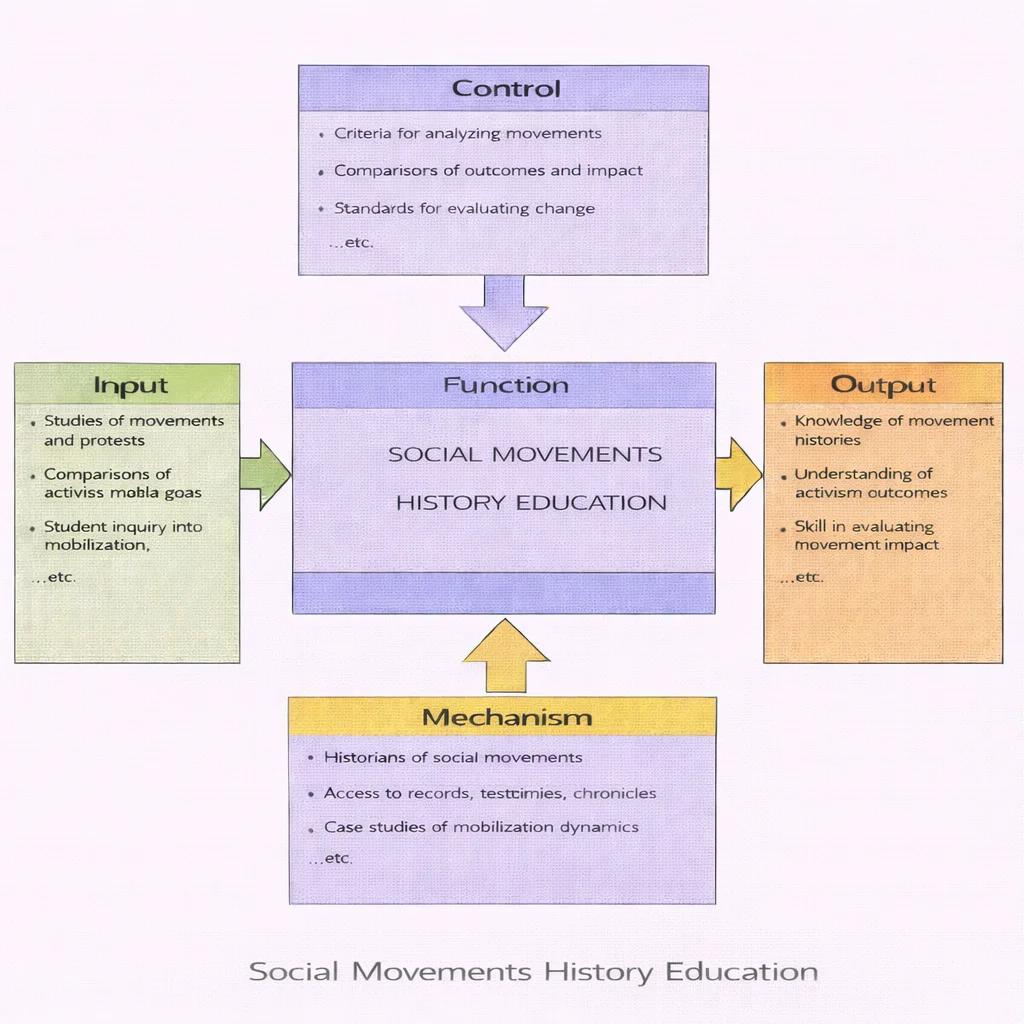

Voices in Motion: Collective Action and Social Change
Social History – Overview
Serves as the foundational umbrella examining how everyday life, labor relations, family structures, and community norms evolve across eras, providing the structural backdrop against which collective grievances form.
Demographic History
Analyzes population shifts, mortality rates, age distributions, and urbanization patterns that generate structural socioeconomic pressures, serving as key catalysts for mass mobilization.
Education History
Investigates the historical expansion of literacy, public schooling, and university spaces that fostered critical political awareness, radical intellectual networks, and student activism.
History of Social Movements (Current Focus)
Focuses directly on organized, sustained collective campaigns challenging institutional power, state authority, and social hierarchies to secure rights and policy reform.
Migration and Diaspora Studies
Examines how spatial displacement, border crossings, and transnational diaspora networks transmit activist ideologies, resistance strategies, and cross-border solidarity.
Urban and Rural History
Explores how geographical environments—from high-density urban public squares to isolated agrarian landscapes—shape tactical choices, protest visibility, and organizational infrastructure.
Women’s History
Highlights the pivotal role of women and gender dynamics in leading reform campaigns, redefining bodily autonomy, labor rights, and universal franchise across global societies.
Key Focus Areas in the History of Social Movements
Defining Social Movements
Characteristics
- Collective Action: Involves groups of people working together to achieve shared goals.
- Sustained Efforts: Unlike isolated protests, social movements are ongoing campaigns.
- Ideological Foundations: Movements are often guided by specific ideologies, such as feminism, environmentalism, or socialism.
Types of Social Movements
- Reform Movements: Aim to improve existing systems without overthrowing them (e.g., Labor movements advocating for workers’ rights).
- Revolutionary Movements: Seek to fundamentally transform or overthrow existing systems (e.g., The French Revolution).
- Resistance Movements: Oppose changes perceived as harmful to traditional values or systems (e.g., Anti-globalization movements).
Historical Social Movements
The Civil Rights Movement (1950s–1960s)
- Context: The civil rights movement in the United States sought to end racial segregation and discrimination against African Americans.
- Key Events: Montgomery Bus Boycott (1955–1956) sparked by Rosa Parks; March on Washington (1963), where Martin Luther King Jr. delivered his iconic “I Have a Dream” speech.
- Outcomes: Landmark legislation such as the Civil Rights Act (1964) and the Voting Rights Act (1965) addressed systemic racial inequalities.
Environmental Activism
- Early Movements: Conservation efforts in the late 19th and early 20th centuries, such as the establishment of national parks in the U.S.
- Modern Activism: The environmental movement gained momentum in the 1960s with Rachel Carson’s book Silent Spring (1962), highlighting the dangers of pesticides.
- Key Events: The first Earth Day (1970) mobilized millions to advocate for environmental protection; movements like Fridays for Future, led by Greta Thunberg, focus on climate change and sustainability.
- Outcomes: International agreements like the Kyoto Protocol (1997) and the Paris Agreement (2015) aim to address global environmental challenges.
LGBTQ+ Rights Movements
- Early Advocacy: The Stonewall Riots (1969) in New York City marked a turning point for LGBTQ+ activism, demanding rights and equality.
- Key Events: The establishment of Pride parades celebrating LGBTQ+ identities; legal victories such as the legalization of same-sex marriage in the U.S. (2015) and other countries.
- Outcomes: Broader societal acceptance of LGBTQ+ individuals and increased legal protections against discrimination.
Strategies and Methods of Social Movements
Protests and Demonstrations
- Public gatherings and marches serve as visible expressions of dissent.
- Examples: The Women’s March (2017) mobilized millions globally to advocate for women’s rights and social justice.
Civil Disobedience
- Nonviolent resistance is a hallmark of many social movements.
- Examples: Gandhi’s Salt March (1930) during India’s struggle for independence; Sit-ins during the U.S. civil rights movement challenged segregation laws.
Grassroots Mobilization
- Building local networks and empowering communities to take action.
- Examples: Community organizing by Cesar Chavez and the United Farm Workers in the U.S.
Media and Communication
- Social movements leverage media to amplify their message and gain public support.
- Examples: The role of newspapers and pamphlets during the abolitionist movement; social media platforms like Twitter and Instagram in movements such as Black Lives Matter.
Challenges Faced by Social Movements
Opposition and Repression
- Governments and powerful institutions may use legal, political, or violent means to suppress movements.
- Examples: Crackdowns on labor strikes during the Industrial Revolution; surveillance and infiltration of civil rights organizations by government agencies.
Internal Divisions
- Movements can experience disagreements over goals, strategies, or leadership.
- Examples: The suffragist movement split over strategies for achieving women’s voting rights.
Sustainability
- Maintaining momentum and resources over time is a common challenge for social movements.
Impact and Legacy of Social Movements
Policy and Legal Changes
- Social movements often lead to significant legislative and policy reforms.
- Examples: The labor movement’s advocacy resulted in laws establishing minimum wages, workplace safety, and the 8-hour workday; the feminist movement’s efforts contributed to legal protections against gender discrimination.
Cultural Shifts
- Movements influence societal values and norms, fostering greater inclusivity and awareness.
- Examples: The civil rights movement advanced conversations about racial equality globally; LGBTQ+ activism has promoted acceptance of diverse sexual and gender identities.
Global Influence
- Successful movements inspire similar efforts in other countries.
- Examples: The anti-apartheid movement in South Africa inspired global campaigns against racial injustice; environmental activism in one region often sparks international collaborations.
Examples in Social Movement History
The Abolitionist Movement
- Context: Advocated for the end of slavery in the 18th and 19th centuries.
- Impact: Achieved the abolition of slavery in many countries, including the U.S. (1865) and the British Empire (1833).
The Women’s Suffrage Movement
- Context: Campaigned for women’s right to vote in the late 19th and early 20th centuries.
- Impact: Secured voting rights for women in countries like New Zealand (1893), the U.S. (1920), and the UK (1928).
Black Lives Matter
- Context: Emerged in 2013 to address police brutality and systemic racism.
- Impact: Catalyzed global conversations about racial justice and led to police reforms in several cities.
The Anti-Nuclear Movement
- Context: Opposed nuclear weapons testing and the expansion of nuclear power in the mid-20th century.
- Impact: Influenced international treaties, such as the Nuclear Non-Proliferation Treaty (1968).
Interactive Analysis: Movement Trajectory & Institutional Impact Simulator
Social Movement Dynamics Simulator
Simulate movement momentum (M) and legislative reform impact (R) across a 10-year campaign timeline based on resource mobilization and counter-repression factors.
Applications of Social Movement Studies
Advocacy and Activism
- Provides strategies for modern movements to mobilize resources and achieve goals.
Policy Development
- Informs policymakers about the historical roots of societal issues and the need for equitable reforms.
Education and Awareness
- Highlights the importance of civic engagement and the power of collective action.
Why Study History of Social Movements
Understanding How Collective Action Drives Social Change
Exploring a Wide Range of Causes and Struggles
Analyzing Tactics, Leadership, and Opposition
Recognizing the Long-Term Impact and Legacy of Movements
Preparing for Active Citizenship and Interdisciplinary Study
Social Movement History: Conclusion
Interactive Review: Core Concepts & Analytical Frameworks
How does Resource Mobilization Theory explain the success or failure of social movements?
What is the Political Opportunity Structure, and why is it vital for timing activism?
Differentiate between Reformative and Revolutionary movement goals.
Frequently Asked Questions
What are social movements in historical perspective?
In historical perspective, social movements are sustained, collective efforts by groups of people who seek to defend or transform aspects of society such as laws, institutions, values, or everyday practices. They emerge when individuals organise around shared grievances and hopes, using various forms of protest and participation to push for change.
How does the history of social movements fit within social history?
The history of social movements fits within social history because it focuses on how ordinary people, rather than only elites, have tried to influence society. It explores how workers, women, students, minorities, and many other groups built organisations, formed alliances, and used collective action to reshape everyday life, law, and culture.
What kinds of social movements do historians commonly study?
Historians study a wide variety of social movements, including labour and trade union movements, suffrage and feminist movements, civil rights and anti-racist struggles, anti-slavery campaigns, peasant and land rights movements, environmental and peace movements, student and youth activism, indigenous rights campaigns, and movements for sexual and gender diversity.
What types of sources are used to study the history of social movements?
To study social movements, historians use sources such as pamphlets and manifestos, meeting minutes, newsletters, posters, songs, memoirs, letters, oral histories, photographs, police and intelligence reports, court cases, newspapers, and social media archives. These materials help reconstruct both leadership debates and grassroots experiences.
How do social movements relate to formal politics and political parties?
Social movements often interact with formal politics in complex ways. Some remain outside parties and parliaments, aiming to shape public opinion and culture. Others support particular parties, try to influence legislation, or eventually form their own political organisations. Historians examine how movements pressure, collaborate with, or oppose state institutions over time.
What roles do organisation and leadership play in social movements?
Organisation and leadership help social movements coordinate actions, maintain participation, and negotiate with allies and opponents. Leaders may come from unions, community groups, religious organisations, universities, or online networks. Historians study both prominent figures and less visible organisers to understand how movements sustain themselves and adapt to challenges.
Which tactics have social movements used historically to pursue change?
Historically, social movements have used tactics such as petitions, marches, strikes, boycotts, sit-ins, civil disobedience, occupations, legal challenges, community education, artistic performances, and media campaigns. The choice of tactics reflects available resources, political contexts, ethical commitments, and assessments of what will be most persuasive or disruptive.
How do social movements address issues of class, gender, race, and other identities?
Social movements both challenge and reflect existing inequalities. Many have focused on class exploitation, gender discrimination, racial injustice, colonial domination, or other forms of exclusion. At the same time, movements themselves can contain internal hierarchies and tensions. Historians explore how activists debated inclusion, leadership, and representation within their own organisations.
How do historians evaluate the success or failure of social movements?
Historians evaluate social movements by looking beyond immediate victories or defeats. They consider legal and policy changes, shifts in public attitudes, new institutions and networks, and long-term cultural effects. Even movements that do not achieve all their goals can leave legacies in language, symbols, and expectations that shape later struggles.
What is the international and transnational dimension of social movements?
Many social movements have international or transnational dimensions. Ideas, strategies, and symbols travel across borders through conferences, exile communities, solidarity campaigns, and media. Historians study how movements in different countries learn from one another, build global networks, or respond to international institutions and corporations.
How are social movements remembered and represented in popular culture and public memory?
Social movements are remembered through commemorations, monuments, school curricula, films, songs, and museums. Some movements are celebrated as heroic, while others are marginalised or portrayed as disruptive. The history of social movements examines how these memories are constructed, contested, and used in later political debates.
What can students learn from studying the history of social movements?
By studying the history of social movements, students learn how collective action develops, how ordinary people have expanded rights and challenged injustices, and how gains can be defended or rolled back. They also develop skills in analysing evidence, understanding multiple perspectives, and reflecting on their own role in public life and civic engagement.
Comprehensive Practice Module
Section 1: Foundational Review Questions
- What is the history of social movements and what does it cover?
Answer: The history of social movements examines the development and impact of organized collective actions aimed at effecting social, political, and economic change. It covers a wide range of movements—from local grassroots initiatives to global campaigns—that have challenged established systems and promoted reforms. This field explores the motivations, strategies, and outcomes of these movements, highlighting how ordinary people have mobilized to drive significant societal transformations. By understanding the historical context of social movements, we gain insight into the dynamic processes of change that shape modern societies. - How do social movements contribute to societal transformation?
Answer: Social movements contribute to societal transformation by mobilizing communities, challenging prevailing norms, and advocating for reforms that address systemic injustices. They serve as catalysts for change by raising awareness about critical issues, influencing public opinion, and pressuring governments to enact policy reforms. These movements often foster a sense of solidarity and collective identity among participants, which can lead to lasting institutional and cultural changes. Their impact is evident in the evolution of laws, social policies, and public attitudes that promote greater equality and social justice. - What are the key drivers behind the emergence of social movements?
Answer: The key drivers behind the emergence of social movements include economic disparities, political repression, cultural shifts, and social injustices that create widespread discontent. When traditional institutions fail to address the needs of marginalized groups, people come together to demand change. These drivers often intersect, creating a complex environment in which revolutionary ideas can flourish and mobilize communities. By analyzing these factors, historians can trace the origins of social movements and understand the conditions that make transformative change possible. - How have technological advancements influenced the evolution of social movements?
Answer: Technological advancements have significantly influenced the evolution of social movements by enhancing communication, organization, and mobilization. Innovations such as the internet, social media, and mobile technology enable rapid dissemination of ideas and facilitate the coordination of protests and campaigns on a global scale. These technologies have democratized information and empowered individuals to engage in activism, breaking down traditional barriers to participation. As a result, social movements have become more agile, far-reaching, and capable of effecting change in an increasingly interconnected world. - What role does leadership play in the success of social movements?
Answer: Leadership plays a critical role in the success of social movements by providing vision, direction, and the ability to mobilize supporters effectively. Charismatic and strategic leaders often serve as the face of the movement, inspiring participation and articulating clear goals that resonate with the public. Their capacity to navigate internal conflicts and adapt to changing circumstances is essential for maintaining momentum and achieving long-term objectives. Effective leadership ensures that the movement’s message is communicated consistently and that diverse voices are united under a common cause. - How do social movements affect public policy and institutional change?
Answer: Social movements affect public policy and institutional change by creating pressure for reform through collective action and sustained public engagement. They bring attention to issues that are often ignored by established political systems, pushing policymakers to address systemic problems such as inequality, discrimination, and environmental degradation. Through protests, advocacy, and lobbying, social movements influence the legislative agenda and contribute to the drafting of new laws and policies. This bottom-up pressure is crucial for the development of institutions that reflect the evolving needs and values of society. - What challenges do social movements face during their development and implementation?
Answer: Social movements face numerous challenges during their development, including internal divisions, limited resources, and opposition from established power structures. These obstacles can impede the movement’s ability to maintain momentum and achieve its goals, often leading to fragmentation or co-optation by political elites. Additionally, external pressures such as state repression and media bias may undermine public support and hinder effective mobilization. Overcoming these challenges requires strong leadership, strategic planning, and the capacity to adapt to changing circumstances while staying true to the movement’s core principles. - How does the historical context shape the trajectory of social movements?
Answer: The historical context shapes the trajectory of social movements by providing the economic, political, and cultural backdrop against which these movements emerge and evolve. Factors such as wars, economic crises, and social revolutions create conditions that can either foster or hinder collective action. The specific historical circumstances influence the strategies employed by movements and determine the issues they prioritize. This context is crucial for understanding why certain movements succeed while others falter, as it frames both the motivations of the participants and the responses of the existing power structures. - How can the study of social movements enhance our understanding of contemporary social issues?
Answer: The study of social movements enhances our understanding of contemporary social issues by revealing the underlying patterns and historical continuities in how societies respond to injustice and inequality. By analyzing past movements, we can identify recurring strategies, successes, and failures that inform current debates and policy decisions. This historical perspective allows us to see the evolution of public sentiment and the gradual shift in cultural norms that shape modern social issues. It also provides a framework for understanding the role of collective action in driving societal change, offering valuable lessons for addressing current challenges. - What lessons can be learned from the history of social movements for future activism?
Answer: The history of social movements offers lessons on the importance of grassroots mobilization, strategic leadership, and sustained public engagement in achieving lasting change. By studying historical successes and failures, activists can learn how to build resilient organizations, articulate clear goals, and effectively challenge oppressive systems. These lessons emphasize the need for adaptability, inclusivity, and ethical conduct in the pursuit of social justice. They also demonstrate that meaningful transformation often requires both gradual reforms and bold, decisive action. This knowledge equips future activists with the tools needed to navigate complex political landscapes and drive progressive reforms.
Section 2: Analytical & Scenario-Based Questions
- How do social movements evolve in response to changing political and economic landscapes?
Answer: Social movements evolve by adapting their goals, strategies, and organizational structures to meet emerging challenges. As economic conditions and political climates change, movements reassess priorities and modify tactics—incorporating new technologies, forming strategic alliances, and reinterpreting core values to remain effective. This continuous adaptation helps sustain momentum and influence long-term policy and cultural norms. - What are the primary mechanisms through which social movements achieve lasting political change?
Answer: Social movements achieve lasting political change through mass mobilization, effective communication, and sustained institutional advocacy. Key mechanisms include organizing protests, practicing civil disobedience, leveraging media, influencing legislation, and building political alliances. Integrating grassroots pressure with formal legislative processes converts temporary disruptions into enduring reforms. - How can historical studies of social movements inform strategies for addressing contemporary social injustices?
Answer: Historical studies reveal proven strategies regarding resource mobilization, coalition building, media framing, and navigating state opposition. By analyzing past successes and failures, modern activists can design resilient tactics tailored to contemporary political contexts while avoiding historical pitfalls like internal fragmentation. - How does the interaction between grassroots activism and institutional politics drive social transformation?
Answer: Grassroots activism builds bottom-up public pressure, forcing issues onto the political agenda. When this pressure meets receptive institutional mechanisms (such as court cases, parliamentary debates, or legislative drafting), popular demands are codified into enforceable law, creating a feedback loop between citizen action and state governance. - What role does public memory play in shaping the long-term impact of social movements?
Answer: Public memory preserves narratives of struggle through memorials, textbooks, and media. A well-established collective memory legitimizes past gains, inspires ongoing civic participation, and frames ongoing debates over rights and state responsibility across generations. - How can digital tools and social media reshape the study and practice of social movements?
Answer: Digital tools enable rapid global mobilization, decentralized coordination, and direct communication bypassing traditional media gatekeepers. For researchers, digital data provides real-time tracking of movement networks and sentiment, though it introduces challenges like algorithmic polarization and state surveillance. - How do shifts in demographic trends influence the emergence and impact of social movements?
Answer: Demographic shifts—such as rapid urbanization, youth bulges, or increased migratory diversity—alter social priorities and collective identity. A younger population may drive radical structural demands, whereas urban density facilitates rapid protest assembly and communication. - How can historical analysis of social movements help in predicting future societal changes?
Answer: By identifying recurring triggers—such as severe economic disparity, state overreach, or sudden policy shifts—historical analysis highlights patterns of escalation and concession, allowing sociologists and policymakers to anticipate when public discontent may crystallize into mass action. - How do political and economic crises interact to shape the evolution of social movements?
Answer: Economic crises heighten systemic grievances (unemployment, inflation), while political dysfunction creates an enforcement deficit or crisis of legitimacy. Their convergence exposes structural vulnerabilities, accelerating movement formation and pushing demands from incremental reform to radical restructuring. - What role does education play in the formation and success of social movements?
Answer: Educational spaces foster critical consciousness, provide organizational platforms, and cultivate activist leadership. Literacy and political education enable activists to articulate coherent manifestos, build international support networks, and sustain long-term ideological commitment. - How might the integration of interdisciplinary research enhance our understanding of social movements?
Answer: Interdisciplinary research combines economic resource analysis, political structural modeling, sociological network analysis, and psychological framing studies. This holistic approach captures the multi-faceted nature of movements better than any single academic discipline. - How do social movements influence the redefinition of cultural identity and collective memory?
Answer: Movements challenge dominant cultural narratives by introducing new vocabulary, artistic expressions, and symbolic rituals. By centering marginalized experiences, they expand public understanding of citizenship, national identity, and human rights.
Section 3: Mathematical & Quantitative Analysis Problems
Apply quantitative models of social movement dynamics, turnout growth, and legislative threshold probabilities using the standard HTML mathematical formats below.
- Movement Growth Rate Analysis:
Suppose a movement’s active participant count grows exponentially during an initial mobilization phase according to P(t) = P0 · er · t, where P0 = 1,200 initial organizers, the growth rate constant r = 0.35 per week, and t is time in weeks. Calculate the total participant count after t = 6 weeks.
Solution:P(6) = 1200 · e(0.35 × 6)After 6 weeks, the total participant count reaches approximately 9,800 active activists.
P(6) = 1200 · e2.10
Since e2.10 ≈ 8.16617:
P(6) = 1200 × 8.16617 = 9,799.4 - Resource Mobilization Efficiency Ratio:
An environmental coalition raises $450,000 in campaign funds. They allocate $180,000 to administrative/legal overhead, $135,000 to digital media campaigns, and $135,000 to grassroots voter mobilization. Calculate the percentage efficiency ratio η defined as non-administrative expenditure divided by total raised funds.
Solution:Non-Administrative Funds = Total Funds – OverheadThe movement operates with a 60% resource mobilization efficiency ratio.
Non-Administrative Funds = $450,000 – $180,000 = $270,000
η = ($270,000 / $450,000) × 100%
η = 0.60 × 100% = 60.0% - Turnout Threshold for Legislative Consideration:
A legislative assembly of 200 representatives requires a 60% supermajority approval to pass a civil rights amendment. A voting movement secures support from 95 representatives initially. If a public advocacy campaign influences ΔN additional representatives such that Nfinal = 95 + ΔN ≥ 120, find the minimum number of additional representatives ΔN required.
Solution:Required Supermajority = 200 × 0.60 = 120 representativesThe campaign must persuade a minimum of 25 additional representatives to guarantee passage.
ΔN = 120 – 95 = 25 - Media Attention Decay Rate:
Following a major national protest event, media coverage volume I(t) decays according to I(t) = I0 · (1 + k · t)-1, where peak initial coverage I0 = 500 news articles/day, decay constant k = 0.25 per day, and t is days post-event. Calculate the media coverage intensity at day t = 12.
Solution:I(12) = 500 · (1 + 0.25 × 12)-1Media coverage intensity decreases to 125 articles per day by Day 12.
I(12) = 500 · (1 + 3.0)-1
I(12) = 500 / 4 = 125 - Coalition Strength Probability Index:
Three distinct advocacy organizations form a joint coalition. The probability of Organization A maintaining alliance is P(A) = 0.85, Organization B is P(B) = 0.80, and Organization C is P(C) = 0.75. Assuming independent decision-making, calculate the probability P(Coalition) that all three organizations stay united throughout the campaign.
Solution:P(Coalition) = P(A) × P(B) × P(C)The probability that the coalition remains fully intact is 0.51 (or 51.0%).
P(Coalition) = 0.85 × 0.80 × 0.75
P(Coalition) = 0.680 × 0.75 = 0.510 - Protest Density Calculation:
A civic demonstration takes place in a urban public square measuring 250 meters by 120 meters. If safety monitoring records a peak crowding count of 45,000 individuals, calculate the average crowd density D in persons per square meter (m2).
Solution:Total Area = 250 m × 120 m = 30,000 m2The peak crowding density is 1.50 persons/m2.
D = Total Individuals / Total Area
D = 45,000 / 30,000 = 1.50 - Petition Signatures Threshold Index:
To qualify a citizen initiative for a state ballot, a campaign needs 150,000 valid signatures. Historical audit data shows that 18% of collected signatures are invalid due to registration mismatches. Calculate the total gross signatures Sgross the campaign must collect to guarantee meeting the 150,000 valid signature requirement.
Solution:Valid Fraction = 1.00 – 0.18 = 0.82The movement must collect at least 182,927 gross signatures to ensure qualification.
Svalid = Sgross × 0.82 = 150,000
Sgross = 150,000 / 0.82 ≈ 182,926.8