

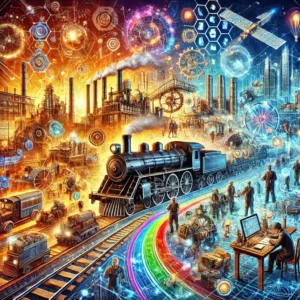
Innovation, Production, and Structural Change in Economic Development
Industrial & Technological History
Explores how advances in technology drive major shifts in production methods, firm organization, market speed, and geopolitical power over time.
Labor History
Shows how mechanization, assembly lines, and automation redefine worker skill demands, factory working conditions, and labor union structures.
Trade & Commerce History
Connects industrial mass production with expanding global commercial networks, transportation systems, and international logistics routes.
Financial History
Highlights how capital markets, corporate venture financing, and banking institutions finance large-scale infrastructure and tech projects.
Comparative Economic History
Compares how different societies, state regimes, and institutional frameworks adopt and adapt new technologies at varying rates.
Economic Thought & Theory
Interprets how economic thinkers explain technological innovation, capital accumulation, total factor productivity, and creative destruction.
Environmental Economic History
Examines the ecological fallout of industrial expansion, analyzing historical fossil fuel consumption, pollution, and resource extraction limits.
Gender & Economic History
Reveals how technological shifts in factory systems and domestic appliances redistributed labor roles and career access across gender boundaries.
Economic History – Overview
Provides the umbrella macroeconomic framework linking industrial revolutions to global living standards, state capacity, and economic growth.
Key Focus Areas in Industrial and Technological History
The First Industrial Revolution (1760–1830)
The First Industrial Revolution marked the fundamental transition from agrarian economies to industrial production systems.
- Key Innovations: Mechanized spinning/weaving (spinning jenny, power loom), James Watt’s steam engine, and coke-smelted iron refining.
- Socio-Economic Impact: Urbanization around manufacturing centers, creation of industrial working classes, and dramatic reductions in manufactured goods prices.
The Second Industrial Revolution (1870–1914)
Expanded industrial capacity through electricity, steel, synthetic chemistry, and long-distance communications.
- Key Innovations: Electrical grids (Edison, Tesla), the Bessemer steel process, synthetic chemical engineering, pharmaceuticals, and telecommunications.
- Global Acceleration: Rise of multinational corporations, rapid transcontinental railway building, steamships, and deepening global trade integration.
The Third & Fourth Industrial Revolutions (Mid-20th Century–Present)
The shift into electronics, microprocessing, software, and digital platforms.
- Computing & Automation: Invention of transistors, microchips, and industrial robotics.
- Information Age: The Internet & Web (Tim Berners-Lee), e-commerce platforms, Artificial Intelligence, and Big Data analytics.
Interactive Tool: Industrial Assembly Line & Automation Productivity Simulator
This interactive tool models how mechanization and automated production lines impact total output, unit manufacturing cost, and labor productivity. Adjust the Line Automation Level (%) and Worker Shift Capacity to observe real-time dynamic shifts in total output and unit cost efficiency.
Output / Efficiency ($)
Daily Units
Unit Cost ($)
Productivity Index
Daily Factory Volume Output: 0 units |
Unit Cost of Production: $0
Labor Productivity (Units per Worker): 0 units/worker
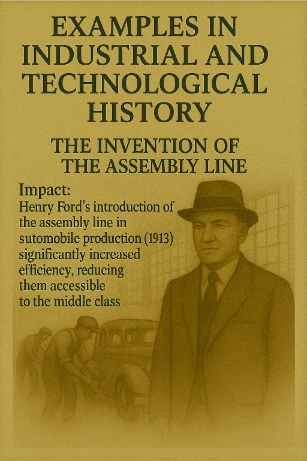
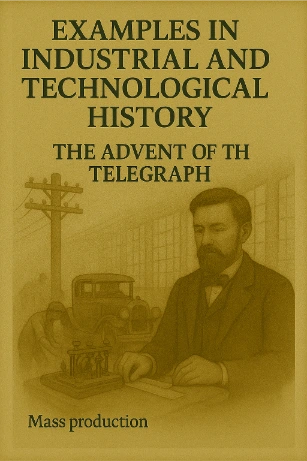
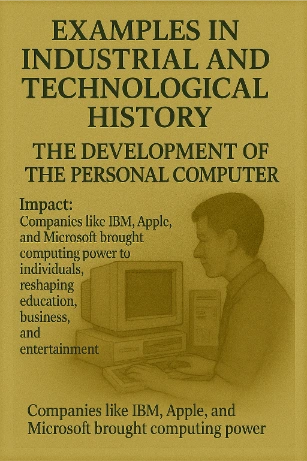
Historical Case Studies in Industrial Progress
Why Study Industrial and Technological History
Understanding How Innovation Has Shaped Modern Societies
Industrial and technological history examines the development of tools, machines, production systems, and industrial processes from early mechanization to the digital age. For students preparing for university, studying this field offers valuable insight into how technological change has driven economic growth, urbanization, labor transformations, and daily life changes.
Exploring Social and Environmental Impacts
While industrial and technological advances have brought remarkable progress, they have also introduced social upheaval, labor displacement, and environmental degradation. Students explore how the rise of factories, energy systems, and mass production affected working conditions, class structures, migration, and ecological balance.
Industrial and Technological History: Conclusion
The history of industrial and technological development reveals the transformative power of innovation in shaping economies, societies, and cultures. From the mechanized looms of the First Industrial Revolution to the interconnected world of the Information Age, this field highlights the dynamic relationship between technology and human progress.
Frequently Asked Questions about Industrial and Technological History
What is industrial and technological history within economic history?
Industrial and technological history studies how industries, production systems, and technological innovations have evolved over time and reshaped macroeconomic productivity, trade, and living standards.
Why does technological change matter for long-run growth?
It drives long-run growth by raising total factor productivity (output per worker), lowering real production costs, and creating entirely new commercial sectors.
What primary sources do industrial historians examine?
Historians analyze factory output ledgers, patent registries, engineering schematics, trade statistics, company board records, and workers’ oral testimonies.
How do energy transitions underpin industrial shifts?
Transitions from wood/water to coal, petroleum, electricity, and nuclear power dramatically scaled machine velocity, factory size, and transportation speed.
Interactive Module: Key Concept Toggles
Click each summary toggle below to reveal detailed explanatory breakdowns of core industrial history concepts:
Understanding Schumpeterian “Creative Destruction”
The Moving Assembly Line and Fordism
The “Great Divergence” in Global Industrialization
Comprehensive Practice & Assessment Module
Section 1: Foundational Review Questions
- What is industrial and technological history and why is it significant?
Answer: It examines the historical development of machinery, production methods, energy systems, and digital networks, explaining how technological innovation drives macroeconomic growth and structural change. - How did James Watt’s improvements to the steam engine transform industrial geography?
Answer: It freed factory locations from geographical dependence on fast-flowing rivers for waterwheels, allowing factories to concentrate near coal deposits, transport hubs, and urban labor pools. - What key metallurgical process enabled mass steel production during the Second Industrial Revolution?
Answer: The Bessemer process, developed in 1856, blasted air through molten pig iron to burn off impurities, dramatically reducing steel production costs. - What impact did the electric telegraph have on 19th-century commercial markets?
Answer: It enabled instant long-distance communication, eliminating market price arbitrage across cities and standardizing commodity and stock trading globally. - What was the significance of the 1947 invention of the transistor at Bell Labs?
Answer: It replaced bulky, fragile vacuum tubes, enabling microelectronics miniaturization and laying the physical foundation for modern digital computing. - How did Henry Ford’s 1913 moving assembly line alter automobile production efficiency?
Answer: It reduced the chassis assembly time for a Model T from 12 hours to 1.5 hours, drastically lowering retail price and making cars affordable to working-class consumers. - What role did ARPANET play in the history of information technology?
Answer: Funded by the U.S. Department of Defense in 1969, ARPANET developed packet-switching network protocols that formed the technical foundation of the global Internet. - How do patent systems historically influence industrial innovation rates?
Answer: Patents grant inventors temporary monopoly property rights, providing financial incentives to invest capital in risky research and development.
Section 2: Analytical & Scenario-Based Questions
- Analyze how current AI automation could reshape global labor markets compared to 19th-century mechanization.
Answer: 19th-century mechanization primarily displaced manual physical labor while creating white-collar administrative demand; AI automation directly targets cognitive, analytical, and creative tasks, altering professional knowledge work. - How did energy transitions from coal to oil alter 20th-century geopolitical relationships?
Answer: Petroleum’s higher energy density and liquid mobility shifted military logistics toward motorized warfare, making middle eastern oil reserves strategic focal points for global super-powers. - Evaluate the environmental trade-offs associated with rapid industrial acceleration since 1950.
Answer: Post-WWII industrial expansion dramatically raised global living standards and life expectancies but accelerated greenhouse gas emissions, ocean acidification, and deforestation. - Compare the economic diffusion of the steam engine with the personal computer.
Answer: The steam engine required heavy capital investment and decades of localized infrastructure buildout; the personal computer benefited from rapid microchip scaling (Moore’s Law), diffusing globally within decades. - In what ways do “digital twins” and Industry 4.0 advance modern manufacturing resilience?
Answer: Real-time digital simulations allow factories to model stress, optimize supply chains, and perform predictive maintenance before physical machine failures occur. - Why did certain regions experience rapid industrialization while others lagged during the Great Divergence?
Answer: Differences in coal access, wage levels, patent protections, financial capital markets, legal institutions, and colonial exploitation dictated regional industrialization speeds. - How can modern public-private R&D partnerships guide sustainable energy technological transitions?
Answer: Governments absorb initial high-risk basic research costs (such as battery chemistry or nuclear fusion), allowing private firms to scale commercial production.
Section 3: Numerical Problems & Calculation Solutions
- Ford Assembly Line Time & Productivity Gain: Before the moving assembly line, constructing a Model T required 12.5 hours of labor. After introducing the moving line in 1913, assembly time dropped to 1.5 hours.
a) Calculate the absolute time saved per vehicle.
b) Calculate the percentage improvement in assembly labor speed.
Answer:a) Absolute Time Saved:
Time Saved = 12.5 hours − 1.5 hours = 11.0 hours per car.b) Percentage Speed Improvement:
Speed Factor = 12.5 / 1.5 = 8.333× faster.
Percentage Time Reduction = (11.0 / 12.5) × 100% = 88.0% reduction in labor time per unit. - Moore’s Law Microchip Transistor Scaling: Moore’s Law observes that the number of transistors on a microchip doubles approximately every 2 years (× 2). A microchip in Year 0 contains 5,000 transistors.
a) Calculate the transistor count after 10 years (5 doubling cycles).
b) Calculate the total growth multiplier over this decade.
Answer:Doubling Cycles = 10 years / 2 years = 5 cycles.a) Final Transistor Count:
Count = 5,000 × (2)5 = 5,000 × 32 = 160,000 transistors.b) Growth Multiplier:
160,000 / 5,000 = 32× increase. - Industrial Energy Efficiency Upgrade: A 19th-century textile factory replaced an old steam engine operating at 4% thermal efficiency with a new high-pressure compound steam engine operating at 12% thermal efficiency.
a) Calculate the absolute efficiency improvement.
b) If the factory required 1,000 tons of coal annually under the old engine, calculate coal consumption under the new engine to produce identical energy output.
Answer:a) Absolute Efficiency Gain:
Gain = 12% − 4% = 8 percentage points (3× more efficient).b) Coal Consumption Reduction:
New Coal Needed = 1,000 tons × (4% / 12%) = 1,000 / 3 = 333.33 tons.
Coal Saved = 1,000 − 333.33 = 666.67 tons per year. - Automated Robot Unit Cost Reduction: An industrial factory installs robotic arms costing $600,000 total. The robots reduce direct labor costs from $25 per unit to $5 per unit. If the plant produces 30,000 units per year:
a) Calculate annual labor cost savings.
b) Calculate the simple payback period in years to recover the initial $600,000 investment.
Answer:a) Annual Labor Cost Savings:
Savings per Unit = $25 − $5 = $20 per unit.
Annual Savings = 30,000 units × $20 = $600,000 per year.b) Payback Period:
Payback = $600,000 / $600,000 = 1.0 year (12 months). - Telegraph vs. Mail Communication Velocity: In 1850, sending a postal letter from New York to San Francisco via steamship took 21 days (504 hours). The transcontinental telegraph reduced transmission time to 2 minutes (0.0333 hours). Calculate the velocity factor increase (× faster).
Answer:Mail Time = 21 days × 24 hours/day × 60 minutes/hour = 30,240 minutes.
Telegraph Time = 2 minutes.Velocity Improvement Factor = 30,240 / 2 = 15,120× faster.
- Factory Total Factor Productivity (TFP) Index: An industrial machinery firm increases output by 25% (+1.25) over a 5-year period. During the same period, total input costs (labor + capital) grow by 10% (+1.10). Calculate the TFP growth multiplier and percentage increase.
Answer:TFP Multiplier = Output Growth / Input Growth
TFP Multiplier = 1.25 / 1.10 = 1.13636TFP Percentage Increase = (1.13636 − 1) × 100% = 13.64% increase in productive efficiency.
- Digital Semiconductor Yield Rates: A semiconductor fabrication plant produces 10,000 silicon wafers per month. Early in manufacturing, the chip yield rate (functional chips per wafer) is 60%. Following process automation upgrades, the yield rate improves to 88%.
a) Calculate functional wafers produced before and after upgrades.
b) Calculate the net increase in monthly functional output.
Answer:a) Functional Output:
Before Upgrade = 10,000 × 0.60 = 6,000 functional wafers.
After Upgrade = 10,000 × 0.88 = 8,800 functional wafers.b) Net Increase:
Net Gain = 8,800 − 6,000 = 2,800 additional functional wafers per month (a 46.67% yield boost).