
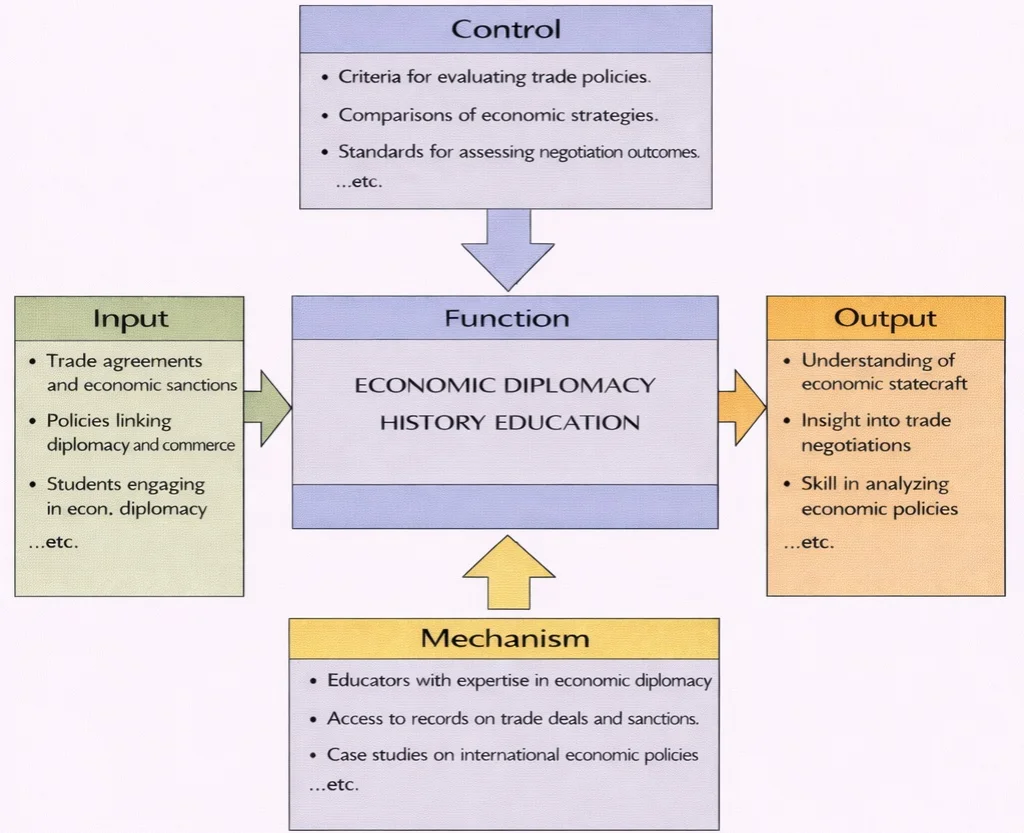

Markets and Influence: Economics as a Tool of Statecraft
Diplomatic History – Overview
Serves as the overarching foundational module, detailing how sovereign states historically interact through high-level negotiation, treaty-making, and geopolitical competition.
Economic Diplomacy (Current Module)
Examines how trade, sanctions, aid, and foreign investment serve as non-kinetic instruments of statecraft, soft power, and geopolitical leverage.
History of Alliances
Explores how mutual economic dependencies, shared markets, and trade pacts act as structural glue to solidify security partnerships and military treaties.
Treaty Analysis
Provides the legal and analytical frameworks necessary to parse formal economic protocols, bilateral investment treaties (BITs), and multi-lateral commercial codes.
Cultural Diplomacy
Investigates how economic cooperation programs, student exchanges, and commercial branding work synergistically with cultural soft power initiatives.
Diplomatic Personalities
Analyzes individual leadership styles, negotiator strategies, and key decision-makers who drove historical trade pacts and economic summits.
Military Diplomacy
Evaluates how economic embargoes, supply chain dominance, and defense industrial funding complement or substitute hard military coercion.
Key Concepts in Economic Diplomacy
Definition and Objectives
Core Objectives
- Promoting Trade and Investment: Facilitating access to markets and fostering economic growth.
- Geopolitical Influence: Using economic incentives or penalties to achieve political or strategic goals (e.g., sanctions imposed on Iran to curb its nuclear program).
- Conflict Resolution: Addressing disputes through economic cooperation and agreements (e.g., European Union integration reducing historical conflicts).
- Development Assistance: Supporting economic stability and development in partner nations (e.g., the Marshall Plan providing reconstruction aid post-WWII).
Scope and Principal Actors
- State Institutions: Ministries of Foreign Affairs, Trade, Finance, Central Banks; export credit agencies; sovereign wealth funds.
- Multilateral Bodies: WTO, IMF, World Bank, regional development banks (ADB, AfDB, EBRD, IADB).
- Private and Hybrid Actors: Multinational enterprises, chambers of commerce, industry associations, credit rating agencies, development finance institutions (DFIs), public–private partnerships.
- Sub-national Stakeholders: City or provincial trade offices, special economic zones, port authorities, and investment promotion agencies.
Operating Arenas
- Bilateral: Free trade agreements (FTAs), investment treaties, currency swap lines, debt restructuring deals.
- Regional: Customs unions and common markets (e.g., EU, ASEAN, Mercosur), cross-border infrastructure corridors.
- Multilateral: Rules-based disciplines on tariffs, subsidies, services, intellectual property, dispute settlement, balance-of-payments support.
- Informal/Club Formats: G7/G20 ministerials, supply-chain compacts, critical-minerals alliances.
Key Modalities Beyond Trade Deals
- Export Controls & Investment Screening: Regulating dual-use technologies, outbound/inbound FDI, and national security reviews.
- Macroeconomic Instruments: Central bank swap lines, exchange-rate coordination, sovereign bond placements, macro-prudential measures.
- Finance & Lending: Concessional loans, guarantees, blended finance, debt-for-reform or debt-for-nature swaps.
- Standards & Regulation: Technical standards, data-governance regimes, competition policy, carbon border adjustments.
- Industrial Policy Linkages: Subsidies, tax incentives, local-content rules, strategic stockpiles, friend-shoring and de-risking of supply chains.
- Connectivity & Logistics: Ports, rail, energy interconnectors, digital cables and cloud regions shaping trade costs and resilience.
Strategic Logics and Trade-offs
- Short-term leverage vs. long-term trust: Coercive tools (sanctions, export bans) can win concessions yet erode reputational capital.
- Efficiency vs. resilience: Global specialization lowers prices, but concentration risk motivates diversification and redundancy.
- Openness vs. security: Liberal flows of data, capital, and tech spur growth but heighten exposure to espionage and dependency.
- Equity vs. power asymmetry: Aid and access can empower partners or entrench dependencies depending on design and governance.
Conceptual Distinctions
- Economic Diplomacy vs. Commercial Diplomacy: The former is statecraft using economic tools; the latter focuses on firm-level promotion and market access support.
- Geo-economics: The use of economic instruments to achieve geopolitical ends; overlaps with but is not identical to trade or development policy.
- Sanctions vs. Embargoes: Targeted restrictions on entities/sectors versus comprehensive bans on trade with a state.
Design Principles for Effective Practice
- Proportionality & Precision: Narrowly tailor measures to minimize civilian harm and avoid excessive spillovers.
- Multilateral Alignment: Coordinate with allies to increase legitimacy and reduce evasion.
- Conditionality with Safeguards: Tie support to transparent benchmarks while protecting vulnerable groups.
- Exit Strategies: Define review clauses, snap-back provisions, and pathways to normalization.
- Data-Driven Evaluation: Monitor real-time trade flows, FDI, prices, bond spreads, employment, and supply-chain metrics.
Outcome Measurement: What to Track
- Economic Signals: Tariff-line import/export shifts, FDI approvals, credit ratings, sovereign yields, exchange-rate movements.
- Behavioral Change: Policy reforms adopted, compliance with agreements, dispute outcomes, alignment in votes or statements.
- Distributional Effects: Impacts on SMEs vs. large firms, regional employment, consumer prices, and income inequality.
- Resilience Indicators: Supplier diversification, inventory days of supply, logistics lead times, energy security buffers.
Contemporary Themes
- Supply-Chain Security: Critical minerals, semiconductors, pharmaceuticals, rare-earth processing.
- Currency & Payments: Dollar dominance, alternatives in cross-border settlements, CBDCs, correspondent-banking access.
- Digital & Data: Cross-border data flows, adequacy decisions, cloud sovereignty, cybersecurity norms.
- Climate Alignment: Green industrial policy, sustainable finance taxonomies, carbon clubs and border adjustments.
Tools of Economic Diplomacy
Trade Agreements
- Purpose: Facilitate the exchange of goods and services, reduce barriers, and ensure fair competition.
- Examples:
- GATT/WTO System: General Agreement on Tariffs and Trade (1947) evolved into the WTO (1995), founding a rules-based system.
- NAFTA/USMCA: Enhanced North American commercial links with updated provisions.
Depth & Design Features
- Architecture: FTAs, customs unions, common markets, and deep integration covering services, digital trade, and investment.
- Rules of Origin (RoO): Cumulation rules and certification models shaping supply-chain routing.
- Standards & Regulations: SPS/TBT chapters, mutual recognition agreements (MRAs), and regulatory coherence.
- Trade Remedies & Disputes: Anti-dumping, countervailing duties, and panel dispute settlement mechanics.
- Labor & Environment: Enforceable commitments tied directly to market access.
Contemporary Illustrations
- CPTPP: High-standard disciplines on services, SOEs, IP, and e-commerce across Asia-Pacific.
- RCEP: Wide tariff coverage linking East and Southeast Asian manufacturing hubs.
- AfCFTA: Progressive continental integration across African nations.
Economic Sanctions
- Purpose: Coerce or punish target states by restricting trade, financial transactions, or resource access.
- Examples: Cuban Embargo (1962–present), Sectoral Sanctions on Russia (2014, 2022).
- Typologies: Targeted asset freezes, sectoral bans, financial SWIFT restrictions, and extraterritorial secondary sanctions.
Development Aid and Assistance
- Purpose: Strengthen bilateral ties and regional stability through economic development.
- Examples: US Marshall Plan (1948–1952), China’s Belt and Road Initiative (BRI).
- Instruments: ODA grants, concessional finance, DFI project loans, and debt-for-nature swaps.
Investment Promotion & Multilateral Policies
- Investment Promotion: Tax incentives, Special Economic Zones (SEZs), and Bilateral Investment Treaties (BITs).
- Multilateral Financial Policies: IMF balance-of-payments support, central bank swap lines, and debt restructurings under the Paris Club.
Interactive Tool: Economic Sanctions & Trade Leverage Simulator
Negotiation Architecture & Playbooks
Structuring the Table
- Package Design: Bundle asymmetries (e.g., market access vs. standards capacity) so both sides gain.
- Sequencing: Agree “early harvest” items first; leave identity-sensitive issues to endgame with clear off-ramps.
- Verification: Build MRV annexes (monitoring, reporting, verification) with timelines, datasets, and who certifies.
- Dispute Paths: Pre-agree panel composition, timelines, and remedies; include snap-back and re-balancing clauses.
Four Practical Playbooks
- Standards Alignment: Pilot MRAs in low-risk sectors → expand to high-impact areas after conformity data improves.
- Debt Workouts: Standstill & data room → DSA (debt sustainability analysis) → comparability of treatment → instruments mix.
- Targeted Sanctions: Define goal → map networks → calibrate measures → humanitarian carve-outs → quarterly audits.
- Investment Compacts: Land/utilities & one-stop shop → supplier development → talent pipelines → reinvestment incentives.
Conceptual Frameworks & Theories
1) The Objectives–Channels–Outcomes (O–C–O) Model
- Objectives: Specify the exact behavior to change (e.g., stop an illicit program; adopt a standard).
- Channels: Choose instruments acting through prices, access, reputation, or rules (tariffs, finance, sanctions).
- Outcomes: Track indicators (imports at tariff line, bond spreads, policy reversals, dispute outcomes).
Ldiplomatic = (Market Size × Tech Control) ⁄ (Evasion Capacity + 1)
2) The Triangle of Power
- Market Size: Access to consumers and capital as leverage.
- Technology: Control over key IP, standards, and know-how.
- Finance: Currency networks, payment rails, and lender-of-last-resort capacity.
Historical Milestones in Economic Diplomacy
The Marshall Plan (1948–1952)
- Context: Post-World War II European economic collapse and humanitarian crisis.
- Features: Over $12 billion provided by the US in aid, machinery, and food to rebuild Western European infrastructure.
- Impact: Catalyzed European integration (OEEC, ECSC) and anchored post-war alliance structures.
GATT/WTO System
- Context: Created post-WWII to replace interwar protectionism with rules-based trade.
- Core Principles: Most-Favoured-Nation (MFN), National Treatment, tariff bindings, and formal dispute settlement.
Sanctions on Apartheid South Africa & China’s BRI
- Apartheid Sanctions: Combined trade embargoes, financial divestment, and UN isolation to compel political reform.
- Belt and Road Initiative (BRI): Massive global infrastructure connectivity network linking trade corridors across continents.
Regional Spotlights
- Europe: Deep market integration with strong regulatory institutions; emphasis on ESG and carbon border adjustments (CBAM).
- East & Southeast Asia: Dense manufacturing value chains; rules-of-origin cumulation in mega-regionals (RCEP, CPTPP).
- Africa: Continental market building via AfCFTA; infrastructure corridors and development finance integration.
- Americas: Near-shoring, supply-chain resilience, and digital trade updates in USMCA.
Interactive Review: Self-Assessment Toggles
Click on each question below to toggle open the detailed explanation and strategic answer.
Toggle Question 1: What distinguishes economic diplomacy from commercial diplomacy?
Toggle Question 2: Why are Rules of Origin (RoO) critical in trade deal negotiations?
Toggle Question 3: How do secondary sanctions operate extraterritorially?
Frequently Asked Questions
What is economic diplomacy?
Economic diplomacy refers to the use of diplomatic tools and state-to-state relationships to advance economic interests. It includes negotiations over trade, investment, finance, sanctions, development assistance, and economic cooperation, linking foreign policy with growth, competitiveness, and economic security.
How is economic diplomacy different from traditional diplomacy?
Traditional diplomacy often focuses on political, security, and territorial issues. Economic diplomacy places trade, investment, technology, and financial flows at the centre of diplomatic activity, bringing together finance ministries, central banks, business associations, and international institutions.
Why has economic diplomacy become more important in recent history?
Globalisation, complex supply chains, financial interdependence, and technological change have made states more economically interconnected. Governments increasingly use diplomacy to secure market access, attract investment, protect strategic industries, and manage economic crises.
What are the main instruments of economic diplomacy?
Key instruments include trade agreements, investment treaties, export promotion, development cooperation, debt negotiations, economic sanctions, participation in international economic organisations, and high-level economic dialogues.
How do trade agreements fit into economic diplomacy?
Trade agreements are negotiated through diplomatic channels to reduce tariffs, remove regulatory barriers, and set rules for commerce in goods, services, and intellectual property. They link domestic economic interests with external bargaining.
What role do sanctions and economic pressure play in economic diplomacy?
Sanctions, embargoes, and financial restrictions are tools of economic statecraft used to influence other states’ behaviour without direct military force, balancing pressure with humanitarian concerns and potential economic spillovers.
How do international economic organisations relate to economic diplomacy?
States conduct economic diplomacy within bodies like the WTO, IMF, and World Bank to negotiate rules, coordinate macro-policies, manage disputes, and provide financial support or technical assistance.
How does economic diplomacy intersect with development and inequality?
It addresses development assistance, debt relief, technology access, and fair trade terms. While helping promote growth, it can also reinforce power asymmetries if stronger states dictate terms during negotiations.
Who are the main actors involved in economic diplomacy?
Main actors include foreign and trade ministries, central banks, export credit agencies, investment promotion boards, development finance institutions, regional blocs, multinational corporations, and business associations.
What sources do historians use to study economic diplomacy?
Historians draw on diplomatic archives, treaty records, central bank reports, international organisation files, trade statistics, business correspondence, and personal memoirs of key negotiators.
What skills can students gain from studying economic diplomacy?
Students gain proficiency in interpreting treaty texts, evaluating economic trade data, parsing regulatory frameworks, and assessing how power, market leverage, and national interests intersect.
How can this Economic Diplomacy page be used with other Prep4Uni resources?
Learners can connect this page with modules on political history, alliance systems, treaty analysis, and economic history to build a holistic understanding of international relations and global statecraft.
Comprehensive Practice Module: Economic Diplomacy
Foundational Mastery: Foundational Concept Checks
-
What is economic diplomacy and why is it significant?
Answer: Economic diplomacy refers to the use of diplomatic tools and strategies to promote a nation’s economic interests abroad. It encompasses negotiations, trade agreements, investment promotion, and other measures that help secure economic benefits while strengthening international relations. Its significance lies in its ability to bridge the gap between political objectives and economic goals, ensuring that diplomatic efforts contribute to national prosperity. -
How does economic diplomacy differ from traditional diplomacy?
Answer: Economic diplomacy differs primarily in its focus on commercial and financial interests rather than purely political or military security issues. While traditional diplomacy centers on state-to-state political relations, economic diplomacy emphasizes trade, investment treaties, and financial cooperation to build alliances and exert soft power. -
What role do trade agreements play in economic diplomacy?
Answer: Trade agreements formalize mutually beneficial commercial terms between nations. They reduce tariffs, standardize regulatory rules, and create predictable rules-based frameworks that stimulate cross-border investment and secure market access for domestic industries. -
How does economic diplomacy contribute to national economic growth?
Answer: It opens new export markets, attracts foreign direct investment (FDI), and facilitates international technology transfers. By negotiating favorable terms, a country expands its industrial base and creates a stable environment for commercial development. -
In what ways can economic diplomacy help resolve international economic disputes?
Answer: It provides structured negotiation frameworks, dialogue channels, and formal dispute settlement mechanisms (such as WTO panels or arbitration) to resolve grievances peacefully without resorting to trade wars or military force. -
How do economic incentives function as tools in economic diplomacy?
Answer: Incentives such as preferential trade access, foreign development aid, loan guarantees, and investment credits encourage cooperation from partner states by creating tangible, mutually beneficial economic outcomes. -
How have globalization and digital transformation impacted economic diplomacy practices?
Answer: They have expanded economic interactions into cross-border data flows, e-commerce, and cybersecurity regulation, requiring diplomats to negotiate digital trade standards, protect data privacy, and utilize digital negotiation tools. -
What challenges do countries face when implementing economic diplomacy in a competitive market?
Answer: Challenges include negotiating equitable deals against asymmetric competitors, balancing domestic industry protections with market opening, and managing geopolitical tensions and supply-chain vulnerabilities. -
How can cultural factors influence the success of economic diplomacy initiatives?
Answer: Cultural factors shape communication styles, business etiquette, and trust. Cultural awareness enables diplomats to align negotiations with foreign counterpart expectations, avoiding misunderstandings and fostering long-term cooperation. -
How does economic diplomacy contribute to global economic stability and peace?
Answer: By building deep economic interdependencies, lowering trade barriers, and fostering joint investments, economic diplomacy makes conflict significantly costlier, encouraging peaceful resolution of geopolitical disputes.
Analytical Debates: Scenario & Strategic Case Analyses
-
How might emerging digital currencies and central bank digital currencies (CBDCs) transform economic statecraft?
Answer: CBDCs can streamline cross-border payments, cut transaction costs, and bypass traditional clearing networks like SWIFT. This could reduce the efficacy of dollar-based financial sanctions, compelling nations to develop new regulatory framework agreements and digital payment diplomacy. -
How can comparative studies of economic diplomacy across different regions enhance global trade relations?
Answer: Analyzing varied regional approaches (such as the EU’s regulatory model versus ASEAN’s consensus-based model) highlights best practices in dispute resolution, regional integration, and trade facilitation, helping diplomats tailor flexible strategies. -
How does increasing global supply chain complexity alter diplomatic strategies during crises?
Answer: Complex supply chains require diplomats to negotiate multi-country rules of origin, critical mineral partnerships, and logistics corridors, shifting focus from mere tariff reductions to supply chain security and “friend-shoring.” -
How do shifting global power dynamics impact the reform of multilateral institutions like the WTO and IMF?
Answer: As emerging market economies gain economic weight, they demand greater voting power, updates to dispute settlement mechanisms, and non-western financial alternatives, challenging legacy post-WWII institutional governance. -
How can economic diplomacy address environmental externalities like carbon leakage?
Answer: Nations use diplomatic channels to negotiate Carbon Border Adjustment Mechanisms (CBAM), climate finance compacts, and green technology transfer agreements to ensure climate regulations do not penalize compliant domestic producers. -
What mechanisms prevent foreign development assistance from creating debt distress in recipient nations?
Answer: Transparent bidding protocols, independent debt sustainability assessments (DSAs), local labor integration rules, and co-financing with multilateral development banks mitigate debt dependency and project failure risks. -
In what ways can sub-national actors (cities, states) engage in economic diplomacy?
Answer: Cities and regional governments establish direct sister-city agreements, trade missions, and port authority partnerships to attract foreign direct investment and foreign tech hubs independently of national foreign offices. -
How can targeted sanctions be designed to minimize civilian collateral damage?
Answer: By focusing narrowly on specific elites, military entities, or state enterprises while embedding explicit, automatic humanitarian exemptions for food, medical supplies, and basic agricultural inputs.
Quantitative Methods: Applied Policy & Trade Calculations
-
Problem: Country A imports $500 million of machinery from Country B with a baseline ad valorem tariff of 12%. Under a new Bilateral Trade Agreement, the tariff is reduced to 4%. Calculate the total annual tariff revenue savings for importers.
Solution: Initial Tariff = $500,000,000 × 0.12 = $60,000,000.
New Tariff = $500,000,000 × 0.04 = $20,000,000.
Tariff Savings = $60,000,000 – $20,000,000 = $40,000,000 (or $40 Million). -
Problem: An export loan of $120 million carries a standard commercial interest rate of 8.5% per annum over 5 years (simple interest). Through a concessional Development Aid compact, the rate is reduced to 2.5% per annum. Calculate the total interest cost saved by the borrowing nation over the 5-year period.
Solution: Commercial Interest = $120,000,000 × 0.085 × 5 = $51,000,000.
Concessional Interest = $120,000,000 × 0.025 × 5 = $15,000,000.
Interest Saved = $51,000,000 – $15,000,000 = $36,000,000 (or $36 Million). -
Problem: Country C imposes a 15% retaliatory tariff on agricultural imports from Country D. Prior to the tariff, Country D exported $200 million worth of products. Assuming the price elasticity of import demand for these products is -1.2, calculate the estimated percentage change in import volume and the new total import value.
Solution: Percentage Price Increase = +15%.
Percentage Quantity Change = % Price Change × Elasticity = 15% × (-1.2) = -18%.
New Import Quantity/Value = $200,000,000 × (1 – 0.18) = $164,000,000.
Result: Import volume drops by 18%, resulting in a new trade value of $164 Million. -
Problem: Under a regional trade agreement, a product must meet a Regional Value Content (RVC) threshold of at least 40% based on the net cost method to qualify for zero-tariff origin preference:RVC = [(Net Cost – Value of Non-Originating Materials) ⁄ Net Cost] × 100If a vehicle’s total net cost is $18,000 and the value of non-originating imported components is $10,000, calculate the RVC percentage and determine if it qualifies under the rule of origin.
Solution: RVC = [($18,000 – $10,000) ⁄ $18,000] × 100 = [$8,000 ⁄ $18,000] × 100 = 44.44%.
Conclusion: Since 44.44% is greater than or equal to 40%, the vehicle qualifies for preferential zero-tariff origin treatment. -
Problem: A sovereign country negotiates a debt-for-nature swap. It has an outstanding debt face value of $80 million trading at a discounted market price of 60 cents on the dollar ($0.60). An environmental organization acquires the debt at market price and agrees to cancel it in exchange for the country investing 50% of the original face value in local currency into a domestic marine park conservation fund over 4 years. Calculate:
a) The purchase price paid to buy the debt.
b) The total local currency funding committed to conservation.
c) The net savings in principal obligation for the debtor state.
Solution: a) Purchase Price = $80,000,000 × 0.60 = $48,000,000.
b) Conservation Commitment = $80,000,000 × 0.50 = $40,000,000.
c) Principal Debt Cancelled = $80,000,000.
Net Fiscal Relief = $80,000,000 debt canceled vs. $40,000,000 local investment = $40,000,000 direct debt reduction. -
Problem: Calculate the Herfindahl-Hirschman Index (HHI) for semiconductor supply chain reliance across 4 supplying nations with the following market shares: Supplier A (40%), Supplier B (30%), Supplier C (20%), Supplier D (10%). Recall that HHI is calculated by summing the squares of the market shares:HHI = ∑ (Si)2
Solution: HHI = 402 + 302 + 202 + 102 = 1600 + 900 + 400 + 100 = 3000.
Interpretation: An HHI of 3000 indicates a highly concentrated supply chain risk (above 2500 threshold), signaling a strategic need for economic diplomacy diversification. -
Problem: A foreign investor evaluates a $50 million investment in a Special Economic Zone. The normal corporate tax rate is 25%, but the zone offers a 5-year tax holiday followed by a reduced rate of 10% for the subsequent 5 years. If the project generates a constant annual taxable income of $8 million, calculate the total tax paid over the 10-year period under the SEZ incentive versus the standard corporate tax system.
Solution: Standard Tax over 10 years = ($8,000,000 × 0.25) × 10 = $2,000,000 × 10 = $20,000,000.
SEZ Tax (Years 1–5) = $0.
SEZ Tax (Years 6–10) = ($8,000,000 × 0.10) × 5 = $800,000 × 5 = $4,000,000.
Total Tax Savings = $20,000,000 – $4,000,000 = $16,000,000.