

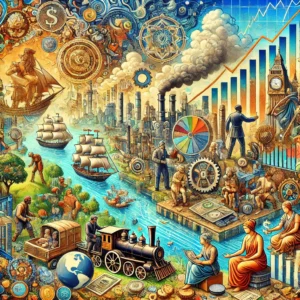
A richly detailed collage that blends major eras of economic change into one scene. Sailing ships and busy waterways suggest early global trade and colonial commerce, while smokestacks, warehouses, and a steam locomotive evoke industrialization and mass transport. Across the image are gears, currency symbols, ledgers, and tools of measurement—alongside pie charts, bar graphs, and an upward trend line—highlighting how economies are tracked, compared, and explained over time. People in the foreground read, plan, and calculate, linking everyday work and decision-making to larger forces such as innovation, urban growth, and the expansion of markets.
Understanding Production Systems, Labor Dynamics, and Economic Transformation
Trade and Commerce History
Analyzes how local, regional, and transoceanic exchange networks expanded commercial markets, connected distant civilizations, and established global trade routes like the Silk Road and maritime mercantilist networks.
Labor History
Examines the evolution of human labor, from feudal serfdom and coerced labor systems to organized union movements, collective bargaining, and modern labor market relations.
Industrial and Technological History
Explores how mechanization, steam power, electricity, and digital technological breakthroughs fundamentally transformed production efficiency, urban structures, and macroeconomic capacities.
Gender and Economic History
Investigates gendered labor division, female entrepreneurship, unpaid domestic labor, and historical disparities in property ownership and resource access across eras.
Financial History
Traces the development of banking institutions, credit expansion, stock exchanges, paper currency, and systemic financial shocks from early merchant banks to modern panics.
Environmental Economic History
Examines the historical interplay between economic growth, natural resource consumption, deforestation, pollution, fossil fuel adoption, and ecological constraints.
Economic Thought and Theory
Interprets how evolving theoretical paradigms—from scholasticism and mercantilism to classical, Marxist, Keynesian, and monetarist models—explained value and market coordination.
Comparative Economic History
Contrasts divergent economic trajectories, institutional configurations, and developmental outcomes across different societies, regions, and historical epochs.
Key Focus Areas
Industrial Revolution
The Industrial Revolution marked a significant turning point in global economic history, transforming economies from agrarian to industrialized.
- Economic Shifts: Transition from manual labor to mechanized production.
- Technological Innovations: Invention of the steam engine, mechanized textile production, and advancements in metallurgy.
- Impact: Increased productivity, urbanization, and the emergence of industrial capitalism.
- Case Study: The United Kingdom as the cradle of industrialization.
The Rise and Fall of Trade Empires
Trade empires have played a pivotal role in shaping global economies and international relations.
- The Silk Road: An ancient network of trade routes connecting Asia, the Middle East, and Europe, fostering cultural and economic exchange.
- The British Empire: Dominated global trade during the 19th and early 20th centuries, driven by industrialization and colonial expansion.
- The Dutch East India Company: One of the first multinational corporations, it shaped early globalization and colonial trade.
Economic Systems
Feudalism: Predominantly agrarian economies based on land ownership and serfdom.
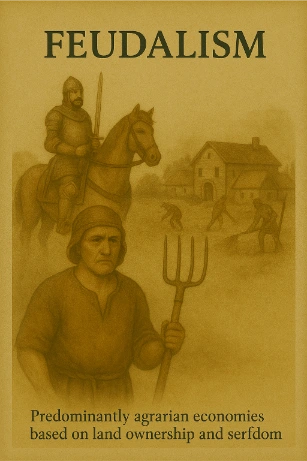
This historical illustration visually represents feudalism as a socio-economic system rooted in land ownership and labor. In the foreground, a weathered serf holds a pitchfork, symbolizing the agricultural toil of peasants. Behind him, a mounted knight in armor watches over the land, reinforcing the feudal hierarchy. In the background, a stone manor and clustered peasants depict the agrarian economy that sustained medieval society. This image captures the essence of feudal relations—lordship, vassalage, and serfdom—and serves as an effective educational resource for understanding medieval history and pre-modern economic systems.
Mercantilism: Focused on accumulating wealth through trade surpluses and colonial exploitation.
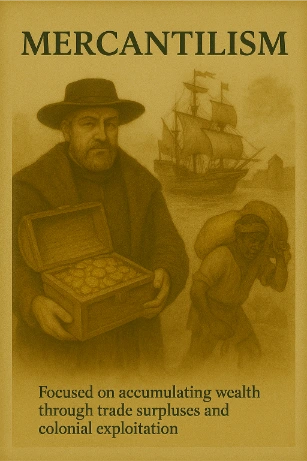
This vintage-style illustration captures the essence of mercantilism as practiced from the 16th to 18th centuries. A wealthy European merchant holds an open chest of gold coins in the foreground, symbolizing the accumulation of wealth. Behind him, a colonial-era ship is docked near a trading port, representing overseas trade. To the side, a laborer struggles with a heavy sack, evoking the exploitative labor systems tied to colonial economies. The scene reflects the core principles of mercantilism—economic nationalism, trade regulation, and resource extraction—making it ideal for educational use in history and economics contexts.
Capitalism: The rise of market-driven economies emphasizing private ownership and industrial production.
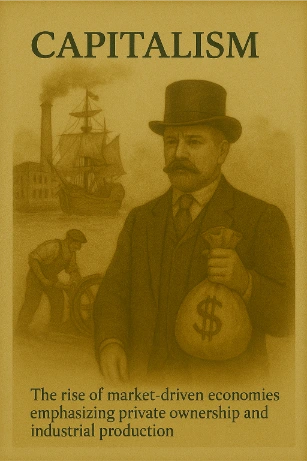
This sepia-toned educational illustration portrays the core elements of capitalism during the Industrial Revolution. In the foreground, a businessman in formal attire holds a money bag marked with a dollar sign, symbolizing private wealth and capital accumulation. Behind him, a steam-era factory and a docked trade ship represent industrial production and global commerce. A laborer working on machinery in the background signifies the rise of the working class and mechanized labor. The image visually communicates how capitalism transformed economies through private enterprise, industrial output, and competitive markets — ideal for history and economics education.
Socialism and Communism: Alternative systems advocating collective ownership of resources.

This sepia-toned illustration visually represents socialism and communism through powerful imagery reminiscent of early propaganda art. At the center, a determined worker holds a placard with the iconic hammer and sickle. A woman waves a red flag marked with a star, while another worker turns a gear in an industrial setting. The factory and smoke in the background reinforce themes of labor and industrial cooperation. The image effectively communicates the core principles of these ideologies—collective resource control and worker solidarity—making it ideal for educational use in political and economic history.
Globalization
The integration of world economies has historical roots in trade, colonization, and technological advances in transportation and communication.
- First Wave (1500–1800): Maritime exploration and colonization.
- Second Wave (19th Century): Industrialization and the Gold Standard.
- Modern Globalization: Post-World War II economic liberalization, driven by institutions like the WTO, IMF, and World Bank.
Economic Crises
Studying historical economic crises reveals patterns and policy responses.
- The Great Depression (1929): A global economic downturn marked by massive unemployment and deflation.
- The 1973 Oil Crisis: Highlighted the vulnerability of economies to resource dependencies.
- The 2008 Financial Crisis: Demonstrated the systemic risks in globalized financial systems.
Applications of Economic History
Informing Economic Policies
Historical analyses provide context for contemporary economic decisions, such as fiscal policy, trade agreements, and monetary interventions.
Understanding Globalization
By studying historical globalization trends, policymakers can anticipate the effects of modern economic integration.
Predicting Economic Trends
Lessons from past economic booms, busts, and technological revolutions help predict future economic trajectories.
Interactive Economic Systems Simulator & Historical Trade Calculator
Use the interactive simulator below to model economic growth dynamics across different historical economic systems, or compute historical currency adjustments using quantitative trade parameters.
Historical Economic System Growth Simulator
Adjust initial capital, labor input, and institutional efficiency to observe projected long-term output ($Y = A \cdot K^{\alpha} \cdot L^{1-\alpha}$) across different economic models.
Why Study Economic History
Understanding How Economies Evolve Over Time
Economic history explores how societies have produced, distributed, and consumed goods and services throughout different periods of history. For students preparing for university, this field provides essential insights into how economic systems, trade networks, institutions, and policies have developed—and how they continue to shape the modern world. It bridges the gap between history and economics by explaining not only what happened, but why it happened and with what consequences.
Connecting Historical Events to Present-Day Challenges
Economic history helps students understand the roots of today’s economic issues, such as inequality, inflation, globalization, and financial crises. By studying past events like the Industrial Revolution, the Great Depression, and the rise of capitalism, students can recognize patterns and draw lessons that inform contemporary economic thinking. This long-term perspective fosters informed and critical engagement with current debates about economic policy and development.
Exploring the Intersections of Economics, Politics, and Society
Economic activity is never isolated from social and political life. Students of economic history examine how wars, revolutions, colonization, migration, and technological change have influenced economic outcomes. This interdisciplinary approach encourages students to think broadly about how wealth is created and distributed, and how power and institutions affect economic behavior across cultures and time periods.
Developing Research, Quantitative, and Analytical Skills
Economic history trains students to work with both qualitative and quantitative data, including archival records, statistical series, and historical documents. They learn to critically assess sources, interpret trends, and construct evidence-based arguments. These skills are highly transferable to university-level coursework in economics, history, and the social sciences, as well as to careers that require analytical reasoning and historical awareness.
Preparing for Careers in Academia, Finance, Policy, and Public Service
A foundation in economic history opens pathways to a range of careers in education, government, international development, banking, business strategy, and journalism. It also supports further study in economics, political science, and history. For students entering university, economic history offers a rigorous and intellectually rewarding path that combines practical relevance with a deep understanding of how economic forces have shaped—and continue to shape—the world.
Interactive Review Questions (Click to Reveal Explanations)
How did the transition from mercantilism to industrial capitalism alter global trade balance principles?
Mercantilism emphasized a zero-sum game focused on accumulating gold bullion through state monopolies, high protective tariffs, and strict colonial trade restrictions. Industrial capitalism, championed by Adam Smith and classical economists, shifted focus toward production capacity, free market competition, absolute/comparative advantage, and bilateral trade expansion, demonstrating that international trade can be mutually wealth-generating rather than fixed.
What institutional mechanisms caused the Great Depression of 1929 to become a worldwide crisis?
The international Gold Standard transmitted monetary deflation rapidly across borders. Combined with protective trade barriers like the U.S. Smoot-Hawley Tariff, systemic bank failures, lack of lender-of-last-resort mechanisms, and strict fiscal austerity policies, national recessions coalesced into a prolonged, global economic collapse.
Why is cliometrics considered a turning point in economic history methodology?
Cliometrics integrated formal economic models and econometric statistical testing with historical data analysis. Pioneered by scholars like Robert Fogel and Douglass North, it allowed historians to rigorously test counterfactual hypotheses—such as the true quantifiable economic impact of railways or education—moving beyond purely qualitative narratives.
Frequently Asked Questions
What is Economic History?
Economic History is the study of how economies have changed over time, and how people, firms, states, and markets have interacted in different historical contexts. It looks at long-run patterns in production, trade, technology, finance, labour, and living standards, and asks why some regions grew rapidly while others faced stagnation, crisis, or inequality.
How is Economic History different from economics and from general history?
Economics typically builds abstract models of how markets, incentives, and institutions work in principle, while general history may focus on political events, culture, or ideas. Economic History sits between them: it uses economic concepts and quantitative evidence to understand concrete historical episodes, such as industrialisation, depressions, or trade booms, and explores how economic forces and political or social developments shape one another.
Why is Economic History important for pre-university students?
Economic History gives pre-university students a deeper sense of how today’s world economy emerged, from early commerce and empires to industrial revolutions and globalisation. It helps them see that policies and institutions are the result of historical choices, conflicts, and experiments, rather than fixed or inevitable. This perspective supports more informed study in economics, business, politics, and international relations at university level.
What time periods and topics does Economic History usually cover?
Economic History covers a wide span, from ancient trade networks and agrarian economies to medieval commercial centres, early modern empires, industrialisation, the Great Depression, post-war reconstruction, and contemporary global value chains. Topics include technology and innovation, money and banking, demographic change, slavery and labour systems, colonial economies, and economic reforms.
What kinds of sources and data do economic historians use?
Economic historians use a mix of qualitative and quantitative sources. These include trade records, price series, wage data, company accounts, tax rolls, census data, household surveys, government reports, diaries, maps, and newspapers. They reconstruct indicators such as real wages, GDP, or income distribution to understand long-term living standards.
What is cliometrics and how does it relate to Economic History?
Cliometrics is an approach within Economic History that applies formal economic theory, statistics, and econometric methods to historical data. Researchers use models and quantitative techniques to test hypotheses about topics such as the impact of railways on growth, the role of education in industrialisation, or the economic effects of slavery and institutional change.
How does Economic History help us understand globalisation and international trade?
Economic History traces earlier waves of globalisation, such as Atlantic and Indian Ocean trade networks, the gold standard era, and post-1945 trade liberalisation. Comparing these periods shows how transport costs, technology, institutions, and power balances shaped gains and losses in international trade.
How does Economic History examine inequality and living standards?
It analyzes how income, wealth, and access to resources were distributed across social classes, regions, genders, and ethnic groups over time using historical wage data, land records, tax rolls, and household budgets.
What skills do students develop by studying Economic History?
Students combine historical narrative analysis with quantitative data interpretation, data reliability criticism, source evaluation, and economic reasoning.
How does Economic History connect with other humanities and social sciences?
It intersects with political history, social geography, sociology, development studies, and philosophy by linking economic drivers to political systems, institutional formation, and social movements.
How can Economic History inform current policy debates?
By examining past policy implementation and economic shocks, economic history highlights intended and unintended outcomes in monetary regimes, trade policy, and financial regulation, offering evidence-based caution to modern decision-makers.
How can a pre-university student start exploring Economic History?
Students can begin with accessible economic history overviews, case studies of major events like the Industrial Revolution or Great Depression, and basic quantitative wage/price data series.
Economic History Practice Module
Section 1: Foundational Concept Review
- What is the significance of studying economic history?
Answer: Studying economic history is significant because it helps us understand how economic systems, trade practices, and financial institutions have evolved over time. It reveals the interplay between economic policies and societal development, providing context for modern economic challenges. By examining past successes and failures, historians and economists can identify patterns and lessons that inform present-day decision-making. - How did trade routes influence the development of early civilizations?
Answer: Trade routes were instrumental in the development of early civilizations by facilitating the exchange of goods, ideas, and technologies across vast regions. They connected disparate cultures, allowing for the spread of innovations and agricultural practices essential for urban growth. The movement of valuable commodities contributed to the wealth and power of emerging empires while fostering cultural and intellectual exchange. - In what ways did financial institutions contribute to economic growth in history?
Answer: Financial institutions provided necessary capital for trade, investment, and innovation. Early banks, moneylenders, and stock markets facilitated the accumulation and distribution of wealth, enabling entrepreneurs to launch ventures and expand businesses while offering mechanisms for savings, borrowing, and risk management. - How did industrial revolutions transform economic structures in societies?
Answer: Industrial revolutions transformed economic structures by shifting societies from agrarian economies to mechanized systems. This led to mass production, increased urbanization, new labor opportunities, and shifts in social and political orders due to concentrated industrial wealth. - What role did technological advancements play in shaping economic history?
Answer: Technological advancements improved productivity, created new industries, and transformed existing markets. Innovations like the steam engine, mechanization, and digital technologies revolutionized production and distribution, continuously restructuring labor demographics and global trade. - How have economic policies historically impacted societal development?
Answer: Economic policies regarding taxation, trade, and regulation influenced resource distribution, wealth accumulation, and social mobility. They shaped public infrastructure, education, and health systems, directly affecting long-term social stability and economic growth. - What are some challenges historians face when interpreting economic data from the past?
Answer: Historians face challenges including scarce or fragmented records, inconsistent historical measurement units, and class-biased documentation. Direct quantitative comparisons across vastly different historical contexts require careful contextualization and cross-referencing. - How did global exploration and colonization affect world economies?
Answer: Global exploration opened transoceanic trade routes that connected distant continents. While this facilitated unprecedented resource accumulation and market expansion for colonizing powers, it caused severe resource exploitation, forced labor systems, and disruption to indigenous economies.
Section 2: Analytical & Scenario-Based Inquiry
- How might emerging technologies reshape the global economic order in the coming decades?
Answer: Technologies like AI, automation, and distributed ledger systems could shift productivity paradigms, streamline international trade, and transform labor requirements. Global economic leadership may concentrate around nations mastering these digital productivity tools, potentially widening technology gaps or forcing new regulatory frameworks. - In what ways could historical lessons of economic recessions inform responses to future global financial crises?
Answer: Past recessions demonstrate the necessity of maintaining liquidity, avoiding premature fiscal austerity during demand shocks, enforcing robust financial regulation, and coordinating international central bank policy to prevent deflationary spirals. - How can economic historians bridge the gap between quantitative data and qualitative narratives?
Answer: By combining statistical econometric models (such as GDP reconstructions or wage indexes) with qualitative archival sources (diaries, legal petitions, literature), historians contextualize human behavior behind numerical market trends. - What might be the long-term consequences of current global trade practices based on historical precedents?
Answer: Historical patterns show that unmanaged trade expansion can generate domestic wealth imbalances and regional deindustrialization. Without supportive labor re-training or equitable policy, protectionist political backlash typically emerges. - How do shifts in economic power historically influence cultural identities and national narratives?
Answer: Economic ascendancy frequently fuels cultural expansion, investments in education, and national confidence. Conversely, relative economic decline often prompts institutional reflection, political reform movements, or protective cultural nationalism. - In what ways could climate change alter economic structures shaped over centuries?
Answer: Shifting environmental conditions force capital realignment from fossil fuel dependence toward renewable technologies, alter agricultural zones, cause infrastructure adaptation costs, and redefine geopolitical trade advantages tied to resource access. - How do past economic decisions continue to influence modern policymaking?
Answer: Historical experiences with inflation, banking panics, tariffs, and social welfare programs serve as precedent benchmarks for contemporary central bankers and legislators when designing tax, monetary, and regulatory policy.
Section 3: Step-by-Step Quantitative & Numerical Calculations
- Calculating Real Wage Adjustments Across Historical Eras:
An English construction worker earned 4 pence per day in 1400 when a basket of consumable goods cost 3.5 pence. In 1550, nominal wages rose to 6 pence per day, but the basket cost rose to 9 pence due to debasement and inflation. Calculate the real wage index for both years (setting 1400 real purchasing power as baseline 100) and state the percentage change in real purchasing power.
Solution & Calculation:
1. Real Purchasing Power (1400) = Nominal Wage / Basket Cost = 4 / 3.5 = 1.1428 baskets/day. Baseline Index = 100.
2. Real Purchasing Power (1550) = 6 / 9 = 0.6667 baskets/day.
3. Index (1550) = (0.6667 / 1.1428) × 100 = 58.33.
4. Percentage Change = [(58.33 – 100) / 100] × 100 = -41.67% decline in real purchasing power. - Mercantilist Trade Balance & Bullion Accumulation Calculation:
In 1680, a mercantilist nation exported goods valued at 1,200,000 gold livres and imported foreign goods worth 850,000 gold livres. If shipping services and tariffs added a net inflow of 50,000 gold livres, calculate the net trade balance surplus and the total gold bullion accumulated by the state treasury in that fiscal year.
Solution & Calculation:
1. Trade Balance = Exports – Imports = 1,200,000 – 850,000 = 350,000 gold livres surplus.
2. Total Net Bullion Inflow = Trade Surplus + Net Service/Tariff Inflow = 350,000 + 50,000 = 400,000 gold livres accumulated. - Cobb-Douglas Production Output Comparison:
Suppose an early industrial textile factory operates with a Cobb-Douglas production function:Y = 10 × K0.5 × L0.5In Year 1, the factory uses 16 machine units (K) and 64 labor hours (L). In Year 2, mechanization increases K to 64 machine units while L remains at 64 hours. Calculate output (Y) for Year 1 and Year 2, and determine total productivity growth.
Solution & Calculation:
1. Year 1 Output (Y1): 10 × (16)0.5 × (64)0.5 = 10 × 4 × 8 = 320 units.
2. Year 2 Output (Y2): 10 × (64)0.5 × (64)0.5 = 10 × 8 × 8 = 640 units.
3. Output Growth = [(640 – 320) / 320] × 100 = 100% output growth. - Compound Return on Early Joint-Stock Colonial Ventures:
An investor in 1602 purchased a share in the Dutch East India Company (VOC) for 1,000 guilders. Over a 20-year period, the investment grew to a total value of 4,000 guilders (including reinvested dividends). Calculate the simple total return percentage and estimate the annualized compound growth rate over the 20-year period.
Solution & Calculation:
1. Total Simple Return = [(4,000 – 1,000) / 1,000] × 100 = 300% total return.
2. Annualized Return (r): (4,000 / 1,000)(1/20) – 1 = (4)0.05 – 1 ≈ 1.0718 – 1 = 7.18% per year. - Hyperinflation Currency Value Depreciation Calculation:
During the Weimar Republic hyperinflation in 1923, the price of a loaf of bread increased from 100 Marks in January to 100,000,000 Marks in November. Calculate the factor multiplier of price increase and the corresponding percentage loss in purchasing power of a single Mark.
Solution & Calculation:
1. Price Multiplier = 100,000,000 / 100 = 1,000,000× (1 million times increase).
2. Real Value of 1 Mark in Nov relative to Jan = 1 / 1,000,000 = 0.000001.
3. Percentage Purchasing Power Loss = [1 – 0.000001] × 100 = 99.9999% loss in purchasing power. - Tariff Impact on Imported Goods Price & Demand:
A country imports 50,000 tons of foreign grain annually at a base price of $200 per ton. The government enacts a 25% protective tariff on foreign grain imports. If price elasticity of demand for foreign grain is -1.2, calculate the new domestic price per ton, the percentage decrease in imported quantity, and the total tariff revenue generated by the government.
Solution & Calculation:
1. New Price per ton = $200 × (1 + 0.25) = $250 per ton.
2. Percentage Quantity Change = Elasticity × Tariff % = -1.2 × 25% = -30% reduction in imported volume.
3. New Import Volume = 50,000 × (1 – 0.30) = 35,000 tons.
4. Government Tariff Revenue = 35,000 tons × $50 tariff/ton = $1,750,000 total tariff revenue. - Estimating Feudal Agrarian Surplus Ratio:
A medieval manor produces 1,200 bushels of wheat. According to feudal obligations, 10% is set aside as seed wheat for next year’s planting, 25% is paid to the lord as feudal rent, 10% is paid to the church as a tithe, and the remaining wheat feeds peasant households. Calculate the total bushels paid in obligations, the bushels remaining for peasant consumption, and the peasant consumption percentage of total harvest.
Solution & Calculation:
1. Seed Wheat = 1,200 × 0.10 = 120 bushels.
2. Feudal Rent = 1,200 × 0.25 = 300 bushels.
3. Tithe = 1,200 × 0.10 = 120 bushels.
4. Total Obligations & Direct Deductions = 120 + 300 + 120 = 540 bushels.
5. Remaining for Peasant Consumption = 1,200 – 540 = 660 bushels.
6. Peasant Share = (660 / 1,200) × 100 = 55% of total harvest.