
Innovation and Advantage: Technology as a Driver of Warfare
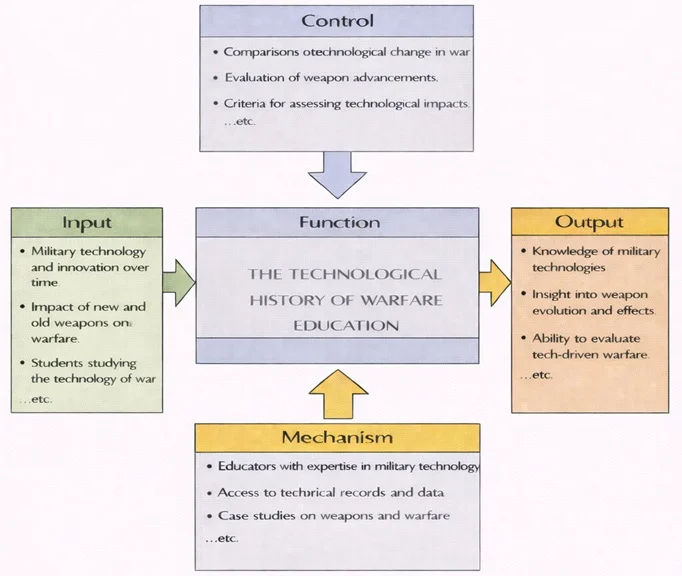
Technological History of Warfare (Current Module)
Explores how advancements in weapons, communication, and industrial systems redefine military capability, power balances, and conflict dynamics over time.
Air Power History
Shows how aviation, rocketry, and aerospace engineering expanded battlefield speed, aerial surveillance, and long-range strategic projection capabilities.
Naval History
Examines how maritime engineering, ironclad armor, steam propulsion, and submarine technology extended control across global ocean trade routes.
Military Strategic Studies
Analyses how technological capabilities dictate military doctrine, force deployment, operational planning, and battlefield coordination.
Guerrilla Warfare and Insurgency Studies
Explores how non-state and irregular forces adapt asymmetric tactics to neutralize the technological superiority of conventional nation-states.
Economic History of Warfare
Connects military R&D and technological innovation with state resource allocation, industrial mobilization, and fiscal policy.
Social and Cultural History of Warfare
Examines how technological shifts alter civilian home-front labor, public safety measures, media propaganda, and collective memory.
Peace Studies and Conflict Resolution
Investigates how weapon proliferation, arms control treaties, satellite verification, and deterrence frameworks shape diplomacy and conflict resolution.
Military History Overview
Provides the macro-historical framework unifying military doctrine, state evolution, strategy, and technological transformation across ages.
Key Developments in the Technological History of Warfare
Ancient and Medieval Innovations
Technological advancements in the ancient and medieval periods laid the groundwork for organized warfare, enabling larger armies, more effective strategies, and prolonged campaigns.
Primitive Tools and Early Weapons
- Stone and Metal Weapons: Early humans used sharpened stones and later bronze and iron tools for hunting and combat. Examples: Stone-tipped spears, bronze swords, and iron daggers.
The Longbow
- Introduction: The longbow, developed during the Middle Ages, was a revolutionary ranged weapon.
- Advantages: Could penetrate armor at long distances, allowing armies to attack from a safer distance and reduce casualties.
- Historical Impact: Played a decisive role in the Battle of Agincourt (1415) during the Hundred Years’ War, where English longbowmen decimated French knights.
Siege Technologies
- Catapults and Trebuchets: Allowed armies to breach fortified structures and stone castles.
- Battering Rams: Used to break down fortified gates and city walls during prolonged sieges.
- Historical Impact: Enabled long campaigns against fortified settlements, making siegecraft central to medieval warfare.
Gunpowder and the Early Modern Era
The introduction of gunpowder in the 14th century revolutionized warfare, rendering traditional fortifications and plate armor less effective.
Firearms
- Muskets and Cannons: Muskets gradually replaced bows and crossbows as the primary infantry weapon. Cannons made vertical stone castle walls vulnerable, leading to new military engineering (such as star forts).
- Impact: Shifted the focus of warfare to open battlefields and centralized state-funded standing armies.
Naval Gunpowder Warfare
- Ships of the Line: Wooden warships equipped with multiple decks of heavy cannons dominated maritime engagements.
- Examples: The Spanish Armada (1588) showcased the power and strategic importance of naval gunpowder artillery.
The Industrial Revolution and Modern Warfare
The 19th century’s Industrial Revolution brought rapid technological advancements, transforming warfare through mass production, steam power, and mechanization.
Steam Power
- Steamships: Replaced wind-powered wooden vessels, enabling greater speed, strategic independence from winds, and armored hulls. Example: Ironclad warships USS Monitor and CSS Virginia during the American Civil War.
- Railways: Allowed for rapid transportation and mobilization of millions of troops and supplies, revolutionizing military logistics.
Rifles and Machine Guns
- Rifling: Helical grooves inside gun barrels vastly improved accuracy and effective range.
- Machine Guns: Provided unprecedented rapid firepower, creating deadly defense zones. Example: The Maxim gun, used extensively during World War I.
Tanks
- Development: Introduced during World War I to break the bloody stalemate of trench warfare by combining mobility, armor, and firepower.
- Example: The British Mark I tank at the Battle of the Somme (1916).
- Impact: Became central to modern mobile and mechanized ground warfare.
20th-Century Advancements
The two world wars accelerated the pace of military technological innovation, leading to transformative changes in three-dimensional combat.
Aircraft
- World War I: Airplanes were initially used for aerial reconnaissance but quickly adapted for air-to-air combat and strategic bombing.
- World War II: Advanced heavy bombers like the B-17 Flying Fortress and fighter aircraft such as the Spitfire played critical roles. Impact: Air superiority became an essential prerequisite for ground and naval operations.
Radar
- Development: Developed during World War II to detect incoming enemy aircraft and ships via radio waves.
- Example: The Battle of Britain (1940) saw the RAF use Chain Home radar to counter German air raids.
- Impact: Revolutionized early warning systems and integrated air defense networks.
Nuclear Weapons
- Development: The Manhattan Project produced the first atomic bombs, dropped on Hiroshima and Nagasaki in 1945.
- Impact: Introduced an era of unprecedented mass destructive power, leading to Cold War geopolitical competition and the doctrine of Mutually Assured Destruction (MAD).
Late 20th and 21st Century Innovations
The latter half of the 20th century and the 21st century saw the rise of digital technology, focusing on precision guidance, automation, and electronic warfare.
Missile Technology
- Ballistic Missiles: Capable of delivering conventional or nuclear warheads across intercontinental distances.
- Precision-Guided Munitions (PGMs): Laser- and GPS-guided munitions enabled surgical strikes on specific targets, reducing required bomb loads. Example: The Gulf War (1991) showcased Tomahawk cruise missiles.
Cyber Warfare
- Development: Digital attacks targeting critical command networks, infrastructure, and communication channels.
- Example: Stuxnet, a complex cyberweapon used to disrupt industrial centrifuges.
Artificial Intelligence and Autonomous Systems
- AI & Drones: AI assists in rapid sensor processing and threat detection, while Unmanned Aerial Vehicles (UAVs) execute long-endurance reconnaissance and precision strikes without risking pilots. Example: The MQ-9 Reaper drone.
Interactive Ballistic Range & Kinetic Energy Calculator
Test the physical principles behind projectile evolution—from archer bows to modern naval artillery—by calculating kinetic energy and impact force.
Kinetic Energy & Armor Penetration Calculator
Enter the projectile mass (in kg) and impact velocity (in m/s) to calculate kinetic energy in Joules (KE = 0.5 × m × v2) and relative penetration power.
Click Calculate Impact Energy to analyze projectile force.
Applications of Technological History of Warfare
- Shaping Military Doctrine: Technological advancements directly force the adaptation of strategic planning, troop formations, and defensive tactics.
- Driving Civilian Innovation: Military R&D often spurs technological breakthroughs that later transform civilian infrastructure (e.g., radar, jet engines, GPS, microprocessors, and the Internet).
- Informing Defense Policy: Analyzing past technological revolutions helps policymakers evaluate emerging risks like autonomous drones and cyber weapons.
Significant Examples in Technological History of Warfare
- The Longbow at Agincourt (1415): Demonstrated how high-rate-of-fire ranged weapons could overcome heavily armored cavalry.
- The Development of Tanks: Solved the offensive impasse of entrenched machine guns and barbed wire during World War I.
- Radar in World War II: Provided crucial early warning that enabled RAF fighters to intercept incoming Luftwaffe bombers during the Battle of Britain.
- Nuclear Weapons: Shifted global military strategy from battlefield victory to strategic deterrence and crisis management under MAD.
- Artificial Intelligence: Currently enabling autonomous sensor fusion and unmanned swarm systems that accelerate decision cycles.
Why Study Technological History of Warfare
Understanding the Impact of Innovation on Military Power
Tracing the Relationship Between Science, Industry, and War
Analyzing Strategic Shifts Caused by Technological Change
Examining the Ethical and Human Consequences of Military Technology
Preparing for Informed Engagement in Policy, History, and Innovation
Interactive Innovation Era Explorer
The Gunpowder Revolution (14th – 17th Century)
Industrialized Total War (19th – Mid 20th Century)
The Information & Autonomous Age (Late 20th Century – Present)
Technological History of Warfare: Conclusion
Frequently Asked Questions – Technological History of Warfare
What is meant by the technological history of warfare?
The technological history of warfare examines how tools, weapons, machines, and systems used in war have developed over time, and how these innovations have reshaped tactics, strategy, and societies. It looks beyond individual inventions to ask how industry, science, and politics interact to change the way wars are planned and fought.
Why is the technological history of warfare important for students to study?
Studying the technological history of warfare helps students see that technology is never neutral. It reveals how scientific advances can shift power balances, alter the scale of destruction, and transform everyday life. This perspective is valuable for understanding modern security debates, ethical questions about innovation, and the broader impact of technology on society.
How has military technology evolved from pre-industrial to modern times?
Military technology has moved from muscle-powered weapons and fortifications to gunpowder artillery, industrial-scale firearms, mechanised forces, air power, nuclear weapons, and digital networks. Each phase brought new capabilities and vulnerabilities, forcing states and armies to rethink organisation, training, and strategy.
How does technological change influence military strategy and tactics?
Technological change can open up new possibilities for surprise, speed, precision, and communication. In response, generals and planners adjust strategies, tactics, and doctrines. Sometimes, however, organisations struggle to adapt, and older ways of thinking persist even when they no longer match the capabilities and risks of new technologies.
What role did industrialisation play in the history of warfare technology?
Industrialisation allowed states to mass-produce weapons, ammunition, and transport systems on an unprecedented scale. Railways, factories, and standardised parts made it possible to equip large conscript armies and maintain lengthy campaigns. The technological history of warfare shows how industrial economies turned war into a total, society-wide effort.
How do logistics and production systems fit into the technological history of warfare?
Logistics and production systems are essential parts of warfare technology. Supplying food, fuel, spare parts, and ammunition requires sophisticated planning, transport, and storage. Historians study supply chains, factories, shipyards, and repair workshops to understand why some forces can sustain operations while others collapse.
What are dual-use technologies, and why do they matter in the study of warfare?
Dual-use technologies are tools and systems that can serve both civilian and military purposes, such as satellites, encryption, nuclear reactors, or advanced materials. The technological history of warfare examines how these technologies move between civilian and military spheres, raising complex issues of regulation, export control, and ethical responsibility.
What ethical questions arise from new military technologies?
New military technologies raise ethical questions about proportionality, responsibility, and human control over violence. Debates around chemical and biological weapons, nuclear arms, autonomous systems, and drone warfare ask whether certain tools should be limited or banned, and how international law and norms can keep pace with innovation.
How has the rise of information and cyber technologies changed warfare?
Information and cyber technologies have introduced new ways to disrupt communications, influence public opinion, and attack critical infrastructure. At the same time, they provide unprecedented tools for surveillance, coordination, and precision targeting. The technological history of warfare traces how the “information dimension” has become central to planning and conducting conflicts.
What kinds of sources do historians use to study the technological history of warfare?
Historians work with technical manuals, patents, military reports, company records, blueprints, photographs, memoirs, and museum collections of equipment. They may also draw on scientific literature, government policy documents, and oral histories from engineers, scientists, and service personnel to understand both design and practical use.
How does the technological history of warfare consider civilians and the environment?
The technological history of warfare examines how weapons and infrastructure affect civilian populations and ecosystems, from bombing and radiation to landmines and pollution. It considers both short-term destruction and long-term consequences, such as unexploded ordnance, toxic residues, and the reshaping of landscapes for military purposes.
What skills can students gain from studying the technological history of warfare?
Students learn to connect technical details with political, social, and ethical questions. They practise reading diverse sources, assessing risk, and thinking critically about innovation and its consequences. This Technological History of Warfare page can be linked with resources on military history, industrial and technological history, international relations, engineering, and ethics.
Comprehensive Practice & Assessment Module
Section 1: Foundational Review Questions
- What is the technological history of warfare and why is it significant?
Answer: The technological history of warfare examines the development and impact of innovations that have transformed military operations over time. It is significant because advancements in weaponry, communications, and logistics have continuously reshaped how conflicts are fought and won. Understanding these changes provides insights into the evolution of military strategy and the shifting balance of power among nations. This field also highlights the interplay between technology and society, demonstrating how innovations in warfare influence broader economic, cultural, and political developments. - How did ancient military innovations set the stage for modern warfare technologies?
Answer: Ancient military innovations, such as the development of the chariot, the use of siege engines, and early metallurgy, laid the foundation for future technological progress in warfare. These early advances introduced concepts of mobility, force projection, and defensive structures that continue to influence military thinking. They demonstrated the strategic value of superior technology and innovation in achieving battlefield success. By studying these ancient breakthroughs, we can trace a clear lineage of technological evolution that culminates in today’s advanced weaponry and combat systems. - In what ways did the introduction of gunpowder revolutionize military technology?
Answer: The introduction of gunpowder revolutionized military technology by fundamentally altering the nature of combat. It led to the development of firearms and artillery, which replaced traditional melee weapons and siege tactics, thereby changing battlefield dynamics. Gunpowder allowed for more destructive power at a distance, which in turn shifted strategic priorities towards fortification and new forms of offense. This innovation not only transformed military engagements but also had far-reaching implications for political power and territorial control. - What impact did industrialization have on the evolution of warfare technology?
Answer: Industrialization had a profound impact on the evolution of warfare technology by enabling mass production and rapid innovation in military hardware. It allowed nations to produce large quantities of standardized weapons, vehicles, and equipment, which increased the scale and efficiency of armed forces. The industrial era introduced technologies such as the steam engine, ironclad ships, and later, mechanized infantry, which fundamentally changed military logistics and battlefield tactics. This period marked the transition from traditional, artisanal warfare to modern, technology-driven conflict. - How have communications technologies influenced military strategy throughout history?
Answer: Communications technologies have dramatically influenced military strategy by enhancing the speed and accuracy of information exchange on the battlefield. Innovations such as the telegraph, radio, and satellite communications have allowed commanders to coordinate operations over vast distances in real time. This rapid communication capability has enabled more dynamic and flexible responses to changing combat conditions, thereby increasing operational effectiveness. As a result, superior communication systems have often provided decisive advantages in military engagements and shaped the conduct of modern warfare. - What role did technological breakthroughs play during the World Wars?
Answer: Technological breakthroughs during the World Wars played a critical role in shaping the outcome of these conflicts by introducing new forms of warfare and changing operational dynamics. Innovations such as tanks, aircraft, radar, and advanced artillery transformed traditional battlefields and enabled unprecedented levels of mobility and firepower. These technologies not only increased the lethality of military forces but also necessitated the development of new strategies and doctrines. The rapid pace of technological change during this period set the stage for the modern military-industrial complex and continues to influence contemporary military planning. - How have modern advancements such as drones and cyber warfare influenced contemporary military operations?
Answer: Modern advancements such as drones and cyber warfare have fundamentally reshaped contemporary military operations by providing new methods for surveillance, precision strikes, and information warfare. Drones enable remote, real-time reconnaissance and targeted attacks while minimizing the risk to personnel, thereby transforming traditional battlefield roles. Cyber warfare, meanwhile, allows for the disruption of enemy communication networks and critical infrastructure, adding a digital dimension to military conflict. These advancements illustrate the ongoing integration of technology into military strategy, leading to more complex, multi-domain operational environments. - What are the strategic implications of emerging technologies like hypersonic missiles in warfare?
Answer: Emerging technologies such as hypersonic missiles carry significant strategic implications by introducing unprecedented speed and precision to military operations. These missiles can travel at speeds exceeding Mach 5, drastically reducing the reaction time available to adversaries and complicating traditional missile defense systems. Their deployment is likely to alter the balance of power, as nations with advanced hypersonic capabilities may gain a decisive strategic advantage. Consequently, the development of hypersonic weapons is prompting a reevaluation of existing doctrines and defense strategies, as well as increased investment in countermeasures and next-generation technologies. - How does the study of technological evolution in warfare contribute to our understanding of modern security challenges?
Answer: The study of technological evolution in warfare contributes to our understanding of modern security challenges by providing a historical context for the rapid advancements that shape current military capabilities. Analyzing the progression of military technology helps to identify trends, forecast future developments, and understand the potential risks associated with emerging technologies. This perspective is crucial for developing effective defense policies and strategies that anticipate and mitigate threats in an increasingly digital and interconnected world. By learning from past technological shifts, policymakers can better prepare for the challenges of modern warfare and enhance overall national security. - How have shifts in military technology influenced the cultural perception of warfare over time?
Answer: Shifts in military technology have significantly influenced the cultural perception of warfare by altering how conflicts are represented and understood by society. As new technologies emerge, they not only change the tactics on the battlefield but also impact public narratives about the nature of war. Innovations such as the introduction of firearms, tanks, and drones have transformed the imagery and symbolism associated with warfare, influencing literature, art, and media representations. These cultural shifts shape collective memory and inform how future generations perceive the costs, ethics, and implications of armed conflict.
Section 2: Analytical & Scenario-Based Questions
- How might future advancements in artificial intelligence revolutionize the development of military technologies and strategic doctrines?
Answer: Future AI advancements can optimize real-time logistics, automate sensor fusion, and orchestrate autonomous drone swarms, compressing the decision-making cycle (OODA loop). Strategic doctrines will shift toward network-centric, algorithmic warfare. However, AI reliance introduces risks regarding accountability, cyber spoofing, and automated escalation without human intervention. - In what ways could the convergence of cyber warfare and traditional military technology redefine the battlefield?
Answer: Combining cyber attacks with kinetic military strikes creates hybrid multi-domain operations. Cyber operations can disable enemy air-defense radar, blind satellite GPS, or paralyze power grids prior to physical troop deployment, multiplying combat effectiveness without firing kinetic ammunition. - How might emerging space-based technologies influence the future of warfare and strategic planning?
Answer: Low-Earth orbit satellite constellations provide real-time targeting imagery, missile launch detection, and encrypted global communication. Space capabilities make terrestrial stealth more difficult, while anti-satellite (ASAT) capabilities make orbital defense a critical national security priority. - How can lessons from the technological history of warfare be applied to improve modern military training and preparedness?
Answer: History reveals that introducing new weapons without updating training doctrines leads to catastrophic failures (e.g., infantry charging machine guns in WWI). Modern training must use virtual simulations and scenario-based multi-domain exercises to help commanders adapt doctrinally alongside hardware deployment. - How might the adoption of renewable energy technologies impact the future strategic capabilities of military forces?
Answer: On-site solar microgrids, hydrogen fuel cells, and electrified logistics vehicles reduce reliance on vulnerable forward-fuel supply convoys. Reducing the fuel logistics tail increases operational endurance and tactical stealth in remote or contested environments. - How could the increasing reliance on unmanned systems and robotics change the human element in warfare?
Answer: Unmanned systems replace personnel in high-threat zones, reducing direct combat casualties. However, this shifts human roles toward remote interface operation, data oversight, and technical maintenance, raising psychological issues related to remote combat detachment and moral decision-making. - How might historical patterns of technological adaptation during wars influence future military innovation cycles?
Answer: Wartime pressure drastically shortens innovation cycles from decades to months as combat feedback drives rapid prototyping. Future conflicts will likely accelerate commercial-off-the-shelf (COTS) tech integration, such as rapid software updates and 3D printing of spare parts near front lines. - How can cross-disciplinary collaborations enhance our understanding of the socio-cultural impacts of military technology?
Answer: Combining engineering with history, sociology, and ethics helps analyze how weapons systems affect civilian infrastructure, labor markets, trauma diagnostics, and international humanitarian law rather than evaluating weapons solely on kinetic destruction capabilities.
Section 3: Numerical Problems & Applied Analysis
1. Kinetic Energy: KE = 0.5 × m × v2
2. Mach Speed / Velocity Ratio: Mach = vobject / vsound (where vsound ≈ 343 m/s at sea level)
3. Radar Detection Range Scaling: Range ∝ (Power)1/4
- Kinetic Energy of Modern Tank Ammunition: An Armor-Piercing Fin-Stabilized Discarding Sabot (APFSDS) round has a projectile mass of 4.5 kg and fires from a smoothbore cannon at a muzzle velocity of 1,750 m/s. Calculate its kinetic energy upon leaving the barrel.
Solution:
KE = 0.5 × m × v2
KE = 0.5 × 4.5 kg × (1,750 m/s)2
KE = 2.25 × 3,062,500 = 6,890,625 Joules (~6.89 Megajoules). - Hypersonic Missile Velocity Calculation: A hypersonic glide vehicle is tracked traveling at Mach 6.2 in standard atmospheric conditions where the speed of sound is 343 m/s. Calculate its flight speed in meters per second and kilometers per hour.
Solution:
Speed (m/s) = 6.2 × 343 m/s = 2,126.6 m/s.
Speed (km/h) = 2,126.6 × 3.6 = 7,655.76 km/h. - Rifle Barrel Accuracy Improvement (Rifling Twist Ratio): A military rifle barrel has a 1-in-7 inch twist rate (1 complete projectile rotation per 7 inches of barrel length). Calculate the total rotations a bullet completes when traveling down a 21-inch barrel.
Solution:
Rotations = Barrel Length / Twist Rate
Rotations = 21 inches / 7 inches = 3 complete rotations. - Artillery Firing Rate Comparison (Artisanal vs. Industrial): An 18th-century muzzle-loading cannon team fires 1.5 rounds per minute. A modern automated 155mm self-propelled howitzer fires 8 rounds per minute. Calculate the percentage increase in fire rate.
Solution:
Increase = 8 – 1.5 = 6.5 rounds/min
Percentage = (6.5 / 1.5) × 100% = 4.333 × 100% = 433.33% increase. - Radar Power Scaling Calculation: According to the radar range equation, doubling the detection range requires increasing transmitter power by 24 (16 times). If a radar unit requires 50 kW of power to detect an aircraft at 100 km, calculate the power required to double the detection range to 200 km.
Solution:
Power Required = Initial Power × 16
Power Required = 50 kW × 16 = 800 kW. - Drone Reconnaissance Area Coverage: An autonomous UAV flies at a ground speed of 180 km/h with a camera sensor swath width of 4 km. Calculate the total land area surveyed during a 3-hour reconnaissance mission.
Solution:
Distance Covered = 180 km/h × 3 hours = 540 km
Area Covered = Distance × Swath Width = 540 km × 4 km = 2,160 km2.