
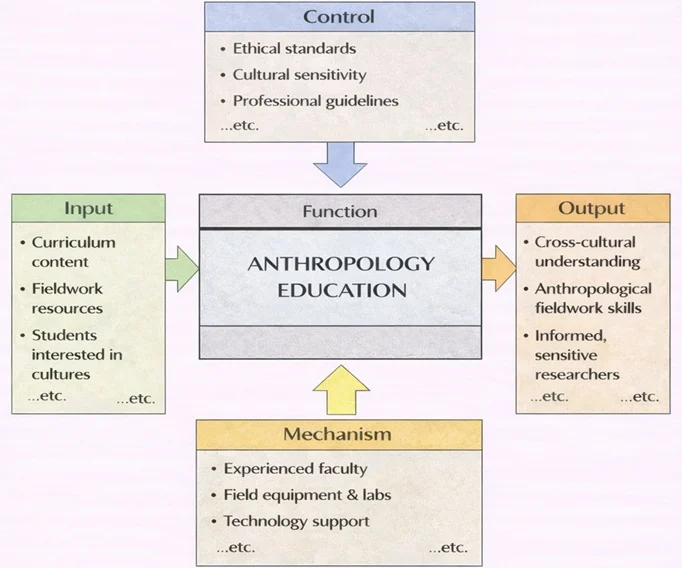
Anthropology Education can be understood as a learning function that transforms interest in human cultures into disciplined, respectful inquiry. The inputs include curriculum content that introduces core ideas about human diversity, fieldwork resources that make real-world observation and data collection possible, and students who bring curiosity about cultures, communities, and everyday life. The process is guided by controls that matter deeply in anthropology: ethical standards, cultural sensitivity, and professional guidelines. These controls shape how questions are asked, how people are engaged, how consent and privacy are handled, and how interpretations avoid careless bias or harm. The function is enabled by mechanisms such as experienced faculty who model careful reasoning and reflexive thinking, field equipment and labs that support documentation and analysis, and technology support for recording, organizing, and interpreting evidence. When these elements align, the outputs extend beyond “knowledge of cultures”: students develop cross-cultural understanding, practical fieldwork skills, and the mindset of informed, sensitive researchers—people who can listen well, observe carefully, and explain human behavior with both rigor and humility.
Anthropology is the comprehensive study of humanity, exploring the cultural, biological, historical, and linguistic aspects of human existence. This discipline seeks to understand what it means to be human by examining our origins, behaviors, social structures, languages, and interactions with the environment. It provides insights into the diversity of human experiences across time and space, bridging the past, present, and future.
Anthropology is divided into several subfields, each addressing different dimensions of human life. These subfields include cultural anthropology, biological anthropology, linguistic anthropology, and archaeology. By integrating these perspectives, anthropology offers a holistic understanding of the complexities of human societies and their evolutionary journeys. This field is vital not only for academic knowledge but also for addressing contemporary issues such as globalization, inequality, and cultural preservation.
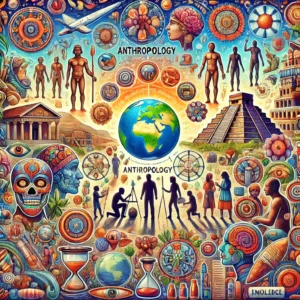
This illustration visually captures the essence of anthropology as the study of humanity across time and space. At the center, the Earth symbolizes the global scope of the discipline. Surrounding it are representations of human evolution, cultural rituals, traditional art, belief systems, social interaction, and ancient civilizations such as pyramids and temples. Human figures of different forms and identities emphasize diversity, while symbols such as tools, masks, timepieces, and maps suggest inquiry into origins, meaning, and social life. The composition reflects anthropology’s core mission: to understand who we are, where we come from, and how culture shapes the human experience.
Humanities & Social Sciences – Cluster Navigation Roadmap
Explore how Anthropology integrates with and enriches the broader Humanities and Social Sciences curriculum roadmap:
HSS Overview
Start with a broad structural view of how human behavior, culture, and institutions are studied across interconnected academic disciplines.
Cultural Studies
Explore how power, media, symbolism, and ideological representation shape everyday cultural experiences and social values.
History
Examine past civilizations, social transformations, and archival evidence to understand how human actions construct present institutions.
Literature
Analyze literary narratives and poetic forms as qualitative reflections of human emotion, historical critique, and creative expression.
Philosophy
Investigate core ethical questions, epistemological frameworks, and normative logic underlying human decision-making.
Political Science
Study governance systems, legislative policy, constitutional law, and institutional power distribution in modern societies.
International Relations
Examine state sovereignty, international diplomacy, global trade, transnational organizations, and conflict resolution mechanisms.
Psychology
Analyze cognitive functions, neurobiological development, human perception, and behavioral motivations using empirical research.
Religious Studies
Explore sacred traditions, theological philosophies, ritual practices, and religious influence across historical contexts.
Sociology
Investigate social structures, group dynamics, institutional inequalities, and community transformations across modern societies.
Linguistics
Study language syntax, phonetics, semantics, sociolinguistic variation, and historical language evolution.
The Subfields of Anthropology
Cultural Anthropology
Cultural anthropology focuses on the study of contemporary human cultures and societies. It investigates how people live, organize themselves, and create meaning through shared beliefs, practices, and institutions.
- Key Areas of Study:
- Kinship and Social Organization: Examining family structures, marriage customs, and social hierarchies.
- Religion and Rituals: Understanding spiritual practices and their significance in different cultures.
- Globalization: Exploring how cultural practices adapt and transform in a globalized world.
- Ethnography: A primary method where anthropologists immerse themselves in a community to study its culture firsthand.
- Applications:
- Assisting in conflict resolution and intercultural communication.
- Informing policy-making in multicultural societies.
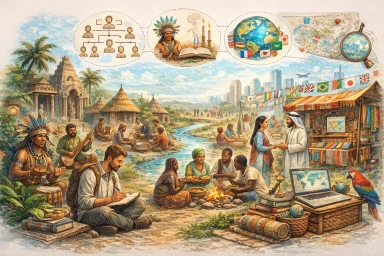
This illustration depicts the essence of cultural anthropology: the study of living cultures through close observation, participation, and understanding. An anthropologist records community life as people engage in conversation, food preparation, music, learning, and exchange. Symbols above the scene highlight key themes such as kinship systems, ritual practices, globalization, and ethnographic fieldwork. Together, these elements reflect how cultural anthropology helps us appreciate human diversity, foster intercultural understanding, and navigate an increasingly interconnected world.
Biological Anthropology
Biological anthropology, also known as physical anthropology, studies the biological and evolutionary aspects of humans and their ancestors.
- Key Areas of Study:
- Human Evolution: Tracing the development of Homo sapiens through the fossil record.
- Primatology: Studying primates to understand human behavior and evolution.
- Forensic Anthropology: Applying biological methods to solve crimes and identify human remains.
- Human Adaptation: Investigating how humans adapt biologically to diverse environments, such as high altitudes or extreme climates.
- Applications:
- Contributing to public health initiatives by understanding genetic and environmental factors.
- Assisting in legal and forensic investigations.
Linguistic Anthropology
Linguistic anthropology examines the relationship between language and culture. It explores how language shapes social interactions, identity, and cultural transmission.
- Key Areas of Study:
- Language Evolution: Studying the origins and development of human language.
- Sociolinguistics: Exploring how language varies across social groups and contexts.
- Language Preservation: Documenting and revitalizing endangered languages.
- Semiotics: Analyzing symbols and their meanings within cultural contexts.
- Applications:
- Enhancing communication strategies in diverse societies.
- Preserving linguistic heritage in marginalized communities.
Archaeology
Archaeology investigates human history and prehistory through the excavation and analysis of material remains.
- Key Areas of Study:
- Ancient Civilizations: Exploring the artifacts and structures of societies like Mesopotamia, Egypt, and the Maya.
- Cultural Landscapes: Studying how humans have modified their environments over time.
- Technological Innovations: Understanding the development of tools, pottery, and architecture.
- Bioarchaeology: Examining human remains to understand health, diet, and migration patterns.
- Applications:
- Informing cultural heritage preservation and museum curation.
- Providing insights into sustainable practices by studying ancient societies.
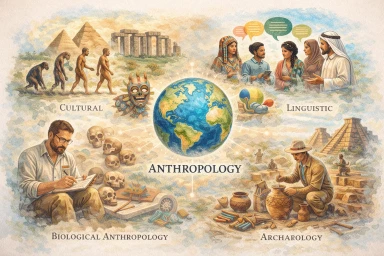
This illustration represents why anthropology matters for students preparing for university and beyond. At the center, the globe symbolizes the shared human story, while the surrounding scenes depict the discipline’s four interconnected dimensions: cultural life and traditions, biological evolution and diversity, language and communication, and archaeological discovery. Together, they convey anthropology’s holistic approach — helping learners understand human diversity across time and space, think critically across disciplines, and develop the empathy and global awareness needed in an interconnected world.
Interdisciplinary Connections
Anthropology intersects with various disciplines, enriching its scope and applications:
- Sociology: Shares interests in social structures and behaviors but focuses more on contemporary societies.
- Biology: Overlaps in the study of genetics, evolution, and adaptation.
- History: Complements archaeology by providing context for material findings.
- Psychology: Explores human cognition, behavior, and cultural influences on mental processes.
Contemporary Issues in Anthropology
Globalization and Cultural Change
- Anthropologists study how globalization impacts cultural identities, traditions, and social structures.
- Example: Examining the effects of digital communication on indigenous communities.
Social Justice and Advocacy
- Anthropology addresses issues like inequality, migration, and human rights, advocating for marginalized groups.
- Example: Documenting the impacts of climate change on indigenous populations.
Cultural Heritage and Preservation
- Anthropologists work to protect cultural heritage threatened by urbanization, conflict, or climate change.
- Example: Collaborating with UNESCO to safeguard World Heritage Sites.
Health and Well-being
- Medical anthropology investigates the intersection of culture and health practices, improving healthcare delivery.
- Example: Studying traditional healing practices in relation to modern medicine.
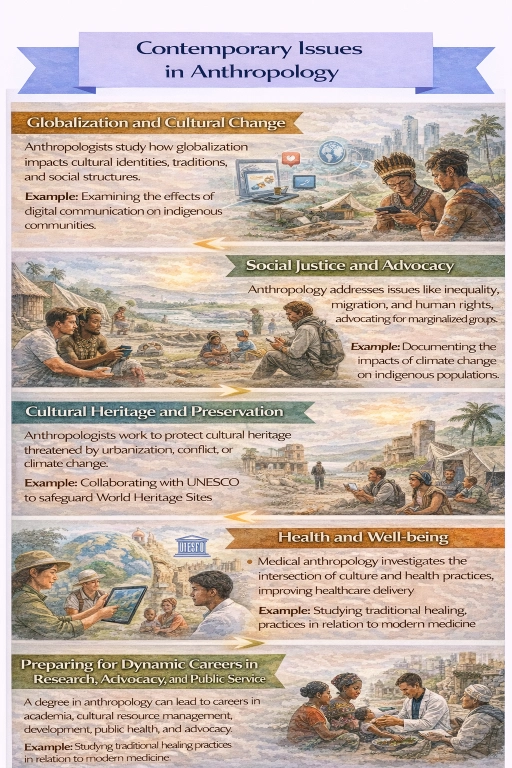
This infographic introduces four major contemporary issues studied in anthropology. It highlights (1) globalization and cultural change, including how digital communication reshapes identities and traditions; (2) social justice and advocacy, focusing on inequality, migration, human rights, and climate impacts on marginalized communities; (3) cultural heritage and preservation, showing efforts to protect threatened sites and practices (e.g., work linked to UNESCO); and (4) health and well-being, emphasizing medical anthropology and the relationship between cultural healing practices and modern healthcare.
Research Methods in Anthropology
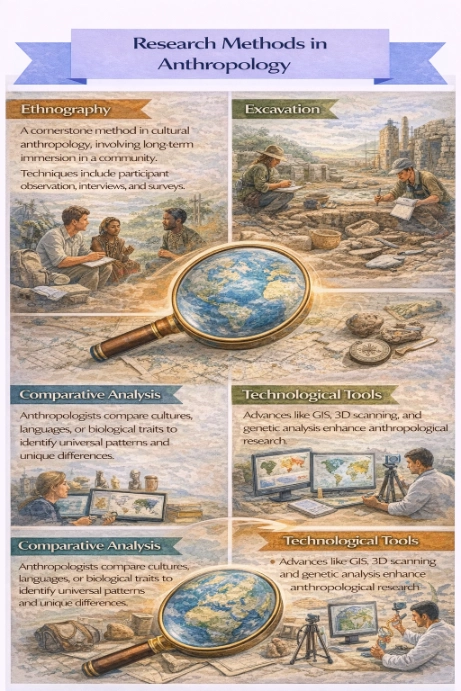
A four-part educational infographic summarizing core research methods used in anthropology. The panels highlight ethnography (long-term community immersion using observation, interviews, and surveys), excavation (uncovering and interpreting material remains), comparative analysis (comparing cultures, languages, or biological traits to identify patterns and differences), and technological tools (GIS, 3D scanning, and genetic analysis). The overall design uses clear headings and supportive visuals to reinforce key ideas at a glance.
Ethnography
- A cornerstone method in cultural anthropology, involving long-term immersion in a community.
- Techniques include participant observation, interviews, and surveys.
Excavation
- Archaeologists uncover and analyze artifacts, structures, and ecofacts to interpret past human behavior.
Comparative Analysis
- Anthropologists compare cultures, languages, or biological traits to identify universal patterns and unique differences.
Technological Tools
- Advances like GIS (Geographic Information Systems), 3D scanning, and genetic analysis enhance anthropological research.
Applications of Anthropology
Cultural Resource Management
- Ensuring the preservation of archaeological sites and heritage during development projects.
Corporate and Business Anthropology
- Helping businesses understand consumer behavior and cultural nuances to improve products and services.
Policy and Development
- Informing policies on migration, healthcare, education, and cultural integration.
Education
- Promoting cultural awareness and diversity through anthropology courses and public outreach.
Future Directions in Anthropology
Digital Anthropology
- Studying human interactions in digital spaces, including social media and virtual reality.
Climate Change Anthropology
- Investigating how communities adapt to and mitigate the impacts of climate change.
Bioinformatics and Genetics
- Using advanced genetic research to explore human evolution and diversity.
Global Collaboration
- Increasing cross-disciplinary and international partnerships to address complex global challenges.
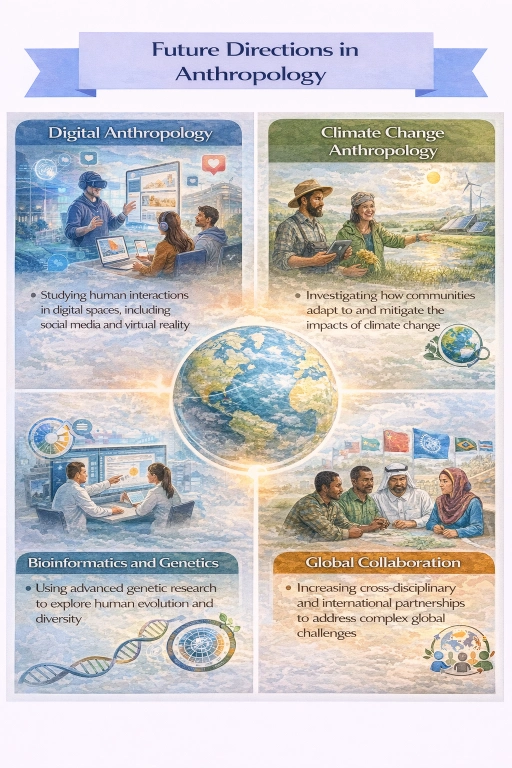
A pastel, infographic-style illustration titled “Future Directions in Anthropology.” It is divided into four labeled panels: Digital Anthropology (people interacting in online/virtual spaces), Climate Change Anthropology (communities adapting to environmental change), Bioinformatics and Genetics (lab work and DNA/genetic research linked to human evolution and diversity), and Global Collaboration (international, cross-disciplinary teams working together). A central globe/magnifying-glass motif visually connects the four directions, emphasizing anthropology’s expanding scope and methods.
Why Study Anthropology
Understanding Human Diversity Across Time and Space
Anthropology is the holistic study of human beings, encompassing our origins, development, behavior, and cultural practices. For students preparing for university, studying anthropology offers the opportunity to explore the incredible diversity of human life—past and present—across different geographic, historical, and social contexts. It encourages an appreciation for cultural differences and a deeper understanding of what it means to be human.
Exploring the Intersections of Culture, Biology, Language, and History
Anthropology bridges the natural sciences, social sciences, and humanities through its four major subfields: cultural anthropology, biological anthropology, linguistic anthropology, and archaeology. Students learn how humans adapt to their environments, create meaning through language and rituals, and leave material traces of their civilizations. This interdisciplinary nature provides a well-rounded foundation for a wide range of university studies.
Developing Skills in Observation, Analysis, and Cross-Cultural Communication
Anthropology trains students to observe carefully, ask critical questions, and analyze human behavior through both qualitative and quantitative methods. It emphasizes empathy, open-mindedness, and ethical research practices. These skills are not only valuable in academic settings but also in any professional context that involves working with people from diverse backgrounds.
Challenging Assumptions and Encouraging Global Awareness
By studying different cultures and belief systems, anthropology encourages students to question their own assumptions and develop a more nuanced view of the world. It addresses pressing global issues such as migration, inequality, climate change, and indigenous rights from a human-centered perspective. For students entering university, anthropology provides the intellectual tools to think critically and act responsibly in a globalized society.
Preparing for Dynamic Careers in Research, Advocacy, and Public Service
A degree in anthropology can lead to careers in academia, museum curation, cultural resource management, international development, public health, education, and social advocacy. It also serves as a strong foundation for graduate study in related fields. For students preparing for university, anthropology offers a flexible and enriching path that combines curiosity about the human experience with practical skills for meaningful engagement in the world.
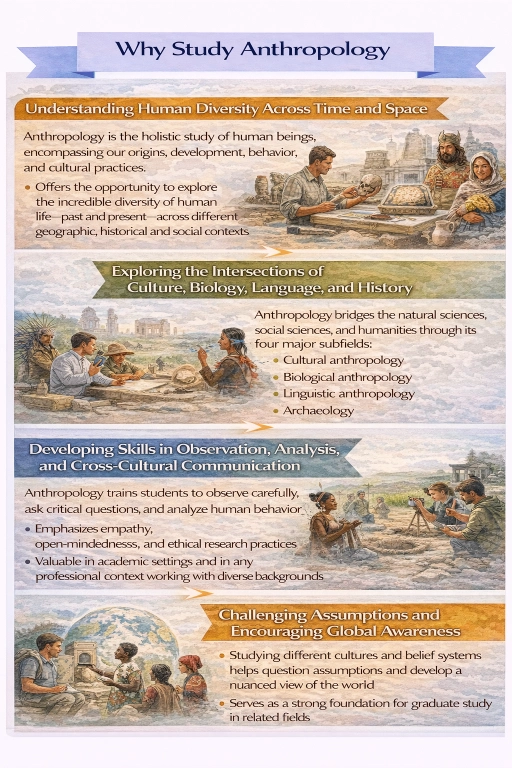
This infographic presents five reasons to study anthropology in a clear, panel-based layout with supporting illustrations. It highlights anthropology’s holistic view of human life across time and place, its four subfields (cultural, biological, linguistic, and archaeology), and the practical skills students develop—careful observation, analysis, ethical research, and cross-cultural communication. It also emphasizes how anthropology encourages questioning assumptions and thinking globally about issues like migration and inequality, while pointing to career pathways in research, public service, advocacy, education, museums, and development.
Interactive Simulator: Archaeological Stratigraphy & Carbon-14 Decay Model
Adjust the excavation depth layer and initial organic mass to simulate artifact decay over millennia and observe how radiocarbon dating establishes chronological horizons in archaeological fieldwork.
5,730 Years (1 Half-Life)
80 dpm/g
50.0%
40.0 dpm/g
Neolithic Period
Interactive Topic Exploration & Self-Check
Click on the questions below to test your knowledge of anthropological subfields, research methods, and theoretical concepts:
What is the fundamental difference between ethnography and ethnology in cultural anthropology?
How does cultural relativism differ from moral relativism in anthropological fieldwork?
What is the principle of stratigraphy in archaeological excavation?
Is Anthropology Right For You?
Explore career pathways, check your fit, and assess your skills — before you commit to a degree.
Anthropology: Conclusion
Anthropology offers a profound understanding of humanity by exploring its cultural, biological, linguistic, and historical dimensions. By studying the past and present, it provides tools to navigate the challenges of the future, fostering cultural sensitivity, sustainability, and social equity. As a dynamic and evolving field, anthropology continues to illuminate the diversity and commonalities that define the human experience, contributing to a more inclusive and informed world.
Frequently Asked Questions
What is anthropology, and what does it study?
Anthropology is the comparative study of humans across time and space. It explores human biology, culture, language, and social organisation, asking how people live, think, believe, create meaning, and adapt to changing environments. Anthropologists examine both everyday life and large-scale systems, from kinship and ritual to globalisation and digital cultures.
What are the main subfields of anthropology?
Anthropology is often divided into four major subfields: sociocultural anthropology, which focuses on contemporary cultures and social life; archaeology, which studies past societies through material remains; biological or physical anthropology, which examines human evolution and variation; and linguistic anthropology, which analyses language and communication in social context. Many degree programmes combine these perspectives to give a holistic view of humanity.
How is anthropology different from sociology and history?
Like sociology and history, anthropology studies societies and change, but it usually places stronger emphasis on cross-cultural comparison, in-depth fieldwork, and the idea of culture as a system of meanings. Anthropologists often live for extended periods in the communities they study, learning local languages and practices. They are interested not only in institutions and events, but also in lived experience, symbols, and everyday interactions.
What research methods do anthropologists use?
Anthropologists use a range of methods, with ethnography and participant observation at the core of sociocultural work. They may conduct interviews, life histories, surveys, focus groups, mapping, and archival research. Archaeologists excavate sites and analyse artefacts, while biological anthropologists use techniques from genetics and anatomy. Many projects combine qualitative and quantitative approaches to understand both meanings and patterns.
What kinds of questions does anthropology help me think about?
Anthropology helps you ask questions such as: How do different societies define family, gender, childhood, or adulthood? How do beliefs about health, religion, or the environment shape behaviour? What happens when economic development, tourism, migration, or technology reshape local ways of life? How are power, inequality, and resistance expressed in everyday routines, language, and rituals?
How does studying anthropology prepare me for university-level work?
Anthropology trains you to read ethnographic case studies, interpret complex social situations, and write clearly about culture and power. You learn to compare societies without oversimplifying them, to question assumptions (including your own), and to connect small-scale observations to broader theories. These are essential skills for university essays, seminar discussions, and independent research projects in many humanities and social science degrees.
What careers can anthropology lead to?
Anthropology graduates work in a wide range of fields. Some pursue academic research and teaching, while others go into international development, public health, museums and heritage, cultural resource management, user experience and design research, policy analysis, media and journalism, non-governmental organisations, and corporate roles that require strong cross-cultural understanding and qualitative research skills.
How does anthropology help me understand globalisation and cultural change?
Anthropology looks at how global processes are experienced locally. It explores how people respond to migration, tourism, media, markets, and environmental change in specific communities. Rather than treating cultures as isolated, it shows how histories of colonialism, trade, and transnational networks shape identities and inequalities today. This helps you think critically about stereotypes, cultural appropriation, and debates over tradition and modernity.
What is ethnography, and why is it important in anthropology?
Ethnography is a method and a written account based on long-term, immersive fieldwork. An anthropologist spends extended time in a community, observing and participating in daily life, and building relationships with people. Ethnography is important because it generates detailed, context-rich insights into how people understand their worlds, rather than relying only on short surveys or distant assumptions.
How can I use this Anthropology page on Prep4Uni.online for self-study?
You can start by reading the overview sections to get a sense of what anthropologists study, then follow internal links to topics like culture, identity, gender, religion, migration, or globalisation. Use the guiding questions and examples as prompts for short reflections, mini-essays, or classroom discussions. Over time, you can build a small portfolio of notes and reflections that will be useful when writing applications or preparing for university-level anthropology modules.
Do I need strong science or maths to study anthropology?
Most sociocultural and linguistic anthropology programmes emphasise reading, writing, and qualitative analysis more than advanced mathematics. However, basic data literacy, statistics, and familiarity with scientific thinking can still be helpful, especially if you are interested in biological anthropology, archaeology, or interdisciplinary areas such as medical or environmental anthropology.
How does anthropology encourage empathy and cultural sensitivity?
Anthropology asks you to take seriously the perspectives of people whose lives may be very different from your own. By learning languages, listening to stories, and situating practices in their historical and social context, you are less likely to judge quickly or rely on stereotypes. This does not mean accepting everything uncritically, but it does mean slowing down, asking questions, and recognising that there are many ways of being human.
Comprehensive Anthropology Assessment Module
Section 1: Core Conceptual Review Questions
- What is anthropology and what are its four primary subfields?
Answer: Anthropology is the holistic scientific study of human beings across time and space. Its four primary subfields are Cultural Anthropology (study of living human societies and practices), Biological/Physical Anthropology (human evolution and adaptation), Archaeological Anthropology (study of past material cultures), and Linguistic Anthropology (study of language structure and cultural communication). - How does cultural anthropology contribute to our understanding of human societies?
Answer: Cultural anthropology explores how shared beliefs, kinship structures, rituals, and institutions shape identity and social organization. Through immersive ethnographic fieldwork, it reveals human diversity and highlights universal social patterns. - What primary role does biological anthropology play in documenting human evolutionary history?
Answer: Biological anthropology analyzes hominin fossil remains, ancient DNA, genetics, and primate behavior to reconstruct anatomical changes, environmental adaptations, and natural selection processes over millions of years. - How does linguistic anthropology explain the dynamic relationship between language and power?
Answer: Linguistic anthropology investigates how speech patterns, dialects, and semiotic codes express social identity, reinforce class hierarchies, and convey institutional authority within specific cultural settings. - What primary methodologies define qualitative research in cultural anthropology?
Answer: Core methodologies include long-term participant observation, unstructured and semi-structured interviews, life histories, genealogies, and detailed field journal recording. - In what ways does anthropology support contemporary social justice initiatives?
Answer: Anthropology documents structural violence, racial disparities, displacement, and marginalized community realities, supplying evidence-based perspectives to challenge ethnocentric policies and defend human rights. - How do anthropologists evaluate the local impact of globalization on traditional communities?
Answer: Anthropologists use localized ethnography to trace how global markets, digital communications, and transnational migration interact with local customs, leading to cultural hybridization or defense of heritage. - Why is immersive, long-term fieldwork considered essential for valid ethnographic analysis?
Answer: Long-term fieldwork enables researchers to build deep rapport, learn local languages, observe daily practices, and distinguish between stated cultural rules (ideal culture) and actual behavior (real culture). - How can anthropological theories assist corporate and organizational decision-making?
Answer: Business anthropology analyzes organizational hierarchy, consumer subcultures, and workplace habits to improve product design, cross-cultural communication, and ethical labor standards. - How does studying anthropology cultivate critical self-reflection (reflexivity)?
Answer: By exposing students to diverse cultural worldviews, anthropology forces individuals to examine their own unstated assumptions, cultural biases, and privileges.
Section 2: Analytical & Thought-Provoking Inquiry
- How might digital tools and online ethnography reshape traditional anthropological research methods?
Answer: Digital tools allow anthropologists to study virtual communities, online identities, and social media networks in real time. While increasing sample accessibility across borders, virtual ethnography requires new ethical frameworks regarding digital consent, avatar identity, and public versus private domain privacy. - In what ways can anthropology inform public policy regarding cultural diversity and social inclusion?
Answer: Anthropology provides nuanced qualitative data on community needs that quantitative censuses miss. By framing policy around indigenous land rights, local healthcare beliefs, and migrant Integration, anthropologists ensure public programs are culturally adaptive and sustainable. - How does globalization challenge traditional concepts of isolated, bounded cultures?
Answer: Globalization demonstrates that cultures are dynamic, porous, and continuously changing through trade, digital media, and diaspora networks, disproving outdated colonial views of static, isolated societies. - How can anthropologists balance empirical objectivity with empathetic participant engagement?
Answer: Anthropologists practice methodological reflexivity—acknowledging their own social positionality while applying rigorous, transparent field documentation to ensure empathetic engagement does not compromise data accuracy. - What challenges does cultural relativism pose to universal human rights, and how is this paradox managed?
Answer: While cultural relativism prevents ethnocentric condemnation of foreign practices, it can conflict with universal human rights when applied uncritically to harmful practices. Anthropologists resolve this by distinguishing methodological relativism (a tool for objective understanding) from moral relativism. - How is the digital revolution transforming the preservation and repatriation of indigenous cultural heritage?
Answer: 3D laser scanning, digital artifact databases, and virtual repatriation allow source communities to access, reconstruct, and curate their sacred artifacts remotely while demanding the physical return of stolen heritage. - How does medical anthropology improve international public health interventions during global pandemics?
Answer: Medical anthropologists examine local illness concepts, burial customs, and mistrust of medical institutions, allowing public health agencies to adapt safety protocols so they align with community values. - Analyze how historical narratives and collective memory shape contemporary ethnic and political conflicts.
Answer: Selective historical narratives are often mobilized by political elites to construct national identity and justify state sovereignty or territorial disputes. Anthropologists deconstruct these narratives by examining archival gaps and oral histories. - How does virtual ethnography alter traditional definitions of field sites in spatial terms?
Answer: Virtual field sites exist as non-geographical, multi-sited digital spaces (such as gaming worlds or online forums), requiring researchers to redefine community interaction across time zones rather than physical terrain. - In what ways does the study of ritual and symbolism reveal implicit mechanisms of social control?
Answer: Rituals symbolize cultural values, status transitions (liminality), and power structures. By participating in recurring rituals, individuals internalize community norms and reinforce institutional cohesion. - How can bioarchaeological analysis of skeletal remains uncover ancient social stratification?
Answer: Stable isotope analysis of bone collagen reveals dietary differences (e.g., meat consumption among elites), while osteological stress markers (pathologies, dental hypoplasia) quantify labor and health disparities in ancient social classes. - How does structural inequality manifest in environmental degradation among indigenous populations?
Answer: Political ecology demonstrates that environmental hazards (polluting industries, deforestation) are disproportionately located near marginalized indigenous communities due to lack of political representation and economic capital.
Section 3: Applied Mathematical & Methodological Calculations
- An archaeological sample of organic wood charcoal discovered in a lower soil stratum contains 12.5% of its original Carbon-14 activity (N(t) / N0 = 0.125). Given that the half-life of Carbon-14 is 5,730 years, calculate the exact age of the artifact in years.
Answer:Using the radioisotope decay formula: N(t) = N0 × (0.5)t / t1/2
0.125 = (0.5)t / 5730
Note that 0.125 = (1/8) = (0.5)3.
Therefore: t / 5730 = 3
t = 3 × 5730 = 17,190 years.
Age of Artifact: 17,190 years Before Present. - In an ethnographic study of language revitalization, a linguist samples 1,500 total sentences spoken in a bilingual community and finds that 375 sentences contain code-switching. Calculate the sample proportion (p) and the standard error (SE) of this proportion.
Answer:Sample Proportion (p) = 375 / 1500 = 0.25 (25%)
Standard Error formula: SE = √[ p(1 - p) / N ]
SE = √[ (0.25 × 0.75) / 1500 ] = √[ 0.1875 / 1500 ] = √[ 0.000125 ] ≈ 0.01118
Result: Proportion = 25.0%; Standard Error = 1.12%. - An anthropological grant totaling $240,000 is distributed among three research modules: Fieldwork Logistics (L), Laboratory Genetic Analysis (G), and Community Outreach (O). The allocation ratio is 5 : 3 : 2 respectively. Calculate the exact dollar amount assigned to each module.
Answer:Total Ratio Parts = 5 + 3 + 2 = 10 parts.
Value per part = $240,000 / 10 = $24,000.
Fieldwork Logistics (L) = 5 × $24,000 = $120,000.
Laboratory Genetics (G) = 3 × $24,000 = $72,000.
Community Outreach (O) = 2 × $24,000 = $48,000.
Funding Breakdown: Logistics = $120,000; Genetics = $72,000; Outreach = $48,000. - A bioarchaeologist measures the femur lengths (in cm) of 5 excavated skeletons to estimate stature: 42.0, 44.5, 46.0, 48.0, and 49.5. Calculate the sample mean (μ) and the sample variance (s2).
Answer:Sample Mean (μ) = (42.0 + 44.5 + 46.0 + 48.0 + 49.5) / 5 = 230.0 / 5 = 46.0 cm.Deviations from mean squared (xi - μ)2:
(42.0 - 46.0)2 = 16.0
(44.5 - 46.0)2 = 2.25
(46.0 - 46.0)2 = 0.0
(48.0 - 46.0)2 = 4.0
(49.5 - 46.0)2 = 12.25
Sum of squared deviations = 16.0 + 2.25 + 0.0 + 4.0 + 12.25 = 34.5Sample Variance (s2) = 34.5 / (5 - 1) = 34.5 / 4 = 8.625 cm2.
Result: Mean = 46.0 cm; Sample Variance = 8.63 cm2. - An archaeological excavation unit digs down through soil layers at a steady rate of 0.4 meters per day. If a key cultural horizon is situated 3.2 meters beneath the surface, calculate the number of digging days required to reach the horizon, and compute the depth after 5 days.
Answer:Days required = Target Depth / Daily Rate = 3.2 meters / 0.4 meters/day = 8 days.
Depth after 5 days = 5 × 0.4 meters = 2.0 meters.
Result: 8 excavation days required; Depth at day 5 = 2.0 meters. - In a primatological study, researchers observe a group of baboons over 200 total observation hours and record 40 grooming interactions. Calculate the interaction frequency per hour, and project the expected number of interactions in a 350-hour observation period.
Answer:Hourly Frequency = 40 interactions / 200 hours = 0.20 interactions per hour.
Projected Interactions in 350 hours = 0.20 × 350 = 70 interactions.
Result: Rate = 0.20 per hour; Projected Interactions = 70. - A physical anthropologist uses a linear regression formula to estimate living stature (H in cm) from male femur length (F in cm): H = 2.32F + 65.53. If an excavated femur measures 45.0 cm, calculate the predicted living height.
Answer:H = (2.32 × 45.0) + 65.53
H = 104.40 + 65.53 = 169.93 cm.
Predicted Living Height: Approximately 169.9 cm (or ~1.70 meters).