
Balancing Growth, Resources, and Ecological Limits in Economic Systems
Environmental Economic History
Investigates how environmental limits and resource availability fundamentally shape human economic choices, policy decisions, and long-term societal development paths.
Industrial & Technological History
Examines technological shifts, energy transitions, and industrial automation to trace how innovation alters raw resource consumption and environmental impact over time.
Trade & Commerce History
Analyzes global merchant exchange networks, commodity chains, and international trade policies that redistribute natural resources and environmental pressures across borders.
Financial History
Connects environmental risks, ecological disasters, and resource scarcity with capital investment, underwriting, insurance markets, and long-term economic planning.
Economic Thought & Theory
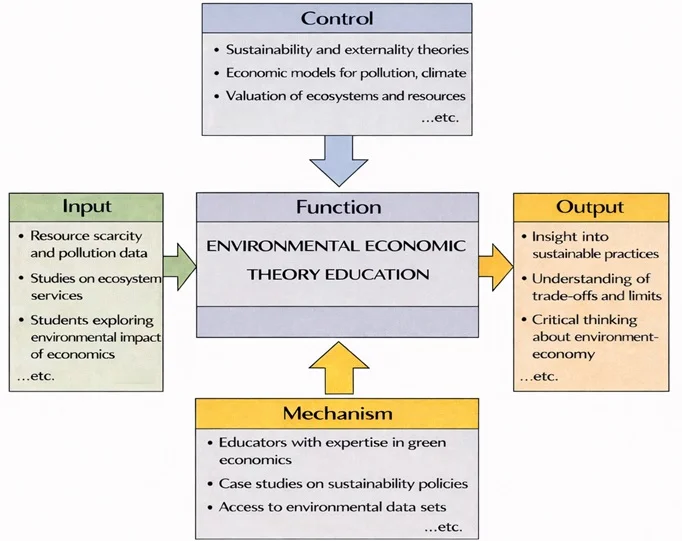
Interprets how classical, neoclassical, and modern economic paradigms address market externalities, ecosystem valuation, and resource allocation constraints.
Labor History
Reveals how changing environmental conditions, workplace health hazards, and resource extraction impact working-class livelihoods, union policies, and labor resilience.
Comparative Economic History
Compares cross-regional historical responses to ecological crises, soil degradation, and resource scarcity across different political and economic regimes.
Gender & Economic History
Highlights how environmental shifts, division of domestic labor, and access to land rights differ across gender lines throughout historical development.
Economic History – Overview
Provides the foundational macroeconomic umbrella context linking environmental, political, and institutional factors to overall global economic evolution.
Key Focus Areas in Environmental Economic History
Deforestation and Land Use During Colonization
Colonization profoundly altered landscapes through deforestation, agricultural expansion, and resource extraction.
Deforestation in the Americas
- European Colonization: The arrival of European settlers led to extensive deforestation for plantations, settlement expansion, and mining.
- The Caribbean: Isensively deforested for sugar monoculture, causing severe soil erosion and biodiversity loss.
- The Amazon: Suffered long-term logging and clearing during colonial and post-colonial commodity booms.
- Impact: Widespread collapse of native ecosystems and systemic displacement of Indigenous populations dependent on forest resources.
The Columbian Exchange
- Definition: The global transfer of plants, animals, culture, human populations, and diseases between the Eastern and Western Hemispheres starting in 1492.
- Environmental Impact: Introduction of European livestock (cattle, sheep) triggered severe overgrazing, while cash-crop monoculture (tobacco, cotton) rapidly depleted soil nutrients.
The Fossil Fuel Economy and Industrialization
The transition to fossil fuels during the Industrial Revolution marked a fundamental shift in energy systems and ecological impacts.
The Transition to Coal
- Impact on Energy Systems: Coal became the main industrial fuel source, driving manufacturing, railways, and steamships while transforming landscapes through intensive mining.
- Historical Examples: British industrial hubs like Newcastle experienced severe degradation, while coal-fired smog plagued 19th-century European and North American urban centers.
Oil and Natural Gas
- Modern Acceleration: The late 19th-century oil boom in Pennsylvania and Texas transformed rural economies into extraction hubs, with 20th-century offshore drilling creating major marine pollution hazards.
Global Trade and Environmental Impact
Global trade architectures have historically accelerated localized resource extraction and environmental pressure.
Colonial Trade Networks
- Resource Extraction: Imperial powers extracted timber from Canada/Baltic regions for navies, and established rubber monocultures in Southeast Asia, altering tropical ecological structures.
Globalization and Industrial Agriculture
- Modern Pressures: Export-driven markets for beef and soy in Brazil accelerate Amazon deforestation, while palm oil expansion in Southeast Asia destroys critical wildlife habitats.
Climate Change and Carbon Dynamics
Climate change represents the cumulative historical output of energy expansion and greenhouse gas emissions.
The Carbon Economy
- The Great Acceleration: Post-WWII economic expansion caused an exponential surge in fossil fuel consumption, industrial output, and carbon dioxide emissions worldwide.
- Land Use Shifts: Widespread wetland drainage and historic deforestation substantially reduced Earth’s natural carbon sinks.
Interactive Tool: Pigouvian Tax & Environmental Policy Simulator
This interactive simulator models the core economic principles of pollution control. Adjust the Pigouvian Carbon Tax rate and Industrial Growth target to observe the real-time dynamic balance between economic output (GDP), private firm costs, environmental damage costs, and net societal welfare.
Emissions Output: 0 MMT CO2 | Gross Economic Output: $0B
Environmental External Cost: $0B | Net Social Welfare (Output – Damage): $0B
Historical Examples of Environmental Crises
- The Dust Bowl (1930s): Over-cultivation and drought in the U.S. Great Plains led to catastrophic soil erosion, demonstrating the risk of unchecked land exploitation.
- The Great Smog of London (1952): Extreme coal pollution resulted in severe mortality, triggering the landmark Clean Air Act of 1956.
- The Aral Sea Desiccation: Soviet river diversion for irrigation shrank the sea dramatically, causing ecological collapse and economic ruin for local fisheries.
Why Study Environmental Economic History
Understanding Historical Interactions
Environmental economic history offers a crucial framework for evaluating long-term relationships between resource utilization, market growth, and natural limits across different historical eras.Tracing the Roots of Modern Crises
Contemporary environmental challenges—such as global warming, deforestation, and resource depletion—are rooted in historical industrialization and colonial expansion patterns.Interdisciplinary Thinking
Combining economics, history, ecology, and political science equips students to analyze qualitative and quantitative historical data, building essential research and analytical skills.Environmental Economic History: Conclusion
Environmental economic history reveals the deep interconnections between human economic systems and the natural world. From colonial resource extraction to the fossil fuel economy and modern climate diplomacy, understanding historical patterns provides crucial guidance for balancing economic development with ecological preservation.Environmental Economic History – Frequently Asked Questions
What is Environmental Economic History?
Environmental Economic History studies how economic activities over time have transformed the natural environment, and how environmental limits, resources, and shocks have shaped economic development.
How does it differ from standard economics or general environmental history?
It bridges both fields by using historical empirical evidence and economic theory (such as market externalities and property rights) to explain how societies managed resource scarcity and pollution over extended timeframes.
Why is this field crucial for modern climate policy?
It analyzes previous energy transitions (e.g., wood to coal, coal to oil) to highlight the structural, institutional, and economic hurdles associated with shifting toward renewable energy systems today.
What primary sources do scholars utilize?
Researchers combine quantitative data (commodity prices, historical energy consumption, emission inventories) with qualitative records (parliamentary acts, colonial trade logs, and maps).
How does the discipline address historical environmental injustice?
It examines the unequal distribution of ecological costs, showing how colonial extraction and industrial siting disproportionately burdened vulnerable populations while benefits accrued elsewhere.
Interactive Module: Key Concept Toggles
Click each summary toggle below to reveal detailed explanatory breakdowns of core environmental economic concepts:Understanding Market Externalities in History
The Tragedy of the Commons and Resource Management
The Concept of Pigouvian Taxation
Comprehensive Practice & Assessment Module
Section 1: Foundational Review Questions
- What is environmental economic history and why is it essential for studying long-term development?Answer: Environmental economic history studies how natural resources, ecological shocks, and environmental policies have influenced economic systems over time. It provides critical context for how past resource use shapes modern ecological and economic realities.
- How have natural resources historically influenced the rise and fall of industrial regions?Answer: Resource availability, such as proximity to coal deposits or fertile land, dictated industrial locations and trade power. Regions that overexploited resources often experienced economic decline when stocks were depleted or degraded.
- What role did geographical features play in establishing early trade routes?Answer: Rivers, mountain passes, and natural harbors dictated transportation costs and accessibility, determining which regions developed into commercial hubs.
- In what ways did the Industrial Revolution alter human resource consumption patterns?Answer: It shifted energy reliance from organic, land-based fuels (wood, muscle) to mineral-based fossil fuels (coal, oil), exponentially increasing energy consumption and industrial waste.
- How did the Columbian Exchange transform agricultural ecology across hemispheres?Answer: It introduced European livestock to the Americas, leading to overgrazing, while introducing American crops (potatoes, maize) to Afro-Eurasia, altering global population dynamics and land use.
- What was the primary economic trigger of the 1930s U.S. Dust Bowl?Answer: Rapid agricultural expansion, deep plowing of native prairie grasses, and market-driven over-cultivation combined with severe drought to cause widespread soil erosion.
- How did the UK respond legislatively to the Great Smog of London in 1952?Answer: The UK government enacted the Clean Air Act of 1956, establishing smoke-free zones and introducing financial incentives for households to shift away from soft coal burning.
- What are the core research methodologies used in environmental economic history?Answer: Researchers combine archival historical research, trade ledger analysis, and price histories with environmental proxy data like tree rings, ice cores, and land-use surveys.
Section 2: Analytical & Scenario-Based Questions
- How might current environmental crises reshape future paradigms in economic thought?Answer: Escalating climate impacts force economists to move beyond traditional GDP metrics toward framework models incorporating natural capital accounting, planetary boundaries, and intergenerational equity.
- In what ways can historical failures in common resource management guide current climate policy?Answer: Historical precedents demonstrate that top-down privatization or bans often fail without local community involvement, clear boundary enforcement, and flexible governance rules tailored to specific ecosystems.
- Compare the economic scale of localized 19th-century pollution crises to modern climate change.Answer: 19th-century pollution was generally localized around industrial cities with immediate regional health impacts, whereas climate change is a global systemic issue where emissions anywhere affect global climate stability.
- How can renewable energy transitions rewrite the global geopolitical balance of power?Answer: Shifting away from fossil fuels reduces the strategic power of petrostates while elevating nations that control critical mineral supply chains (lithium, rare earths) and green technology patents.
- Analyze how industrial pollution legacy affects urban economic development today.Answer: Historic industrial contamination creates “brownfields” that inflate redevelopment costs, depressing property values and reinforcing spatial economic inequality in post-industrial cities.
- How did colonial property rights regimes contribute to long-term environmental degradation in postcolonial states?Answer: Colonial powers often dismantled indigenous communal land structures in favor of state or plantation ownership optimized for export extraction, leaving postcolonial states with degraded ecosystems and tenure conflicts.
- What role do cultural perceptions of nature play in determining national environmental legislation?Answer: Societies viewing nature as a finite shared trust tend to pass strict precautionary regulations, whereas utilitarian views prioritize resource exploitation and rapid capital accumulation.
Section 3: Numerical Problems & Calculation Solutions
- Marginal External Damage Calculation: A power plant generates electricity where the private marginal cost is PMC = 20 + 0.5Q. Production generates sulfur emissions causing external health damage estimated at a constant Marginal External Cost (MEC) = $15 per megawatt-hour (MWh). Calculate the Social Marginal Cost (SMC) equation and determine the SMC when output Q = 40 MWh.Answer:SMC = PMC + MEC SMC = (20 + 0.5Q) + 15 = 35 + 0.5QFor Q = 40 MWh: SMC = 35 + (0.5 × 40) = 35 + 20 = $55 per MWh.
- Pigouvian Tax Determination: Suppose private market demand for coal is P = 100 − Q, and private supply is PMC = 10 + 2Q. The burning of coal creates a negative marginal external cost of MEC = $12 per unit.a) Calculate the unregulated private market equilibrium quantity (Qp).b) Calculate the socially optimal equilibrium quantity (Qs) and state the exact Pigouvian tax required per unit to achieve it.Answer:a) Private Market Equilibrium (PMC = Price): 10 + 2Q = 100 − Q → 3Q = 90 → Qp = 30 units.b) Socially Optimal Equilibrium (SMC = Price): SMC = PMC + MEC = (10 + 2Q) + 12 = 22 + 2Q. 22 + 2Q = 100 − Q → 3Q = 78 → Qs = 26 units.Optimal Pigouvian Tax: Set tax t = MEC at Qs = $12 per unit.
- Resource Depletion Rate: An oil field has a total finite capacity of 500 million barrels. In Year 0, extraction is 20 million barrels. If annual extraction increases by γ = 5% (× 1.05) each year due to industrial growth, calculate total cumulative extraction over the first 3 years (Years 0, 1, and 2).Answer:Year 0 Extraction = 20.00 million barrels. Year 1 Extraction = 20 × 1.05 = 21.00 million barrels. Year 2 Extraction = 21 × 1.05 = 22.05 million barrels.Total Cumulative Extraction = 20.00 + 21.00 + 22.05 = 63.05 million barrels.
- Percentage Reduction in Emissions: An industrial city emitted 120 million metric tons (MMT) of CO2 in 1990. Through technology adoption and environmental regulations, emissions dropped to 84 MMT by 2020. Calculate the total percentage reduction in emissions.Answer:Reduction = 120 − 84 = 36 MMT CO2. Percentage Reduction = (36 / 120) × 100% = 0.30 × 100% = 30%.
- Net Present Value (NPV) of Conservation: A timber company evaluates whether to clear-cut a forest or preserve it for eco-tourism. Clear-cutting yields an immediate one-time profit of $100,000 today (Year 0). Preservation yields eco-tourism profits of $12,000 per year at the end of Year 1, Year 2, and Year 3. Assuming a discount rate of r = 10% (0.10), calculate the Net Present Value of the 3-year preservation plan and determine if it exceeds clear-cutting.Answer:PVYear 1 = 12,000 / (1.10)1 = $10,909.09 PVYear 2 = 12,000 / (1.10)2 = $9,917.36 PVYear 3 = 12,000 / (1.10)3 = $9,015.78NPV Preservation = 10,909.09 + 9,917.36 + 9,015.78 = $29,842.23. Conclusion: $29,842.23 is far less than $100,000 immediate profit. From a strict short-term 3-year financial perspective, clear-cutting yields a higher direct nominal return, illustrating why market mechanisms without environmental valuation favor rapid resource exploitation over long-term preservation.
- Cost-Benefit Ratio of Abatement Technology: Installing industrial scrubbers costs $2,000,000 up front. The equipment reduces localized health costs by $450,000 annually over a 6-year operational lifespan. Calculate the simple benefit-to-cost ratio (un-discounted total benefits divided by initial cost).Answer:Total Benefits = $450,000 × 6 = $2,700,000. Benefit-to-Cost Ratio = $2,700,000 / $2,000,000 = 1.35.Since the ratio exceeds 1.0, total social benefits exceed total investment costs.
- Carbon Intensity of GDP Calculation: In 2010, a nation produced $500 billion in GDP while emitting 250 million tons of carbon. By 2025, its GDP grew to $800 billion while carbon emissions were capped at 200 million tons. Calculate the carbon intensity (tons CO2 per $1,000 of GDP) for both years and state the percentage improvement in carbon efficiency.Answer:2010 Carbon Intensity: 250,000,000 tons / $500,000,000,000 = 0.0005 tons/$1 = 0.50 tons per $1,000 GDP.2025 Carbon Intensity: 200,000,000 tons / $800,000,000,000 = 0.00025 tons/$1 = 0.25 tons per $1,000 GDP.Percentage Improvement: ((0.50 − 0.25) / 0.50) × 100% = 50% reduction in carbon intensity per unit of output.