
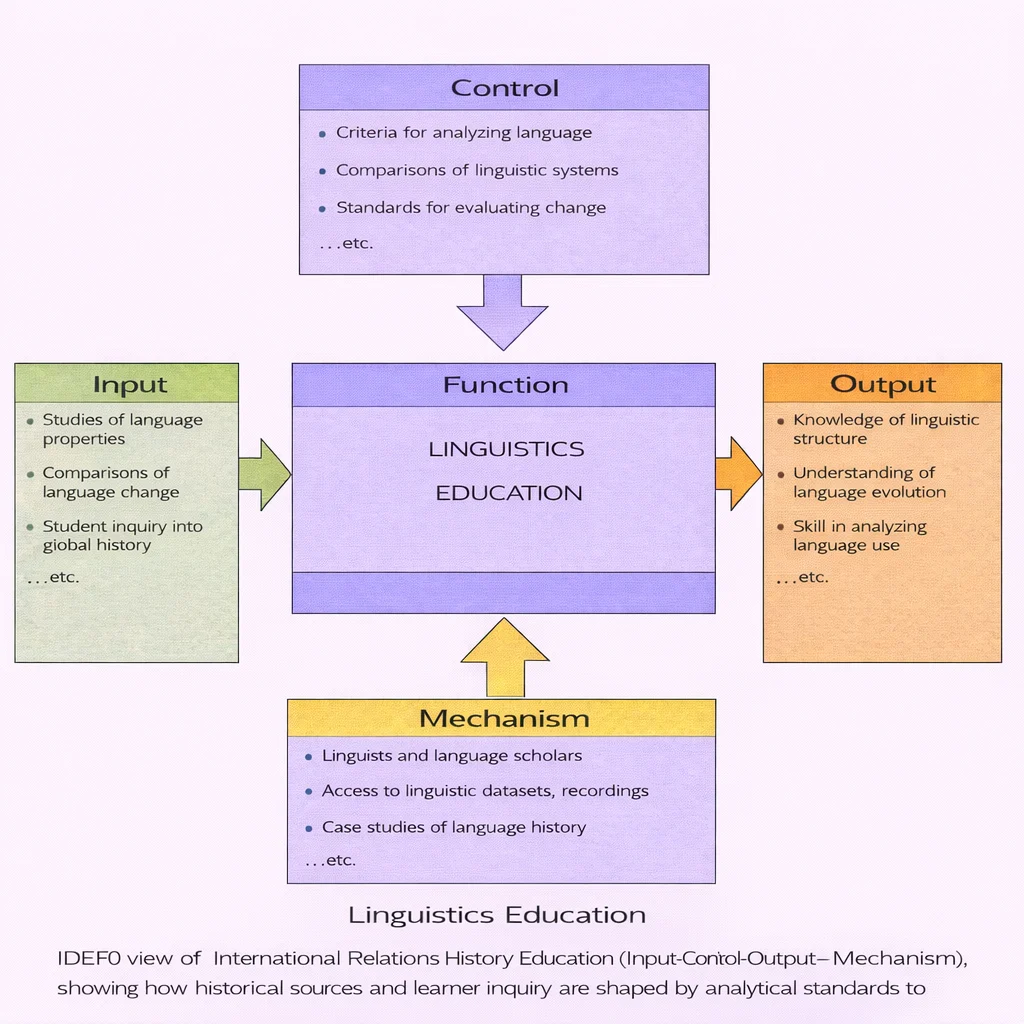

Study and Career Pathways in Linguistics
Linguistics can be studied as a full degree, a major within a broader humanities or social science programme, or a minor combined with fields such as psychology, computer science, education, or literature. For university preparation, it is helpful to see how a background in linguistics opens doors to both academic and professional pathways.1. Academic and Research Pathways
Students who enjoy theoretical questions – how grammar works, how languages change, or how the brain processes language – may pursue postgraduate study (Master’s and Ph.D.) and a research-oriented career. This could involve teaching at universities, working on language documentation and revitalisation, or contributing to research on bilingualism, language disorders, or language policy. A strong foundation in data analysis and critical reading is essential here.2. Language Technology and AI
The intersection of linguistics with computing has grown rapidly. Knowledge of syntax, semantics, and discourse is valuable in natural language processing (NLP), speech recognition, machine translation, chatbots, and language-based AI tools. Students who combine linguistics with programming, data science, or information technology can work in tech companies, startups, or research labs, helping design systems that “understand” and generate human language more effectively.3. Education, Language Teaching, and Curriculum Design
Many linguistics graduates move into language education: teaching first, second, or foreign languages in schools, universities, and private institutions. Linguistics informs how syllabuses are designed, how grammar and pronunciation are taught, and how learning difficulties are diagnosed. With additional pedagogical training, graduates can become teachers, teacher-trainers, curriculum designers, or assessment specialists in language testing.4. Translation, Interpreting, and Multilingual Communication
Linguistics provides tools for understanding meaning, nuance, and cross-cultural communication, which are central to translation and interpreting. Graduates may work as freelance translators, in localisation teams for global companies, in international organisations, or in media and publishing. Combining linguistics with strong proficiency in one or more languages can lead to roles that bridge different linguistic and cultural communities.5. Speech, Language, and Communication Support
In some countries, a linguistics background is part of the route into speech and language therapy, clinical linguistics, or communication support roles. Additional professional qualifications are usually required, but training in phonetics, phonology, and language acquisition is an important foundation. Graduates may work with children or adults who have difficulties with articulation, fluency, or language comprehension.6. Law, Policy, and Public Service
Because linguistics sharpens analytical reading and argumentation, it pairs well with law, public policy, and international relations. Some graduates move into forensic linguistics (analysing language evidence), legal drafting, or public communication. Others work on language policy, language rights, and planning in multilingual societies, contributing to decisions about official languages, education medium, and inclusion.7. Media, Publishing, and Communication Industries
Linguistics graduates often bring a keen awareness of audience, tone, and style to roles in journalism, editing, advertising, branding, and corporate communication. Understanding how language frames issues and influences perception is valuable in designing clear, persuasive messages across print, broadcast, and digital platforms.Overall, studying linguistics trains you to notice patterns, question assumptions, and work carefully with evidence – skills that are in demand far beyond language-focused jobs. Whether you eventually specialise in technology, education, policy, or the creative industries, a linguistics background offers a flexible and intellectually rich preparation for university and for a wide range of careers.
How Linguistics Connects to Other Prep4Uni.Online Pages
Linguistics rarely stands alone. Because language is present in every field of study, the concepts you meet in linguistics connect naturally to many other Prep4Uni.Online pages across the humanities, social sciences, STEM, and professional disciplines. Seeing these links can help you build a more integrated programme of self-study before university.1. Cultural History, Media, and Communication
Many cultural history and media-related pages explore how ideas, beliefs, and power relationships are communicated across time. Linguistics offers tools for analysing the language used in religious texts, political speeches, advertisements, news reports, and social media. Concepts from sociolinguistics and discourse analysis help you read these materials more critically, noticing how word choice, metaphor, and framing shape public opinion and cultural memory.2. Social History, Migration, and Identity
Social history topics such as migration, diaspora, and urban–rural change are closely tied to language. Linguistics sheds light on how dialects, multilingual practices, and language shift reflect broader social transformations. When you study migration and diaspora on Prep4Uni.Online, you can use ideas from contact linguistics and sociolinguistics to understand code-switching, heritage languages, and the politics of “standard” versus “non-standard” speech.3. Political History, Law, and Power
In political history and law-oriented pages, you often encounter constitutions, treaties, legal judgments, and policy documents. Linguistics contributes methods for examining how these texts define rights, obligations, and boundaries of authority. Pragmatics and discourse analysis help explain how ambiguity, vagueness, or carefully chosen wording can influence interpretation in courts, elections, and public debates. This is particularly relevant if you are interested in areas such as constitutional history, diplomatic history, or international law.4. Education, Learning Sciences, and Digital Communication
Pages on education, pedagogy, and digital communication connect strongly with applied linguistics. Insights into language acquisition inform how children and adults learn, while research on classroom discourse and feedback supports more inclusive teaching practices. In digital communication topics, ideas from pragmatics and discourse analysis help you understand how tone, emojis, and online platforms change the way we express politeness, disagreement, and identity.5. Information Technology, AI, and Data Science
Linguistics also links directly to STEM-focused pages on information technology, artificial intelligence, and data science. Natural language processing (NLP), machine translation, speech recognition, and conversational agents all depend on models of phonetics, syntax, semantics, and discourse. If you explore AI, big data, or analytics topics on Prep4Uni.Online, a grounding in linguistics will help you see why human language is such a rich, challenging data source for computing.6. Business, Marketing, and Public Relations
In business, marketing, and public relations pages, you will find many examples of persuasive communication, branding, and reputation management. Linguistics provides a toolkit for analysing slogans, campaign messaging, crisis communication, and cross-cultural negotiation. Understanding how language positions products, builds trust, or mitigates conflict helps you read case studies more sharply and design more effective communication strategies.7. Interdisciplinary Reflection and Study Skills
Finally, linguistics supports your general study skills across Prep4Uni.Online: careful reading, precise writing, awareness of audience, and sensitivity to nuance. Whether you are working through history case studies, engineering explanations, or economics problem sets, noticing how language is used to define terms, build arguments, and present evidence will make you a more attentive and critical learner. In this way, linguistics becomes a quiet but powerful companion to almost every other page you explore.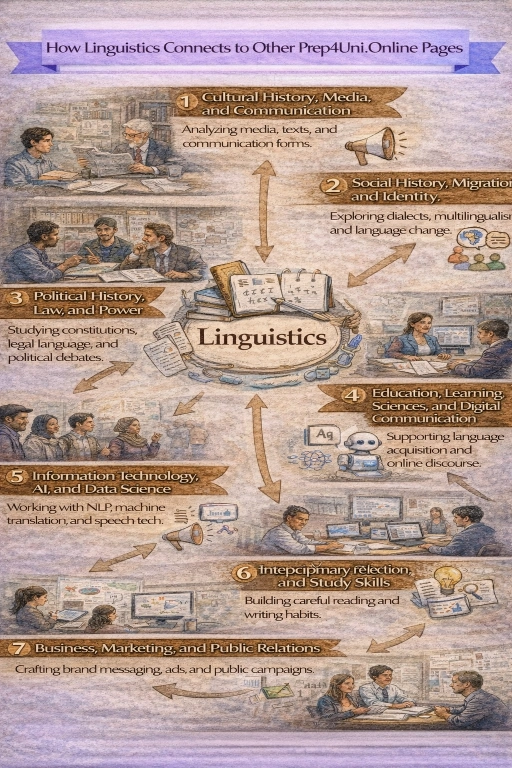
Why Study Linguistics? – 8 Reasons
1. Understand How Language Really Works
Everyday experience gives us the feeling that language is “natural” and effortless, but linguistics shows how much hidden structure lies beneath ordinary sentences. By studying phonetics, grammar, and meaning, you learn why some expressions feel “right” or “wrong”, how ambiguity arises, and how languages differ yet follow deep patterns. This gives you a more precise, evidence-based understanding of one of the most fundamental human abilities.2. Build Strong Analytical and Critical Thinking Skills
Linguistics trains you to notice patterns, formulate hypotheses, and test them against real data. You learn to move from intuition to structured analysis: identifying patterns in sound systems, sentence structures, or word meanings, and explaining them clearly. These habits of mind are valuable for university study in any field that requires logical reasoning, careful argumentation, and attention to detail.3. Connect the Humanities, Social Sciences, and STEM
Linguistics sits at the crossroads of many disciplines. It draws on philosophy and literature when dealing with meaning and interpretation, on psychology and neuroscience when exploring the mind and brain, and on computer science and data science in language technology. Studying linguistics helps you become comfortable crossing boundaries between qualitative and quantitative approaches – a key advantage in modern university programmes.4. Gain Insight into Culture, Identity, and Power
How people speak is closely tied to who they are, where they come from, and how they are treated in society. Sociolinguistics and discourse analysis show how language reflects and shapes identity, inequality, and power. By examining dialects, multilingual practices, and public debates, you become more sensitive to issues of discrimination, inclusion, and respect. This perspective is especially valuable for fields such as social history, cultural studies, education, law, and politics.5. Prepare for Language-Related Careers and Professional Roles
A background in linguistics supports many language-focused careers: language teaching, translation and interpreting, speech and language therapy (with further training), publishing, editing, and communication strategy. It equips you with technical knowledge about grammar, pronunciation, and meaning, as well as practical tools for designing courses, analysing texts, and communicating clearly across cultures and contexts.6. Engage with AI, Language Technology, and Data
Modern AI systems that handle text and speech rely heavily on linguistic concepts. If you are interested in natural language processing, machine translation, conversational agents, or speech recognition, linguistics gives you a conceptual map of what “understanding” language involves. This makes it easier to collaborate with computer scientists, evaluate AI tools critically, and think about the ethical and technical challenges of language-based technologies.7. Improve Your Own Communication and Language Learning
Studying linguistics helps you become more aware of how you speak, write, and listen. You learn why certain explanations work better for learners, why some sentences are clearer than others, and how subtle shifts in wording change the tone of a message. This awareness can make you a more effective writer, presenter, and language learner, strengthening your performance in essays, presentations, and group discussions across all subjects.8. Keep Your Future Options Open
Because linguistics develops transferable skills – analysis, problem-solving, research, and communication – it keeps many pathways open. You can combine it with subjects like psychology, computer science, education, history, law, or business, and later specialise in whichever intersection interests you most. For students preparing for university, linguistics is an intellectually satisfying way to explore language while building a flexible foundation for a wide range of degree programmes and careers.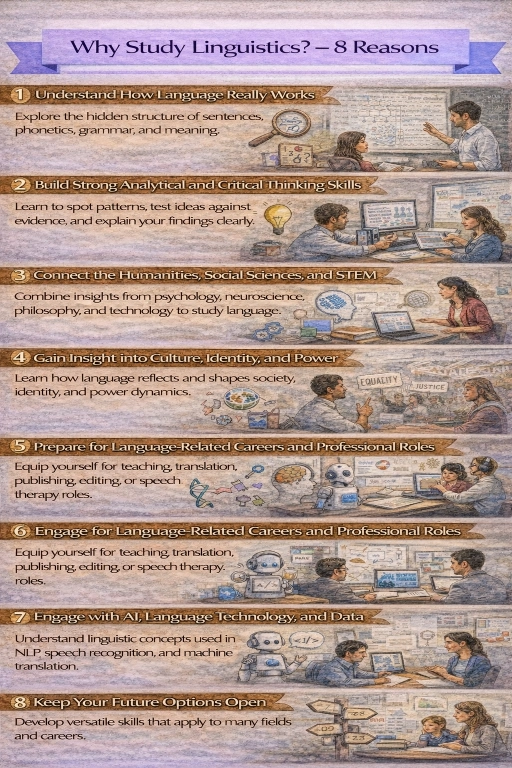
Summary – Linguistics Studies
Linguistics is the disciplined study of human language in all its dimensions – sound, structure, meaning, use, and change. It treats language not simply as a school subject, but as a complex system that can be described, modelled, and tested using real data. By examining how languages are organised and how people actually speak and write, linguistics builds bridges between the humanities, social sciences, and STEM.At the core of linguistics are several key areas: phonetics and phonology (the sounds of language), morphology and syntax (the structure of words and sentences), semantics and pragmatics (meaning in context), and broader fields such as sociolinguistics, discourse analysis, psycholinguistics, and historical linguistics. Together, these strands help us understand how language is learned, how it varies across communities, how it evolves over time, and how it interacts with technology, culture, and power.For students preparing for university, linguistics develops habits that are central to academic success: careful observation, pattern recognition, logical reasoning, and clear explanation. It invites you to move from “gut feeling” about language to systematic analysis, using examples, counterexamples, and evidence-based argument. These skills transfer directly to reading complex texts, writing structured essays, evaluating data, and engaging critically with debates in many disciplines.Linguistics also opens up a wide range of study and career pathways. It can be combined with psychology, computer science, education, law, media, and business, among others. Graduates may work in language teaching, translation and interpreting, language technology and AI, publishing and communication, policy and planning, or research and academia. Even when you do not work “as a linguist”, the ability to listen closely, read carefully, and notice what language is doing beneath the surface remains a powerful advantage.In short, linguistics studies invite you to look again at something you already use every day – language – and to see it with new clarity. As you explore related Prep4Uni.Online pages, you can treat linguistics as both a subject in its own right and a quiet companion, helping you make sense of texts, arguments, and communication across your entire journey into university and beyond.Interactive Quantitative Linguistics Simulator
In quantitative linguistics, Zipf’s Law dictates that the frequency f of any word is inversely proportional to its frequency rank r:
Adjust the exponent exponent parameter (γ) and corpus vocabulary size to observe how language distribution curves shift. The visualization explicitly includes horizontal X-axis lines, tick marks, and labeled intervals.
Is Linguistics Right For You?
Explore career pathways, check your fit, and assess your skills — before you commit to a degree.
Interactive Conceptual Deep-Dives (Toggle to Reveal)
How does structural ambiguity illustrate the boundary between Syntax and Semantics?
What is the role of information structure in sentence formatting?
Frequently Asked Questions
What is linguistics as a field of study?
Linguistics is the scientific study of language. It investigates how languages are structured, how they are used in context, how they change over time, and how they are processed in the mind and brain. Linguists analyse sounds, words, sentences, meanings, and conversations across many different languages and communities.
How is linguistics different from simply learning a language?
Learning a language focuses on using that language to communicate, while linguistics asks how language works in general. A linguist might study pronunciation systems, grammar patterns, meaning, and conversation in multiple languages, often comparing them. Language learning can be part of linguistics, but the main aim is analysis and explanation rather than fluency alone.
What are the main branches of linguistics?
Core branches of linguistics include phonetics (speech sounds), phonology (sound systems), morphology (word structure), syntax (sentence structure), semantics (meaning in words and sentences), and pragmatics (meaning in context). Important applied and interdisciplinary areas include sociolinguistics, psycholinguistics, historical linguistics, discourse analysis, and computational linguistics.
What kinds of questions do linguists ask?
Linguists ask questions such as: How do children acquire their first language? Why do languages change over time? What makes one sentence grammatical and another not? How do speakers signal politeness or power in conversation? How do bilinguals manage multiple languages? How can we model language in computers for translation or speech recognition?
What methods are used in linguistic research?
Linguistic research uses a range of methods, including close analysis of example sentences, fieldwork with speakers of under-documented languages, recording and measuring speech with acoustic tools, collecting and analysing large text or speech corpora, experiments on perception and comprehension, and building computational models of language structure and processing.
Is linguistics mainly about grammar rules and correcting mistakes?
No. Linguistics describes how people actually use language, rather than enforcing fixed rules of correctness. Linguists are interested in dialects, slang, and everyday speech as much as in standard varieties. They distinguish between prescriptive rules that tell people how they ought to speak and descriptive rules that explain how language works in real life.
How does linguistics connect with psychology, computer science, and sociology?
Linguistics connects with psychology through psycholinguistics and neurolinguistics, which study how language is processed and represented in the mind and brain. It connects with computer science through computational linguistics and natural language processing. It connects with sociology and anthropology through sociolinguistics, which examines how language varies across social groups, identities, and cultures.
What is sociolinguistics, and why is it important?
Sociolinguistics studies how language varies and changes across different social contexts. It looks at how factors such as region, class, ethnicity, gender, age, and setting influence pronunciation, vocabulary, grammar, and interaction styles. Sociolinguistics is important for understanding language attitudes, language policy, multilingualism, and communication in diverse societies.
What is applied linguistics?
Applied linguistics uses insights from linguistic research to address real-world issues. It includes areas such as language teaching and assessment, language planning and policy, translation and interpreting, literacy and reading, forensic linguistics, and communication in professional settings like healthcare or business.
What skills do students gain from studying linguistics?
Students of linguistics learn to analyse complex patterns systematically, work with data from different languages, construct and test hypotheses, and present clear, evidence-based arguments. They develop strong skills in critical thinking, formal reasoning, problem-solving, and precise written and oral communication, often across more than one language.
What kinds of careers can a linguistics background support?
A linguistics background can support careers in language education, speech and language technology, translation and interpreting, publishing, lexicography, language documentation and revitalisation, communications and marketing, forensic and legal language analysis, and research roles in universities or industry. It is also a strong foundation for further study in areas like speech therapy or computational linguistics.
How can students prepare for university-level linguistics?
Students can prepare by paying close attention to language in everyday life, noticing patterns in pronunciation, word choice, and grammar, and exploring introductory books or online resources about linguistics. Learning or comparing multiple languages, practising logic and basic formal notation, and developing good essay-writing and data-handling skills are also excellent preparation.
Comprehensive Linguistic Exercises & Practice Module
Part 1: Foundational Review Questions
- What is linguistics, and how does it differ from simply “knowing a language”?Answer: Linguistics is the scientific study of human language – its sounds, structures, meanings, and uses. It aims to describe and explain language systematically, using evidence and clear methods. Simply “knowing a language” means you can speak and understand it as a native or fluent user, usually without being able to explain the rules you follow. A linguist steps back and asks: What patterns are speakers using? How can we describe those patterns? Linguistics therefore moves from intuition (“this sounds right”) to systematic analysis.
- Briefly explain the difference between phonetics and phonology, and give one example of a question each field might ask.Answer: Phonetics studies the physical side of speech sounds: how they are produced by the vocal tract, how they travel as sound waves, and how they are perceived by the ear and brain (e.g., “What tongue positions produce the sound /r/?”). Phonology studies how sounds are organized and patterned within a particular language or across languages (e.g., “Why can English words begin with /str-/ but not /ftr-/?”). Phonetics focuses on physical details, while phonology focuses on systemic organization.
- How do morphology and syntax work together to create meaningful sentences?Answer: Morphology deals with internal word structure (roots, prefixes, suffixes), while syntax explains how words combine into phrases and sentences. For example, in "The researchers analysed the data", morphology accounts for research-er-s and analys-ed, while syntax dictates the valid word order (Subject-Verb-Object).
- What is the distinction between semantics and pragmatics?Answer: Semantics studies the literal meaning of words and sentences based on dictionary definitions and formal structure. Pragmatics studies how context, speaker intention, and social norms alter meaning during actual use (e.g., "It's cold in here" literally refers to temperature [semantics], but pragmatically functions as a request to close a window).
- Describe what sociolinguistics studies regarding language variation.Answer: Sociolinguistics investigates how language varies across social factors such as region, class, ethnicity, age, and situation, demonstrating that dialects and slang are rule-governed structures rather than "incorrect" grammar.
- What questions do psycholinguistics and neurolinguistics ask?Answer: Psycholinguistics examines mental language processing (e.g., word recognition speed, language acquisition), while neurolinguistics examines physical brain structures involved in processing language (e.g., brain activation during speech or aphasia).
- How does historical linguistics trace language evolution?Answer: Historical linguistics compares sound correspondences and vocabulary shifts across centuries to reconstruct ancestral protolanguages and establish language family trees.
Part 2: Analytical & Thought-Provoking Scenarios
- How do speakers shift registers across social situations?Answer: Speakers systematically adjust vocabulary, phonetics, and syntax to manage social distance, identity, and authority—using casual vernacular with peers and formal registers in academic or legal environments.
- How do linguists evaluate claims that non-standard dialects are "broken language"?Answer: Linguists use empirical field recordings to prove that non-standard dialects follow strict, internal descriptive rules, demonstrating that labels like "broken" stem from social prestige bias rather than structural flaw.
- How does critical discourse analysis expose political framing?Answer: By analyzing passive voice, metaphor selection, and pronoun usage, discourse analysis reveals how political texts shift responsibility or construct ideological biases beneath superficial neutrality.
- Why do AI language models struggle with sarcasm and pragmatics?Answer: Large language models predict textual probability but lack real-world situational context, shared human history, and emotional embodiment needed to interpret pragmatic inversion in sarcasm.
- What intellectual assets are lost when an endangered language dies?Answer: Language loss erases unique botanical/ecological taxonomies, historical oral traditions, and rare typological structures essential to cognitive science.
- How does linguistic relativity (the Sapir-Whorf hypothesis) affect perception?Answer: Modern soft linguistic relativity shows that grammatical categories (e.g., spatial terms, grammatical gender) habituate speakers to pay attention to specific environmental details faster.
- Analyze how miscommunication occurs in cross-cultural pragmatic interactions.Answer: Miscommunications occur when indirect politeness strategies (e.g., soft refusals) in one culture are literally interpreted as agreement in cultures favoring direct speech acts.
Part 3: Quantitative & Computational Linguistics Problems
- Zipfian Frequency Calculation: In a corpus of 100,000 words, the top-ranked word (r = 1) appears 10,000 times. Assuming standard Zipfian distribution (γ = 1.0), calculate the theoretical frequency f(r) for the 5th most frequent word (r = 5).Solution: Using the formula f(r) = C / rγ: For r = 1: 10,000 = C / 11 ⇒ C = 10,000. For r = 5: f(5) = 10,000 / 51 = 2,000 occurrences.
- Type-Token Ratio (TTR): A transcript contains N = 500 total words (tokens) and V = 200 unique vocabulary words (types). Calculate the TTR.Solution: TTR = V / N TTR = 200 / 500 = 0.40 (or 40%).
- Shannon Entropy of Phoneme Distribution: Given a mini-language with 2 phonemes where phoneme A appears with probability P(A) = 0.75 and phoneme B with P(B) = 0.25, calculate the information entropy H in bits.Solution: H = - Σ [ P(x) × log2(P(x)) ] H = - [ 0.75 × log2(0.75) + 0.25 × log2(0.25) ] Since log2(0.75) ≈ -0.415 and log2(0.25) = -2.000: H = - [ (0.75 × -0.415) + (0.25 × -2.000) ] = - [ -0.311 - 0.500 ] = 0.811 bits per phoneme.
- Bigram Probability in Language Modeling: In a text corpus, the word "linguistic" occurs 400 times. The bigram sequence "linguistic analysis" occurs 80 times. Calculate the conditional probability P(analysis | linguistic).Solution: P(w2 | w1) = Count(w1, w2) / Count(w1) P(analysis | linguistic) = 80 / 400 = 0.20 (or 20%).
- Lexicostatistical Cognate Decay: Two languages separated t = 1000 years ago from a parent language. The retention rate of core vocabulary is r = 0.81 per millennium. Calculate the remaining shared cognate percentage C = r2t (where t is in millennia).Solution: For t = 1 millennium: C = 0.81(2 × 1) = 0.812 = 0.6561 (or 65.61% shared cognates).
- Acoustic Formant Measurement: A vowel spectrum shows an open vocal tract standing wave resonance formula Fn = (2n - 1)v / (4L), where speed of sound v = 34000 cm/s and vocal tract length L = 17 cm. Calculate the first formant frequency F1 (where n = 1).Solution: F1 = (2(1) - 1) × 34000 / (4 × 17) F1 = 1 × 34000 / 68 = 500 Hz.
- Morphological Combinatorics: A language forms words using 1 optional prefix (from a set of 4), 1 compulsory root (from a set of 500), and up to 2 optional distinct suffixes (from a set of 10). Calculate the total number of unique word combinations possible with exactly 1 suffix.Solution: Prefix choices = 1 (none) + 4 = 5 options. Root choices = 500 options. Suffix choices = 10 options. Total combinations = 5 × 500 × 10 = 25,000 unique word forms.
Humanities & Social Sciences Curriculum Cluster
Explore related disciplines within the Prep4Uni Humanities and Social Sciences pathway to build a well-rounded foundation for university-level study.
Humanities & Social Sciences Hub
The central portal connecting foundational theories, methodological frameworks, and interdisciplinary pathways across human culture and society.
Anthropology
Examines human societies, cultural diversity, and evolutionary biology, complementing linguistics through ethnography and linguistic anthropology.
Cultural Studies
Investigates media, identity, and cultural practices, providing critical methods to analyze how language constructs ideological meaning in society.
History
Traces past events, historical shifts, and archival documents, linking directly with historical linguistics to track language change across centuries.
International Relations
Explores global diplomacy, treaty negotiation, and geopolitical governance, where precise language and pragmatic discourse analysis are paramount.
Linguistics
The scientific study of language structure, sound systems, meaning, and socio-cognitive processing, serving as a vital bridge discipline.
Literature
Analyzes textual narrative, stylistics, and poetics, utilizing semantic and syntactic frameworks to decode complex creative expression.
Philosophy
Investigates logic, epistemology, and ethics, underpinning formal semantics and philosophy of language through analytical rigor.
Political Science
Studies political systems, rhetoric, and institutional power, offering contexts for analyzing language usage in public policy and debate.
Psychology
Focuses on human cognition, behavior, and mental processes, interfacing directly with psycholinguistics and language acquisition.
Religious Studies
Examines sacred texts, rituals, and belief systems, utilizing hermeneutics and textual analysis to understand religious communication.
Sociology
Analyzes social structures, group dynamics, and institutions, providing the foundational framework for sociolinguistic research.