
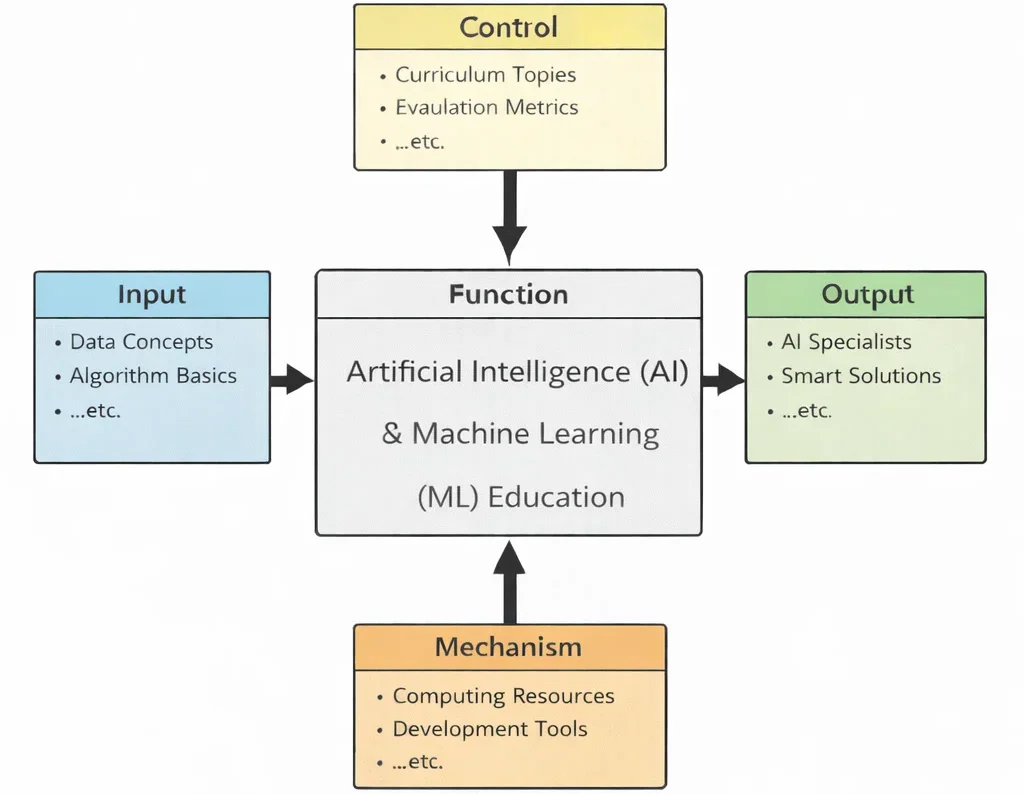
The AI Ecosystem: From Learning Methods to Real-World Systems

Why Study Artificial Intelligence
Understanding Systems That Learn and Adapt
AI systems differ from traditional programs because they improve through experience. By studying how models learn from data, students gain insight into how machines recognise patterns, make predictions, and adjust to changing conditions.
Working with Data and Models
AI requires the ability to move from raw data to meaningful outcomes. This involves selecting appropriate models, evaluating performance, and understanding trade-offs between accuracy, complexity, and efficiency. These skills are central to many areas of modern science and engineering.
Solving Real Problems
Across industries, AI is used to interpret information, automate processes, and support decision-making. Whether analysing medical images, improving manufacturing quality, or assisting communication, AI connects abstract methods to practical outcomes.
Engaging with Ethical and Social Questions
As AI systems influence real-world decisions, questions of fairness, transparency, and responsibility become essential. Studying AI encourages students to think critically about how technology affects individuals and society.
Preparing for Further Study and Careers
A foundation in AI supports advanced learning in areas such as machine learning, data science, and intelligent systems. It also prepares students for roles that require both technical skill and the ability to reason about complex systems.
Mapping the Field of Artificial Intelligence
| AI Domain / Subfield | Core Focus & Concepts | Primary Real-World Applications |
|---|---|---|
| Supervised Learning | Learning mappings from labelled inputs to outputs, training loss functions, and cross-validation splits. | Credit scoring, medical diagnostics, spam filtering, demand forecasting. |
| Unsupervised Learning | Discovering latent structure, clustering unannotated data, and performing dimensionality reduction. | Customer segmentation, anomaly detection, topic modeling, PCA embeddings. |
| Deep Learning | Multi-layer neural network architectures, representation learning, backpropagation, and transformers. | Generative AI, speech recognition, visual perception, large language models. |
| Reinforcement Learning | Agent interaction with environments using policy feedback, state-action rewards, and Q-learning. | Autonomous navigation, game-playing agents, adaptive industrial control. |
| Natural Language Processing (NLP) | Processing human language, tokenization, text embeddings, attention mechanisms, and translation. | Search engines, chatbots, document summarization, voice assistants. |
| Computer Vision | Interpreting pixel data, feature extraction, convolutional networks, and object segmentation. | Medical image analysis, autonomous vehicles, visual quality inspection. |
| Expert Systems | Rule-based reasoning, knowledge bases, inference engines, and certainty factors. | Clinical triage pathways, legal compliance auditing, equipment configuration. |
| Robotics & Autonomous Systems | Bridging AI to physical actuation, sensor fusion, spatial mapping, and trajectory planning. | Industrial cobots, warehouse automation, autonomous drones, space rovers. |
| MLOps & AI Infrastructure | CI/CD/CT pipelines, containerized serving clusters, model registries, and drift detection. | Production ML scaling, automated retraining loops, telemetry dashboards. |
| AI Safety, Ethics & Governance | Algorithmic fairness auditing, disparate impact evaluation, hallucination guardrails, and compliance. | EU AI Act compliance, SHAP adverse action explanations, red-teaming. |
| Edge AI & Embedded Machine Learning | Model quantization (INT8), weight pruning, TinyML C++ runtimes, and low-power microcontroller execution. | Wearable health monitors, smart IoT sensors, local keyword spotting. |
How AI Systems Learn, Decide, and Improve
Learning from Data
In supervised learning, models are trained on labelled examples to map inputs to known outputs. Tasks such as classification and regression reveal how features, loss functions, and generalisation interact. In contrast, unsupervised learning works without labels, discovering structure through clustering and dimensionality reduction. Together, these approaches show how systems extract meaning from data rather than relying on fixed rules.
Model Structures and Representations
Different model families represent data in different ways. Neural networks learn complex, non-linear relationships through layered transformations, enabling systems to process images, speech, and language. Decision trees and ensemble methods offer more interpretable alternatives, often serving as strong baselines in practical applications. Choosing between models involves balancing accuracy, interpretability, and computational cost.
Deep Learning and Specialised Domains
Modern AI systems often rely on deep learning architectures that learn hierarchical representations. Convolutional networks excel in visual tasks, while transformers handle sequential and language-based data. These models underpin applications in computer vision and natural language processing, where perception and communication become computational processes.
Learning Through Interaction
Reinforcement learning introduces a different paradigm, where an agent learns by interacting with an environment and receiving feedback through rewards. Concepts such as policies, value functions, and exploration strategies are central to systems that must make decisions over time, including robotics and adaptive control.
From Logic to Hybrid Intelligence
Not all AI is data-driven. Expert systems encode structured knowledge through rules and inference, offering transparency and reliability in domains where decisions must be explainable. Increasingly, modern systems combine symbolic reasoning with learned models, creating hybrid neuro-symbolic approaches that balance flexibility with control.
From Models to Real-World Systems
In real applications, AI does not operate in isolation. Systems must integrate perception, planning, and execution while functioning under constraints such as latency, reliability, and safety. MLOps, Edge AI, and autonomous systems highlight this integration, where models interact with dynamic production environments.
Evaluation, Tuning, and Responsibility
Building a model is only the beginning. Students learn to refine models through systematic tuning of parameters such as learning rate and regularisation, and to evaluate performance using metrics suited to each task. Validation techniques, including cross-validation and test sets, ensure results are reliable.
Equally important is recognising the impact of data and design choices. Bias in datasets can lead to unfair outcomes, while poorly evaluated models may fail in real-world conditions. Responsible AI therefore requires careful auditing, transparency, and an understanding of trade-offs between accuracy, fairness, and cost.
Quick Check: Understanding Core Concepts
1. What is the main role of a loss function?
• A. Store training data
• B. Measure prediction error
• C. Increase model complexity
• D. Select hardware
Toggle Answer
Answer: B. A loss function measures how far predictions are from actual ground-truth values and guides gradient optimization during model training.
2. What does overfitting mean?
• A. Model trains too slowly
• B. Model ignores data
• C. Model memorizes training data but fails on new data
• D. Model has too few parameters
Toggle Answer
Answer: C. Overfitting occurs when a model fits the training noise too closely and fails to generalize to unseen test data.
Building & Deploying Real Systems with AI
Working with Language
Natural Language Processing (NLP) enables systems to process and generate human language. Projects include summarising documents, translating text, extracting key information, and building question–answering systems. Through these tasks, students encounter tokenisation, embeddings, attention mechanisms, and evaluation methods that measure not just correctness, but usefulness.
Working with Images and Video
Computer Vision focuses on interpreting visual data. Applications include classification, object detection, and segmentation in contexts such as medical imaging, quality control, and safety monitoring. Students learn to curate datasets, apply augmentation techniques, and optimise models for efficient real-world deployment.
Training Modern AI Models
Deep Learning underpins many modern AI systems. Projects involve training and fine-tuning neural networks such as convolutional models and transformers. Students explore transfer learning, prompt-based methods, and evaluation beyond simple accuracy, focusing on robustness and generalisation.
Real-World Industry Applications Matrix
| Domain Application | Core AI Technology Applied | Operational Impact & Output |
|---|---|---|
| Medical Imaging Triage | Computer Vision & Deep Learning | Highlights anomaly patterns in scans, helping clinicians prioritize urgent cases. |
| Personalized Recommendations | Supervised Filtering & Embeddings | Analyzes user interaction behavior to suggest products and content. |
| Document Summarisation | NLP & Transformer Language Models | Condenses massive text files into concise actionable insights for analysis. |
| Manufacturing Defect Detection | Edge AI & Vision Inspection | Detects surface assembly defects on high-speed production lines in real time. |
| Traffic Flow & Analytics | Autonomous Perception & Detection | Segment vehicles and pedestrians to optimize signal routing and safety. |
| Adaptive Learning Systems | Intelligent Tutoring & Analytics | Adjusts content pacing based on student performance to optimize learning. |
Is Artificial Intelligence Right For You?
Explore career pathways, evaluate your technical fit, and assess required math and programming skills before committing to a university degree.
Key Terms in Artificial Intelligence and Machine Learning
- Baseline Model
- A simple, transparent starting model used to benchmark whether complex architectures provide genuine metric gains.
- Loss Function
- A mathematical function quantifying prediction error that optimization algorithms seek to minimize during model training.
- Overfitting
- A failure mode where a model memorizes training dataset noise and fails to generalize to validation/test data.
- Cross-Validation
- A resampling evaluation protocol that partitions data into rotating train/validation folds to estimate generalization stability.
- Precision & Recall
- Precision measures the accuracy of positive predictions; Recall measures the proportion of actual positive cases correctly identified.
- ROC-AUC & PR-AUC
- ROC-AUC evaluates ranking separability across thresholds; PR-AUC measures retrieval performance specifically under heavy class imbalance.
- Data Leakage
- An error occurring when validation/test information or future state data pollutes training feature engineering.
- Regularization
- Techniques (L1, L2, dropout) that penalize excessive model parameters to improve generalization and reduce variance.
- Gradient Descent
- An iterative optimization algorithm updating parameter weights in the direction of negative loss gradients.
- MLOps
- Machine Learning Operations: engineering practices unifying CI/CD pipelines, containerized serving, and real-time telemetry monitoring.
Quick Check: Applying Key Terms
3. Which metric is most useful when evaluating rare positive outcomes (class imbalance)?
• A. Accuracy
• B. Precision and Recall (PR-AUC)
• C. Training execution time
• D. Initial learning rate
Toggle Answer
Answer: B. Precision and Recall (and PR-AUC) focus specifically on positive class retrieval without being distorted by high true negative counts.
4. What is the primary operational purpose of establishing a baseline model?
• A. Replace advanced neural networks
• B. Clean missing values from data
• C. Provide a reference performance benchmark for comparison
• D. Store production prediction logs
Toggle Answer
Answer: C. A baseline sets a minimal performance standard to verify if additional model complexity delivers genuine value.
Artificial Intelligence (AI): Frequently Asked Questions
1. What is the difference between Artificial Intelligence and Machine Learning?
Artificial Intelligence is the overarching discipline aimed at creating intelligent systems. Machine Learning is a specific subfield of AI focused on algorithms that learn statistical patterns from data rather than following hand-coded rules.
2. What background knowledge is useful before studying AI?
A foundation in linear algebra, calculus, probability, and basic statistics, combined with Python programming proficiency, provides the essential foundation for implementing and evaluating algorithms.
3. How does MLOps differ from traditional software DevOps?
DevOps manages code versioning and software builds. MLOps must simultaneously version code, data distributions (DVC), and model weights while monitoring production data drift and automating continuous retraining.
4. Where are AI systems typically deployed in enterprise production?
AI is deployed in healthcare (diagnostic imaging), finance (credit underwriting and fraud prevention), manufacturing (visual QA), retail (recommender engines), and transport (autonomous perception).
5. What is the significance of Edge AI in modern infrastructure?
Edge AI optimizes neural models via quantization and pruning to execute inference locally on low-power microcontrollers, delivering zero network latency, milliwatt power draw, and total data privacy.
Review Questions and Exercises
Part 1: Conceptual Understanding
Q1: Explain the distinction between AI, Machine Learning, and Deep Learning.
Answer: AI is the broad umbrella of intelligent systems. Machine Learning is the statistical subset learning patterns from data. Deep Learning is a specialized ML subfield utilizing multi-layer neural networks for representation learning.
Q2: What role does a baseline model fulfill during system development?
Answer: A baseline provides a simple, reproducible performance reference point to verify if adding model capacity or complex feature engineering yields genuine accuracy improvements.
Q3: Define overfitting and state two techniques used to mitigate it.
Answer: Overfitting occurs when a model memorizes training noise and fails to generalize to test data. Mitigation techniques include regularisation (L1/L2), cross-validation, early stopping, and data augmentation.
Q4: Why is data leakage dangerous in production ML pipelines?
Answer: Leakage contaminates training feature engineering with validation/test statistics, artificially inflating performance metrics during validation that subsequently collapse when deployed on live data.
Part 2: Applied Thinking & Case Scenarios
Q1: Visual Defect Detection on a Manufacturing Line
Scenario: A factory deploys a computer vision system to detect product flaws. Defective items represent only 0.2% of total production volume.
Analysis: Evaluating by standard accuracy is misleading (a dummy model predicting “no defect” achieves 99.8% accuracy). The engineering team must evaluate using Precision-Recall curves (PR-AUC), optimize decision thresholds based on missed-defect costs, and apply class-weighted loss functions.
Q2: Production Latency and Drift in Credit Scoring
Scenario: A loan approval model encounters a 30% drop in conversion accuracy six months post-deployment despite perfect offline validation scores.
Analysis: The system suffered from Covariate Shift / Data Drift due to changing macroeconomic conditions. The solution requires deploying automated MLOps monitoring to track Population Stability Index (PSI) drift metrics and triggering continuous retraining loops.
External Technical References
- Google AI Research Portal – Technical papers on deep learning architectures and intelligent systems.
- NIST AI Risk Management Framework (AI RMF 1.0) – Official standard guidelines for trustworthy AI engineering.