
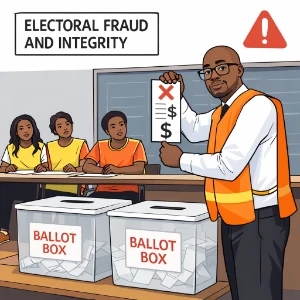
Procedural Scrutiny: This scene illustrates an election environment where transparent ballot boxes and high-visibility election observers ensure open auditability. When irregularities occur, independent scrutiny and official oversight allow for procedural verification rather than systemic failure.
Trust at the Ballot: Safeguarding Electoral Integrity
Electoral History Overview
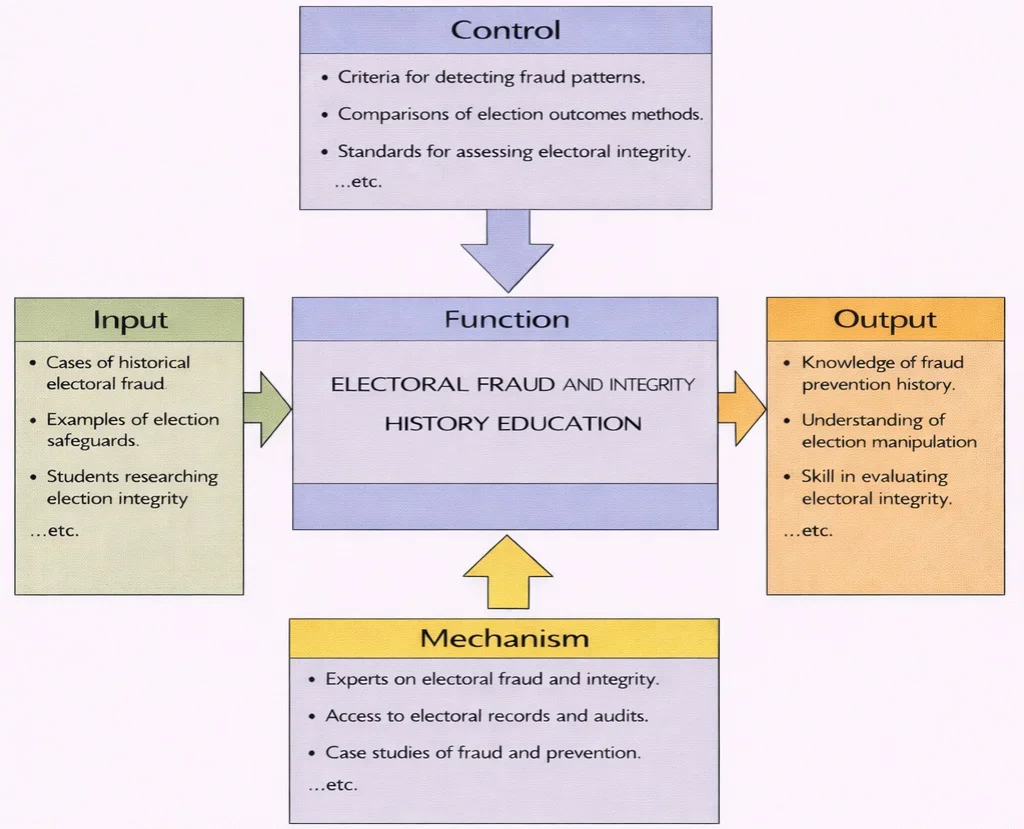
Curriculum Roadmap: Provides the foundational timeline showing how democratic systems developed institutional norms and legal frameworks to transform chaotic vote counting into legitimate governance.
Suffrage & Civil Rights Movements
Curriculum Roadmap: Examines historical campaigns against voter suppression, poll taxes, and literacy tests, illustrating how expanding franchise access goes hand-in-hand with fighting electoral bias.
Role of Technology in Elections
Curriculum Roadmap: Analyzes the dual nature of technological tools—from biometric voter rolls that prevent impersonation to digital vulnerabilities, cyber intrusions, and paper trail requirements.
Political Campaigns
Curriculum Roadmap: Investigates campaign finance transparency, dark money, patronage networks, and the fine line between persuasive political mobilization and voter coercion.
Comparative Electoral Systems
Curriculum Roadmap: Compares how majoritarian versus proportional voting structures create distinct institutional incentives that either mitigate or exacerbate risks of fraud and boundary manipulation.
Red Flags and Gold Standards in Electoral Systems
Electoral Fraud
Electoral fraud encompasses illegal or unethical actions intended to distort the electoral process, manipulate voter choice, or falsify results to secure political office.
Types of Electoral Fraud
- Ballot Stuffing: Illegally depositing forged or extra ballots into polling boxes before or during vote counts. Historical Example: 19th-century political machines in urban centers stuffing ballot boxes with pre-marked paper tickets.
- Voter Suppression: Administrative mechanisms or legal hurdles designed to discourage or prevent specific demographic groups from voting. Historical Example: Literacy tests, poll taxes, and grandfather clauses in the Jim Crow U.S. South.
- Vote Buying: Offering cash, commodities, jobs, or patronage in exchange for guaranteed votes. Historical Example: Post-colonial and contemporary clientelistic networks distributing goods prior to polling days.
- Electoral Coercion & Intimidation: Threatening physical violence, economic termination, or social reprisal to dictate voter choices. Historical Example: Paramilitary groups or partisan thugs policing polling station entryways in conflict zones.
- Results Tampering & Tabulation Fraud: Altering tally sheets, hacking electronic voting databases, or declaring false figures during central aggregation.
Electoral Integrity
Electoral integrity refers to the strict adherence to international human rights norms and democratic standards throughout the entire election cycle.
Pillars of Electoral Integrity
- Robust Legal Framework: Clear constitutional rules defining voter qualifications, campaign finance restrictions, and stringent penalties for violations.
- Independent Electoral Commissions (EMBs): Non-partisan, autonomous institutions managed by impartial professionals rather than incumbent politicians.
- Full Transparency & Public Observation: Unrestricted access for accredited domestic observers, civil society watchdogs, and international monitoring delegations.
- Universal Accessibility: Providing accessible polling stations, voter education campaigns, early voting, and secure mail-in procedures for all eligible citizens.
- Verifiable Technological Safeguards: Implementing voter-verifiable paper audit trails (VVPAT), biometric registration, and multi-party election audit protocols.
Interactive Tool: Electoral Vulnerability & Risk Index Simulator
Adjust the 5 institutional control factors below to calculate the overall Electoral Risk Index (ERI) for a hypothetical national election (0 = Maximum Security, 100 = Severe Vulnerability to Fraud).
Calculated Electoral Risk Score (ERI):
Historical Instances of Electoral Fraud
Tammany Hall Corruption (19th-Century New York City)
- Context: Tammany Hall was an urban political machine in New York City that dominated local Democratic politics for over a century.
- Tactics: Controlled voter registration rolls, utilized repeat voters ("repeaters"), stuffed ballot boxes, and bribed impoverished European immigrants with housing and jobs in exchange for partisan votes.
- Impact: Institutionalized political corruption, prompting urban reform movements.
- Reforms Triggered: Creation of civil service examinations, civil voter registration registries, and adoption of the Australian secret ballot in the late 1880s.
Jim Crow Era Disenfranchisement (United States)
- Context: Following Reconstruction, Southern state legislatures enacted legal structures to systematically disenfranchise African American citizens.
- Tactics: Discriminatory literacy tests administered subjectively by white registrars, burdensome poll taxes, understanding clauses, and state-sanctioned paramilitary intimidation.
- Impact: Black voter registration in Southern states plummeted to single-digit percentages for decades.
- Reforms Triggered: Passage of the landmark Voting Rights Act of 1965, which abolished literacy tests and instituted federal preclearance over discriminatory election laws.
Zimbabwe’s Post-Independence Contests
- Context: Elections under the long ruling party faced widespread domestic and international criticism over electoral subversion.
- Tactics: State-sponsored voter intimidation, manipulation of voter rolls, restricting opposition media access, and delaying official result announcements during close counts.
- Impact: Substantial international sanctions and long-term erosion of domestic institutional trust.
- Reforms Triggered: Demands for independent electoral commissions and mandatory international observer access by African Union and SADC delegations.
2000 U.S. Presidential Election (Florida Recount)
- Context: An exceptionally close election where Florida's 25 electoral votes determined the national presidency between George W. Bush and Al Gore.
- Issues: Technical failure of punch-card ballots ("hanging chads"), confusing ballot layouts ("butterfly ballots"), and inconsistent standards for manual vote recounts across counties.
- Impact: Triggered intense litigation culminating in the Supreme Court case Bush v. Gore.
- Reforms Triggered: Passage of the Help America Vote Act (HAVA) of 2002, which replaced outdated punch-card mechanics with optical scanner systems and established federal voting equipment standards.
Ballots in the Crosshairs: Twenty‑First Century Threats
Digital Intrusions & Cyber Threats
Modern voting infrastructure faces state-sponsored cyber intrusions aimed at voter registration databases, voting machine software, and result transmission networks.
Disinformation & Algorithmic Amplification
Social media platforms and digital micro-targeting enable automated bot networks and foreign intelligence services to disseminate false polling information, suppress target turnout, and polarize electorates.
Voter ID Laws & Administrative Integrity Debates
Nations struggle to balance election security against voter access. Proponents argue strict government photo ID requirements prevent impersonation fraud, while critics demonstrate that expensive ID requirements disproportionately suppress low-income and minority voters.
Reforms to Ensure Electoral Integrity
Independent Electoral Management Bodies (EMBs)
Establishing constitutionally protected, non-partisan commissions (such as the Electoral Commission of India or Elections Canada) removes election administration from executive influence.
Biometric Voter Verification
Nations across Africa and Latin America utilize fingerprint and facial recognition scanners at polling places to eliminate duplicate voter registration and voter impersonation.
Voter-Verifiable Paper Audit Trails (VVPAT)
Electronic voting machines must print an independent physical paper ballot that the voter inspects behind glass before casting, providing a non-hackable physical audit trail for manual recounts.
Interactive Review: Fraud Tactics & Institutional Defenses
Click on each scenario below to test your understanding of integrity mechanisms:
How does a Voter-Verifiable Paper Audit Trail (VVPAT) mitigate electronic voting machine risks?
What is the historical relationship between the Australian Secret Ballot and voter coercion?
How do independent election observation missions detect central tabulation fraud?
Frequently Asked Questions
What is the core difference between electoral fraud and administrative error?
Electoral fraud involves intent to alter election outcomes or disenfranchise voters illegally. Administrative errors are unintentional mistakes caused by poor poll worker training, equipment malfunction, or logistical delays that do not involve deliberate subversion.
Why is electoral integrity vital to democratic legitimacy?
When citizens trust that election results accurately reflect popular choice, losing political factions accept defeat peacefully, enabling stable governance and orderly transfers of executive power.
What is voter suppression?
Voter suppression encompasses legal or administrative strategies—such as purging voter rolls, closing urban polling sites, or imposing strict ID rules—designed to lower turnout among targeted demographic groups.
How did political machines historically execute vote buying?
Political machines used patronage networks, handing out food, housing, city jobs, or cash directly outside open polling stations before secret ballot laws enforced private marking.
What role do independent election observers play?
Independent observers monitor campaign conditions, polling access, ballot secrecy, counting accuracy, and media fairness, providing objective reports that validate clean elections or expose subversion.
How does biometric registration prevent voter impersonation?
Biometric systems capture fingerprints or facial scans, linking each unique individual to a single voter record so that no person can register multiple times or vote under someone else's name.
What is gerrymandering and does it constitute electoral fraud?
Gerrymandering is the manipulation of district boundaries to favor a political party. While often legal under state law, it is classified by political scientists as a form of electoral manipulation that distorts representation.
How did the Voting Rights Act of 1965 bolster electoral integrity in the US?
It outlawed literacy tests and poll taxes, authorized federal election observers in discriminatory jurisdictions, and required preclearance before states could change voting laws.
What primary sources are used to investigate historical electoral fraud?
Historians analyze legislative contestation records, court testimony, grand jury indictments, investigative journalism archives, precinct polling ledgers, and forensic statistical anomaly data.
How can digital disinformation erode trust in clean elections?
Disinformation campaigns spread false claims that legitimate systems are rigged, convincing voters to lose faith in democratic institutions even when physical counting is entirely secure.
What is a risk-limiting audit (RLA)?
An RLA is a post-election audit procedure that manually inspects a random statistical sample of paper ballots to guarantee a high mathematical probability that the reported machine winner was correct.
What academic skills are gained from studying electoral integrity?
Students develop forensic statistical skills, legal analysis capabilities, comparative institutional assessment techniques, and evidence-based historical reasoning.
End-of-Page Practice Modules
Module 1: Foundational Review Questions
-
Define electoral fraud and distinguish it from general election dissatisfaction.
Answer: Electoral fraud refers specifically to illegal or unethical activities that intentionally distort voting mechanics, counting, or voter eligibility to alter election results. General dissatisfaction occurs when voters dislike candidates or platforms under fair rules. -
How did Tammany Hall maintain political control in 19th-century New York elections?
Answer: Tammany Hall utilized patronage, bribed voters with city jobs and housing, stuffed ballot boxes, and deployed repeat voters to secure municipal political power. -
What administrative tools were used during the Jim Crow era to disenfranchise Black American voters?
Answer: Discriminatory literacy tests, poll taxes, grandfather clauses, and state-sanctioned paramilitary intimidation. -
Explain the function of an Independent Electoral Commission (EMB).
Answer: An EMB is an autonomous body legally shielded from partisan political influence, responsible for managing voter registration, polling logistics, and vote counting impartially. -
Why was the Help America Vote Act (HAVA) enacted in 2002?
Answer: It was enacted following the 2000 Florida recount crisis to replace unreliable punch-card voting machines, mandate centralized state voter registration databases, and establish provisional voting rights. -
What is ballot stuffing?
Answer: The illegal act of adding extra or forged ballots into polling boxes to artificially inflate a candidate or party's vote total. -
How does a Voter-Verifiable Paper Audit Trail (VVPAT) protect direct-recording electronic voting systems?
Answer: It prints a physical paper record of each electronic vote cast, allowing voters to confirm their selection visually while creating a non-hackable paper record for manual post-election audits. -
What are the main duties of international election observers during an election cycle?
Answer: To monitor pre-election media freedom and campaign finance, evaluate polling station logistics and ballot secrecy on election day, inspect tabulation integrity, and issue public findings on fairness. -
How does biometric voter registration reduce voter fraud?
Answer: By recording physical data (fingerprints, iris scans), it prevents individuals from creating multiple voter records or impersonating registered voters at polling places. -
What is the primary objective of Parallel Vote Tabulation (PVT)?
Answer: To independently verify official election results by collecting actual result tallies from a statistically representative sample of polling stations to detect central manipulation.
Module 2: Analytical & Scenario-Based Inquiry
-
Analyze why reliance solely on electronic voting without paper trails threatens public confidence in election outcomes.
Answer: Without a physical paper trail, electronic software glitches or cyber hacks cannot be audited independently by hand. Citizens must rely entirely on machine outputs, making result verification impossible if software integrity is challenged. -
Evaluate the trade-off between strict voter identification laws and voter accessibility.
Answer: Strict photo ID laws can deter impersonation fraud (though statistically rare), but they disproportionately disenfranchise low-income, elderly, and student voters who lack official government photo documentation or financial means to obtain it. -
How do post-conflict environments heighten systemic risks of electoral coercion?
Answer: In post-conflict zones, armed militias or state security forces remain active. Weak judicial institutions fail to penalize intimidation, allowing armed groups to coerce voters at polling places without fear of legal reprisal. -
Discuss the impact of dark money and unregulated campaign finance on electoral integrity.
Answer: Unregistered or undisclosed campaign contributions allow wealthy individuals or foreign actors to influence elections covertly, corrupting public policy and creating hidden conflicts of interest for elected officials. -
How can digital disinformation campaigns suppress voter turnout without modifying physical ballots?
Answer: By disseminating targeted false information regarding polling locations, dates, ID requirements, or legal penalties, disinformation tricks targeted voter groups into staying home on election day. -
Compare the vulnerability to ballot tampering between single-member majoritarian districts and large list proportional systems.
Answer: Single-member majoritarian districts are highly vulnerable to localized fraud in close swing districts because shifting a few hundred votes alters the seat winner. List PR spreads votes nationally, requiring massive nationwide manipulation to alter seat totals significantly. -
Explain how independent civil society watchdogs strengthen electoral integrity during pre-election campaigns.
Answer: Civil society groups track illegal state resource usage by incumbents, fact-check campaign claims, monitor media coverage equality, and advocate for transparent election administration rules before voting begins. -
Why is state media bias considered a structural form of electoral subversion?
Answer: When state media provides exclusive, flattering coverage to incumbent leaders while censoring or demonizing opposition candidates, voters are deprived of balanced information needed to make informed democratic choices. -
How can risk-limiting audits (RLAs) scientifically verify election outcomes?
Answer: RLAs use statistical sampling algorithms to manually inspect randomly selected paper ballots. The sample size dynamically expands until there is mathematical certainty that the machine-reported winner was correct. -
Evaluate why international election observation missions must maintain strict non-partisan neutrality.
Answer: If observer delegations display partisan preference, their final integrity assessments lose credibility. True neutrality ensures that both winning and losing parties respect their findings on election quality.
Module 3: Step-by-Step Numerical Problems & Electoral Formulas
-
In a city with 100,000 registered voters, Election Day turnout is reported as 85%. An independent post-election audit discovers 12,000 votes were added fraudulently to the ballot boxes. Calculate the genuine voter turnout percentage.
Answer: Step 1: Calculate total reported votes = 100,000 × 0.85 = 85,000 votes.
Step 2: Subtract fraudulent votes = 85,000 - 12,000 = 73,000 genuine votes.
Step 3: Calculate genuine turnout = (73,000 / 100,000) × 100.
Calculation: Genuine voter turnout was 73.0%. -
An election monitoring group conducts a audit of 2,000 randomly selected paper ballots from a district of 40,000 total cast votes. In the sample, 40 ballots show tabulation errors. Calculate the estimated total error rate and the projected total invalid votes across the district.
Answer: Step 1: Calculate sample error rate = 40 / 2,000 = 0.02 (2.0%).
Step 2: Apply rate to total cast votes = 40,000 × 0.02 = 800.
Calculation: Projected 800 invalid votes across the entire district. -
Calculate the Electoral Risk Index (ERI) using the formula ERI = 100 - ( 0.25L + 0.25I + 0.20T + 0.15A + 0.15S ) given the following scores: Legal Penalties L = 80, EMB Independence I = 60, Transparency T = 70, Accessibility A = 90, Audit Trail S = 40.
Answer: Step 1: Calculate weighted components:
0.25 × 80 = 20.0
0.25 × 60 = 15.0
0.20 × 70 = 14.0
0.15 × 90 = 13.5
0.15 × 40 = 6.0
Step 2: Sum weighted scores = 20.0 + 15.0 + 14.0 + 13.5 + 6.0 = 68.5.
Step 3: Calculate ERI = 100 - 68.5 = 31.5.
Result: Electoral Risk Index score is 31.5. -
In a precinct where 1,200 ballots were cast, 150 voters were turned away due to voter roll purge errors. Calculate the disenfranchisement rate for this precinct.
Answer: Step 1: Total attempted voters = 1,200 cast + 150 turned away = 1,350 total voters.
Step 2: Disenfranchisement rate = (150 / 1,350) × 100.
Calculation: Disenfranchisement rate = 11.11%. -
In a Parallel Vote Tabulation (PVT), observers monitor 500 polling stations out of 5,000 statewide. The PVT sample projects Candidate A won 52% of the vote with a margin of error of ±2%. The official central electoral commission reports Candidate A won 61% of the national vote. Evaluate whether there is statistical evidence of tabulation manipulation.
Answer: Step 1: Calculate PVT confidence interval for Candidate A = 52% − 2% to 52% + 2% (50% to 54%).
Step 2: Compare reported national figure (61%) to confidence interval (50% to 54%).
Step 3: Since 61% falls significantly outside the 54% upper bound, there is strong statistical evidence of tabulation manipulation or fraudulent reporting at central aggregation. -
A district has 80,000 voters. Under Law A, obtaining a photo ID costs $25 and takes 2 hours of missed work (at $15/hour). Calculate the total financial cost imposed on the electorate if 15% of voters must acquire a new ID to vote under Law A.
Answer: Step 1: Number of voters needing ID = 80,000 × 0.15 = 12,000 voters.
Step 2: Cost per voter = $25 fee + (2 hours × $15/hour) = $25 + $30 = $55 per voter.
Step 3: Total cost = 12,000 × $55 = $660,000.
Result: Total financial burden imposed on voters is $660,000. -
In a contested constituency election, Candidate Y lost by 120 votes out of 25,000 cast. A post-election forensic audit discovers that 2.5% of all optical scan machines in the district experienced memory card errors that miscounted 1 in every 10 ballots cast on those specific machines. If each machine processed 500 ballots, calculate how many machines were affected and whether the machine error exceeded the margin of victory.
Answer: Step 1: Total machines in district = 25,000 / 500 = 50 machines.
Step 2: Affected machines = 50 × 0.025 = 1.25 (1 machine affected).
Step 3: Ballots on 1 affected machine = 500 ballots.
Step 4: Miscounted ballots = 500 × (1 / 10) = 50 miscounted ballots.
Step 5: Compare miscounted ballots (50) to candidate margin of loss (120 votes).
Result: The 50 miscounted ballots were insufficient by themselves to alter the 120-vote margin of victory, though a full recount is still legally warranted.