
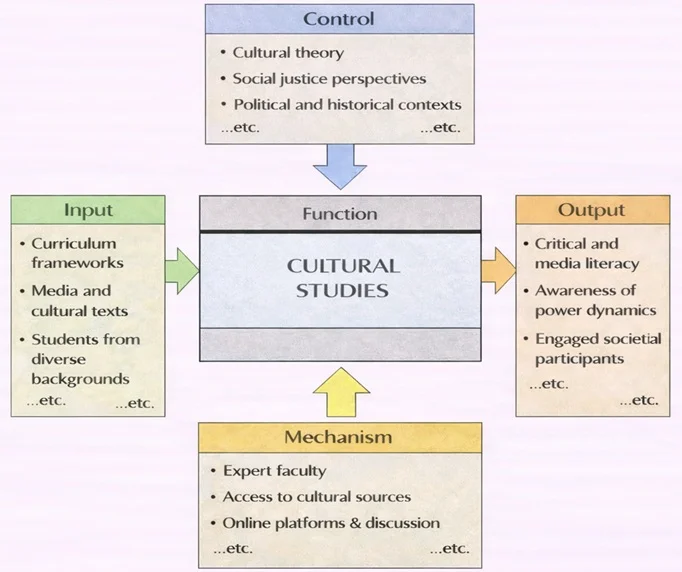
Cultural Studies can be understood as a learning function that turns everyday cultural experience into careful interpretation and informed judgment. The inputs include curriculum frameworks that offer guiding lenses, media and cultural texts that serve as the “evidence” of meaning-making in society, and students from diverse backgrounds who bring different perspectives, questions, and lived realities into the conversation. The process is shaped by controls such as cultural theory, social justice perspectives, and political and historical contexts—because cultural meaning is never floating in empty space; it is formed within histories, institutions, and struggles over whose voices are amplified or silenced. The function is enabled by mechanisms like expert faculty who model critical reading, access to cultural sources that broaden what can be studied, and online platforms and discussion that support dialogue, debate, and collaborative analysis. When these elements work together, the outputs become clear: students develop critical and media literacy, sharpen their awareness of power dynamics in representation and social life, and grow into engaged societal participants who can interpret culture thoughtfully rather than consuming it passively.
Cultural Studies is an interdisciplinary field that examines the social, political, and economic dimensions of culture in shaping human experience. It goes beyond traditional understandings of culture as art and literature, focusing instead on the everyday practices, media, ideologies, and power dynamics that define societies. Emerging in the mid-20th century, Cultural Studies has become a critical framework for analyzing the complex relationships between culture, identity, and power in a globalized world.
Rooted in disciplines like sociology, anthropology, history, and media studies, Cultural Studies addresses how culture influences and is influenced by issues such as class, race, gender, sexuality, and technology. It provides tools to deconstruct dominant narratives, uncover marginalized perspectives, and understand the role of culture in sustaining or challenging social structures. This field is particularly relevant in today’s world, where cultural flows and conflicts are intensified by globalization, digital technology, and social media.
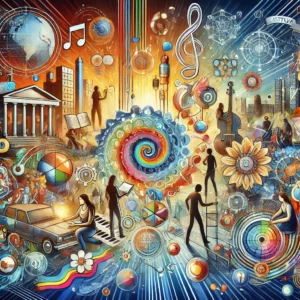
This illustration captures the spirit of cultural studies as an exploration of how people create meaning through art, music, language, media, symbols, traditions, and social practices. The swirling patterns suggest the dynamic flow of ideas across time and cultures, while the surrounding imagery—from books and architecture to technology and performance—reflects the many influences that shape identity and social experience. For students preparing for university, cultural studies encourages critical thinking about how culture shapes beliefs, values, communication, and power in everyday life, helping learners better understand both themselves and the world around them.
Tracing Identity, Power, and Representation Across Disciplines
Explore how Cultural Studies functions as an interdisciplinary nexus connecting media, politics, sociology, and critical philosophy:
Media & Communication
Extends cultural analysis into how ideological messages are produced, circulated, and decoded across digital platforms and mass audiences.
Political Science
Reveals how state narratives, legislative power structures, and political ideologies construct social consensus and civic authority.
Sociology
Provides structural insight into how cultural meanings emerge from group interactions, social class hierarchies, and community networks.
Anthropology
Broadens comparative interpretation by evaluating ethnographic practices, rituals, and human diversity across diverse cultural settings.
Psychology
Connects cultural messaging and media exposure to personal identity formation, cognition, and behavioral motivation.
Literature
Examines how narrative structures, symbolism, and genre conventions reflect and contest societal values and power conflicts.
History
Situates cultural artifacts within temporal contexts, documenting how social meanings evolve across historical epochs.
Religious Studies
Explores sacred texts and ritual frameworks as living cultural traditions that construct moral identity and social solidarity.
Linguistics
Analyzes semiotics, discourse structures, and language patterns that code cultural meaning and social power dynamics.
International Relations
Highlights how cultural soft power, national narratives, and transnational media influence global diplomacy.
Philosophy
Supplies critical theoretical frameworks to challenge normative cultural assumptions, ideology, and ethics.
HSS Overview
Connects Cultural Studies to the overarching Humanities framework, mapping broad disciplinary relationships.
Historical Development of Cultural Studies
Cultural Studies originated in the United Kingdom in the 1960s, with the establishment of the Centre for Contemporary Cultural Studies (CCCS) by Richard Hoggart, Stuart Hall, and others. This school of thought challenged traditional views of culture as elite and unchanging, emphasizing instead the dynamic and contested nature of cultural practices.
- Key Influences:
- Marxism: Analyzed how culture reflects and sustains class structures and capital accumulation.
- Frankfurt School: Explored mass media industries and their role in perpetuating ideological conformity.
- Post-Structuralism: Focused on how meaning is constructed and deconstructed through linguistic discourse.
- Feminist Theory: Highlighted gender as a crucial axis of power in cultural production and interpretation.
Over time, Cultural Studies expanded beyond its British roots, incorporating perspectives from postcolonial theory, critical race theory, and queer studies. It became a global field of inquiry, addressing diverse cultural contexts and social challenges.
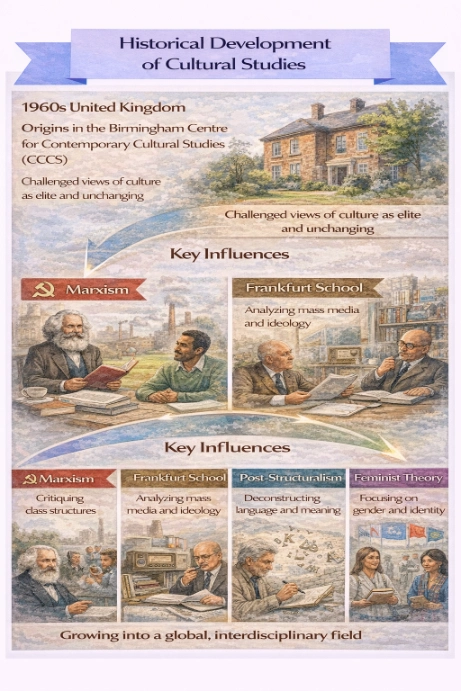
A timeline-style infographic with a UK map and “Founded in 1960s United Kingdom,” highlighting the Birmingham Centre for Contemporary Cultural Studies (CCCS). It then presents four influence panels—Marxism (class/capitalism), Frankfurt School (media/ideology), Post-Structuralism (language/discourse), and Feminist Theory (gender/power)—followed by a “Global Expansion” section with a world map and later frameworks such as postcolonial and critical race perspectives.
Key Themes in Cultural Studies
1. Power and Ideology
- Overview: Cultural Studies examines how power operates through cultural norms, practices, and institutions to shape identities and maintain social hierarchies.
- Key Concepts:
- Hegemony: Coined by Antonio Gramsci, refers to the political and cultural dominance of a ruling group’s worldview accepted as social common sense.
- Ideology: The systematic set of ideas that naturalizes power relations, institutional structures, and social inequalities.
- Applications: Deconstructing advertising and media to reveal underlying commercial ideologies, and analyzing how institutions perpetuate systems of privilege.
2. Identity and Representation
- Overview: This theme explores how culture constructs and represents social identities such as race, gender, sexuality, disability, and economic class.
- Key Questions: Who controls dominant cultural narratives? How are marginalized identities represented or silenced in mainstream media?
- Examples: Examining stereotypical portrayals of minority groups in television, and studying the rise of identity movements in social history.
3. Globalization and Cultural Exchange
- Overview: Cultural Studies investigates the flow of cultural practices, media commodities, and ideas across international borders.
- Key Issues:
- Cultural Imperialism: The imposition of dominant Western cultural norms on local traditions.
- Cultural Hybridization: The creative synthesis of local and global cultural forms to produce novel identities.
- Applications: Understanding the global influence of international cinema and music trends, and analyzing how the internet creates digital diaspora communities.
4. Media and Popular Culture
- Overview: Media and popular culture are central arena in Cultural Studies, reflecting and actively shaping societal values and ideologies.
- Key Questions: How do media narratives construct objective reality? What role do popular culture artifacts play in subverting authority or promoting conformity?
- Examples: Analyzing how superhero media reinforce or challenge traditional gender roles, and studying digital influencers in consumer markets.
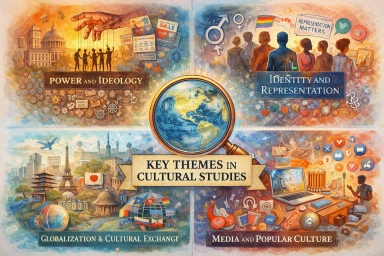
This illustration visually brings together the four core themes of Cultural Studies. At the center, the globe and magnifying glass represent critical inquiry into culture and meaning. Surrounding scenes symbolize power and ideology, identity and representation, globalization and cultural exchange, and media and popular culture. Together, they highlight how culture shapes beliefs, social structures, communication, and everyday life across the world.
Research Methods in Cultural Studies
Cultural Studies employs a variety of qualitative methodologies to analyze cultural artifacts and practices:
Textual Analysis
- Interpreting cultural texts (films, literature, advertising imagery) to decode implicit meanings, semiotics, and ideologies.
Ethnography
- Immersive qualitative research into subcultures and fan communities to understand lived audience experience.
Critical Discourse Analysis
- Examining how linguistic structures, news framing, and rhetoric reproduce institutional power dynamics.
Historical & Archival Analysis
- Tracing how specific cultural symbols, practices, and institutional norms evolve over time.
Applications of Cultural Studies
Education and Curriculum Design
- Developing inclusive curricula that reflect diverse cultural perspectives and foster critical media literacy.
- Encouraging students to question dominant historical narratives.
Media and Communication
- Enhancing media literacy so audiences critically evaluate digital misinformation.
- Informing representative, ethical media production.
Policy and Social Change
- Advocating for institutional policies addressing cultural discrimination and supporting social justice.
- Supporting community-led grassroots resistance movements.
Corporate and Market Research
- Assisting global brands in understanding cultural nuances, audience subcultures, and consumer behavior.
- Designing respectful, culturally aware communication strategies.
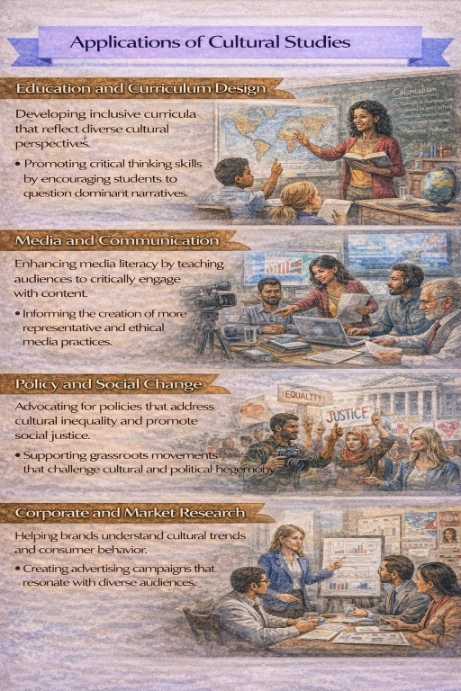
This infographic presents four practical ways cultural studies is used in real life. It highlights (1) education and curriculum design—building inclusive curricula and encouraging critical thinking, (2) media and communication—strengthening media literacy and promoting ethical representation, (3) policy and social change—supporting social justice policies and grassroots movements, and (4) corporate and market research—interpreting cultural trends and consumer behavior to design culturally aware campaigns.
Contemporary Issues in Cultural Studies
Digital Culture & Platformization
- Investigating how algorithmic recommendation engines shape digital identities and online echo chambers.
- Analyzing data privacy inequalities across platform economies.
Cultural Resistance & Counter-Publics
- Studying how marginalized groups use digital media, protest art, and subcultural music to contest state authority.
Postcolonial Perspectives
- Addressing the legacies of imperial power structures in global trade and media representation.
- Foregrounding knowledge frameworks from indigenous and formerly colonized communities.
Environmental Humanities
- Exploring how cultural narratives shape human relationships with ecosystems and climate change mitigation.
Future Directions in Cultural Studies
Interdisciplinary Expansion
- Integrating data science, artificial intelligence ethics, and cognitive science into cultural analysis.
Global South Perspectives
- De-centering Western theoretical models by prioritizing epistemologies from non-Western regions.
Ethical Digital Research
- Establishing strict privacy and consent standards when conducting online qualitative research.
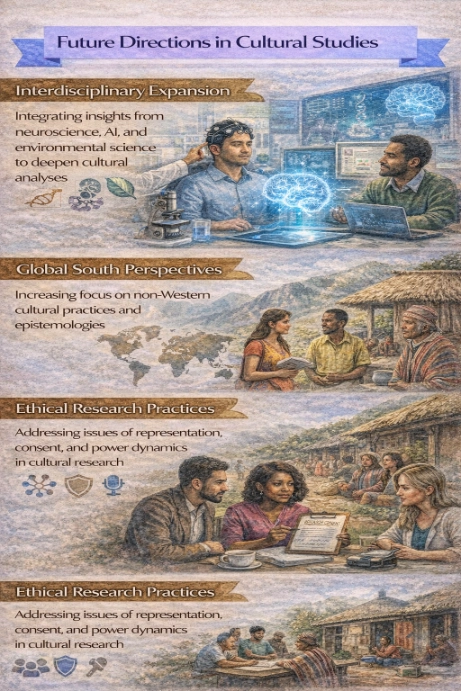
A watercolor-style infographic with a top banner reading “Future Directions in Cultural Studies,” followed by themed panels. It visualizes interdisciplinary expansion through lab and digital imagery (including AI and neuroscience motifs), highlights Global South perspectives through community-based fieldwork and dialogue, and emphasizes ethical research practices with a consent-focused discussion scene and related icons (representation, consent, and power dynamics).
Why Study Cultural Studies
Understanding the Role of Culture in Everyday Life
Cultural studies is an interdisciplinary field that explores how culture shapes our beliefs, behaviors, institutions, and identities. For students preparing for university, studying cultural studies offers a powerful lens through which to understand the everyday meanings embedded in media, language, fashion, rituals, and social practices. It encourages critical reflection on how cultural norms are constructed, challenged, and transformed across time and space.
Exploring Power, Identity, and Representation
Cultural studies examines how issues of race, gender, class, sexuality, nationality, and religion are represented in texts and institutions—and how these representations affect social dynamics. Students learn to question dominant narratives and recognize how power operates within cultural forms. This equips them with the analytical tools to engage thoughtfully with contemporary debates and advocate for equity and inclusion in academic and public discourse.
Linking Theory to Contemporary Social Issues
Cultural studies connects theory to real-world concerns such as globalization, consumer culture, digital media, environmentalism, and social activism. Students investigate how cultural production—whether in literature, music, advertising, or online platforms—reflects and shapes societal values. This relevance to current events makes cultural studies an engaging and dynamic field of study for those entering university.
Developing Critical Thinking, Research, and Communication Skills
Through textual analysis, ethnography, media criticism, and interdisciplinary research, students of cultural studies develop strong skills in critical thinking, argumentation, and writing. These academic tools are valuable for university success and highly transferable to careers in journalism, public relations, policy, education, and the creative industries. The field also nurtures creativity and intellectual curiosity.
Preparing for a Flexible and Engaged Career Path
A background in cultural studies prepares students for a wide range of careers where cultural literacy, social awareness, and critical analysis are important. Graduates may work in media, publishing, education, cultural institutions, non-profits, or community organizations. For students entering university, cultural studies offers an empowering academic journey that encourages them to think deeply, act ethically, and engage meaningfully with the world around them.
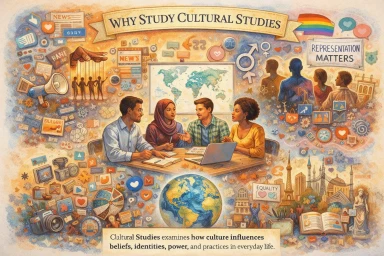
This illustration captures the essence of Cultural Studies as an exploration of how culture shapes beliefs, identities, and social life. The students at the center represent critical inquiry and dialogue, while the surrounding symbols—media, language, global diversity, activism, technology, and representation—reflect the interconnected themes of power, identity, communication, and social change. Together, they convey how Cultural Studies equips learners to think critically about the world and engage thoughtfully with contemporary issues.
Interactive Module: Stuart Hall’s Encoding / Decoding Media Simulator
Simulate how media institutions encode dominant ideological messages into cultural texts and how diverse audiences decode them through preferred, negotiated, or oppositional positions based on socio-economic background.
8 (High Commercial Framing)
5 (Moderate Literacy)
0%
0%
0%
Interactive Topic Exploration & Self-Check
Click on the questions below to test your baseline knowledge of Cultural Studies theories and key thinkers:
How does Antonio Gramsci's concept of cultural hegemony explain social control?
What is the significance of the Birmingham Centre for Contemporary Cultural Studies (CCCS)?
How does semiotics analyze cultural texts according to Roland Barthes?
Is Cultural Studies Right For You?
Explore career pathways, check your fit, and assess your skills — before you commit to a degree.
Cultural Studies: Conclusion
Cultural Studies is an essential field for understanding the complexities of human societies and the ways culture intersects with power, identity, and social change. By challenging dominant narratives and amplifying marginalized voices, it equips us with the tools to navigate and shape a rapidly changing world. As globalization, technology, and cultural exchange continue to transform societies, Cultural Studies will remain a critical lens for analyzing and influencing the cultural landscapes of the future.
Frequently Asked Questions
What is Cultural Studies, and what does it focus on?
Cultural Studies is an interdisciplinary field that examines how culture is produced, circulated, experienced, and contested in everyday life. It looks at texts (such as films, social media, music, and literature), practices (from fashion to fandom), and institutions (like schools, platforms, and media industries) to understand how meaning, identity, and power are organised in contemporary societies.
How is Cultural Studies different from traditional literature or media studies?
While literature and media studies often focus on close reading of texts or genres, Cultural Studies places stronger emphasis on how texts are embedded in social relations, history, and power. A Cultural Studies approach asks: Who produces this text? For whom? Under what economic and political conditions? How do different audiences interpret it? It connects detailed textual analysis with questions of ideology, identity, and inequality.
What key concepts are important in Cultural Studies?
Some core concepts in Cultural Studies include representation, ideology, hegemony, identity, discourse, intersectionality, popular culture, subculture, and resistance. Students learn how these concepts help to analyse racialisation, gender norms, class relations, nationalism, colonial legacies, and the politics of everyday life, from advertising and memes to news reporting and streaming platforms.
What methods do Cultural Studies scholars use?
Cultural Studies combines methods from several disciplines. Common approaches include textual and discourse analysis, audience and reception studies, ethnography of cultural practices, archival research, and critical theory. Students may be asked to analyse a media campaign, conduct small-scale interviews, read theoretical texts, or map how a cultural phenomenon travels across different platforms or countries.
Why is Cultural Studies especially relevant in the digital age?
In the digital age, culture circulates rapidly through social media, streaming services, games, and global brands. Cultural Studies helps you make sense of how algorithms shape visibility, how influencers construct authenticity, how online communities form, and how misinformation spreads. It also asks who controls data and platforms, and how digital culture reproduces or challenges existing inequalities.
How does Cultural Studies prepare me for university-level work?
Cultural Studies trains you to read critically, think theoretically, and write analytically about complex, everyday phenomena. You learn to connect concrete examples to abstract concepts, to interpret contradictory viewpoints, and to build arguments supported by evidence. These skills are valuable for university essays, seminar discussions, project work, and research in many humanities and social science degrees.
What topics might I encounter in a Cultural Studies degree?
Typical topics include popular culture and mass media, race and ethnicity, gender and sexuality, youth cultures and subcultures, postcolonial and decolonial thought, cultural policy and creative industries, digital cultures and platforms, visual culture, and cultural theory. Many programmes also include modules on research methods and independent projects or dissertations.
What careers can Cultural Studies support?
Cultural Studies graduates work in diverse areas, including media and communications, advertising and branding, cultural and creative industries, public relations, journalism, policy and advocacy, education, NGOs, user research, and content strategy. The degree strengthens skills in critical analysis, communication, and cultural literacy, which are increasingly valued in globally connected workplaces.
How does Cultural Studies engage with questions of power and inequality?
Cultural Studies developed partly to understand how power operates through culture, not just through laws or formal politics. It examines how representations shape who is seen as normal or deviant, whose voices are amplified or silenced, and how stereotypes become naturalised. At the same time, it looks at how people reinterpret cultural texts, form subcultures, and use creativity to resist or reimagine social orders.
Is Cultural Studies only about popular culture?
Popular culture is a major focus, but Cultural Studies is not limited to it. The field also investigates high art, religion, education, urban spaces, science and technology, and policy debates. What matters is not whether a cultural form is popular or elite, but how it organises meaning, identity, and power, and how it is experienced by different groups.
How can I use the Cultural Studies page on Prep4Uni.online effectively?
You can use the Cultural Studies page as a starting point to explore key concepts, examples, and links to related topics such as media, communication, sociology, or postcolonial studies. Try turning the guiding questions into short practice essays, or apply the ideas to a film, series, advertisement, or social media trend that you know well. This will help you build a portfolio of reflections for university applications or first-year modules.
Do I need prior background in theory to study Cultural Studies?
No formal background in theory is required at the beginning, but a willingness to engage with abstract ideas is important. Prep4Uni.online materials can help you bridge the gap by introducing key thinkers and concepts gradually, always linking them back to concrete cultural examples. Over time, you will gain confidence in reading theoretical texts and using them in your own analyses.
Comprehensive Cultural Studies Practice Module
Section 1: Foundational Theoretical Questions
- What defines Cultural Studies as an interdisciplinary academic field?
Answer: Cultural Studies is an interdisciplinary field that synthesizes sociology, anthropology, history, literature, and media studies to analyze how cultural texts and everyday practices construct meaning, reinforce ideology, and mediate social power. - How does Cultural Studies critique traditional definitions of 'high' versus 'low' culture?
Answer: Cultural Studies rejects elitist views that restrict culture to fine art and classic literature. It posits that mass media, popular music, subcultures, and everyday practices are equally significant arenas where social values and power relations are contested. - What is Gramsci’s concept of 'cultural hegemony' and how does it operate in democratic societies?
Answer: Cultural hegemony refers to the political and cultural dominance of a ruling group achieved by establishing its worldview as the accepted common sense of society, securing popular consent without relying solely on coercive force. - Explain Stuart Hall’s Encoding/Decoding model of communication.
Answer: Hall’s model posits that media texts are encoded by producers with dominant ideological meanings, but audiences decode them through three distinct positions: Dominant-Hegemonic (full acceptance), Negotiated (partial modification), or Oppositional (total rejection). - What role did the Birmingham Centre for Contemporary Cultural Studies (CCCS) play in developing subcultural theory?
Answer: The CCCS pioneered research demonstrating that youth subcultures (such as punk or mod) use style, fashion, and music as symbolic resistance against class hegemony and post-war socio-economic alienation. - How does Critical Discourse Analysis (CDA) uncover power dynamics in media texts?
Answer: CDA systematically examines grammar, framing, rhetoric, and word choice in texts to reveal how linguistic structures naturalize institutional authority, exclude marginalized voices, and sustain social inequalities. - What is the difference between cultural imperialism and cultural hybridization?
Answer: Cultural imperialism refers to the aggressive imposition of dominant Western cultural commodities on foreign markets, whereas cultural hybridization describes the creative blending of global and local practices to form new subcultural expressions. - How does postcolonial theory contribute to decolonizing Cultural Studies curricula?
Answer: Postcolonial theory dismantles Eurocentric biases by analyzing how colonial power structures persist in modern media, while amplifying non-Western perspectives and indigenous knowledge systems. - How does environmental humanities intersect with Cultural Studies?
Answer: Environmental humanities explores how cultural stories, media representations, and economic values construct human perceptions of nature, climate crisis, and ecological justice. - In what ways do algorithmic recommendation systems affect digital culture?
Answer: Algorithms curate media streams based on engagement data, creating filter bubbles, amplifying polarized content, and controlling visibility within platform capital economies.
Section 2: Analytical & Scenario-Based Inquiry
- How might digital transformation and AI content creation reshape traditional textual analysis methodologies?
Answer: AI content generation democratizes media creation while introducing algorithmic bias at scale. Scholars must expand textual analysis beyond human authorship to critique machine-learning dataset biases, automated moderation algorithms, and synthetic deepfake media representation. - Analyze how social media platforms function as contemporary public spheres for political advocacy and surveillance.
Answer: Social media allows grass-roots counter-publics to organize global activism rapidly, but simultaneously subjects participants to commercial data harvesting, state surveillance, and algorithmic suppression. - Evaluate the tension between corporate commodification and authentic subcultural resistance in streetwear marketing.
Answer: Streetwear originated as subcultural expression against mainstream norms, but multinational corporations co-opted its symbols into luxury commodities—demonstrating how capital absorbs oppositional culture into profitable consumer markets. - How do postcolonial perspectives challenge Western human rights frameworks in international cultural policy?
Answer: Postcolonial critique argues that Western frameworks often universalize liberal individualism, neglecting collective community rights, indigenous sovereignty, and local historical contexts. - Analyze how algorithms reinforce racial and gender biases in automated facial recognition systems.
Answer: Automated systems trained on unrepresentative historical datasets misidentify dark-skinned individuals at higher rates, proving that technical infrastructure encodes existing societal inequalities. - In what ways does greenwashing in advertising serve as an ideological apparatus for corporate sustainability campaigns?
Answer: Greenwashing uses visual codes of nature to construct a myth of ecological responsibility, neutralizing consumer anxiety while allowing fossil-fuel-dependent industries to avoid structural policy regulation. - Deconstruct the cultural myth of the 'self-made digital influencer' using Marxist commodity fetishism.
Answer: Influencer culture frames success as individual authenticity, concealing the hidden labor, platform exploitation, paid sponsorships, and economic capital required to maintain audience metrics. - How does online fandom culture perform negotiated decodings of mainstream film franchises?
Answer: Fans accept general franchise narrative universes but rewrite marginalized character arcs through fan-fiction, asserting creative ownership over dominant corporate intellectual property. - Assess the role of memory work and museum curation in contesting official state historical narratives.
Answer: Counter-curation introduces oral histories, colonial artifacts, and subaltern testimonies that directly challenge state-sponsored nationalistic mythologies. - Analyze how digital access divides reproduce socio-economic class stratification in online higher education.
Answer: Disparities in high-speed hardware, quiet study environments, and bandwidth access restrict lower-income students' ability to participate fully in digital learning spaces.
Section 3: Applied Quantitative & Empirical Research Exercises
- In an audience reception study of 800 television viewers, 360 viewers decoded a news broadcast using a Dominant-Hegemonic reading, 280 used a Negotiated reading, and 160 used an Oppositional reading. Calculate the percentage distribution for all three decoding positions.
Answer:Dominant-Hegemonic = (360 / 800) × 100 = 45.0%
Negotiated = (280 / 800) × 100 = 35.0%
Oppositional = (160 / 800) × 100 = 20.0%
Distribution: Dominant = 45%; Negotiated = 35%; Oppositional = 20%. - A media research grant of $300,000 is allocated between Digital Text Mining (D), Audience Focus Groups (F), and Archival Analysis (A) in a 4 : 3 : 1 ratio. Calculate the exact dollar allocation for each component.
Answer:Total Ratio Parts = 4 + 3 + 1 = 8 parts.
Value per part = $300,000 / 8 = $37,500.
Digital Text Mining (D) = 4 × $37,500 = $150,000.
Audience Focus Groups (F) = 3 × $37,500 = $112,500.
Archival Analysis (A) = 1 × $37,500 = $37,500.
Allocations: Text Mining = $150,000; Focus Groups = $112,500; Archival Analysis = $37,500. - A quantitative content analysis of 1,200 advertisement images records gender representation. Male figures are featured in 720 ads, while female figures appear in 480 ads. Compute the sample proportion of female representation (p) and calculate the 95% confidence interval margin of error (±1.96).
Answer:Sample Proportion (p) = 480 / 1200 = 0.40 (40%)
Standard Error (SE) = √[ p(1 - p) / N ] = √[ (0.40 × 0.60) / 1200 ] = √[ 0.24 / 1200 ] = √[ 0.0002 ] ≈ 0.01414
Margin of Error (ME) at 95% = 1.96 × 0.01414 ≈ 0.0277 (or 2.77%)
Confidence Interval: 40% ± 2.77% (37.23% to 42.77%). - An online cultural platform tracks user interactions over 5 months: Month 1 = 1,200, Month 2 = 1,800, Month 3 = 2,700, Month 4 = 4,050. Determine if growth is exponential by calculating the constant common ratio (r), and project Month 5 interaction volume.
Answer:Ratio M2 / M1 = 1800 / 1200 = 1.50
Ratio M3 / M2 = 2700 / 1800 = 1.50
Ratio M4 / M3 = 4050 / 2700 = 1.50
Constant common ratio r = 1.50 confirms exponential growth.
Projected Month 5 Volume = 4,050 × 1.50 = 6,075 interactions.
Result: Exponential Growth with r = 1.50; Month 5 = 6,075. - A sociolinguistic survey scores audience engagement on a scale of 0 to 100 across 5 cultural workshops: 68, 74, 82, 88, 93. Calculate the sample mean (μ) and standard deviation (s).
Answer:Sample Mean (μ) = (68 + 74 + 82 + 88 + 93) / 5 = 405 / 5 = 81.0 points.Sum of Squared Deviations:
(68 - 81)2 = 169
(74 - 81)2 = 49
(82 - 81)2 = 1
(88 - 81)2 = 49
(93 - 81)2 = 144
Sum = 169 + 49 + 1 + 49 + 144 = 412Sample Variance (s2) = 412 / (5 - 1) = 412 / 4 = 103.0
Standard Deviation (s) = √(103.0) ≈ 10.15 points.
Result: Mean = 81.0; Standard Deviation = 10.15. - A platform algorithmic visibility metric (V) depends on posting frequency (x posts/week): V(x) = -1.2x2 + 24x + 10. Find the optimal posting frequency that maximizes platform visibility.
Answer:Quadratic function with a = -1.2, b = 24.
Maximum vertex occurs at x = -b / (2a):
x = -24 / [ 2 × (-1.2) ] = -24 / (-2.4) = 10 posts per week.
Maximum Visibility Score = -1.2(10)2 + 24(10) + 10 = -120 + 240 + 10 = 130 points.
Optimal Frequency: 10 posts/week yields a maximum visibility score of 130.