Prepare for University Studies & Career Advancement
Literature
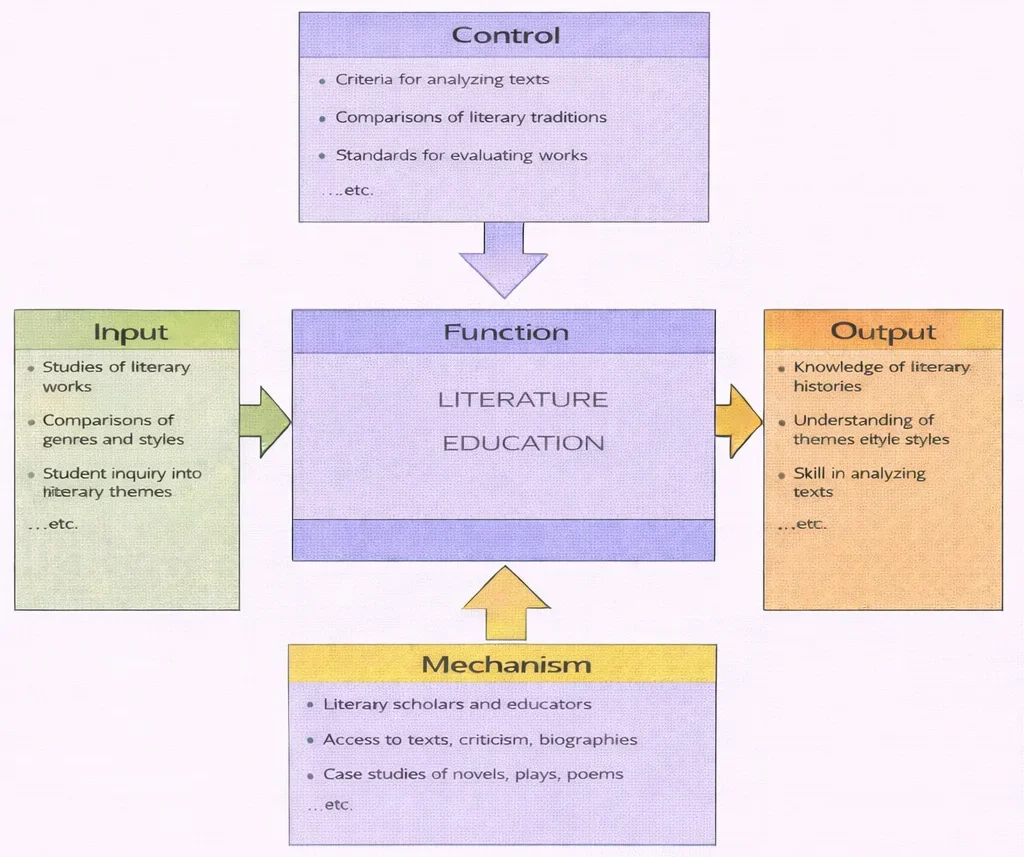
Literature Education, as shown here, is the process of turning encounters with poems, plays, and novels into disciplined understanding. Students begin with works, genres, and thematic questions as their raw material (inputs), but they do not read in a vacuum: their reading is guided by shared criteria, traditions of interpretation, and standards for judging arguments and evidence (controls). The work becomes possible and richer through the supports of educators, scholarship, and access to reliable texts and critical resources (mechanisms). When these pieces come together, learners move beyond “liking” or “disliking” a text and instead gain historical perspective, clearer insight into theme and style, and the transferable ability to analyze language and meaning with care (outputs).
IDEF0 view of Literature Education (Input–Control–Output–Mechanism): how students’ engagement with works, genres, and themes is guided by analytical standards and supported by scholarly resources to produce literary understanding and critical reading skills.
Literature, as both a reflection and critique of human experience, provides a unique gateway into the heart of the humanities and social sciences. Through the study of prose, poetry, and drama, students examine how language shapes identity, history, and meaning across cultures and time. Literature often intersects with philosophy by probing into the nature of truth, morality, and existence, while also drawing from psychology to explore emotion, motivation, and the human condition.
A literary lens can help interpret the societal frameworks analyzed in sociology, where narratives serve as microcosms of class, race, gender, and power relations. Themes found in fiction often mirror real-world dynamics studied in political science, reflecting political ideologies, resistance, and reform. Likewise, spiritual themes and religious symbolism tie literature closely to religious studies, enabling a deeper appreciation of rituals, mythologies, and worldviews.
In the global context, literature reveals the cultural dimensions of diplomacy and conflict, aligning with studies in international relations. Stories are cultural artifacts that contribute to the collective imagination of a people, paralleling the kind of analysis used in evaluating internet and web technologies for digital storytelling and social discourse. Literature also becomes increasingly relevant in an age defined by emerging technologies and information technology, as authors imagine futures shaped by AI, automation, and ethical dilemmas.
Explorations of speculative fiction intersect with studies in robotics and autonomous systems and cybersecurity, while dystopian narratives probe into surveillance and control. Data-driven analysis of literary corpora links with data science and analytics and reflects growing interest in computational literary studies. Meanwhile, the mathematical underpinnings of meter, structure, and logic create intersections with mathematics and statistics.
Literature also dialogues with disciplines concerned with the built and natural environment. As narratives increasingly address ecological concerns and urban futures, students can find common ground with topics like environmental engineering and green building. The implications of climate change and disaster are themes also explored in earthquake and disaster engineering. Urban life, infrastructure, and planning often serve as rich narrative backdrops, tying literature to urban and regional planning.
From the speculative to the historical, literature helps illuminate the human impact of technologies like satellite technology and smart technologies. It can even help narrate industrial transitions, as reflected in smart manufacturing and renewable energy. In all these dimensions, literature remains a dynamic and resonant means of understanding humanity’s journey—its hopes, its fears, and its enduring questions.
Literature—where stories, voices, and ideas travel across time, shaping how we imagine ourselves and the world.
This richly illustrated image presents literature as a source of imagination and cultural memory. At the center, an open book radiates light, with flowing, flame-like ribbons of color rising upward to suggest creativity, narrative energy, and the power of words. Around the book are portraits of writers and thinkers, theatrical masks, classical columns, and artistic icons, representing different genres and traditions—poetry, drama, fiction, and literary criticism. The dense collage-like composition conveys how literature connects many forms of human experience: emotion, history, philosophy, and social life, all woven together through language and storytelling.
Stories that Shape Us: Literature, Meaning, and Human Experience
Literature explores the human condition through stories, poetry, and drama. Across cultures and time, it reflects emotions, values, conflicts, and aspirations. Studying literature allows us to interpret meaning, understand diverse perspectives, and engage with the deeper questions of identity, society, and existence.
Anthropology
— Study human societies and cultures that shape storytelling traditions.
Cultural Studies
— Examine how literature reflects and influences cultural identity and media.
History
— Understand the historical contexts that shape literary works and themes.
Literature — Explore narratives that reveal human experiences, imagination, and meaning.
Philosophy
— Analyse ideas about truth, ethics, and existence expressed through literary works.
Political Science
— Examine how literature engages with power, governance, and social issues.
International Relations
— Explore how literature reflects global perspectives and cross-cultural interactions.
Psychology
— Understand characters, emotions, and human behaviour through narrative.
Religious Studies
— Examine how belief systems and spirituality are expressed in literature.
Sociology
— Analyse how literature reflects social structures, norms, and inequalities.
Linguistics
— Study language, style, and meaning in literary expression.
Table of Contents
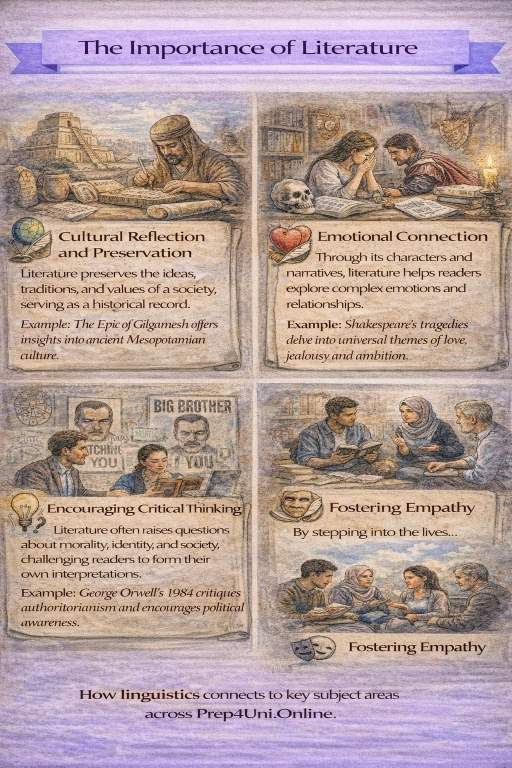
The Importance of Literature
Cultural Reflection and Preservation
Literature preserves the ideas, traditions, and values of a society, serving as a historical record.
Example: The Epic of Gilgamesh offers insights into ancient Mesopotamian culture.
Emotional Connection
Through its characters and narratives, literature helps readers explore complex emotions and relationships.
Example: Shakespeare’s tragedies delve into universal themes of love, jealousy, and ambition.
Encouraging Critical Thinking
Literature often raises questions about morality, identity, and society, challenging readers to form their own interpretations.
Example: George Orwell’s 1984 critiques authoritarianism and encourages political awareness.
Fostering Empathy
By stepping into the lives of characters, readers gain a deeper understanding of perspectives different from their own.
Stories make abstract struggles personal, helping readers feel the weight of choices, hopes, fears, and everyday dilemmas.
Example: Harper Lee’s To Kill a Mockingbird invites readers to see injustice through a child’s eyes, strengthening moral awareness and compassion.The importance of literature—preserving culture, deepening emotion, sharpening critical thought, and building empathy.A four-panel infographic that summarises why literature matters. It portrays (1) cultural reflection and preservation through an ancient writer and historical setting (e.g., The Epic of Gilgamesh), (2) emotional connection through intimate reading and conversation (e.g., Shakespearean tragedy), (3) encouraging critical thinking through themes of power and morality (e.g., Orwell’s 1984), and (4) fostering empathy through a diverse group exchanging perspectives and experiences.
Forms of Literature
Poetry
Definition: A condensed form of literature that uses rhythm, imagery, and metaphor to evoke emotions and ideas.
Forms:
Lyric Poetry: Expresses personal emotions (e.g., Emily Dickinson’s works).
Epic Poetry: Narrates grand tales of heroism (e.g., Homer’s The Iliad).
Haiku: A short Japanese form focusing on nature and brevity.
Impact:
Poetry captures the beauty of language and offers insights into the human spirit.
Prose
Definition: Written or spoken language in its ordinary form, encompassing novels, short stories, and essays.
Genres:
Realistic Fiction: Reflects real-life situations (e.g., Jane Austen’s Pride and Prejudice).
Science Fiction: Explores futuristic and speculative themes (e.g., Isaac Asimov’s Foundation).
Non-Fiction: Includes memoirs, biographies, and essays (e.g., Anne Frank’s The Diary of a Young Girl).
Drama
Definition: Literature written for performance, involving dialogue and action to tell a story.
Forms:
Tragedy: Deals with themes of human suffering (e.g., Sophocles’ Oedipus Rex).
Comedy: Focuses on humor and satire (e.g., Molière’s Tartuffe).
Impact:
Drama combines literary artistry with visual performance to engage audiences.
Non-Fiction
Definition: Factual literature that educates, informs, or persuades.
Examples:
Philosophical works like Plato’s The Republic.
Historical accounts like Herodotus’ Histories.
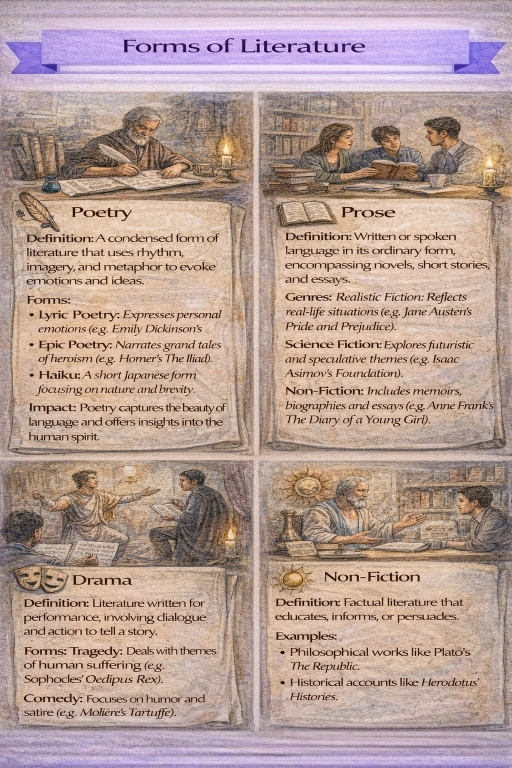
Forms of Literature: a visual overview of poetry, prose, drama, and non-fiction, with key features and examples.
This infographic presents four major literary forms in a 2×2 layout. Each section uses a painted scene (a writer with quill for Poetry, readers in discussion for Prose, actors on stage for Drama, and scholars in debate for Non-Fiction) paired with parchment-like text blocks. The panels outline what each form is, highlight common subtypes (e.g., lyric/epic/haiku for poetry; tragedy/comedy for drama), and include well-known examples such as The Iliad, Pride and Prejudice, Oedipus Rex, and The Republic, helping students compare how different forms express ideas and shape readers’ understanding.
Themes in Literature
Love and Relationships
Examples:
Romeo and Juliet by Shakespeare explores the complexities of romantic love.
Wuthering Heights by Emily Brontë examines passion and revenge.
Identity and Self-Discovery
Examples:
James Baldwin’s Giovanni’s Room addresses themes of sexual identity and societal expectations.
Chinua Achebe’s Things Fall Apart explores cultural identity amidst colonial disruption.
Social and Political Critique
Examples:
Charles Dickens’ Oliver Twist highlights class struggles in Victorian England.
Margaret Atwood’s The Handmaid’s Tale critiques gender oppression and authoritarianism.
The Human Condition
Examples:
Franz Kafka’s The Metamorphosis delves into themes of alienation and existential angst.
Albert Camus’ The Stranger explores absurdism and meaning in life.
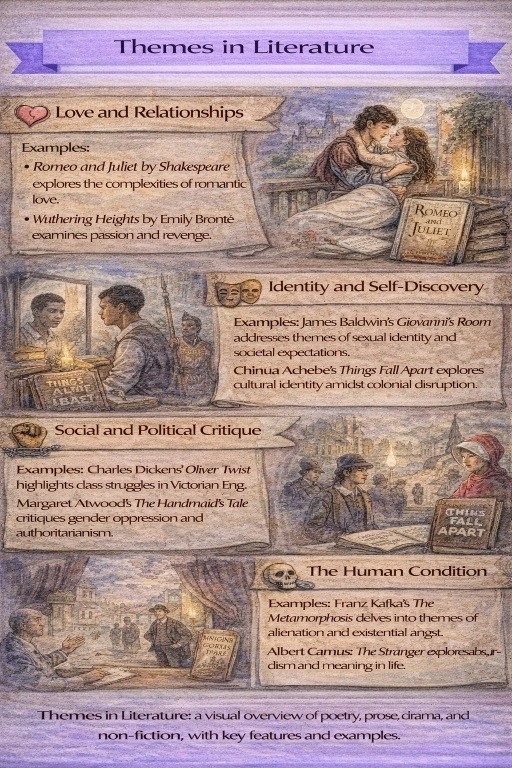
Themes in Literature: four major themes with classic examples, shown in a soft watercolor infographic.
A hand-painted, parchment-style infographic headed “Themes in Literature.” It is divided into four illustrated sections: Love and Relationships (with Romeo and Juliet and Wuthering Heights), Identity and Self-Discovery (with James Baldwin’s Giovanni’s Room and Chinua Achebe’s Things Fall Apart), Social and Political Critique (with Charles Dickens’ Oliver Twist and Margaret Atwood’s The Handmaid’s Tale), and The Human Condition (with Franz Kafka’s The Metamorphosis and Albert Camus’ The Stranger). Each section includes a small icon (heart, theatre masks, raised fist/chain motif, and skull) and a matching scene (readers, city or historical backdrops, and book stacks) to visually reinforce the theme.
Historical Periods of Literature
Classical Literature
Encompasses works from ancient Greece and Rome, emphasizing epic poetry, drama, and philosophy.
Key Figures: Homer, Virgil, Sophocles, Plato.
Medieval Literature
Reflects religious and chivalric themes, with notable works like Dante’s Divine Comedy and Geoffrey Chaucer’s The Canterbury Tales.
Renaissance Literature
Marked by humanism, exploration, and innovation in form and content.
Key Figures: William Shakespeare, Miguel de Cervantes, Christopher Marlowe.
Enlightenment and Romanticism
The Enlightenment emphasized reason and progress (e.g., Voltaire), while Romanticism celebrated emotion and nature (e.g., Wordsworth, Keats).
Modern and Postmodern Literature
Modernism broke traditional conventions (e.g., James Joyce’s Ulysses), while Postmodernism questioned narrative structures and reality (e.g., Thomas Pynchon’s Gravity’s Rainbow).
Contemporary Literature
Contemporary literature reflects diverse voices and global issues, often addressing themes of identity, technology, and social justice.
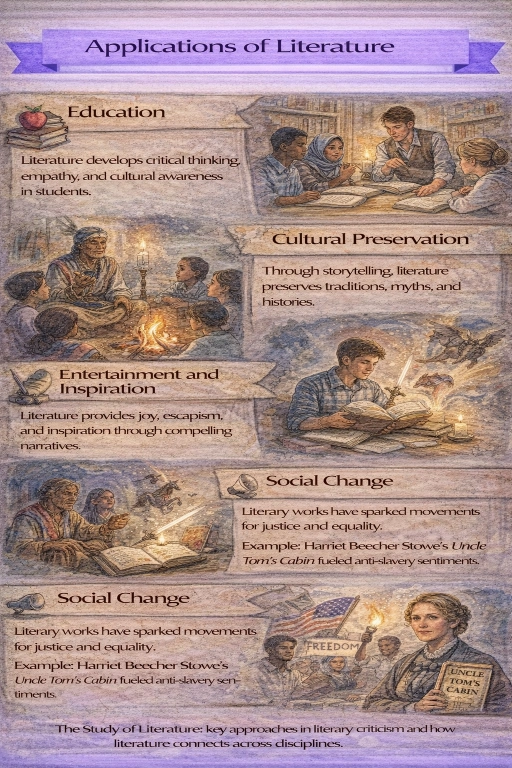
Applications of Literature—how stories educate, preserve culture, inspire, and drive social change.
A hand-painted, textured infographic with a purple title ribbon reading “Applications of Literature.” Four main illustrated panels explain: Education (students learning together with books), Cultural Preservation (an elder telling stories to children by fire/candlelight), Entertainment and Inspiration (a reader illuminated by candlelight with imaginative figures in the background), and Social Change (activism imagery and a portrait-like figure holding a book labeled Uncle Tom’s Cabin, paired with text about justice and equality). The “Social Change” section appears twice, and there is a small footer line referencing “The Study of Literature.”
Challenges in Literature
Translation and Interpretation
Translating literature across languages can alter its nuances.
Censorship
Literary works are often banned for challenging social or political norms.
Relevance in a Digital Age
Ensuring literature remains relevant in a world dominated by digital media.
Why Study Literature
Understanding Human Experience Across Time and Cultures
Literature captures the thoughts, emotions, and experiences of individuals and societies across different historical periods and cultural contexts. For students preparing for university, studying literature provides a powerful means of understanding how people have expressed love, fear, injustice, hope, and identity through stories, poems, plays, and novels. It bridges the personal and the universal, helping learners make sense of both the world around them and their own inner lives.
Exploring Language, Imagination, and Creativity
Literature challenges students to appreciate the richness and complexity of language. Through careful reading and analysis, students encounter metaphor, symbolism, irony, narrative structure, and rhythm. These literary tools not only enhance aesthetic appreciation but also stimulate imagination, critical interpretation, and creative expression—skills that are essential in both academic and personal development.
Analyzing Social, Political, and Ethical Themes
Many literary works reflect and critique the social and political conditions of their time. Students learn how authors address themes such as power, gender, race, colonialism, class, and morality through fiction and poetry. This encourages reflection on current issues and promotes informed discussions about justice, identity, and human rights. Literature becomes a space to question the world and explore alternative perspectives.
Recognizing Diverse Voices and Cultural Narratives
Literature introduces students to voices from across the globe, allowing them to encounter unfamiliar cultures, traditions, and worldviews. Whether reading Shakespeare, Tagore, Achebe, Morrison, or Murakami, students develop a broader understanding of human diversity and a deeper empathy for others. This global perspective is especially important in today’s interconnected world.
Preparing for Academic Excellence and Lifelong Learning
A foundation in literature supports further study in English, comparative literature, philosophy, history, cultural studies, and education. It builds advanced reading comprehension, analytical writing, and interpretive thinking—skills that are vital across academic disciplines and professional careers. For university-bound learners, literature offers not just academic enrichment but also personal growth, inspiring a lifelong love of reading and learning.
Literature: Conclusion
Literature is an enduring art form that captures the depth and breadth of human experience. From ancient epics to contemporary novels, it reflects our struggles, dreams, and realities. The study of literature enriches our understanding of ourselves and the world, fostering creativity, empathy, and critical thought. As we continue to tell stories, literature will remain a vital force in shaping cultures, inspiring change, and connecting generations.