

This colorful image depicts a TESOL learning community with students from varied backgrounds gathered in a classroom-like setting. A teacher stands near a globe and classroom materials, suggesting global communication and language as a bridge across cultures. Around the scene are multiple “English” labels and flags (including the UK and other countries), symbolizing multilingual learners and international contexts. Books, notebooks, and a globe in the foreground emphasize literacy and practical language use, while the friendly group interactions highlight confidence-building, inclusion, and the social nature of learning English.
Connecting Global Learners Across Educational Dimensions
Language education functions as a dynamic system connecting individuals, institutions, and cultures. The pathways below demonstrate how different educational domains contribute to seamless language transfer, pedagogical innovation, and institutional success across global environments.
Focus of TESOL
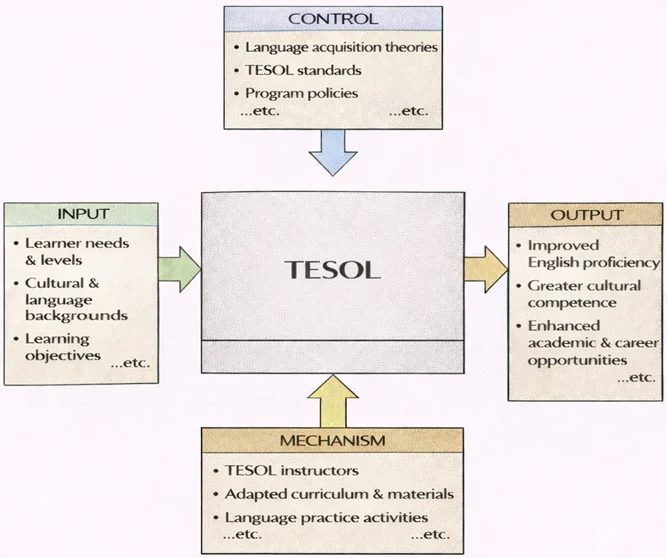
TESOL focuses on equipping learners with the ability to understand, speak, read, and write in English, while also navigating cultural differences and addressing unique learner needs. The discipline emphasizes:
- Language Mastery: Teaching the four core skills—listening, speaking, reading, and writing.
- Cultural Competence: Helping learners understand and adapt to cultural nuances in English-speaking environments.
- Pedagogical Strategies: Employing innovative methods to enhance language acquisition and learner engagement.
TESOL also prioritizes inclusivity, tailoring instruction to meet the diverse linguistic and cultural backgrounds of learners. It seeks to create a supportive and adaptive learning environment that empowers students to achieve their personal, academic, and professional goals.
Key Areas in TESOL
1. Language Acquisition
- Definition: Understanding how individuals learn a new language, including the cognitive, emotional, and social processes involved.
- Key Concepts:
- Second Language Acquisition (SLA): Theories explaining how non-native speakers acquire English.
- Input Hypothesis: The importance of comprehensible input in language learning.
- Affective Factors: How motivation, anxiety, and confidence influence learning outcomes.
- Applications:
- Adapting teaching methods to accommodate learners at different proficiency levels.
- Creating immersive environments that encourage natural language use.
- Examples:
- Using storytelling to provide context-rich language input.
- Designing interactive activities that promote both fluency and accuracy.
2. Cross-Cultural Communication
- Definition: Navigating the cultural dynamics that influence communication and classroom interactions.
- Key Challenges:
- Addressing cultural barriers that affect participation and understanding.
- Recognizing the role of nonverbal communication, such as gestures and body language.
- Strategies for Educators:
- Integrating cultural awareness into lesson plans.
- Encouraging learners to share their cultural perspectives to enrich discussions.
- Examples:
- Teaching idioms and expressions that reflect cultural norms.
- Discussing cultural differences in social etiquette to enhance real-world communication skills.
3. Assessment and Evaluation
- Definition: Measuring learners’ language proficiency and progress using formative and summative tools.
- Key Components:
- Placement Tests: Determining appropriate entry levels for new learners.
- Diagnostic Assessments: Identifying strengths and areas for improvement.
- Proficiency Exams: Standardized tests like IELTS, TOEFL, and Cambridge English.
- Applications:
- Designing rubrics to evaluate speaking and writing skills.
- Using self-assessment tools to encourage learner autonomy.
- Examples:
- Conducting oral interviews to assess conversational abilities.
- Administering reading comprehension quizzes to monitor progress.
Interactive TESOL Tool: Readability & Vocabulary Profile Estimator
Analyze text complexity using standard L2 readability indicators (Type-Token Ratio and Vocabulary Density) to adapt reading materials for second-language learners.
L2 Text Complexity & CEFR Scaffolding Calculator
Lexical Analysis Output
Applications of TESOL
1. Training Educators for ESL and EFL Classrooms
- Overview: TESOL prepares teachers to work in diverse educational settings, including ESL (English as a Second Language) and EFL (English as a Foreign Language) contexts.
- Key Areas of Teacher Training:
- Classroom management strategies for multilingual groups.
- Techniques for integrating technology, such as language learning apps and online platforms.
- Examples:
- Training teachers to use task-based learning for real-world language application.
- Conducting workshops on incorporating cultural materials into lessons.
2. Supporting International Students and Immigrant Communities
- Overview: TESOL educators play a critical role in helping non-native speakers adapt to English-speaking environments.
- Strategies:
- Providing language support for academic and workplace success.
- Offering cultural orientation programs to ease transitions.
- Examples:
- Running English conversation clubs for immigrant families.
- Assisting international students with academic writing for university assignments.
3. Developing Customized Language Programs
- Overview: TESOL practitioners design tailored programs to meet the needs of specific groups, such as business professionals or refugees.
- Applications:
- Creating English for Specific Purposes (ESP) courses, such as medical or legal English.
- Offering intensive language boot camps for rapid skill development.
- Examples:
- Designing a curriculum for healthcare workers to improve patient communication.
- Conducting workshops on professional email etiquette for business executives.
Emerging Trends in TESOL
Integration of Technology
- Overview: Digital tools and platforms are transforming TESOL by enhancing engagement and accessibility.
- Examples:
- Language learning apps like Duolingo and Rosetta Stone.
- Virtual reality environments for immersive language practice.
Focus on Multilingualism
- Overview: Emphasizing the benefits of maintaining native languages alongside English proficiency.
- Examples:
- Bilingual education programs that celebrate linguistic diversity.
- Teaching strategies that leverage learners’ first languages as assets.
Task-Based and Project-Based Learning
- Overview: Shifting from traditional grammar instruction to real-world language use through tasks and projects.
- Examples:
- Assigning group projects that simulate workplace scenarios.
- Organizing community engagement activities, such as volunteering in English-speaking settings.
Focus on Social-Emotional Learning (SEL)
- Overview: Incorporating emotional intelligence and interpersonal skills into language teaching.
- Examples:
- Teaching conflict resolution strategies in cross-cultural contexts.
- Building student confidence through supportive feedback.
Challenges in TESOL
Addressing Diverse Learner Needs
- Adapting teaching methods to accommodate varied proficiency levels, learning styles, and cultural backgrounds.
Overcoming Language Anxiety
- Building confidence in learners who fear making mistakes or speaking publicly.
Access to Resources
- Ensuring equitable access to high-quality materials and technology, especially in underfunded programs.
Balancing Language Proficiency with Cultural Fluency
- Teaching language skills while fostering cultural understanding and respect.
Future Directions in TESOL
Global Collaboration
- Expanding partnerships between countries to share best practices and resources in language teaching.
Personalized Learning
- Using AI and data analytics to create customized learning paths for individual students.
Focus on Lifelong Learning
- Supporting adult learners and professionals seeking to improve their English skills for personal or career growth.
Sustainability and Equity
- Promoting sustainable teaching practices and ensuring equal opportunities for marginalized communities.
Why Study Teaching English to Speakers of Other Languages (TESOL)
Understanding the Global Importance of English Language Education
Exploring Language Acquisition and Instructional Methods
Promoting Cross-Cultural Understanding and Empathy
Building Practical Communication and Classroom Management Skills
Preparing for a Versatile and Rewarding International Career
Conclusion on TESOL
TESOL is a vital field that empowers individuals by providing them with the linguistic and cultural tools to succeed in an interconnected world. By focusing on language acquisition, cultural competence, and effective assessment, TESOL addresses the unique challenges faced by non-native English speakers. Its applications in education, community support, and professional development highlight its far-reaching impact. As the demand for English language instruction continues to grow, TESOL will play an increasingly important role in bridging cultures, fostering communication, and shaping global opportunities.
Is TESOL Right For You?
Explore career pathways, check your fit, and assess your skills — before you commit to a degree.
Frequently Asked Questions – TESOL (Teaching English to Speakers of Other Languages)
What does TESOL mean in simple terms?
TESOL stands for Teaching English to Speakers of Other Languages. It refers to teaching English to learners whose first language is not English, in either English-speaking countries or non-English-speaking contexts.
How is TESOL different from TEFL and ESL?
TESOL is an umbrella term for teaching English to non-native speakers in any context. TEFL usually refers to Teaching English as a Foreign Language in non-English-speaking countries, while ESL typically refers to English as a Second Language in English-dominant countries. In practice, the terms often overlap, and many programmes use TESOL to cover them all.
What does a TESOL teacher do?
A TESOL teacher helps learners develop their English listening, speaking, reading, and writing skills. They plan lessons, select and adapt materials, teach grammar and vocabulary in context, give feedback on communication, and create opportunities for students to use English for real-world purposes such as study, work, or travel.
Where can TESOL teachers work?
TESOL teachers can work in language centres, schools, colleges, universities, community programmes, corporate training, online platforms, and international schools. They may teach in English-speaking countries to recent migrants or international students, or overseas in public schools, private institutes, and universities.
What skills are important for future TESOL teachers?
Important skills include clear communication, patience, intercultural sensitivity, and the ability to explain language in simple, accurate ways. TESOL teachers also benefit from strong planning and classroom-management skills, creativity in designing activities, and a reflective mindset for improving their teaching over time.
Which school subjects help prepare for studying TESOL at university?
Useful subjects include English language and literature, linguistics if available, foreign languages, and any subject that develops communication, analysis, and cultural understanding. Experience with drama, debate, or peer tutoring can also be helpful for building confidence in speaking and leading groups.
What do TESOL degree or certificate programmes usually cover?
TESOL programmes typically cover English grammar and pronunciation, second language acquisition, teaching methodology, lesson planning, classroom management, assessment, and sometimes curriculum design and educational technology. Many include observed teaching practice so that students can apply theory in real classrooms.
What is second language acquisition and why is it important in TESOL?
Second language acquisition is the study of how people learn an additional language after their first language. Understanding how learners notice patterns, make errors, build vocabulary, and develop fluency helps TESOL teachers choose techniques that support natural language growth rather than just memorisation of rules.
How does culture affect TESOL teaching and learning?
Culture influences how learners participate in class, how they view teachers and authority, what topics feel comfortable, and how they use language in everyday life. TESOL teachers need to be aware of cultural differences, avoid stereotypes, and design lessons that respect learners’ identities while introducing them to new ways of communicating in English.
How is technology used in TESOL?
Technology in TESOL includes learning management systems, video-conferencing for online classes, language learning apps, digital dictionaries and corpora, videos, interactive exercises, and tools for recording and sharing speech or writing. These tools can support practice, feedback, and exposure to authentic English, especially when learners have limited contact with native speakers.
What career paths are open to someone with TESOL training?
TESOL training can lead to roles such as language school teacher, school or university English instructor, curriculum or materials writer, academic skills tutor for international students, teacher-trainer, language assessment specialist, or educational consultant. Some TESOL professionals also work in publishing or edtech focused on language learning.
How does the TESOL page on Prep4Uni.online support my study and career planning?
The TESOL page on Prep4Uni.online introduces key ideas about teaching English to speakers of other languages, from language skills and teaching methods to intercultural communication and technology use. It helps you understand what TESOL study involves, how it connects with linguistics and education, and what kinds of careers and international opportunities it can open.
TESOL: Comprehensive Practice Module
Section 1: Core Concept Review Questions
-
What is TESOL and why is it important?
Answer: TESOL stands for Teaching English to Speakers of Other Languages, a field dedicated to educating non-native English speakers. It is important because it facilitates cross-cultural communication and opens up opportunities in global education and employment. TESOL integrates linguistic theory, pedagogy, and practical classroom strategies to improve language acquisition. Moreover, it plays a vital role in empowering learners to succeed in an increasingly interconnected world. -
What are the core principles of TESOL?
Answer: The core principles of TESOL include communicative competence, learner-centered instruction, and cultural sensitivity. These principles ensure that teaching methods focus on real-life communication and practical language use rather than just grammar and vocabulary. TESOL emphasizes the importance of engaging learners through interactive activities and meaningful contexts. This approach helps students develop confidence and fluency in using English in diverse situations. -
How do TESOL methodologies differ from traditional language teaching approaches?
Answer: TESOL methodologies differ from traditional approaches by prioritizing communication and interaction over rote memorization. Instead of focusing solely on grammar drills, TESOL employs techniques that encourage practical language use through activities, discussions, and collaborative learning. This approach supports the development of both receptive and productive language skills. Additionally, TESOL methodologies are adaptive, catering to diverse learner needs and incorporating cultural contexts into the teaching process. -
What role does cultural sensitivity play in TESOL?
Answer: Cultural sensitivity is a critical component in TESOL as it acknowledges the diverse backgrounds of learners. By integrating cultural awareness into lesson plans, teachers can create a more inclusive classroom where students feel respected and valued. This sensitivity helps to tailor instruction to meet the specific needs and experiences of each student. It also fosters an environment where learners can share their cultural perspectives, enriching the learning experience for everyone. -
How can technology enhance TESOL practices?
Answer: Technology enhances TESOL practices by providing innovative tools and resources that make language learning more interactive and accessible. Digital platforms, multimedia content, and online collaboration tools allow for personalized instruction and flexible learning environments. These technologies facilitate real-time feedback and data-driven decision-making to improve teaching strategies. Moreover, they enable learners to access a vast array of resources and connect with educators and peers worldwide, enriching the overall educational experience. -
What challenges do TESOL educators typically face?
Answer: TESOL educators often face challenges such as diverse language proficiency levels, cultural differences, and varying learning styles among students. These challenges require teachers to adapt their instructional strategies and provide individualized support. Additionally, limited resources and time constraints can hinder the implementation of innovative teaching methods. Overcoming these obstacles necessitates continuous professional development and collaboration among educators to share effective practices. -
How can effective lesson planning benefit TESOL instruction?
Answer: Effective lesson planning benefits TESOL instruction by ensuring that each class is structured, goal-oriented, and responsive to learners’ needs. It helps educators organize content, select appropriate teaching methods, and design activities that promote active learning and language use. Well-planned lessons allow for smooth transitions between different learning activities and facilitate meaningful interactions among students. Additionally, clear lesson plans provide a roadmap for assessing student progress and adjusting instruction accordingly, ultimately enhancing overall learning outcomes. -
How does learner-centered instruction contribute to TESOL success?
Answer: Learner-centered instruction contributes to TESOL success by placing students at the heart of the learning process. This approach emphasizes active participation, personalized learning paths, and the use of student feedback to tailor instruction. By focusing on learners’ interests, strengths, and challenges, teachers can create engaging and effective lessons that promote autonomy and critical thinking. This method not only improves language acquisition but also boosts students’ confidence and motivation to communicate in English. -
What strategies can TESOL teachers use to assess student progress effectively?
Answer: TESOL teachers can use a variety of strategies to assess student progress, including formative and summative assessments, performance tasks, and interactive activities. These strategies provide insights into both the linguistic and communicative competencies of learners. Regular assessments, such as quizzes, oral presentations, and group projects, allow teachers to monitor progress and identify areas needing additional support. By employing diverse evaluation methods, educators can ensure that assessment is comprehensive, fair, and aligned with learning objectives. -
How do professional development opportunities influence TESOL educators’ effectiveness?
Answer: Professional development opportunities greatly influence TESOL educators’ effectiveness by keeping them updated on the latest pedagogical research, technology tools, and innovative teaching strategies. Such opportunities allow teachers to refine their instructional techniques and address classroom challenges more effectively. Continuous learning and collaboration with peers enhance their ability to create dynamic, engaging, and culturally responsive lessons. Ultimately, ongoing professional development fosters a more knowledgeable and confident teaching workforce, leading to improved educational outcomes for students.
Section 2: Analytical & Scenario-Based Inquiry
1. How might advances in artificial intelligence reshape TESOL practices in the near future?
In addition, AI can assist educators by automating administrative tasks, such as grading and data analysis, freeing up more time for personalized instruction. It can also facilitate the development of virtual tutors and language practice bots that offer continuous support outside the classroom. The combination of these innovations could transform the traditional TESOL model, making it more dynamic and capable of adapting to rapid changes in language education.
2. What challenges might arise from the integration of virtual reality (VR) in TESOL, and how could they be addressed?
To address these challenges, educational institutions can begin with pilot programs that allow for gradual implementation and evaluation of VR technologies. Providing professional development and technical support is essential to build educators’ confidence and competence in using VR. Collaborative efforts with technology providers and research institutions can also help develop cost-effective solutions and best practices for integrating VR into TESOL, ensuring that the technology enhances learning rather than becoming a barrier.
3. In what ways can cultural competence be further developed in TESOL to support diverse learner populations?
Furthermore, ongoing collaboration with multicultural experts and community leaders can enrich educators’ understanding of the unique cultural backgrounds of their students. By fostering an environment that celebrates diversity and promotes mutual respect, TESOL programs can better support all learners. This continuous focus on cultural competence not only improves educational outcomes but also prepares students to thrive in a globalized world where cultural sensitivity is essential.
4. How might the evolving role of technology in education impact the traditional classroom dynamics in TESOL?
Moreover, technology enables real-time feedback, adaptive learning, and multimedia content that can significantly enhance student engagement and motivation. This transformation can lead to a more dynamic classroom environment where interactive activities, virtual discussions, and digital assessments complement face-to-face instruction. While these changes bring many benefits, they also require educators to adapt their teaching methods and continuously update their digital literacy skills to effectively manage the evolving classroom dynamics.
5. How can TESOL programs ensure equitable access to technology for all learners?
Additionally, designing curricula that accommodate different levels of digital proficiency is essential for equity. Educators should offer multiple modalities of instruction—such as printed materials alongside digital content—to ensure that all students can participate fully, regardless of their access to technology. By taking a proactive and inclusive approach, TESOL programs can bridge the gap and ensure that every learner has the opportunity to benefit from the advantages of modern technology.
6. What role do ongoing professional development and collaboration play in enhancing TESOL practices?
Moreover, collaboration among TESOL educators encourages the development of interdisciplinary approaches and integrated curricula that address the diverse needs of learners. By working together, teachers can create a supportive network that enhances their ability to implement adaptive and effective teaching strategies. This collaborative environment ultimately leads to more dynamic and responsive educational practices, benefiting both educators and students in a rapidly changing world.
7. How might shifts in global migration patterns impact TESOL education and language acquisition?
To meet these challenges, TESOL programs can incorporate multilingual resources, culturally responsive teaching methods, and differentiated instruction strategies that cater to diverse learners. Moreover, understanding global migration trends can help educators design curricula that are relevant and inclusive, fostering an environment where all students can succeed. This proactive approach not only enhances language acquisition but also prepares educators to work effectively in increasingly multicultural and multilingual settings.
8. What are the implications of integrating social-emotional learning (SEL) into TESOL programs?
Additionally, SEL enhances classroom dynamics by promoting a positive and inclusive atmosphere, encouraging students to support each other and work collaboratively. When learners feel emotionally secure, they are more likely to participate actively and take risks in language practice, ultimately leading to better fluency and proficiency. The combination of SEL and TESOL thus fosters holistic development, ensuring that students not only master language skills but also develop essential life skills that contribute to overall success.
9. How can technology be used to create immersive language learning experiences in TESOL?
Furthermore, immersive technologies enable personalized learning by allowing educators to design scenarios tailored to the individual needs and interests of students. This not only increases engagement but also facilitates a deeper understanding of language nuances and cultural contexts. As a result, technology-driven immersive learning experiences can significantly enhance the effectiveness of TESOL instruction, leading to improved language acquisition and greater learner confidence.
10. What challenges exist in assessing language proficiency in a TESOL context, and how might these be overcome?
To overcome these challenges, educators can adopt a variety of assessment methods, including formative assessments, performance-based evaluations, and portfolio assessments. These approaches provide a more comprehensive view of a student's language proficiency by incorporating interactive and authentic tasks. Additionally, integrating technology can facilitate real-time assessments and personalized feedback, allowing educators to adjust instruction based on individual progress. A combination of diverse assessment strategies ensures that language proficiency is measured holistically and accurately.
11. How can TESOL programs adapt to evolving global educational standards and expectations?
In addition, fostering collaboration between TESOL educators, researchers, and policymakers is essential for driving innovation in language instruction. By participating in international conferences, workshops, and collaborative research projects, TESOL programs can stay ahead of global trends and implement cutting-edge strategies. This proactive approach not only enhances the quality of TESOL education but also prepares students to meet the demands of a globalized world where English proficiency is increasingly vital.
12. What role do cultural and contextual factors play in shaping effective TESOL practices?
Contextual factors, such as the learning environment, local language dynamics, and community values, also play a significant role in shaping TESOL practices. By considering these factors, educators can develop curricula and teaching strategies that are both culturally appropriate and contextually relevant. This holistic approach not only improves language acquisition but also fosters an inclusive and supportive learning environment, ultimately contributing to more successful TESOL outcomes.
Section 3: Applied Applied Linguistic & Psychometric Calculations
-
Type-Token Ratio (TTR) Calculation: A student draft contains 400 total words (tokens) and 180 unique words (types). Calculate the TTR and evaluate lexical diversity.
Answer:TTR = Types / Tokens
TTR = 180 / 400 = 0.45
Interpretation: A TTR of 0.45 indicates a moderate level of lexical variation suitable for an intermediate (B1/B2) academic writing level. -
Language Assessment Inter-Rater Reliability (Cohen's Kappa): Two raters evaluate 50 spoken exam responses. They agree on 40 pass/fail decisions. By chance, agreement expected is 25. Calculate Cohen's Kappa (κ).
Answer:Po (Observed Agreement) = 40 / 50 = 0.80
Pe (Expected Chance Agreement) = 25 / 50 = 0.50
κ = (Po - Pe) / (1 - Pe)
κ = (0.80 - 0.50) / (1 - 0.50) = 0.30 / 0.50 = 0.60
Interpretation: κ = 0.60 indicates moderate inter-rater reliability, suggesting scoring rubrics require further standardization calibration. -
Vocabulary Coverage Percentage Calculation: A text has 1,200 words. A student knows 1,080 of the words. Calculate text coverage percentage and assess independent reading readiness (threshold ≥ 95%).
Answer:Coverage = (1,080 / 1,200) × 100 = 90.0%
Conclusion: 90% coverage is below the 95% threshold for unassisted reading comprehension, indicating the text requires pre-teaching or glossary scaffolding. -
IELTS to CEFR Standard Score Alignment Conversion: A student earns an IELTS overall score of 6.5. Convert this score to the corresponding CEFR band level.
Answer:Standard Benchmark Mapping:
IELTS 5.5 - 6.5 = CEFR B2 (Vantage/Upper-Intermediate)
IELTS 7.0 - 8.0 = CEFR C1 (Effective Operational Proficiency)
Result: An IELTS score of 6.5 maps firmly to CEFR Level B2. -
Oral Reading Fluency Rate (WPM & WCPM): A student reads a 180-word passage in 2 minutes, committing 6 pronunciation errors. Calculate Words Per Minute (WPM) and Words Correct Per Minute (WCPM).
Answer:WPM = 180 words / 2 minutes = 90 WPM.
Correct Words = 180 - 6 = 174 words.
WCPM = 174 / 2 = 87 WCPM.
Accuracy Rate = (174 / 180) × 100 = 96.67%. -
Standardized Test Item Discrimination Index (D): In a group of 40 candidates (top 10 upper, bottom 10 lower), 9 upper-group students and 3 lower-group students correctly answer Question 12. Calculate the item discrimination index D.
Answer:D = (U - L) / Ngroup
D = (9 - 3) / 10 = 6 / 10 = 0.60
Interpretation: D = 0.60 indicates an excellent level of item discrimination for language placement testing. -
Language Acquisition Gain Score Percentage: A cohort receives a mean pre-test score of 45/100 on listening comprehension. Following an intensive immersion module, the post-test mean score rises to 72/100. Calculate absolute gain and relative percentage gain.
Answer:Absolute Gain = 72 - 45 = 27 points.
Relative Percentage Gain = (27 / 45) × 100 = 60.0% gain relative to baseline.
Max Gain Potential = (27 / (100 - 45)) × 100 = (27 / 55) × 100 ≈ 49.09% Hake normalized gain.