
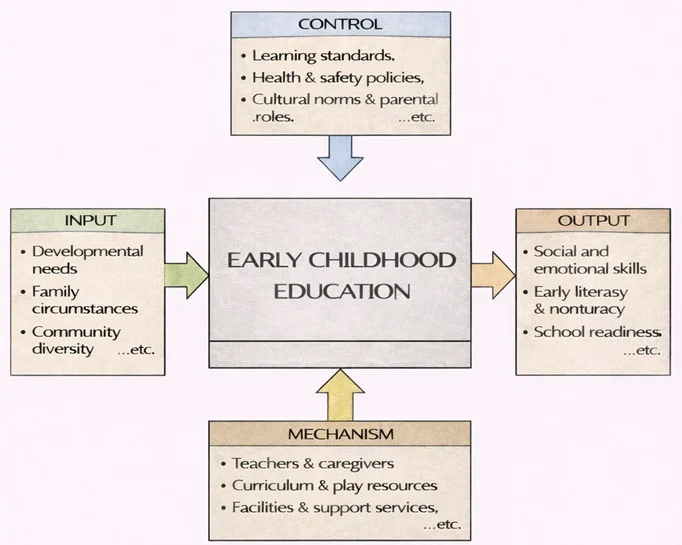
Early Childhood Education can be understood as a practical “learning-and-care” function that turns children’s starting conditions into strong foundations for later schooling. As the diagram shows, the inputs include each child’s developmental needs, family circumstances, and the diversity of the community they grow up in. This work is shaped by controls such as early learning standards, health and safety requirements, and cultural expectations about caregiving and family involvement. The function is performed through mechanisms—teachers and caregivers, play-based curriculum resources, and supportive facilities and services that make learning safe, consistent, and responsive. When these parts work well together, the outputs are visible in children’s growing social-emotional strength, early language and number sense, and overall school readiness—skills that help them enter primary education with confidence and resilience.
Welcome to the Early Childhood Education section of Prep4Uni.online — your trusted guide for exploring the foundational years of learning and development. Early childhood education (ECE) is pivotal in shaping a child’s cognitive, social, and emotional growth, laying the groundwork for lifelong learning and success. Research underscores the significance of quality ECE programs in fostering academic readiness and holistic development.
A well-structured curriculum is at the heart of effective early childhood education. Thoughtful curriculum design ensures that learning experiences are developmentally appropriate, engaging, and responsive to the needs of young learners. Incorporating insights from educational psychology aids in understanding how children learn, enabling educators to tailor instruction that nurtures curiosity and fosters a love for learning.
Leadership plays a crucial role in the success of ECE programs. Effective educational leadership and administration ensure that early learning environments are well-managed, inclusive, and conducive to both teaching and learning. As technology becomes increasingly integrated into education, understanding the role of technology in education is essential. Emerging tools, including artificial intelligence and machine learning, are beginning to influence early learning through adaptive learning platforms and interactive educational resources.
Early childhood education does not exist in isolation; it connects with broader educational pathways. Foundational skills developed during these early years are built upon in adult education and lifelong learning. Moreover, early exposure to subjects like STEM can spark lasting interest and proficiency in these critical areas.
Cultural and philosophical contexts also enrich early education. Integrating elements from philosophy, literature, and history can provide young learners with a broader understanding of the world. Discussions around liberalism and conservatism can be introduced in age-appropriate ways to encourage critical thinking and awareness of diverse perspectives.
Specialized areas within early education, such as special education and TESOL, address the unique needs of diverse learners, ensuring that all children have access to quality education. Ongoing teacher training and professional development are vital for educators to stay abreast of best practices and emerging research in the field.
Incorporating emerging technologies into early childhood education can enhance learning experiences and better prepare children for the digital age. Understanding the basics of information technology and its applications in the classroom can lead to more interactive and personalized learning.
As children grow, the skills and knowledge acquired during early childhood serve as a foundation for future academic and personal achievements. Engaging with subjects like management and peace studies and conflict resolution in later education builds upon the critical thinking and social skills developed in early years.
At Prep4Uni.online, we are committed to supporting educators, parents, and learners in navigating the dynamic landscape of early childhood education. Our resources aim to provide comprehensive insights and practical tools to foster environments where young children can thrive.

How Educational Elements Interact and Influence Learning
Effective education emerges from the interaction between learners, educators, systems, and environments. The areas below highlight how different forces—ranging from psychology and inclusion to leadership and technology—interact to shape outcomes, influence experiences, and transform learning across contexts.
Focus of Early Childhood Education
The focus of ECE is to provide a nurturing, stimulating, and inclusive environment that supports all aspects of a child’s development during their formative years. It involves fostering intellectual curiosity, emotional resilience, and social competence, while encouraging self-expression and confidence. ECE aims to:
- Build foundational skills in literacy, numeracy, and communication.
- Cultivate problem-solving abilities and creativity.
- Promote social-emotional development through relationships and collaboration.
ECE recognizes that children learn best through play and exploration, emphasizing activities that are engaging, age-appropriate, and culturally relevant. By addressing the diverse needs of children, ECE ensures they are well-prepared for the transition to primary education and beyond.
Key Areas in Early Childhood Education
1. Child Development
- Definition: The study of how children grow and change across cognitive, emotional, physical, and social domains.
- Key Components:
- Cognitive Development: Understanding how children think, solve problems, and acquire knowledge.
- Emotional Development: Teaching children to identify, express, and regulate emotions.
- Physical Development: Enhancing motor skills through activities that promote coordination and strength.
- Social Development: Building interpersonal skills through group interactions and cooperative play.
- Applications:
- Designing activities that align with developmental milestones, such as recognizing letters and numbers.
- Supporting children with special needs through tailored interventions.
2. Play-Based Learning
- Definition: An educational approach that uses play as a medium to foster creativity, critical thinking, and learning.
- Key Features:
- Encouraging imaginative play to develop problem-solving skills.
- Incorporating games and hands-on activities to teach foundational concepts.
- Promoting unstructured play to boost independence and exploration.
- Examples:
- Using building blocks to teach spatial awareness and basic math skills.
- Role-playing scenarios to enhance communication and empathy.
3. Family and Community Involvement
- Definition: Engaging families and communities as active partners in a child’s education.
- Importance:
- Strengthens the connection between home and school environments.
- Reinforces learning through consistent messaging and support.
- Strategies:
- Hosting workshops to educate parents about child development.
- Involving families in classroom activities and decision-making processes.
- Collaborating with community organizations to provide resources and support.
Applications of Early Childhood Education
1. Shaping Preschool and Kindergarten Curricula
- Overview: ECE professionals design curricula that are age-appropriate, engaging, and aligned with developmental needs.
- Key Components:
- Balancing academic instruction with play and exploration.
- Incorporating thematic learning to make connections across subjects.
- Examples:
- A curriculum that introduces science concepts through gardening projects.
- Storytelling sessions to enhance language and comprehension skills.
2. Promoting Early Literacy and Numeracy Skills
- Overview: ECE programs focus on building foundational skills in reading, writing, and math, which are critical for academic success.
- Strategies:
- Phonics games to teach letter recognition and sounds.
- Counting activities using everyday objects to develop number sense.
- Examples:
- Reading aloud to children to improve vocabulary and listening skills.
- Using songs and rhymes to teach sequencing and patterns.
3. Supporting Social-Emotional Development
- Overview: ECE emphasizes the importance of emotional well-being and social skills as part of holistic development.
- Applications:
- Teaching empathy through cooperative activities.
- Providing tools for conflict resolution and effective communication.
- Examples:
- Role-playing exercises to practice sharing and turn-taking.
- Encouraging mindfulness activities to promote self-regulation.
Emerging Trends in Early Childhood Education
- Integration of Technology
- Interactive apps and digital tools are increasingly used to enhance learning experiences.
- Examples:
- Educational games that teach coding basics to preschoolers.
- Virtual storybooks with interactive elements to engage young readers.
- Focus on Inclusivity
- ECE programs are evolving to include children with diverse needs and backgrounds.
- Examples:
- Bilingual education programs to support language development in multicultural communities.
- Adaptive learning tools for children with disabilities.
- Outdoor and Nature-Based Learning
- Emphasizing the benefits of outdoor play and environmental education.
- Examples:
- Forest schools that teach through exploration in natural settings.
- Gardening projects to instill an appreciation for the environment.
- Culturally Responsive Education
- Recognizing and celebrating cultural diversity in learning materials and practices.
- Examples:
- Including stories and songs from various cultures in the curriculum.
- Encouraging family participation in sharing cultural traditions.
- Mental Health Awareness
- Addressing the emotional needs of young children through mental health-focused programs.
- Examples:
- Training teachers to identify signs of anxiety or stress.
- Integrating mindfulness and relaxation exercises into daily routines.
Challenges in Early Childhood Education
- Access to Quality Education: Many children, particularly in underserved areas, lack access to quality ECE programs.
- Training and Retention of Educators: Ensuring teachers receive proper training and support to meet the demands of modern ECE.
- Balancing Play and Academics: Striking the right balance between fostering creativity and meeting academic standards.
- Adapting to Technology: Integrating technology effectively without compromising hands-on learning experiences.
Future Directions in Early Childhood Education
- Personalized Learning Approaches: Using data-driven insights to tailor learning experiences to individual needs.
- Global Collaboration: Sharing best practices and innovations in ECE across countries to improve outcomes globally.
- Focus on Sustainability: Incorporating environmental education into ECE curricula to promote sustainability from an early age.
- Strengthened Family Engagement: Expanding opportunities for families to participate actively in their children’s education.
- Research and Policy Development: Using evidence-based research to inform policies that ensure equitable access to quality ECE.
Why the Need to Study Early Childhood Education
Understanding the Foundations of Human Development
Early childhood education focuses on the care and learning of children from birth to around age eight—a period that is critical for cognitive, emotional, social, and physical development. For students preparing for university, studying this field offers a deep understanding of how young minds grow and how early experiences shape lifelong outcomes. It introduces key developmental theories and encourages students to appreciate the long-term value of early education.
Exploring the Role of Educators in Children’s Growth
Early childhood educators play a vital role in nurturing curiosity, fostering emotional resilience, and laying the groundwork for future academic success. Students learn how to create engaging, supportive, and inclusive learning environments tailored to the needs of young learners. This knowledge prepares them for university-level work in education, psychology, and human development, and builds a strong foundation for future teaching or caregiving roles.
Developing Observation, Planning, and Communication Skills
Working with young children requires attentiveness, creativity, and the ability to communicate effectively with both children and their families. Students studying early childhood education develop essential skills in observing behavior, planning age-appropriate activities, and fostering positive relationships. These skills are highly transferable to university settings, where collaboration, empathy, and critical thinking are key to academic and personal success.
Engaging with Play-Based and Inquiry-Based Learning
A central feature of early childhood education is learning through play, exploration, and discovery. Students examine how these approaches support language development, problem-solving, and social interaction. Understanding the importance of play not only informs effective teaching practices but also encourages students to adopt flexible, learner-centered perspectives in their own academic journey.
Preparing for Meaningful Careers in Education and Child Development
A background in early childhood education leads to careers in teaching, childcare, family services, curriculum development, and educational leadership. It is also a strong starting point for advanced studies in child psychology, speech therapy, social work, and special education. For students entering university, this field offers both intellectual fulfillment and the opportunity to make a lasting difference in the lives of children and their communities.
Conclusion
Early childhood education is a cornerstone of personal and societal development, shaping the cognitive, emotional, and social abilities of future generations. By addressing all aspects of a child’s growth, ECE prepares young learners for academic success, emotional resilience, and lifelong learning. As the field continues to evolve, integrating emerging trends and addressing challenges, it remains a powerful tool for building healthier, more equitable, and innovative societies. Through its emphasis on nurturing, inclusivity, and collaboration, ECE ensures that every child has the opportunity to thrive.
Is Early Childhood Education Right For You?
Explore career pathways, check your fit, and assess your skills — before you commit to a degree.
Frequently Asked Questions – Early Childhood Education
What is early childhood education in simple terms?
Early childhood education focuses on the learning, development, and care of children from birth to around age eight. It looks at how young children grow socially, emotionally, physically, and cognitively, and how play, relationships, and rich environments support their development.
Why are the early years considered so important for learning and development?
The early years are important because the brain develops rapidly and children form many of the foundations for language, thinking, self-regulation, and social skills. Positive experiences, secure relationships, and stimulating environments in early childhood can have long-lasting effects on health, learning, and life chances.
What does an early childhood educator do?
Early childhood educators plan and guide play-based learning, support language and social skills, build secure relationships with children and families, observe development, and create safe, inclusive environments. They also work with colleagues and parents to support each child’s wellbeing and early learning journey.
How is early childhood education different from primary or elementary teaching?
Early childhood education usually focuses on younger children, often before formal schooling begins or in the early primary grades. It places strong emphasis on play, routines, relationships, and holistic development, rather than on subject-based instruction alone. Primary teaching tends to be more structured around curriculum subjects and formal assessment.
What kinds of settings provide early childhood education?
Early childhood education can take place in preschools, kindergartens, childcare centres, playgroups, early years units in primary schools, and community or home-based programmes. These settings may be public, private, or run by non-profit organisations, but they all aim to provide safe, supportive spaces for young children to grow and learn.
Which school subjects help prepare for studying early childhood education at university?
Helpful subjects include literature and language, social studies, psychology, biology, and any courses that involve child development, communication, or community work. Experience in volunteering, mentoring, or caring roles also builds useful skills in empathy, observation, and working with families and children.
What personal qualities are important for working in early childhood education?
Important qualities include patience, warmth, and a genuine respect for children. Early childhood educators also need good communication skills, creativity, curiosity, and the ability to work closely with families and colleagues. They must be observant, reflective, and committed to safeguarding and inclusion.
How does play support learning in early childhood education?
Play allows children to explore ideas, experiment, and express themselves. Through play, they practise language, problem-solving, cooperation, and self-regulation. Early childhood educators design play experiences and environments so that children can investigate, imagine, and build understanding in ways that feel meaningful and joyful.
What are some key theories that influence early childhood education?
Key influences include theories of child development, attachment, and learning from thinkers such as Piaget, Vygotsky, Bronfenbrenner, and others. These perspectives highlight the role of play, social interaction, culture, and environment in shaping how young children learn and how educators can support them effectively.
How does early childhood education relate to social justice and inclusion?
Early childhood education can reduce inequalities by providing high-quality learning and care for all children, including those from disadvantaged backgrounds or with additional needs. Inclusive early years settings value diversity in language, culture, and ability, and work with families and communities to support every child’s rights and participation.
What careers are related to early childhood education?
Careers include early childhood teacher, preschool or kindergarten educator, childcare centre educator, early intervention worker, family support roles, curriculum or resource developer for early years, education policymaker, and researcher in child development or early childhood studies. Some educators move into leadership or advisory positions over time.
How does the Early Childhood Education page on Prep4Uni.online support my study and career planning?
The Early Childhood Education page on Prep4Uni.online introduces key ideas about child development, play, inclusion, and professional roles in a student-friendly way. It helps you understand what studying early childhood education involves, how it connects with psychology and social policy, and what kinds of university programmes and careers you might pursue.
Early Childhood Education Mastery Module
Section 1: Foundational Review Checkpoints
Click each question below to toggle the answer explanation.
-
What is early childhood education?
Show Answer & Explanation
Answer: Early childhood education refers to the structured learning experiences provided to children from birth to around eight years old. It encompasses various educational approaches aimed at fostering cognitive, social, and emotional development during the crucial early years.
-
Why is early childhood education important for holistic development?
Show Answer & Explanation
Answer: Early childhood education is critical because it lays the foundation for lifelong learning and well-being. By engaging young children through play, exploration, and social interaction, it supports their intellectual growth, emotional stability, and social competence.
-
What are the key principles of effective early childhood education?
Show Answer & Explanation
Answer: Key principles include creating a safe, nurturing environment; promoting active, play-based learning; and encouraging social interaction and creativity. An effective program is child-centered, culturally responsive, and designed to meet the diverse needs of young learners.
-
How do play-based learning strategies support child development?
Show Answer & Explanation
Answer: Play-based learning strategies allow children to explore, experiment, and make sense of the world around them. Through play, children develop critical thinking, language, and motor skills while learning to interact with others in a relaxed and engaging setting.
-
What role does teacher-child interaction play in early education?
Show Answer & Explanation
Answer: Teacher-child interaction is vital as it provides guidance, support, and positive reinforcement that fosters learning and emotional security. Skilled educators tailor their interactions to each child’s developmental stage, promoting individualized learning and growth.
-
How can curriculum design enhance early learning experiences?
Show Answer & Explanation
Answer: Thoughtfully designed curricula align learning objectives with developmentally appropriate activities that engage children. Integrating a balance of structured lessons and free play, the curriculum adapts to the interests and needs of young learners, ensuring a holistic learning experience.
-
What are the benefits of integrating technology into early childhood education?
Show Answer & Explanation
Answer: Technology can enhance early childhood education by providing interactive and multimedia learning tools that engage young learners. Digital platforms offer opportunities for personalized learning experiences, while carefully selected educational apps and resources support foundational skills in a fun and engaging way.
-
How do family and community engagement contribute to early learning?
Show Answer & Explanation
Answer: Family and community engagement enrich early learning by creating a supportive network that reinforces educational goals. Involving parents and community members in classroom activities and decision-making processes enhances cultural relevance and provides children with additional resources and role models.
-
What challenges do educators face in early childhood education and how can they be addressed?
Show Answer & Explanation
Answer: Educators often encounter challenges such as limited resources, diverse learner needs, and balancing academic content with play. Addressing these challenges requires ongoing professional development, collaborative planning, and the use of flexible, innovative teaching methods to adapt to the dynamic learning environment.
-
How can assessment methods be used to support growth in early childhood education?
Show Answer & Explanation
Answer: Assessment in early childhood education involves both formal and informal methods that gauge a child’s progress in cognitive, social, and emotional areas. Continuous, formative assessments help educators adjust instruction to meet each child’s developmental needs, ensuring that learning experiences are effective and supportive.
Section 2: Analytical & Scenario-Based Inquiry
Click each scenario below to explore detailed analytical answers.
-
How does play-based learning influence long-term cognitive development in children?
Show Answer & Analysis
Answer: Play-based learning is foundational in early childhood as it engages children in activities that stimulate their imagination, problem-solving skills, and social interaction. Through play, children experiment with ideas, develop language skills, and learn to navigate social situations, all of which contribute to robust cognitive development.
In the long term, children who engage in play-based learning are often better equipped to approach challenges with flexibility and critical thinking. This early exposure to exploratory learning not only enhances their academic performance but also promotes a lifelong love of learning. -
In what ways can curriculum design be adapted to meet the diverse needs of early learners?
Show Answer & Analysis
Answer: Curriculum design can be adapted to meet diverse learning needs by incorporating differentiated instruction and culturally responsive pedagogy. Tailoring educational content and activities accommodates various learning styles, abilities, and backgrounds.
Additionally, adaptive curricula that include flexible grouping, personalized learning plans, and continuous assessment enable educators to adjust lessons based on real-time feedback, fostering an inclusive environment. -
How can technology be leveraged to enhance teacher training in early childhood education?
Show Answer & Analysis
Answer: Digital platforms offer accessible professional development programs, including webinars, virtual classrooms, and interactive simulations that keep educators updated on research and pedagogical strategies.
Furthermore, technology facilitates peer collaboration and online networks where teachers exchange best practices and solve classroom challenges collectively. -
What role does family involvement play in enhancing early childhood education, and how can schools foster stronger partnerships with families?
Show Answer & Analysis
Answer: Family involvement reinforces learning at home and builds a supportive network around the child. Consistent values and communication between parents and teachers lead to improved academic and emotional resilience.
Schools build partnerships through regular communication apps, parent workshops, flexible conference schedules, and involving parents in advisory boards. -
How might early childhood education influence lifelong learning and career success?
Show Answer & Analysis
Answer: Quality ECE lays a foundation in executive functioning, emotional regulation, and social cooperation. Children who develop these core competencies early exhibit higher graduation rates, stronger college performance, and enhanced adaptability in workforce environments.
-
What are the potential benefits of integrating arts and creative expression into early childhood curricula?
Show Answer & Analysis
Answer: Creative expression promotes fine motor development, spatial reasoning, and symbolic thinking. Arts activities provide non-verbal emotional outlets, building self-confidence, empathy, and creative problem-solving skills.
-
How can assessment practices in early childhood education be designed to support continuous learning and development?
Show Answer & Analysis
Answer: ECE assessments should rely on observational checklists, learning portfolios, and authentic performance tasks rather than paper-and-pencil standardized testing. Continuous portfolio documentation allows educators to track individualized milestones without imposing stress on the child.
-
What strategies can be implemented to ensure equity and inclusion in early childhood education?
Show Answer & Analysis
Answer: Strategies include Universal Design for Learning (UDL), providing adaptive toys/furniture, utilizing multilingual instructional materials, and ensuring early intervention specialists work directly within inclusive general classrooms.
-
How does early childhood education contribute to the development of critical thinking skills?
Show Answer & Analysis
Answer: By posing open-ended questions during play (e.g., “What happens if we stack this block sideways?”), educators encourage children to form hypotheses, test cause-and-effect relationships, and solve tangible spatial and social problems.
-
How can community involvement enhance the effectiveness of early childhood education programs?
Show Answer & Analysis
Answer: Community partnerships bring local libraries, health professionals, and cultural organizations into centers, expanding access to pediatric screenings, literacy resources, and diverse cultural field trips.
-
How might changes in early childhood education policy influence future workforce readiness?
Show Answer & Analysis
Answer: Universal pre-K policies and subsidies increase labor market participation for parents while ensuring all children receive foundational cognitive and social preparation, shrinking long-term achievement gaps.
-
What role does teacher quality play in the success of early childhood education, and how can it be improved?
Show Answer & Analysis
Answer: Highly qualified educators facilitate richer linguistic interactions and manage classrooms with emotional warmth. Quality is improved through competitive compensation, degree-granting pathways, and ongoing mentorship.
Section 3: Mathematical & Operational Metrics in ECE
Quantitative evaluation, teacher-child ratios, and space allocation calculations for ECE operations.
-
Teacher-to-Child Staffing Ratios
State regulations dictate a maximum ratio of 1 teacher per 4 infants (0–12 months) and 1 teacher per 10 preschoolers (3–4 years). If an early learning center has 12 infants and 30 preschoolers enrolled, calculate the minimum number of qualified teachers required on duty.
Show Full Step-by-Step Solution
Step 1: Calculate teachers needed for infants.
Infant Teachers = 12 / 4 = 3 teachers.
Step 2: Calculate teachers needed for preschoolers.
Preschool Teachers = 30 / 10 = 3 teachers.
Step 3: Sum total staff required.
Total Staff = 3 + 3 = 6 teachers.
Answer: Minimum of 6 qualified teachers required. -
Classroom Floor Space Allocation per Child
Licensing standards require at least 35 square feet of usable indoor activity space per child. A preschool room measures 28 feet by 20 feet. Fixed storage cabinets occupy 56 square feet. Calculate the maximum licensed capacity of children for this room.
Show Full Step-by-Step Solution
Step 1: Calculate gross floor area.
Gross Area = 28 ft × 20 ft = 560 sq ft.
Step 2: Subtract fixed non-usable cabinet area.
Usable Area = 560 – 56 = 504 sq ft.
Step 3: Divide usable area by per-child requirement (35 sq ft).
Child Capacity = 504 / 35 = 14.4 children.
Step 4: Round down to nearest whole child.
Maximum Capacity = 14 children.
Answer: Maximum capacity is 14 children. -
Calculated Play-to-Instruction Time Percentage
In a 6-hour daily preschool schedule (360 minutes), children spend 90 minutes in child-initiated free play, 45 minutes in outdoor play, 30 minutes in circle story time, and 45 minutes in small group activities (the remainder is meals/naps). Calculate the percentage of active operational time spent in play (free + outdoor play).
Show Full Step-by-Step Solution
Step 1: Calculate total play minutes.
Total Play = 90 mins (free) + 45 mins (outdoor) = 135 minutes.
Step 2: Calculate active instruction/play total time (excluding meals/naps).
Active Time = 90 + 45 + 30 + 45 = 210 minutes.
Step 3: Calculate percentage of active time devoted to play.
Play Percentage = (135 / 210) × 100% ≈ 64.29%.
Answer: 64.29% of active classroom time is spent in play-based learning. -
Early Screening Sensitivity Index Calculation
A developmental screening tool evaluates 200 children. Out of 40 children with verified speech delays, the tool correctly identifies 34. Out of 160 children without speech delays, it correctly identifies 144 as typical. Calculate the Sensitivity percentage of the screening tool.
Show Full Step-by-Step Solution
Step 1: Recall the Sensitivity formula.
Sensitivity = (True Positives / Total Actual Positive Cases) × 100%.
Step 2: Plug in speech delay figures.
Sensitivity = (34 / 40) × 100% = 85%.
Answer: Screening sensitivity is 85%. -
Parent Engagement Participation Rate
An ECE center hosts 4 family engagement workshops throughout the year. Out of 80 enrolled families: 20 families attend all 4 workshops, 30 attend 2 workshops, 15 attend 1 workshop, and 15 attend 0 workshops. Calculate the average family attendance rate per workshop.
Show Full Step-by-Step Solution
Step 1: Calculate total family-workshop attendance instances.
Total Attendance = (20 × 4) + (30 × 2) + (15 × 1) + (15 × 0)
Total Attendance = 80 + 60 + 15 + 0 = 155 attendance instances.
Step 2: Calculate total possible attendance instances.
Possible Instances = 80 families × 4 workshops = 320 instances.
Step 3: Calculate overall average participation rate.
Participation Rate = (155 / 320) × 100% = 48.44%.
Answer: Average participation rate is 48.44%. -
Nutritional Meal Planning Quantity Calculation
ECE regulations mandate 0.5 cups of fluid milk per child per snack. If a childcare center serves 64 children during afternoon snack over 5 operating days, calculate the total gallons of milk required (1 gallon = 16 cups).
Show Full Step-by-Step Solution
Step 1: Calculate daily cup requirement.
Daily Cups = 64 × 0.5 cups = 32 cups per day.
Step 2: Calculate 5-day weekly cup requirement.
Weekly Cups = 32 cups × 5 days = 160 cups.
Step 3: Convert cups to gallons (16 cups/gallon).
Total Gallons = 160 / 16 = 10 gallons.
Answer: Exactly 10 gallons of milk required. -
Per-Pupil ECE Grant Allocation Index
A community pre-K grant provides $450,000 annually. 60% is designated for teacher salaries, 25% for classroom materials, and 15% for administrative overhead. If the grant serves 120 children, calculate the materials budget allocated per child.
Show Full Step-by-Step Solution
Step 1: Calculate total dollar amount for classroom materials.
Materials Budget = $450,000 × 0.25 = $112,500.
Step 2: Divide materials budget by total enrolled children.
Per-Child Allocation = $112,500 / 120 = $937.50.
Answer: $937.50 allocated per child for classroom materials.