
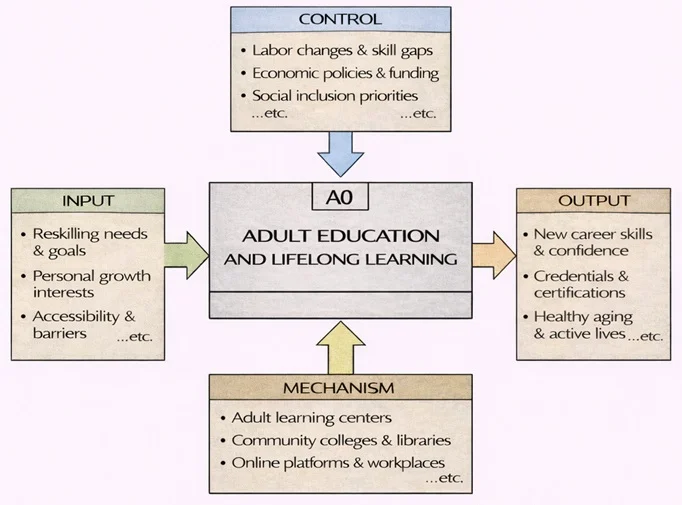
Adult Education and Lifelong Learning as a working system: Adult Education and Lifelong Learning can be understood as a practical “learning engine” that turns real-life needs into meaningful outcomes. In the diagram, the inputs are the reasons adults return to learning—reskilling goals for work, personal growth interests, and barriers such as time, cost, or access. These flow into the core function, where learning is designed and delivered. What guides the system are the controls—the changing skills demanded by the economy, government policy and funding, and social priorities such as inclusion and equitable access. The work is carried out by the mechanisms: adult learning centers, community colleges and libraries, and online platforms and workplace programs that provide courses, coaching, assessment, and support. When the function works well, the outputs are visible and measurable: adults gain new career skills and confidence, earn credentials or certifications, and strengthen well-being through healthy aging and active participation in community life.
Welcome to the Adult Education and Lifelong Learning section of Prep4Uni.online — your guide to personal and professional growth across all stages of life. In an era where technological advances and social transformations occur at breakneck speed, lifelong learning is not just a luxury; it is a necessity. The value of education and training goes far beyond the traditional classroom. It encompasses everything from foundational skills to advanced disciplines such as artificial intelligence and machine learning and technology in education.
The journey often starts with designing effective learning pathways. Thoughtfully crafted curriculum design ensures that adult education programs address diverse learner needs while aligning with workforce demands. Whether you are returning to learning after years away or enhancing your professional credentials, a well-structured curriculum can make all the difference. It also works hand-in-hand with educational psychology to support adult learners through cognitive and emotional growth.
Leadership within learning institutions also plays a crucial role. Strong educational leadership and administration frameworks are essential in building inclusive, accessible, and innovative adult learning environments. And thanks to emerging technologies, today’s learners can tap into flexible digital platforms to pursue education in their own time and space, aligning education with real-life obligations and career ambitions.
Adult education is also deeply interconnected with broader disciplines. A solid grounding in STEM fields or philosophy might enhance critical thinking, while exploring literature or history fosters a richer understanding of the world. Moreover, ideas in liberalism and conservatism deepen civic awareness and societal engagement.
Professional development, especially through teacher training and professional development, is another pillar of lifelong learning. Specialized areas like special education and TESOL demand upskilling and a sensitivity to learner diversity. Simultaneously, evolving frontiers such as natural language processing, supervised learning, unsupervised learning, and reinforcement learning invite adult learners to participate in technological innovation.
Whether you are revisiting education after a long gap or preparing for a new career phase, you are not alone. Initiatives that encourage peace studies and conflict resolution or promote broader knowledge through platforms like Prepare for Your University Studies show the expansive scope of adult education. With the right mindset and support, lifelong learning becomes a powerful tool for personal fulfillment and societal contribution.
Interconnected Pathways in Education
Education unfolds as an evolving system where design, psychology, technology, and leadership interact to shape meaningful learning experiences. The pathways below highlight how different domains contribute to building, delivering, and sustaining effective education across diverse contexts and stages of life.
💻 Digital & EdTech Integration →
Connects adult pedagogy with LMS, mobile apps, and flexible e-learning tools, bridging digital gaps and enabling asynchronous upskilling across diverse schedules.
📚 Curriculum Architecture & Alignment →
Structures competency-based outcomes and authentic performance tasks, aligning adult modules with industry certifications, RPL frameworks, and labor market needs.
🧠 Learning Science & Cognitive Processes →
Leverages andragogical principles, intrinsic motivation, and cognitive load management to help working adults process, retain, and transfer practical skills efficiently.
🧸 Early Learning Foundations →
Informs family literacy initiatives and intergenerational learning practices, demonstrating how adult skill development directly enriches early childhood support environments.
📈 Educator Growth & Professional Practice →
Provides continuous professional development (CPD), micro-credentialing pathways, and peer coaching routines to keep adult education instructors and corporate trainers current.
🧩 Inclusive & Differentiated Education →
Applies Universal Design for Learning (UDL) and adaptive accommodations to ensure neurodiverse adult learners and returners access equitable educational opportunities.
🗣️ Language Teaching & TESOL Practice →
Delivers vocational ESOL, functional workplace literacy, and cross-cultural communication training for immigrant populations and global workforce integration.
🏫 Education Leadership & System Management →
Manages public funding, provider governance, employer co-funding schemes, and quality KPI dashboards to sustain scalable lifelong learning ecosystems.
What Counts as Adult Education & Lifelong Learning?
Adult education covers all intentional learning that people do after compulsory schooling. It spans formal programs (qualifications), non-formal offerings (courses without a qualification aim), and informal learning (self-directed, on-the-job, or community based). Use the categories and examples below to map any activity quickly.
- Foundational skills & on-ramps: adult literacy, numeracy, English language, and basic digital skills that enable participation in work and society and prepare learners to use technology in education.
- Career & workforce learning: upskilling/reskilling, short industry certificates, apprenticeships, return-to-work programs, and competency-based training that connect directly to curriculum design, assessment, and job standards.
- Continuing professional development (CPD): micro-credentials, short courses, workshops, and teacher training & professional development taken to keep practice current or progress in a field.
- Community, family & civic learning: languages, wellbeing and parenting classes, financial capability, cultural literacy, and civic education that strengthen participation in public life (e.g., courses touching on ideas in liberalism and conservatism).
- STEM & emerging technologies: accessible routes into STEM, coding bootcamps, data skills, and introductions to artificial intelligence for mobility and new careers.
Who is it for? Anyone learning beyond school: returners to study, mid-career changers, recent immigrants, carers, jobseekers, older adults, and professionals building skills over time. Learning may be fully online, in community venues, at work, or blended.
Quick boundary check: If the activity has a clear learning goal and a plan for practice or assessment (even light-touch), it belongs on this page—whether it leads to credit/qualifications or not.
Principles of Effective Adult Learning (What to Use on Day 1)
Core ideas
- Start from experience: surface learners’ prior knowledge, roles, and constraints; use a quick “experience scan” or problem prompt to anchor new content.
- Problem-centred outcomes: define success as tasks adults will perform (e.g., “submit a job application with attachments”), then align activities and checks. See curriculum design for writing outcomes.
- Self-direction with structure: offer choice (topics, sequence, evidence of learning) within clear boundaries, timelines, and rubrics.
- Relevance & transfer: use authentic artefacts (forms, dashboards, workplace tools) and practice in contexts that mirror real use so skills transfer quickly.
- Support the whole learner: plan for motivation, cognition, and emotion together—an anchor from educational psychology (e.g., chunking to reduce cognitive load; praise effort and strategy; normalise setbacks).
- Spacing, retrieval, feedback: revisit key ideas over time, include short recall prompts, and give specific, actionable feedback tied to the task.
Translate principles into classroom moves
- Kick-off (5 min): pose a real-world scenario and ask, “How would you handle this today?” Capture current strategies.
- Model (8–10 min): show a worked example and think-aloud the decisions (“why this step?”). Provide a checklist or template.
- Guided practice (10–15 min): learners complete the task with scaffolds (sentence starters, exemplar, partner coaching).
- Independent practice (10–15 min): repeat in a new but similar context; remove scaffolds; require visible evidence (file, form, short demo).
- Feedback & retrieval (5 min): quick peer/coach notes using the checklist + two retrieval questions to cement memory.
- Reflection & transfer (2–3 min): “Where will I use this this week?” Write a one-line action plan and barrier/solution.
Quality bar (micro-rubric): task defined in behaviour terms · authentic materials used · learner choice visible · at least one retrieval + one feedback moment · explicit prompt for transfer.
Adult Education & Lifelong Learning: Why It Matters
Adult education covers learning that adults pursue after or outside compulsory schooling—whether to gain a credential, reskill for work, or learn for personal growth. Lifelong learning emphasizes continuing development across an entire life span (formal, non-formal, and informal contexts).
What makes adult learning different
- Experience-anchored: adults bring deep prior knowledge, work and life roles that shape motivation and expectations.
- Goal-driven: learning is typically tied to immediate problems or opportunities (job change, career progression, community needs).
- Self-direction: adults prefer autonomy—choice over topics, pacing, and assessment formats.
- Multiple constraints: time, caregiving, and finances require flexible delivery and recognition of prior learning (RPL).
- Context matters: workplace, community, online platforms, and micro-credential pathways all function as learning sites.
Clear outcomes for learners and society
- Employability & mobility: reskilling/upskilling aligned to labor market change.
- Health & civic life: improved health literacy, financial literacy, and social participation.
- Equity: second-chance education pathways reduce barriers related to earlier schooling or life events.
Why Study Adult Education and Lifelong Learning
Understanding Learning Beyond Traditional Classrooms
Adult education and lifelong learning focus on how individuals continue to learn and grow beyond formal schooling. This field examines how adults acquire new skills, adapt to changes, and pursue personal or professional development throughout life. For students preparing for university, studying this area highlights the value of education as an ongoing process and introduces important concepts such as self-directed learning, motivation, and adult learning theory.
- Equipping adults with practical skills: targeted competencies for work and everyday problem-solving.
- Fostering personal growth: confidence, creativity, purpose, and wellbeing through learning.
- Promoting a lifelong-learning mindset: opportunities to re-enter, continue, and upgrade learning at any stage.
Exploring the Social and Economic Importance of Lifelong Learning
In a rapidly changing world, lifelong learning is essential for keeping up with evolving technologies, job market demands, and societal needs. Students gain insight into how adult education supports workforce development, social inclusion, and active citizenship. This understanding reinforces the broader role of education in addressing inequality and enabling continuous personal and professional growth across all stages of life.
Developing Skills to Support Diverse Learners
Adult learners bring varied experiences, learning styles, and goals to the educational setting. Programs are designed to be inclusive, serving working adults, newcomers, people returning after long gaps, seniors, and marginalized groups. Students studying this field learn how to create flexible, supportive environments that respect adults’ backgrounds and responsibilities—skills that transfer directly to university contexts (peer mentoring, group collaboration, and community engagement).
Integrating Technology and Innovation in Adult Learning
With the rise of online courses, mobile learning, and virtual platforms, adult education increasingly involves integrating digital tools to support flexible learning. Students explore how technology can make learning more accessible and effective for working professionals, caregivers, and older adults. This prepares students to participate in—and design—learning experiences that meet the needs of a diverse and ever-evolving population.
Preparing for Careers in Education, Workforce Development, and Social Change
A background in adult education and lifelong learning supports careers in community education, vocational training, instructional design, corporate learning, and educational policy. It also provides a strong foundation for roles that promote social development, empowerment, and equity. For university-bound students, this field emphasizes the relevance and responsibility of education in shaping resilient, informed, and adaptable societies.
Design Blueprint: Build a Short Adult Learning Program
Use this 8-step blueprint to design a 4–8 week module that fits adult schedules and constraints.
- Needs & constraints: time windows, devices, language, transport, childcare; leadership and resourcing via educational leadership and administration.
- Outcomes: 3–5 observable “can do” statements tied to real tasks.
- Assessment first: design authentic assessments (do the task with real tools). Build rubrics from the outcomes.
- Learning map: chunk content into 60–90-minute sessions; alternate demonstrate → practice → feedback.
- UDL & accessibility: plain language, captions, transcripts, keyboard navigation, alt text; options to read, watch, or listen.
- RPL/PLA intake: recognize prior learning to shorten time; allow challenge assessments.
- Delivery blend: in-person + online (recordings, messaging, low-bandwidth options) using tools from technology in education.
- Support net: orientation, micro-cohorts, tutor hours, nudges, and progress dashboards.
Learner profile: time windows, devices, language level, supports needed
Outcomes (3–5): 1) __________________ 2) __________________ 3) __________________
Authentic assessments (match outcomes):
• A1: ____________________________________ (criteria: _______________________)
• A2: ____________________________________ (criteria: _______________________)
Weekly map (session → task → feedback):
• W1: ____________________________________ • W2: ____________________________________
UDL/Accessibility plan: captions, alt text, keyboard paths, plain language
RPL/PLA option: challenge task? evidence accepted?
Support plan: tutor hours, peer group, messages, progress checks
Interactive Model: Adult RPL Exemption & Savings Analyzer
Select a common adult learner scenario below to compare standard tuition costs against Recognition of Prior Learning (RPL) accelerated pathways:
Scenario A: Mid-Career Professional Certificate (8 Modules, $400/mod)
Scenario B: Advanced Vocational Diploma (12 Modules, $500/mod)
Scenario C: Foundation Upskilling Module (4 Modules, $300/mod)
Assessment & Recognition (Make Learning Count)
Authentic assessment
- Performance tasks: learners complete the real task (e.g., submit a benefits form, build a simple data dashboard, prepare a lesson plan).
- Portfolios & artifacts: keep evidence (files, screenshots, reflections) for job or university applications.
- Observation & sign-off: supervisor or mentor validates application on-the-job.
Recognition routes
- Micro-credentials / badges: short, evidence-backed signals that can stack into certificates or degrees.
- RPL/PLA: evaluate prior experience or training for credit; align to your curriculum design outcomes.
- Bridging pathways: map how non-formal courses connect to formal qualifications and professional development.
Policy, Funding & Quality (1-Page Primer)
Why this matters: Adult programs live inside real systems—who pays, who approves, and how “quality” is judged. Use this primer to align your offer with funders, accreditation, and learners’ expectations.
Who pays (typical mixes)
- Learner fees: sliding scales, income-based waivers, instalments.
- Employer/union support: tuition assistance, paid time to learn, apprenticeship co-funding.
- Public/charitable funds: workforce grants, community development, adult literacy, re-entry programs.
- In-kind: venues, equipment, mentors, software (see technology in education).
Accreditation & approval (what to know)
- Provider approval: organisation meets governance, staffing and safeguarding standards (see educational leadership & administration).
- Program approval: outcomes, hours/credits, assessment plan, and resources align with a recognised framework (connect with curriculum design and teacher training).
- Assessment integrity: transparent criteria, moderation, secure records.
What “quality” usually means (practical KPIs)
- Access & equity: reach of priority groups; reasonable adjustments provided.
- Participation & retention: enrolments, attendance, timely progression; early-alert/support actions recorded.
- Achievement: competency/credit completion, portfolio passes, external exam success.
- Destinations: employment, promotion, further study, credential attainment within 3–12 months.
- Learner voice: satisfaction, perceived relevance, confidence gain.
Lightweight quality cycle
- Plan: set 3–5 KPIs; define target groups and supports.
- Do: deliver with an assessment plan and clear rubrics.
- Check: review monthly dashboard + two learner-voice snapshots.
- Act: one change per quarter (curriculum tweak, support, delivery mode).
Evidence pack checklist: program spec · mapped outcomes · assessment samples · moderation notes · KPI dashboard · safeguarding & data protection polices · tutor qualifications/CPD.
Recognition of Prior Learning (RPL) & Micro-credentials
Goal: Give adults credit for what they already know and can do, and let them earn small, stackable proofs of new learning.
RPL: what counts as evidence
- Workplace artefacts: reports, lesson plans, code repos, care plans—mapped to outcomes.
- Performance demonstrations: observed practicals, simulations, challenge tasks.
- Third-party attestations: supervisor statements with dates, duties, and standards.
- Reflective accounts: brief narrative tying experience to specific competencies (use STAR: Situation–Task–Action–Result).
- Challenge exams/skills checks: written or practical tests to verify gaps.
RPL process (4 steps you can run)
- Pre-screen: quick conversation; share the program outcomes and an evidence guide (see curriculum design).
- Map & collect: learner uploads artefacts; assessor maps each item to outcomes and rates sufficiency/authenticity/recency.
- Verify & gap-plan: short challenge task or observation if needed; agree a mini-learning plan only for gaps.
- Award & record: credit/waiver issued; transcript updated; feedback highlights strengths and next steps.
Micro-credentials: design rules
- Clear, narrow outcomes: 1–3 assessable competencies (e.g., “Create an accessible slide deck with captions and alt text” — link to technology in education).
- Authentic assessment: produce a real artefact; include a short rationale; assess with a simple rubric.
- Metadata on the badge: issuer, date, learning hours/level, outcomes, assessment type, evidence link.
- Stackability: show how 3–4 badges ladder into a certificate or module; publish the pathway.
- Verification: public badge URL and evidence bundle; expiry/renewal if the skill changes quickly.
RPL Evidence Map: Outcome · Evidence item & date · Authentic? · Sufficient? · Current? · Assessor decision · Gap action.
Micro-credential Spec: Title · Purpose · Outcomes · Learning hours/level · Assessment task & rubric link · Evidence link · Renewal · Pathway/stack mapping.
Good practice: give every learner an RPL option at entry; publish the badge pathway; train assessors through professional development; store decisions securely and reuse evidence across modules when outcomes match.
Delivery Models & Learner Support
Flexible delivery that adults actually use
- In-person anchors: kick-off and assessment days to build trust and clarity.
- Blended core: short video demonstrations (captioned), live Q&A, and asynchronous practice.
- Low-bandwidth options: downloadable PDFs, print packs, phone-first workflows.
Support that prevents dropout (wrap-around services)
- Orientation & study skills: time planning, device setup, LMS walkthrough.
- Micro-cohorts & mentors: 4–8 learners per mentor for accountability.
- Early alerts (ethical analytics): check-ins when practice or attendance dips; see educational psychology for motivation and habit building.
- Accessibility & inclusion: UDL patterns + accommodations, aligning services with special education.
Equity, Inclusion & Adult Learners
Adults often juggle work, caregiving, and finances. Equity means reducing friction while holding standards.
- Plain language & bilingual materials: avoid academic jargon; translate critical forms.
- Multiple ways to show learning: oral demonstration, video, written, or live performance—same rubric.
- Predictable structure: consistent module layout and deadlines; clear time estimates.
- Financial & practical help: fee waivers, device lending, childcare/transport solutions via strong leadership.
Universal Design for Learning (UDL) & Accessibility — Quick Guide
Design learning that works for the widest range of adults from the start. Use UDL’s three pillars:
- Multiple ways to engage: offer live, recorded, and self-paced options; let learners choose project topics tied to their goals.
- Multiple ways to represent content: slides + transcript + captions; plain-language summaries beside technical docs.
- Multiple ways to act/express: permit a short video, a written brief, or a slide deck for the same outcome.
Accessibility checklist (10 minutes)
- Text contrast meets WCAG AA; body text ≳ 16 px.
- All images have
alttext that states purpose (not “image of…”). - Provide captions/subtitles for video; upload an .srt when possible.
- Keyboard access works (Tab/Shift-Tab order makes sense).
- Links describe the target (“Download rubric”), not “click here”.
- Forms: clear labels, error hints, example inputs.
- Avoid color-only meaning (add labels/patterns/icons).
Low-effort supports that prevent dropout
- Flexible deadlines windows (grace periods) and make-up options.
- Device-first materials: everything readable on a phone; PDFs under ~2 MB.
- Quiet channel for help: an email or form that routes to a person within 48 hours.
Learning & Career Pathways (Where This Leads)
Study routes on this site
- Curriculum Design → outcomes, mapping, assessment.
- Educational Psychology → motivation, memory, feedback.
- Technology in Education → platforms, accessibility, analytics.
- Teacher Training & Professional Development → facilitation craft.
- TESOL → language programs for adults; connect to civic and workplace goals.
Roles you can aim for
- Adult literacy/ESOL instructor; community educator
- Workforce development specialist; apprenticeship coordinator
- Instructional/Learning Experience Designer (LXD)
- Program manager (continuing ed, outreach, community learning)
Portfolio starter: include one needs analysis, one outcomes map, one authentic assessment with rubric, a UDL/accessibility checklist, and a short reflection showing learner impact.
Quick Exercise: Draft a 3-Week Micro-Module
Scenario: A local community center needs a short course to help adults complete online job applications.
- Write three outcomes (task-based and observable).
- Design one authentic assessment per outcome (what will the learner do?).
- Sketch the weekly map (demonstrate → practice → feedback), applying UDL.
- State your support plan (orientation, mentor, check-ins) and one RPL option.
Key Areas in Adult Education and Lifelong Learning
Vocational Training
- Definition: Education focused on teaching job-specific skills to enhance employability or career advancement.
- Key Features:
- Hands-on training in fields such as healthcare, technology, and skilled trades.
- Programs tailored to meet industry demands and workforce needs.
- Applications:
- Offering apprenticeships and internships to provide real-world experience.
- Developing technical skills for high-demand jobs, such as coding or machine operation.
- Examples:
- A program training electricians or HVAC technicians for certification.
- Courses teaching culinary arts for aspiring chefs.
Continuing Education
- Definition: Programs designed to support lifelong learning through workshops, certifications, and advanced studies.
- Key Features:
- Flexible schedules to accommodate working adults.
- Opportunities for professional development and personal enrichment.
- Applications:
- Providing certifications in emerging fields like cybersecurity or data analytics.
- Offering creative workshops in areas like painting, writing, or photography.
- Examples:
- A weekend course on digital marketing strategies for small business owners.
- A certification program in project management for professionals seeking advancement.
Literacy Programs
- Definition: Initiatives aimed at addressing literacy challenges among adults to improve reading, writing, and numeracy skills.
- Key Features:
- Basic education programs for adults with limited formal schooling.
- Targeted interventions for populations with specific needs, such as immigrants or rural communities.
- Applications:
- Teaching functional literacy to enable individuals to manage daily tasks like reading labels or filling forms.
- Incorporating digital literacy to navigate modern technology.
- Examples:
- A program helping adults achieve high school equivalency through GED preparation.
- Literacy classes for non-native speakers to learn English as a second language.
Applications of Adult Education and Lifelong Learning
Enhancing Workforce Readiness Through Upskilling Programs
- Overview: Adult education addresses the skills gap by preparing individuals for evolving job markets.
- Strategies:
- Collaborating with industries to design relevant training programs.
- Offering short-term courses that lead to immediate employment opportunities.
- Examples:
- Upskilling programs for factory workers transitioning to automated systems.
- Teaching programming languages to professionals seeking careers in tech.
Promoting Personal Development Through Community Education Initiatives
- Overview: Community-based programs foster self-improvement, civic engagement, and social inclusion.
- Strategies:
- Organizing workshops on topics like mental health, financial literacy, or parenting.
- Offering recreational classes to promote creativity and well-being.
- Examples:
- A workshop teaching seniors how to use smartphones and social media.
- Public speaking courses to build confidence and communication skills.
Supporting Social Inclusion and Equity
- Overview: Adult education programs help marginalized groups overcome barriers to education and employment.
- Strategies:
- Providing scholarships or free programs for low-income learners.
- Offering language and integration courses for refugees and immigrants.
- Examples:
- A program teaching job interview skills to individuals re-entering the workforce after incarceration.
- Classes on citizenship preparation for immigrants seeking naturalization.
Encouraging Active Aging
- Overview: Lifelong learning programs for seniors promote mental agility, social interaction, and quality of life.
- Strategies:
- Offering courses on health and wellness tailored to older adults.
- Providing opportunities for creative and intellectual engagement.
- Examples:
- Senior yoga classes focusing on balance and flexibility.
- Book clubs or history lectures to stimulate intellectual curiosity.
Adult Education Case Studies — Quick Comparison
Three working models from different contexts comparing policy levers, delivery models, recognition pathways, and implementation steps:
| Country / Program | Main policy lever | Delivery model | Recognition | What to copy |
|---|---|---|---|---|
| Singapore — SkillsFuture | Individual learning credit + curated national catalog | Short, stackable micro-courses; blended, evening/weekend | Micro-credentials stack to certs/diplomas; quality gate for providers | Starter credit/waiver; outcome-based course pages; portal filters by role/skill gap |
| Denmark — Folk High Schools | Public support for liberal adult education (civic/cultural focus) | Residential & community courses; dialogue-based, project work | Non-formal certs; bridges to formal credit via portfolios | Interest-led tracks (arts, citizenship); portfolio/showcase instead of exams |
| Kenya — TVET & RPL | Occupational standards + Recognition of Prior Learning (RPL) | Short TVET modules; community centres; mobile/on-the-job assessment | Modular badges stack to national certificates; competency-based rubrics | RPL candidate guides; evidence checklists; weekend/mobile assessments |
Emerging Trends in Adult Education and Lifelong Learning
- Digital & Online Learning (incl. MOOCs, VR/AR): Flexible access and scale; risk of dropout if support is weak. Pilot one MOOC with a study circle; see Technology in Education.
- Micro-credentials & Open Badges: Fast recognition for job-relevant skills. Design stackable 10–20 hour badges with public metadata.
- Work-Integrated & Employer Partnerships: Direct pipeline to jobs. Co-write outcomes with local industry partners through Curriculum Design.
- AI-supported Learning (tutors, feedback, analytics): Personalized practice; human-in-the-loop verification required. See our AI overview.
- Green Skills & Sustainability: Training for renewable energy and sustainable agriculture job families.
- Inclusive & Accessible Design: Universal Design for Learning (UDL) principles integrated from day one. See Educational Psychology.
Challenges in Adult Education and Lifelong Learning
- Access & Affordability: Counter with modular fees, waivers, open educational resources (OER), and hybrid delivery using Technology in Education.
- Time Scarcity: Counter with micro-learning (15–30 min units) and RPL to shorten pathways.
- Engagement & Retention: Counter with problem-first tasks, weekly feedback, and peer cohorts.
- Digital Gaps: Counter with device lending, offline packs, and low-bandwidth mobile options.
- Keeping Curriculum Current: Counter with quarterly content refreshes and employer review panels in Curriculum Design.
- Supporting Diverse Learners: Counter with multilingual resources, targeted tutoring, and UDL patterns.
Future Directions in Adult Education and Lifelong Learning
- Personalized Learning Paths: Leveraging AI and data analytics to tailor education to individual needs and goals.
- Global Collaboration: Sharing best practices and resources across nations to improve access and quality.
- Focus on Emotional Intelligence and Soft Skills: Integrating leadership, empathy, and collaboration into vocational and continuing education.
- Sustainability Education: Expanding programs that address environmental and societal challenges.
- Policy Support and Advocacy: Governments and organizations investing in lifelong learning as a public good.
Interactive Concept Review
Test and reinforce your understanding of core adult education concepts by toggling each section below:
What is Recognition of Prior Learning (RPL)?
RPL is a formal evaluation process that assesses skills and knowledge gained through work experience, uncertified training, or self-directed learning, granting academic credit or course waivers toward a credential.
How do Micro-credentials support adult career mobility?
Micro-credentials verify specific, practical competencies achieved in short timeframes. They are digitally shareable, employer-aligned, and can be “stacked” together to construct full diplomas or degrees over time.
Why is Universal Design for Learning (UDL) essential in adult classrooms?
UDL proactively designs flexible instructional goals, methods, materials, and assessments to accommodate adult learners with varied work commitments, physical abilities, language backgrounds, and digital skill levels.
Frequently Asked Questions
What is meant by adult education and lifelong learning?
Adult education and lifelong learning refer to continuing to learn beyond compulsory schooling, whether through formal courses, workplace training, community programmes, online learning, or self-study. The focus is on helping adults update skills, change careers, pursue personal interests, and stay engaged in a fast-changing world.
Why is lifelong learning important in today’s world?
Lifelong learning is important because technologies, job markets, and social expectations change rapidly. Adults often need to reskill or upskill several times in their working lives. Ongoing learning helps people remain employable, adapt to new roles, participate in civic life, and maintain personal growth and confidence at every age.
How does adult education differ from traditional school or university learning?
Adult education is usually more flexible, goal-oriented, and connected to life and work experience. Adults bring prior knowledge, responsibilities, and motivations that shape how they learn. Programmes may be offered part-time, online, or in short modules, with a stronger focus on practical application, recognition of prior learning, and learner autonomy.
What types of programmes are included under adult education and lifelong learning?
Adult education and lifelong learning can include basic skills and literacy classes, language learning, professional certificates, continuing professional development (CPD), higher education for mature students, community education, online courses and micro-credentials, and informal learning such as public lectures, workshops, or hobby-based classes.
Who can benefit from adult education and lifelong learning?
Almost everyone can benefit, including working adults seeking promotion, people changing careers, parents returning to work, older adults staying mentally active, and young graduates updating skills after entering the workforce. Lifelong learning supports both professional development and personal enrichment at different life stages.
How does adult education support career change and upskilling?
Adult education provides structured pathways to gain new qualifications, learn industry-relevant skills, and build portfolios or professional networks. Short courses, stackable credentials, and flexible degree programmes allow adults to move from one sector to another, respond to automation, and meet the skill needs of emerging industries.
What challenges do adults face when returning to study?
Common challenges include balancing study with work and family, managing time and energy, rebuilding academic confidence, financing further study, and adapting to digital learning platforms. Adult education programmes try to address these issues through flexible timetables, learner support, counselling, and recognition of prior experience.
Which skills are most important for lifelong learners to develop?
Key skills include self-directed learning, time management, digital literacy, critical thinking, communication, and the ability to reflect on one’s own learning needs. Lifelong learners also benefit from resilience, curiosity, and a growth mindset, seeing abilities as improvable rather than fixed.
How does adult education relate to education policy and social inclusion?
Adult education is a major tool for improving social inclusion, reducing skills gaps, and supporting active citizenship. Policies that invest in accessible adult learning help people who missed earlier opportunities, support migrants and mid-career workers, and strengthen communities by raising overall education levels and participation in public life.
What school subjects or experiences help prepare for studying adult education at university?
Useful backgrounds include social studies, psychology, sociology, language and communication subjects, and any experience in mentoring, peer tutoring, youth work, or training roles. These foundations help students understand how adults learn, how societies change, and how to design learning experiences for diverse groups.
What careers are related to adult education and lifelong learning?
Related careers include adult and community education teaching, workplace training and development, learning and development (L&D) roles in organisations, higher education support for mature students, educational policy and planning, e-learning design, career guidance, and roles in NGOs or public agencies that promote learning across the lifespan.
How does the Adult Education and Lifelong Learning page on Prep4Uni.online support my study and career planning?
The Adult Education and Lifelong Learning page on Prep4Uni.online introduces key ideas about learning across the lifespan, adult learning theories, policy debates, and practical pathways into this field. It helps you connect education, psychology, social policy, and workforce development, and supports you in exploring university programmes and careers focused on helping adults learn and adapt.
End-of-Page Exercises & Assessment Modules
Section 1: Foundational Concept Review Questions
- What is adult education and lifelong learning?
Answer: Adult education and lifelong learning refer to the continuous process of acquiring knowledge and skills throughout an individual’s life. These educational opportunities extend beyond traditional schooling to include professional development, personal enrichment, and career advancement. - How does lifelong learning benefit personal and professional growth?
Answer: Lifelong learning fosters continuous personal development, adaptability, and career progression. It enables individuals to stay competitive in rapidly changing job markets while also enhancing overall quality of life through ongoing education. - What types of programs are typically offered in adult education?
Answer: Programs in adult education include vocational training, online courses, certificate programs, workshops, and degree programs designed for working adults. These offerings cater to diverse needs ranging from skill enhancement to complete career transitions. - How can technology enhance adult education?
Answer: Technology enhances adult education by providing flexible, accessible learning platforms such as online courses, webinars, and mobile apps. These digital tools allow learners to study at their own pace, access a wide range of resources, and connect with peers and instructors virtually. - Why is lifelong learning important in today’s fast-changing world?
Answer: In today’s dynamic environment, skills and knowledge can quickly become outdated. Lifelong learning ensures individuals remain adaptable and competitive by continuously updating their skills, which is essential for personal growth and economic resilience. - How do adult education programs address diverse learning needs?
Answer: Adult education programs are designed to accommodate different learning styles and schedules. They offer flexible formats—such as part-time, online, and blended learning—that allow learners to balance education with work and personal responsibilities. - What challenges do adult learners typically face, and how can they overcome them?
Answer: Adult learners often face challenges like time constraints, financial limitations, and balancing education with work and family commitments. They can overcome these obstacles by choosing flexible learning options, seeking financial aid, and using effective time management strategies. - How does lifelong learning contribute to social and economic development?
Answer: Lifelong learning drives social and economic development by enhancing workforce skills, fostering innovation, and reducing unemployment. It enables a more adaptable and competitive labor market, which supports overall economic growth and societal progress. - What role do community colleges and online platforms play in adult education?
Answer: Community colleges and online platforms expand access to education by offering affordable, flexible, and diverse programs. They serve as vital resources for skill development and career advancement, especially for individuals who cannot attend traditional full-time programs. - How can employers support lifelong learning among their workforce?
Answer: Employers can support lifelong learning by offering professional development programs, tuition reimbursement, on-the-job training, and flexible work arrangements. These initiatives help employees stay current with industry trends and contribute to a more skilled and innovative workforce.
Section 2: Analytical & Scenario-Based Thought-Provoking Questions
- How might the rise of digital learning platforms transform the future of adult education?
Answer: The rise of digital learning platforms is revolutionizing adult education by making learning more accessible, flexible, and personalized. These platforms allow adults to engage in self-paced courses, access diverse content from anywhere, and tailor their learning experiences to meet specific career goals. As a result, individuals can overcome geographical and time constraints, significantly expanding opportunities for continuing education. Moreover, digital platforms foster interactive and collaborative learning environments through virtual classrooms, discussion forums, and real-time feedback. This technological shift not only enhances the learning experience but also promotes lifelong learning as a continuous, dynamic process that evolves with technological advancements. - In what ways can employers leverage lifelong learning to boost organizational competitiveness?
Answer: Employers can leverage lifelong learning by creating a culture of continuous improvement and investing in employee development. Offering access to training programs, certification courses, and digital learning platforms enables workers to update their skills, which in turn drives innovation and productivity within the organization. Such investments not only enhance individual performance but also contribute to the overall competitiveness of the company in a dynamic market. Additionally, by fostering lifelong learning, employers can better retain top talent and attract new talent seeking opportunities for growth. - How does lifelong learning impact economic growth at the national level?
Answer: Lifelong learning contributes to national economic growth by continually upgrading the skills of the workforce, which enhances productivity and drives innovation. As individuals pursue additional education and training throughout their lives, they are better equipped to adapt to technological advancements and shifting market demands. This adaptability is crucial for maintaining economic competitiveness in a rapidly evolving global economy. Moreover, a culture of lifelong learning can stimulate entrepreneurship and the development of new industries. - What challenges do adult learners face in integrating education with professional and personal responsibilities, and how can these be overcome?
Answer: Adult learners often struggle with balancing education alongside work, family, and personal commitments. Time constraints, financial pressures, and a lack of support systems are common challenges that can hinder their progress. To overcome these obstacles, institutions can offer flexible learning options such as evening classes, online courses, and part-time programs that accommodate busy schedules. Additionally, providing financial aid, scholarships, and employer-sponsored training can alleviate economic burdens. - How might the evolution of online education influence traditional higher education models?
Answer: The evolution of online education is transforming traditional higher education models by offering more flexible, accessible, and cost-effective alternatives to on-campus learning. Online education allows institutions to reach a broader audience, including working professionals, remote learners, and international students. This shift challenges the conventional model that relies on physical infrastructure, prompting traditional institutions to innovate. Furthermore, the integration of online education fosters a hybrid learning environment combining digital and in-person instruction. - What are the potential long-term societal benefits of promoting adult education and lifelong learning?
Answer: Promoting adult education and lifelong learning has significant long-term societal benefits, including improved workforce skills, enhanced social mobility, and stronger civic engagement. A well-educated population is better equipped to contribute to economic growth, adapt to technological changes, and innovate in various fields. Moreover, lifelong learning promotes social inclusion by providing opportunities for individuals from diverse backgrounds to enhance their knowledge, helping reduce income inequality and empowering people to improve their quality of life. - How can advancements in educational technology enhance lifelong learning opportunities for adults?
Answer: Advancements in educational technology are dramatically enhancing lifelong learning opportunities by making education more accessible, interactive, and personalized. Online learning platforms, mobile apps, and virtual classrooms allow adults to pursue courses at their own pace and from any location. In addition, adaptive learning technologies use data analytics and artificial intelligence to tailor educational content to individual learning styles and needs, helping learners identify and overcome knowledge gaps efficiently. - What role do government policies play in encouraging lifelong learning, and how might these policies evolve?
Answer: Government policies play a crucial role in encouraging lifelong learning by providing funding, incentives, and regulatory support for educational programs. Policies such as tax credits for continuing education, grants for workforce training, and investments in digital infrastructure help create an environment where lifelong learning is accessible and affordable. Future policies are likely to focus on integrating digital education tools, promoting public-private partnerships, and establishing lifelong learning as a key component of national development strategies. - How can educational institutions better tailor their programs to meet the needs of adult learners?
Answer: Educational institutions can better tailor their programs to meet the needs of adult learners by offering flexible, modular courses that accommodate diverse schedules and learning preferences. This includes providing evening classes, online modules, and hybrid formats. Customizable learning paths and competency-based assessments can also help adult learners progress at their own pace. In addition, institutions should invest in support services specifically designed for adult learners, such as career counseling, tutoring, and mentoring programs. - How might global trends in workforce development influence adult education and lifelong learning initiatives?
Answer: Global trends in workforce development, such as the rapid pace of technological change and the increasing demand for specialized skills, are driving a greater emphasis on adult education and lifelong learning. As industries evolve, workers must continuously update their skills to remain competitive, leading to a surge in demand for flexible, accessible education programs. Furthermore, global workforce trends highlight the need for international collaboration and knowledge sharing to foster an adaptable global labor force. - What are the potential benefits of integrating interdisciplinary approaches into adult education curricula?
Answer: Integrating interdisciplinary approaches into adult education curricula offers numerous benefits by bridging gaps between distinct fields of knowledge and fostering innovative thinking. Combining technology, business, and communication studies provides a holistic skill set highly valuable in today’s multifaceted job market. This integration encourages learners to apply insights from various disciplines to solve complex problems, making them more adaptable and creative in their professional roles. - How might changes in digital literacy impact the effectiveness of lifelong learning programs for adults?
Answer: Digital literacy is increasingly essential for lifelong learning, as technology plays a central role in modern education. As digital literacy improves among adult learners, they are better equipped to navigate online learning platforms, utilize digital tools, and access a wealth of educational resources. However, disparities in digital literacy can create challenges. To ensure equitable access, lifelong learning programs must incorporate digital literacy training and support services that help learners overcome technological barriers.
Section 3: Mathematical & Quantitative Adult Learning Metrics Problems
- An adult worker earns a professional certificate after 6 months of study, increasing their hourly wage from $22.00 to $27.50. Calculate the percentage increase in their hourly wage.
Solution:
1. Calculate absolute wage increase: $27.50 – $22.00 = $5.50.
2. Divide by original wage: $5.50 / $22.00 = 0.25.
3. Convert to percentage: 0.25 × 100% = 25%.
Final Answer: The hourly wage increased by 25%. - An adult student applies for Recognition of Prior Learning (RPL) for a 30-credit diploma. The institution grants RPL credit for 9 prior work-experience credits. What percentage of the degree is fulfilled via RPL?
Solution:
1. Percentage RPL = (RPL Credits / Total Credits Required) × 100%.
2. Percentage = (9 / 30) × 100% = 0.30 × 100% = 30%.
Final Answer: The RPL exemption fulfills 30% of total degree credits. - A corporate retraining program costs an employer $1,500 per worker. Due to increased productivity, each worker generates $4,500 in additional value over the following year. Calculate the Return on Investment (ROI) percentage: ROI = [(Net Gain) / (Cost)] × 100%.
Solution:
1. Calculate Net Gain: $4,500 – $1,500 = $3,000.
2. Calculate ROI ratio: $3,000 / $1,500 = 2.0.
3. Convert to percentage: 2.0 × 100% = 200%.
Final Answer: The employer’s ROI on the retraining program is 200%. - An adult evening class has an initial enrollment of 40 students. Over a 12-week semester, 6 students drop out due to work schedule conflicts. Calculate the completion (retention) rate.
Solution:
1. Calculate completing students: 40 – 6 = 34.
2. Calculate completion rate: (34 / 40) × 100% = 0.85 × 100% = 85%.
Final Answer: The course completion rate is 85%. - A working adult spends 4 hours per week attending live webinars and 6 hours per week completing self-paced assignments. Over an 8-week module, what is the total number of study hours logged?
Solution:
1. Calculate weekly total: 4 hours + 6 hours = 10 hours/week.
2. Multiply by total weeks: 10 hours/week × 8 weeks = 80 hours.
Final Answer: The student logs a total of 80 study hours. - A micro-credential badge costs $250. A full professional certificate requires stacking 4 distinct badges. If a learner receives a 20% employer discount on the total package, how much do they pay?
Solution:
1. Calculate base total cost: 4 × $250 = $1,000.
2. Calculate 20% discount multiplier: 1.00 – 0.20 = 0.80.
3. Compute final price: $1,000 × 0.80 = $800.
Final Answer: The discounted cost for the certificate is $800.00. - In an adult literacy program of 150 learners, 45 are enrolled in ESL, 60 in High School Equivalency (GED), and the remainder in Digital Literacy. What percentage of learners are in Digital Literacy?
Solution:
1. Sum ESL + GED learners: 45 + 60 = 105.
2. Calculate Digital Literacy learners: 150 – 105 = 45 learners.
3. Compute percentage: (45 / 150) × 100% = 0.30 × 100% = 30%.
Final Answer: Digital Literacy learners account for 30% of total enrollment. - A vocational college offers a tuition assistance grant that covers 65% of a $3,200 adult training program. How much out-of-pocket tuition remains for the adult learner?
Solution:
1. Calculate remaining percentage ratio: 100% – 65% = 35% (or 0.35).
2. Calculate out-of-pocket cost: $3,200 × 0.35 = $1,120.
Final Answer: The student must pay $1,120.00 out-of-pocket. - An online university tracks engagement across 500 adult learners. If 380 learners complete all weekly retrieval quizzes, what is the active engagement rate?
Solution:
1. Engagement Rate = (Active Learners / Total Learners) × 100%.
2. Compute rate: (380 / 500) × 100% = 0.76 × 100% = 76%.
Final Answer: The active engagement rate is 76%. - An adult learner’s target score on an industry certification exam is 80%. If the exam consists of 120 multiple-choice questions, how many questions must they answer correctly to pass?
Solution:
1. Convert percentage to decimal: 80% = 0.80.
2. Multiply by total questions: 120 × 0.80 = 96.
Final Answer: The learner must answer at least 96 questions correctly.
Adult Education & Lifelong Learning — Review & Conclusion
Adult education is an ecosystem—formal, non-formal, and informal—where learning is designed around real tasks, prior experience, flexible delivery, and meaningful recognition. When paired with smart assessment and inclusive support, it leads to mobility for learners and capacity for communities and workplaces. At Prep4Uni.online, we believe learning never stops. Measure what matters, recognize what adults already know, and keep learning visibly connected to life and work.