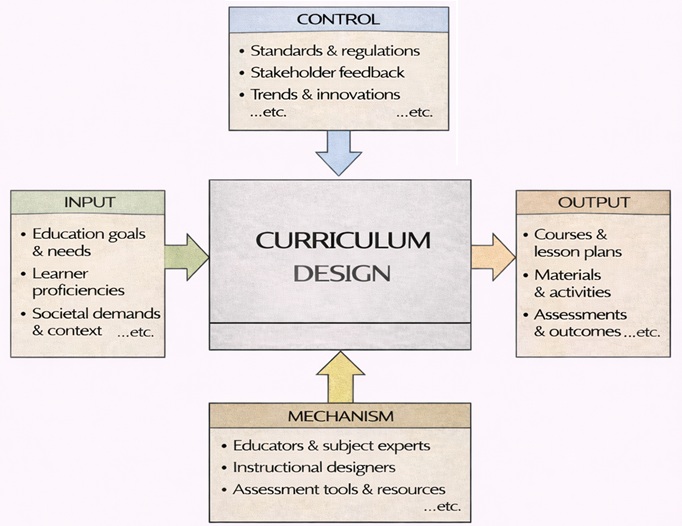
Curriculum design works like a “translation system” that turns broad educational intentions into teachable, assessable learning experiences. On the left are the inputs—the goals a program wants to achieve, what learners already know (and what they still need), and the real-world context the curriculum must serve. These inputs are shaped by controls from above: standards and regulations, stakeholder feedback (students, teachers, employers, parents), and emerging trends or innovations that affect what should be taught and how.
Inside the function, these elements are organized into a coherent pathway: learning outcomes are clarified, topics are sequenced, teaching activities are chosen, and assessments are aligned so that what is taught matches what is tested. The work is carried out by the mechanisms from below—educators and subject experts, instructional designers, and the tools/resources used to build content and assessments. The result is the output on the right: a structured set of courses and lesson plans, learning materials and activities, and assessments that reliably measure progress toward the intended outcomes.
Welcome to the Curriculum Design section of Prep4Uni.online — your trusted resource for exploring the art and science of shaping effective learning experiences. Whether designing for early childhood education or adult education and lifelong learning, curriculum development involves more than just lesson planning. It requires understanding the cognitive, emotional, and social needs of learners — a focus shared with educational psychology.
At the heart of successful educational programs is a curriculum that aligns with the goals of education and training as a whole. Effective curriculum design also considers broader institutional goals, closely tied to sound educational leadership and administration. Educators need to stay informed about emerging technologies and new pedagogical frameworks, as innovations in fields such as artificial intelligence and machine learning are rapidly transforming how students learn and engage with information.
Curriculum developers often incorporate interdisciplinary perspectives. Topics from literature and history to philosophy and liberalism and conservatism offer frameworks for critical thinking and inquiry. Such inclusions are especially valuable for preparing students for broader societal engagement and understanding global issues — themes also explored in peace studies and conflict resolution.
Modern curriculum design is increasingly data-informed and responsive to global trends. By integrating developments in information technology and technology in education, designers ensure that learning outcomes are aligned with the skills needed in today’s world. These may include fluency in natural language processing, or understanding the principles behind supervised, unsupervised, and reinforcement learning.
In applied settings, curriculum development directly supports teacher training and professional development as well as targeted programs like special education and TESOL. Designers must also account for cross-sector relevance, especially in areas like management and STEM, ensuring learners are equipped for both academic success and workforce demands. Prep4Uni.online’s commitment to inclusive and forward-thinking education can also be seen in its core mission to Prepare for Your University Studies, making curriculum design a cornerstone of educational strategy in the modern age.

Building Education Across Lifelong Pathways
Education is not a single stage but a continuous progression shaped by development, inclusion, design, and innovation. The domains below reveal how learning evolves from early foundations to advanced professional practice, forming an interconnected journey across different learner needs and societal contexts.
Focus of Curriculum Design
The primary focus of curriculum design is to create educational frameworks that guide teaching and learning processes effectively. It involves aligning educational content with learning objectives, standards, and student needs while incorporating innovative methods to enhance engagement and comprehension. Curriculum design emphasizes:
- Clear Learning Outcomes: Defining what students should know, understand, and be able to do by the end of a course or program.
- Effective Instructional Strategies: Employing diverse teaching methods to accommodate varied learning styles and promote active participation.
- Comprehensive Assessment Tools: Using formative and summative assessments to measure student progress and ensure accountability.
Curriculum design also prioritizes adaptability, allowing educators to respond to changes in educational standards, technology, and the needs of diverse learners.
Key Areas in Curriculum Design
1. Learning Outcomes
- Definition: Clear, measurable statements describing what students are expected to learn.
- Components of Effective Learning Outcomes:
- Knowledge: Understanding of specific concepts or facts.
- Skills: Practical abilities demonstrated through application.
- Attitudes: Behavioral and emotional responses developed during learning.
- Applications:
- Aligning lesson plans with overarching goals for subject mastery.
- Ensuring consistency across courses and grade levels.
- Examples:
- “Students will be able to solve quadratic equations using various methods.”
- “Students will demonstrate teamwork and problem-solving skills in group projects.”
2. Instructional Strategies
- Definition: Methods and approaches used to deliver educational content and facilitate learning.
- Popular Strategies:
- Project-Based Learning (PBL): Encouraging students to explore real-world problems and present solutions.
- Flipped Classrooms: Reversing traditional teaching by delivering lectures online and using class time for discussions and activities.
- Collaborative Learning: Promoting peer-to-peer interaction and teamwork.
- Applications:
- Enhancing engagement by integrating technology, such as interactive apps and virtual reality.
- Differentiating instruction to meet the needs of diverse learners.
- Examples:
- Using role-playing to teach historical events in social studies.
- Implementing coding projects to teach problem-solving in STEM education.
3. Assessment Tools
- Definition: Instruments and methods used to evaluate student learning and progress.
- Types of Assessments:
- Formative Assessments: Ongoing evaluations, such as quizzes and peer reviews, to provide immediate feedback.
- Summative Assessments: Comprehensive evaluations, such as final exams and capstone projects, conducted at the end of a unit or course.
- Performance-Based Assessments: Tasks like presentations, portfolios, and experiments that showcase applied knowledge.
- Applications:
- Designing rubrics that provide clear criteria for grading assignments.
- Using data from assessments to refine teaching practices and curricula.
- Examples:
- Creating a rubric for evaluating student essays on literary analysis.
- Developing online quizzes to test knowledge retention after each module.
Interactive Tool: Constructive Alignment & Cognitive Balance Calculator
Curriculum designers must ensure alignment between Learning Outcomes, Assessment Types, and Cognitive Demand (Bloom’s Taxonomy). Adjust the allocations below to simulate a unit module and check your Constructive Alignment Score.
1. Module Distribution Parameters
2. Alignment Diagnostics
Applications of Curriculum Design
1. Creating Curricula for K-12, Vocational, and Higher Education
- Overview: Curriculum design caters to diverse educational settings, ensuring age-appropriate and skill-specific content.
- Strategies for K-12:
- Incorporating interdisciplinary themes to make learning relevant and engaging.
- Emphasizing foundational skills in literacy, numeracy, and critical thinking.
- Strategies for Vocational Education:
- Aligning curricula with industry standards and workforce demands.
- Including hands-on training and apprenticeships to build practical skills.
- Strategies for Higher Education:
- Offering flexible course structures to support independent research and specialization.
- Integrating ethics and global perspectives into advanced learning programs.
- Examples:
- Designing a high school curriculum that includes STEM-focused electives.
- Developing a nursing program with clinical rotations and simulated patient care.
2. Implementing Culturally Responsive Teaching Practices
- Overview: Curriculum design increasingly emphasizes cultural relevance to reflect the diverse backgrounds of students.
- Strategies:
- Including literature, history, and examples from various cultures in course materials.
- Using instructional methods that value students’ experiences and perspectives.
- Examples:
- Incorporating Indigenous storytelling traditions into language arts lessons.
- Designing history curricula that explore global perspectives on major events.
3. Promoting Lifelong Learning and Adaptability
- Overview: Modern curricula aim to develop transferable skills that prepare students for evolving careers and societal changes.
- Strategies:
- Emphasizing critical thinking, creativity, and digital literacy.
- Incorporating career exploration and problem-solving activities.
- Examples:
- Creating courses on emerging technologies, such as artificial intelligence and renewable energy.
- Offering life skills programs that teach financial literacy and communication skills.
Emerging Trends in Curriculum Design
- Technology Integration
- Overview: Incorporating digital tools and platforms to enhance learning experiences.
- Examples:
- Using AI to create personalized learning pathways.
- Designing courses that leverage augmented reality for immersive experiences.
- Interdisciplinary Learning
- Overview: Combining subjects to encourage holistic understanding and innovation.
- Examples:
- A course that integrates environmental science, economics, and social studies.
- Project-based learning units that solve real-world problems through collaboration.
- Focus on Social-Emotional Learning (SEL)
- Overview: Including emotional intelligence, empathy, and resilience in the curriculum.
- Examples:
- Embedding mindfulness exercises into daily routines.
- Teaching conflict resolution skills through role-playing activities.
- Sustainability Education
- Overview: Preparing students to address environmental challenges through knowledge and action.
- Examples:
- Creating lessons on renewable energy and climate change.
- Promoting community-based projects on conservation and recycling.
Challenges in Curriculum Design
- Balancing Standardization and Flexibility: Aligning curricula with standards while allowing room for teacher creativity and student choice.
- Addressing Diverse Learner Needs: Designing programs that accommodate various abilities, backgrounds, and learning styles.
- Keeping Up with Technological Advances: Ensuring curricula remain relevant in the face of rapid technological change.
- Resource Constraints: Providing adequate funding, materials, and training to implement new curricula effectively.
Future Directions in Curriculum Design
- Personalized Learning Models: Tailoring content to individual student strengths, interests, and goals.
- Global Collaboration: Sharing best practices and curricula across countries to address global educational challenges.
- Focus on Equity and Inclusion: Developing programs that bridge gaps in access and achievement.
- Integration of Lifelong Learning Pathways: Connecting K-12, higher education, and adult learning in seamless, flexible frameworks.
The Benefits of Studying Curriculum Design
Understanding the Foundation of Effective Education
Curriculum design is the process of planning, organizing, and structuring educational content to promote meaningful learning. It involves determining what students should learn, how they should learn it, and how success should be measured. For students preparing for university, studying curriculum design provides valuable insight into the principles that guide instructional planning and helps them appreciate how educational systems are shaped to meet learning goals and societal needs.
Exploring How Learning Objectives Translate into Practice
A well-designed curriculum aligns learning objectives with teaching methods, assessment strategies, and learner needs. Students gain an understanding of how theory is transformed into classroom practice through scope and sequence, subject integration, and differentiated instruction. This knowledge is essential for anyone considering a future in education, training, or academic leadership, and supports deeper engagement in university coursework.
Developing Critical and Creative Thinking Skills
Designing a curriculum requires both analytical and creative thinking. Students evaluate existing programs, identify gaps, and propose improvements that are pedagogically sound and culturally relevant. These tasks foster strategic planning, innovation, and reflective thinking—skills that are valuable for academic success, group work, and future roles in education or instructional design.
Adapting to Changing Learner Needs and Technologies
Curriculum design also involves adapting educational programs to reflect emerging technologies, new research, and evolving learner needs. Students explore how to incorporate digital tools, inclusive practices, and global perspectives into learning environments. This forward-thinking approach prepares university-bound students to navigate and contribute to dynamic academic and professional contexts.
Preparing for Careers in Education, Training, and Development
A background in curriculum design opens pathways to careers in teaching, instructional coordination, corporate training, educational consulting, and policy development. It also supports advanced studies in education, psychology, and learning sciences. For students entering university, curriculum design provides both a theoretical foundation and practical skill set for shaping learning experiences that are purposeful, engaging, and impactful.
Conclusion on Curriculum Design
Curriculum design is a cornerstone of effective education, shaping how knowledge and skills are imparted to learners. By focusing on clear outcomes, innovative strategies, and robust assessments, it ensures that teaching and learning are purposeful and impactful. As education evolves to meet the needs of a diverse and rapidly changing world, curriculum design remains a vital tool for fostering adaptability, creativity, and inclusivity. Its role in preparing individuals for success in life and work underscores its importance as a driving force in global education systems.
Is Curriculum Design Right For You?
Explore career pathways, check your fit, and assess your skills — before you commit to a degree.
Frequently Asked Questions – Curriculum Design
What is curriculum design in simple terms?
Curriculum design is the process of deciding what learners should learn, why they should learn it, and how learning experiences are organised over time. It involves selecting topics, setting learning outcomes, choosing activities and resources, and planning how learning will be assessed.
How is curriculum design different from curriculum development and implementation?
Curriculum design focuses on planning the overall structure and intent of a programme—its goals, content, and learning pathways. Curriculum development adds the creation of detailed materials such as lesson plans, tasks, and assessments. Implementation is about putting the curriculum into practice in real classrooms, monitoring how it works, and adjusting it based on feedback.
Why is curriculum design important for schools and learners?
Good curriculum design helps ensure that learning is coherent, purposeful, and aligned with what learners need for further study, work, and life. A well-designed curriculum avoids random topics, reduces gaps and repetition, and makes it clearer how each subject and year level builds towards broader competencies and qualifications.
What are the main components of a well-designed curriculum?
A well-designed curriculum usually includes clear aims and learning outcomes, a sequence of topics and units, guidance on teaching and learning approaches, assessment strategies, and connections to wider skills such as critical thinking, communication, and collaboration. It also takes into account learners’ prior knowledge, local context, and available resources.
What is meant by alignment between outcomes, teaching, and assessment?
Alignment means that the learning outcomes, teaching activities, and assessments all point in the same direction. If an outcome emphasises problem-solving or teamwork, for example, then classroom tasks and assessments should also involve authentic problems and collaborative work, rather than only memorisation or multiple-choice tests.
How does curriculum design support diverse learners and inclusion?
Inclusive curriculum design considers different backgrounds, abilities, languages, and interests. It may provide multiple ways to access content, demonstrate learning, and engage in activities. It also tries to represent diverse perspectives in examples and case studies, and builds in support structures so that more learners can succeed without lowering standards.
How is technology integrated into modern curriculum design?
Modern curriculum design treats technology as more than just a tool for presentation. It looks at how digital resources, online collaboration, simulations, learning management systems, and data from learning analytics can support deeper understanding, personalisation, and flexible learning pathways while still meeting core learning outcomes.
Which school subjects provide a good foundation for studying curriculum design at university?
Helpful backgrounds include literature, languages, social studies, history, mathematics, and the sciences, because curriculum designers often work across multiple subject areas. Psychology, philosophy, or any course that discusses learning, thinking, or society also helps you understand how people learn and how education systems are organised.
What skills are important for future curriculum designers?
Curriculum designers need strong analytical and writing skills, the ability to break complex knowledge into learnable steps, and an understanding of how people learn. They also benefit from creativity, collaboration, project management, and the ability to interpret data from assessments and research to improve programmes over time.
How does curriculum design connect with assessment and feedback?
Assessment and feedback are central to curriculum design because they show whether learners are actually reaching the intended outcomes. Designers decide what evidence of learning is needed, plan a mix of formative and summative assessments, and build in opportunities for feedback so that teaching and learning can be adjusted during a course, not just judged at the end.
What careers are related to curriculum design and development?
Related careers include curriculum specialist, instructional designer, textbook or resource developer, educational technologist, assessment designer, education consultant, and roles in ministries of education, examination boards, publishing, edtech companies, and international organisations working on education reform.
How does the Curriculum Design page on Prep4Uni.online support my study and career planning?
The Curriculum Design page on Prep4Uni.online explains key ideas such as learning outcomes, alignment, inclusion, and assessment in a student-friendly way. It helps you see how theory and practice fit together and supports you in exploring university programmes and careers in education, instructional design, and education policy.
Curriculum Design Mastery Module
Section 1: Foundational Review Checkpoints
Click each question below to toggle the answer explanation.
-
What is curriculum design?
Show Answer & Explanation
Answer: Curriculum design is the systematic planning and organization of educational content, learning experiences, and assessment methods. It aims to create coherent and effective instructional programs that meet educational goals and respond to students’ needs.
-
Why is curriculum design important in modern education?
Show Answer & Explanation
Answer: Effective curriculum design ensures that educational programs are aligned with learning objectives and industry standards. It supports the development of critical thinking, problem-solving, and adaptability, which are essential skills in today’s rapidly changing world.
-
What are the key components of a well-designed curriculum?
Show Answer & Explanation
Answer: Key components include clearly defined learning objectives, organized content, appropriate teaching strategies, assessment methods, and continuous feedback mechanisms. These elements work together to ensure a structured and engaging learning experience.
-
How does curriculum design impact student learning outcomes?
Show Answer & Explanation
Answer: A thoughtfully designed curriculum provides clear pathways for learning, which can enhance student engagement and retention of knowledge. It helps students build on prior knowledge and achieve higher academic performance through a coherent and progressive instructional plan.
-
What role do educators play in curriculum design?
Show Answer & Explanation
Answer: Educators are critical in curriculum design as they bring practical insights and expertise into the planning process. Their input ensures that the curriculum is relevant, culturally responsive, and tailored to the diverse needs of learners.
-
How can technology be integrated into curriculum design?
Show Answer & Explanation
Answer: Technology can be integrated by incorporating digital tools, online resources, and interactive media to create blended learning environments. This enhances accessibility and engagement while providing opportunities for personalized instruction and real-time assessment.
-
What challenges are associated with curriculum design in today’s educational landscape?
Show Answer & Explanation
Answer: Challenges include keeping pace with rapidly evolving technologies, addressing diverse learner needs, and aligning curriculum with both national standards and local contexts. Balancing innovation with proven educational practices also poses significant challenges for educators.
-
How does curriculum design support lifelong learning?
Show Answer & Explanation
Answer: A well-designed curriculum not only meets immediate academic needs but also encourages critical thinking, adaptability, and a love of learning. These skills are essential for lifelong learning, enabling individuals to continue acquiring knowledge and skills throughout their lives.
-
What is the role of assessment in curriculum design?
Show Answer & Explanation
Answer: Assessment is integral to curriculum design as it provides feedback on student learning and the effectiveness of instructional strategies. Formative and summative assessments help educators adjust the curriculum to better meet learning objectives and address areas of weakness.
-
How can curriculum design be adapted to meet future educational trends?
Show Answer & Explanation
Answer: Curriculum design can be adapted by continuously integrating new pedagogical theories, emerging technologies, and feedback from stakeholders. This dynamic approach ensures that education remains relevant and responsive to changes in society, the job market, and technological advancements.
Section 2: Analytical & Scenario-Based Inquiry
Click each scenario below to explore detailed analytical answers.
-
How might emerging digital technologies reshape the process of curriculum design?
Show Answer & Analysis
Answer: Emerging digital technologies, such as artificial intelligence, virtual reality, and learning analytics, are transforming curriculum design by providing data-driven insights and personalized learning experiences. AI can analyze student performance data to identify learning gaps and suggest tailored instructional strategies, while virtual reality offers immersive experiences that bring abstract concepts to life.
Furthermore, digital tools facilitate collaboration among educators across different regions, leading to the sharing of best practices and innovative ideas. As a result, curriculum design becomes a more dynamic and iterative process, continuously evolving based on real-time feedback and technological advancements. -
In what ways can interdisciplinary curriculum design enhance student learning outcomes?
Show Answer & Analysis
Answer: Interdisciplinary curriculum design integrates concepts and methodologies from multiple disciplines to provide a more holistic learning experience. By connecting subjects such as science, technology, engineering, arts, and mathematics (STEAM), students gain a deeper understanding of how different fields intersect.
Moreover, interdisciplinary curricula foster collaboration and communication skills. Working in teams across diverse academic backgrounds prepares students for the interconnected nature of modern workplaces. -
How does the incorporation of cultural relevance in curriculum design benefit diverse student populations?
Show Answer & Analysis
Answer: Incorporating cultural relevance involves integrating content and perspectives that reflect students’ diverse identities and backgrounds. When students see their own cultures represented, they feel valued and motivated, leading to improved academic performance and self-esteem.
Culturally relevant curricula also build empathy and tolerance among all students, fostering an equitable classroom environment where differences are celebrated. -
What are the long-term impacts of effective curriculum design on workforce development?
Show Answer & Analysis
Answer: Effective curriculum design equips students with technical skills, critical thinking, and adaptability needed for evolving industries. Aligning education with industry standards ensures a competitive workforce that drives economic growth and innovation.
In addition, it instills lifelong learning habits, allowing professionals to upskill continuously as market demands shift over time. -
How can feedback mechanisms improve the process of curriculum design?
Show Answer & Analysis
Answer: Feedback mechanisms, including student surveys, peer evaluations, and assessment analytics, provide actionable data to identify curriculum deficiencies. This evidence enables designers to make targeted refinements rather than relying on guesswork.
It fosters a collaborative, responsive educational culture where curriculum continuously adapts to user feedback and changing needs. -
In what ways does professional development for educators impact curriculum design and student success?
Show Answer & Analysis
Answer: Ongoing training equips teachers with updated pedagogical strategies and tech competencies. Well-trained teachers implement curriculum blueprints with higher fidelity, leading to superior classroom instruction and improved student engagement and outcomes.
-
How might global educational trends influence the evolution of curriculum design in the coming decade?
Show Answer & Analysis
Answer: Global trends like competency-based progression, online learning, and cross-border accreditation force curricula to be more flexible, modular, and skill-focused rather than time-bound. Emphasizing transferable skills (e.g., cross-cultural communication) ensures learners remain globally employable.
-
What are the key challenges in aligning curriculum design with rapidly changing industry needs, and how can they be addressed?
Show Answer & Analysis
Answer: The primary challenge is the administrative latency in updating formal degree frameworks relative to rapid technological shifts. Solutions include forming industry advisory boards, integrating micro-credentials, and utilizing modular course design for quick updates.
-
How can data analytics be utilized to enhance curriculum design and improve student outcomes?
Show Answer & Analysis
Answer: Learning analytics track student interactions within digital platforms, highlighting bottleneck topics where drop-off or failure rates spike. Designers can restructure specific modules, re-sequence topics, or insert scaffolding resources based on empirical usage data.
-
In what ways can interdisciplinary curriculum design contribute to solving complex societal challenges?
Show Answer & Analysis
Answer: Complex issues like climate change or ethical AI cannot be solved by a single discipline. Interdisciplinary curricula train students to synthesize environmental science, policy, ethics, and technology to formulate systems-level solutions.
-
How might changes in educational policy influence the future development of curriculum design?
Show Answer & Analysis
Answer: Legislative mandates regarding standardized testing, digital equity, or vocational training directly dictate resource allocation and learning standards, requiring curriculum teams to re-align learning outcomes and assessment strategies to remain compliant.
-
What are the potential impacts of globalization on curriculum design in higher education?
Show Answer & Analysis
Answer: Globalization promotes international credit transferability, joint degree programs, and multicultural case studies. Universities must design curricula that meet international accreditation standards while maintaining regional relevance.
Section 3: Mathematical & Instructional Design Metrics
Quantitative evaluation and instructional load calculations for curriculum planning.
-
Calculating Total Course Credit Hours via Carnegie Units
A university curriculum requires 1 hour of direct classroom instruction and 2 hours of out-of-class student work per week for 15 weeks per credit hour. Calculate the total student workload (in hours) for a 4-credit curriculum module.
Show Full Step-by-Step Solution
Step 1: Determine weekly workload per credit hour.
Weekly Workload = Direct Instruction (1 hr) + Out-of-Class Work (2 hrs) = 3 hrs/week per credit.
Step 2: Multiply by total course credit hours.
Weekly Total for 4 Credits = 4 × 3 hrs = 12 hrs/week.
Step 3: Multiply by semester duration (15 weeks).
Total Module Workload = 12 hrs/week × 15 weeks = 180 total hours.
Answer: 180 total hours of student engagement. -
Curriculum Alignment Score Calculation
A course has 20 key learning objectives. An audit reveals that 16 objectives are directly assessed by summative tasks, 12 are explicitly taught in learning activities, and 10 meet both criteria (fully constructively aligned). Calculate the percentage of Constructively Aligned Objectives.
Show Full Step-by-Step Solution
Step 1: Identify fully aligned objectives.
Fully Aligned Objectives (Assessed + Taught) = 10 objectives.
Step 2: Calculate percentage against total course objectives.
Alignment Percentage = (10 / 20) × 100% = 50%.
Answer: The curriculum alignment score is 50%. 10 objectives require further instructional or assessment alignment. -
Formative vs. Summative Weighting Ratio
A syllabus allocates marks across 4 formative quizzes (10% each), 1 mid-term project (25%), and 1 final examination (35%). What is the ratio of Formative to Summative assessment weight?
Show Full Step-by-Step Solution
Step 1: Calculate total formative weight.
Formative Total = 4 × 10% = 40%.
Step 2: Calculate total summative weight.
Summative Total = 25% (Project) + 35% (Final Exam) = 60%.
Step 3: Determine the simplified ratio.
Ratio = 40 : 60 = 2 : 3.
Answer: The Formative to Summative ratio is 2:3 (or 40% Formative / 60% Summative). -
Cognitive Load Allocation Index
A 40-hour module allocates 10 hours to Bloom’s Level 1-2 (Remember/Understand), 18 hours to Level 3-4 (Apply/Analyze), and 12 hours to Level 5-6 (Evaluate/Create). Calculate the percentage allocated to Higher-Order Thinking Skills (HOTS, Levels 4-6) assuming Level 4 constitutes 50% of the middle tier.
Show Full Step-by-Step Solution
Step 1: Find hours allocated to Level 4 (Analyze).
Level 4 hours = 50% of 18 hours = 9 hours.
Step 2: Calculate total HOTS hours (Level 4 + Level 5-6).
HOTS Hours = 9 hrs (Level 4) + 12 hrs (Level 5-6) = 21 hours.
Step 3: Calculate percentage of total module.
HOTS Percentage = (21 / 40) × 100% = 52.5%.
Answer: 52.5% of the curriculum is focused on Higher-Order Thinking Skills. -
Student-Teacher Ratio Impact on Assessment Workload
An instructor teaches 3 cohort sections with 45 students each. The curriculum includes 5 detailed essay assessments per student, each taking 15 minutes to grade with rubric feedback. Calculate the instructor’s total grading workload in hours.
Show Full Step-by-Step Solution
Step 1: Calculate total number of students.
Total Students = 3 × 45 = 135 students.
Step 2: Calculate total essays submitted.
Total Essays = 135 students × 5 essays = 675 essays.
Step 3: Calculate total time in minutes and hours.
Total Minutes = 675 × 15 mins = 10,125 minutes.
Total Hours = 10,125 / 60 = 168.75 hours.
Answer: Total grading load is 168.75 hours per term. -
Bloom’s Taxonomy Assessment Balance Ratio
A test blueprint contains 60 total questions. 18 questions measure Knowledge/Comprehension, 24 measure Application/Analysis, and 18 measure Evaluation/Synthesis. Calculate the proportion of the assessment devoted to middle and upper cognitive tiers combined.
Show Full Step-by-Step Solution
Step 1: Sum items in middle and upper cognitive tiers.
Middle + Upper Items = 24 (App/Ana) + 18 (Eval/Syn) = 42 questions.
Step 2: Divide by total test items.
Proportion = 42 / 60 = 0.70 = 70%.
Answer: 70% of the exam measures application-level or higher cognitive skills. -
Curriculum Revision Cycle Depreciation Rate
In a fast-evolving computer science field, a curriculum loses relevance at a decay rate of 15% per year if not updated. Calculate the percentage of valid, relevant content remaining after 3 years without updates.
Show Full Step-by-Step Solution
Step 1: Use the annual decay multiplier formula.
Multiplier = (1 – 0.15) = 0.85 per year.
Step 2: Calculate compound retention over 3 years.
Retention = (0.85)3 = 0.85 × 0.85 × 0.85 = 0.614125.
Step 3: Convert to percentage.
Percentage Remaining = 0.614125 × 100% ≈ 61.41%.
Answer: 61.41% of the original content remains fully relevant after 3 years.