
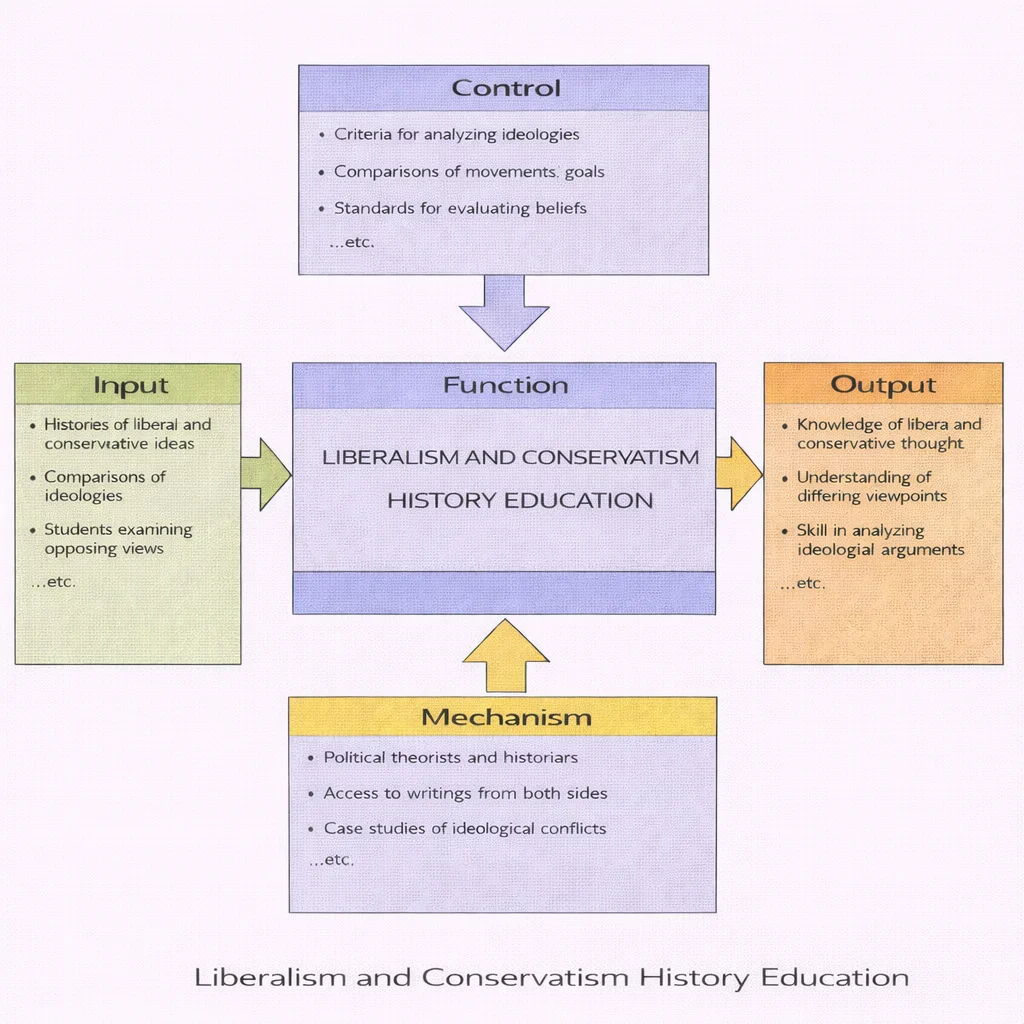
Liberalism and Conservatism History Education, as represented in the diagram below, turns historical material into disciplined understanding. The inputs—key texts, turning points, and contrasting traditions of liberal and conservative thought—enter the learning process alongside students’ own efforts to read, question, and compare. The controls act like intellectual guardrails: criteria for analyzing ideologies, standards for evaluating beliefs, and structured comparisons that prevent discussion from becoming mere slogans. The mechanisms—historians and political theorists, curated access to writings from both sides, and vivid case studies of ideological conflicts—provide the tools and context that make careful interpretation possible. When these elements work together, the outputs are not just facts, but a clearer grasp of how liberal and conservative ideas developed, why viewpoints diverge, and how to analyze ideological arguments with fairness, precision, and historical awareness.
Liberalism and conservatism have shaped the foundations of modern political discourse, governance, and policy across the globe. These two broad traditions, though differing in principles, both emerged in response to historical upheavals and evolving concepts of authority, liberty, and responsibility. A solid grounding in history allows us to trace their evolution from Enlightenment-era writings to contemporary movements, elections, and policymaking.
The rise of political ideologies such as liberalism and conservatism was closely tied to transformations in the history of economic thought and debates over the role of the state in markets, trade, and taxation. These frameworks have shaped legislation on labor and social policy and continue to influence modern economic agendas. Related perspectives are found in labor history and trade and commerce history, where political movements often reflected the underlying ideological battles of their time.
Exploring intellectual political history reveals how thinkers and public figures articulated competing visions of governance. These views were often presented during major political campaigns, shaped by ideological leanings, and spread through changing communication systems, as seen in the role of technology in elections.
Historically, liberalism has emphasized individual rights, constitutionalism, and secular governance, while conservatism has often emphasized tradition, continuity, inherited institutions, and national stability. These orientations were tested during periods of social upheaval, such as the history of social movements and suffrage and civil rights movements. One can trace the social undercurrents of these ideologies within social history and women’s history, which highlight how citizens across time have negotiated authority, autonomy, reform, and belonging.
Geopolitical events such as revolutions, colonialism, and wars also placed liberal and conservative principles under scrutiny. The development of global alliances and statecraft, covered in history of alliances and treaty analysis, reflects how ideological leanings guided foreign policy decisions. Similarly, the impact of conflict is explored in military strategic studies, naval history, and guerrilla warfare and insurgency studies.
Liberal and conservative worldviews also intersect in ethical frameworks and peacebuilding efforts, especially as addressed in peace studies and conflict resolution. These perspectives inform governance at every level—from the ideals upheld in constitutions to the cultural narratives maintained in social and cultural history of warfare and the socioeconomic conditions of urban and rural history.
Understanding the interplay between these two schools of thought requires reflection on their historical champions and critics, many of whom are profiled in political biography. Their legacies help students make sense of ideological continuity and change, particularly as contemporary debates remain deeply rooted in long-standing liberal and conservative traditions.
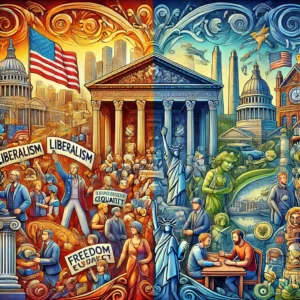
This vivid, divided scene presents liberalism and conservatism as parallel ways of thinking about political life. The left side is energetic and crowded, showing public mobilization, banners about freedom and equality, and civic symbols that suggest reform, expanded rights, and social change. The right side feels more orderly and institution-focused, featuring formal buildings, deliberation, and symbols of continuity that suggest tradition, stability, and gradual change. Shared imagery—such as legislatures, national monuments, and public spaces—highlights that both traditions operate within constitutional frameworks, but differ in what they prioritize and how they approach change.
Curriculum Cluster Navigation
Contextualize modern ideological traditions within the broader roadmap of intellectual political history:
Intellectual Political History – Hub
Strategic Context: Parent Overview. Maps the complete historical evolution of political philosophy from antiquity to modern state systems.
Ancient Political Philosophy
Strategic Context: Classical Foundations. Explores early Greco-Roman concepts of justice and civic virtue that informed later ideological developments.
Religious Political Thought
Strategic Context: Spiritual Authority. Examines theological frameworks of order and divine legitimacy that paralleled early conservative and liberal debates.
Revolutionary Thought
Strategic Context: Radical Upheaval. Analyzes radical challenges to established regimes, providing the catalyst against which modern conservatism formulated its defense of tradition.
Global Political Thought
Strategic Context: Cross-Cultural Perspectives. Broadens ideological analysis beyond Western contexts by comparing liberal and conservative traditions with global intellectual systems.
Balancing Change and Tradition: Liberalism and Conservatism
Modern political life is shaped by enduring debates between change and continuity. Liberalism emphasizes individual rights, freedom, and reform, while conservatism values tradition, stability, and gradual evolution. Together, these ideologies define much of contemporary political discourse and institutional design.
Key Tenets of Liberalism and Conservatism
Liberalism
Liberalism is founded on the principles of individual freedom, equality, and rationality. It promotes limited government and the protection of natural rights, often emphasizing progress and reform.
Core Principles of Liberalism
- Individual Rights: Each person is entitled to fundamental rights, such as freedom of speech, religion, and property. (Example: John Locke’s assertion of natural rights to “life, liberty, and property” shaped liberal thought.)
- Equality: Advocates for equal treatment under the law and equal opportunities for all individuals. (Example: The liberal push for universal suffrage reflects this principle.)
- Democracy and Popular Sovereignty: Governments derive legitimacy from the consent of the governed. (Example: The American and French Revolutions were inspired by liberal ideals of self-governance.)
- Progress and Reform: Supports societal advancement through rationality, education, and innovation.
Conservatism
Conservatism emphasizes preserving tradition, valuing social stability, and promoting gradual change rather than radical reform. It often prioritizes inherited institutions, communal responsibility, and continuity over rapid transformation.
Core Principles of Conservatism
- Tradition and Continuity: Views established institutions and customs as foundations of societal stability. (Example: Edmund Burke praised the British monarchy and parliamentary system as stabilizing forces.)
- Skepticism of Radical Change: Argues that abrupt transformations can disrupt social harmony and produce unintended consequences. (Example: Burke’s critique of the French Revolution focused on its violent and destabilizing nature.)
- Hierarchy and Order: Accepts some forms of social hierarchy as historically developed and sometimes necessary for maintaining order.
- Community and Responsibility: Emphasizes social cohesion, duty, and collective responsibility alongside individual freedom.
Historical Development of Liberalism and Conservatism
Liberalism
Liberalism emerged during the Enlightenment, especially in the 17th and 18th centuries, drawing on ideas about natural rights, reason, consent, and the rejection of absolute authority.
Key Thinkers in Liberalism
- John Locke (1632–1704): Argued for the protection of natural rights and the necessity of limited government in Two Treatises of Government. Advocated for a social contract in which governments exist to serve the people, who retain the right to resist oppressive rulers.
- Jean-Jacques Rousseau (1712–1778): Emphasized popular sovereignty and the collective will in The Social Contract.
- Adam Smith (1723–1790): Promoted economic liberalism, arguing for free markets and limited state intervention in The Wealth of Nations.
Conservatism
Conservatism emerged partly as a reaction to liberal and revolutionary movements, especially the French Revolution of 1789. It emphasized the importance of maintaining social order, respecting historical continuity, and reforming institutions cautiously rather than destroying them abruptly.
Key Thinkers in Conservatism
- Edmund Burke (1729–1797): In Reflections on the Revolution in France, Burke criticized the revolution’s radicalism and argued for incremental change rooted in tradition. Advocated for maintaining established institutions, which he saw as repositories of collective wisdom.
- Joseph de Maistre (1753–1821): Defended monarchy and religious authority as pillars of social order.
- Alexis de Tocqueville (1805–1859): While analyzing democracy in America, Tocqueville acknowledged its strengths but warned against the risks of excessive individualism undermining social cohesion.
Examples of Liberalism and Conservatism in Action
Liberalism: The American Revolution
- Context: Inspired by Enlightenment ideals, American colonists sought independence from British rule, emphasizing liberty and self-governance.
- Key Liberal Features: The Declaration of Independence (1776) drew on Locke’s principles, asserting the right to “life, liberty, and the pursuit of happiness.” The U.S. Constitution established a democratic framework with protections for individual rights.
Conservatism: The British Response to Revolution
- Context: Edmund Burke viewed the American Revolution as a legitimate struggle for self-governance but criticized the radicalism of the French Revolution.
- Conservative Principles: Emphasized gradual reform and the preservation of Britain’s constitutional monarchy as a stabilizing institution.
Post-Revolutionary France: Liberalism Versus Conservatism
- Context: The French Revolution sparked debates between liberal advocates for democracy and conservative defenders of monarchy.
- Key Outcomes: Liberal ideals led to the abolition of feudal privileges and the Declaration of the Rights of Man and of the Citizen in 1789. Conservative backlash culminated in Napoleon’s rise and the eventual restoration of the Bourbon monarchy.
Impact of Liberalism and Conservatism on Modern Democracies
Liberalism
Liberalism laid the foundation for many modern democratic principles, including constitutionalism, universal suffrage, civil liberties, and human rights.
- Examples: The Universal Declaration of Human Rights (1948) reflects liberal ideals of equality and individual freedom. Liberal reforms in the 19th and 20th centuries, such as labor rights and gender equality, expanded democratic participation.
Conservatism
Conservatism has shaped the evolution of political systems by emphasizing stability, gradual change, institutional continuity, and the importance of tradition.
- Examples: The British Conservative Party has historically supported gradual social reform, such as extending suffrage in the 19th century, while preserving key institutions like the monarchy and the Church of England. In the United States, conservatism has influenced debates on states’ rights, free-market policies, constitutional interpretation, and the role of government in social life.
Liberalism and Conservatism in Dialogue
Complementary Roles
Although liberalism and conservatism are often viewed as oppositional, they can also complement each other by balancing progress with stability. Liberalism often presses societies to expand rights and reform unjust institutions, while conservatism asks whether change preserves social trust, inherited wisdom, and institutional continuity.
- Example: In post-war Europe, liberal economic policies combined with conservative emphasis on social cohesion to rebuild societies.
Contemporary Debates
Modern democracies continue to grapple with the tension between liberal and conservative principles. These debates are not merely abstract; they shape policies affecting welfare, education, healthcare, national identity, civil liberties, taxation, and public morality.
- Examples: Debates over government intervention in healthcare and education often pit liberal calls for equality against conservative concerns about individual responsibility and fiscal prudence. Social issues such as same-sex marriage highlight the liberal emphasis on rights and equality alongside conservative concern for tradition, continuity, and social norms.
Challenges and Criticisms of Liberalism and Conservatism
Liberalism
- Challenges: Excessive individualism can undermine community cohesion and shared responsibility. Economic liberalism has been criticized for perpetuating inequality and prioritizing profit over social welfare.
Conservatism
- Challenges: Resistance to change can hinder necessary reforms and perpetuate systemic injustices. Overemphasis on tradition may marginalize progressive movements advocating for rights and equality.
Interactive Ideological Trade-off Simulator
Use the interactive tool below to simulate how shifts in state intervention and social tradition impact overall economic growth, social stability, and individual autonomy within a democratic model.
Liberal vs. Conservative Policy Trade-off Simulator
Adjust the sliders below to calibrate the balance between State Welfare Intervention and Traditional Social Order.
Interactive Review Questions
Toggle each box below to reveal detailed answers and analytical commentary on key ideological differences:
How does John Locke's concept of the social contract differ from Edmund Burke's view of society?
Why did Edmund Burke sharply criticize the French Revolution while supporting the American Revolution?
What distinguishes classical liberalism from modern welfare liberalism?
Frequently Asked Questions
What is liberalism in political thought?
Liberalism is a family of political ideas that emphasizes individual rights, freedom of conscience, the rule of law, and limits on state power to protect personal autonomy.
What is conservatism in political thought?
Conservatism is a tradition stressing the value of continuity, inherited institutions, social order, and skepticism about rapid or radical change.
How did liberalism emerge historically?
Liberalism developed in early modern Europe during the Enlightenment in response to religious conflict, absolute monarchy, and mercantilism.
How did conservatism emerge historically?
Conservatism emerged as a direct reaction to the French Revolution and the destabilizing social changes of industrialization.
What are the main differences between liberalism and conservatism?
Liberalism prioritizes individual autonomy and reform, whereas conservatism gives greater weight to institutional continuity, tradition, and social stability.
Can liberal and conservative ideas be combined?
Yes. Currents like liberal conservatism fuse market capitalism and individual rights with support for traditional social institutions and gradual reform.
Why do liberal and conservative labels vary globally?
Because they are historical traditions shaped by unique national conflicts, institutional structures, and local political cultures.
Comprehensive Mastery & Exercise Module
Section 1: Foundational Review Questions
-
What is liberalism and what are its core principles?
Answer: Liberalism is a political ideology emphasizing individual freedom, civil liberties, the rule of law, popular sovereignty, and limited government intervention, designed to protect personal autonomy and foster societal progress. -
What is conservatism and how does it differ from liberalism?
Answer: Conservatism is an ideology valuing tradition, social stability, and gradual change through inherited institutions. Unlike liberalism's focus on individual rights and rapid reform, conservatism emphasizes social cohesion, duty, and skepticism of radical transformation. -
How did historical context influence the development of liberalism?
Answer: Liberalism developed during the Enlightenment and the Industrial Revolution, driven by the rejection of absolute monarchy, religious intolerance, and mercantilism in favor of natural rights and free markets. -
How did historical context influence the development of conservatism?
Answer: Conservatism emerged as a reaction against the violent radicalism of the French Revolution and industrial disruption, arguing that established institutions embody accumulated wisdom necessary for social order. -
What are the key differences between liberal and conservative approaches to governance?
Answer: Liberals favor state intervention to promote social equality and civil rights, whereas conservatives advocate for free markets, fiscal restraint, strong national defense, and the preservation of traditional social norms. -
How have liberal and conservative ideologies evolved over time?
Answer: Liberalism expanded from classical laissez-faire to welfare-state social liberalism, while conservatism adapted to modern democracy by embracing constitutionalism, free markets, and incremental reform. -
In what ways have key thinkers shaped the debate between liberalism and conservatism?
Answer: Thinkers like John Locke and Adam Smith established the intellectual bedrock for individual rights and free markets, while Edmund Burke and Joseph de Maistre provided the philosophical framework for traditional conservatism. -
How do liberalism and conservatism influence policy-making in modern democracies?
Answer: They provide competing legislative priorities—liberals pushing for civil rights expansion and welfare programs, and conservatives advocating for institutional stability, tax cuts, and regulatory restraint. -
What criticisms are commonly leveled against liberal and conservative ideologies?
Answer: Liberalism is criticized for excessive individualism and bureaucratic overregulation; conservatism is criticized for resisting necessary social reforms and maintaining hierarchical injustices. -
How does the interplay between liberalism and conservatism reflect intellectual political history?
Answer: It exemplifies the enduring dialectic between change and continuity, demonstrating how societies continuously negotiate the tension between innovation and institutional stability.
Section 2: Analytical & Scenario-Based Challenges
-
How have the historical trajectories of liberalism and conservatism informed contemporary political polarization?
Answer: Contemporary polarization is amplified when ideological factions treat liberalism and conservatism as absolute zero-sum moral conflicts rather than complementary governance principles. Historical entrenchment over economic redistribution and social values hardens partisan identities, reducing bipartisan compromise. -
Analyze how economic crises shift the balance of power between liberal welfare interventions and conservative fiscal austerity.
Answer: Economic meltdowns (such as the 2008 financial crisis) typically discredit unbridled free-market orthodoxy, prompting a temporary swing toward liberal state intervention and stimulus. Conversely, prolonged sovereign debt crises often trigger conservative backlashes emphasizing spending cuts, deregulation, and fiscal austerity. -
How do digital echo chambers and social media algorithms distort traditional liberal and conservative discourse?
Answer: Algorithms reward emotional outrage and ideological conformity over nuanced debate. This isolates liberals and conservatives into insular information silos, caricaturing opposing viewpoints and eroding the shared factual baseline required for democratic deliberation. -
Evaluate the tension between individual autonomy (liberalism) and communal moral order (conservatism) regarding public health mandates.
Answer: During public health emergencies, liberalism prioritizes bodily autonomy and individual liberty against state mandates. Conservatism prioritizes collective welfare, public order, and deference to established public health authorities to preserve community survival and social stability. -
How does globalization challenge traditional national conservatism while energizing cosmopolitan liberalism?
Answer: Globalization erodes national borders, cultural homogeneity, and domestic manufacturing—core concerns for nationalists and traditional conservatives. Simultaneously, it aligns with liberal cosmopolitanism, which champions open borders, multiculturalism, and transnational institutional cooperation. -
In what ways do emerging social movements (e.g., environmentalism) force both liberalism and conservatism to revise their core tenets?
Answer: Environmental crises force liberals to expand state regulation beyond civil rights into ecological management, while challenging conservatives to reconcile free-market growth with the conservative stewardship of inherited natural landscapes. -
How can a democratic system synthesize liberal reform with conservative stability to prevent revolutionary upheaval?
Answer: By ensuring that institutional reforms occur incrementally through constitutional channels, satisfying demands for justice (liberal) without discarding the legal and procedural safeguards that guarantee social order (conservative).
Section 3: Quantitative Ideological & Legislative Calculations
-
In a legislative assembly of 500 seats, Party A (Liberal) holds 210 seats, Party B (Conservative) holds 190 seats, and Party C (Centrist) holds 100 seats. A constitutional amendment requires a 2/3 supermajority. Calculate: (a) Exact votes required to pass, and (b) The minimum number of cross-party seats Party A must secure from Parties B and C to reach the supermajority.
Answer:
(a) Supermajority = (2 / 3) × 500 = 333.33 → 334 votes required.
(b) Party A current seats = 210. Shortfall = 334 - 210 = 124 seats needed from Parties B and C. -
An economic reform package proposes shifting tax brackets: high-income earners face a tax rate increase from 35% to 42% on taxable income exceeding $200,000. Calculate the exact additional tax revenue generated from a cohort of 15,000 taxpayers, assuming each taxpayer has an average taxable income of $350,000 above the $200,000 threshold.
Answer:
Taxable income subject to increase per taxpayer = $350,000 - $200,000 = $150,000.
Previous tax per taxpayer at 35% = $150,000 × 0.35 = $52,500.
New tax per taxpayer at 42% = $150,000 × 0.42 = $63,000.
Additional tax per taxpayer = $63,000 - $52,500 = $10,500.
Total additional revenue = 15,000 taxpayers × $10,500 = $157,500,000 ($157.5 million). -
In a public opinion poll of 2,400 registered voters regarding welfare reform, 58% express support for expanding state-funded social safety nets. Calculate the 95% margin of error using formula: 1.96 × sqrt((p × (1 - p)) / n).
Answer:
p = 0.58, n = 2400.
p × (1 - p) = 0.58 × 0.42 = 0.2436.
Standard error = sqrt(0.2436 / 2400) = sqrt(0.0001015) ≈ 0.01007.
Margin of Error = 1.96 × 0.01007 = 0.01974 or ±1.97%. -
A conservative fiscal policy reduces government spending by 15% across a $40,000,000 public budget. If 60% of the budget was allocated to fixed administrative overhead (which cannot be cut) and the remainder to variable public programs, calculate the required percentage cut applied exclusively to the variable programs to achieve the 15% total budget reduction.
Answer:
Total budget = $40,000,000.
Target total reduction = 0.15 × $40,000,000 = $6,000,000.
Fixed overhead (60%) = $40,000,000 × 0.60 = $24,000,000 (cut = $0).
Variable programs (40%) = $40,000,000 × 0.40 = $16,000,000.
Required cut percentage on variable budget = ($6,000,000 / $16,000,000) × 100 = 37.5% reduction. -
Calculate the Index of Ideological Disproportionality (Gallagher Index) for an election where a Liberal Party wins 48% of the popular vote and 56% of parliamentary seats, while a Conservative Party wins 52% of the popular vote and 44% of seats. Formula: sqrt(0.5 × ∑(Vi - Si)2).
Answer:
Liberal Difference = 48 - 56 = -8. Squared = 64.
Conservative Difference = 52 - 44 = +8. Squared = 64.
Sum of squared differences = 64 + 64 = 128.
Gallagher Index = sqrt(0.5 × 128) = sqrt(64) = 8.0. -
In a polarized electorate of 3,000,000 voters, 45% identify as firmly Liberal, 40% as firmly Conservative, and 15% as Independent. If 80% of Liberals, 85% of Conservatives, and 50% of Independents turn out to vote, calculate the total number of actual votes cast and the effective vote share percentage obtained by the Conservative bloc.
Answer:
Liberal voters = 3,000,000 × 0.45 × 0.80 = 1,080,000 votes.
Conservative voters = 3,000,000 × 0.40 × 0.85 = 1,020,000 votes.
Independent voters = 3,000,000 × 0.15 × 0.50 = 225,000 votes.
Total votes cast = 1,080,000 + 1,020,000 + 225,000 = 2,325,000 votes.
Conservative vote share percentage = (1,020,000 / 2,325,000) × 100 = 43.87%. -
A social welfare grant program distributes $500 per month to low-income households. Following a liberal policy expansion, recipient eligibility is broadened by 30%, increasing the total recipient pool from 40,000 to 52,000 households. Calculate the exact annual budgetary increase required to sustain the expanded program.
Answer:
Initial monthly cost = 40,000 × $500 = $20,000,000.
New monthly cost = 52,000 × $500 = $26,000,000.
Monthly increase = $26,000,000 - $20,000,000 = $6,000,000.
Annual budgetary increase = $6,000,000 × 12 = $72,000,000 ($72 million).