
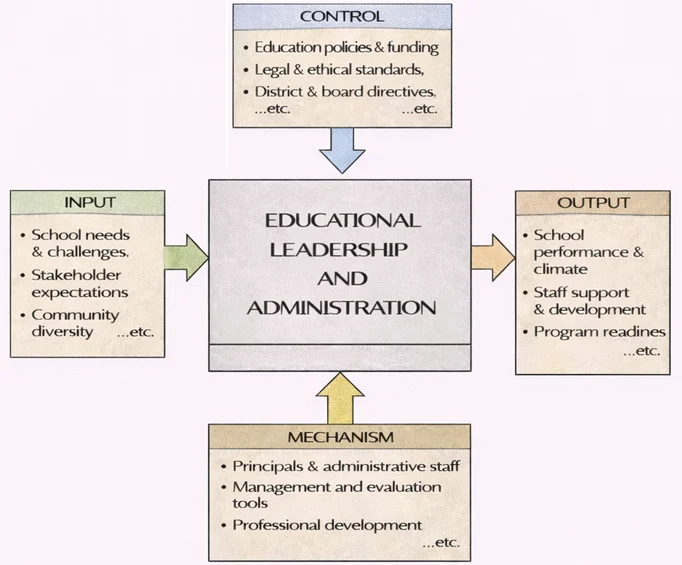
Educational Leadership and Administration can be viewed as a practical “coordination function” that turns a school’s everyday realities into steady improvement. In the diagram, the inputs are the needs and challenges within the school, the expectations of students, parents, and staff, and the diversity of the community being served. These inputs do not flow freely—they are shaped by controls such as education policies and funding rules, legal and ethical standards, and district or board directives, which define what is allowed, required, and prioritized.
The work is carried out through mechanisms: principals and administrative teams, management and evaluation tools (planning, budgeting, performance review, feedback systems), and ongoing professional development that strengthens leadership capacity. When these mechanisms operate well under clear controls, the outputs are visible: a healthier school climate and stronger performance, better-supported and better-developed staff, and programs that are more ready to meet learning goals and adapt to new demands.
Welcome to the Educational Leadership and Administration section of Prep4Uni.online — your trusted guide for exploring the dynamic world of educational leadership. In today’s rapidly evolving educational landscape, effective leadership and administration are pivotal in shaping institutions that foster learning, innovation, and equity.
Educational leaders are tasked with creating environments that support both teaching excellence and student achievement. This involves a deep understanding of curriculum design, ensuring that educational programs meet diverse learner needs. Incorporating insights from educational psychology allows leaders to implement strategies that enhance student engagement and motivation.
The integration of technology in education has transformed administrative processes and classroom instruction. Leaders must stay abreast of emerging technologies to make informed decisions about resource allocation and pedagogical approaches. Understanding information technology systems is essential for managing data, facilitating communication, and supporting digital learning platforms.
In the realm of policy and governance, educational administrators must navigate complex frameworks and regulations. A solid foundation in management principles is crucial for effective decision-making and organizational leadership. Engaging with disciplines such as philosophy and history can provide valuable perspectives on ethical considerations and the evolution of educational systems.
Leaders must also be attuned to the needs of diverse learner populations. Expertise in special education and TESOL equips administrators to develop inclusive policies and programs that support all students. Promoting teacher training and professional development ensures that educators are prepared to meet the challenges of modern classrooms.
Furthermore, educational leaders play a pivotal role in fostering a culture of continuous improvement and lifelong learning. By championing initiatives in adult education and lifelong learning, they extend the impact of educational institutions beyond traditional boundaries. Engagement with literature and liberalism and conservatism can enrich leaders’ understanding of cultural and ideological influences on education.
In an era where data-driven decision-making is paramount, familiarity with artificial intelligence and machine learning becomes increasingly important. Knowledge of natural language processing, reinforcement learning, supervised machine learning, and unsupervised machine learning can empower leaders to harness analytics for improving educational outcomes.
At Prep4Uni.online, we are committed to supporting current and aspiring educational leaders in navigating the complexities of administration and leadership. Our resources are designed to provide comprehensive insights and practical tools to foster environments where educators and students thrive.

Designing, Guiding, and Sustaining Education Systems
Education operates through structures that organise learning, guide instruction, and sustain long-term development. The domains below highlight how systems are designed, controlled, and continuously refined—from foundational learning environments to institutional leadership and evolving professional practice.
Focus of Educational Leadership and Administration
The primary focus of educational leadership is to equip individuals with the skills and knowledge needed to manage and inspire within educational environments. This involves:
- Strategic Vision: Establishing goals and aligning resources to meet the needs of students and educators.
- Policy Implementation: Translating educational policies into actionable plans that improve outcomes.
- Community Engagement: Building partnerships among stakeholders, including parents, educators, and local organizations.
Educational leadership also emphasizes fostering inclusivity, supporting professional development, and maintaining accountability to create environments where both educators and students can thrive.
Key Areas in Educational Leadership and Administration
1. Policy and Governance
- Definition: Developing and implementing policies that ensure equitable and effective education systems.
- Key Responsibilities:
- Crafting policies that address access, quality, and accountability.
- Navigating local, state, and federal regulations.
- Advocating for educational equity and inclusivity.
- Applications:
- Establishing guidelines for teacher evaluations and student assessments.
- Developing frameworks to support underserved communities.
- Examples:
- Designing anti-bullying policies to create safe school environments.
- Implementing initiatives to reduce achievement gaps among different student demographics.
2. Financial Management
- Definition: Allocating and managing financial resources to support educational goals and student success.
- Key Responsibilities:
- Budget planning and allocation to ensure resources meet institutional needs.
- Securing funding through grants, partnerships, and fundraising.
- Ensuring transparency and accountability in financial operations.
- Applications:
- Funding professional development programs for teachers.
- Investing in technology to enhance digital learning.
- Examples:
- Allocating resources for infrastructure improvements, such as modernizing classrooms.
- Managing scholarship funds to support low-income students.
3. Staff Development
- Definition: Training and supporting educators to enhance their professional skills and effectiveness.
- Key Responsibilities:
- Organizing workshops and training sessions on pedagogy and curriculum design.
- Encouraging collaborative practices and peer mentorship.
- Evaluating teacher performance and providing constructive feedback.
- Applications:
- Offering leadership training programs for aspiring principals or department heads.
- Providing resources for educators to integrate technology into their teaching.
- Examples:
- Hosting diversity and inclusion workshops for school staff.
- Implementing mentorship programs for new teachers to ease their transition.
Interactive Simulator: Institutional Resource Allocation & Performance Modeler
Simulate how adjusting budget allocations across instruction, technology, and support services affects total institutional operating expenditure and calculated per-student support levels.
Applications of Educational Leadership and Administration
1. Leading Schools as Principals, Deans, or Superintendents
- Overview: Educational leaders manage the daily operations of schools and districts, ensuring academic and administrative excellence.
- Responsibilities:
- Overseeing curriculum implementation and student outcomes.
- Managing faculty, staff, and student affairs.
- Fostering a positive and inclusive school culture.
- Examples:
- A principal introducing restorative justice practices to address student discipline.
- A superintendent launching district-wide STEM initiatives to enhance career readiness.
2. Advocating for Systemic Improvements in Education
- Overview: Leaders in education influence policy changes and drive systemic reforms to enhance learning environments.
- Responsibilities:
- Collaborating with policymakers to develop equitable funding models.
- Championing initiatives that promote digital literacy and access to technology.
- Examples:
- Advocating for increased teacher salaries to attract and retain talent.
- Partnering with community organizations to provide after-school programs for at-risk youth.
3. Fostering Innovation in Teaching and Learning
- Overview: Educational leaders introduce and support innovative practices to enhance instruction and engagement.
- Strategies:
- Encouraging project-based and experiential learning approaches.
- Investing in professional development for teachers to adopt new teaching methods.
- Examples:
- Implementing flipped classrooms to encourage active learning.
- Using data analytics to personalize learning and track student progress.
Emerging Trends in Educational Leadership and Administration
Technology Integration
- Overview: Leaders are increasingly leveraging technology to improve educational management and teaching practices.
- Examples:
- Using learning management systems (LMS) to track academic performance.
- Implementing AI tools for personalized learning and administrative efficiency.
Focus on Equity and Inclusion
- Overview: Ensuring all students, regardless of background, have access to quality education.
- Examples:
- Developing bilingual education programs to support non-native speakers.
- Addressing digital divides through initiatives like one-to-one device programs.
Sustainability in Education
- Overview: Promoting environmentally sustainable practices within schools and curricula.
- Examples:
- Establishing green school initiatives, such as energy-efficient buildings.
- Incorporating sustainability education into science and social studies classes.
Collaborative Leadership Models
- Overview: Moving from hierarchical structures to team-based approaches.
- Examples:
- Creating leadership teams to share decision-making responsibilities.
- Encouraging teacher leadership roles in curriculum development.
Challenges in Educational Leadership and Administration
- Budget Constraints: Managing limited resources while meeting the diverse needs of students and staff.
- Teacher Retention and Recruitment: Addressing teacher shortages and ensuring job satisfaction to retain skilled educators.
- Evolving Educational Standards: Keeping up with changing curricula and assessment requirements.
- Balancing Stakeholder Expectations: Navigating the often-conflicting demands of parents, teachers, policymakers, and students.
- Technological Adaptation: Ensuring all educators and students have access to and can effectively use digital tools.
Future Directions in Educational Leadership and Administration
- Data-Driven Decision Making: Using analytics to inform policies and strategies for improved student outcomes.
- Global Collaboration: Learning from international best practices to address local educational challenges.
- Focus on Mental Health and Well-Being: Incorporating programs that support the mental health of students and educators.
- Leadership for Hybrid and Online Education: Preparing leaders to manage virtual learning environments effectively.
- Community Engagement and Partnerships: Building stronger connections between schools and their communities to foster support and collaboration.
Why Study Educational Leadership and Administration
Understanding the Structure and Governance of Educational Institutions
Educational leadership and administration focus on how schools, colleges, and learning organizations are managed, guided, and improved. Students learn how policies are developed, how resources are allocated, and how decisions are made at the institutional level. For those preparing for university, this field provides essential insight into the organizational frameworks that support teaching and learning across all levels of education.
Exploring the Role of Leaders in Shaping Educational Outcomes
Effective leadership is a key driver of school improvement, student achievement, and teacher development. Students examine how educational leaders foster vision, culture, and accountability within institutions. By understanding how leadership influences outcomes, students preparing for university gain a deeper appreciation of the importance of strategic planning, staff support, and stakeholder engagement in creating high-performing educational environments.
Developing Communication, Decision-Making, and Management Skills
Educational administrators must be skilled in leading teams, resolving conflicts, managing change, and communicating clearly with diverse audiences. Through case studies and leadership theory, students develop essential skills in delegation, supervision, and community relations. These transferable skills enhance their ability to lead group projects, manage responsibilities, and work collaboratively during their university studies.
Engaging with Education Policy, Equity, and Reform
Leadership in education is deeply connected to broader social and policy issues. Students explore topics such as equity in education, curriculum reform, inclusive practices, and accountability measures. This helps them critically analyze how educational policies affect learners, teachers, and communities, and prepares them to advocate for positive change in future academic or professional roles.
Preparing for Careers in Educational Leadership and Public Service
A foundation in educational leadership and administration opens doors to careers as school principals, academic coordinators, education policymakers, nonprofit directors, and higher education administrators. It also supports further studies in education management, public policy, or leadership development. For students preparing for university, this field offers the opportunity to become thoughtful, ethical leaders dedicated to transforming education and empowering others.
Educational Leadership and Administration: Conclusion
Educational leadership and administration are essential for ensuring the success of schools and broader educational systems. By focusing on policy, resource management, and staff development, leaders create environments where students and educators can thrive. As the field evolves to address new challenges and embrace emerging trends, educational leadership remains at the forefront of innovation and equity in education. Through strategic vision and collaborative efforts, these leaders are shaping the future of education, preparing learners for success in an ever-changing world.
Is Educational Leadership Right For You?
Explore career pathways, check your fit, and assess your skills — before you commit to a degree.
Frequently Asked Questions – Educational Leadership and Administration
What is educational leadership and administration in simple terms?
Educational leadership and administration focus on how schools, colleges, and education systems are guided, organised, and improved. It includes the work of principals, heads of department, system leaders, and policy makers who set direction, support teachers, manage resources, and create conditions for effective teaching and learning.
How is educational leadership different from general management?
Educational leadership shares some tools with general management, such as planning, budgeting, and staff development, but it is rooted in educational values and learning goals. Educational leaders focus not only on efficiency, but also on student outcomes, equity, professional culture, and the wider mission of education in society.
Why is educational leadership and administration important for school quality?
Research consistently shows that school leadership is one of the most important in-school factors influencing student learning, after classroom teaching. Strong educational leadership sets a clear vision, supports teacher collaboration, uses data thoughtfully, and creates a safe, inclusive climate where students and staff can thrive.
What does an educational leader typically do in their daily work?
Educational leaders balance many roles: they shape school vision and goals, observe teaching and give feedback, coordinate curriculum and assessment, handle staffing and budgets, work with parents and communities, respond to policy changes, and manage crises—all while modelling professional and ethical behaviour.
What is the difference between instructional leadership and administrative tasks?
Instructional leadership focuses on teaching and learning—supporting teachers, analysing student data, leading professional development, and aligning curriculum and assessment. Administrative tasks cover areas like timetabling, facilities, finance, and compliance. Effective educational leaders integrate both, so that administration serves learning rather than distracts from it.
How does educational leadership support equity and inclusion?
Educational leaders play a key role in promoting equity by setting high expectations for all students, monitoring gaps in achievement and participation, allocating resources where they are most needed, and building inclusive policies and cultures. They also engage with families and communities to ensure diverse voices are heard in decision making.
Which school subjects provide a good foundation for studying educational leadership and administration?
Useful subjects include literature and language, social studies, history, mathematics, and any course that develops critical thinking and communication. Psychology, economics, and basic business or management subjects can also help, as leadership requires understanding people, organisations, data, and policy.
What skills are important for future educational leaders?
Important skills include clear communication, active listening, strategic thinking, problem solving, and data literacy. Educational leaders also need emotional intelligence, the ability to build trust, skill in coaching and mentoring staff, and the resilience to navigate change and conflict while keeping students’ learning at the centre.
How do educational leadership programmes at university typically prepare students?
University programmes in educational leadership and administration usually combine theory and practice. Students study leadership models, organisational behaviour, law and policy, finance, assessment, and change management, while engaging in case studies, school-based projects, internships, or reflective practice linked to real educational settings.
What ethical questions arise in educational leadership and administration?
Educational leaders face ethical questions about fairness in discipline and admissions, allocation of limited resources, inclusion of marginalised groups, accountability pressures, and how to respond to policy directives that may conflict with professional judgment. Ethical leadership involves transparency, dialogue, and a commitment to students’ wellbeing and rights.
What careers are related to educational leadership and administration?
Careers include school principal or vice-principal, head of department, curriculum or assessment coordinator, district or system-level officer, education ministry or government policy roles, leadership positions in higher education, education consultancy, and roles in NGOs or international organisations focused on educational improvement and reform.
How does the Educational Leadership and Administration page on Prep4Uni.online support my study and career planning?
The Educational Leadership and Administration page on Prep4Uni.online introduces key concepts such as instructional leadership, school culture, equity, and change management in a student-friendly way. It helps you understand what leadership roles in education involve, how they connect with policy and practice, and which university pathways can lead to these careers.
Educational Leadership and Administration Mastery Module
Section 1: Foundational Review Checkpoints
Click each question below to toggle the answer explanation.
-
What is educational leadership and administration?
Show Answer & Explanation
Answer: Educational leadership and administration involve guiding and managing schools and educational institutions to foster academic excellence, create effective learning environments, and drive strategic initiatives that benefit students, staff, and communities.
-
How does effective leadership impact school performance?
Show Answer & Explanation
Answer: Effective leadership sets a clear vision, motivates teachers, and creates a positive school culture. It leads to improved student outcomes by ensuring that educational programs are well-organized, innovative, and responsive to the needs of the community.
-
What are some key qualities of an effective educational leader?
Show Answer & Explanation
Answer: Key qualities include vision, integrity, effective communication, empathy, adaptability, and the ability to inspire and motivate others. These attributes enable leaders to make informed decisions, resolve conflicts, and foster a supportive educational environment.
-
How can data-driven decision-making enhance educational administration?
Show Answer & Explanation
Answer: Data-driven decision-making enables administrators to analyze student performance, resource allocation, and operational efficiency. This approach supports strategic planning, helps identify areas for improvement, and ensures that policies are based on reliable evidence.
-
What role does professional development play in educational leadership?
Show Answer & Explanation
Answer: Professional development is crucial for enhancing leadership skills and staying current with best practices. Continuous training helps educational leaders refine their strategies, adopt innovative practices, and improve overall school performance.
-
How do collaborative practices contribute to effective school management?
Show Answer & Explanation
Answer: Collaborative practices involve engaging teachers, parents, and community stakeholders in decision-making processes. This inclusivity fosters shared ownership of educational goals, promotes diverse perspectives, and leads to more comprehensive and effective management solutions.
-
What challenges do educational leaders face in today’s dynamic learning environment?
Show Answer & Explanation
Answer: Leaders face challenges such as budget constraints, diverse student needs, rapid technological changes, and evolving educational policies. Addressing these issues requires adaptability, strategic planning, and effective communication skills.
-
How can educational leaders foster a culture of innovation within schools?
Show Answer & Explanation
Answer: Leaders can foster innovation by encouraging creative thinking, supporting professional development, and integrating new technologies and teaching methods into the curriculum. This approach promotes a forward-thinking environment that adapts to changing educational demands.
-
What is the significance of stakeholder engagement in educational administration?
Show Answer & Explanation
Answer: Engaging stakeholders, including teachers, parents, and the wider community, ensures that school policies reflect collective needs and priorities. It builds trust, promotes transparency, and creates a collaborative atmosphere that benefits the entire educational ecosystem.
-
How do strategic planning and vision contribute to successful school administration?
Show Answer & Explanation
Answer: Strategic planning and vision provide a roadmap for long-term success by setting clear objectives, allocating resources effectively, and anticipating future challenges. They enable educational leaders to steer their institutions toward continuous improvement and academic excellence.
Section 2: Analytical & Scenario-Based Inquiry
Click each scenario below to explore detailed analytical answers.
-
How might digital transformation influence the future of educational leadership and administration?
Show Answer & Analysis
Answer: Digital transformation is reshaping education by introducing tools that enhance communication, data management, and instructional delivery. Educational leaders increasingly rely on digital platforms to streamline administrative tasks, analyze student performance data, and engage with stakeholders through virtual forums.
Furthermore, integrating digital tools fosters innovation across classrooms. As schools adopt technologies like learning analytics and AI, leaders must update strategies to ensure personalized learning and optimized resource allocation. -
In what ways can educational leaders address the challenges of diverse student populations while maintaining academic excellence?
Show Answer & Analysis
Answer: Leaders address diversity by implementing inclusive policies and culturally responsive curricula. Tailoring instruction through differentiated support ensures all learning styles are accommodated.
Professional development in equity practices and collaboration with community networks further reinforce a holistic support system that fosters belonging alongside rigorous academic standards. -
How does the concept of lifelong learning reshape the role of educational administrators in today’s society?
Show Answer & Analysis
Answer: Lifelong learning expands administrators’ duties beyond traditional K-12/degree boundaries, requiring them to build flexible pathways for continuous adult upskilling.
Administrators must champion agile curricula that prepare learners for continuous adaptation in a rapidly changing labor market. -
What are the implications of global educational trends for local curriculum development and school administration?
Show Answer & Analysis
Answer: Global trends like digital literacy and STEM force local leaders to benchmark curricula against international standards while preserving local cultural relevance.
Administrators must balance infrastructure investments with community values to prepare students for both regional needs and global competition. -
How can data analytics and evidence-based decision-making improve curriculum design and school management?
Show Answer & Analysis
Answer: Data analytics reveals hidden trends in attendance, grade distribution, and module completion rates. Administrators can deploy targeted academic interventions and optimize scheduling based on empirical evidence rather than intuition.
-
How might collaborative leadership models influence educational outcomes in diverse learning environments?
Show Answer & Analysis
Answer: Shared governance builds institutional trust and distributes decision-making among department heads and teachers. Involving multi-stakeholder committees leads to higher policy compliance and culturally responsive solutions.
-
What strategies can be implemented to promote equity and inclusion in educational leadership?
Show Answer & Analysis
Answer: Key strategies include establishing transparent hiring protocols, implementing leadership mentorship pipelines for underrepresented groups, and conducting regular institutional equity audits.
-
How can mentorship programs improve the effectiveness of educational leadership and administration?
Show Answer & Analysis
Answer: Pairing novice principals with experienced superintendents accelerates Tacit Knowledge transfer regarding conflict resolution, budget administration, and district political navigation.
-
How does the integration of technology in school administration enhance communication and efficiency?
Show Answer & Analysis
Answer: Centralized Enterprise Resource Planning (ERP) and Learning Management Systems (LMS) automate attendance tracking, grade reporting, and parent notifications, freeing administrators to focus on instructional supervision.
-
How might policy reforms in educational leadership influence the quality of teaching and learning outcomes?
Show Answer & Analysis
Answer: Policy reforms mandating instructional leadership training ensure principals spend less time on facilities management and more time conducting classroom observations and providing pedagogical feedback.
-
How can interdisciplinary approaches in educational leadership drive innovation in curriculum development?
Show Answer & Analysis
Answer: Synthesizing principles from public administration, organizational psychology, and data science helps educational leaders create innovative cross-curricular pathways that mirror complex real-world challenges.
-
What future trends might shape the evolution of educational leadership in a rapidly changing world?
Show Answer & Analysis
Answer: Key future trends include AI-driven predictive enrollment modeling, hybrid school administration frameworks, and an increased institutional focus on student/staff mental health programs.
Section 3: Mathematical & Operational Metrics in Educational Administration
Quantitative calculations covering student-teacher ratios, budget allocation, retention rates, and facility utilization.
-
Calculating Student-Teacher Ratio (STR) and Staffing Requirements
A high school has an enrollment of 1,200 students. The school board mandates a maximum Student-Teacher Ratio (STR) of 20:1. If the school currently employs 52 full-time teachers, calculate how many additional teachers must be hired to meet compliance.
Show Full Step-by-Step Solution
Step 1: Calculate required number of teachers for 20:1 ratio.
Required Teachers = Total Students / Target STR = 1,200 / 20 = 60 teachers.
Step 2: Calculate deficit in current staff.
Additional Hires Needed = 60 – 52 = 8 teachers.
Answer: The administration must hire 8 additional full-time teachers. -
Per-Pupil Expenditure (PPE) Calculation
A school district operates with a total annual budget of $18,500,000. Capital debt service accounts for $2,500,000, which is excluded from operational PPE. If the district serves 1,600 enrolled students, calculate the Operational Per-Pupil Expenditure (PPE).
Show Full Step-by-Step Solution
Step 1: Calculate Net Operating Budget.
Net Operating Budget = Total Budget – Capital Debt = $18,500,000 – $2,500,000 = $16,000,000.
Step 2: Divide net operational budget by total enrolled students.
PPE = $16,000,000 / 1,600 = $10,000 per student.
Answer: Operational Per-Pupil Expenditure is $10,000 per student. -
Teacher Retention and Annual Attrition Rate
At the start of the academic year, a district employs 250 teachers. Over the course of the year, 15 teachers retire and 10 resign for other opportunities. Calculate the annual Teacher Retention Rate percentage.
Show Full Step-by-Step Solution
Step 1: Calculate total teacher departures (attrition).
Total Departures = 15 (retired) + 10 (resigned) = 25 teachers.
Step 2: Calculate retained teachers.
Retained Staff = 250 – 25 = 225 teachers.
Step 3: Calculate retention rate percentage.
Retention Rate = (225 / 250) × 100% = 90%.
Answer: The annual teacher retention rate is 90% (attrition rate is 10%). -
Classroom Facility Capacity Utilization Rate
A school facility has 40 usable instructional classrooms, each designed for a maximum capacity of 30 students (Total Maximum Capacity = 1,200). If current enrollment stands at 1,020 students, calculate the Facility Capacity Utilization Rate percentage.
Show Full Step-by-Step Solution
Step 1: Verify total maximum building capacity.
Max Building Capacity = 40 classrooms × 30 seats = 1,200 seats.
Step 2: Divide actual enrollment by total maximum capacity.
Utilization Rate = (1,020 / 1,200) × 100% = 85%.
Answer: The facility utilization rate is 85%. -
Grant Funding Indirect Cost Recovery Calculation
A university administration receives a federal educational research grant worth $1,200,000 in Direct Costs. The federal indirect cost rate (F&A rate) approved for the institution is 15% of direct costs. Calculate the Total Grant Award value (Direct + Indirect Costs).
Show Full Step-by-Step Solution
Step 1: Calculate indirect costs recovered by administration.
Indirect Costs = $1,200,000 × 0.15 = $180,000.
Step 2: Add direct and indirect costs together.
Total Grant Award = $1,200,000 + $180,000 = $1,380,000.
Answer: Total grant award value is $1,380,000 ($180,000 retained for administrative overhead). -
Projected Student Enrollment Growth Rate
A district superintendent projects student enrollment to grow at a compound annual rate of 4% per year. If current enrollment is 2,500 students, calculate the projected enrollment in 3 years (round to the nearest whole student).
Show Full Step-by-Step Solution
Step 1: Apply compound growth formula: P3 = P0 × (1 + r)n.
P3 = 2,500 × (1.04)3.
Step 2: Calculate compound growth factor.
(1.04)3 = 1.04 × 1.04 × 1.04 = 1.124864.
Step 3: Multiply by initial enrollment.
P3 = 2,500 × 1.124864 = 2,812.16 ≈ 2,812 students.
Answer: Projected enrollment in 3 years is 2,812 students. -
Administrator-to-Teacher Ratio Calculation
A school district employs 8 central administrative officers, 16 school principals/vice-principals, and 480 classroom teachers. Calculate the Teacher-to-Administrator ratio expressed as N:1.
Show Full Step-by-Step Solution
Step 1: Calculate total administrative headcount.
Total Administrators = 8 (central) + 16 (building principals) = 24 administrators.
Step 2: Divide total teachers by total administrators.
Ratio = 480 teachers / 24 administrators = 20 teachers per administrator.
Answer: The Teacher-to-Administrator ratio is 20:1.