
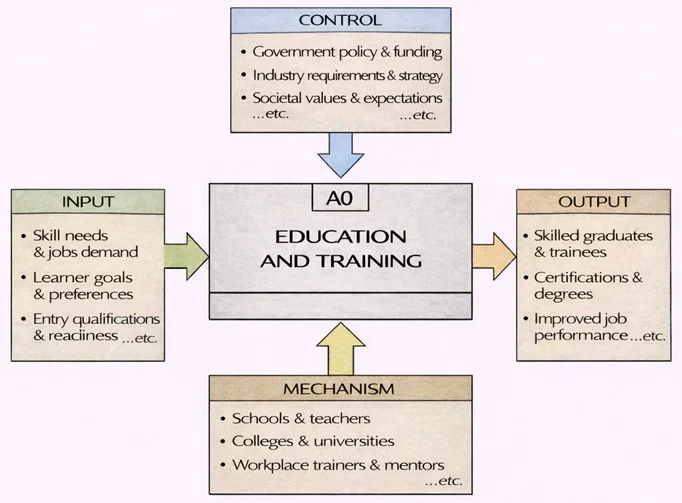
Education and Training as a working system: The diagram frames Education and Training as a single function that turns learning needs into real capability. Inputs come from the world outside the classroom—skills demanded by jobs and society, learners’ goals, and their entry readiness. These inputs are shaped by controls such as government policy and funding priorities, industry competency expectations, and broader social values about what education should achieve. The work is carried out through mechanisms: schools and teachers, colleges and universities, and workplace trainers and mentors who translate curriculum into practice. The system then produces clear outputs: skilled graduates and trainees, recognized credentials (certificates, diplomas, degrees), and improved job and life performance—evidence that learning has moved from intention to competence.
Welcome to the Education and Training section of Prep4Uni.online — your trusted guide for exploring the diverse and evolving world of learning, instruction, and academic development. Education is not merely the transmission of knowledge but a dynamic and lifelong journey shaped by innovations, diverse learners, and shifting societal needs. Whether you’re preparing to teach, lead, or learn, this section connects you to key themes and developments shaping modern education and pedagogy.
At the heart of this field is the design and delivery of meaningful learning experiences, as explored in our page on Curriculum Design. Early educational foundations, covered in Early Childhood Education, influence lifelong cognitive and social development. Similarly, Special Education ensures inclusivity and equity by addressing diverse learner needs. Educators and trainers benefit from focused preparation through Teacher Training and Professional Development and grow into leadership roles through Educational Leadership and Administration.
The field also embraces psychological and technological insights. Educational Psychology sheds light on how students think, learn, and stay motivated. Meanwhile, Technology in Education opens new pathways for online learning, AI-driven tutoring, and personalized feedback systems. Pages on Artificial Intelligence and Machine Learning, including subfields like Natural Language Processing, Supervised Learning, Unsupervised Learning, and Reinforcement Learning, demonstrate how algorithms can enhance educational outcomes and assessment strategies.
Beyond formal schooling, Adult Education and Lifelong Learning prepares individuals to reskill, upskill, and adapt in a rapidly changing economy. For those seeking global opportunities, our section on TESOL (Teaching English to Speakers of Other Languages) supports cross-cultural communication and teaching excellence. Students planning their academic futures can begin with Prepare for Your University Studies, designed to equip you for interdisciplinary thinking and career readiness.
Broader societal and historical contexts also shape educational priorities. Pages like Philosophy, History, and Literature help learners critically evaluate ideas and worldviews, while Liberalism and Conservatism unpacks ideological underpinnings of modern education systems. Peace Studies and Conflict Resolution and Management offer insights for those working in educational policy, mediation, or organizational leadership.
Finally, the integration of STEM and emerging technologies is transforming how knowledge is created and shared. For all these reasons and more, our Education and Training section provides a rich, multi-dimensional perspective on the future of learning and teaching in both traditional and innovative contexts.

Education Hub — Start with a Doorway
Early Childhood Education →
Establishes foundational cognitive and emotional development through play-based pedagogy and early intervention frameworks, forming the critical initial step in lifelong learning pipelines.
Special Education →
Provides adaptive teaching methodologies, IEP structures, and assistive technology integrations to ensure equitable educational access for learners with neurodiverse or physical needs.
Educational Psychology →
Investigates cognitive processing, motivation, and developmental dynamics to scientifically optimize instructional strategies and classroom climate.
Curriculum Design →
Structures learning outcomes, backward design maps, and assessment rubrics to ensure systematic alignment across academic sequences and degree pathways.
TESOL →
Delivers specialized language acquisition methods and cross-cultural communication techniques for multilingual learners in global academic and community settings.
Adult Education & Lifelong Learning →
Addresses ongoing professional re-skilling, andragogical principles, micro-credentials, and vocational development in an evolving knowledge economy.
Educational Leadership & Administration →
Examines institutional management, policy reform, fiscal allocation, and strategic governance required to drive systemic educational improvement.
Technology in Education →
Explores digital pedagogy, Learning Management Systems (LMS), and AI integration to construct interactive, scalable hybrid learning environments.
Teacher Training & Professional Development →
Focuses on initial teacher certification, peer mentorship, instructional coaching, and reflective practice to maintain high teaching standards.
See the Bigger Picture
Humanities & Social Sciences
Ground pedagogy in culture, ethics, and the human stories behind learning.
STEM
Bring computational thinking and lab-based inquiry into the classroom.
Arts, Design & Media
Use storytelling and design to make learning memorable and inclusive.
Business, Economics & Law
Understand policy, management, and finance in educational settings.
Health
Promote wellbeing, sport, and safe learning environments for every student.
Quick Wins for Educational Practice
- Turn learning objectives into success criteria (assessment for learning).
- Use spaced practice + retrieval to lift retention this week.
- Swap one slide-lecture for an interactive activity (low-tech or EdTech).
- Differentiate one task using choice boards or tiered prompts.
- Run a 10-minute peer micro-teaching with feedback.
Key Areas of Focus in Education and Training
Teaching and Pedagogy
- Learn innovative, learner-centered teaching methodologies.
- Discover inclusive strategies for engaging diverse student populations.
- Understand evidence-based practices to improve classroom outcomes.
Educational Leadership
- Develop leadership skills to influence change in educational systems.
- Explore educational management, policy development, and strategic planning.
- Build capacity to lead institutions effectively and ethically.
Curriculum and Assessment
- Gain insights into curriculum design frameworks.
- Understand learning outcome alignment and assessment strategies.
- Improve educational quality through data-driven evaluation tools.
Practical Resources and Tools for Educators
Career Opportunities in Education
- Navigate diverse careers: classroom teaching, school administration, academic advising, educational consulting, curriculum development, and policymaking.
- Explore sector-specific roles in early childhood, adult learning, and corporate training.
Educational Technology Integration
- Explore digital tools such as learning management systems (LMS), virtual classrooms, AI-powered tutoring, and assessment platforms.
- Discover how edtech enhances learner engagement and teacher productivity.
Ongoing Professional Development
- Stay updated with trends in teacher training, instructional coaching, and reflective practice.
- Engage in upskilling and microcredentialing opportunities to future-proof your career.
Interactive Learning: Memory Retention & Spaced Retrieval Simulator
Simulate how spaced retrieval intervals alter memory retention over time according to Ebbinghaus’s forgetting curve model: R = e–t / S, where R is memory retention, t is time (days), and S is memory strength.
Core Disciplines in Education and Training
Early Childhood Education
- Focus on child development, early literacy, and foundational learning frameworks.
- Build nurturing environments that foster holistic growth in young learners.
Special Education
- Learn adaptive teaching strategies for learners with disabilities and learning challenges.
- Design inclusive classroom practices that promote equal access to education.
Educational Psychology
- Explore cognitive, behavioral, and emotional factors influencing learning.
- Apply psychology-based approaches to improve teaching effectiveness and student wellbeing.
TESOL (Teaching English to Speakers of Other Languages)
- Develop ESL teaching methodologies for multilingual learners.
- Address cultural diversity and language acquisition challenges.
Adult Education and Lifelong Learning
- Support adult learners through flexible learning strategies, vocational training, and community education.
- Promote reskilling and continuing education in response to workforce changes.
Educational Leadership and Administration
- Prepare for leadership roles in institutional governance, strategic planning, and staff development.
- Lead change management initiatives and educational reform.
Technology in Education
- Master the use of e-learning platforms, interactive media, and blended learning.
- Bridge the gap between traditional instruction and 21st-century learning environments.
Teacher Training and Professional Development
- Create impactful teacher induction and mentorship programs.
- Implement evidence-based approaches to instructional coaching and teacher evaluation.
Why Education and Training Matter
Societal and Global Relevance
Education and training systems are foundational to national development, global competitiveness, and equity in opportunity. They empower individuals, build resilient communities, and shape informed global citizens.
Real-World Applications
Educational skills are applied in classrooms, public institutions, NGOs, corporate training, and global development initiatives. Graduates of education programs contribute meaningfully to society through teaching, research, advocacy, and leadership.
Transferable Core Skills
Engaging in education and training builds key skills:
- Critical and analytical thinking
- Verbal and written communication
- Leadership and teamwork
- Curriculum and program design
- Cultural competence and adaptability
Lifelong Value Beyond University
Educational and training competencies remain relevant in all career stages and sectors. These skills support career mobility, personal development, and continuous learning, even in non-educational roles such as human resources, communications, and organizational development.
Future Directions in Education
- Personalized and adaptive learning pathways
- AI and data-driven education solutions
- Educational neuroscience and learning science research
- Cross-cultural, globalized education models
- Sustainable education systems for inclusive futures
Examples of Disciplines in Education and Training
1. Early Childhood Education
- Focus: Nurturing young children’s intellectual, emotional, and social development during their formative years.
- Key Areas:
- Child development: Understanding cognitive, emotional, and physical growth.
- Play-based learning: Encouraging creativity and critical thinking through play.
- Family and community involvement: Collaborating with families to support children’s learning.
- Applications:
- Shaping preschool and kindergarten curricula.
- Promoting early literacy and numeracy skills.
2. Special Education
- Focus: Supporting learners with diverse needs, including disabilities, learning differences, and giftedness.
- Key Areas:
- Inclusive education: Creating environments where all students can thrive.
- Individualized Education Plans (IEPs): Tailoring teaching strategies to specific needs.
- Assistive technology: Leveraging tools to enhance learning for students with disabilities.
- Applications:
- Training educators to support students with autism, ADHD, or dyslexia.
- Advocating for policies that ensure equitable access to education.
3. Educational Psychology
- Focus: Understanding how people learn and applying psychological principles to improve education.
- Key Areas:
- Motivation and learning theories: Exploring what drives student engagement.
- Cognitive development: Understanding how students process and retain information.
- Behavioral interventions: Supporting positive classroom behaviors.
- Applications:
- Designing evidence-based teaching strategies.
- Providing counseling services to address student mental health.
4. Curriculum Design
- Focus: Developing structured educational programs that align with learning goals and standards.
- Key Areas:
- Learning outcomes: Defining what students should know and be able to do.
- Instructional strategies: Integrating methods like project-based learning and flipped classrooms.
- Assessment tools: Creating tests, rubrics, and performance evaluations to measure learning.
- Applications:
- Creating curricula for K-12, vocational, and higher education.
- Implementing culturally responsive teaching practices.
5. TESOL (Teaching English to Speakers of Other Languages)
- Focus: Teaching English to non-native speakers, addressing linguistic and cultural challenges.
- Key Areas:
- Language acquisition: Understanding how students learn new languages.
- Cross-cultural communication: Navigating diverse cultural contexts in the classroom.
- Assessment and evaluation: Measuring language proficiency and progress.
- Applications:
- Training educators for ESL (English as a Second Language) and EFL (English as a Foreign Language) classrooms.
- Supporting international students and immigrant communities.
Additional Areas in Education and Training
6. Adult Education and Lifelong Learning
- Focus: Equipping adults with skills for personal and professional growth.
- Key Areas:
- Vocational training: Teaching job-specific skills.
- Continuing education: Supporting lifelong learning through workshops and certifications.
- Literacy programs: Addressing adult literacy challenges.
- Applications:
- Enhancing workforce readiness through upskilling programs.
- Promoting personal development through community education initiatives.
7. Educational Leadership and Administration
- Focus: Preparing leaders to manage schools, colleges, and educational systems.
- Key Areas:
- Policy and governance: Shaping policies for equitable and effective education.
- Financial management: Allocating resources to support student success.
- Staff development: Training educators and fostering professional growth.
- Applications:
- Leading schools as principals, deans, or superintendents.
- Advocating for systemic improvements in education.
8. Technology in Education
- Focus: Integrating digital tools and resources to enhance teaching and learning.
- Key Areas:
- E-learning platforms: Designing online courses and virtual classrooms.
- Gamification: Using game elements to make learning engaging and interactive.
- Data analytics: Leveraging data to personalize instruction and track student progress.
- Applications:
- Implementing hybrid learning models.
- Supporting remote education during crises like pandemics.
9. Teacher Training and Professional Development
- Focus: Equipping educators with skills and knowledge for effective teaching.
- Key Areas:
- Pedagogical strategies: Teaching educators how to engage diverse learners.
- Classroom management: Maintaining productive and positive learning environments.
- Continuous improvement: Providing ongoing training in emerging educational trends.
- Applications:
- Enhancing teacher effectiveness through workshops and certifications.
- Addressing challenges like burnout and evolving student needs.
Why Study Education and Training
Understanding How People Learn and Grow
Education and training focus on the methods, theories, and practices that support learning across all stages of life. For students preparing for university, studying this field provides a deep understanding of how individuals acquire knowledge, develop skills, and reach their potential. It also introduces foundational concepts such as cognitive development, learning styles, and educational psychology—important for anyone interested in teaching, mentoring, or leadership roles.
Exploring the Role of Education in Society
Education plays a critical role in shaping communities, reducing inequality, and promoting civic engagement. Students who study education and training gain insight into how school systems are structured, how education policy is made, and how education supports economic and social development. This knowledge fosters a greater appreciation for the impact of educators and prepares students to think critically about educational reform and access.
Developing Communication and Facilitation Skills
Effective educators and trainers must be skilled communicators who can inspire, motivate, and guide learners. Students learn how to plan lessons, deliver content clearly, assess performance, and adapt to diverse learning needs. These communication and facilitation skills are invaluable not only for future teaching careers but also for success in university group projects, presentations, tutoring roles, and leadership positions.
Engaging with Educational Technology and Innovation
As digital tools become increasingly important in classrooms and training environments, students explore how technology enhances learning through multimedia, e-learning platforms, and virtual collaboration. Studying education and training helps students stay informed about emerging trends in educational technology, preparing them for academic and professional contexts that demand adaptability and innovation in teaching methods.
Preparing for Careers in Teaching, Leadership, and Human Development
A background in education and training opens doors to careers in teaching, instructional design, curriculum development, educational policy, and corporate training. It is also a strong foundation for those pursuing psychology, social work, or counseling. For students entering university, this field offers both academic richness and the opportunity to make a lasting difference in the lives of others through the power of education.
Interactive Concept Review
Test and reinforce your understanding of core educational principles by toggling each concept below:
What is the primary difference between Pedagogy and Andragogy?
Pedagogy refers to the art and science of teaching children, characterized by teacher-led instruction and dependent learning. Andragogy focuses on adult learning, emphasizing self-directed, problem-centered learning that leverages prior life experience.
How does Formative Assessment differ from Summative Assessment?
Formative assessment occurs during the learning process (e.g., quizzes, exit tickets) to guide ongoing instruction and feedback. Summative assessment evaluates student learning at the end of an instructional unit (e.g., final exams) against benchmark standards.
What role does Vygotsky’s Zone of Proximal Development (ZPD) play in classroom instruction?
The ZPD represents the distance between what a learner can do independently and what they can achieve with guidance. Effective instruction provides “scaffolding” within this zone to support higher-level skill mastery.
Frequently Asked Questions
What kind of courses does Prep4Uni offer under Education?
Prep4Uni offers a range of courses covering foundational knowledge in education theory, teaching methodology, educational psychology, policy and administration — useful for future educators, policy-minded students, and anyone interested in education studies.
Is the Education section suitable for students who want to become teachers?
Yes — the Education section gives an overview of key concepts, important issues and frameworks in education studies, which can help you prepare for university programmes in education, teaching certification, or related fields.
Does Prep4Uni cover both theory and practical aspects of education?
The content emphasises both theoretical foundations such as educational philosophy and psychology, and practical considerations including classroom management, teaching strategies, and educational policy — providing a balanced introduction.
Who should read the Education materials on Prep4Uni?
High school students exploring university majors, prospective teachers, parents evaluating education paths, and anyone interested in understanding how education systems work and what studying education might involve.
Are there sections on global and comparative education issues?
Yes — the Education category includes topics on global education challenges, comparative systems, education equity, and policy debates, to give a broader perspective beyond local schooling contexts.
Does Prep4Uni advise on how to choose a university education programme?
The Education page provides guidance on subject prerequisites, strengths required, and what to look for when selecting a university education programme — helping you make informed decisions about your academic path.
What foundational school subjects help before studying Education at university?
Strong backgrounds in subjects like literature, social studies, history, psychology, and any humanities or social science subjects are helpful. Communication, critical thinking, and empathy are also important skills for education studies.
What career paths are possible after studying education?
Careers include teaching, educational policy or administration, curriculum design, educational research, school counselling, educational consultancy, and roles in NGOs or international organisations focused on education and development.
How does Prep4Uni help with understanding educational policy and reform?
Prep4Uni introduces key debates and frameworks around equity, access, funding, curriculum standards, and reform — giving students a grounding in how education policies affect societies and how law, economics and social science intersect in education decisions.
Is education content on Prep4Uni updated regularly to reflect changes in education trends?
Yes — the site aims to keep course content and overviews current, incorporating emerging issues such as digital learning, equity, global education trends, and contemporary challenges in schooling.
Can international students benefit from the Education page on Prep4Uni?
Absolutely. The materials discuss education systems, theory and policy in general terms, which are often relevant across countries. They can help international students compare education systems and prepare for global university application processes.
How can I use the Education page to plan my university major or career path?
Use the Education page to explore what studying education involves, understand the necessary skills and interests, compare different education-related pathways, and see potential careers — helping you decide whether to major in education or choose a related field such as social policy, psychology, or public administration.
End-of-Page Exercises & Assessment Modules
Section 1: Foundational Concept Review Questions
- What is the primary focus of the education section?
Answer: The education section focuses on providing a comprehensive range of resources that support academic excellence, innovative teaching methods, and lifelong learning. It offers insights into various educational programs, strategies for effective learning, and guidance on career development. - How does the education content cater to different learning needs?
Answer: The content is designed to address diverse learning needs by offering resources for various educational levels, from primary to higher education, as well as vocational training. It includes strategies tailored to different learning styles and challenges, ensuring inclusivity and accessibility for all learners. - What types of educational resources are typically featured?
Answer: Educational resources include articles on study techniques, curriculum guides, career advice, and insights into modern teaching practices. Additionally, it covers trends in educational technology, policy updates, and strategies for academic success. - How is innovation in teaching and learning promoted through this section?
Answer: Innovation is promoted by showcasing new teaching methodologies, the integration of digital tools in classrooms, and research-based practices that enhance student engagement and learning outcomes. The content highlights how educators can leverage technology and innovative approaches to improve educational delivery. - What role does career guidance play in the education content?
Answer: Career guidance is a key component, providing students and professionals with information on career planning, job market trends, and skills development. It helps individuals make informed decisions about their educational paths and future career opportunities. - How can educators benefit from the resources provided?
Answer: Educators benefit by gaining access to best practices, new teaching strategies, and professional development tips. The resources offer practical advice on classroom management, curriculum design, and integrating technology, all of which can enhance teaching effectiveness and student learning. - What impact do current educational trends have on academic success?
Answer: Current educational trends, such as blended learning, personalized instruction, and digital education, are transforming the learning experience. They help cater to individual student needs, improve engagement, and drive academic success by making learning more relevant and interactive. - How does the education section address the challenges faced by modern learners?
Answer: The section addresses challenges such as information overload, digital distractions, and varying learning abilities by offering strategies for effective time management, critical thinking, and digital literacy. It provides tips to help learners navigate the complex educational landscape and stay focused on their goals. - What strategies are recommended for lifelong learning?
Answer: Recommended strategies include setting clear personal goals, embracing continuous education through online courses, and staying curious about new developments. The content emphasizes the importance of adaptability, self-directed learning, and ongoing skills development to remain competitive in a rapidly changing world. - How is the importance of education for personal and societal development emphasized?
Answer: The content underscores education as a cornerstone for personal growth and societal progress by highlighting its role in fostering critical thinking, innovation, and civic engagement. It illustrates how education empowers individuals to improve their quality of life and contribute positively to their communities.
Section 2: Analytical & Scenario-Based Thought-Provoking Questions
- How might digital transformation shape the future of education and learning methodologies?
Answer: Digital transformation is revolutionizing education by introducing technologies that make learning more accessible, personalized, and engaging. Innovations such as artificial intelligence, virtual reality, and online learning platforms are enabling educators to tailor lessons to individual student needs, enhance interactive learning, and provide real-time feedback. These technologies allow for more flexible learning environments, where students can access high-quality educational resources anytime, anywhere, breaking down traditional barriers of time and location. - In what ways can public-private partnerships enhance the quality and accessibility of education?
Answer: Public-private partnerships (PPPs) can significantly enhance the quality and accessibility of education by combining the strengths of both sectors. Governments can leverage private sector expertise, innovation, and financial resources to upgrade educational infrastructure, develop advanced digital learning platforms, and implement modern curricula. These collaborations can lead to improved educational facilities, cutting-edge technology in classrooms, and innovative teaching methods that benefit a broad range of students. - How does lifelong learning contribute to individual and societal advancement in the digital age?
Answer: Lifelong learning is essential in the digital age as it enables individuals to continuously upgrade their skills and adapt to changing job market demands. With rapid technological advancements, the shelf life of skills is decreasing, making ongoing education critical for personal career growth and employability. Lifelong learning fosters adaptability, critical thinking, and innovation, allowing individuals to remain competitive in an evolving economy. It also empowers people to pursue diverse interests and improve their overall quality of life through continuous personal development. - What challenges do traditional educational systems face in integrating digital learning, and how can they overcome these challenges?
Answer: Traditional educational systems often struggle with integrating digital learning due to factors such as outdated infrastructure, lack of teacher training, and resistance to change among stakeholders. Many institutions face challenges in securing the necessary funding to upgrade technology and develop online learning platforms. Furthermore, educators may lack the skills or confidence to effectively incorporate digital tools into their teaching, resulting in underutilization of available resources. - How can education systems be reformed to better prepare students for the challenges of the 21st century?
Answer: Reforming education systems to prepare students for the 21st century involves a shift from rote memorization to the development of critical thinking, problem-solving, and digital literacy skills. Curricula should be updated to include interdisciplinary learning, incorporating technology, science, and humanities in a way that reflects the interconnected nature of modern challenges. Emphasizing project-based and experiential learning can help students apply theoretical knowledge to real-world scenarios, fostering practical skills and creativity. - What is the role of teacher training in transforming educational outcomes in the digital era?
Answer: Teacher training is fundamental to transforming educational outcomes in the digital era, as educators are the primary facilitators of learning. Effective teacher training programs that focus on digital literacy, innovative pedagogies, and the integration of technology in the classroom can significantly enhance teaching effectiveness. By equipping teachers with modern skills and methodologies, education systems can ensure that digital tools are used to their full potential to create engaging and interactive learning experiences. - How might globalization influence the demand for multilingual education in modern schools?
Answer: Globalization has significantly increased the demand for multilingual education as the world becomes more interconnected and international communication becomes essential. In an increasingly globalized economy, proficiency in multiple languages is a valuable skill that enhances cultural understanding and opens up career opportunities. As businesses and institutions operate across borders, the ability to communicate effectively in different languages is crucial for success in a global marketplace. - What are the potential benefits and drawbacks of remote learning for higher education?
Answer: Remote learning offers significant benefits for higher education, including increased accessibility, flexibility, and cost savings. Students can access high-quality courses from anywhere in the world, allowing for greater diversity and inclusion in higher education. The flexibility of remote learning enables students to balance studies with work or other responsibilities, while institutions can reduce overhead costs associated with physical infrastructure. - How can the integration of experiential learning enhance traditional academic curricula?
Answer: Experiential learning, which involves hands-on, practical experiences, can significantly enhance traditional academic curricula by bridging the gap between theory and practice. By incorporating internships, laboratory work, field studies, and project-based learning, students can apply theoretical knowledge to real-world situations, deepening their understanding and developing critical skills. This approach not only makes learning more engaging and relevant but also prepares students for the workforce by equipping them with practical experience and problem-solving abilities. - How might changes in educational technology influence future trends in academic research and teaching methodologies?
Answer: Advancements in educational technology are set to transform academic research and teaching methodologies by enabling more interactive, personalized, and data-driven approaches to learning. Emerging tools such as virtual reality (VR), augmented reality (AR), and artificial intelligence (AI) can create immersive educational experiences that enhance understanding and retention of complex concepts. These technologies allow educators to simulate real-world scenarios, providing students with hands-on experiences that are not possible in traditional classroom settings. - How can policy changes in education improve access and quality for underprivileged communities?
Answer: Policy changes in education can significantly improve access and quality for underprivileged communities by addressing systemic barriers such as inadequate funding, limited infrastructure, and unequal resource distribution. Implementing policies that provide targeted financial assistance, infrastructure development, and teacher training can help bridge the gap between affluent and disadvantaged areas. These policies may include scholarships, grants, and community-based educational programs that specifically aim to uplift underprivileged students. - What are the implications of lifelong learning policies on workforce adaptability and economic growth?
Answer: Lifelong learning policies have profound implications for workforce adaptability and economic growth. By promoting continuous education and skill development, these policies ensure that workers can adapt to rapidly changing job markets and technological advancements. This adaptability is crucial for maintaining competitiveness in a global economy, as it helps individuals update their skills and remain relevant in an increasingly dynamic labor market. In turn, a more adaptable workforce contributes to higher productivity and innovation, driving sustained economic growth.
Section 3: Mathematical & Quantitative Educational Metrics Problems
- Calculate student memory retention using the Ebbinghaus Forgetting Curve formula R = e–t / S. A student learns a set of vocabulary words with an initial strength S = 4 days. What is their retention percentage after t = 6 days?
Solution:
1. Substitute the parameters into the exponent: –t / S = -6 / 4 = -1.5.
2. Calculate e-1.5 ≈ 0.2231.
3. Convert to percentage: 0.2231 × 100% = 22.31%.
Final Answer: The memory retention level after 6 days is approximately 22.31%. - Calculate the Student-Teacher Ratio (STR) for a school district that has 3,600 total enrolled students and 150 full-time equivalent (FTE) teaching staff.
Solution:
1. Apply the ratio formula: STR = Total Enrolled Students / Total FTE Teachers.
2. STR = 3,600 / 150 = 24.
Final Answer: The Student-Teacher Ratio is 24:1 (24 students per teacher). - A school district allocates funding using a weighted formula: $5,000 base per general student, plus a 40% booster (1.40 multiplier) for Special Education students. Calculate the total budget allocated for a school with 400 general students and 50 Special Education students.
Solution:
1. General Student Allocation = 400 × $5,000 = $2,000,000.
2. Special Education Per Student Funding = $5,000 × 1.40 = $7,000.
3. Special Education Allocation = 50 × $7,000 = $350,000.
4. Total Allocation = $2,000,000 + $350,000 = $2,350,000.
Final Answer: The total allocated budget is $2,350,000. - Evaluate instructional efficiency using the Normalized Learning Gain formula: g = (<Post-test %> – <Pre-test %>) / (100% – <Pre-test %>). If a class scores an average of 40% on the pre-test and 76% on the post-test, calculate g.
Solution:
1. Calculate Actual Gain = 76% – 40% = 36%.
2. Calculate Maximum Possible Gain = 100% – 40% = 60%.
3. Compute g = 36 / 60 = 0.60.
Final Answer: The normalized learning gain g is 0.60 (or 60% of potential gain achieved). - An online university course has 1,200 initial enrollees. 900 complete Module 1, 720 complete Module 2, and 540 complete the final capstone project. Calculate the overall course retention rate.
Solution:
1. Overall Retention Rate = (Final Completers / Initial Enrollees) × 100%.
2. Rate = (540 / 1,200) × 100% = 0.45 × 100% = 45%.
Final Answer: The overall course retention rate is 45%. - A school’s library digital learning resource subscription costs $12,000 per year. If 800 students actively use the platform throughout the academic year, calculate the cost per student user.
Solution:
1. Cost per User = Total Cost / Active Student Users.
2. Cost per User = $12,000 / 800 = $15.
Final Answer: The annual cost per student user is $15.00. - A student scores 65, 78, 82, and 95 on four term assessments weighted equally. Calculate the student’s final mean percentage grade.
Solution:
1. Sum of scores = 65 + 78 + 82 + 95 = 320.
2. Divide by total assessments = 320 / 4 = 80.
Final Answer: The final mean score is 80%. - A school district operates 80 classrooms. If 20% of classrooms are equipped with modern interactive whiteboards, how many additional whiteboards must be installed to bring total coverage up to 75%?
Solution:
1. Current whiteboards = 80 × 0.20 = 16 classrooms.
2. Targeted whiteboards = 80 × 0.75 = 60 classrooms.
3. Required additions = 60 – 16 = 44 classrooms.
Final Answer: The district must install 44 additional whiteboards. - In a professional development workshop, 120 teachers attended. If 30 teachers specialize in STEM, 45 in Humanities, and the remaining in Primary Education, calculate the percentage of Primary Education teachers.
Solution:
1. Sum of STEM + Humanities = 30 + 45 = 75 teachers.
2. Primary Education teachers = 120 – 75 = 45 teachers.
3. Percentage = (45 / 120) × 100% = 0.375 × 100% = 37.5%.
Final Answer: Primary Education teachers represent 37.5% of attendees. - According to a school survey, a student’s study time T (hours per week) relates to test performance P (%) via the linear approximation formula: P = 50 + 3.5T. Calculate the required study hours to achieve a target score of 85%.
Solution:
1. Set up equation: 85 = 50 + 3.5T.
2. Subtract 50 from both sides: 35 = 3.5T.
3. Divide by 3.5: T = 35 / 3.5 = 10.
Final Answer: The student needs to study 10 hours per week to reach 85%.
Education and Training: Conclusion
At Prep4Uni.online, we believe education and training are lifelong investments. Explore our in-depth resources, stay ahead of global trends, and leverage AI-powered learning tools to transform your academic goals into meaningful career outcomes. Start your journey toward educational excellence today.