
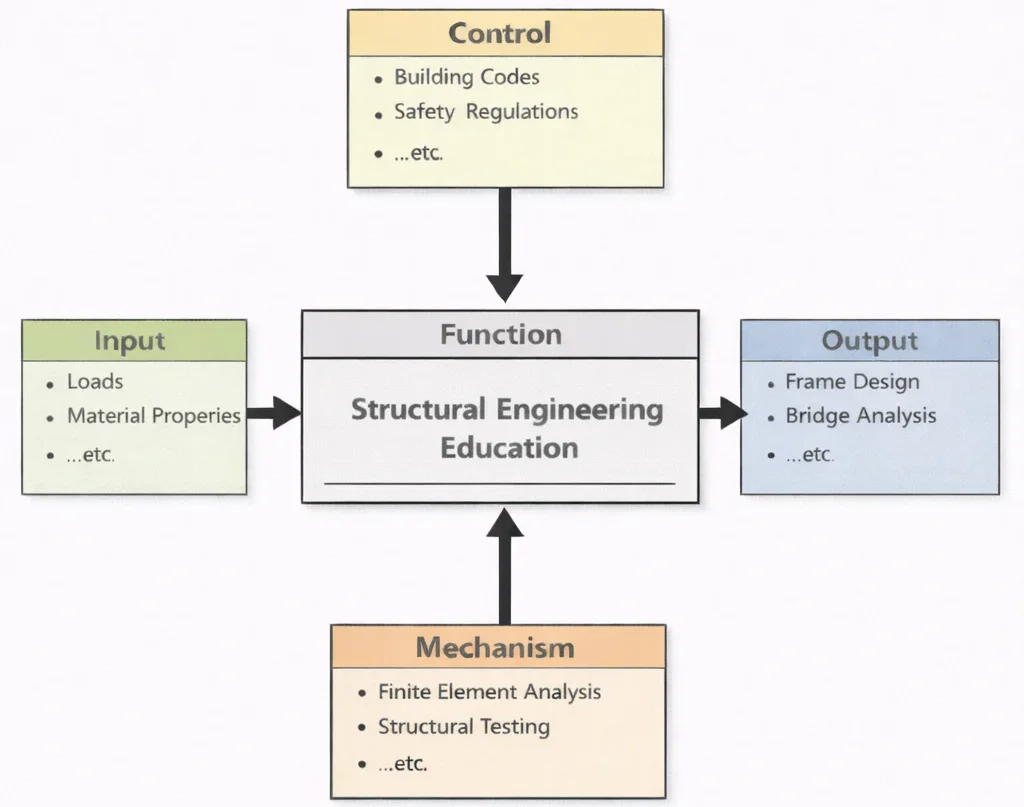
Structural Engineering Education, as the diagram suggests, is less like memorizing formulas and more like learning a disciplined conversation between reality and responsibility. The “inputs” are what the world throws at a structure—loads, material behavior, and messy details that never arrive neatly packaged. The “controls” are the non-negotiables: building codes and safety regulations that act like guardrails for judgment, keeping ambition aligned with public trust. The “mechanisms” are the craft tools that make thinking tangible—finite element analysis to interrogate stress paths, and structural testing to ground theory in evidence. Out of that intersection comes the “output”: students who can translate force and uncertainty into clear decisions—designing frames that stand with calm confidence, and analyzing bridges with an engineer’s blend of caution, curiosity, and clarity.
Structural Engineering is the backbone of modern infrastructure, dedicated to ensuring that buildings, bridges, towers, and other frameworks remain safe, stable, and efficient throughout their service life. Rooted in the principles of Civil Engineering, this discipline focuses on analyzing and designing structures to withstand various loads and environmental conditions. It interacts closely with Geotechnical Engineering, which determines how structural loads interact with soil and rock foundations.
Successful project execution depends on coordination with Construction Management, ensuring that structural designs are translated into reality within cost and time constraints. Safety under extreme conditions is further enhanced through collaboration with Earthquake and Disaster Engineering, where seismic resilience and disaster mitigation strategies are integral.
Infrastructure such as highways, flyovers, and tunnels often require joint work with Transportation Engineering, while urban space optimization involves inputs from Urban and Regional Planning. Water infrastructure—including dams, spillways, and retaining walls—adds further relevance to Water Resources Engineering.
Today’s structural engineers must incorporate emerging technologies such as Instrumentation and Measurement for real-time stress monitoring, and Embedded Systems and Microelectronics for smart material responses. Digital control mechanisms drawn from Control Systems Engineering further optimize structural adaptability and safety.
Structural Engineering also benefits from innovations in Internet of Things (IoT) and Smart Technologies, enabling remote monitoring of buildings and bridges. Coupled with Signal Processing, these systems help detect anomalies like vibration or settlement before failure occurs.
Many structures are now expected to integrate sustainability measures, supported by knowledge in Environmental Engineering. Low-carbon materials and energy-efficient systems connect with broader concerns such as Air Quality Engineering and Climate Change Mitigation and Adaptation.
Students may also explore cutting-edge domains like Quantum Electronics for ultra-sensitive structural monitoring or Robotics and Automation in E&E for automated inspection of large infrastructure. Power stability in smart buildings often ties into Power Systems Engineering, while renewable integration benefits from Renewable Energy and Energy Storage.
Further interdisciplinary exploration may involve Biomedical Electronics to understand human-structure interaction or Communication Engineering for wireless monitoring networks. Essential design simulations are complemented by developments in Electronics Engineering and the broader field of Electrical and Electronic Engineering.
Lastly, the integration of ecological sensitivity into designs—such as green roofs, recycled materials, and ecosystem-safe foundations—brings Ecological Engineering into focus. Structural Engineering, therefore, stands at the intersection of classical mechanics, digital technology, and environmental responsibility, making it a compelling field for future engineers.

Structural Engineering: Ensuring Stability, Strength, and Safety of Built Systems
Civil Engineering Curriculum Navigation Hub
Explore key specialized disciplines within Civil Engineering to understand how load paths, material mechanics, foundation interactions, and dynamic resilience converge across built systems:
Civil Engineering – Overview
Provides the overarching infrastructure context, showing how structural frameworks integrate into broader societal networks and municipal systems.
Structural Engineering (Current Hub)
Focuses on analyzing internal forces, material stresses, and structural mechanics to design safe, resilient, and durable built environments.
Geotechnical Engineering
Directly anchors superstructures by analyzing soil-structure interaction, bearing capacity, and foundation settlement dynamics.
Construction Management
Translates structural blueprints into physical reality through resource scheduling, site safety, quality control, and cost execution.
Earthquake & Disaster Engineering
Extends structural design into extreme dynamic response, mitigating seismic waves, impact forces, and natural hazard vulnerabilities.
Transportation Engineering
Collaborates on key transit links, applying heavy structural principles to bridge spans, elevated highways, and underground tunnels.
Water Resources Engineering
Integrates hydraulic load analysis with heavy reinforced concrete design for dams, spillways, retaining walls, and aqueducts.
Urban & Regional Planning
Aligns high-density structural developments and vertical growth with municipal zoning, land development, and civic strategies.
Structural Beam Deflection & Shear Simulator
Simulate bending deformation and internal shear forces on a simply supported structural beam under a center point load. Adjust load magnitude \(P\), span length \(L\), and flexural rigidity \(EI\) to observe maximum displacement and reaction forces.
Simulated in runtime on Prep4Uni.Online
Key Areas of Structural Engineering
Structural Analysis
Structural analysis forms the backbone of engineering design by enabling engineers to predict how structures will behave under various loads. This includes:
- Load Analysis: Evaluating dead loads (e.g., self-weight), live loads (e.g., people, furniture), environmental loads (e.g., snow, rain), and accidental loads (e.g., vehicles, machinery).
- Load Path Understanding: Determining how forces are transferred through beams, columns, trusses, and slabs to the foundation.
- Non-linear and Dynamic Analysis: Examining structural response to large deformations or time-dependent loads such as wind gusts or seismic shaking.
- Finite Element Modeling: Using software tools to simulate complex geometries and detailed member interactions.
Material Science
Material science is critical in structural engineering as it defines how materials behave under stress and environmental exposure:
- Steel Behavior: Understanding yield strength, fatigue, buckling, weldability, and corrosion resistance.
- Concrete Properties: Assessing compressive strength, tensile capacity, shrinkage, creep, and durability in various environments.
- Timber and Engineered Wood: Exploring moisture-related expansion, decay resistance, and sustainable sourcing.
- Composite Materials: Utilizing fiber-reinforced polymers and carbon-fiber composites to achieve high strength-to-weight ratios and corrosion resistance.
- Advanced Materials: Employing ultra-high-performance concrete (UHPC), shape memory alloys (SMAs), and self-healing materials to extend service life and reduce maintenance.
Structural Design
Structural design transforms analysis into actionable blueprints and construction documents:
- Blueprint Preparation: Creating detailed structural drawings that specify member sizes, reinforcement, connections, and erection sequences.
- Codes and Regulations: Ensuring compliance with national and international design standards (e.g., Eurocode, AISC, IS codes).
- Load Combinations: Applying various load factors to represent real-world scenarios safely.
- Connection Design: Designing bolted, welded, or riveted joints that reliably transfer loads.
- Serviceability Checks: Ensuring deflection, vibration, and cracking remain within acceptable limits for occupant comfort and structural durability.
Seismic Engineering
Seismic engineering focuses on designing structures that can survive earthquakes:
- Ground Motion Assessment: Characterizing potential seismic hazards through historical records and site-specific studies.
- Performance-Based Design: Defining acceptable damage levels and designing structures to meet those performance goals.
- Base Isolation Systems: Using bearings or sliding interfaces to decouple the building from ground movement.
- Energy Dissipation Devices: Installing dampers (viscous, friction, yielding) to absorb seismic energy.
- Retrofitting Techniques: Upgrading existing structures with shear walls, braces, and external dampers.
Wind Engineering
Wind engineering ensures structures can resist aerodynamic forces and dynamic effects:
- Wind Load Analysis: Computing pressure distributions using standard codes or computational fluid dynamics (CFD).
- Dynamic Response Modeling: Investigating phenomena like vortex shedding and buffeting that affect tall or slender structures.
- Wind Tunnel Testing: Verifying design assumptions through scale-model experimentation.
- Mitigation Devices: Incorporating tuned mass dampers or aerodynamic modifications to minimize wind-induced motion.
- Performance Standards: Meeting criteria for occupant comfort, structural safety, and serviceability under wind events.
Sub-Disciplines and Integration
Structural engineering does not exist in isolation—it intersects with multiple related fields such as:
- Geotechnical Engineering: To ensure foundations perform as intended in various soil conditions.
- Construction Management: Collaborating on sequencing, cost control, and risk management during erection.
- Architectural Integration: Balancing structural integrity with aesthetic designs and spatial planning.
- Environmental and Sustainability Engineering: Implementing green design solutions and reducing embodied carbon.
Digital Transformation and Innovation
Modern structural practice increasingly depends on technological advances:
- BIM and Digital Twins: Providing real-time visualization, collaborative design, and lifecycle tracking.
- Parametric Design: Enabling optimization of complex geometries for form and performance efficiency.
- AI and Machine Learning: Automating design checks and identifying structural risks using pattern recognition.
- Smart Sensors: Embedding IoT-enabled devices in structures for ongoing health monitoring and proactive maintenance.
Educational Foundation and Skills
Becoming a structural engineer demands a strong foundation in:
- Advanced Mathematics and Mechanics: Understanding statics, dynamics, continuum mechanics, and material behavior.
- Structural Load Analysis: Comparing theoretical predictions with simulations and real-world tests.
- Design Codes Proficiency: Applying engineering regulations and adapting for local conditions.
- Communication Skills: Coordinating interdisciplinary teams and translating complex designs into practical solutions.
Global Outlook and Future Opportunities
As the world faces increasing urbanization, climate change, and population growth, the demand for adaptable and sustainable structures continues to rise. Structural engineers will lead initiatives in developing:
- Net-Zero and Carbon-Negative Buildings: Using low-carbon materials and energy-efficient forms.
- Resilient Urban Infrastructure: Designing city systems that bounce back after natural or man-made disruptions.
- Adaptive and Reconfigurable Structures: Allowing buildings to change for new uses, occupancy levels, or environmental demands.
- Modular and 3D-Printed Buildings: Reducing construction waste, improving speed, and offering customizable design solutions.
For more on how digital workflows are reshaping modern construction, explore the latest practices in Building Information Modeling (BIM). Additionally, stay informed on emerging structural materials and smart systems via the ASCE Infrastructure & Engineering Mechanics Division.
Systems Engineering: Structural Framing & Lateral Resisting Systems Trade-offs
Selecting a structural framing typology requires balancing lateral stiffness, architectural space planning, ductility, constructability, and total embodied carbon.
| Structural Framing System | Lateral Resistance Mechanism | Primary Engineering Advantages | Physical Constraints & Failure Modes | Lifecycle Trade-off Synthesis |
|---|---|---|---|---|
| Moment-Resisting Frames (MRF) | Rigid beam-column joints resisting flexure and shear; frame action distributes lateral loads through bending. | Maximum architectural flexibility; zero diagonal bay obstructions; excellent seismic ductility (\(R = 8.0\)). | Flexible lateral response leads to large inter-story drift; heavy beam and column cross-sections required; \(P\text{-}\Delta\) sensitive. | Economical for low- to mid-rise buildings; drift criteria govern design rather than strength in tall structures. |
| Braced Frame Systems (CBF / EBF) | Triangulated truss behavior carrying lateral loads primarily through axial tension and compression forces. | High lateral stiffness; compact member sizes; highly efficient drift control in tall steel structures. | Obstructs architectural window openings and corridors; buckling of compression diagonals in concentric configurations. | High structural steel efficiency; Eccentrically Braced Frames (EBF) provide predictable shear link energy dissipation. |
| Reinforced Concrete Shear Walls | Deep vertical cantilever plates resisting in-plane shear and overturning moment from base upwards. | Exceptional lateral stiffness and strength; minimizes inter-story drift; doubles as acoustic and fire barriers. | High structural self-weight; concentrated foundation overturning moments requiring deep pile groups; rigid floor planning. | Standard solution for multi-family residential towers; high embodied concrete carbon offset by low maintenance. |
| Outrigger & Belt Truss Systems | Deep trusses link central core shear wall to perimeter mega-columns, engaging exterior columns in axial tension/compression. | Reduces core overturning moments by 30–40%; drastically suppresses wind-induced accelerations in supertall towers. | Consumes mechanical plant room levels; differential axial shortening between core and columns induces high secondary shear. | Essential for supertall towers (\(\gt 200\text{ m}\)); complex structural connection detailing required at outrigger junctions. |
Ultimate Limit State Design: Singly Reinforced Concrete Beam in Flexure
Problem Formulation: A simply supported rectangular reinforced concrete beam spans \(L = 6.0\text{ m}\) and has cross-sectional dimensions of width \(b = 300\text{ mm}\), total depth \(h = 550\text{ mm}\), and effective depth \(d = 500\text{ mm}\). The beam is constructed with concrete having specified compressive strength \(f_c' = 30\text{ MPa}\) and reinforced with longitudinal high-yield steel having yield strength \(f_y = 500\text{ MPa}\). The tension reinforcement consists of \(3\text{ No. } 25\text{ mm}\) deformed bars (\(A_s = 1{,}473\text{ mm}^2\)). Using ACI 318 / Eurocode 2 equivalent rectangular stress block parameters (\(\alpha = 0.85\), \(\beta_1 = 0.85\), ultimate concrete strain \(\epsilon_{cu} = 0.003\)):
Determine: (1) The equivalent stress block depth \(a\); (2) The neutral axis depth \(c\) and tension steel strain \(\epsilon_s\); (3) Verify whether the section is tension-controlled; (4) The nominal flexural capacity \(M_n\); and (5) The design flexural resistance \(\phi M_n\) (with \(\phi = 0.90\)).
Setting internal horizontal compression force \(C\) equal to internal tensile yield force \(T\): $$C = T \Rightarrow 0.85 f_c' b a = A_s f_y$$ $$a = \frac{A_s f_y}{0.85 f_c' b} = \frac{1{,}473\text{ mm}^2 \times 500\text{ N/mm}^2}{0.85 \times 30\text{ N/mm}^2 \times 300\text{ mm}} = \frac{736{,}500}{7{,}650} \approx \mathbf{96.27\text{ mm}}$$Step 2: Determine Neutral Axis Depth (\(c\)) and Check Ductility Limit State
Using the stress block depth factor \(\beta_1 = 0.85\): $$c = \frac{a}{\beta_1} = \frac{96.27\text{ mm}}{0.85} \approx \mathbf{113.26\text{ mm}}$$ Calculate extreme tension steel strain \(\epsilon_s\) from linear strain compatibility: $$\epsilon_s = \epsilon_{cu} \left(\frac{d - c}{c}\right) = 0.003 \left(\frac{500 - 113.26}{113.26}\right) = 0.003 \times \frac{386.74}{113.26} \approx \mathbf{0.01024}$$ Since \(\epsilon_s = 0.01024 \gt 0.005\), the tension steel yields far beyond its yield strain (\(\epsilon_y = 500 / 200{,}000 = 0.0025\)). The section is fully tension-controlled, confirming a ductile flexural failure mode and justifying the strength reduction factor \(\phi = 0.90\).Step 3: Calculate Nominal Flexural Capacity (\(M_n\))
Taking moments about the center of the concrete compressive stress block: $$M_n = A_s f_y \left(d - \frac{a}{2}\right)$$ $$M_n = 736{,}500\text{ N} \times \left(500\text{ mm} - \frac{96.27\text{ mm}}{2}\right) = 736{,}500\text{ N} \times (500 - 48.14)\text{ mm}$$ $$M_n = 736{,}500\text{ N} \times 451.86\text{ mm} = 332{,}794{,}890\text{ N}\cdot\text{mm} = \mathbf{332.79\text{ kN}\cdot\text{m}}$$Step 4: Compute Design Flexural Strength (\(M_d = \phi M_n\))
Applying the strength reduction factor \(\phi = 0.90\): $$M_d = \phi M_n = 0.90 \times 332.79\text{ kN}\cdot\text{m} = \mathbf{299.51\text{ kN}\cdot\text{m}}$$
Sub-Areas of Studies in Structural Engineering
Building Structures
- This sub-area deals with the design and construction of structures intended for residential, commercial, industrial, and institutional purposes. It involves analyzing loads, evaluating the behavior of structural elements under stress, and ensuring the safety and functionality of buildings throughout their service life.
- Structural engineers in this field work on framing systems using steel, concrete, timber, or hybrid materials. They collaborate with architects to translate design concepts into stable and resilient structures, incorporating elements such as shear walls, diaphragms, and load paths.
- Building information modeling (BIM) is frequently used to visualize and coordinate various structural components and services during the design phase.
Bridge Engineering
- Bridge engineering is a specialized branch focusing on long-span structures that connect regions and facilitate transportation. Engineers evaluate dynamic loading conditions caused by traffic, wind, seismic activity, and temperature variations.
- This field includes the design of beam bridges, truss bridges, arch bridges, cable-stayed bridges, and suspension bridges, each suited for different spans and site conditions.
- Advanced materials and analytical tools are employed to enhance longevity and ensure that bridges meet both functional and aesthetic criteria.
Geotechnical and Foundation Engineering
- This area examines the interaction between soil or rock and structural foundations. Engineers conduct site investigations to assess ground conditions and choose appropriate foundation systems based on load requirements and environmental constraints.
- Techniques like pile driving, micropiles, caissons, and soil improvement methods are used to stabilize weak or compressible soils. Understanding settlement behavior is also essential to prevent long-term damage to superstructures.
- Advances in ground improvement—such as the use of geosynthetics and chemical grouting—allow for safer and more cost-effective construction.
Hydraulic Structures
- This field encompasses the analysis and design of structures that control or utilize water, such as dams, weirs, sluice gates, spillways, levees, and culverts.
- Hydraulic structures must withstand water pressure, seepage, uplift forces, and hydrostatic loading. Engineers apply fluid mechanics, hydrology, and soil-structure interaction principles to ensure performance and safety.
- Sustainable designs increasingly integrate nature-based solutions, such as vegetated embankments or fish-friendly dams.
High-Performance Materials
- Advanced materials like fiber-reinforced polymers (FRP), ultra-high-performance concrete (UHPC), and shape memory alloys (SMA) are transforming structural design. These materials offer superior strength, ductility, corrosion resistance, and durability.
- Engineers use high-performance materials in seismic retrofitting, bridge decks, facades, and tall buildings to reduce maintenance costs and improve structural life.
- Research published by the American Society of Civil Engineers provides ongoing updates on the latest material innovations.
Structural Rehabilitation and Retrofitting
- This area focuses on strengthening and restoring aging structures, especially in seismic zones. Common techniques include jacketing columns with steel or concrete, fiber wrapping beams, or base isolating entire structures.
- Retrofitting ensures compliance with updated building codes and prolongs structural service life while improving resilience against natural hazards.
- Case studies, such as those from UNDRR’s PreventionWeb, highlight successful retrofitting efforts in earthquake-prone regions.
Offshore Structures
- This sub-discipline deals with designing and analyzing structures in marine environments, including oil rigs, offshore wind platforms, and underwater pipelines.
- Designers consider wave loads, corrosion from saltwater, and environmental degradation. Fatigue analysis is crucial due to cyclic loading from waves and currents.
- Offshore structures also require specialized foundation systems such as monopiles, jackets, or floating platforms anchored to the seabed.
Computational Structural Engineering
- With increasing complexity in projects, computational modeling has become a central tool for structural engineers. Finite Element Analysis (FEA) allows for precise modeling of stress distribution and failure modes.
- Software platforms like ANSYS, SAP2000, and ETABS are used for analysis, optimization, and design verification. Computational fluid dynamics (CFD) may also be used for wind and thermal modeling.
- Integration with parametric and generative design tools enhances flexibility in developing unconventional structural forms.
Sustainable Structural Design
- This sub-area addresses the growing demand for environmentally responsible design. Engineers aim to minimize carbon footprints by selecting recycled or low-carbon materials and designing for disassembly and reuse.
- Life Cycle Assessment (LCA) and Environmental Product Declarations (EPDs) are commonly used to quantify environmental impact. Green certification systems like LEED and BREEAM also guide design decisions.
- Net-zero energy buildings and resilient communities depend on structural strategies that integrate sustainability from the earliest project phases.
Career Opportunities
Graduates specializing in structural engineering can pursue a wide array of rewarding and impactful career paths across public, private, academic, and international sectors. The demand for structural engineers continues to rise globally, driven by the need for sustainable infrastructure, climate-resilient designs, and technological innovation.
Consulting Firms as Design Engineers
Structural engineers often begin their careers in consulting firms where they are responsible for designing buildings, bridges, towers, and complex facilities. These roles require mastery of structural analysis software, a deep understanding of material science, and the ability to collaborate with architects and other engineers. Engineers may specialize in high-rise design, seismic detailing, or innovative use of composite materials. Many firms also provide forensic engineering services, investigating structural failures to enhance future safety.
Construction Companies as Project Managers
Beyond design, structural engineers are integral to construction project management. They oversee implementation on site, ensuring structural elements are constructed according to specifications. Project managers must balance timelines, budgets, and safety standards, frequently using tools like BIM (Building Information Modeling) to coordinate activities. As urban megaprojects and smart city initiatives expand, experienced structural engineers are being entrusted with leadership positions in multinational construction companies.
Research Institutions as Material or Structural Analysts
Research roles offer the opportunity to work at the forefront of structural innovation. Analysts in research institutions develop and test new materials such as ultra-high-performance concrete and shape-memory alloys, evaluate structural behavior under extreme conditions, and advance design methodologies like performance-based seismic design. This work not only informs industry standards but also directly impacts public safety. Researchers often collaborate with global initiatives and contribute to open-access engineering data platforms.
Government Agencies Focusing on Infrastructure Projects
Structural engineers are essential in planning, maintaining, and upgrading national infrastructure. Within government bodies, they conduct structural health monitoring, seismic retrofitting programs, and disaster risk assessments. Their expertise ensures bridges, tunnels, public buildings, and transportation systems meet modern codes and withstand extreme events. In developing countries, engineers also support foreign aid programs that focus on resilient infrastructure development, such as those run by the World Bank.
Academia as Educators and Researchers
Academic careers allow structural engineers to inspire future generations while contributing to the field's evolution. University faculty often split their time between teaching core subjects like structural mechanics and supervising graduate research in areas such as computational modeling, sustainability, or retrofitting heritage buildings. They may also participate in interdisciplinary initiatives involving architecture, environmental science, and urban planning. Academia offers opportunities for long-term impact through curriculum development and international scholarly collaboration.
Specialized and Emerging Roles
In response to modern challenges, structural engineers are now finding careers in specialized domains such as offshore engineering, where they design oil rigs and wind turbine platforms, or in aerospace, contributing to the structural integrity of launch pads and hangars. Others move into the realm of climate resilience, working on adaptive infrastructure for flood-prone or seismic regions. With the rise of digital construction, a growing number are working as computational design engineers or digital twin specialists, harnessing AI and real-time monitoring to simulate and optimize structural behavior.
Entrepreneurship and Startups
A small but growing number of structural engineers are founding startups focused on niche innovations such as 3D-printed buildings, modular construction systems, or AI-powered design tools. These entrepreneurs leverage technical expertise and business acumen to disrupt traditional construction workflows and contribute to the future of sustainable development.
International Development and Humanitarian Engineering
Structural engineers can also contribute to humanitarian efforts by designing emergency shelters, schools, and health facilities in post-disaster or low-income contexts. Organizations like Engineers Without Borders and UN Habitat rely on their expertise to deliver cost-effective, culturally appropriate, and structurally safe solutions in vulnerable communities.
Certifications and Professional Advancement
To advance their careers, many engineers pursue licensure such as PE (Professional Engineer), SE (Structural Engineer), or chartership (CEng/MIStructE), or certifications in specialized areas like seismic design or sustainability. These qualifications enhance employability and open doors to senior management, international consultancy, and high-stakes project leadership.
Conclusion
In summary, structural engineering is a gateway to a diverse and meaningful career landscape. Whether one is drawn to hands-on design, large-scale project leadership, advanced research, teaching, or humanitarian service, the field offers continuous learning, international opportunities, and the satisfaction of building a better, safer world.
Emerging Trends in Structural Engineering
Smart Materials and Sensors
- Use of materials that adapt to environmental changes.
- Integration of sensors for real-time monitoring of structural health.
Smart materials—such as shape memory alloys and piezoelectric compounds—are being embedded within structural systems to automatically respond to changes in temperature, stress, or load. These innovations enhance safety by enabling real-time adjustments, improving load distribution and prolonging service life. The integration of smart materials with distributed sensor networks creates structures capable of self-diagnosis, essential for bridges, tunnels, and high-rise buildings that endure dynamic loads and environmental fluctuations.
Structural health monitoring systems equipped with sensors can detect minute cracks, corrosion, or deformation early, preventing catastrophic failures. These sensors are increasingly connected through IoT (Internet of Things) frameworks, allowing for remote diagnostics and predictive maintenance scheduling. As a result, infrastructure managers gain powerful tools to reduce downtime and optimize lifecycle costs.
3D Printing in Construction
- Applications of additive manufacturing techniques in building structures.
3D printing, also known as additive manufacturing, is revolutionizing how structures are conceived and constructed. It allows for complex geometries that would be difficult or expensive to achieve with conventional formwork. Applications range from small modular housing units to pedestrian bridges, using printable concrete, polymer composites, or recycled materials.
This technology offers increased efficiency, reduced labor costs, and faster project timelines. For instance, entire homes can be printed within a day, significantly reducing construction time while maintaining structural integrity. The environmental impact is also minimized, as 3D printing can use exact material quantities with minimal waste, aligning well with sustainable development goals. Countries like the Netherlands and the UAE are pioneering efforts in this domain, showcasing practical use cases of large-scale 3D-printed infrastructure.
Resilient Urban Infrastructure
- Developing structures that can withstand natural disasters and climate change impacts.
With rising sea levels, increased storm frequency, and seismic threats, structural engineers are shifting focus toward resilient urban infrastructure. This includes reinforced buildings, flood-adaptable designs, and flexible urban planning strategies. Cities are incorporating redundancy and modularity into their infrastructure to ensure continuity of function during emergencies.
Urban resilience also encompasses social equity and inclusive design—ensuring that vulnerable populations are not disproportionately affected by structural failures or inadequate shelter. Public infrastructure such as hospitals, transit systems, and power grids must be designed for uninterrupted operation under adverse conditions. The UN’s Making Cities Resilient initiative supports urban policymakers in implementing strategies rooted in resilient design principles.
Artificial Intelligence and Machine Learning
- Employing AI to optimize designs and predict structural performance.
Artificial intelligence (AI) and machine learning (ML) are reshaping structural engineering through data-driven design, predictive analytics, and generative modeling. AI systems can rapidly analyze vast datasets of structural behavior under different loading conditions, enabling engineers to forecast failures, identify optimal materials, and reduce design cycles.
Machine learning algorithms are being trained to detect patterns in sensor data, automate inspection processes, and even recommend retrofitting solutions. Generative design platforms, powered by AI, can explore thousands of design permutations in real-time based on project constraints, thereby improving efficiency and innovation.
In educational and industrial settings, AI-enhanced simulation platforms now serve as powerful tools for training future structural engineers in disaster scenarios and structural failures, enhancing their readiness for real-world challenges. The synergy between human expertise and computational intelligence is pushing the boundaries of what's possible in structural resilience, efficiency, and creativity.
Why Study Structural Engineering
Structural Engineering: Conclusion
Structural engineering continues to stand as a cornerstone of the built environment, with its relevance only increasing in the face of evolving societal, technological, and environmental demands. As populations grow and urbanize, and as climate risks intensify, structural engineers are tasked not only with designing buildings and infrastructure that are functional and safe, but also with pushing the boundaries of sustainability, innovation, and resilience.
Integrating Sustainability and Green Engineering
One of the most significant shifts in modern structural engineering is the commitment to sustainable practices. Engineers are now integrating green materials—such as recycled steel, engineered timber, and low-carbon concrete—into their designs to reduce embodied carbon. Life-cycle analysis is increasingly being used to evaluate and minimize environmental impacts over a structure’s lifespan. Structural systems are also being optimized to reduce waste and energy consumption during both construction and operation phases. According to findings published by Elsevier’s Journal of Building Engineering, these trends are transforming how buildings are conceived, emphasizing circular economy principles and climate-resilient frameworks.
Resilience in the Face of Natural Hazards
With natural disasters becoming more frequent and severe, structural engineers are playing a key role in designing disaster-resilient infrastructure. From seismic-resistant buildings in earthquake-prone regions to wind- and flood-resilient structures in coastal zones, engineers employ advanced simulations and performance-based design methodologies to anticipate and mitigate failure modes. Innovative solutions such as base isolation, energy-dissipating devices, and adaptive structural systems are being used to improve survivability and facilitate rapid post-event recovery. Collaborations with geotechnical and earthquake engineering specialists ensure that structural performance is aligned with site-specific hazard risks, contributing to more holistic resilience strategies.
Smart Structures and Digital Design
The advent of digital design tools has revolutionized structural engineering. With Building Information Modeling (BIM), structural engineers can create fully integrated digital twins of buildings and infrastructure, enabling real-time collaboration with architects, civil engineers, and contractors. Parametric modeling tools and generative design are being used to explore complex geometries and structural optimization based on performance criteria. Furthermore, the integration of Internet of Things (IoT) sensors into smart structures allows for real-time structural health monitoring. These systems can detect stress, vibration, and displacement, alerting stakeholders to potential issues before they become critical. Organizations such as ASCE’s Structural Engineering Institute highlight how digital transformation is accelerating both innovation and quality assurance in construction projects worldwide.
Innovation in Materials and Construction Methods
Emerging materials are reshaping possibilities in structural design. Ultra-high-performance concrete, shape memory alloys, self-healing materials, and carbon fiber composites are opening new frontiers in both new construction and retrofitting of aging infrastructure. At the same time, innovative construction methods like 3D printing, modular assembly, and prefabrication are reducing construction time, labor costs, and material waste. Structural engineers must now adapt to designing systems compatible with these methods, requiring new approaches in load distribution, joining systems, and stability analysis. These advances not only improve efficiency but also expand access to affordable and sustainable housing, especially in rapidly urbanizing regions.
Collaboration and Cross-Disciplinary Integration
Structural engineering is increasingly interwoven with other disciplines, including architecture, environmental engineering, and computational sciences. The ability to collaborate across domains is essential for designing buildings that are not only structurally sound but also visually appealing, energy-efficient, and user-centric. Engineers are now expected to understand acoustics, thermal performance, fire resistance, and even post-occupancy behavior as part of the design process. This evolution underscores the need for interdisciplinary education and professional development, ensuring that future structural engineers are equipped to lead complex, multifaceted projects.
Future Outlook
As structural engineers face a future of heightened expectations and unprecedented challenges, their role is becoming more strategic and visionary. They are being called upon not only to ensure the safety and functionality of structures, but also to align with the global goals of decarbonization, climate adaptation, and inclusive design. Through ongoing innovation, education, and ethical practice, structural engineering will continue to be a key enabler of progress—empowering societies to build smarter, safer, and more sustainable environments for generations to come.
Frequently Asked Questions
1. What does a structural engineer actually do on a project?
A structural engineer turns architectural and planning ideas into safe, buildable frameworks. They choose structural systems, size beams, columns and slabs, check foundations with geotechnical inputs, review drawings and calculations, and often visit site to confirm that the structure is built as designed.
2. How is structural engineering different from civil engineering in general?
Civil engineering looks at infrastructure as a whole – roads, water systems, earthworks and buildings. Structural engineering zooms in on how the skeleton of a structure carries loads. A civil engineer might plan a bridge route; the structural engineer ensures the bridge deck, piers and foundations safely resist all forces.
3. Which loads are most important for everyday buildings?
For typical buildings, dead loads from the structure itself, live loads from people and furniture, and wind loads are usually dominant. In some regions, seismic loads or snow loads also become critical, and must be considered alongside day-to-day usage loads.
4. Why do structural engineers care so much about material choice?
The same geometry behaves very differently in concrete, steel, timber or composite materials. Material choice affects weight, flexibility, durability, fire performance, cost and even the construction method. Good design matches each element with the most appropriate material.
5. What does “sustainable structural design” look like in practice?
Sustainable design aims to use less material, select lower-carbon options, design for long life and easy maintenance, and allow future adaptation or deconstruction. Examples include slim floor systems, recycled steel, engineered timber frames, and structures that maximise natural light and ventilation.
6. How are structures made resistant to earthquakes and strong winds?
Engineers provide clear and continuous load paths, use ductile detailing, add shear walls or braced frames, and sometimes incorporate devices such as base isolators or dampers. The aim is not to make the structure rigid, but to let it move in a controlled, energy-dissipating way without collapsing.
7. What is finite element analysis (FEA), in simple terms?
FEA is like breaking a complex structure into many tiny pieces and asking a computer to calculate how each piece deforms under load. By assembling those answers, engineers get a detailed picture of stresses and deflections, helping them refine the design before anything is built on site.
8. Why is redundancy important in structural systems?
Redundancy ensures that if one beam, connection or column under-performs or is damaged, other components can share the load. This prevents local problems from growing into a disproportionate collapse and gives occupants more time to evacuate in extreme events.
9. What new materials are changing the way we design structures?
High-strength steel, carbon-fibre reinforced polymers, ultra-high-performance concrete, self-healing concrete and engineered timber products all allow lighter, longer-span and more durable structures, and open up new architectural possibilities.
10. How do engineers check if an existing structure is still safe?
They combine visual inspections with tools such as strain gauges, accelerometers, ground-penetrating radar and load tests. The measurements are compared with analytical models and code requirements to decide whether the structure can remain as it is, needs strengthening, or should be replaced.
End-of-Page Exercises
Section 1: Interactive Practice & Foundational Review
Test your knowledge of core structural engineering concepts. Click on each question to reveal the detailed answer.
1. What is structural engineering, and how does it differ from civil engineering?
2. What are the fundamental principles that guide structural engineering design?
3. What are the main types of loads that affect structural integrity?
4. How do material properties influence structural design decisions?
5. What is the role of sustainability in modern structural engineering?
6. How do engineers design structures to resist earthquake actions?
7. What is finite element analysis (FEA), and how is it used in structural engineering?
8. What is the significance of redundancy in structural systems?
9. What innovative materials are commonly used in contemporary structural engineering?
10. How do structural engineers assess the safety and performance of existing structures?
Section 2: Analytical & Scenario-Based Thought Questions
Explore deep conceptual, ethical, and design trade-offs in modern structural engineering practice.
1. How can artificial intelligence improve structural engineering designs?
2. How can urban infrastructure adapt to climate change through structural engineering?
3. What are the advantages and challenges of using 3D printing in structural engineering?
4. How do cultural and historical factors influence modern structural engineering?
5. What role does biomimicry play in structural engineering?
6. How can structural engineering support the development of smart cities?
7. How do structural engineers address the challenges of high-rise construction?
8. How does structural engineering contribute to space exploration?
9. How can structural engineers minimize waste and maximize efficiency in large-scale projects?
10. What are the ethical considerations in structural engineering?
11. What innovations in structural engineering are shaping the future of sustainable construction?
12. How can we make infrastructure more adaptable to future urbanization and technological changes?
Section 3: Numerical Problems & Step-by-Step Solutions
Practice quantitative calculations involving shear force, bending moments, axial stress, and deflection.
Problem 1: Simply Supported Beam Reaction Forces
Solution:
By equilibrium of vertical forces (\(\sum F_y = 0\)) and symmetry: $$R_A + R_B = P = 40.0\text{ kN}$$ $$R_A = R_B = \frac{P}{2} = \frac{40.0\text{ kN}}{2} = \mathbf{20.0\text{ kN}}$$ The vertical reactions at both supports are 20.0 kN each.
Problem 2: Maximum Bending Moment under Midspan Point Load
Solution:
The maximum bending moment for a simply supported beam with a center point load occurs at mid-span: $$M_{\max} = \frac{P \times L}{4}$$ $$M_{\max} = \frac{40.0\text{ kN} \times 8.0\text{ m}}{4} = \frac{320.0}{4} = \mathbf{80.0\text{ kN}\cdot\text{m}}$$
Problem 3: Uniformly Distributed Load (UDL) Maximum Bending Moment
Solution:
The maximum bending moment for a simply supported beam under a uniform load occurs at mid-span: $$M_{\max} = \frac{w \times L^2}{8}$$ $$M_{\max} = \frac{15.0\text{ kN/m} \times (12.0\text{ m})^2}{8} = \frac{15.0 \times 144.0}{8} = \frac{2{,}160.0}{8} = \mathbf{270.0\text{ kN}\cdot\text{m}}$$
Problem 4: Axial Compressive Stress in a Steel Column
Solution:
Axial stress is defined as force per unit area: $$\sigma = \frac{N}{A}$$ $$\sigma = \frac{1{,}200.0\text{ kN}}{0.015\text{ m}^2} = 80{,}000.0\text{ kN/m}^2 = \mathbf{80.0\text{ MPa}}$$
Problem 5: Column Elastic Axial Strain Calculation
Solution:
Strain is the ratio of change in length to original length: $$\epsilon = \frac{\Delta L}{L}$$ $$\Delta L = 1.6\text{ mm} = 0.0016\text{ m}, \quad L = 4.0\text{ m}$$ $$\epsilon = \frac{0.0016\text{ m}}{4.0\text{ m}} = \mathbf{0.0004\text{ (or } 4.0 \times 10^{-4}\text{)}}$$
Problem 6: Elastic Modulus Verification using Hooke's Law
Solution:
According to Hooke's Law (\(\sigma = E \times \epsilon\)): $$E = \frac{\sigma}{\epsilon}$$ $$E = \frac{80.0 \times 10^6\text{ Pa}}{0.0004} = 200.0 \times 10^9\text{ Pa} = \mathbf{200.0\text{ GPa}}$$ This matches the standard Young's Modulus of structural steel (\(200\text{ GPa}\)).
Problem 7: Simply Supported Beam Elastic Mid-Span Deflection
Solution:
The maximum center deflection formula is: $$\delta_{\max} = \frac{P \times L^3}{48 \times EI}$$ $$\delta_{\max} = \frac{60.0\text{ kN} \times (6.0\text{ m})^3}{48 \times 12{,}000.0\text{ kN}\cdot\text{m}^2} = \frac{60.0 \times 216.0}{576{,}000.0} = \frac{12{,}960.0}{576{,}000.0} = 0.0225\text{ m} = \mathbf{22.50\text{ mm}}$$
Problem 8: Cantilever Beam Support Shear and Bending Moment
Solution:
At the fixed support: $$V = P = \mathbf{25.0\text{ kN}}$$ $$M = P \times L = 25.0\text{ kN} \times 3.0\text{ m} = \mathbf{75.0\text{ kN}\cdot\text{m}}$$