
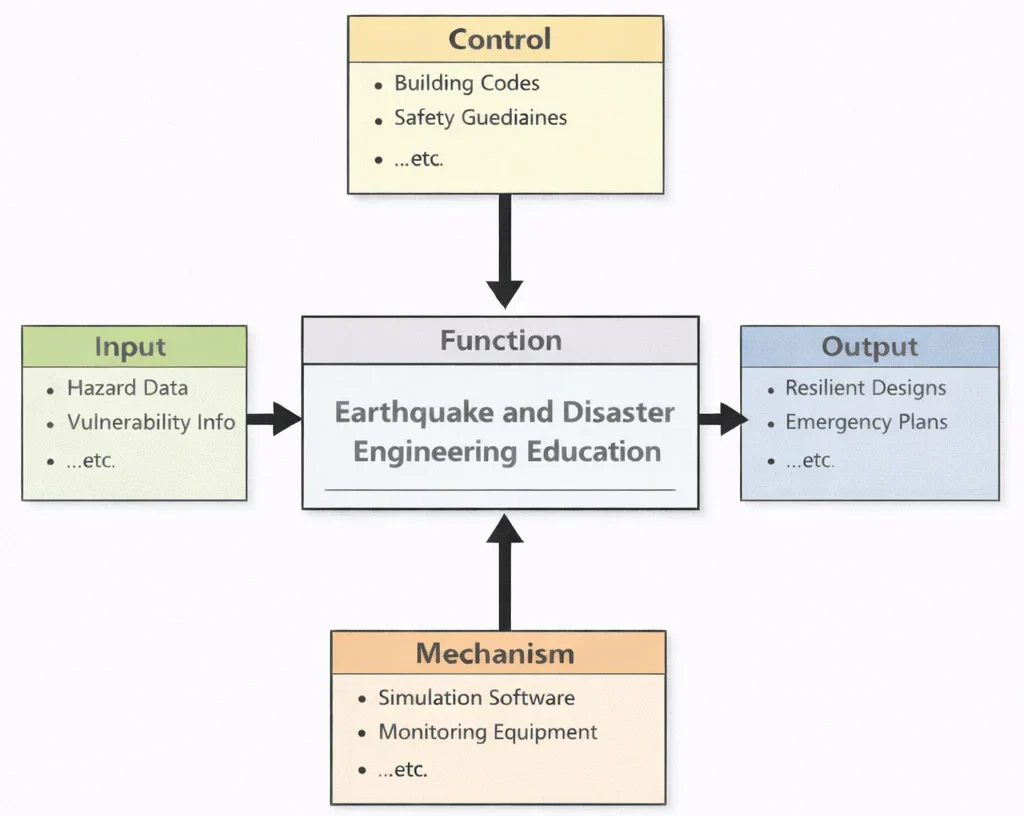
With mechanisms such as simulation software and monitoring equipment, learners move beyond theory into evidence-based practice—modeling earthquake loads, exploring failure modes, interpreting sensor readings, and stress-testing design assumptions before the real world does. The outputs are not just technical skills, but practical readiness: the ability to propose resilient designs and to develop emergency plans that connect engineering choices to response, recovery, and long-term adaptation. In this way, the education function turns uncertain hazards into clearer decisions—helping future engineers build environments that bend, endure, and protect.
Earthquake and Disaster Engineering focuses on designing resilient infrastructure capable of withstanding natural hazards such as seismic events, floods, and storms. It builds on a solid foundation in Civil Engineering, applying advanced knowledge of materials, structural dynamics, and geophysical conditions. Engineers in this field must anticipate how structures behave under stress, particularly in vulnerable zones.
Seismic resilience is closely related to Geotechnical Engineering, which assesses soil stability and foundation interactions during ground shaking. Design strategies also draw from Structural Engineering, ensuring load-bearing elements can absorb shocks and redistribute forces. Reliable disaster response systems are integrated into transportation routes planned through Transportation Engineering.
Urban safety planning requires a broader systems approach, aligning with Urban and Regional Planning to optimize land use, evacuation routes, and emergency facility placement. As water systems are also vulnerable in disaster scenarios, collaboration with Water Resources Engineering helps secure supply and prevent contamination.
The effectiveness of disaster mitigation also hinges on advanced technologies. Real-time monitoring systems use components from Instrumentation and Measurement and Embedded Systems and Microelectronics. These systems are supported by robust frameworks informed by Control Systems Engineering and signal interpretation from Signal Processing.
Communication is critical during and after disasters, necessitating reliable infrastructure designed by experts in Communication Engineering. Supporting technologies, such as Internet of Things (IoT) and Smart Technologies, allow for early warning systems and decentralized decision-making. These are often powered by resilient grids influenced by Power Systems Engineering.
New frontiers in Quantum Electronics and Robotics and Automation in E&E are also shaping the field by enabling predictive analytics and autonomous responses. Broad expertise from Electrical and Electronic Engineering enhances multidisciplinary collaboration during infrastructure recovery and resilience planning.
Environmental sustainability is increasingly embedded into disaster engineering, as it intersects with Environmental Engineering and efforts in Air Quality Engineering. Long-term strategies to adapt and prepare communities against changing climate risks are informed by Climate Change Mitigation and Adaptation and reinforced by nature-based solutions from Ecological Engineering.
Finally, systems like Biomedical Electronics play a role in post-disaster healthcare delivery, and Renewable Energy and Energy Storage ensure power continuity in affected regions. Earthquake and Disaster Engineering thus merges structural insight, technological innovation, and environmental stewardship to build safer and more adaptive communities.
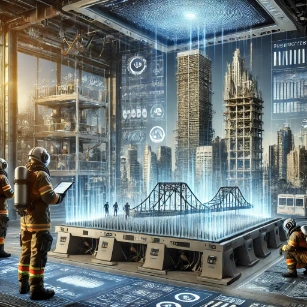
This image visualizes earthquake and disaster engineering as a mix of structural science, simulation, and emergency preparedness. In the center, a raised test platform supports a projected “digital twin” of buildings and a bridge, suggesting shake-table experiments and virtual stress testing used to study how infrastructure behaves under extreme events. The vertical streams of light resemble sensor data or hazard intensity fields, hinting at real-time monitoring, early-warning systems, and performance dashboards. The surrounding construction setting and partially damaged-looking structures imply post-disaster assessment and retrofitting—strengthening existing buildings, improving connections, and reducing collapse risks. Overall, the scene communicates the goal of the field: design safer structures, predict failure modes, protect communities, and support faster, smarter recovery when earthquakes or other disasters occur.
Earthquake & Disaster Engineering: Resilience, Risk Reduction, and Safety Systems
Civil Engineering – Overview
Provides the core infrastructure foundations, connecting civil works with safety, structural resilience, and long-term societal protection across macro-scale developments.
Earthquake & Disaster Engineering
Designs specialized systems to withstand extreme natural hazards, minimize structural damage, and guarantee rapid recovery of life-safety infrastructure.
Structural Engineering
Develops advanced earthquake-resistant structural frames and evaluates dynamic structural response under extreme shock and seismic loads.
Geotechnical Engineering
Analyzes soil-structure interaction, studying soil dynamics, slope failure, and liquefaction phenomena during major seismic shaking events.
Transportation Engineering
Ensures critical transport arteries, evacuation corridors, and logistics bridges remain functional and rapidly recoverable post-disaster.
Water Resources Engineering
Safeguards critical water hydraulic infrastructure, including dams, levees, and drainage systems, against flood and tsunami impacts.
Urban & Regional Planning
Integrates disaster risk management into municipal land-use strategies, zoning guidelines, and comprehensive city evacuation maps.
Construction Management
Executes resilient construction standards on site and manages complex post-disaster staging, clearing, and reconstruction programs.
Scope of Earthquake and Disaster Engineering
Disaster engineering is a multidisciplinary field dedicated to understanding, preparing for, and mitigating the effects of both natural and man-made hazards. Its scope extends beyond simply designing structures—it encompasses an entire ecosystem of research, policy, community engagement, and technological innovation aimed at protecting lives, infrastructure, and ecosystems under stress.
Disaster Types and Hazard Focus Areas
- Earthquakes:
- Seismic design of buildings, bridges, and lifeline systems to resist shaking, liquefaction, and surface fault rupture.
- Implementation of base isolation, energy dissipation devices, and ductile detailing to enhance resilience.
- Site-specific hazard analysis—using geotechnical investigations and seismic hazard maps—to inform design loads and safety margins.
- Tsunamis:
- Design of coastal barriers, seawalls, and strategically elevated evacuation routes to lessen impacts.
- Integration of green infrastructure—such as mangrove belts and dune restoration—as natural protective buffers.
- Predictive modeling of wave behavior and run-up zones to guide urban planning and land-use zoning.
- Hurricanes and Typhoons:
- Wind-resistant engineering strategies, including aerodynamic building profiles and robust roof-fastening systems.
- Storm surge planning—leveraging flood storage, pumping stations, and tidal barriers to manage flood risk.
- Updating building codes in coastal regions based on the latest intensity-duration-frequency (IDF) analyses of cyclones.
- Floods:
- Comprehensive flood risk assessments that combine hydrology and hydraulic modeling.
- Design of levees, detention basins, overflow channels, and smart drainage systems equipped with sensors for real-time control.
- Integration with resilient landscape design—such as retention ponds and permeable pavements—to reduce run-off and improve groundwater recharge.
- Landslides:
- Geotechnical stabilization—using soil nailing, retaining walls, and terracing—to reinforce slopes.
- Real-time slope behavior monitoring via inclinometers, piezometers, and early-warning systems.
- Risk-based land-use policies that restrict development in vulnerable hillside zones and protect downstream communities.
- Volcanic Eruptions:
- Protection of infrastructure—like hospitals and evacuation routes—from lahars, ashfall, and pyroclastic density currents.
- Vent design for critical shelters to avoid ash clogging and maintain air quality.
- Multihazard planning that addresses simultaneous threats such as seismic tremors, gas emissions, and debris flow.
- Man-Made Disasters:
- Structural design for blast resistance in buildings near industrial facilities or high-risk areas.
- Robust accident response systems featuring shut-off valves, fire suppression infrastructure, and safe evacuation protocols.
- Counter-terror engineering measures including surveillance systems, toughened glazing, and buffer zones.
Cross‑Cutting Engineering Components
- Structural Health Monitoring (SHM): embedding sensors and employing real-time diagnostics to detect damage and trigger emergency protocols.
- Emergency Response and Evacuation Design: optimizing circulation paths, signage, and shelter placement using simulation tools.
- Community Planning: engaging stakeholders for disaster drills, capacity building, and implementing ‘build back better’ strategies post-event.
- Policy Development: drafting resilience-focused building codes, land-use planning guidelines, and zoning regulations.
- Education and Training: professional certification, research partnerships, and public awareness programs on disaster preparedness.
Technological Innovations and Tools
- Simulation and Modeling Software: Facilitates earthquake shake-map generation, tornado wind-field analysis, and tsunami inundation mapping.
- Remote Sensing and GIS: Employs satellite imagery and LiDAR to analyze terrain, monitor changes, and guide infrastructure enhancements.
- Smart Sensors and IoT: Enables real-time monitoring of structural responses, hydrological levels, and alerts to authorities.
- Advanced Materials: Uses energy-dissipating devices, shape-memory alloys, and fiber-reinforced composites to improve durability.
Collaboration and Integrated Resilience Frameworks
- Interdisciplinary Teams: Involves engineers, urban planners, ecologists, sociologists, and emergency managers working together for holistic solutions.
- International Standards: Supports application of ISO 37120, Sendai Framework, and UNDRR guidelines for global resilience benchmarks.
- Resilience Certification Systems: Organizes programs like LEED for Cities and Envision for rating infrastructure resilience.
- Public–Private Partnerships: Encourages investment in disaster-proof infrastructure through insurance-linked securities and resilience bonds.
For a comprehensive overview of resilient design principles, the FEMA Building Science page provides detailed guidance on structural mitigation, while PreventionWeb offers up-to-date global insights on disaster risk reduction strategies.
Principles of Earthquake and Disaster Engineering
Risk Assessment
Risk assessment forms the cornerstone of earthquake and disaster engineering by enabling professionals to understand, anticipate, and mitigate potential hazards before they occur. It involves:
- Hazard analysis: This includes the statistical study of past disaster occurrences such as earthquakes, floods, and hurricanes to determine the likelihood and magnitude of future events. Engineers use seismic zoning maps and hydrological models to predict where and how frequently events may strike.
- Vulnerability assessment: Engineers and urban planners evaluate existing structures, critical infrastructure, and social systems to identify weak points—such as poorly constructed buildings, outdated bridges, or communities without evacuation routes—that may fail under stress.
- Risk modeling: Advanced software tools combine hazard and vulnerability data to simulate disaster scenarios and estimate potential losses in terms of human life, economic cost, and environmental degradation. These models support decisions on investment in preventive measures and disaster insurance.
Resilience
Resilience refers to the capacity of infrastructure, communities, and ecosystems to absorb shocks and recover quickly after a disaster. A resilient system is not only robust but also flexible and adaptive. Key components include:
- Robust design: Incorporating ductile materials, seismic reinforcements, and aerodynamic structures that can withstand extreme forces without catastrophic failure.
- Redundancy in critical systems: Establishing multiple pathways and backups for power, communication, transportation, and water systems to ensure continuity of operations even if one component fails.
- Rapid response and recovery plans: Pre-planned emergency protocols, resource stockpiling, and coordinated response teams enhance a community’s ability to act swiftly and effectively following a disaster.
Sustainability
Sustainability in disaster engineering ensures that risk reduction does not compromise future generations. Engineers balance structural resilience with environmental stewardship and social equity by:
- Using sustainable materials such as recycled concrete, bamboo, and bio-based composites that reduce carbon footprints and minimize waste.
- Designing systems for long-term adaptability, allowing infrastructure to be upgraded or modified as environmental and social conditions evolve.
- Implementing low-impact development strategies—like green roofs, permeable pavements, and rain gardens—that manage stormwater and reduce urban heat.
Performance-Based Design
Performance-based design (PBD) moves beyond prescriptive codes and instead tailors solutions to meet specific safety and functionality goals under defined hazard scenarios. It enables more nuanced, flexible, and cost-effective solutions, particularly for high-risk or critical facilities. PBD emphasizes:
- Life safety: Structures must protect occupants during severe events, even if they become unserviceable afterward.
- Damage control: The extent and location of damage are managed to allow safe evacuation and prevent economic loss.
- Operational continuity: Essential services—like hospitals, emergency centers, and data hubs—are designed to remain functional or resume quickly after a disaster.
Guidelines for implementing PBD in seismic zones are detailed by the Pacific Earthquake Engineering Research Center, a global leader in this approach.
Community Engagement
Community engagement ensures that disaster mitigation efforts are not only technically sound but also socially accepted and culturally relevant. It emphasizes:
- Inclusive planning: Collaborating with local residents, businesses, and institutions in identifying risks and shaping solutions that reflect their needs and values.
- Capacity building: Providing education, training, and resources to empower communities to prepare for and respond to disasters effectively.
- Respecting local knowledge: Integrating indigenous practices and community wisdom into engineering strategies enhances resilience and ownership.
By embedding the public voice into technical processes, engineers foster trust, improve uptake of disaster-resistant technologies, and strengthen social cohesion.
Seismic Base Isolation & Structural Response Simulator
Compare the dynamic displacement and acceleration response of a Fixed-Base structure versus a Base-Isolated structure under simulated seismic ground motion.
Key Areas in Earthquake and Disaster Engineering
Seismic Engineering
Seismic engineering is dedicated to designing buildings and structures that resist earthquake forces through a combination of advanced analysis and innovative technologies. Important facets include:
- Ground Motion Analysis: Engineers study seismic wave propagation, magnitude, and frequency content to determine how different soils and regions will amplify earthquake shaking.
- Structural Dynamics: Computational models analyze how various building frames—steel, concrete, timber—respond to dynamic loads, helping optimize stiffness, mass distribution, and damping.
- Base Isolation: This involves installing flexible bearings or sliders between a building and its foundation, inspired by concepts outlined in a comprehensive overview of the method’s benefits in reducing ground-transferred forces.
- Energy Dissipation Systems: Devices such as viscous, hysteretic, or friction dampers are integrated to absorb and dissipate seismic energy, limiting structural deformation and damage.
Geotechnical Earthquake Engineering
This subfield centers on soil–structure interactions during seismic events, addressing:
- Liquefaction: High groundwater pressures during quakes can turn soils into quasi-liquids. Experts design mitigation methods—like drainage, densification, or stone columns—to prevent loss of soil strength.
- Seismic Slope Stability: Hills and embankments may collapse during shaking, prompting engineers to stabilize them using retaining structures, vegetation, or geo-grids.
- Foundation Design: Foundations—including piles, mats, and deep-footings—are engineered to resist uplift, shear, and differential settlements, guided by standards such as those found on FEMA’s seismic design tips.
Disaster Mitigation Engineering
Strategies here aim to proactively reduce disaster damage through:
- Retrofitting: Upgrading older buildings with seismic bracing, foundation support, or wall strengthening to meet current safety standards.
- Flood and Surge Barriers: Designing and constructing levees, floodwalls, tide gates, and storm surge barriers to protect coastal cities from rising waters.
- Fire-Resistant Materials: Utilizing non-combustible claddings, fire-rated glass, and auto-closing dampers to limit fire spread in urban and forested settings.
Early Warning Systems
Rapid detection and alert systems help save lives before disasters fully unfold:
- Seismic Early Warning: Networks of accelerometers detect P-waves and transmit warnings to building control systems and emergency services seconds before the destructive S-waves arrive.
- Tsunami Warning Systems: Integration of underwater pressure sensors, GPS buoys, and seismic data allows near-real-time alerts to coastal populations.
- Flood Prediction Models: Engineers combine weather forecasts, soil saturation data, and river flow models to issue flood warnings ahead of time.
Urban Planning for Disaster Resilience
Disaster resilience begins with smart city planning:
- Zoning Regulations: Local laws restrict development in high-risk zones—such as fault lines, floodplains, or steep slopes—to reduce vulnerability.
- Evacuation Routes and Shelters: Infrastructure planning prioritizes wide, clear evacuation corridors and community shelters strategically placed for rapid access.
- Green Infrastructure: Designing parks, wetlands, and green roofs that absorb excess stormwater and reduce urban heat, improving resilience to floods and heatwaves.
Emergency Response Systems
Post-disaster engineering focuses on rapid recovery and sustained relief:
- Search-and-Rescue Robotics: Drones, ground robots, and sensor-equipped devices navigate collapsed structures to locate survivors and relay data to response teams.
- Temporary Shelter Design: Engineering lightweight, modular shelters that can be quickly deployed and withstand aftershocks and weather exposure.
- Portable Utilities: Field-deployable systems such as water purification units, micro-grids, and medical shelters ensure basic services remain available during recovery.
Tools and Techniques in Earthquake and Disaster Engineering
Numerical Modeling and Simulation
Numerical modeling forms the backbone of predictive and performance-based engineering. It enables professionals to analyze how infrastructure behaves under complex dynamic loads.
- Finite Element Analysis (FEA): This method breaks down structures into smaller elements to simulate stress, strain, and deformation during seismic events. FEA helps refine the geometry and materials used in buildings and bridges.
- Hazard Models: These models integrate geological data, fault line activity, and historical earthquakes to predict future seismic threats. Tools like probabilistic seismic hazard analysis (PSHA) are widely adopted in seismic zoning regulations.
- Disaster Impact Models: These simulations estimate a disaster's socioeconomic and ecological consequences, guiding policymakers in resource allocation. They help assess damage scenarios, casualty projections, and reconstruction costs.
Experimental Testing
Experimental techniques validate computational models and reveal how real-world structures behave under stress.
- Shake Table Testing: Scaled models of buildings are subjected to simulated earthquake motion, allowing researchers to evaluate failure mechanisms and the efficacy of damping or base-isolation systems.
- Wind Tunnel Testing: Structures, especially high-rises and bridges, are tested in wind tunnels to examine how wind-induced forces affect stability, vibration, and safety.
- Material Testing: This involves compressive, tensile, and fatigue tests on concrete, steel, composites, and advanced materials to ensure durability under disaster scenarios. These tests are aligned with standards such as those provided by the ASTM International Construction Standards.
Geospatial Technologies
Modern disaster management relies on location-based technologies to monitor risks and coordinate response.
- GIS (Geographic Information Systems): GIS tools are used to visualize seismic risk maps, overlay population data, and support emergency planning. They assist in identifying critical facilities in high-risk zones.
- Remote Sensing: Satellites and drones provide real-time imagery to assess disaster-prone regions, monitor land deformation, and evaluate structural damage after events. This technology has been widely used in efforts documented by NASA's Earthdata portal.
Artificial Intelligence and Machine Learning
AI is revolutionizing how engineers predict, plan for, and respond to disasters by making sense of massive datasets quickly and effectively.
- Predicting Disaster Impacts: AI models trained on historical and environmental data can forecast how future disasters will unfold and identify which regions or structures are most at risk.
- Optimizing Evacuation Routes: Algorithms simulate pedestrian and vehicular flow to suggest the most efficient evacuation strategies under real-time conditions.
- Satellite Image Analysis: Machine learning models scan satellite images to flag damaged infrastructure or detect early signs of landslides and ground shifts, aiding rapid response and recovery.
Community-Based Risk Assessment
Effective disaster mitigation must integrate local context and knowledge. Community-based methods involve stakeholders directly in preparedness and planning.
- Participatory Mapping: Residents collaborate with planners to identify hazard-prone areas, emergency routes, and vulnerable structures.
- Indigenous Knowledge Integration: Local traditions, materials, and construction techniques can improve disaster resilience, particularly in rural or remote regions.
- Risk Perception Surveys: Gathering insights into how communities perceive threats enables targeted education and tailored mitigation strategies that are more likely to be accepted and adopted.
Applications of Earthquake and Disaster Engineering
Critical Infrastructure
Earthquake and disaster engineering plays a vital role in enhancing the resilience of critical infrastructure that forms the backbone of modern society. This includes facilities essential for emergency response and public safety.
- Designing Earthquake-Resistant Facilities: Hospitals, fire stations, and emergency operation centers must remain operational during and after seismic events. Engineers employ seismic isolation systems, reinforced concrete, and advanced bracing technologies to ensure structural integrity.
- Transportation Networks: Bridges, highways, tunnels, and airports are designed with dynamic load-resistance and fault-tolerant joints. Retrofitting old bridges using tuned mass dampers and flexible bearings is a widespread practice, especially in earthquake-prone regions like Japan and California.
- Telecommunication and Utility Networks: These systems are hardened using shock-absorbing foundations and redundant routing to maintain connectivity and power during emergencies.
Residential and Commercial Buildings
Disaster-resistant housing is critical in minimizing casualties and economic losses during natural calamities. Residential and commercial buildings are being redesigned for both performance and sustainability.
- Retrofitting and Strengthening: Older structures, especially those built before seismic codes were enforced, are retrofitted using shear walls, base isolators, and steel jackets. Public awareness campaigns often encourage retrofits in urban centers.
- Sustainable and Resilient Design: Modern construction practices integrate passive solar design, rainwater harvesting, and insulation with earthquake-resistant frameworks. This dual emphasis promotes long-term environmental and structural sustainability.
- Affordable Safe Housing: Community-driven designs that use local materials and culturally sensitive methods are being promoted globally, as noted in UNDRR's Build Back Better initiative.
Industrial and Energy Facilities
Industrial zones and energy generation centers are particularly vulnerable during natural disasters due to the hazardous materials and technologies they host.
- Safety of Energy Facilities: Earthquake and tsunami protection for nuclear reactors and dams includes emergency shutdown systems, containment structures, and elevation of vital components. After the 2011 Fukushima disaster, global standards were revised to enhance safety protocols.
- Pipelines and Refineries: Flexible joints, seismic shut-off valves, and real-time monitoring systems are used to reduce rupture risks in long-distance pipelines and chemical plants.
- Hazardous Material Storage: Earthquake-resistant tanks and spill-containment systems prevent secondary disasters involving toxic or flammable substances, aligning with international best practices such as those outlined by the U.S. Occupational Safety and Health Administration (OSHA).
Coastal Protection
Coastal communities face growing threats from climate-driven hazards, including tsunamis, typhoons, and rising sea levels. Engineers use both gray and green infrastructure to mitigate these risks.
- Seawalls and Breakwaters: These structures reduce the force of incoming waves and prevent erosion. In Japan and the Philippines, multi-tiered seawalls are common features of tsunami-prone coastlines.
- Natural Barriers: Mangrove reforestation, coral reef preservation, and wetland restoration help dissipate wave energy and buffer inland areas. These eco-solutions are often integrated into disaster risk reduction strategies and promoted by organizations like IUCN.
- Elevated Structures: Homes and community buildings in flood-prone zones are increasingly being designed on stilts or elevated platforms to reduce vulnerability to storm surges.
Post-Disaster Reconstruction
Reconstruction after a disaster provides a critical opportunity to rebuild with enhanced safety and sustainability in mind, rather than replicating pre-disaster vulnerabilities.
- Modular and Prefabricated Units: These allow for rapid deployment of shelters and schools. Prefabrication ensures speed, quality, and cost-effectiveness, especially in remote or inaccessible regions.
- “Build Back Better” Strategies: Reconstruction efforts increasingly adopt forward-looking standards—reinforced foundations, disaster-resilient materials, and community-based designs—to enhance resilience and equity.
- Urban Renewal: In some cases, entire neighborhoods are redesigned post-disaster to include better evacuation routes, improved infrastructure, and safer land-use planning.
Challenges in Earthquake and Disaster Engineering
Unpredictable Nature of Disasters
- Disasters such as earthquakes, tsunamis, and landslides often occur without warning, making real-time mitigation extremely challenging. Despite advances in early warning systems, pinpointing the exact timing, location, and magnitude remains a complex task.
- Compound events—like earthquakes triggering tsunamis or landslides—introduce cascading hazards that are difficult to model accurately. These interconnected risks can overwhelm infrastructure that was designed for singular events.
- Emerging technologies such as machine learning and real-time seismic sensor networks show promise but require global data-sharing and collaboration, which are still lacking in many parts of the world.
Aging Infrastructure
- Many urban centers are built on outdated infrastructure that was constructed before modern seismic codes were implemented. Retrofitting such structures can be costly and disruptive, especially in densely populated areas.
- Infrastructure degradation over time—due to corrosion, fatigue, and environmental exposure—compromises disaster resilience. Identifying and prioritizing these vulnerable assets is critical.
- According to the American Society of Civil Engineers’ Infrastructure Report Card, much of the critical infrastructure in developed nations is rated below acceptable standards.
Resource Constraints
- Developing nations often lack the financial, technical, and institutional resources needed for comprehensive disaster risk management. This creates inequalities in safety and recovery between regions.
- Even in wealthier countries, disaster mitigation competes with other pressing needs such as healthcare, education, and housing. This frequently results in underfunded engineering programs and delayed safety upgrades.
- International aid and collaborative engineering initiatives—such as those supported by the UN Office for Disaster Risk Reduction (UNDRR)—can help fill these gaps but are often hampered by bureaucracy and politics.
Climate Change
- Climate change is increasing the frequency, intensity, and unpredictability of extreme weather events such as floods, hurricanes, and heatwaves. This introduces new stressors for disaster engineers to address in both design and response.
- Rising sea levels and increased rainfall also pose severe risks to coastal cities and floodplain developments. Civil infrastructure must now be designed for evolving baseline conditions, not just historical extremes.
- The integration of climate models with disaster engineering tools is still a developing field, requiring interdisciplinary collaboration and adaptive design frameworks.
Social and Political Barriers
- Engineering solutions are often met with resistance due to political inertia, lack of public awareness, and conflicting land-use priorities. Zoning regulations that restrict building in high-risk areas are sometimes overridden by economic interests.
- Public education about disaster risks and safety measures is crucial but often underfunded. Engaging communities in risk-aware planning helps build grassroots support for resilient development.
- Legislation and enforcement of building codes vary significantly across regions. Even where codes exist, lack of compliance monitoring undermines their effectiveness.
Future Trends in Earthquake and Disaster Engineering
Resilient Cities
- Resilient cities of the future are being designed with the capacity to absorb, adapt to, and recover rapidly from disasters. Urban planners and engineers are rethinking everything from building layout to transportation networks to reduce vulnerability to earthquakes, floods, and other hazards.
- Decentralized systems—such as distributed energy grids, localized water storage, and modular housing—play a key role in ensuring that cities can continue functioning even when central infrastructure fails. These systems also support faster recovery and reduce reliance on singular, potentially vulnerable nodes.
- Disaster resilience is also increasingly being embedded into land-use planning, using hazard mapping to steer development away from high-risk zones. Initiatives like the UN's Making Cities Resilient campaign emphasize the integration of resilience goals into local governance and infrastructure development.
Smart Infrastructure
- The integration of smart technologies in infrastructure is revolutionizing earthquake and disaster engineering. IoT (Internet of Things) sensors embedded in bridges, buildings, and dams can now monitor structural health in real time and issue alerts when anomalies are detected.
- These systems allow predictive maintenance, reducing the likelihood of catastrophic failure by identifying early warning signs like stress accumulation or minor cracks. This enhances safety and also extends the service life of infrastructure.
- Smart infrastructure also plays a crucial role in emergency response. Systems can automatically shut down utilities, redirect traffic, or activate evacuation protocols during disasters. Many new developments are integrating digital twins—virtual replicas of infrastructure—to simulate damage scenarios and optimize decision-making under stress.
Green Engineering
- Green engineering emphasizes the use of nature-based solutions to mitigate disaster risk. Wetlands, mangroves, and green roofs are being increasingly used to absorb excess rainfall, reduce storm surge impact, and stabilize soil.
- In addition to physical benefits, these natural systems also enhance biodiversity and offer recreational and cultural value to communities. They often outperform conventional engineering in long-term adaptability and cost-effectiveness.
- The concept of regenerative design—going beyond sustainability to restore ecosystems—is gaining traction. Engineers are now working closely with ecologists and landscape architects to ensure that disaster-resilient projects also support environmental health.
Advanced Materials
- Innovation in materials science is enabling new levels of performance in disaster-resistant infrastructure. Materials such as ultra-high-performance concrete (UHPC), fiber-reinforced composites, and self-healing polymers are now being tested in critical structures.
- Self-healing materials can automatically seal cracks and restore mechanical properties after damage, significantly reducing maintenance needs and improving longevity. Lightweight composites are replacing heavy steel and concrete in some applications, enhancing seismic performance.
- Other promising developments include shape-memory alloys and materials that change stiffness in response to environmental stimuli, offering real-time adaptability during seismic events. These materials are also being incorporated into retrofitting techniques to strengthen older buildings.
Collaborative Global Efforts
- Disaster resilience is a global concern that requires cross-border cooperation. Countries are increasingly pooling resources, expertise, and research to develop shared frameworks for risk reduction and emergency response.
- International bodies such as the Global Facility for Disaster Reduction and Recovery (GFDRR) are funding projects that build capacity in vulnerable regions, develop open-access risk data, and promote technology transfer.
- Joint simulation exercises, cross-training for engineers, and harmonized building codes are all part of an evolving global architecture for resilience. The focus is on making best practices universally accessible while allowing room for local adaptation and innovation.
Case Studies in Earthquake and Disaster Engineering
Tokyo Skytree, Japan
The Tokyo Skytree is one of the most advanced examples of seismic engineering in practice. Standing at 634 meters, it is the tallest structure in Japan and the second tallest in the world at the time of its completion. Located in one of the most seismically active regions, its design incorporates a central reinforced concrete shaft (shinbashira), inspired by traditional Japanese pagodas, to act as a dynamic stabilizer. This shaft is structurally separated from the outer steel frame and connected via oil dampers, allowing it to counteract vibrations during earthquakes through a motion-canceling effect.
The structure also includes tuned mass dampers and base isolation systems, which absorb and dissipate seismic energy to reduce oscillations. These technologies significantly increase the safety and stability of the building during both minor tremors and major earthquakes. The Skytree has undergone rigorous testing through structural simulations and physical modeling, making it a global benchmark in vertical seismic safety engineering. Beyond safety, the tower symbolizes Japan's commitment to blending modern technology with traditional insights in disaster resilience.
Netherlands’ Delta Works
The Delta Works is a massive flood defense and water management project in the Netherlands, consisting of dams, sluices, locks, dykes, levees, and storm surge barriers. Initiated in response to the devastating North Sea Flood of 1953, which killed over 1,800 people, the Delta Works is designed to protect low-lying Dutch provinces from flooding due to storm surges and rising sea levels. It is often referred to as one of the "Seven Wonders of the Modern World" by the American Society of Civil Engineers.
At the heart of this system is the Oosterscheldekering, a unique storm surge barrier that can be closed during severe weather events but remains open most of the time to allow ecological continuity. The Delta Works uses adaptive engineering principles, including real-time data from tidal gauges and weather systems, to respond dynamically to climate conditions. Its success has made it a model for flood defense systems worldwide and has influenced the design of similar structures such as the Thames Barrier in London and Venice's MOSE system. For those interested in integrated water management, the Delta Works is extensively studied by institutions like Deltares, a renowned Dutch research institute on water and subsurface management.
Indian Ocean Tsunami Warning System
The Indian Ocean Tsunami Warning System (IOTWS) was established after the catastrophic tsunami of December 26, 2004, which was triggered by a magnitude 9.1 undersea earthquake off the coast of Sumatra. The disaster resulted in over 230,000 deaths across 14 countries, highlighting the urgent need for a coordinated regional early warning mechanism.
The IOTWS is a multi-layered system that integrates seismic monitoring stations, deep-ocean tsunami detection buoys, and coastal tide gauges to detect and assess tsunamigenic earthquakes. Once potential threats are identified, alerts are issued to national and regional disaster management agencies within minutes. The system covers the Indian Ocean basin and is coordinated by the Intergovernmental Oceanographic Commission of UNESCO in collaboration with national meteorological and geological services.
Since its inception, the system has undergone multiple enhancements, including better integration with public communication networks, increased redundancy in detection systems, and the use of AI-assisted modeling to improve accuracy. It has successfully issued alerts for several tsunamis since 2004, reducing potential casualties and damage. The IOTWS is considered a key case study in transforming tragedy into resilience through science, engineering, and international cooperation.
Why Study Earthquake and Disaster Engineering
Earthquake and Disaster Engineering: Conclusion
Earthquake and disaster engineering stands as a critical discipline ensuring society’s resilience against natural catastrophes and unexpected hazards. This field bridges scientific research, engineering innovation, policy development, and community engagement to build safer infrastructure and adaptive communities. As the threats posed by climate change, rapid urbanization, and aging infrastructure grow, the influence of earthquake and disaster engineering becomes increasingly vital.
Mitigating Seismic Risks through Engineering Innovation
- Seismic Design Codes: Modern building codes incorporate lessons from past quakes, employing performance-based design to ensure structures withstand ground shaking, torsion, and differential movement.
- Base Isolation Systems: These systems use flexible bearings or sliders to decouple a building's movement from the ground, reducing structural damage and preserving critical operations during seismic events.
- Energy Dissipation Devices: Tuned mass dampers and viscous dampers absorb earthquake energy, protecting skyscrapers and bridges from harsh vibrations.
Advanced Materials and Construction Techniques
- Smart Materials: Shape‑memory alloys and self-healing concrete can adapt to tectonic stress and repair micro-cracks autonomously.
- Fiber‑Reinforced Polymers (FRP): Lightweight, high-strength composite wraps reinforce columns, beams, and walls in retrofitting projects.
- Modular Construction: Factory-built seismic-resistant modules, using precision and quality control, are rapidly installed in high-risk zones.
Structural Monitoring and Predictive Analytics
- Sensor Networks: Embedded accelerometers and strain gauges feed real-time data to building dashboards for live performance tracking.
- Digital Twin Models: Robust digital twins simulate post-earthquake damage and predict structural resilience under future seismic scenarios.
- AI-based Early Warning Systems: Algorithms linked to seismic sensors can initiate emergency shutdowns, elevator halts, and text alerts to save lives.
Community and Site Planning Strategies
- Risk Zoning: Urban planning uses Hazard Maps and GIS to avoid high-risk zones—implementing open spaces that serve as evacuation plazas.
- Resilient Infrastructure: Bridges, pipelines, and power grids are designed with flexible joints, seismic shutoff valves, and redundancy.
- Community Drills and Education: Collaboration with local authorities ensures evacuation rehearsals, vulnerable population mapping, and public awareness programs.
Policy Instruments and Post-Disaster Response
- Building Retrofit Incentives: Governments often provide grants or low-interest loans to retrofit older buildings for seismic safety.
- Insurance and Reconstruction Funds: Public–private insurance models and disaster reconstruction funds are designed to enable rapid, equitable recovery.
- Regulatory Frameworks: Stronger compliance checks, peer reviews, and performance audits ensure that buildings meet post-disaster safety standards.
Future Outlook: Integration and Innovation
- Climate Resilience: Engineers are now combining seismic precautions with flood, fire, and wind-damage protections, building multi-hazard resilient structures.
- Smart Infrastructure: Cities deploy sensor-rich networks in roads, bridges, and power systems to provide early warnings and targeted maintenance.
- Global Knowledge Exchange: Cross-border collaborations—such as the UN Office for Disaster Risk Reduction—share data and best practices globally.
- Education and Workforce Development: Universities and professional bodies offer curricula in disaster risk analysis, post-disaster reconstruction, and resilient design. Additionally, platforms like Coursera provide up-to-date training for practitioners worldwide.
Final Reflections
As the frequency and intensity of natural and human-induced disasters increase, earthquake and disaster engineering emerges as one of the most essential fields for protecting communities, economies, and environments. Through innovation, multi-disciplinary collaboration, and proactive strategies, the discipline aims not only to withstand shocks but to enable faster recovery and sustainable growth. As this vital field continues to evolve, it offers hope and tangible solutions for building a safer, more resilient tomorrow.
Frequently Asked Questions
1. What does an earthquake and disaster engineer actually work on?
Earthquake and disaster engineers design, assess and improve buildings and infrastructure so they can cope with earthquakes and other extreme events. Their work ranges from calculating seismic loads on new structures to developing retrofit schemes for older buildings, contributing to emergency planning, and advising governments on safer construction practices.
2. Are all buildings designed to survive earthquakes without any damage?
No. Most modern codes aim for life safety: the building should not collapse and should protect occupants, but some damage is expected in a major earthquake. Special facilities, such as hospitals or emergency control centres, may be designed to remain operational with only limited damage.
3. How do engineers “measure” the shaking from an earthquake for design?
Engineers use seismic hazard maps and response spectra to estimate the level of ground motion that a structure is likely to experience at its site. These design spectra are built into local building codes and depend on regional seismicity, soil conditions and the importance of the structure.
4. What is the difference between base isolation and damping devices?
Base isolation reduces the transmission of ground motion to the structure by allowing the building to move more gently relative to the ground. Damping devices, such as viscous or friction dampers, are installed within the structure to absorb and dissipate energy, thus reducing motion and damage.
5. Can older buildings be made earthquake-resistant?
Yes. Through seismic retrofitting, engineers can add new elements—such as steel bracing, shear walls, jacketing, or base isolation—to strengthen weak parts of the structure and improve its overall behaviour under seismic loads. Retrofitting is often more economical than replacement, especially for historic or densely built urban areas.
6. What is liquefaction, and why do engineers worry about it?
Liquefaction happens when loose, saturated soils temporarily lose strength and behave like a liquid during shaking. Foundations can sink or tilt, buried pipes can float, and embankments can slide. Geotechnical investigations and ground improvement techniques are used to reduce this risk on vulnerable sites.
7. Does disaster engineering only focus on earthquakes?
No. Disaster engineering looks at a range of hazards, including floods, tsunamis, storms, landslides and technological accidents. Earthquakes are a major focus, but the same principles of risk assessment, mitigation and resilient design apply across different hazard types.
8. How do early warning systems actually help if earthquakes cannot be stopped?
Even a few seconds of warning can make a big difference. Automated systems can halt trains, close gas valves, and protect sensitive equipment, while people can move away from hazardous areas or take cover. Early warning does not prevent shaking, but it reduces the chance of secondary accidents and injuries.
9. What role do communities play in disaster risk reduction?
Technical measures alone are not enough. Community education, drills, evacuation planning and clear communication strategies help people understand how to respond when disasters strike. Well-prepared communities recover faster and suffer fewer casualties, even when physical damage occurs.
10. Why is earthquake and disaster engineering a promising field for students?
As urban populations grow and climate and seismic risks intensify, there is a strong demand for engineers who can design safer, more resilient infrastructure. The field combines technical challenge with clear social impact, giving graduates the opportunity to save lives and support sustainable development.
Earthquake and Disaster Engineering: End-of-Page Practice Module
Section 1: Interactive Review Questions (Foundational Concepts)
Test your understanding of core concepts in earthquake and disaster engineering. Click each question below to reveal the detailed answer.
1. What is earthquake engineering, and why is it important?
2. What are seismic forces, and how do they affect structures?
3. What role do building codes play in earthquake engineering?
4. What are base isolators, and how do they improve earthquake resistance?
5. How is structural damping used in earthquake engineering?
6. What is disaster mitigation, and why is it critical in disaster engineering?
7. How does retrofitting enhance the earthquake resilience of existing buildings?
8. What is liquefaction, and how does it affect infrastructure during an earthquake?
9. What factors influence the design of disaster-resistant infrastructure?
10. How do early warning systems contribute to disaster preparedness?
Section 2: Thought-Provoking & Analytical Questions
Explore scenario-based challenges, ethical considerations, and interdisciplinary trade-offs in disaster management.
-
How do different soil types influence the severity of earthquake damage to buildings and infrastructure?
Answer: Loose, water-saturated soils amplify vibrations and are prone to liquefaction, which undermines structural foundations. Conversely, rocky or dense soils transmit seismic energy with less amplification, reducing damage. Engineers must conduct geotechnical studies to understand soil behavior and design appropriate foundations, such as deep pilings or soil stabilization techniques. -
In what ways can urban planning reduce the impact of natural disasters in densely populated areas?
Answer: Urban planning can minimize disaster impacts by enforcing zoning regulations to prevent construction in high-risk areas, designing wide evacuation routes, and incorporating green infrastructure like parks to serve as emergency shelters. -
How can engineers balance cost and safety when designing earthquake-resistant structures in developing countries?
Answer: Cost-effective solutions include using locally available materials, applying simple retrofitting techniques, and employing modular designs. Balancing cost and safety requires prioritizing critical structures like schools and hospitals and focusing on "life-safe" design over complete damage prevention. -
What role do cultural and societal factors play in disaster preparedness and response strategies?
Answer: Cultural factors influence risk perception, willingness to follow safety protocols, and trust in authorities. Educating communities in culturally relevant ways ensures better engagement, while tailoring preparedness measures to local customs increases the likelihood of adoption. -
How can adaptive architecture mitigate disaster risks in regions prone to multiple types of natural disasters?
Answer: Adaptive architecture uses flexible materials, adjustable components, and multi-hazard assessment to balance structural resilience across varied threats (e.g., elevated foundations with base isolators for combined flood and seismic zones). -
Why is retrofitting older buildings often more complex than designing new disaster-resistant structures?
Answer: Retrofitting requires modifying existing structures within historical or architectural constraints, facing limited access to structural joints, material incompatibility, and working around active building occupants. -
What ethical considerations arise when prioritizing infrastructure for disaster mitigation?
Answer: Dilemmas involve deciding which communities or facilities receive limited upgrade budgets. A fair approach balances equity, public risk exposure, and urgency, ensuring essential public services (hospitals, schools) in vulnerable areas are addressed first.
Section 3: Numerical Problems & Step-by-Step Solutions
Apply mathematical and physical principles to seismic load analysis and structural design calculations.
-
Problem 1 (Equivalent Lateral Force Procedure): A 4-story building has a total seismic weight W = 8,000 kN. The seismic response coefficient (base shear coefficient) is calculated as Cs = 0.12. Calculate the total design base shear V acting at the foundation.
Solution:
Using the formula for Base Shear: V = Cs × W
V = 0.12 × 8,000 kN = 960 kN.
The total horizontal inertia force that the foundation and structural frames must resist is 960 kN. -
Problem 2 (Natural Period of Vibration): An empirical formula for estimating the fundamental natural period T of a steel moment-resisting frame is T = 0.085 × (h)0.75, where h is the building height in meters. Calculate the period T for a 36-meter tall steel building.
Solution:
1. Calculate (36)0.75: 360.75 = (363)1/4 = (46,656)0.25 ≈ 14.696 m.
2. Compute T: T = 0.085 × 14.696 ≈ 1.25 seconds.
The natural period of the building is approximately 1.25 seconds. -
Problem 3 (Base Isolation Force Reduction): A fixed-base building experiences a peak spectral acceleration of Sa = 0.80g during a maximum considered earthquake. Installing a elastomeric base isolation system reduces the floor spectral acceleration to Sa,iso = 0.22g. Calculate the percentage reduction in lateral seismic acceleration demand.
Solution:
1. Compute absolute acceleration reduction: 0.80g - 0.22g = 0.58g.
2. Compute percentage reduction: (0.58 / 0.80) × 100% = 72.5%.
The base isolation system decreases lateral force demands on the superstructure by 72.5%. -
Problem 4 (Story Lateral Force Distribution): A 2-story building has a total base shear V = 500 kN. Story 1 has weight w1 = 1,000 kN at height h1 = 4 m. Story 2 has weight w2 = 1,000 kN at height h2 = 8 m. Using the vertical distribution formula Fx = V × (wxhx / ∑wihi), calculate the lateral seismic force F2 applied at Story 2.
Solution:
1. Calculate term for Story 1: w1h1 = 1,000 × 4 = 4,000 kN·m.
2. Calculate term for Story 2: w2h2 = 1,000 × 8 = 8,000 kN·m.
3. Sum of terms: ∑wihi = 4,000 + 8,000 = 12,000 kN·m.
4. Calculate F2: F2 = 500 × (8,000 / 12,000) = 500 × (2/3) = 333.33 kN. -
Problem 5 (Seismic Energy Dissipation by Dampers): A viscous damper dissipates 45 kJ of energy per cycle of motion. If a building undergoes 15 key cycles of strong ground shaking during an earthquake event, calculate the total energy dissipated by a network of 8 identical dampers installed in the frame.
Solution:
1. Energy per damper = 45 kJ/cycle × 15 cycles = 675 kJ.
2. Total energy for 8 dampers = 675 kJ × 8 = 5,400 kJ (or 5.4 MJ).
The supplemental damping system absorbs 5.4 Megajoules of seismic kinetic energy. -
Problem 6 (Factor of Safety Against Liquefaction): At a depth of 6 meters, the Cyclic Resistance Ratio (soil capacity) CRR is determined to be 0.28, and the Cyclic Stress Ratio (seismic demand) CSR induced by a magnitude 7.0 earthquake is 0.20. Calculate the Factor of Safety against liquefaction FSliq = CRR / CSR, and state whether liquefaction is expected (FS < 1.0).
Solution:
1. Compute FSliq: FSliq = 0.28 / 0.20 = 1.40.
2. Evaluation: Since FSliq = 1.40 > 1.0, the soil layer is considered safe against liquefaction under the design shaking event. -
Problem 7 (Tsunami Wave Run-Up Hydrodynamic Pressure): The maximum dynamic surge pressure p exerted by a tsunami wave front can be approximated by p = 0.5 × ρ × u2, where water density ρ = 1,025 kg/m3 and flow velocity u = 6 m/s. Calculate the peak dynamic pressure p in kilopascals (kPa).
Solution:
1. Compute velocity squared: u2 = 62 = 36 m2/s2.
2. Compute pressure p: p = 0.5 × 1,025 × 36 = 18,450 N/m2 (Pa).
3. Convert to kPa: 18,450 / 1,000 = 18.45 kPa.
The dynamic tsunami hydrodynamic pressure on structural walls is 18.45 kPa.