
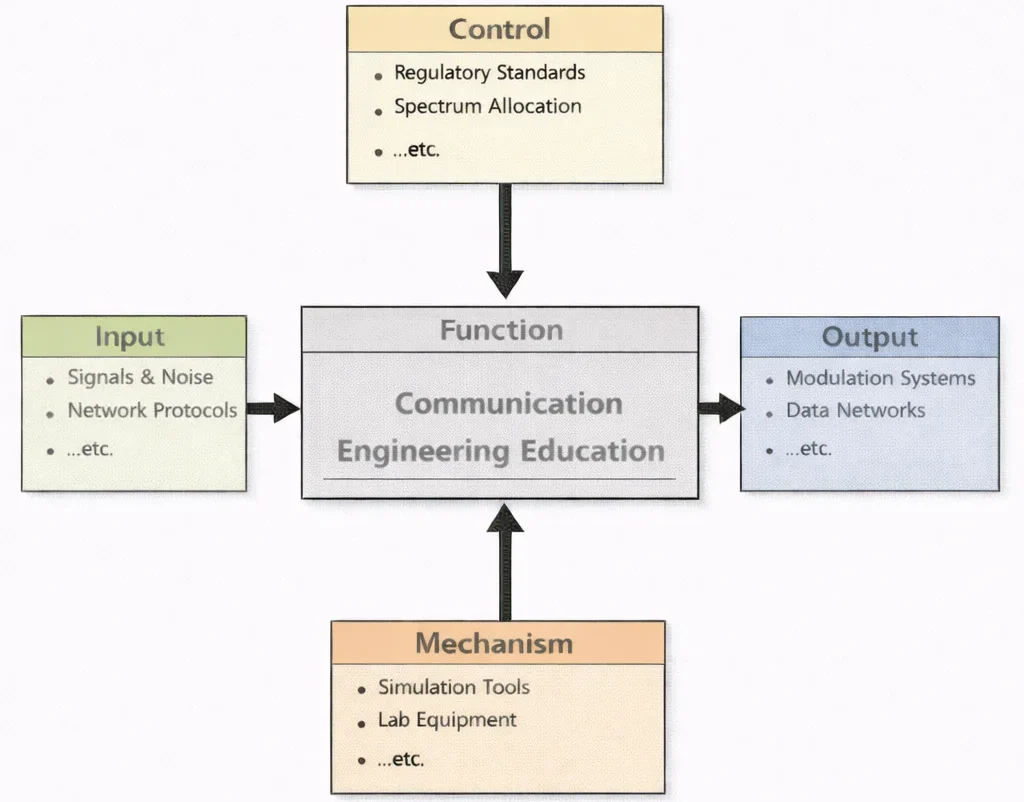
Communication Engineering Education, as this diagram suggests, is where messy reality is tamed into reliable connection. Students begin with the raw ingredients—signals that must survive noise, and protocols that keep networks orderly—then learn to think within the boundaries of regulation and scarce spectrum. Using simulation platforms and lab instruments, they repeatedly translate theory into working models, measure what actually happens, and refine their designs with evidence rather than guesswork. The result is not just familiarity with “how phones and Wi-Fi work,” but the practical competence to design modulation schemes, build data networks, and make communication systems dependable, efficient, and fair in shared airwaves.
Communication Engineering plays a pivotal role in enabling modern digital infrastructure. It forms the backbone of Electrical and Electronic Engineering and facilitates seamless data transmission across diverse platforms. From traditional analog systems to next-generation optical and wireless networks, communication technologies are evolving rapidly to meet the demands of global connectivity.
The integration of Electronics Engineering ensures that communication devices are compact, efficient, and reliable. Advances in Embedded Systems and Microelectronics have led to the miniaturization of transmitters, receivers, and sensors, which are critical for mobile and satellite communication. Enhanced accuracy in Instrumentation and Measurement allows communication systems to monitor and adapt to channel conditions in real time.
Interactive Digital Modulation (BPSK vs. QPSK) & Channel Noise Simulator
Adjust the carrier frequency, signal-to-noise ratio (SNR), and modulation constellation to evaluate real-time continuous time-domain phase transitions, IQ constellation symbol dispersion, and bit error rate (BER) degradation across an Additive White Gaussian Noise (AWGN) channel.
Modern communication protocols often incorporate Signal Processing techniques to reduce noise and optimize bandwidth usage. Coupled with Control Systems Engineering, these technologies ensure data fidelity across unstable environments. The proliferation of smart devices is closely tied to the Internet of Things (IoT) and Smart Technologies, which rely on robust communication frameworks for sensor networks and autonomous systems.
Energy-efficient transmission is crucial in mobile networks and base stations. This has prompted significant research in Power Systems Engineering and the adoption of Renewable Energy and Energy Storage technologies to support sustainable operation. In high-frequency systems and quantum communication, developments in Quantum Electronics are opening new frontiers in security and performance.
Communication systems are increasingly intertwined with automation and intelligent control, a synergy facilitated by Robotics and Automation in E&E. These systems must also operate within ecological constraints. Solutions inspired by Green Building and Sustainable Design help network infrastructure meet energy and environmental standards.
Beyond infrastructure, communication engineering contributes to global sustainability goals. Environmental data collection depends on Environmental Monitoring and Data Analysis, transmitted securely and accurately through engineered networks. Applications range from real-time air quality tracking supported by Air Quality Engineering to the communication of water system telemetry used in Water Resources Engineering.
Policy compliance and planning also benefit from communication frameworks that streamline information sharing in Environmental Policy and Management and Climate Change Mitigation and Adaptation. Communication engineers also contribute to industrial ecosystems that embrace Industrial Ecology and Circular Economy principles and support operations in Industrial and Manufacturing Technologies.
Students interested in this field gain insights into how electronic signals, coding techniques, and environmental integration form the basis of communication networks. They also discover how biomedical advances, such as in Biomedical Electronics, rely on communication modules to transmit patient data across care systems. As such, Communication Engineering stands as an indispensable discipline in shaping the world’s digital and physical landscapes.

Communication Engineering: Connectivity, Networks, and Information Exchange
Electrical & Electronic Engineering – Overview
Establishes the foundational EEE domain roadmap, demonstrating how energy distribution, circuit design, and signal transmission converge across global digital infrastructure.
Communication Engineering
Focuses on the mathematical and hardware frameworks needed to encode, modulate, transmit, and recover data across wireless, optical fiber, and satellite networks.
Signal Processing
Provides Fourier analysis, adaptive filtering, and error-correction algorithms required to eliminate channel noise and optimize spectral bandwidth.
Electronics Engineering
Delivers the physical radio-frequency (RF) power amplifiers, low-noise amplifiers (LNAs), and mixer circuits required for physical transceivers.
IoT & Smart Technologies
Expands network topologies to low-power mesh environments, enabling massive device connectivity via NB-IoT, LoRaWAN, and 5G cellular integration.
Embedded Systems & Microelectronics
Integrates physical-layer communication stacks and MAC protocols directly into system-on-chip (SoC) silicon for edge computing devices.
Control Systems Engineering
Utilizes low-latency telemetry channels to execute real-time closed-loop control across industrial manufacturing plants and smart grids.
Robotics & Automation in EE
Enables ultra-reliable low-latency communication (URLLC) for swarm robotics coordination, autonomous driverless cars, and drone networks.
Instrumentation & Measurement
Ensures precise signal conditioning and calibrated wireless data transfer from industrial sensor arrays to centralized SCADA control hubs.
Power Systems Engineering
Relies on secure power-line communication (PLC) and cellular backhaul to coordinate electrical substations and smart grid load balancing.
Renewable Energy & Energy Storage
Uses wireless telemetry networks to manage distributed solar PV arrays, wind farms, and battery energy storage systems (BESS).
Quantum Electronics
Pushes communication limits via Quantum Key Distribution (QKD) and single-photon optics for unbreakable network security.
Biomedical Electronics
Applies encrypted wireless medical telemetry (MICS bands) to stream real-time patient physiological data from implants to hospital hubs.
Core Concepts in Communication Engineering
Communication engineering centers on transferring information from a source to a destination over physical channels. This domain spans both continuous analog signals and discrete binary digital transmissions, using mathematical transformations to maximize data rate and minimize errors over noisy media.
- Data TransmissionTransferring information across wired or wireless channels. Continuous analog signals represent real-world acoustic or optical waves smoothly, while discrete digital binary signals (0s and 1s) offer superior immunity to noise, simpler encryption, and efficient digital processing.
- Modulation and DemodulationBaseband signals cannot propagate efficiently over long distances. Modulation alters a high-frequency carrier wave's amplitude (AM), frequency (FM), or phase (PM). Advanced schemes like Quadrature Amplitude Modulation (QAM) combine amplitude and phase shifts to maximize spectral efficiency. At the receiver, demodulation algorithms reconstruct the original message stream.
- MultiplexingMultiplexing aggregates multiple user signals onto a single medium. Time-Division Multiplexing (TDM) assigns discrete time slots, Frequency-Division Multiplexing (FDM) assigns non-overlapping frequency bands, and Code-Division Multiple Access (CDMA) separates users using orthogonal mathematical codes over the same spectrum band.
- Channel Coding and Error CorrectionNoise and fading introduce bit errors during transmission. Channel coding introduces structured redundancy into data streams. Parity bits provide simple detection, Hamming codes fix single-bit errors, Reed-Solomon codes combat burst errors, and modern Turbo or Low-Density Parity-Check (LDPC) codes approach Shannon's theoretical channel capacity limit.
- NetworkingCircuit-switched networks reserve a dedicated continuous channel (e.g., legacy PSTN telephony). Modern packet-switched networks chop data into discrete headers and payloads, routing packets dynamically across shared routers to maximize network utilization and fault tolerance.
- Signal PropagationSignals propagate through free space (RF, microwave, satellite) or guided media (copper twisted-pair, coaxial cable, low-attenuation optical fiber). Engineers mitigate multipath fading, attenuation, and atmospheric distortion using adaptive equalization and smart antenna arrays.
Key Technologies in Communication Engineering
Contemporary communication relies on a layered technological ecosystem that spans local short-range connections, high-speed regional optical backbones, and global orbital satellite networks.
- Wireless CommunicationIncludes cellular networks (4G LTE, 5G, 6G), local Wi-Fi (IEEE 802.11 standards), and short-range Bluetooth WPAN protocols for mobile device connectivity. Key Features: Beamforming, massive MIMO, millimeter-wave spectrum, and low-latency packet switching.
- Satellite CommunicationUtilizes Geostationary (GEO), Medium Earth (MEO), and Low Earth Orbit (LEO) satellite constellations. Key Applications: Global GPS navigation, remote broadband access, maritime tracking, and weather telemetry.
- Fiber Optic CommunicationTransmits pulses of light through high-purity glass fibers using total internal reflection. Key Advantages: Terabit bandwidth, near-zero EMI susceptibility, and ultra-low attenuation for transoceanic submarine backbones.
- Internet Protocol (IP) CommunicationThe universal suite (TCP/IP) packetizing global data delivery. Key Protocols: Voice over IP (VoIP), Real-Time Transport Protocol (RTP), and HTTP Live Streaming (HLS).
- Mobile Communication & 6G ResearchAdvanced cellular networks targeting sub-millisecond latencies and peak multi-gigabit throughput. Key Frontiers: Terahertz frequency transceivers, integrated spatial sensing, and AI-driven radio access networks (RAN).
- Radio & Microwave CommunicationPoint-to-point microwave line-of-sight links and terrestrial radio broadcasting. Key Uses: Cellular backhaul links, radar surveillance, aviation traffic control, and emergency services.
- Quantum CommunicationHarnesses photon quantum entanglement and superposition states. Key Application: Quantum Key Distribution (QKD) enabling physically eavesdrop-proof cryptographic transmission.
Applications of Communication Engineering
- TelecommunicationsUnderpins mobile, landline, and broadband voice and video networks, utilizing network slicing and virtualization to deliver customized quality-of-service (QoS) across continents.
- BroadcastingDelivers digital terrestrial, satellite, and hybrid internet television and radio streams to millions of concurrent viewers with high-definition audio and video coding.
- Internet and Data ServicesPowers global cloud data center interconnects, content delivery networks (CDNs), and high-speed fiber routing infrastructure driving global e-commerce and streaming.
- IoT (Internet of Things)Connects billions of industrial and residential sensors using low-power wide-area network protocols (NB-IoT, LoRaWAN) for smart city and agricultural monitoring.
- HealthcareFacilitates remote telemedicine consultations, continuous ambulatory patient telemetry, and secure EHR transmission across hospital networks.
- Aerospace and DefenseDeploys encrypted anti-jamming tactical radio networks, satellite military links, and secure telemetry links for unmanned aerial vehicles (UAVs).
- Navigation and TransportationEnables GNSS fleet tracking, railway signaling systems, and vehicle-to-everything (V2X) wireless communications for autonomous driverless cars.
- Industrial AutomationImplements deterministically timed wireless industrial Ethernet for real-time machine-to-machine (M2M) communication in Industry 4.0 automated factories.
Contemporary Computational Paradigms in Modern Communications
Modern communication systems increasingly operate in nonlinear, non-stationary regimes where closed-form analytical models become intractable. Emerging computational paradigms integrate physical propagation invariants with deep learning architectures:
- Physics-Informed Neural Networks (PINNs) in Electromagnetic Wave Propagation: In dense urban micro-cells and reconfigurable intelligent surface (RIS) environments, PINNs embed the vector Helmholtz wave equation directly into loss functions: $$\mathcal{L}_{\text{total}} = \mathcal{L}_{\text{data}} + \lambda_{\text{wave}} \left\| \nabla^2 \mathbf{E} + \omega^2 \mu \epsilon(\mathbf{x}) \mathbf{E} \right\|^2$$ This allows rapid reconstruction of complex urban diffraction, shadowing, and multipath power distributions without executing massive 3D finite-difference time-domain (FDTD) grid calculations.
- DeepONets & Neural Operators for Nonlinear Optical Fiber Compensation: In transoceanic fiber links, Kerr nonlinearity causes severe inter-channel cross-phase modulation described by the Nonlinear Schrödinger Equation (NLSE): $$j \frac{\partial A}{\partial z} - \frac{\beta_2}{2} \frac{\partial^2 A}{\partial t^2} + \gamma |A|^2 A = -j \frac{\alpha}{2} A$$ Fourier Neural Operators (FNOs) learn continuous mesh-independent mappings of pulse envelope distortions across varying dispersion parameters, executing real-time digital back-propagation (DBP) at a fraction of standard split-step Fourier complexity.
- Edge Invariant State Estimation in Terrestrial-Satellite Handover: In Low Earth Orbit (LEO) megaconstellations (e.g., Starlink), high orbital velocities (\(\sim 7.5\,\text{km/s}\)) induce massive dynamic Doppler shifts (\(\Delta f_d = \pm 100\,\text{kHz}\)). Software-defined radio (SDR) front-ends utilize Invariant Extended Kalman Filters (IEKF) mapped onto Lie groups to track satellite trajectory state vectors and carrier phase errors deterministically under heavy rain fade.
- AI-Driven Radio Access Networks (Open RAN Digital Twins): Synchronized digital twins run real-time telemetry analytics on massive MIMO beamforming weights, dynamically reallocating sub-carrier resource blocks and power allocations via Deep Reinforcement Learning (DRL) to maximize sum-rate capacity.
Challenges in Communication Engineering
- RF Spectrum Scarcity and Thermodynamic Shannon LimitsExponential growth in high-definition video streaming, autonomous systems, and edge telemetry has led to severe radio-frequency congestion below \(6\,\text{GHz}\). The Shannon-Hartley capacity theorem: $$C = B \log_2\left(1 + \frac{P}{N_0 B}\right)$$ establishes a fundamental physical ceiling on channel throughput. As spectral efficiency approaches theoretical limits, expanding network capacity requires shifting to millimeter-wave (\(30\text{--}300\,\text{GHz}\)) and sub-terahertz bands, which suffer extreme atmospheric oxygen absorption (\(60\,\text{GHz}\)) and molecular rain attenuation.
- Nonlinear Distortion, Fading Channels, and Intersymbol Interference (ISI)Radio frequency power amplifiers (PAs) driven near saturation generate severe third-order intermodulation distortion (IMD3), causing spectral regrowth that spills into adjacent channels. In wideband wireless systems, multipath delay spread (\(\tau_d\)) exceeds the symbol duration (\(T_s\)), inducing severe frequency-selective fading and intersymbol interference (ISI). Overcoming this requires high-order orthogonal frequency-division multiplexing (OFDM) combined with computationally intensive digital predistortion (DPD) algorithms.
- Hardware Roots-of-Trust and Post-Quantum Cryptographic VulnerabilitiesWireless links propagate through public open space, exposing raw data packets to eavesdropping, spoofing, and man-in-the-middle attacks. As quantum computers mature, Shor's algorithm threatens to crack classical RSA and elliptic-curve cryptography (ECC) backbones. Network architects must migrate to lattice-based post-quantum cryptographic (PQC) standards and integrate quantum key distribution (QKD) over terrestrial optical backbones.
- Capital Expenditure and Extreme Fiber Backhaul Deployment ConstraintsDeploying high-frequency 5G/6G small cells requires a cell radius under \(150\,\text{meters}\), demanding unprecedented base station density and expensive dark fiber backhaul infrastructure. Laying submarine transoceanic cables involves high capital costs, extreme underwater hydrostatic pressures (\(\gt 70\,\text{MPa}\)), and vulnerability to seismic seabed activity and anchor snagging.
- Heterogeneous Network Slicing and Legacy InteroperabilityIntegrating legacy 2G/3G infrastructure, low-power IoT networks (LoRaWAN, NB-IoT), and virtualized 5G Open RAN architectures within a unified packet core requires complex software-defined networking (SDN) and multi-vendor interoperability compliance.
Future Trends in Communication Engineering
- Sub-Terahertz and 6G Wireless NetworksActive research into 6G targets carrier frequencies between \(100\,\text{GHz}\) and \(1\,\text{THz}\), unlocking extreme spectral bandwidths to provide data rates exceeding \(1\,\text{Tbps}\), sub-millisecond latencies, and integrated radio-frequency imaging.
- Reconfigurable Intelligent Surfaces (RIS)Metamaterial surfaces equipped with thousands of sub-wavelength phase-shifting elements dynamically reconfigure the wireless propagation environment, turning dead zones into reflective signal pathways without power-hungry RF amplifiers.
- Non-Terrestrial Networks (NTN) & Direct-to-Cell Satellite HandoverDirect-to-cell satellite constellations bridge orbital LEO nodes with unmodified consumer smartphones, providing seamless global coverage across oceans, deserts, and disaster-affected zones.
- Integrated Sensing and Communication (ISAC)Future mobile base stations will simultaneously function as communication transmitters and high-resolution bistatic radar arrays, tracking vehicles and mapping physical cities using the same wireless waveform.
- Optical Wireless Communication (Li-Fi and Free-Space Optics)Li-Fi utilizes solid-state LED lighting to transmit high-speed data indoors, providing gigabit throughput immune to RF interference in hospitals and aircraft cabins.
Worked Numerical Application: Link Budget Analysis & Shannon Channel Capacity
Engineering Calculation: Satellite Downlink Budget & Maximum Achievable Bitrate
Problem Formulation: A geostationary earth orbit (GEO) communication satellite transmits a high-speed telemetry downlink at carrier frequency \(f_c = 12\,\text{GHz}\) (Ku-band) over an orbital distance \(d = 36\,000\,\text{km}\). The satellite transmitter output power is \(P_t = 50\,\text{W}\) into a directional parabolic antenna with gain \(G_t = 34\,\text{dBi}\). The receiving ground station antenna has a diameter of \(2.4\,\text{m}\) providing an antenna gain \(G_r = 45\,\text{dBi}\) and operates at an equivalent system noise temperature \(T_{\text{sys}} = 150\,\text{K}\). The allocated channel bandwidth is \(B = 36\,\text{MHz}\). Additional atmospheric and rain attenuation is \(\mathcal{L}_{\text{atm}} = 2.5\,\text{dB}\).
Step-by-Step Analytical Derivation & Calculations:
Step 1: Convert Transmitter Power and Calculate Free-Space Path Loss (\(\text{FSPL}\)):
Transmitter power in dBW: \(P_t(\text{dBW}) = 10 \log_{10}(50\,\text{W}) \approx \mathbf{16.99\,\text{dBW}}\).
The free-space path loss equation is:
Step 2: Calculate Received Signal Power (\(P_r\)):
Applying the decibel link budget equation:
$$P_r(\text{dBW}) = P_t(\text{dBW}) + G_t(\text{dBi}) + G_r(\text{dBi}) - \text{FSPL}(\text{dB}) - \mathcal{L}_{\text{atm}}(\text{dB})$$ $$P_r(\text{dBW}) = 16.99 + 34.0 + 45.0 - 205.16 - 2.5 = \mathbf{-111.67\,\text{dBW}}$$In linear scale: \(P_r = 10^{-11.167} = 6.808 \times 10^{-12}\,\text{W} \approx \mathbf{6.81\,\text{pW}}\).
Step 3: Determine Thermal Noise Power (\(N\)) and Signal-to-Noise Ratio (\(\text{SNR}\)):
Using Boltzmann's constant \(k_B = 1.3806 \times 10^{-23}\,\text{J/K}\):
$$N = k_B \times T_{\text{sys}} \times B = (1.3806 \times 10^{-23}) \times 150 \times (36 \times 10^6) = 7.455 \times 10^{-14}\,\text{W}$$ $$N(\text{dBW}) = 10 \log_{10}(7.455 \times 10^{-14}) = \mathbf{-131.28\,\text{dBW}}$$The resulting Signal-to-Noise Ratio at the ground receiver demodulator:
$$\text{SNR}(\text{dB}) = P_r(\text{dBW}) - N(\text{dBW}) = -111.67 - (-131.28) = \mathbf{19.61\,\text{dB}}$$ $$\text{SNR}_{\text{linear}} = 10^{\frac{19.61}{10}} \approx \mathbf{91.41}$$Step 4: Compute Theoretical Shannon Channel Capacity (\(C\)):
$$C = B \log_2(1 + \text{SNR}_{\text{linear}}) = (36 \times 10^6) \times \log_2(1 + 91.41) = (36 \times 10^6) \times \log_2(92.41)$$ $$\text{Since } \log_2(92.41) = \frac{\ln(92.41)}{\ln(2)} \approx \frac{4.5262}{0.69315} \approx 6.530$$ $$C = 36 \times 10^6 \times 6.530 \approx \mathbf{235.08\,\text{Mbps}}$$Physical & Engineering Takeaways: Despite an extreme path loss of \(205.16\,\text{dB}\), high-gain parabolic antennas combined with a low-noise front-end receiver yield a robust \(\text{SNR} = 19.61\,\text{dB}\). This supports an uncompressed channel capacity of \(235.08\,\text{Mbps}\). In practical implementations, applying an advanced Low-Density Parity-Check (LDPC) forward error correction code operating within \(1.5\,\text{dB}\) of Shannon capacity allows the operator to deploy 16-APSK modulation at a net useful bit rate exceeding \(180\,\text{Mbps}\) while guaranteeing a Bit Error Rate \(\text{BER} \le 10^{-9}\).
Systems Engineering Architecture: Trade-Off Analysis
Modern telecommunication infrastructure demands balancing physical RF propagation parameters, digital computational latency, hardware cost, and energy dissipation. The following matrix illustrates primary architectural compromises:
| Design Domain | Primary Architectural Dilemma | Favorable Attributes (+) | Compromised Metrics (−) | System Mitigation Strategy |
|---|---|---|---|---|
| Digital Modulation | Higher-Order QAM (e.g., 256-QAM) vs. QPSK / BPSK | High spectral efficiency (\(8\,\text{bits/s/Hz}\)), maximum aggregate throughput. | Extremely sensitive to channel noise; requires \(\text{SNR} \ge 32\,\text{dB}\); prone to phase jitter. | Adaptive Modulation and Coding (AMC) that dynamically falls back to QPSK under fading conditions. |
| Multiplexing Schemes | OFDM vs. Single-Carrier Frequency Division Multiple Access (SC-FDMA) | Robust resistance to multipath delay spread; simple frequency-domain equalization. | High Peak-to-Average Power Ratio (PAPR), requiring high PA linearity and reducing handset battery life. | Deploy OFDM on downlink and SC-FDMA on battery-constrained uplink channels. |
| Cellular Architecture | Millimeter-Wave (mmWave) vs. Sub-6 GHz Macro-Cells | Massive contiguous bandwidth (\(\gt 400\,\text{MHz}\)), gigabit data throughput, compact antennas. | Severe path loss, near-zero penetration through building walls and foliage, small coverage radius. | Massive MIMO hybrid beamforming arrays and dual-connectivity with sub-6 GHz carrier anchors. |
| Optical Backbone | Coherent Detection vs. Direct Detection (IM-DD) | Recovers amplitude, phase, and polarization; enables \(\gt 400\,\text{Gbps}\) per wavelength channel over thousands of km. | High transceiver cost, complex local oscillator lasers, high DSP power dissipation. | Direct detection (PAM4) for short datacenter links (\(\le 10\,\text{km}\)); coherent detection for long-haul backbones. |
Why Study Communication Engineering
Communication Engineering: Conclusion
Communication engineering is an indispensable pillar of modern society. By applying fundamental electromagnetic theory, digital signal processing, and dynamic networking protocols, communication engineers transform raw noise-corrupted channels into crystal-clear data pipelines. As networks transition toward 6G, quantum encryption, and edge AI, communication engineering will continue to define the future of human connectivity.
Frequently Asked Questions
1. What does communication engineering actually deal with?
Communication engineering is about sending information reliably from one point to another, whether that is a phone call, a video stream, or sensor data. It covers everything from radio and fiber-optic links to mobile networks, satellite systems, and the protocols that hold the internet together.
2. Why do we need to modulate signals before transmitting them?
Most information, such as voice or digital data, starts as a low-frequency signal that cannot travel far on its own. Modulation shifts this information onto higher-frequency carriers, allowing it to share spectrum with other users, travel long distances, and resist noise more effectively.
3. What is the practical difference between analogue and digital communication?
Analogue systems send continuously varying signals, while digital systems transmit discrete bits or symbols. Digital communication is easier to process, encrypt, and correct for errors, which is why almost all modern mobile, Wi-Fi, and internet systems are digital at their core.
4. Why do engineers care so much about bandwidth and channel capacity?
Bandwidth is a limited resource, and more users want higher data rates. Channel capacity tells us the theoretical maximum throughput a channel can support. Understanding this limit helps engineers design systems that use spectrum efficiently without sacrificing reliability.
5. How do error detection and correction make communications more reliable?
Real-world channels are noisy, so some bits will flip or get lost. By adding carefully chosen redundancy, error-detecting and error-correcting codes allow the receiver to spot mistakes and often fix them, so users see a clean message even when the channel is imperfect.
6. What makes wireless communication particularly challenging?
Wireless signals fade with distance, can be blocked by buildings, and can bounce off surfaces to create multiple delayed copies. These effects cause interference and distortion. Engineers respond with techniques such as diversity, equalisation, adaptive modulation, and smart antennas to keep links stable and fast.
7. How does multiplexing help networks serve many users at once?
Multiplexing splits a shared channel into slots in time, frequency, code, or wavelength so that multiple users or data streams can coexist. This is how a single fiber carries many independent channels, or how a cellular base station serves dozens of phones simultaneously.
8. What is the difference between circuit-switched and packet-switched networks?
Circuit-switched networks reserve a dedicated path for each call, which can be wasteful when the line is silent. Packet-switched networks, like the internet, chop data into packets that share common routes. This improves efficiency and flexibility and supports many services on the same infrastructure.
9. Why are communication protocols so important for the internet?
Protocols specify how devices address each other, structure messages, handle errors, and keep data secure. Without common protocol rules, such as those in the TCP/IP stack, devices made by different manufacturers and in different countries would not “speak the same language” and could not exchange data smoothly.
10. What kinds of careers can communication engineering lead to?
Graduates can work on mobile networks, satellite communications, fiber-optic systems, internet infrastructure, wireless sensor networks, IoT platforms, and network security. Many roles sit at the intersection of hardware, software, and systems design, supporting global connectivity.
Section 1: Foundational Review Questions with Answers
1. What is the primary goal of communication engineering, and how has it evolved with modern technology?
Answer: The central goal of communication engineering is to move information from a source to a destination reliably, efficiently, and securely, whether the path is a copper cable, a fiber-optic link, a radio channel, or a satellite hop. Modern systems emphasize digital techniques, including high-order modulation, compression, and channel coding to support broadband internet, 5G, and streaming media.
2. Why is modulation necessary in communication systems, and what are the key differences between analogue and digital modulation?
Answer: Modulation shifts baseband information signals onto high-frequency carrier waves that propagate efficiently over long distances. Analogue modulation continuously varies carrier amplitude, frequency, or phase, whereas digital modulation maps discrete bit patterns onto distinct symbol states (e.g., PSK, QAM), offering superior noise resilience and spectral efficiency.
3. How do channel capacity and bandwidth limitations influence the design of communication systems?
Answer: Shannon’s channel capacity theorem places an absolute upper limit on error-free data rates for a given bandwidth and signal-to-noise ratio (SNR). When physical bandwidth is constrained, engineers deploy higher-order modulation schemes, advanced error-correcting codes, and dynamic spectrum allocation to approach capacity limits.
4. What role does error detection and correction play in digital communication, and how is it implemented?
Answer: Channel noise and fading flip transmitted bits. Forward error correction (FEC) introduces mathematical redundancy (e.g., Hamming, Reed-Solomon, or LDPC codes) into the transmitted payload, enabling the receiver to detect and automatically repair bit errors without requiring slow packet retransmissions.
5. Why is signal-to-noise ratio (SNR) a critical metric, and how can communication engineers improve it?
Answer: SNR quantifies signal strength relative to background channel noise, directly dictating maximum bitrates and error rates. Engineers boost SNR by increasing transmitter power, using high-gain directional antennas, installing low-noise amplifiers (LNAs), and applying beamforming techniques.
6. How has the transition from circuit-switched networks to packet-switched networks transformed communication systems?
Answer: Circuit switching reserves a dedicated channel for the entire duration of a call, leading to idle bandwidth waste. Packet switching chops data into header-addressed packets that share network infrastructure dynamically, dramatically increasing capacity, resilience, and multi-service scalability.
7. In wireless communication, what challenges do path loss, shadowing, and multipath propagation pose, and how are they mitigated?
Answer: Path loss reduces signal strength over distance, shadowing blocks signals behind obstacles, and multipath reflections cause constructive/destructive phase interference and delay spread. Engineers mitigate these using adaptive equalization, spatial diversity, rake receivers, and MIMO antenna arrays.
8. What is multiplexing, and how does it enhance the efficiency of communication channels?
Answer: Multiplexing combines multiple independent user signals over a single transmission channel. Methods include Time Division Multiplexing (TDM), Frequency Division Multiplexing (FDM), and Wavelength Division Multiplexing (WDM) in optical fibers, allowing shared infrastructure usage without signal crosstalk.
9. How do communication protocols ensure seamless data exchange across global networks, and what key elements define a robust protocol?
Answer: Protocols define standardized rules for device addressing, message framing, error handling, flow control, and session handshaking. Layered architectures (like OSI and TCP/IP) isolate hardware layers from application software, enabling universal global interoperability.
10. Which emerging technologies might reshape the future of communication engineering, and what impact could they have?
Answer: 6G terahertz networks, massive MIMO, LEO satellite constellations, Quantum Key Distribution (QKD), and AI-driven radio access networks will enable sub-millisecond latencies, terabit throughputs, and un-hackable global encryption.
Section 2: Analytical & Scenario-Based Inquiry
1. How does understanding signal behavior at physical and abstract levels enable engineers to tackle real-world communication challenges?
At the physical level, communication engineers examine how signals propagate, attenuate, and distort through wired cables, airwaves, and optical fibers. At the abstract level, they use mathematical models to understand limits such as channel capacity. Combining both perspectives allows engineers to choose suitable modulation, coding, filtering, and networking methods for real-world conditions where noise, bandwidth limits, and multipath fading cannot be ignored.
2. In a world crowded with wireless devices, how can designers ensure different systems coexist without excessive interference?
Engineers reduce interference through spectrum planning, frequency hopping, spread spectrum methods, beamforming, power control, and careful protocol design. These methods allow many devices to share limited spectrum without overwhelming one another. The goal is not only to make each device work, but to ensure that an entire communication ecosystem remains usable as more wireless applications appear.
3. What motivates the migration from traditional circuit-switched networks to packet-switched systems?
Circuit-switched networks reserve an entire channel for each call, even when little information is being sent. Packet-switched systems break information into packets that share pathways dynamically, making better use of network resources. This shift enabled the modern internet, where many types of traffic—voice, video, files, messages, and sensor data—can coexist on shared infrastructure.
4. How do power, complexity, and speed intersect when designing next-generation wireless modulation schemes?
High-order modulation schemes can increase data rates but require stronger signal quality, more complex receivers, and often more power. Simpler schemes are more robust but carry less data. Engineers balance battery life, hardware cost, application needs, and channel conditions. Adaptive systems can switch modulation schemes in real time, increasing speed when conditions are good and prioritizing reliability when conditions worsen.
5. In what ways can advanced error-correcting codes transform network reliability and reduce retransmissions?
Error-correcting codes add carefully designed redundancy so the receiver can detect and correct errors caused by noise or fading. By reducing the need for retransmission, they improve reliability, lower latency, and increase effective throughput. This is especially important for real-time services such as video calls, satellite communication, and mobile networks operating near capacity limits.
6. What challenges and innovations do engineers encounter when integrating massive MIMO technology in cellular networks?
Massive MIMO uses large antenna arrays to communicate with multiple devices at once through spatial separation and beamforming. This can greatly improve capacity and coverage, but it introduces hardware calibration challenges, high signal-processing demands, and complex real-time beam management. When implemented well, it improves spectrum use, data speed, and network reliability.
7. How do optical fiber links achieve such high data rates, and what new frontiers exist for optical communication?
Optical fibers transmit data using light, whose high carrier frequency enables very high data rates. Low attenuation and immunity to electromagnetic interference allow signals to travel long distances. Techniques such as wavelength division multiplexing send many channels through the same fiber. Future frontiers include coherent detection, advanced modulation, space-division multiplexing, and better control of dispersion and nonlinear fiber effects.
8. How can communication engineers guard against eavesdropping, data tampering, and denial-of-service attacks?
Communication engineers protect systems through encryption, authentication, secure protocols, firewalls, traffic monitoring, anomaly detection, and denial-of-service mitigation. Security must be designed across multiple layers, from hardware and wireless links to routing, applications, and user authentication. As attacks become more sophisticated, resilient communication systems must combine technical defenses with constant monitoring and timely updates.
9. Why is latency an essential parameter in certain applications, and what strategies help minimize delay?
Latency is critical in applications such as online gaming, telemedicine, autonomous vehicles, industrial control, and augmented reality. High latency causes delayed responses and can create safety risks in control systems. Engineers reduce latency by optimizing routing, reducing network hops, using edge computing, streamlining protocols, and prioritizing time-sensitive traffic.
10. How do engineers adapt communication technologies to extreme environments, such as deep space or undersea cables?
Extreme environments require communication systems that tolerate long distances, high delay, limited power, pressure, corrosion, or difficult maintenance. Deep-space systems use directional antennas, sensitive receivers, and robust error correction. Undersea cables use repeaters, protective materials, and redundancy over thousands of kilometers. These scenarios teach engineers the value of reliability, efficiency, fault tolerance, and careful material design.
11. What trade-offs must be considered when designing communication systems for the Internet of Things?
IoT systems must balance battery life, cost, range, data rate, reliability, and security. Many devices send small amounts of data but must operate for months or years on limited power. Engineers use low-power protocols, efficient access methods, local processing, and careful spectrum choices to prevent congestion while keeping devices affordable and dependable.
12. How might emerging AI-driven technologies reshape the field of communication engineering?
AI can help communication systems optimize routing, allocate spectrum, detect anomalies, adjust beam directions, and predict congestion in real time. Self-organizing networks could respond automatically to changes in user density, interference, or equipment failure. This may shift communication engineering toward more adaptive, intelligent networks, while also requiring engineers to understand data quality, explainability, privacy, and system oversight.
Section 3: Numerical Problems with Solutions
1. According to the Shannon-Hartley theorem, calculate the theoretical maximum channel capacity (\(C\)) in Mbps for a channel with a bandwidth \(B = 2\,\text{MHz}\) and a Signal-to-Noise Ratio (SNR) of \(20\,\text{dB}\).
Solution:
Convert SNR from decibels to linear ratio:
$$\text{SNR}_{\text{linear}} = 10^{\frac{20}{10}} = 10^2 = 100$$
Apply the Shannon channel capacity formulation:
$$C = B \log_2(1 + \text{SNR}) = (2 \times 10^6\,\text{Hz}) \times \log_2(1 + 100) = (2 \times 10^6) \times \log_2(101)$$
Evaluating the logarithm:
$$\log_2(101) = \frac{\ln(101)}{\ln(2)} \approx \frac{4.61512}{0.69315} \approx 6.6582$$
$$C = 2 \times 10^6 \times 6.6582 = 13\,316\,400\,\text{bps} \approx \mathbf{13.32\,\text{Mbps}}$$
2. A carrier wave with frequency \(f_c = 100\,\text{MHz}\) is amplitude-modulated by a single-tone audio signal with frequency \(f_m = 5\,\text{kHz}\). Determine the upper sideband (USB) frequency, lower sideband (LSB) frequency, and total transmission bandwidth required.
Solution:
Upper sideband frequency:
$$f_{\text{USB}} = f_c + f_m = 100\,\text{MHz} + 0.005\,\text{MHz} = \mathbf{100.005\,\text{MHz}}$$
Lower sideband frequency:
$$f_{\text{LSB}} = f_c - f_m = 100\,\text{MHz} - 0.005\,\text{MHz} = \mathbf{99.995\,\text{MHz}}$$
Total double-sideband amplitude modulation (DSB-AM) bandwidth:
$$B_{\text{AM}} = 2 f_m = 2 \times 5\,\text{kHz} = \mathbf{10.0\,\text{kHz}}\quad (0.01\,\text{MHz})$$
3. Calculate the free-space path loss (FSPL) in dB for a \(5.8\,\text{GHz}\) Wi-Fi signal transmitting over a distance of \(500\,\text{meters}\). Use the formula \(\text{FSPL} = 20\log_{10}(d) + 20\log_{10}(f) + 32.44\), where \(d\) is in km and \(f\) is in MHz.
Solution:
Distance \(d = 500\,\text{m} = 0.5\,\text{km}\); Frequency \(f = 5.8\,\text{GHz} = 5800\,\text{MHz}\).
Calculate constituent terms:
$$20 \log_{10}(0.5) = 20 \times (-0.30103) = -6.02\,\text{dB}$$
$$20 \log_{10}(5800) = 20 \times 3.76343 = 75.27\,\text{dB}$$
Total Free-Space Path Loss:
$$\text{FSPL} = -6.02 + 75.27 + 32.44 = \mathbf{101.69\,\text{dB}}$$
4. A digital communication link transmits a stream of \(1\,000\,000\) bits over a wireless channel. If the receiver detects \(15\) corrupted bits, calculate the Bit Error Rate (BER) and express it in scientific notation.
Solution:
Bit Error Rate is defined as the ratio of errored bits to total transmitted bits:
$$\text{BER} = \frac{N_{\text{errors}}}{N_{\text{total}}} = \frac{15}{1\,000\,000} = 0.000015 = \mathbf{1.5 \times 10^{-5}}$$
5. An optical fiber link has an attenuation of \(0.25\,\text{dB/km}\). If an optical signal with an initial power of \(10\,\text{mW}\) enters a \(40\,\text{km}\) fiber span without repeaters, calculate the output power (\(P_{\text{out}}\)) in mW.
Solution:
Total optical attenuation across the link:
$$\alpha_{\text{total}} = 0.25\,\text{dB/km} \times 40\,\text{km} = 10.0\,\text{dB}$$
Convert total decibel loss to linear attenuation power ratio:
$$\text{Loss}_{\text{linear}} = 10^{-\frac{10.0}{10}} = 10^{-1} = 0.10$$
The delivered output optical power:
$$P_{\text{out}} = P_{\text{in}} \times \text{Loss}_{\text{linear}} = 10\,\text{mW} \times 0.10 = \mathbf{1.0\,\text{mW}}\quad (0.0\,\text{dBm})$$
6. Calculate the symbol rate (baud rate) for a \(16\)-QAM digital transmission system carrying a raw bit rate of \(48\,\text{Mbps}\).
Solution:
For a \(M = 16\) constellation, the number of bits encoded per constellation symbol is:
$$k = \log_2(M) = \log_2(16) = 4\,\text{bits/symbol}$$
The required symbol transmission rate (baud):
$$R_{\text{symbol}} = \frac{R_{\text{bit}}}{k} = \frac{48\,\text{Mbps}}{4\,\text{bits/symbol}} = \mathbf{12.0\,\text{Mbaud}}\quad (12 \times 10^6\,\text{symbols/second})$$
7. A geostationary satellite orbits at an altitude of \(35\,786\,\text{km}\) directly above the equator. Calculate the one-way propagation delay in milliseconds for a radio signal traveling at the speed of light (\(c \approx 3 \times 10^8\,\text{m/s}\)) from a ground station to the satellite.
Solution:
Distance to the orbital slot:
$$d = 35\,786\,\text{km} = 35\,786\,000\,\text{m}$$
One-way speed-of-light propagation latency:
$$t_{\text{prop}} = \frac{d}{c} = \frac{35\,786\,000\,\text{m}}{3 \times 10^8\,\text{m/s}} \approx 0.119287\,\text{seconds} \approx \mathbf{119.29\,\text{ms}}$$