
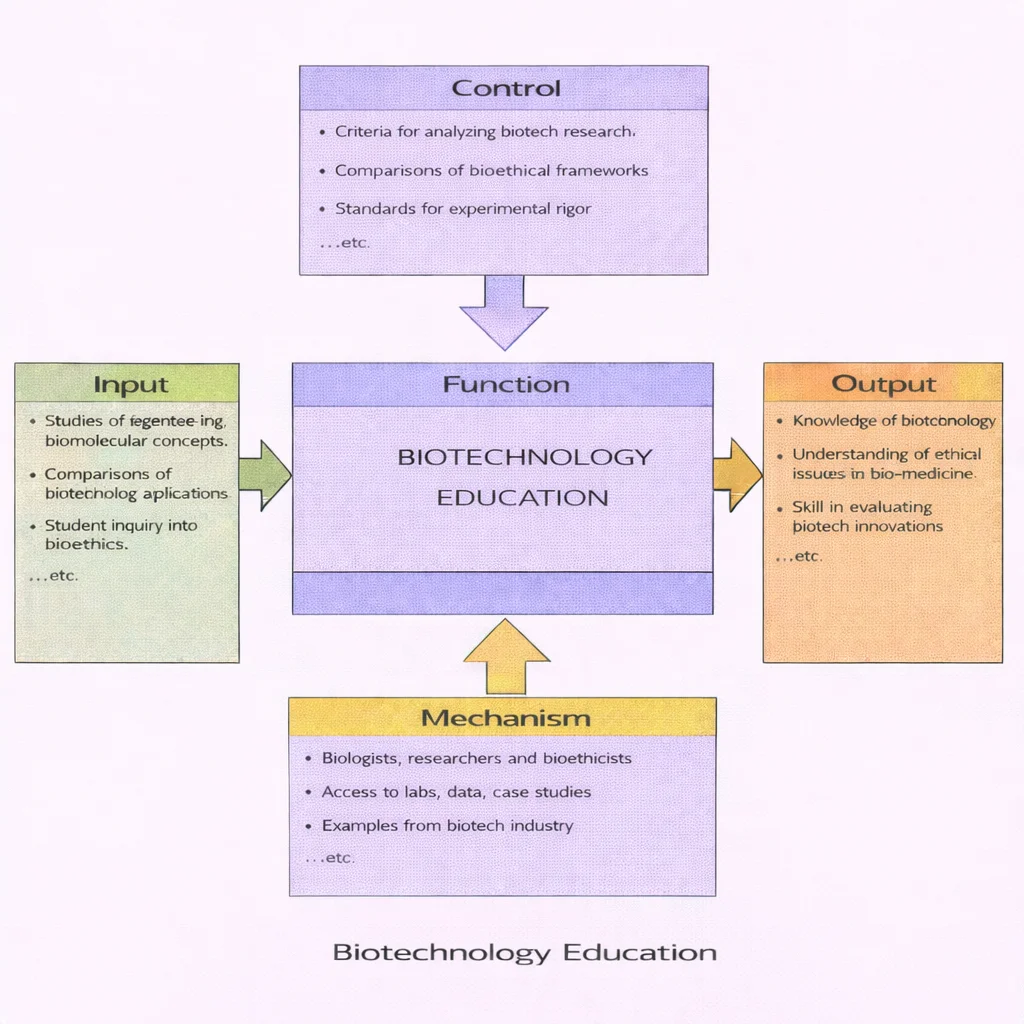
Biotechnology education transforms observational curiosity about living organisms and molecular processes into disciplined, quantitative systems engineering. In this IDEF0 functional architecture, learners contribute inputs: core biological principles, molecular sequences, and authentic challenges spanning therapeutics, metabolic engineering, and agro-ecological resilience. This progression is governed by strict epistemological controls: the scientific method, evidentiary clinical verification, laboratory safety protocols, and formal bioethical frameworks. Enabled by computational modeling suites, genomic datasets, advanced wet-lab instrumentation, and interdisciplinary faculty mentorship, students generate verified competencies: mechanistic biotechnology literacy, bioethical discernment, and the capability to engineer biological solutions responsibly.
Biotechnology operates at the convergence of biology, chemical engineering, and computational sciences. Contemporary advancements rely heavily on formal mathematical models from applied mathematics and probabilistic inference from statistics to evaluate experimental variability and parameterize enzyme kinetics. In parallel, the integration of artificial intelligence and deep learning enables structural biologists to resolve 3D protein conformations, map receptor-ligand docking affinities, and accelerate de novo therapeutic discovery.
Modern biotechnology is inherently high-throughput and data-driven. Leveraging data science and analytics pipelines, vast next-generation sequencing (NGS) and multi-omic datasets are mined to identify single-nucleotide polymorphisms (SNPs) and decipher complex gene-regulatory networks. These computational workflows rely on distributed cloud infrastructure supported by internet and web technologies to coordinate worldwide bio-databanks.
Within the broader spectrum of emerging technologies, biotechnology interfaces with adjacent technical fields to expand its physical execution capabilities. Autonomous systems and microfluidic liquid handlers automate repetitive assay pipetting, maximizing experimental reproducibility. Embedded IoT sensors track bioreactor parameters (such as dissolved oxygen, pH, and agitation rates) in real time to optimize industrial bioprocess operations.

Engineering Life Systems Within Emerging Technologies
Examine how biotechnology integrates across related domains within the Prep4Uni Emerging Technologies curriculum:
Re-engineering biological systems, metabolic pathways, CRISPR gene editing, and bioprocess kinetics.
Automated liquid handling, microfluidic cell sorting, and adaptive control algorithms in bio-manufacturing.
Quantum chemistry algorithms simulating molecular orbitals, enzyme catalysis, and complex protein folding.
Closed-loop bioregenerative life support systems (ECLSS), microgravity cell biology, and space agriculture.
Primary Branches of Contemporary Biotechnology
Biotechnology is organized into specialized branches that translate cellular biology and molecular genetics into practical applications:
| Branch | Core Methodological Focus | Key Applications |
|---|---|---|
| Medical Biotechnology (Red) | Recombinant DNA, targeted monoclonal antibodies, mRNA vaccines, CRISPR gene therapeutics, and autologous stem cell differentiation. | Oncology immunotherapies, human insulin synthesis, and diagnostic assays. |
| Agricultural Biotechnology (Green) | Transgenic plant breeding, marker-assisted selection, microbial biofertilizers, and RNA-interference pest management. | Drought-tolerant crops, biofortified crops (Golden Rice), and biopesticides. |
| Industrial Biotechnology (White) | Enzyme biocatalysis, metabolic engineering for chemical synthesis, continuous bioreactor fermentation, and bio-polymerization. | Bioethanol, polyhydroxyalkanoates (PHA bioplastics), and industrial enzymes. |
| Environmental Biotechnology (Grey) | Microbial bio-augmentation, phytoremediation, anaerobic digestion, and whole-cell biosensors for toxicological screening. | Heavy-metal chelation, petrochemical spill degradation, and wastewater treatment. |
| Marine Biotechnology (Blue) | Extremophile bioprospecting, microalgal cultivation, and marine-derived biomaterial harvesting. | Marine-derived antimicrobials, aquaculture diagnostics, and microalgal lipids. |
Core Foundational Technologies in Modern Bioprocessing
Modern biotechnology relies on a versatile suite of molecular tools that enable the precise manipulation of genetic code and biological pathways:
- CRISPR-Cas9 & Base Editing: RNA-guided nucleases enable site-specific genomic modifications. Beyond double-strand breaks, base and prime editors allow precise nucleotide transitions without requiring double-strand DNA cleavage.
- Recombinant DNA & Plasmid Vector Engineering: Enzymatic restriction and Gibson assembly integrate heterologous genetic code into expression vectors. Host organisms (e.g., Escherichia coli or Pichia pastoris) are transformed into scalable biomanufacturing platforms.
- Synthetic Biology & Metabolic Circuit Design: Designing biological circuits using standardized genetic parts (promoters, ribosome binding sites, terminators). Engineers rewire metabolic pathways to optimize bio-product accumulation.
- Bioprocess & Bioreactor Kinetics: Controlling batch, fed-batch, and continuous perfusion bioreactors. Bioprocess engineers manage nutrient consumption, oxygen mass transfer (\(k_L a\)), and shear stress to maximize viable cell density.
- High-Throughput Bioinformatics: Analyzing genomic, transcriptomic, and proteomic data using Python, R, and specialized algorithms (BLAST, Hidden Markov Models) to map molecular functions and disease mechanisms.
Evaluating a Pathway in Biotechnology & Bioengineering?
Evaluate your analytical skills, explore industry specializations, and review academic requirements before declaring a university major.
Launch Biotechnology Career Assessment →Interactive Bioreactor Bacterial Growth & Yield Kinetics Model
Simulate exponential cell population dynamics, doubling intervals, and biomass accumulation under first-order growth kinetics:
Frequently Asked Questions on Biotechnology
1. How does modern molecular biotechnology differ from traditional fermentation?
Traditional biotechnology leveraged naturally occurring, wild-type organisms empirically without structural understanding of underlying genetics (such as brewing or traditional plant cross-breeding). Modern biotechnology works with precise knowledge of DNA sequences, employing genetic engineering, site-directed mutagenesis, and targeted metabolic engineering to program cellular outputs directly.
2. What makes CRISPR-Cas9 such a significant breakthrough in genetic engineering?
Earlier gene-editing technologies (like Zinc Finger Nucleases and TALENs) required engineering bespoke proteins for each target DNA sequence, which was time-consuming and expensive. CRISPR uses a simple synthetic single-guide RNA (sgRNA) to direct the Cas9 endonuclease to any matching 20-base-pair target adjacent to a Protospacer Adjacent Motif (PAM). This makes genetic modification faster, more precise, and highly scalable.
3. What role does bioinformatics play in modern pharmaceutical discovery?
Bioinformatics connects genomics with practical medicine. By applying machine learning, statistical inference, and sequence alignment algorithms to biological datasets, bioinformaticians identify disease-linked mutations, model 3D target receptor bindings, and optimize candidate compounds in silico before moving to wet-lab synthesis.
Interactive Self-Assessment & Conceptual Verification
Select any question below to expand the detailed technical explanation:
1. What advantages does recombinant human insulin offer over animal-extracted insulin?
2. How does engineering drought tolerance illustrate the relationship between DNA, proteins, and physical traits?
3. Why are monoclonal antibodies often more specific than conventional small-molecule drugs?
4. Which environmental variables must engineers balance during microbial bioremediation?
End-of-Page Comprehensive Practice Module
Part I: Foundational Concepts & Direct Review
1. How does PCR amplify target sequences in clinical diagnostics?
2. How can CRISPR-Cas9 be used to study gene function through knockouts?
3. What challenges arise when scaling yeast-based bioplastics from bench to industrial scale?
Part II: Analytical & Scenario-Based Inquiry
1. How are foundation AI models transforming protein engineering?
2. What biosafety and containment strategies are required for synthetic organisms?
Part III: Step-by-Step Quantitative Bioprocess Computations
Problem 1: Exponential Cellular Population Growth Dynamics
Scenario: A stirred-tank bioreactor is inoculated with an initial population of \(N_0 = 1.0 \times 10^6 \text{ cells}\). Under unconstrained nutrient conditions, the culture displays a generation doubling time of \(t_d = 3.0 \text{ hours}\). Calculate the total viable cell population present after \(t = 12.0 \text{ hours}\) of exponential growth.
Step-by-Step Derivation:
$$ \begin{aligned} n &= \frac{t}{t_d} = \frac{12.0 \text{ h}}{3.0 \text{ h}} = 4.0 \text{ doubling periods} \\ N(t) &= N_0 \times 2^n \\ N(12) &= 1.0 \times 10^6 \times 2^4 = 1.0 \times 10^6 \times 16 = 1.6 \times 10^7 \text{ cells} \end{aligned} $$Answer & Conclusion: The final population reaches exactly \(1.6 \times 10^7 \text{ cells}\) (or 16,000,000 cells).
Problem 2: Industrial Fermentation Yield Optimization Sizing
Scenario: An industrial fermenter with working volume \(V = 800.0 \text{ L}\) yields a baseline product titer of \(C_0 = 250.0 \text{ g}\cdot\text{L}^{-1}\). Optimization of the dissolved oxygen profile enhances product yield by \(10.0\%\). Determine the baseline mass yield and the revised total mass output.
Step-by-Step Derivation:
$$ \begin{aligned} Y_{\text{baseline}} &= C_0 \times V = 250.0 \text{ g}\cdot\text{L}^{-1} \times 800.0 \text{ L} = 200{,}000.0 \text{ g} \quad (200.0 \text{ kg}) \\ \Delta Y &= Y_{\text{baseline}} \times 0.10 = 200{,}000.0 \text{ g} \times 0.10 = 20{,}000.0 \text{ g} \quad (20.0 \text{ kg}) \\ Y_{\text{total}} &= Y_{\text{baseline}} + \Delta Y = 200{,}000.0 \text{ g} + 20{,}000.0 \text{ g} = 220{,}000.0 \text{ g} \quad (220.0 \text{ kg}) \end{aligned} $$Answer & Conclusion: Total harvest yield increases to \(220{,}000.0 \text{ g}\) (or 220.0 kg).
Problem 3: Transgenic Growth Acceleration and Doubling Time Reduction
Scenario: A wild-type microalgae strain exhibits a generation doubling time of \(t_{d,\text{wild}} = 6.0 \text{ hours}\). A CRISPR-edited transgenic strain shows a \(30.0\%\) faster growth rate, reducing its generation interval. Compute the new generation doubling time.
Step-by-Step Derivation:
$$ \begin{aligned} t_{d,\text{gmo}} &= t_{d,\text{wild}} \times (1 - 0.30) \\ t_{d,\text{gmo}} &= 6.0 \text{ h} \times 0.70 = 4.2 \text{ hours} \\ \text{Minutes conversion} &= 0.2 \text{ h} \times 60 \text{ min/h} = 12.0 \text{ minutes} \end{aligned} $$Answer & Conclusion: The edited strain's doubling time decreases to \(4.2 \text{ hours}\) (or 4 hours and 12 minutes).
Problem 4: Enzyme Concentration Scaling & Catalytic Velocity
Scenario: An enzyme reaction runs at a velocity of \(v_0 = 5.0 \ \mu\text{mol}\cdot\text{min}^{-1}\). Assuming excess substrate under pseudo-first-order conditions, increasing enzyme concentration by \(40.0\%\) scales the reaction rate proportionally. Compute the updated velocity.
Step-by-Step Derivation:
$$ \begin{aligned} \Delta v &= v_0 \times 0.40 = 5.0 \times 0.40 = 2.0 \ \mu\text{mol}\cdot\text{min}^{-1} \\ v_{\text{new}} &= v_0 + \Delta v = 5.0 + 2.0 = 7.0 \ \mu\text{mol}\cdot\text{min}^{-1} \end{aligned} $$Answer & Conclusion: The catalytic reaction velocity increases to \(7.0 \ \mu\text{mol}\cdot\text{min}^{-1}\).
Problem 5: Non-Ideal PCR Thermal Cycle Product Amplification
Scenario: A PCR reaction begins with \(Y_0 = 150.0 \text{ ng}\) of target amplicon. Due to non-ideal primer annealing, the per-cycle amplification factor is \(1.50\) (an efficiency of \(50\%\)). Calculate the amplicon mass present after \(n = 25\) complete cycles.
Step-by-Step Derivation:
$$ \begin{aligned} Y_n &= Y_0 \times (1.50)^n \\ (1.50)^{25} &\approx 25{,}251.157 \\ Y_{25} &= 150.0 \text{ ng} \times 25{,}251.157 \approx 3{,}787{,}673.6 \text{ ng} \\ \text{Convert to mg} &= \frac{3{,}787{,}673.6 \text{ ng}}{10^6 \text{ ng/mg}} \approx 3.788 \text{ mg} \end{aligned} $$Answer & Conclusion: Final amplicon yield reaches approximately \(3{,}787{,}674 \text{ ng}\) (or \(3.79 \text{ mg}\)).
Problem 6: Spectrophotometric Optical Density (OD600) Doubling Kinetics
Scenario: A microbial culture has an initial optical density of \(OD_0 = 0.20\) at \(600 \text{ nm}\). The culture doubles in biomass every \(t_d = 2.0 \text{ hours}\) within the linear spectrophotometer range. Calculate the optical density after \(t = 8.0 \text{ hours}\).
Step-by-Step Derivation:
$$ \begin{aligned} n &= \frac{8.0 \text{ h}}{2.0 \text{ h}} = 4.0 \text{ doublings} \\ OD(8) &= OD_0 \times 2^n = 0.20 \times 2^4 = 0.20 \times 16 = 3.20 \end{aligned} $$Answer & Conclusion: The final culture density reaches \(OD_{600} = 3.20\).
Problem 7: First-Order Substrate Consumption Kinetic Rate Constant
Scenario: In an aerobic bioreactor, glucose substrate concentration decreases from \(C_0 = 100.0 \text{ mM}\) to \(C(t) = 25.0 \text{ mM}\) over \(t = 5.0 \text{ hours}\) following first-order kinetics. Calculate the consumption rate constant \(k\).
Step-by-Step Derivation:
$$ \begin{aligned} C(t) &= C_0 \times e^{-k t} \\ \frac{C(t)}{C_0} &= e^{-k t} \implies \ln\left(\frac{25.0}{100.0}\right) = -k \times 5.0 \\ \ln(0.25) &\approx -1.386294 \\ k &= \frac{-1.386294}{-5.0 \text{ h}} \approx 0.27726 \text{ h}^{-1} \end{aligned} $$Answer & Conclusion: The first-order substrate consumption rate constant is \(k \approx 0.277 \text{ h}^{-1}\).
Problem 8: Recombinant Protein Expression With Step-Efficiency Shifts
Scenario: A \(500.0 \text{ L}\) bioreactor produces recombinant protein at a baseline rate of \(r_1 = 20.0 \text{ mg}\cdot\text{L}^{-1}\cdot\text{h}^{-1}\) for the first \(5.0 \text{ hours}\). An automated nutrient feed then improves expression by \(15.0\%\) for the remaining \(5.0 \text{ hours}\). Determine the total protein harvested.
Step-by-Step Derivation:
$$ \begin{aligned} C_1 &= 20.0 \text{ mg}\cdot\text{L}^{-1}\cdot\text{h}^{-1} \times 5.0 \text{ h} = 100.0 \text{ mg}\cdot\text{L}^{-1} \\ r_2 &= 20.0 \times (1 + 0.15) = 23.0 \text{ mg}\cdot\text{L}^{-1}\cdot\text{h}^{-1} \\ C_2 &= 23.0 \text{ mg}\cdot\text{L}^{-1}\cdot\text{h}^{-1} \times 5.0 \text{ h} = 115.0 \text{ mg}\cdot\text{L}^{-1} \\ C_{\text{total}} &= C_1 + C_2 = 100.0 + 115.0 = 215.0 \text{ mg}\cdot\text{L}^{-1} \\ M_{\text{total}} &= 215.0 \text{ mg}\cdot\text{L}^{-1} \times 500.0 \text{ L} = 107{,}500.0 \text{ mg} = 107.5 \text{ g} \end{aligned} $$Answer & Conclusion: The bioreactor produces \(107{,}500 \text{ mg}\) (or \(107.5 \text{ g}\)) of recombinant therapeutic protein.
Problem 9: Plasmid DNA Extraction Scale-Up Ratio
Scenario: Benchtop purification yields \(Y_1 = 80.0 \ \mu\text{g}\) of plasmid DNA from \(N_1 = 2.0 \times 10^8\) bacterial cells. If extraction scales linearly to an industrial lysis batch of \(N_2 = 1.0 \times 10^9\) cells, determine the expected plasmid yield.
Step-by-Step Derivation:
$$ \begin{aligned} S &= \frac{N_2}{N_1} = \frac{1.0 \times 10^9}{2.0 \times 10^8} = 5.0 \\ Y_2 &= Y_1 \times S = 80.0 \ \mu\text{g} \times 5.0 = 400.0 \ \mu\text{g} \end{aligned} $$Answer & Conclusion: The scaled extraction produces \(400.0 \ \mu\text{g}\) of plasmid DNA.
Problem 10: Biocatalytic Synthesis Yield Loss Quantification
Scenario: A fermentation synthesis pathway has a stoichiometric theoretical maximum yield of \(Y_{\text{theo}} = 500.0 \text{ g}\). The operational downstream recovery efficiency is \(\eta = 85.0\%\). Calculate actual recovered mass and efficiency losses.
Step-by-Step Derivation:
$$ \begin{aligned} Y_{\text{actual}} &= Y_{\text{theo}} \times \eta = 500.0 \text{ g} \times 0.85 = 425.0 \text{ g} \\ Y_{\text{loss}} &= Y_{\text{theo}} - Y_{\text{actual}} = 500.0 \text{ g} - 425.0 \text{ g} = 75.0 \text{ g} \end{aligned} $$Answer & Conclusion: Actual recovery yields \(425.0 \text{ g}\), with \(75.0 \text{ g}\) lost in downstream separation.
Problem 11: Biotech Venture Compound Revenue Valuation
Scenario: A synthetic biology diagnostics venture reports current annual revenue of \(R_0 = \$5.00 \text{ million}\). Revenue increases by \(g = 12.0\%\) compounded annually. Calculate projected revenue after \(t = 5.0 \text{ years}\).
Step-by-Step Derivation:
$$ \begin{aligned} R(t) &= R_0 \times (1 + g)^t = \$5.00\text{M} \times (1.12)^5 \\ (1.12)^5 &\approx 1.76234 \\ R(5) &= \$5.00\text{M} \times 1.76234 \approx \$8.8117 \text{ million} \end{aligned} $$Answer & Conclusion: Projected revenue reaches \(\$8.81 \text{ million}\) after 5 years.
Problem 12: IPTG Inducer Concentration & Linear Expression Scaling
Scenario: In an engineered lac operon system, inducer concentration (IPTG) increases from \(C_1 = 10.0 \ \mu\text{M}\) to \(C_2 = 50.0 \ \mu\text{M}\). Within this sub-saturation window, expression increases linearly at \(2.0\%\) per \(\mu\text{M}\). Compute the percentage increase in expression efficiency.
Step-by-Step Derivation:
$$ \begin{aligned} \Delta C &= C_2 - C_1 = 50.0 \ \mu\text{M} - 10.0 \ \mu\text{M} = 40.0 \ \mu\text{M} \\ \text{Percentage Increase} &= \Delta C \times 2.0\%\cdot\mu\text{M}^{-1} = 40.0 \times 2.0\% = 80.0\% \end{aligned} $$Answer & Conclusion: Process expression efficiency improves by \(80.0\%\).
Biotechnology: Summary & Learning Wrap-Up
Biotechnology bridges molecular genetics with modern process engineering. By combining genetic technologies (such as CRISPR-Cas9), quantitative bioreactor kinetics, bioinformatic workflows, and ethical frameworks, students learn to design and evaluate solutions across medicine, agriculture, and environmental restoration. Mastering these principles prepares aspiring scientists and bioengineers to contribute to future innovations across the life sciences.