Prepare for University Studies & Career Advancement
Engineering
Engineering is the disciplined process of turning scientific knowledge into systems that work. It draws on mathematics, physics, chemistry, and computing to design structures, machines, and technologies that solve real-world problems.
At its core, engineering is not just about knowledge—it is about decision-making under constraints. Engineers must balance performance, cost, safety, efficiency, and sustainability when designing solutions.
As you explore this page, think of engineering as a transformation:
From theory → application
From ideas → working systems
From problems → designed solutions
Start by exploring the major engineering disciplines below, then move deeper into how engineers think, design, and solve complex problems in real-world contexts.
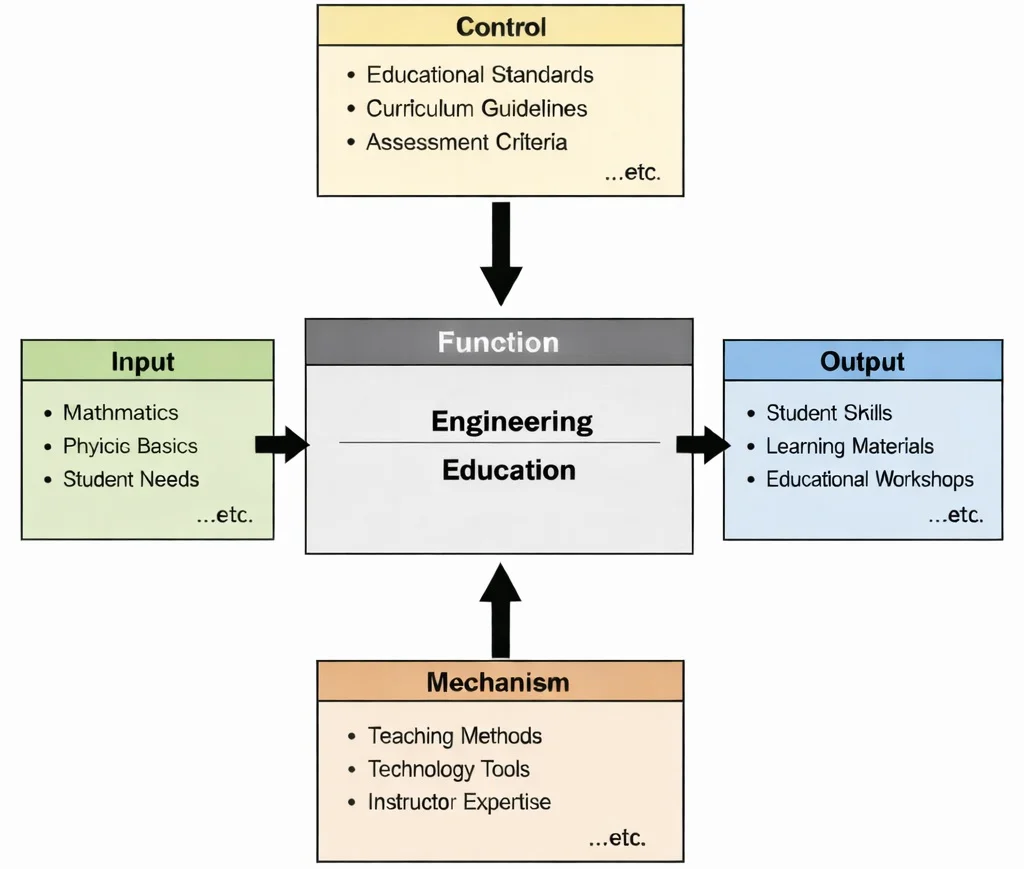
IDEF0 view of Engineering Education: foundational inputs shaped by standards and assessment, enabled by methods and tools, producing skills, materials, and workshops.
Engineering education, as portrayed in the diagram, is the disciplined transformation of raw foundational knowledge into the ability to design, analyze, and make responsible technical decisions. The inputs—mathematics and physics basics—supply the language of models, while student needs determine how the journey is scaffolded, paced, and contextualized.
Controls above the function—standards, curriculum guidance, and assessment criteria—define the destination: what competencies count as “engineering thinking,” what depth is appropriate, and what evidence shows mastery. Mechanisms below—effective teaching methods, technology tools (simulation, computation, lab platforms), and instructor expertise—provide the means to connect theory to real constraints, trade-offs, and safety-minded practice. The outputs therefore go beyond knowledge: students develop durable skills (problem framing, modeling, design reasoning), and educators produce learning materials and workshops that help learners rehearse engineering judgment in increasingly realistic contexts.
Explore Engineering Disciplines
Engineering is organised into specialised fields, each focused on designing systems that solve real-world problems. Choose a discipline to explore its methods, applications, and future developments.
Optimise production systems, automation, and supply chains using robotics, AI, and advanced manufacturing techniques.
Engineering: Designing, Building, and Maintaining Systems
Engineering is the discipline of making useful things behave reliably in the real world. It takes ideas—often from science, mathematics, and human needs—and turns them into systems that can be designed, built, operated, repaired, and trusted. A bridge, a water network, a phone, a medical device, a solar farm, a factory line, even a search engine: each is a system whose parts must work together under constraints of time, cost, safety, and environment.
A practical way to understand engineering is as a repeating loop with three responsibilities:
Design: Define requirements, predict performance, select materials and architectures, and plan for uncertainty.
Build: Translate models into reality, where tolerances, workmanship, supply chains, and testing determine success.
Maintain: Keep systems safe and effective through inspection, monitoring, upgrades, and learning from failure.
In many cases, the “best” engineering solution is not the most elegant theory but the most dependable trade-off. Engineers weigh competing goals—strength vs. weight, speed vs. accuracy, cost vs. durability, efficiency vs. complexity—and justify decisions through calculations, simulations, testing, and clear documentation. Engineering is not just invention; it is responsible implementation.
Engineering Thinking versus Scientific Thinking
Engineering and science are closely related, but they ask different questions and reward different ways of thinking. Science seeks to understand how the world works—discovering laws, patterns, and explanations that aim to be universally valid. Engineering, by contrast, focuses on making things work reliably in specific real-world conditions.
A scientist may ask why a material behaves a certain way under stress. An engineer asks whether that material is suitable for a bridge, aircraft, or medical device—given cost, manufacturing constraints, safety margins, and long-term reliability. Scientific answers often remain open to refinement, while engineering decisions must be made, justified, and implemented within practical limits.
This difference shapes how problems are approached. Scientific thinking emphasises controlled experiments, idealised models, and isolating variables. Engineering thinking accepts complexity and uncertainty, using approximations, safety factors, simulations, and testing to manage risk rather than eliminate it completely.
Understanding this distinction early helps students adjust their expectations. Engineering is not only about learning theories, but about developing judgement—knowing when a model is sufficient, when assumptions fail, and when human, ethical, or environmental considerations must guide decisions.
What Engineers Are Ultimately Responsible For
Engineering is not only a technical discipline—it is a social responsibility. Engineers make decisions that affect public safety, environmental sustainability, economic efficiency, and long-term societal well-being. Unlike purely academic work, engineering outcomes operate in the real world, where failures can carry serious human, financial, and ecological consequences.
At the core of engineering responsibility is safety. Systems must perform reliably under expected conditions and fail predictably under extreme ones. This requires accounting for material limits, human error, environmental stresses, and interactions between components. Safety factors, redundancy, and rigorous testing are not optional—they are ethical obligations.
Accountability distinguishes engineering from many other disciplines. When systems fail—whether bridges, medical devices, or power networks—engineers must justify their design choices, assumptions, and trade-offs. Documentation, standards, and professional codes exist because engineering decisions must remain defensible over time.
Ethical responsibility extends beyond preventing failure. Engineers must consider who benefits from a system, who bears its risks, and how it affects communities and the environment. Decisions about cost, materials, automation, and energy use often involve ethical judgement as much as technical optimisation.
Modern engineering increasingly emphasises sustainability and long-term impact. Engineers are expected to reduce waste, minimise environmental harm, and design systems that remain useful and adaptable. Lifecycle thinking—from construction to disposal—is now a core responsibility.
For students, understanding these responsibilities early helps frame engineering education correctly. Engineering is not only about mastering equations or tools, but about developing judgement, ethical awareness, and a sense of responsibility toward society.
Failure as a Design Teacher in Engineering
Engineering advances not only through success, but through careful study of failure. Accidents, near-misses, and system breakdowns have historically shaped safer designs, stronger standards, and more resilient technologies. In engineering, failure is not simply something to avoid—it is a source of knowledge when analysed responsibly.
Many engineering disciplines rely on post-incident investigations to understand unexpected behaviour. Structural collapses, aviation incidents, industrial accidents, and software outages are examined to identify root causes and contributing factors. These analyses often reveal that failures arise not from a single mistake, but from chains of technical, human, and organisational factors.
Near-misses are especially valuable. When a system narrowly avoids failure, engineers can study limits, margins, and interactions without catastrophic consequences. Industries such as aviation, nuclear engineering, and chemical processing actively document near-misses to improve future design and operation.
Engineering standards and codes often evolve in response to failure analysis. Safety margins, inspection requirements, and testing procedures are refined when real-world incidents expose hidden vulnerabilities. Over time, these lessons become formal knowledge that strengthens the profession.
Failure analysis also plays a key role in engineering education. Case studies of bridge collapses, spacecraft failures, and infrastructure breakdowns help students understand how assumptions, communication gaps, and underestimated risks can lead to serious consequences.
Modern engineering culture emphasises learning rather than blame. While accountability remains essential, effective organisations focus on transparent reporting and continuous improvement. This encourages engineers to identify issues early and prevent escalation.
In this sense, failure acts as a design teacher. Each analysed incident improves future systems, sharpens judgement, and reinforces the responsibility engineers carry when turning ideas into technologies that people depend on.
Engineering Judgment: When Equations Are Not Enough
Equations, models, and simulations are essential tools in engineering, but they are not sufficient on their own. Real systems operate under uncertainty: materials vary, users behave unpredictably, environments change, and assumptions rarely hold perfectly in practice. Engineering judgment is the ability to recognise these limits and make sound decisions when information is incomplete or uncertain.
Engineering judgment develops through experience, reflection, and exposure to real-world constraints. It involves knowing which model is appropriate, when simplifying assumptions are acceptable, and when added complexity creates false confidence rather than better understanding. A precise answer to the wrong question is often less useful than a reasonable answer to the right one.
Judgment is also central to risk assessment. Engineers must decide how conservative a design should be, where redundancy is needed, and which failure modes require the most attention. These decisions are rarely determined by formulas alone—they depend on context, consequences, and system behaviour over time.
In practice, engineering judgment enables engineers to communicate uncertainty honestly, defend design decisions clearly, and adapt as conditions change. It transforms technical knowledge into responsible action, and distinguishes a trained engineer from someone who simply applies calculations mechanically.
Trade-offs, Constraints, and Imperfect Solutions
Engineering problems rarely have perfect solutions. Instead, they involve navigating trade-offs among competing objectives under real constraints. A design that maximizes performance may increase cost; a design that minimizes weight may reduce durability; a design that improves safety may require additional complexity or maintenance. Engineering is the discipline of making these compromises explicit and manageable.
Constraints shape every engineering decision. These may include physical limits, regulatory requirements, budgets, timelines, environmental conditions, manufacturing capabilities, and human factors. Rather than viewing constraints as obstacles, engineers treat them as defining features of the problem space. A successful design is one that works well within its constraints, not one that ignores them.
Trade-offs are evaluated using analysis, testing, and comparison, but they are ultimately resolved through informed choice. Engineers must prioritize which goals matter most in a given context and justify why certain compromises are acceptable. This process requires transparency, documentation, and a clear understanding of stakeholder needs.
Accepting imperfection is central to engineering thinking. Systems are designed not to be flawless, but to be robust, repairable, and resilient. By anticipating limitations and planning for degradation, failure, and adaptation, engineers create solutions that remain useful over time. In this way, engineering progress is driven not by ideal answers, but by practical solutions that work reliably in the real world.
Engineering as a Team-Based Discipline
Modern engineering is rarely the work of a single individual. Most systems are too complex, large, and consequential to be designed or maintained alone. Engineering is therefore a team-based discipline, where success depends on coordination, communication, and shared responsibility across diverse expertise.
Engineering teams bring together specialists from multiple domains: design engineers, analysts, software developers, materials experts, manufacturing engineers, safety reviewers, and project managers. Each contributes a partial view, and effective engineering requires integrating these perspectives into a coherent system. Miscommunication is a common source of failure, which is why documentation, design reviews, and clearly defined interfaces are treated as essential technical practices.
Collaboration extends beyond engineering teams. Engineers work with clients, regulators, operators, technicians, and end users. Understanding how people interact with systems is critical for designing solutions that are usable, maintainable, and safe.
For students, this means engineering education is not only about solving problems individually. It also involves learning to communicate ideas clearly, evaluate designs constructively, accept critique, and make decisions collectively under uncertainty.
Standards, Codes, and Why Engineers Don’t Start from Scratch
Engineering rarely begins with a blank page. Most work builds on established standards, codes, and best practices developed over decades of experience. These frameworks capture lessons from past successes and failures, translating them into requirements for materials, dimensions, safety margins, testing procedures, and documentation.
Standards serve multiple purposes. They promote safety by defining minimum acceptable performance, enable compatibility between systems and components, and reduce uncertainty in design and manufacturing. They also provide a shared technical language that allows engineers across organisations and countries to collaborate effectively.
Following standards does not limit creativity—it guides it. Engineers innovate within structured frameworks, adapting established principles to new technologies and contexts. When standards are insufficient or outdated, deviations must be supported by additional analysis, testing, and clear justification.
Learning to work with standards is a key part of engineering education. Students are introduced to industry codes, safety regulations, and professional guidelines to understand that responsible engineering involves not only technical correctness, but also compliance, traceability, and respect for shared professional knowledge.
Engineering Communication: Explaining Decisions to Non-Engineers
Engineering decisions rarely affect engineers alone. Designs influence clients, regulators, operators, investors, policymakers, and the public—many of whom do not share the same technical background. Effective communication is therefore not about oversimplifying, but about translating complex reasoning into explanations that are accurate, transparent, and meaningful to each audience.
Engineers must explain why a particular option was chosen, what assumptions were made, what risks remain, and what trade-offs were accepted. This requires moving beyond equations and diagrams to connect technical decisions with safety, cost, reliability, timelines, and societal impact. Even strong technical work can lose credibility if it is poorly communicated.
Different audiences require different perspectives. Regulators focus on compliance and risk, managers on cost and schedule, operators on usability and maintenance, and the public on safety and environmental impact. Skilled engineers adapt their language while preserving accuracy, making uncertainty visible rather than hiding it behind technical terms.
In practice, communication is inseparable from responsibility. Clear documentation, concise reporting, design reviews, and honest discussion of limitations allow decisions to be understood, questioned, and improved. For students, learning to communicate engineering reasoning is as important as learning to perform calculations, because engineering only fulfills its purpose when others can understand and act on it.
Why Engineering Solutions Must Be Defensible Years Later
Engineering work does not end when a system is built or deployed. Bridges, buildings, medical devices, software systems, and energy infrastructure may remain in use for decades, long after the original designers have moved on. For this reason, engineering solutions must remain defensible not only at the moment of approval, but years later as conditions, standards, and expectations evolve.
Defensibility means that design choices can be explained and justified based on the information, standards, and constraints that existed at the time. Engineers document assumptions, calculations, testing results, and trade-offs so that others can understand why decisions were made. This record becomes essential during audits, failure investigations, upgrades, or legal review.
As technologies advance, earlier designs may appear inefficient or overly conservative. However, responsible engineering is judged by whether decisions were reasonable and ethical given the knowledge available at the time—not by hindsight alone. Clear documentation protects both the public and the engineers by showing that risks were considered and managed thoughtfully.
For students, this perspective reframes engineering education. Assignments and projects are not just exercises to obtain correct answers—they are practice in making decisions that could be examined years later. Learning to justify choices, acknowledge uncertainty, and leave a clear trail of reasoning is a core professional habit.
How Engineering Is Studied at University
University engineering typically follows a progression from foundations to specialisation and practical application. In the early years, students build core knowledge in mathematics, physics, programming, and fundamental engineering topics such as statics, dynamics, circuits, materials, thermodynamics, and basic modelling.
As studies advance, the focus shifts from understanding to application. Students learn to translate ideas into designs through drawing and CAD, simulation and computation, laboratory measurement, prototyping, and testing. This stage develops the ability to move from assumptions to working systems.
Team-based work becomes increasingly important. Real engineering is rarely done alone, so communication, documentation, and project planning are treated as essential technical skills rather than optional additions.
By the final year, students typically complete a capstone project that resembles industry practice: defining requirements, proposing solutions, justifying design choices, managing trade-offs, validating performance, and presenting results clearly under scrutiny.
Prerequisites & Quick Engineering Toolbox
Engineering builds on a small set of core skills. Strengthening these early will make university study much smoother and more intuitive.
Mathematics Foundations
Ratios and units, functions, vectors, basic calculus, and probability form the core tools for engineering analysis.
Explore Mathematics →
Science Fundamentals
Key concepts include mechanics (forces, energy, momentum), electricity and magnetism, and basic materials behaviour.
Explore Science →
Digital Skills
Basic tools such as spreadsheets, plotting, version control (Git), and introductory Python support modelling, analysis, and automation.
Explore IT →
Safety Awareness
Understanding lab safety, machine handling, electrical hazards, and risk assessment is essential in all engineering environments.
Engineering Across Disciplines
Modern engineering increasingly integrates knowledge from multiple fields to solve complex global challenges. These cross-disciplinary connections drive innovation and expand the impact of engineering solutions.
Civil + Environmental Engineering
Sustainable infrastructure such as green buildings, stormwater systems, and climate-resilient cities integrates environmental principles into structural design.
Mechanical + Biomedical Engineering
Technologies such as prosthetics, robotic surgery, and wearable devices combine mechanical design with biological and medical insight.
Chemical Engineering + Energy Systems
Advanced materials, batteries, and hydrogen systems support renewable energy and sustainable industrial processes.
Electrical Engineering + AI
Smart grids, autonomous systems, and predictive diagnostics combine electronics with machine learning and data-driven control.
Materials Science + Aerospace
Advanced composites and thermal systems enable high-speed flight, space exploration, and extreme-environment engineering.
Challenges and Future Directions in Engineering
Engineering continues to evolve in response to global challenges, technological advances, and societal needs. Future engineers must navigate complex systems and emerging uncertainties.
Sustainability
Engineers must design systems that minimise environmental impact, using life-cycle thinking and circular economy principles.
Integration of AI
Artificial intelligence is transforming engineering through automation, predictive maintenance, and real-time optimisation.
Resource Management
Efficient use of materials, energy, and water is critical, alongside ethical sourcing of key resources.
Global Collaboration
Engineering solutions increasingly require international cooperation to address large-scale challenges such as climate change and infrastructure development.
Mini-Projects You Can Try (≈10 Hours)
The best way to understand engineering is to build something. Try one of these small projects and keep a simple logbook: goal, plan, tests, results, and next steps.
Civil Engineering
Design a small pedestrian bridge in CAD and estimate deflection using basic beam calculations. Compare materials such as wood and steel.
Explore Civil →
Mechanical Engineering
Create a gearbox or linkage in CAD and 3D-print a component. Measure motion or torque and compare with your model.
Explore Mechanical →
Electrical & Electronic Engineering
Build a simple sensor logger using a microcontroller. Record data and apply basic filtering or visualisation.
Explore EEE →
Chemical Engineering
Model a simple separation process using a spreadsheet, then validate with a safe real-world example.
Explore Chemical →
Aerospace Engineering
Design a basic wing profile and estimate lift and drag, then test a simple physical model.
Explore Aerospace →
Environmental Engineering
Prototype a basic water filter and evaluate performance using simple measurements.
Explore Environmental →
Biomedical Engineering
Use a phone sensor to analyse motion (e.g., gait or grip), then discuss measurement limitations.
Explore Biomedical →
Industrial & Manufacturing
Map a simple process and improve it using basic efficiency or automation ideas.
Explore Industrial →
Tools & Starter Kits
To begin building and experimenting, you only need a small set of tools. These form the “engineering toolkit” that supports design, testing, and iteration.
CAD & Simulation
Use tools such as FreeCAD or Onshape for design, KiCad for electronics, and Python or Octave for modelling and analysis. These help turn ideas into testable designs.
Electronics Basics
Start with a microcontroller (Arduino-class), breadboard, and simple sensors such as temperature or motion modules. Optional tools include a USB oscilloscope or logic probe.
Making & Prototyping
Access to a 3D printer or makerspace, along with basic hand tools, calipers, and a soldering iron, enables rapid prototyping and testing.
Data & Documentation
Use spreadsheets for calculations, Git for version control, and simple reports to document results, insights, and next steps.
From Subjects to Roles
Branch
Entry-level roles
Grow toward
Civil
Assistant structural/civil engineer, site engineer, CAD/BIM technician
Manufacturing/automation engineer, industrial data analyst
Operations excellence, Industry 4.0 architect
Frequently Asked Questions
What is engineering?
Engineering is the discipline of designing, building, operating, and maintaining systems that work reliably in the real world. It applies scientific principles, mathematical models, and practical judgment to create solutions that meet functional, safety, economic, and societal requirements.
Which major areas are included in engineering?
Engineering includes fields such as mechanical, civil, electrical and electronic, chemical, biomedical, environmental, aerospace, and industrial engineering. These disciplines apply principles from physics, mathematics, materials science, and computation to solve real-world problems.
How does materials science influence engineering design?
Materials science determines the properties of metals, polymers, ceramics, and composites used in engineering systems. These properties influence strength, durability, efficiency, and performance across applications in infrastructure, energy, electronics, and healthcare.
What role do sensors and measurement play?
Sensors convert physical quantities such as temperature, pressure, strain, and motion into measurable electrical signals. They enable real-time monitoring, feedback control, diagnostics, and predictive maintenance.
How is engineering involved in energy and sustainability?
Engineering supports energy transition through generation, storage, and grid distribution, including renewable technologies such as solar, wind, and hydro. It also drives efficiency improvements across buildings, transport, and manufacturing processes.
How does engineering support infrastructure and cities?
Engineering designs and maintains transport systems, buildings, power grids, water networks, and communication backbones. In modern smart cities, these systems are integrated with sensor networks and data-driven automation.
What challenges arise when moving from prototype to real-world systems?
Real-world deployment introduces cost, manufacturability, safety, environmental wear, and long-term maintenance constraints. Designs must tolerate variability in materials, human operation, and changing environmental conditions.
How do digital tools support engineering practice?
Digital tools enable virtual prototyping through CAD, finite element analysis (FEA), computational fluid dynamics (CFD), and digital twins. Engineers test and optimize designs before fabrication, cutting time, cost, and physical risk.
Engineering Conclusion
Engineering is the practice of turning ideas into systems that work reliably in the real world. It connects scientific understanding with practical action, transforming concepts into structures, machines, and technologies that shape everyday life. From infrastructure and energy systems to medical devices and digital networks, engineering defines how society functions and evolves.
Unlike purely theoretical disciplines, engineering operates under constraints—cost, safety, time, environment, and human factors. It requires making informed trade-offs, applying judgment under uncertainty, and ensuring that decisions remain defensible long after implementation. In this way, engineering is not only about solving problems, but about solving them responsibly.
As you have seen throughout this page, engineering is also collaborative, iterative, and grounded in real-world feedback. It learns from failure, builds on established standards, and relies on clear communication to ensure that solutions are understood and trusted. These qualities distinguish engineering as both a technical and social discipline.
For students, engineering offers more than a pathway to a career—it provides a way of thinking. It trains you to approach complex problems systematically, to balance competing demands, and to design solutions that are robust, adaptable, and meaningful. Whether you pursue engineering directly or apply its mindset elsewhere, the ability to turn ideas into reliable outcomes is one of the most valuable skills you can develop.
Engineering – Review Questions and Answers
Use these questions to check your understanding of how engineering systems are designed, tested, and applied in the real world.
What are physical technologies in engineering?
Physical technologies are engineered systems that apply the laws of physics to act on matter and energy in the real world. They include structures, machines, energy systems, sensors, and transport technologies that must function reliably and safely.
How do materials influence engineering design?
Materials determine strength, durability, weight, and operational limits. Advances in materials allow engineers to design lighter, stronger, and more energy-efficient systems across infrastructure, aerospace, and biomedical applications.
Why are sensors important in engineering systems?
Sensors provide real-time information about system operating conditions such as temperature, pressure, vibration, or motion. This data enables closed-loop control, fault detection, predictive maintenance, and performance optimization.
What challenges arise when scaling from prototype to real-world systems?
Scaling introduces manufacturing tolerances, material availability, cost constraints, reliability requirements, and environmental variability. Systems must be hardened and tested to perform safely outside lab-controlled conditions.
How do simulation and modelling support engineering?
Simulation allows engineers to test designs virtually under extreme and normal operational conditions. This identifies potential failure modes early, evaluates alternatives, and shortens development cycles while reducing cost.
How do physical and digital technologies work together?
Physical systems connect to digital platforms through embedded sensors, actuators, and communication networks. This integration enables remote monitoring, data-driven optimization, and predictive maintenance via digital twins.