
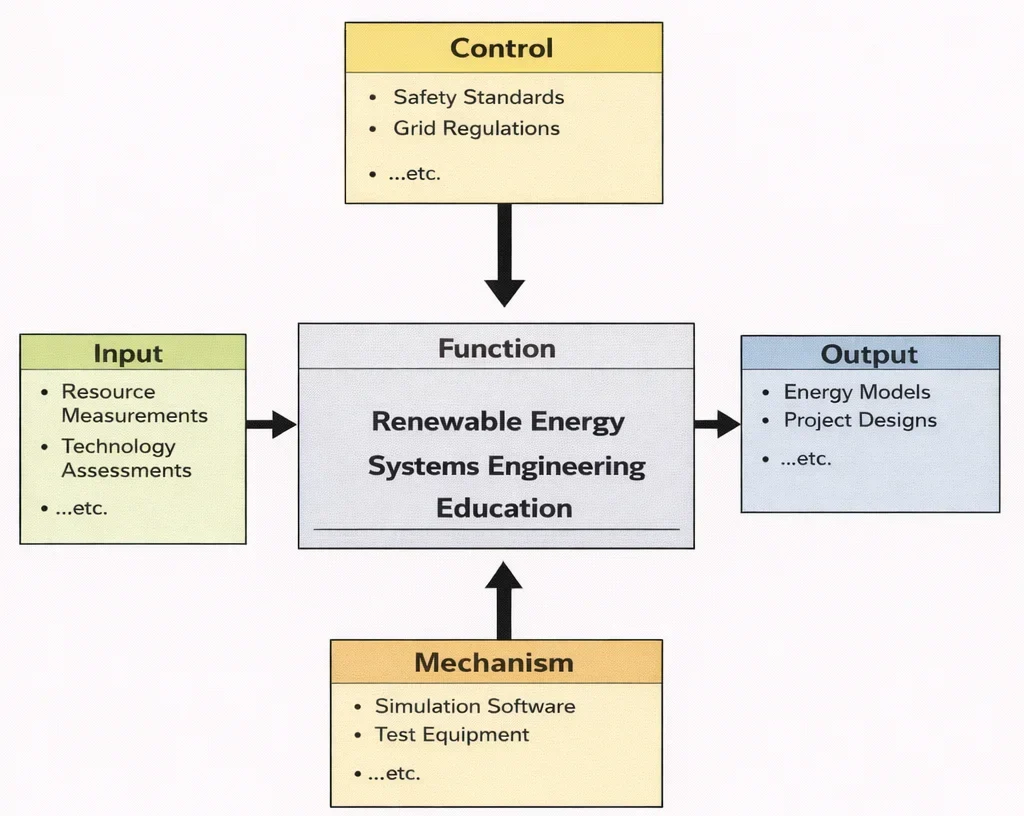
Renewable Energy Systems Engineering Education is where “clean energy” stops being a slogan and becomes an engineered system you can defend, test, and operate. Using the IDEF0 diagram above as a guide, students begin with messy realities—variable sun and wind, uncertain loads, land limits, budget pressure, and imperfect data—and learn to shape them into coherent designs. They work under strict controls such as grid interconnection rules, safety requirements, and sustainability objectives, so every solution is not only clever, but compliant and dependable. With modelling software, experiments, and design workflows as their mechanisms, learners practice balancing generation, storage, conversion, and control until the whole system behaves predictably. The result is a new kind of engineering confidence: the ability to design renewable energy systems that stay stable on bad days, scale on busy days, and remain responsible to people, infrastructure, and the environment.
This IDEF0 diagram frames Renewable Energy Systems Engineering Education as a structured transformation process. Inputs (such as resource data, energy demand profiles, and site constraints) flow into the central function. Controls (standards, grid codes, safety rules, sustainability targets, and policy constraints) shape what is acceptable and responsible. Mechanisms (simulation tools, laboratory setups, testbeds, industry practices, and multidisciplinary teams) enable learners to do the work. The outputs are practical deliverables—integrated renewable-and-storage designs, operating strategies, performance evaluations, and deployment-ready plans—prepared with reliability and real-world constraints in mind.
Renewable Energy Systems Engineering is a pivotal discipline driving the transition from fossil fuels to clean, sustainable power sources. As global energy demands continue to rise, engineers must design and optimize systems that harness solar, wind, hydro, geothermal, and bioenergy sources. This growing field is intrinsically tied to broader concerns in Environmental Engineering, where minimizing ecological impact and maximizing efficiency are core objectives.
Implementing renewable energy systems also supports goals outlined in Climate Change Mitigation and Adaptation. Renewable solutions reduce greenhouse gas emissions, improve Air Quality, and enhance national energy resilience. The systems designed must be integrated with strategies in Environmental Policy and Management to ensure regulatory compliance and public adoption.
Students engaging with this discipline will also encounter intersections with Ecological Engineering, where nature-based solutions guide the placement and integration of renewable infrastructure. For instance, hybrid systems that combine solar with small-scale hydro in sensitive ecosystems require deep understanding of ecological impact. Monitoring these systems is made possible through advanced Environmental Monitoring and Data Analysis.
Modern infrastructure demands that energy systems be part of a larger sustainable design philosophy. This is evident in Green Building and Sustainable Design, where renewable energy is integrated into architectural planning. These principles are similarly extended through the lens of Industrial Ecology and Circular Economy, where energy loops are closed through efficient reuse and recovery.
Beyond environmental applications, Renewable Energy Systems Engineering relies heavily on technology and automation. Concepts from Robotics and Automation in E&E are used to track sun position or control turbine blade angles. Data processing tasks such as fault detection or performance optimization often utilize advanced Signal Processing techniques.
In the industrial sector, the transition to renewables requires rethinking traditional production systems. Energy and Resource Efficiency becomes a top priority, especially in synergy with technologies like Additive Manufacturing and Advanced Materials. These innovations reduce energy input while supporting circular design strategies.
Advanced control of energy systems also depends on digital tools such as Digital Twin Technology and Computer-Integrated Manufacturing, which simulate performance and adaptively manage distribution. This digital backbone aligns well with Smart Manufacturing and Industry 4.0 principles that make renewable energy systems more agile and responsive.
In addition to hardware, system-wide quality assurance is essential. Students will benefit from knowledge in Manufacturing Quality Control and Assurance to ensure that energy components meet safety and performance standards. This is complemented by insight into Human Factors and Ergonomics, especially in remote energy installations that must be operated and maintained by on-site teams.
The knowledge gained through Waste Management Engineering and Water Resources Engineering also reinforces sustainable energy system design, especially in hybrid projects such as waste-to-energy plants or hydro-powered desalination units. Students engaging in this field are uniquely positioned to shape the future of global energy.

Environmental Engineering Curriculum Navigation
Explore the broader academic cluster of Environmental Engineering through these specialized subhub links, each providing critical context within the sustainable systems domain:
Environmental Engineering Overview
Foundational gateway setting the core principles of air, water, and waste resource management.
Air Quality Engineering
Focuses on particulate transport, emission controls, and atmosphere mitigation technologies.
Water Resources Engineering
Covers hydrologic cycles, watershed distribution, and fluid mechanics for sustainable supply.
Waste Management Engineering
Details solid waste remediation, landfill design, and conversion technologies like waste-to-energy.
Renewable Energy Systems Engineering (Current Page)
Systemic design, grid integration, storage, and optimization of clean energy generation assets.
Industrial Ecology & Circular Economy
Analyzes material loops, closed-loop industrial systems, and environmental life-cycle dynamics.
Green Building & Sustainable Design
Integration of passive systems, energy efficiency, and low-impact material footprints in architecture.
Environmental Policy & Management
Covers legislative frameworks, market instruments, risk assessment, and regulatory compliance.
Environmental Monitoring & Data Analysis
Utilizes field remote sensing, IoT sensors, and statistical tools to measure ecological metrics.
Ecological Engineering
Focuses on nature-based solutions, wetland restoration, and ecosystem feedback design.
Climate Change Mitigation & Adaptation
Focuses on systemic strategies to curtail greenhouse gases and build infrastructure resilience.
Core Areas of Renewable Energy Systems Engineering
Development of Sustainable Energy Technologies
- Engineers in the renewable energy sector dedicate significant effort to researching and developing innovative technologies aimed at efficiently capturing and converting natural energy flows such as sunlight, wind, and biomass into usable electrical or thermal power. These innovations encompass the refinement of traditional methods as well as the exploration of next-generation solutions that promise higher efficiency, reliability, and scalability in diverse environments.
- Among the most prominent technologies being developed are advanced wind turbines capable of operating under variable wind speeds, solar photovoltaic systems with improved conversion efficiency, scalable bioenergy plants that utilize agricultural and organic waste, and hydropower turbines tailored for low-flow river systems. Additionally, geothermal systems are being engineered with improved heat-extraction capabilities that minimize ecological disturbance while maximizing output.
- Emerging areas of interest include ocean energy technologies such as wave and tidal power, which have the potential to provide highly predictable and sustainable electricity. Engineers are working on creating resilient underwater turbines, flexible floating solar platforms, and modular devices capable of adapting to varying marine conditions. Many of these projects are supported by international collaborations and pilot programs aimed at demonstrating commercial feasibility.
- In parallel, innovations in materials science have led to lighter, more durable components for energy systems, enabling reduced transportation costs and enhanced longevity. Engineers are incorporating smart monitoring systems, real-time diagnostics, and predictive maintenance algorithms to further improve the performance and operational safety of renewable installations.
- The design of hybrid systems that combine multiple renewable sources—such as wind-solar or solar-bioenergy setups—is becoming increasingly popular for enhancing reliability and ensuring continuous power supply in off-grid or microgrid applications. Such systems are especially critical in remote or disaster-prone regions where energy access is a matter of survival.
- Supporting these technical advancements is a robust ecosystem of simulation software, prototyping tools, and test facilities that allow engineers to model performance, optimize configurations, and rapidly iterate on new ideas. Open-source platforms and collaborative databases are also playing a role in sharing best practices and reducing duplication of research efforts.
- Another promising direction involves the development of energy-positive buildings and cities that generate more renewable energy than they consume. This requires tight integration of architectural design with smart energy systems, storage units, and demand response mechanisms.
- To keep pace with the global energy transition, several international organizations, such as the International Energy Agency (IEA), regularly publish research and guidelines. A notable example is the IEA’s Tracking Clean Energy Progress report, which evaluates the development trajectories of key energy technologies across sectors and countries.
- Ultimately, the role of engineers in developing sustainable energy technologies extends beyond technical design. It involves addressing economic, social, and environmental dimensions, engaging with stakeholders, and aligning innovation pathways with global sustainability goals, including the United Nations’ Sustainable Development Goals (SDGs).
- As climate change concerns grow and fossil fuel resources become increasingly constrained, the need for highly efficient, low-emission, and economically viable renewable technologies becomes more urgent. Engineers will continue to be at the forefront of this movement, driving innovation that can transform the global energy landscape.
Integration into Existing Energy Systems
- Integrating renewable energy technologies into the traditional energy infrastructure requires a comprehensive understanding of electrical grid dynamics, energy demand patterns, and advanced control strategies. Engineers must navigate complex issues such as grid reliability, compatibility, and load balancing while transitioning toward low-carbon power systems.
- One of the primary technical challenges involves managing the variability of renewable energy generation. Solar and wind outputs are intermittent and can fluctuate unpredictably due to weather conditions. Engineers employ forecasting algorithms, demand-side management techniques, and dynamic load control to anticipate and mitigate these fluctuations.
- Modern power grids are increasingly adopting smart grid technologies, which incorporate digital communication, real-time monitoring, and decentralized energy management. These grids are capable of self-healing, optimizing energy flows, and accommodating a greater proportion of distributed renewable sources, such as rooftop solar and community wind farms.
- Another vital strategy for integration is the deployment of energy storage systems. Batteries, flywheels, pumped hydro, and compressed air storage help stabilize supply by absorbing excess energy during peak generation and releasing it during high demand. Storage plays a pivotal role in enhancing flexibility and preventing curtailment of renewable resources.
- Power electronics and inverters are essential components in the integration process. They facilitate the conversion of DC output from solar panels or variable-frequency output from wind turbines into grid-compatible AC power. Engineers design these systems to ensure voltage and frequency stability across interconnected networks.
- Moreover, grid codes and technical standards must evolve to reflect the needs of a renewable-intensive system. Engineers collaborate with regulatory bodies to define operating parameters, protection schemes, and performance metrics that enable safe and efficient grid interconnection.
- Hybrid power plants, combining renewable and conventional sources, are becoming more common as transitional solutions. These configurations allow a smoother shift away from fossil fuels while maintaining energy security. Grid-friendly technologies, like synchronous condensers and virtual inertia emulators, are introduced to replicate the stabilizing effects of traditional generators.
- Engineers also play a key role in retrofitting existing infrastructure to support bi-directional energy flows. This includes upgrading substations, transmission lines, and distribution networks to handle decentralized generation and energy feedback from prosumers.
- From a socio-economic perspective, grid integration involves creating equitable access to clean energy while minimizing disruptions. Engineers assess the impact of integration on energy pricing, community acceptance, and environmental justice, ensuring that solutions are both technically viable and socially inclusive.
- Ultimately, successful integration of renewable energy into the grid requires a systemic approach involving interdisciplinary collaboration, robust testing, and continuous adaptation. By embracing a holistic perspective, engineers can design power systems that are not only resilient and scalable but also aligned with long-term sustainability goals.
Energy Efficiency
- Energy efficiency is a fundamental principle of sustainable engineering, aimed at reducing energy losses throughout the entire supply chain—from production and transmission to end-use applications. Engineers working in this domain develop systems that not only consume less energy but also deliver improved performance with minimized waste and emissions.
- One of the major areas of focus is enhancing the conversion efficiency of renewable energy technologies. For instance, optimizing the design of wind turbine blades to capture more kinetic energy or improving solar panel cell materials to increase the conversion of sunlight into electricity significantly boosts overall system output without requiring more space or resources.
- In thermal energy systems, engineers explore ways to maximize heat recovery, reduce parasitic losses, and implement combined heat and power (CHP) strategies that utilize waste heat for secondary processes. This is particularly relevant in bioenergy and geothermal applications, where heat management can dramatically influence efficiency.
- Electrical efficiency improvements involve minimizing transmission losses through the adoption of high-voltage direct current (HVDC) systems and superconducting materials. Additionally, smart transformers and energy-efficient power electronics help optimize energy flow and voltage regulation, especially in systems with fluctuating loads.
- In buildings and industrial settings, energy efficiency is pursued through advanced insulation materials, passive solar design, high-efficiency HVAC systems, and intelligent control systems that monitor and adjust energy usage in real-time. Engineers integrate sensors, automation, and predictive algorithms to fine-tune energy consumption patterns.
- Another essential strategy is load management, which involves shifting energy demand to off-peak hours or coordinating demand with renewable generation availability. Demand response programs enable utilities to send price or incentive signals that prompt consumers to reduce or reschedule their energy usage.
- Energy audits and performance benchmarking provide engineers with quantitative insights into inefficiencies and potential upgrades. These audits serve as the basis for retrofit projects, targeted investments, and policy recommendations that yield measurable improvements in energy productivity.
- Emerging technologies such as Internet of Things (IoT) devices, machine learning, and edge computing are revolutionizing the way energy systems are monitored and optimized. Engineers use these tools to predict equipment degradation, schedule maintenance, and proactively address inefficiencies before they escalate.
- Energy efficiency is also deeply tied to lifecycle analysis and circular design. Engineers assess the environmental footprint of materials and processes to ensure that energy savings are not offset by hidden resource costs. Circular design principles encourage reuse, repair, and recycling, enhancing long-term energy sustainability.
- Governments and international agencies offer a range of programs and certifications—such as ENERGY STAR and ISO 50001—to promote energy-efficient practices. Engineers play a central role in helping organizations meet these standards and participate in initiatives like the Advanced Building Construction Initiative by the U.S. Department of Energy, which fosters the adoption of high-performance building systems.
Decarbonization of Energy Systems
- Decarbonization refers to the strategic reduction and eventual elimination of carbon dioxide (CO2) emissions from energy generation, distribution, and consumption. Engineers lead this transition by developing and implementing technologies that replace fossil fuels with low- or zero-carbon energy sources such as solar, wind, hydro, geothermal, and green hydrogen.
- A key focus is on the electrification of sectors traditionally reliant on fossil fuels, including transportation, industrial heat, and residential heating. Electrification requires substantial investment in infrastructure and control systems capable of handling new load profiles and ensuring reliability across varying demand cycles.
- To support the shift, engineers design robust electric vehicle (EV) charging networks, heat pump systems, and electric boilers that reduce direct emissions. Simultaneously, decarbonizing the electricity supply itself involves accelerating the deployment of renewables and phasing out coal and natural gas-fired plants.
- Carbon capture, utilization, and storage (CCUS) technologies are also essential in hard-to-abate sectors like cement and steel manufacturing. Engineers develop systems to capture CO2 at the source, convert it into valuable products, or sequester it safely underground, helping industries transition while maintaining operational output.
- Grid decarbonization includes integrating high-penetration renewables into electricity markets, enhancing transmission capacity, and introducing market incentives that prioritize clean energy dispatch. Engineers use optimization models and simulation platforms to evaluate the trade-offs involved and recommend least-cost, high-impact pathways.
- Life-cycle emissions analysis is another important tool used by engineers to assess the full environmental impact of technologies. This ensures that the apparent benefits of renewables are not offset by emissions during equipment production, installation, maintenance, or disposal.
- At the community level, engineers support energy justice by designing decarbonization strategies that benefit all socioeconomic groups. This includes incorporating decentralized energy systems like solar microgrids in underserved areas, providing access to clean energy without the burden of rising utility costs.
- Internationally, engineers contribute to national decarbonization roadmaps and collaborate on global initiatives such as Mission Innovation, which aims to accelerate public and private investment in clean energy R&D. A key document guiding these efforts is the UN Net-Zero Coalition framework, which outlines global commitments to achieve carbon neutrality by mid-century.
- Financial innovation is also critical for scaling decarbonization efforts. Engineers often work with economists and policymakers to model carbon pricing mechanisms, green bonds, and clean energy subsidies that align market behavior with emissions goals.
- As climate science continues to underscore the urgency of reducing greenhouse gases, engineers will be increasingly called upon to design, implement, and monitor decarbonization pathways that are technologically sound, economically feasible, and environmentally sustainable.
Key Technologies in Renewable Energy Systems
Wind Energy Systems
- How It Works:
- Wind energy systems harness the kinetic energy of moving air masses using wind turbines, which convert this mechanical motion into electrical energy through electromagnetic induction.
- Wind turbines are composed of several key components: large rotor blades that capture wind energy, a nacelle that contains the generator and gearbox, a tall tower that elevates the system to higher altitudes with stronger winds, and control systems for orientation and braking.
- Modern wind turbines often include anemometers and wind vanes that feed real-time data into automated systems for optimal blade alignment.
- Applications:
- Onshore wind farms are typically situated in wide open landscapes such as plains, plateaus, and coastal regions, where wind speeds are sufficient and land use allows for extensive infrastructure.
- Offshore wind farms, which are installed in shallow or deep waters, benefit from stronger and more consistent wind patterns, and are increasingly being developed with floating platforms for deployment in previously inaccessible locations.
- Hybrid renewable systems now often combine wind with solar or hydro sources to improve energy reliability and balance output fluctuations.
- Distributed wind systems are used in rural and remote communities for localized power generation, contributing to energy independence and reduced transmission losses.
- Challenges:
- One major challenge is the intermittency of wind, which can lead to fluctuations in power output that must be managed through energy storage or grid integration strategies.
- Environmental concerns include the impact on avian species, noise pollution, and visual disruption in sensitive landscapes, necessitating careful siting and design mitigation strategies.
- The capital cost of installation, although decreasing, remains substantial, especially for offshore projects requiring specialized vessels and infrastructure.
- Integration into existing power grids poses technical hurdles, particularly in regions where the grid was not designed for decentralized or bidirectional energy flows.
- Recent Advances:
- Technological innovations have enabled the development of floating wind turbines that can be anchored in deep waters beyond the continental shelf, opening new geographic markets for wind power.
- The size and efficiency of turbines have increased significantly, with next-generation models capable of producing over 15 MW of power per unit.
- Advanced materials such as carbon fiber composites are being employed to reduce weight and increase durability of rotor blades.
- Predictive maintenance using machine learning and sensor data is enhancing turbine longevity and minimizing downtime.
- Global initiatives like the IEA Wind TCP are facilitating knowledge exchange and collaborative research on wind energy innovation.
- New offshore wind projects are being developed in regions like Southeast Asia, supported by favorable policies and investment frameworks outlined in sources such as IRENA’s Offshore Wind Outlook.
- How It Works:
Energy Storage and Grid Integration
Energy Storage Systems
- Purpose:
- Energy storage systems are designed to tackle the variable nature of renewable energy sources such as solar and wind, which do not produce power consistently throughout the day or across seasons. By storing excess energy during periods of surplus generation, these systems ensure that electricity is available during times of high demand or when generation is low. This not only enhances the reliability of renewable energy systems but also helps to stabilize the grid by balancing supply and demand more effectively.
- Energy storage also plays a vital role in reducing the need for peaking power plants, which are typically less efficient and more polluting. Additionally, they provide ancillary services like frequency regulation and voltage support to improve grid performance.
- Technologies:
- Batteries:
- Batteries are among the most widely deployed energy storage technologies due to their scalability, modular design, and ability to deliver electricity almost instantaneously. Lithium-ion batteries, in particular, dominate the market for both residential installations—such as home solar battery systems—and utility-scale applications where they are used in large battery energy storage systems (BESS).
- New developments are emerging in the field of battery technology, including solid-state batteries that offer greater safety and energy density, and flow batteries, which use liquid electrolytes and are particularly suited for long-duration storage applications. Researchers and companies alike are pushing the limits of battery innovation to achieve lower costs, longer cycle life, and more sustainable manufacturing practices.
- Pumped Hydroelectric Storage:
- This is one of the oldest and most mature energy storage methods. During periods of excess electricity generation, water is pumped from a lower elevation reservoir to a higher one. When energy is needed, the water is released back down, spinning turbines to generate electricity. Pumped hydro accounts for more than 90% of the world’s installed grid-scale energy storage capacity due to its efficiency and long operational life.
- Despite its advantages, the implementation of pumped hydro is limited by geographic requirements and environmental considerations, such as potential impacts on aquatic ecosystems and water availability.
- Thermal Storage:
- Thermal energy storage systems store heat generated from solar or other sources and release it as needed to produce electricity or provide heating. Common media for storing heat include molten salts, phase-change materials, and insulated water tanks. These systems are particularly useful in concentrated solar power (CSP) plants, where thermal energy can be stored during the day and used to generate power at night.
- Thermal storage can also enhance the energy efficiency of buildings through seasonal storage systems that store excess heat in the summer for use in winter.
- Batteries:
- Challenges:
- One major hurdle for energy storage deployment is the high initial cost of installation and the economic return on investment, especially in large-scale applications. While prices for lithium-ion batteries have fallen, the total system costs, including inverters and management systems, can still be prohibitive for many users.
- Another issue involves the environmental impact and sustainability of battery materials. Mining for lithium, cobalt, and other rare metals used in battery production can have negative consequences on ecosystems and human health.
- Furthermore, battery degradation over time affects their performance and lifespan, necessitating ongoing research into improved chemistries and recycling solutions. One promising area of development, supported by initiatives like the U.S. Department of Energy’s Energy Storage Grand Challenge, focuses on creating cost-effective, long-duration energy storage solutions that can operate for ten hours or more.
- Purpose:
Smart Grids
- What It Is:
- Smart grids refer to next-generation electricity networks that use digital technologies, sensors, and real-time communication to monitor, control, and optimize the generation, distribution, and consumption of electricity. These systems represent a paradigm shift from traditional grids by enabling two-way flows of information and electricity, thereby supporting decentralized energy production and active consumer participation.
- Smart grids incorporate a wide array of technologies, including advanced metering infrastructure (AMI), grid automation systems, communication networks, and data analytics platforms. Together, these elements create an intelligent system that can detect faults, manage load fluctuations, and respond dynamically to changing conditions.
- Applications:
- One significant application of smart grids is demand response, where utilities send signals to consumers or automatically adjust appliances and systems to reduce or shift electricity usage during peak hours. This helps alleviate stress on the grid and reduces the need for expensive peaker plants.
- Smart grids also enable the seamless integration of distributed energy resources such as rooftop solar panels, wind turbines, and electric vehicles. These decentralized assets can be aggregated and managed as virtual power plants, contributing to grid resilience and energy independence.
- In urban areas, smart grids support smart city initiatives by linking energy systems with transportation, water, and building management systems, thereby creating synergies across sectors.
- Challenges:
- While smart grids offer numerous benefits, they also introduce new challenges. One of the most pressing issues is cybersecurity. As grids become more connected and reliant on digital technologies, they become more vulnerable to cyberattacks that could disrupt service or compromise sensitive data.
- Another challenge is the cost and complexity of upgrading existing infrastructure to support smart grid functionalities. Legacy systems often lack the flexibility and capacity to incorporate digital tools, requiring substantial investments in modernization.
- There are also regulatory and standardization hurdles, as utilities, governments, and technology providers must coordinate to establish interoperable systems and data protocols.
- What It Is:
Applications of Renewable Energy Systems Engineering
24-Hour Microgrid Dispatch & Battery Storage Simulator
Simulate hourly power generation, storage state of charge (SoC), and net grid interaction over a typical 24-hour cycle.
Residential Energy Solutions
- Residential applications are among the most visible and widely adopted forms of renewable energy integration. Homeowners across the globe are increasingly investing in rooftop solar panels as a cost-effective way to generate clean electricity, reduce dependence on the grid, and lower energy bills. Advances in photovoltaic technology have led to more efficient and affordable panels, making solar power more accessible to the average consumer.
- To further enhance energy independence, many households now incorporate battery storage systems—such as Tesla Powerwall or LG Chem—which store excess solar energy generated during the day for use at night or during outages. This setup provides resilience and can help offset peak-time energy usage charges imposed by utilities.
- Additionally, net metering programs offered in many countries allow residents to feed unused electricity back into the grid in exchange for bill credits or compensation, creating an economic incentive to invest in home-based renewable systems.
Commercial and Industrial Energy Systems
- In commercial and industrial settings, renewable energy solutions are being adopted not just for environmental reasons, but also for strategic and financial advantages. Large-scale rooftop solar installations on warehouses, office buildings, and factories help reduce energy expenses and hedge against future electricity price fluctuations.
- Businesses are also pursuing energy efficiency through building designs that incorporate natural lighting, superior insulation, and integration of geothermal systems for heating and cooling. These improvements are often paired with smart building technologies that optimize energy usage in real-time based on occupancy and demand.
- For industries with high energy consumption, such as manufacturing and data centers, the integration of on-site wind or biomass generators can offer both sustainability and grid reliability benefits. In addition, participation in renewable energy certificates (RECs) or power purchase agreements (PPAs) allows firms to meet corporate sustainability goals without managing the infrastructure directly.
Large-Scale Renewable Projects
- Large-scale renewable energy projects are fundamental to transitioning entire regions or countries toward a more sustainable energy future. These projects include vast solar farms, sprawling wind parks, and hydroelectric plants that supply power to thousands or even millions of homes and businesses.
- These installations are often connected to national or regional grids and play a crucial role in decarbonizing the energy sector. By generating electricity at scale, they benefit from economies of scale, which helps drive down costs per kilowatt-hour over time.
- To overcome the intermittency associated with renewables, hybrid energy systems are increasingly deployed. These systems combine various sources—such as solar, wind, and storage technologies—into a unified infrastructure that delivers more consistent and reliable power output.
- Global collaborations and funding from international institutions like the International Renewable Energy Agency (IRENA) are accelerating the development of such infrastructure in both developed and emerging economies.
Off-Grid and Rural Electrification
- Renewable energy systems are making a transformative impact in off-grid and remote areas where traditional utility infrastructure is not viable or cost-effective. Microgrids—self-contained energy systems powered by solar, wind, biomass, or hydro—offer an elegant solution to rural electrification.
- In regions of Sub-Saharan Africa and South Asia, for instance, solar home systems and mini-grids have enabled millions of people to gain access to electricity for the first time. These systems support basic needs such as lighting, mobile charging, refrigeration, and communication, drastically improving quality of life and economic opportunity.
- Solar lanterns and portable systems also provide scalable options for lighting and cooking in isolated villages, schools, and clinics. These innovations reduce dependence on kerosene and diesel generators, thereby improving indoor air quality and reducing carbon emissions.
Transportation
- Transportation is one of the largest sources of global carbon emissions, and renewable energy systems are playing a pivotal role in its decarbonization. Electric vehicles (EVs), powered by batteries and charged using renewable electricity, offer a clean alternative to gasoline and diesel-powered cars.
- Governments and private companies are investing heavily in building charging infrastructure, often powered by solar canopies or wind turbines. Smart charging systems can synchronize with grid demand, ensuring minimal strain and promoting the use of renewable energy during optimal periods.
- In public transit, electric buses and light rail systems are being integrated into urban transportation networks, contributing to cleaner air and quieter cities. Renewable energy is also being explored for aviation and maritime transport, though these sectors face steeper technological challenges.
Agriculture
- The agricultural sector has much to gain from renewable energy systems, both for improving productivity and reducing environmental impact. Solar-powered irrigation pumps enable farmers to water crops without relying on expensive and polluting diesel engines.
- Biogas plants installed on farms convert animal manure and crop residues into usable energy for cooking, heating, and electricity. This not only reduces methane emissions but also provides a nutrient-rich byproduct that can be used as fertilizer.
- In addition, small wind turbines and hybrid systems offer continuous power supply for cold storage, dairy processing, and other agricultural operations, particularly in off-grid regions. The use of renewables in agriculture also helps mitigate climate risk by promoting resilience and energy independence.
Challenges in Renewable Energy Systems Engineering
Intermittency
- One of the most significant challenges in renewable energy systems is intermittency—the variability in power generation caused by changing environmental conditions. Solar panels produce no energy at night and less during cloudy days, while wind turbines are only effective when wind speeds fall within optimal ranges.
- This inconsistency complicates efforts to maintain a stable and reliable power supply, especially in large-scale grid systems where consistent electricity delivery is critical. Peak production periods often do not align with peak demand, leading to inefficiencies and potential energy waste.
- Solutions:
- To mitigate intermittency, energy storage technologies such as lithium-ion batteries, flow batteries, and pumped hydro systems are increasingly deployed to store surplus energy and release it when production drops. Smart grid technologies also play a role by dynamically managing supply and demand through demand-side response mechanisms.
- Forecasting tools powered by artificial intelligence and weather data help grid operators predict fluctuations and make informed decisions. Additionally, integrating diverse renewable sources—like combining solar with wind or hydro—can smooth out variability by leveraging their complementary production profiles.
Infrastructure and Cost
- Developing and deploying renewable energy systems often require substantial upfront investment in infrastructure, such as solar panels, wind turbines, storage facilities, and smart grid components. This cost can be a barrier, particularly in developing regions or areas with limited access to financing.
- Existing energy infrastructure, including transmission lines and substations, may also need to be upgraded or expanded to accommodate decentralized and variable energy sources. These modifications are capital-intensive and involve complex planning and regulatory processes.
- Solutions:
- Governments worldwide are addressing these challenges by offering subsidies, tax incentives, feed-in tariffs, and low-interest loans to encourage adoption. The private sector is also innovating financing models, such as third-party ownership and power purchase agreements (PPAs), to reduce financial risk and upfront costs.
- Moreover, advancements in manufacturing and economies of scale have driven down the cost of renewable technologies significantly over the last decade, making them increasingly competitive with fossil fuels.
Resource Management
- Renewable energy systems require thoughtful management of land, water, and raw materials to ensure long-term sustainability. For instance, large-scale solar farms and wind parks can consume vast land areas, potentially competing with agriculture or natural habitats.
- Biomass energy systems rely on feedstock that could otherwise be used for food or require significant water and fertilizer inputs. Similarly, mining materials for batteries and solar panels—such as lithium, cobalt, and rare earth elements—raises concerns about environmental impact and resource scarcity.
- Solutions:
- Engineers and planners are increasingly using geographic information systems (GIS) and life cycle assessment (LCA) tools to evaluate and optimize site selection, material sourcing, and system design. Technologies like agrivoltaics, which combine agriculture and solar generation, offer dual land use benefits.
- Efforts are also underway to develop more sustainable materials, such as organic solar cells and recyclable battery chemistries, reducing dependence on rare and environmentally damaging inputs. These innovations are documented and supported by institutions such as the National Renewable Energy Laboratory (NREL).
Policy and Regulation
- Effective policy and regulatory frameworks are critical for the widespread adoption of renewable energy. Inconsistent or outdated regulations can hinder innovation, delay project approvals, and create uncertainty for investors and developers.
- In some regions, utility monopolies or fossil fuel subsidies distort market dynamics, making it harder for renewable projects to compete fairly. Additionally, grid access, interconnection standards, and feed-in tariff policies vary widely, adding complexity to deployment.
- Solutions:
- Collaborative policymaking that brings together government agencies, industry stakeholders, and academic experts is key to developing adaptive, supportive regulations. Establishing long-term national energy strategies with clear targets and incentives helps provide direction and confidence to markets.
- Furthermore, international cooperation and knowledge-sharing through platforms like the International Energy Agency (IEA) facilitate harmonization of standards and best practices across borders.
Future Trends in Renewable Energy Systems
Hydrogen Energy
- Hydrogen energy is poised to become a cornerstone of future energy systems, particularly through the development of “green hydrogen” produced using renewable electricity via electrolysis. This clean fuel offers a versatile solution for sectors that are difficult to decarbonize, such as heavy industry, shipping, and aviation.
- As renewable energy costs decline, producing hydrogen from solar and wind becomes increasingly feasible. Electrolyzers, the devices used to split water into hydrogen and oxygen, are becoming more efficient and scalable, reducing production costs and improving deployment rates.
- Applications include fuel cells for hydrogen-powered vehicles, heating solutions in buildings, and industrial uses such as steelmaking. Hydrogen also acts as a long-duration energy storage medium, balancing seasonal supply and demand fluctuations.
- Countries such as Germany, Japan, and Australia are leading hydrogen strategies, while international partnerships promote the development of global hydrogen supply chains and infrastructure.
Artificial Intelligence (AI)
- Artificial intelligence is transforming the renewable energy landscape by enabling more intelligent, adaptive, and predictive system operations. Through machine learning and data analytics, AI helps forecast energy demand and supply, optimize grid operations, and maintain system reliability despite the variable nature of renewable sources.
- In wind and solar energy, AI models predict weather patterns and energy output, allowing operators to make real-time adjustments. In battery storage, AI balances charging and discharging cycles to extend lifespan and efficiency.
- AI also supports smart home systems and demand-side management, tailoring energy use to match availability. Moreover, it aids in maintenance through predictive diagnostics, reducing downtime and operational costs.
- The integration of AI with Internet of Things (IoT) devices and sensors paves the way for fully automated and decentralized energy networks. This trend is increasingly supported by collaborative efforts among energy providers, tech firms, and research organizations, such as those documented by the International Energy Agency (IEA).
Floating Solar Farms
- Floating solar farms represent a growing innovation in land-constrained areas, utilizing reservoirs, lakes, and other water surfaces to deploy photovoltaic panels. This approach conserves land for agriculture or urban development while improving energy yields due to cooler operating conditions over water.
- In addition to energy generation, floating solar installations help reduce water evaporation, inhibit algae growth, and enhance reservoir management. They are particularly beneficial in countries facing both land scarcity and high solar potential, such as Singapore and Japan.
- Recent advances include modular platforms and improved anchoring systems that withstand harsh marine environments. Hybrid systems that combine floating solar with hydropower plants are also being explored to optimize infrastructure usage and storage capabilities.
Carbon Capture and Storage (CCS)
- CCS technology is gaining renewed attention as a complementary tool in the fight against climate change. It involves capturing carbon dioxide emissions from power plants and industrial processes, then transporting and storing it underground in geological formations.
- When combined with bioenergy or integrated into renewable energy systems, CCS has the potential to achieve negative emissions, a critical requirement for meeting ambitious climate targets. This application is known as BECCS (Bioenergy with Carbon Capture and Storage).
- Despite its promise, CCS faces challenges in cost, infrastructure, and public acceptance. However, pilot projects and large-scale demonstrations are underway globally, showcasing its feasibility in various contexts. Continued innovation and policy support are key to scaling this technology responsibly.
Energy-as-a-Service (EaaS)
- EaaS is an emerging business model that allows customers to access energy services without owning the underlying infrastructure. Instead, they pay for energy performance, reliability, or usage as a subscription or service package.
- This model reduces financial barriers to adopting clean technologies such as solar panels, battery storage, and energy management systems. Providers install and maintain the systems while customers enjoy predictable costs and environmental benefits.
- EaaS is gaining traction among commercial and industrial clients, as well as in residential markets through community solar and shared battery systems. It supports decentralization and democratization of energy access, empowering users to participate in the transition to renewable energy.
- Advancements in digital platforms, mobile applications, and blockchain further facilitate secure and transparent transactions under the EaaS framework, fostering a more resilient and customer-focused energy ecosystem.
Why Study Renewable Energy Systems Engineering
Harnessing Clean and Sustainable Energy
Renewable energy systems engineering focuses on generating electricity from sustainable sources like solar, wind, hydro, and geothermal. Students learn how to design systems that reduce reliance on fossil fuels. This contributes to global efforts to combat climate change.
System Integration and Grid Connectivity
Students study how renewable sources are integrated into existing electrical grids. They explore grid stability, energy storage, and load balancing. These skills are essential for building reliable and scalable energy infrastructure.
Design and Optimization of Renewable Technologies
The course covers photovoltaic design, wind turbine placement, and hybrid systems. Students use simulation tools to improve performance and cost-efficiency. This prepares them for innovation in renewable system engineering.
Economic and Environmental Evaluation
Students assess the financial viability and environmental impact of renewable projects. They study life-cycle analysis, return on investment, and carbon reduction. This enables informed decision-making in project planning and policy.
Global Applications and Career Outlook
Renewable energy engineers work on international development, utility-scale projects, and research. Students gain the skills needed to lead the energy transition worldwide. The field offers rewarding careers with environmental and social impact.
Renewable Energy Systems Engineering: Conclusion
Renewable energy systems engineering stands as a cornerstone in the global transition toward sustainable energy. As climate change, resource depletion, and environmental degradation intensify, the need for resilient, clean, and efficient energy systems becomes ever more pressing. This discipline empowers engineers to develop and deploy technologies that harness solar, wind, hydro, geothermal, and bioenergy sources—mitigating greenhouse gas emissions and reducing reliance on finite fossil fuels.
The scope of renewable energy systems engineering is multifaceted. It encompasses the design and optimization of renewable technologies, integration into smart grids, advancement of energy storage solutions, and application across residential, commercial, industrial, and rural settings. From hydrogen fuel cells and floating solar farms to predictive AI and carbon capture techniques, engineers in this field continuously innovate to enhance energy reliability, efficiency, and environmental performance.
A critical aspect of this field is the systemic integration of technical, economic, and environmental considerations. Engineers must evaluate the lifecycle impacts, financial viability, and policy frameworks that influence technology adoption and scalability. Interdisciplinary collaboration is essential—drawing on expertise in electrical, mechanical, civil, and environmental engineering, as well as data science and policy studies.
As global awareness of sustainability deepens, renewable energy systems engineering offers expansive career pathways. Professionals contribute to international development, national grid modernization, private-sector innovation, and academic research. Their work shapes not only infrastructure but also societal attitudes toward energy consumption, conservation, and equity.
In the coming decades, this field will remain pivotal to achieving net-zero emissions, enhancing energy security, and promoting global resilience. Numerous academic institutions and industry leaders—including those highlighted by the National Renewable Energy Laboratory (NREL)—are advancing systems integration research to unlock new possibilities for clean energy.
Ultimately, renewable energy systems engineering is more than a technological pursuit—it is a mission to reshape how humanity interacts with the planet. By fostering innovation, systems thinking, and environmental stewardship, it empowers societies to chart a course toward a cleaner and more equitable future.
Frequently Asked Questions
What are the main renewable energy sources and how do they differ in availability and use?
The main renewable energy sources used today are solar, wind, hydropower, geothermal and biomass. They differ in how predictable they are, where they can be sited and which applications they best serve. Solar and wind are widely deployable but intermittent, whereas hydropower and geothermal can provide more stable baseload output where the right geographical or geological conditions exist. Biomass can be stored and dispatched when needed, but its sustainability depends on careful feedstock sourcing and land-use management.
How does energy storage help manage the intermittency of renewables and support grid stability?
Energy storage systems absorb surplus electricity when renewable generation is high and release it when output falls or demand rises. By shifting energy in time, they smooth fluctuations from solar and wind, reduce the need for fossil-fuel peaking plants and support reliable power supply. Fast-responding storage technologies also provide frequency regulation and ancillary services that help maintain grid stability. In addition, storage can act as backup during outages and enhance the resilience of power systems with high renewable penetration.
How do government policies and incentives encourage the adoption of renewable energy systems?
Government policies and incentives lower financial and regulatory barriers for renewable energy projects and create predictable market conditions. Instruments such as tax credits, grants, feed-in tariffs and renewable portfolio standards improve the business case for clean energy compared with conventional generation. Carbon pricing mechanisms further reward low-emission technologies by internalising the cost of greenhouse gas emissions. Public funding for research, development and grid infrastructure also accelerates innovation and enables higher shares of renewables to be integrated into energy systems.
How is lifecycle assessment used to improve the sustainability of renewable energy systems?
Lifecycle assessment (LCA) evaluates environmental impacts associated with all stages of a renewable energy system, from raw material extraction and manufacturing to operation and end-of-life. By identifying hotspots in energy use, emissions and resource consumption, LCA helps engineers target design changes with the greatest sustainability benefits. It also supports fair comparisons between technologies and configurations by using consistent system boundaries and metrics. Insights from LCA guide choices of materials, processes and recycling strategies that reduce overall footprints while maintaining performance.
What are the key components of a wind energy system and what does each component do?
A modern wind energy system typically consists of rotor blades, a hub, a nacelle containing the drivetrain, a tower, foundations and a control system. The rotor blades and hub capture the kinetic energy of the wind and convert it into rotational motion. Inside the nacelle, a gearbox or direct-drive system and generator convert this mechanical power into electricity. The tower elevates the rotor into stronger, more consistent wind flows, while the foundations anchor the structure safely to the ground or seabed. The control system continuously monitors wind conditions and turbine status to optimise output, protect components and ensure safe operation.
What are the main benefits and challenges of integrating solar PV into existing buildings?
Integrating solar PV into existing residential and commercial buildings can significantly reduce electricity bills, lower carbon emissions and increase property value by generating clean power on-site. Building owners gain greater energy independence and can hedge against rising grid prices, especially when policies enable net metering or similar arrangements. However, challenges include the upfront capital cost, the need for suitable roof space with good solar exposure and potential structural or aesthetic constraints. Intermittent generation may also require storage or grid support, and permitting or regulatory procedures can add complexity to project implementation.
How can engineers maximise the performance and reliability of geothermal energy systems?
Engineers maximise the performance and reliability of geothermal energy systems by carefully characterising the reservoir, designing robust wells and optimising heat exchanger and plant configurations. Comprehensive geological and thermal assessments identify sites with adequate temperature, permeability and fluid availability for long-term production. Proper well design, reinjection strategies and monitoring help maintain reservoir pressure, minimise environmental impacts and avoid excessive temperature decline. Regular inspection, predictive maintenance and, where appropriate, the use of closed-loop systems further improve reliability and support stable baseload output over decades.
Why is hydrogen considered an important energy carrier in renewable energy systems?
Hydrogen is considered an important energy carrier because it can store large amounts of renewable electricity in chemical form and deliver zero-direct-emission energy when used in fuel cells or combustion processes. When produced via electrolysis powered by renewables, so-called green hydrogen enables deep decarbonisation of sectors that are hard to electrify directly, such as heavy industry, shipping and long-haul transport. Hydrogen can also provide long-duration and seasonal energy storage, complementing batteries and other short-term storage technologies. Its use across multiple sectors helps link power, transport and industry into an integrated, low-carbon energy system.
How do biomass and bioenergy contribute to the renewable energy mix and what sustainability issues must be managed?
Biomass and bioenergy contribute dispatchable, often local, renewable energy in the form of electricity, heat and transport fuels derived from organic materials. When sourced and managed sustainably, biomass can be close to carbon-neutral because carbon absorbed during plant growth offsets emissions from conversion. However, sustainability depends on avoiding deforestation, protecting biodiversity and preventing competition with food production or excessive water use. Engineers and planners must also address air pollutant emissions, evaluate full lifecycle greenhouse gas impacts and ensure reliable feedstock supply chains to keep bioenergy genuinely sustainable.
What social, economic and environmental co-benefits arise from investing in renewable energy systems?
Investing in renewable energy systems improves air quality and public health by displacing fossil fuel combustion and associated pollutants. It stimulates job creation and local economic development in manufacturing, installation, operations and supporting services, including in rural and remote areas. Expanding renewables also enhances energy security by diversifying supply and reducing exposure to volatile fossil fuel prices. At the environmental level, renewables lower greenhouse gas emissions, reduce pressure on finite resources and support climate change mitigation, while well-designed projects can be integrated with land-use and conservation goals to protect ecosystems.
End-of-Page Practice & Assessment Modules
Section 1: Interactive Foundational Concepts Review
Toggle each block below to verify core understandings and detailed technical rationale:
1. What are the primary renewable energy sources and how do geographic constraints dictate their deployment?
2. Explain how energy storage technologies mitigate intermittency and support grid stability.
3. Discuss the key policy and financial tools used by governments to accelerate clean energy adoption.
4. How does Lifecycle Assessment (LCA) assist engineers in optimizing environmental benefits?
5. Outline the core functional components of a utility-scale wind turbine generation assembly.
6. What design engineering factors govern retrofitting rooftop solar PV onto existing infrastructure?
7. What operational strategies preserve long-term reservoir performance in geothermal plants?
8. Why is green hydrogen critical for long-duration energy storage and industrial decarbonization?
9. What sustainability constraints apply to high-volume bioenergy production systems?
10. How do distributed renewable microgrids enhance socioeconomic resilience in remote regions?
Section 2: Analytical & Scenario-Based Deep-Dives
-
AI Integration in Dynamic Dispatch:
Answer: AI optimizes real-time grid operation through neural network weather forecasting, load profile predictions, and automated battery scheduling. By processing millions of sensor data points per second, predictive algorithms prevent transformer overloading, reduce curtailment of peak solar generation, and dynamically route power through virtual power plant (VPP) networks. -
Community-Based Ownership & Socioeconomic Benefits:
Answer: Community-owned solar and wind co-operatives retain revenue within local economies, reduce retail electricity costs, and generate local maintenance jobs. Involving citizens directly fosters public acceptance of clean energy infrastructure and promotes local environmental stewardship. -
Offshore Wind Engineering Barriers:
Answer: Deepwater installation demands floating foundations with dynamic cabling capable of enduring marine corrosion, wave loads, and hurricanes. Engineers overcome these through modular semi-submersible platforms, synthetic mooring lines, high-voltage direct current (HVDC) transmission lines, and automated underwater inspection ROVs. -
Biofuel Carbon Neutrality vs. Land-Use Tradeoffs:
Answer: While biofuels recycle atmospheric CO2 absorbed during plant growth, first-generation crops can drive deforestation and soil erosion. Sustainable pathways focus on second- and third-generation non-food biomass like agricultural residues, municipal waste, and algae grown on non-arable land. -
Utility-Scale Solar PV Environmental & Economic Tradeoffs:
Answer: Utility solar provides low-cost power and zero operational emissions, but requires large land footprints that may disturb desert or agricultural ecosystems. Mitigation strategies include agrivoltaics (combining crops with solar tracking arrays), brownfield development, and closed-loop PV recycling programs to recover silver, silicon, and copper. -
Smart City Renewable System Integration:
Answer: Smart cities deploy IoT energy management systems, vehicle-to-grid (V2G) EV chargers, rooftop solar arrays, and district heating loops. Digital twins track real-time urban energy demand, dynamically matching municipal building loads with local renewable generation. -
Hydrogen Fuel Cell Infrastructure & Safety:
Answer: Hydrogen possesses high energy density by mass but extremely low volumetric density, requiring 700-bar compression tanks or cryogenic liquid storage (-253°C). Infrastructure expansion requires specialized embrittlement-resistant alloy pipelines, high-efficiency electrolyzers, and strict leak-detection safety protocols.
Section 3: Applied Engineering Quantitative Calculations
-
Solar PV Array Energy Yield & Area Sizing:
Problem: A industrial facility requires 1,200 kWh of electrical energy per day. The site receives an average peak sun hours (PSH) of 4.5 hours/day. The solar panels selected have an efficiency of 20% under standard test conditions (1,000 W/m2), and overall balance-of-system (BOS) efficiency is 80%. Calculate the required total peak power rating (kWp) of the array and the minimum roof area needed (m2).
Solution:
1. Required DC Generation = Daily Demand / BOS Efficiency = 1,200 kWh / 0.80 = 1,500 kWh/day.
2. Required Peak Array Power (kWp) = Daily DC Generation / PSH = 1,500 kWh / 4.5 h = 333.33 kWp.
3. Solar Irradiance at Standard Conditions = 1 kW/m2. Array output per unit area = 1 kW/m2 × 20% efficiency = 0.2 kW/m2.
4. Minimum Roof Area = Peak Power / Output per Area = 333.33 kW / 0.2 kW/m2 = 1,666.67 m2. -
Wind Turbine Power Output Calculation:
Problem: A wind turbine has a rotor blade radius (r) of 50 meters. Calculate the electrical power output (in MW) when sweeping air at a wind velocity (v) of 12 m/s. Assume air density (ρ) is 1.225 kg/m3, the turbine power coefficient (Cp) is 0.42, and generator/mechanical efficiency (η) is 90%.
Solution:
1. Rotor Swept Area (A) = π × r2 = 3.14159 × (50)2 = 7,853.98 m2.
2. Kinetic Power in Wind (Pwind) = 0.5 × ρ × A × v3 = 0.5 × 1.225 × 7,853.98 × (12)3 = 0.5 × 1.225 × 7,853.98 × 1,728 = 8,313,006 Watts.
3. Extracted Electrical Power (Pelec) = Pwind × Cp × η = 8,313,006 × 0.42 × 0.90 = 3,142,316 Watts = 3.14 MW. -
Battery Energy Storage Sizing for Microgrid Backup:
Problem: A remote clinic load averages 15 kW continuously and requires a 12-hour emergency backup storage system. The battery bank operates at a nominal voltage of 48 V DC. To maximize battery lifespan, the maximum Depth of Discharge (DoD) is capped at 70%, and inverter efficiency is 92%. Calculate the minimum required usable battery storage capacity (kWh) and total rated capacity (Ah).
Solution:
1. Total Energy Delivered to Load = 15 kW × 12 hours = 180 kWh.
2. Required Energy from Battery (accounting for inverter losses) = 180 kWh / 0.92 = 195.65 kWh.
3. Total Rated Battery Bank Capacity (accounting for DoD) = 195.65 kWh / 0.70 = 279.5 kWh.
4. Rated Capacity in Amp-hours (Ah) at 48V = (279.5 kWh × 1,000 Wh/kWh) / 48 V = 279,500 Wh / 48 V = 5,822.92 Ah. -
Hydroelectric Plant Power Generation:
Problem: A small run-of-river hydroelectric facility processes a water flow rate (Q) of 8 m3/s with an effective hydraulic head (H) of 25 meters. Assuming water density (ρ) is 1,000 kg/m3, acceleration due to gravity (g) is 9.81 m/s2, and combined turbine-generator efficiency (η) is 85%, calculate the power generated in Megawatts (MW).
Solution:
1. Hydraulic Power Input (Pin) = ρ × g × Q × H = 1,000 × 9.81 × 8 × 25 = 1,962,000 Watts = 1.962 MW.
2. Electrical Output (Pout) = Pin × η = 1.962 MW × 0.85 = 1.668 MW. -
Green Hydrogen Electrolysis Yield:
Problem: An industrial PEM electrolyzer operates with a specific energy consumption of 52 kWh per kilogram of Hydrogen (H2) produced. A 10 MW dedicated solar facility supplies power to the electrolyzer running at full load for 6 hours during peak generation. How many kilograms of H2 gas are produced during this period?
Solution:
1. Total Energy Input = 10 MW × 6 hours = 60 MWh = 60,000 kWh.
2. Mass of H2 Produced = Total Energy Input / Specific Consumption = 60,000 kWh / (52 kWh/kg) = 1,153.85 kg of H2. -
Geothermal Power Heat Rate & Efficiency:
Problem: A geothermal binary-cycle power plant receives 50 MW of thermal energy from geothermal brine and produces 7.5 MW of net electricity. Calculate the overall thermal efficiency (%) of the power plant and determine the rate of heat rejection to the environment (MW).
Solution:
1. Thermal Efficiency (ηth) = (Net Electrical Output / Thermal Energy Input) × 100 = (7.5 MW / 50 MW) × 100 = 15.0%.
2. Rate of Waste Heat Rejection = Thermal Input – Electrical Output = 50 MW – 7.5 MW = 42.5 MW. -
Levelized Cost of Energy (LCOE) Simplified Model:
Problem: A commercial wind turbine project has an initial capital expenditure (CAPEX) of $2,000,000, annual operating expenses (OPEX) of $40,000/year over a 20-year operational lifetime, and produces an average of 3,500,000 kWh of electricity per year. Assuming zero discount rate for a simplified baseline calculation, estimate the simple LCOE in $/kWh.
Solution:
1. Total Lifetime Operational Cost = 20 years × $40,000/year = $800,000.
2. Total Lifetime System Cost = CAPEX + Total OPEX = $2,000,000 + $800,000 = $2,800,000.
3. Total Lifetime Energy Production = 20 years × 3,500,000 kWh/year = 70,000,000 kWh.
4. Simple LCOE = Total Lifetime Cost / Total Energy Output = $2,800,000 / 70,000,000 kWh = $0.040 per kWh (or 4.0 cents/kWh).