
Pure mathematics is the rigorous study of abstract structures and foundational principles that underpin the entire mathematical universe. In the modern era—characterized by the explosion of artificial intelligence, automated reasoning, and complex digital infrastructure—pure mathematics is more indispensable than ever. While applied disciplines focus on solving immediate real-world equations, pure mathematics builds the bulletproof logical architectures, symmetry principles, and cryptographic foundations that make advanced algorithms and AI possible.
Students entering this field benefit from a broad foundation in mathematics, while progressively immersing themselves in specialized domains such as algebra, calculus, and geometry. These areas form the backbone of both theoretical inquiries and cutting-edge machine learning models.
As students progress, they encounter more refined branches of the subject, such as mathematical analysis, which examines limits, continuity, and convergence with utmost precision—providing the strict convergence bounds required in gradient descent optimization.
Equally enriching is the study of number theory, often regarded as the "queen of mathematics," which secures modern global communications through prime distributions and cryptography.
Another critical area is topology, which investigates spatial properties preserved under continuous transformations, laying the mathematical groundwork for Topological Data Analysis (TDA), high-dimensional data shape recognition, and AI latent space mapping.
Though abstract, pure mathematics has profound connections with disciplines such as statistics and its branches like descriptive statistics and inferential statistics. For example, understanding distributions, stochastic convergence, and large language model hallucinations relies heavily on probability theory and measure theory—both deeply rooted in pure mathematics.
Likewise, its synergy with applied mathematics is evident in areas like computational mathematics, engineering mathematics, and operations research, where rigorous proofs underpin practical models and reliable algorithms.
Students also benefit from recognizing pure mathematics as a conceptual framework for understanding systems across disciplines. In finance and insurance, areas such as actuarial science, actuarial risk modeling, investment and portfolio management, life insurance, and pension systems rest on the mathematical rigor developed in pure domains. Theoretical insight leads to better risk models, deeper understanding, and more accurate economic forecasts.
The influence of pure mathematics extends into physical technologies, particularly fields like aerospace and aeronautical engineering. Applications emerge through abstract theories being translated into simulations, as seen in aero control systems and robotics and aero materials science. Moreover, in mathematical physics, the pure formulation of laws in algebraic and analytical terms becomes the foundation of entire physical and synthetic simulation models.
Ultimately, the pursuit of pure mathematics nurtures clarity, abstraction, and logical reasoning—skills indispensable in AI safety research, automated theorem proving, algorithm design, and the technologies of tomorrow.
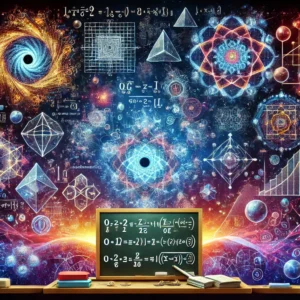
This vibrant illustration blends a traditional chalkboard scene with an imaginative mathematical universe. Above the board, geometric forms (polyhedra, lattices, and symmetric patterns) hover among glowing, galaxy-like swirls and abstract notation, suggesting the major realms of pure math—algebra, geometry, number theory, and analysis. The chalkboard anchors the image in the discipline of rigorous proof, while the expansive, dreamlike backdrop conveys pure mathematics as a world of ideas where beauty, logic, and deep structure are discovered for their own sake and leveraged in modern computational systems.
Mathematics – Overview
Connects all branches of mathematics through shared logical structures, abstraction, and quantitative reasoning.
Pure Mathematics – Overview
Focuses on abstract structures, rigorous proofs, and symbolic systems that form the theoretical foundation of all mathematics and AI.
Algebra
Examines symbolic structures such as groups, rings, and fields that govern transformations, symmetries, and neural network weights.
Number Theory
Investigates properties of integers and prime structures underlying modern cryptography, blockchain, and secure AI pipelines.
Geometry
Studies spatial structures and high-dimensional manifolds critical for understanding deep learning embedding spaces.
Calculus
Explores continuous change and accumulation, powering backpropagation and optimization algorithms in machine learning.
Mathematical Analysis
Provides rigorous foundations for limits, convergence, and measure theory ensuring algorithm stability in AI systems.
Topology
Examines properties of space preserved under continuous deformation, driving topological data analysis and neural network topology.
Applied Mathematics
Translates abstract mathematical structures into practical numerical tools for engineering and scientific modeling.
Statistics
Applies measure and probability theories to analyze quantitative data and quantify stochastic uncertainty in data science.
Actuarial Science
Uses pure mathematical foundations to model financial risk, solvency structures, and long-term economic systems.
Core Concepts & Key Domains in Pure Mathematics
Pure mathematics is the study of patterns, structures, and logical relationships in their most abstract form. In the age of artificial intelligence, where machines generate text, analyze vision, and predict outcomes, pure mathematics provides the indispensable framework ensuring these models operate on sound logical structures rather than mere statistical coincidence.
1. Number Theory: Often called the "queen of mathematics," number theory studies the properties of integers. Key concepts include prime distribution, divisibility, modular arithmetic, and Diophantine equations. In the digital and AI era, these pure structures provide the mathematical trapdoors for public-key cryptography (RSA and ECC), secure distributed ledgers, and zero-knowledge proofs essential for data privacy.
2. Abstract Algebra: Focuses on algebraic structures like groups, rings, fields, and vector spaces to analyze operations and symmetry systematically. It supplies the theoretical groundwork for computer graphics transformations, quantum computing logic gates, error-correcting codes, and the multi-dimensional weight matrices powering deep learning architectures.
3. Geometry & Topology: Geometry examines spatial properties, ranging from Euclidean flat spaces to non-Euclidean curved manifolds in general relativity. Topology investigates spatial invariants preserved under continuous deformations. Today, topological data analysis (TDA) maps complex datasets and neural network hidden layers, revealing hidden geometric shapes in high-dimensional AI data.
4. Analysis & Calculus: Analysis provides the rigorous axiomatic foundation for calculus by examining functions, limits, sequences, series, and measure theory. In the era of machine learning, real analysis guarantees the convergence bounds of gradient descent, loss function optimization, and the mathematical stability of large-scale neural networks.
About This Interactive Simulator:
This simulator models abstract Modular Arithmetic cycles (x mod m) in Number Theory. Users can adjust the modulus base (m) and multiplier factor (a) to visualize modular congruences, prime field cyclic subgroups, and algebraic symmetry on a modular circle—the foundational arithmetic behind modern cryptography.
- Solid Blue Lines: Congruence Mappings connecting integer x to (a · x) mod m
- Dashed Red Line: Highlighted Modular Generator Trajectory Line
- Modulus Slider (m): Adjusts the field size; prime modulus values demonstrate algebraic field properties used in RSA cryptography and secure AI token protocols
Pure Mathematics: Modular Arithmetic Ring & Cyclic Congruence Simulator
Applications of Pure Mathematics in the AI Age
Although driven by theoretical inquiry, pure mathematics forms the critical foundation for modern technological breakthroughs and artificial intelligence:
1. Cybersecurity & Cryptography: Prime factorization, modular arithmetic, and elliptic curve discrete logarithms in number theory underpin RSA and ECC encryption protocols securing global digital transactions and confidential AI cloud pipelines.
2. Artificial Intelligence & Deep Learning: High-dimensional linear algebra, matrix decomposition, tensor categories, and measure theory in mathematical analysis enable deep neural network architectures, attention mechanisms, and probabilistic generative models.
3. Topological Data Analysis (TDA) & AI Latent Spaces: Persistent homology and algebraic topology identify intrinsic data shapes and cluster boundaries in complex datasets, improving neural network interpretability and anomaly detection.
4. Automated Reasoning & Formal Verification: Mathematical logic and set theory power interactive theorem provers (like Lean and Coq) used to formally verify software correctness and ensure safety guarantees in autonomous AI agents.
5. Theoretical Physics & Synthetic Simulation: Lie groups, differential manifolds, and functional analysis formulate quantum field theory, general relativity, and physics-informed neural networks (PINNs) that simulate physical reality.
Emerging Trends, Challenges & Future Directions
Pure mathematics continues to develop rapidly alongside computational tools and artificial intelligence:
Emerging Trends:
• AI-Assisted Theorem Discovery: Utilizing machine learning models (such as AlphaProof) to guide mathematicians in discovering new proofs and conjectures across algebra and knot theory.
• Automated Theorem Proving: Utilizing interactive proof assistants to formalize complex mathematical proofs computationally with absolute logical certainty.
• Category Theory Integration: Applying categorical frameworks to unify disparate domains across algebra, topology, and advanced computer science type systems.
Key Challenges:
• Proof Complexity: Verifying multi-hundred-page mathematical proofs that require immense specialized domain expertise or collaborative distributed verification.
• Pedagogical Abstraction: Translating highly abstract logical structures into accessible educational frameworks for developing students entering university STEM fields.
Why Study Pure Mathematics in the AI Era?
While AI can calculate and compute rapidly, human pure mathematical training cultivates unmatched logical reasoning, abstract problem-solving, and structural intuition—skills indispensable for directing AI research, designing novel algorithms, and navigating future technologies.
Is Pure Mathematics Right For You?
Explore career pathways, check your fit, and assess your skills — before you commit to a degree.
Frequently Asked Questions
Why is Pure Mathematics considered indispensable in the Age of Artificial Intelligence?
Although AI excels at pattern matching and computation, pure mathematics provides the logical bedrock, convergence proofs, and structural frameworks (such as linear algebra, topology, and abstract algebra) that make deep learning, cryptography, and automated reasoning reliable and secure.
What is Pure Mathematics and how is it different from Applied Mathematics?
Pure Mathematics focuses on understanding mathematical structures and ideas for their own sake. It develops rigorous theories in areas such as algebra, analysis, geometry, number theory, and topology. Applied Mathematics starts from real-world questions in science, engineering, or economics. In practice, pure breakthroughs frequently become the foundational tools of tomorrow's applied technologies and AI systems.
Which core topics in Pure Mathematics should students know before university?
Before university, students aiming at Pure Mathematics should be comfortable with algebraic manipulation, functions, equations and inequalities, basic combinatorics, and introductory calculus. Meeting ideas such as mathematical proof, sequences, limits, complex numbers, and vectors prepares students for rigorous university courses.
Why is proof so central in Pure Mathematics?
In Pure Mathematics, proof is the primary way to justify that a statement is universally true. Writing proofs develops precise reasoning, careful language use, and the ability to build rigorous chains of argument—skills essential for algorithm design and formal system verification.
How can studying Pure Mathematics help with AI, computer science, and physics?
Pure mathematics provides the universal language of computation. Logic and set theory underpin computer science; linear algebra and analysis support machine learning and quantum mechanics; number theory secures cryptography. A strong pure background makes mastering advanced technical research seamless.
What kinds of careers can a background in Pure Mathematics lead to?
Graduates work in academic research, AI development, cryptography, quantitative finance, data science, technology consulting, and advanced engineering roles where deep analytical thinking and abstract problem-solving are required.
How can pre-university students practise writing mathematical proofs?
Students can begin by proving familiar algebraic identities or divisibility properties using direct proof, contradiction, contrapositive, and induction. Checking each logical step against rigorous textbooks steadily builds confidence.
What study habits help students succeed in Pure Mathematics at university?
Successful students treat pure math actively—reading definitions slowly, testing them on examples and non-examples, attempting exercises before looking at solutions, and regularly revisiting core concepts.
Comprehensive Practice & Knowledge Self-Assessment Module
Section 1: Foundational Review Questions & Answers
- What defines pure mathematics as a field of inquiry?
Answer: The rigorous study of abstract concepts, logical structures, and theoretical principles using axiomatic systems and formal proofs, independently of immediate physical applications. - What role does proof by induction play in mathematics?
Answer: It establishes that a proposition P(n) holds for all natural numbers by proving a base case P(1) and demonstrating that the truth of P(k) logically implies P(k+1). - What is the difference between a group and a field in abstract algebra?
Answer: A group is a set with a single binary operation satisfying closure, associativity, identity, and invertibility; a field is a set with two binary operations (addition and multiplication) where both form commutative groups. - How does topology define equivalence between two physical shapes?
Answer: Shapes are topologically equivalent (homeomorphic) if one can be transformed into the other via a continuous, bijective deformation without tearing or gluing. - What is the fundamental theorem of arithmetic in number theory?
Answer: It states that every integer greater than 1 is either a prime number itself or can be represented uniquely as a product of prime numbers, up to order. - What does measure theory contribute to mathematical analysis?
Answer: It generalizes concepts of length, area, and volume to abstract sets, providing the rigorous foundation for Lebesgue integration and modern probability theory. - Why is the concept of a limit central to calculus and analysis?
Answer: Limits formally define how a function behaves as its input approaches a point, establishing precise mathematical definitions for continuity, derivatives, and integrals. - What is a manifold in differential geometry?
Answer: A topological space that locally resembles Euclidean space near each point, allowing calculus and differential equations to be formulated on curved global surfaces.
Section 2: Analytical & Thought-Provoking Questions
- How does Gödel's Incompleteness Theorem establish intrinsic limits on pure mathematical systems?
Answer: It proves that any consistent formal axiomatic system capable of describing basic arithmetic contains true mathematical statements that cannot be proven within the system itself. - Why does prime number distribution in Number Theory safeguard modern digital communications and AI data?
Answer: The computational asymmetry between prime multiplication and prime factorization of large integers forms the trapdoor function underlying RSA public-key encryption and secure data transmissions. - How does category theory unify distinct branches like algebra and topology?
Answer: By abstracting mathematical structures into objects and arrows (morphisms), category theory translates algebraic structures into topological invariants via functors. - In what ways does non-Euclidean geometry challenge classical physical intuition?
Answer: By relaxing Euclid's parallel postulate, non-Euclidean geometry models curved spaces where triangle angles do not sum to 180°, enabling Einstein's general relativity. - How does the concept of compactness simplify convergence proofs in real analysis?
Answer: In compact spaces, every infinite sequence contains a convergent subsequence (Bolzano-Weierstrass theorem), guaranteeing optimal solutions in optimization problems. - Why is the distinction between countable and uncountable infinity crucial in set theory?
Answer: Cantor's diagonal argument proves real numbers are uncountably infinite, establishing that continuous spaces contain strictly greater cardinality than discrete integer sets. - How does algebraic topology use homology groups to count "holes" in multi-dimensional spaces?
Answer: Homology maps topological spaces into sequence chains of abelian groups, where non-trivial group cycles detect n-dimensional structural cavities in complex data.
Section 3: Numerical Problems & Solutions
Problem 1: Evaluating an Integral via Simpson's Rule
Approximate \(I = \int_{0}^{\pi} \sin^2(x) \, dx\) using Simpson's Rule with \(n = 4\) subintervals.
Key Formula Callout: Modular Congruence Equivalence
\(a \equiv b \pmod m \iff m \mid (a - b) \quad|\quad x = a^{-1}b \pmod m\)
Problem 2: Cubic Polynomial Factorization
Solve \(x^3 - 6x^2 + 11x - 6 = 0\) using the Rational Root Theorem.
Problem 3: Trigonometric Limit Evaluation
Evaluate \(\lim_{x \to 0} \frac{\sin(3x)}{x}\).
Problem 4: Arithmetic Series Summation
Calculate the sum of the first 20 terms of an arithmetic sequence with first term \(a_1 = 5\) and common difference \(d = 3\).
Problem 5: Determinant of a 3x3 Matrix
Find \(\det(\mathbf{A})\) for \(\mathbf{A} = \begin{pmatrix} 1 & 2 & 3 \\ 4 & 5 & 6 \\ 7 & 8 & 10 \end{pmatrix}\).
Problem 6: System of Linear Equations Matrix Solution
Solve \(2x + 3y - z = 1, \, -x + 4y + 2z = 10, \, 3x - y + z = 2\).
Problem 7: First Fourier Sine Series Coefficient
Calculate \(b_1\) for \(f(x) = x\) on \([-\pi, \pi]\).