
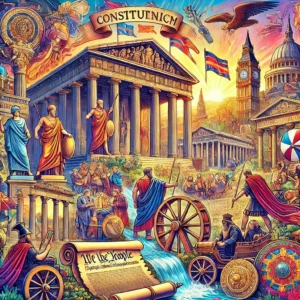
Origins of Governance: Early Structures of Authority and Law
Ancient and Medieval Constitutionalism
Current Topic: Serves as the primary foundation, exploring how early civilisations and medieval societies organised authority, codified legal principles, and balanced political order prior to modern constitutions.
Comparative Constitutional History
Cross-Regional Analysis: Examines how different global regions developed distinct yet converging systems of governance, expanding ancient practices into comparative frameworks.
Constitutional Law and Interpretation
Legal Hermeneutics: Connects early written traditions (like Roman codifications) directly to modern judicial methods of interpreting constitutional authority and text.
Constitutional Amendments and Reforms
Institutional Adaptation: Traces how foundational structures evolve over time as societies modify legal obligations and rebalance power structures across eras.
Revolutionary Constitutions
Transformational Ruptures: Shows how modern revolutionary movements build upon or dramatically break away from feudal and monarchical medieval constitutional models.
Post-Colonial Constitutionalism
Modern Legacy & Sovereignty: Explores how historical European and global imperial legal traditions impacted state-building and sovereignty in former colonial territories.
Constitutional History – Overview Hub
Macro Curriculum Hub: Provides the overarching thematic roadmap linking ancient proto-constitutional practices to contemporary global constitutional frameworks.
Key Features of Ancient and Medieval Constitutionalism
Codification of Laws
- Example:
- The Roman Twelve Tables (451–450 BCE) were the first codified laws of Rome, providing a public and accessible legal framework for citizens.
Participatory Governance
- Example:
- Athenian democracy (5th century BCE) was characterized by the active participation of male citizens in legislative and judicial processes.
Limitation of Authority
- Example:
- The Magna Carta (1215) was a landmark document in England that limited the powers of King John and established the principle that even monarchs are subject to the law.
Protection of Rights
- Example:
- Roman law granted specific rights to Roman citizens, distinguishing them from non-citizens and setting legal standards for protection and justice.
Historical Examples of Ancient and Medieval Constitutionalism
Athenian Democracy
- Context:
- Developed in Athens during the 5th century BCE, it is one of the earliest examples of a direct democracy.
- Key Features:
- Ecclesia (Assembly): Primary decision-making body open to all male citizens, voting directly on laws and foreign policy.
- Council of 500 (Boule): Prepared legislation for the Ecclesia and managed daily state administrative duties.
- Jury System (Dikasteria): Large citizen juries selected by lot to ensure democratic oversight in legal proceedings.
- Legacy:
- Athenian democracy influenced later republican and democratic systems, emphasizing the importance of citizen participation in governance.
The Roman Twelve Tables
- Context:
- Codified in 451–450 BCE, the Twelve Tables were Rome’s first set of written laws, created to address tensions between the patricians (elite class) and plebeians (commoners).
- Key Features:
- Public Accessibility: Inscribed on bronze tablets and displayed publicly in the Roman Forum for all to see.
- Equality Before the Law: Established legal protections for all Roman citizens, reducing class-based legal disparities.
- Specific Legal Provisions: Covered a wide range of issues, including property rights, contracts, procedure, and familial obligations.
- Legacy:
- The Twelve Tables provided the foundation for Roman law, influencing legal systems in Europe and beyond for centuries.
Medieval Charters
Magna Carta (1215):
- Context: A response to King John’s abuses of power, signed under pressure from rebellious barons at Runnymede.
- Key Features:
- Limitation of Monarchical Power: Required the king to seek consent for taxation and respect barons’ legal rights.
- Rule of Law: Affirmed the principle that the king is not above the law.
- Habeas Corpus / Due Process: Established the right to fair judicial process (Habeas Corpus foundations), preventing arbitrary imprisonment.
- Legacy: Often regarded as a precursor to modern constitutional documents, inspiring the English Bill of Rights (1689) and the U.S. Constitution.
Charter of Liberties (1100):
- Context: Issued by Henry I of England upon his coronation to limit royal exploitation of church and noble revenues.
- Legacy: Served as an early precedent and foundational model for the Magna Carta.
Themes in Ancient and Medieval Constitutionalism
The Evolution of Legal Frameworks
- Example: The Twelve Tables laid the foundation for legal systems emphasizing transparency and fairness.
The Balance of Power
- Example: The Magna Carta limited the king’s powers, giving barons and eventually broader segments of society a role in governance.
The Concept of Citizenship
- Example: Athenian democracy granted political rights to male citizens, excluding women, slaves, and foreigners.
Impact of Ancient and Medieval Constitutionalism
Influence on Modern Constitutions
- Example: The separation of powers in Athenian democracy influenced the checks and balances in modern democratic systems.
Promotion of Rule of Law
- Example: The Magna Carta’s insistence that even the king must follow the law became a foundational concept in constitutional democracies.
Social Contract Theory
- Example: Enlightenment thinkers like John Locke and Jean-Jacques Rousseau expanded on these principles, influencing revolutions and constitutional frameworks.
Challenges in Ancient and Medieval Constitutionalism
Exclusionary Practices
- Example: Athenian democracy excluded women, enslaved people, and non-citizens (metics) from political participation.
Vulnerability to Corruption
- Example: In medieval Europe, kings frequently violated charters like the Magna Carta, leading to renewed military conflicts.
Limited Reach
Modern Relevance of Ancient and Medieval Constitutionalism
Foundations of Democratic Governance
- Example: Modern parliaments draw inspiration from assemblies like the Athenian Ecclesia and medieval councils.
Legal Traditions
- Example: The principle of habeas corpus, originating from the Magna Carta, is a cornerstone of modern justice systems.
Why Study Ancient and Medieval Constitutionalism
Exploring the Roots of Constitutional Thought
Understanding Early Models of Law and Governance
Analyzing Foundational Texts and Institutions
Recognizing the Limits and Legacies of Pre-Modern Systems
Preparing for Interdisciplinary and Comparative Study
Interactive Simulator: Governance Stability & Constitutional Balance
Adjust executive authority and legal restraint parameters to calculate regime stability and determine the resulting constitutional status.
Ancient and Medieval Constitutionalism: Conclusion
Frequently Asked Questions – Ancient and Medieval Constitutionalism
What is meant by ancient and medieval constitutionalism?
Ancient and medieval constitutionalism refers to the ways in which earlier societies organised political authority, limited power, and defined the relationship between rulers and ruled long before modern written constitutions. It covers practices, customs, laws, and charters that structured governance in Greek city-states, the Roman Republic and Empire, medieval kingdoms, city communes, and religious institutions.
How is ancient and medieval constitutionalism different from modern constitutional law?
Modern constitutional law usually centres on a single written document, judicial review, and clearly defined rights. Ancient and medieval constitutionalism was often based on a mix of customs, assemblies, oaths, charters, and overlapping jurisdictions. Limits on power existed, but they were expressed through tradition, privilege, and negotiated obligations rather than a single codified constitution.
Why is it important to study ancient and medieval constitutional traditions today?
Studying ancient and medieval constitutional traditions shows that ideas about limiting power, sharing authority, and protecting communities long pre-date modern democracies. It helps students see how current concepts such as rule of law, representation, and mixed government grew out of older experiments, conflicts, and compromises rather than appearing suddenly in the modern era.
What are some key examples of ancient constitutional practices?
Key examples include the assemblies and councils of Greek city-states, the mixed institutions of the Roman Republic, and codifications such as early law codes. These systems used rules about offices, term limits, voting procedures, and checks between different bodies to organise power and manage political competition.
How did medieval charters and privileges contribute to constitutionalism?
In the medieval period, charters granted by kings, emperors, or lords recognised specific rights for towns, guilds, nobles, and church bodies. These documents often limited taxation, guaranteed local courts, or protected certain freedoms. Over time, they became reference points for negotiations and resistance, helping to embed the idea that rulers were bound by law and custom.
What role did representative assemblies play in medieval constitutional life?
Representative assemblies such as estates, parliaments, diets, and cortes brought together nobles, clergy, and sometimes townspeople to consent to taxation, advise rulers, or address grievances. Although not democratic in a modern sense, these bodies provided institutional forums where different groups could bargain with rulers and assert collective rights.
How did religious institutions influence ancient and medieval constitutionalism?
Religious institutions, including temples, churches, and councils, often had their own laws, courts, and corporate rights. They could act as checks on secular rulers, shape moral ideas about just rule, and provide alternative spaces of authority. Debates about the relationship between spiritual and temporal power became central to many constitutional conflicts.
What kinds of sources do historians use to study ancient and medieval constitutionalism?
Historians use a wide range of sources, including legal codes, charters, chronicles, council records, letters, literary works, inscriptions, and material evidence from public buildings and meeting places. By comparing these sources, they reconstruct how institutions worked in practice and how people understood their rights and obligations.
How did ideas of law and custom limit rulers in ancient and medieval societies?
In many ancient and medieval societies, rulers were expected to respect established laws and customs, even if they claimed divine or hereditary authority. Oaths, coronation rituals, and advisory councils formalised these expectations. When rulers were seen as breaking fundamental laws or customs, subjects sometimes justified resistance, reform, or even deposition.
How does ancient and medieval constitutionalism connect to later constitutional developments?
Later constitutional developments often drew on older practices and memories. Early modern debates about rights, parliaments, and limits on kingship frequently referenced ancient republics, medieval charters, and church–state conflicts. Studying ancient and medieval constitutionalism helps students trace these intellectual lineages and see continuity as well as change.
What skills can students gain from studying ancient and medieval constitutionalism?
Students develop skills in interpreting complex texts, understanding institutional structures, and analysing how norms and power interact. They learn to move between legal, political, and social history, building a foundation that is useful for further study in law, politics, international relations, and historical research.
How can this Ancient and Medieval Constitutionalism page be used with other Prep4Uni resources?
Learners can use this Ancient and Medieval Constitutionalism page alongside resources on political history, constitutional history, legal history, and the history of ideas. Linking these pages helps students see how early constitutional practices connect to later debates about sovereignty, rights, representation, and the design of modern states.
Comprehensive End-of-Page Assessment & Mastery Module
Section 1: Foundational Core Knowledge (Toggle Interactive Questions)
-
What is ancient and medieval constitutionalism and why is it significant?
Click to reveal explanation and answer
Answer: Ancient and medieval constitutionalism refers to the early forms of legal and political frameworks that governed societies in antiquity and the Middle Ages. These early constitutional ideas laid the groundwork for modern democratic principles by establishing the rule of law, separation of powers, and the protection of rights. They are significant because they reveal how early civilizations balanced authority and accountability, influencing later political systems. Understanding these early constitutional models provides valuable insights into the evolution of governance and legal thought over time. -
How did ancient legal systems contribute to the development of constitutional principles?
Click to reveal explanation and answer
Answer: Ancient legal systems, such as those in Athens, Rome, and other early civilizations, contributed to constitutional principles by formalizing laws and establishing procedures for governance and dispute resolution. These systems introduced ideas like codification of laws, checks on executive power, and citizen participation in government, which are foundational to constitutionalism. They also set precedents for the concept of legal equality and accountability, influencing the development of later legal frameworks. -
In what ways did medieval constitutionalism differ from its ancient predecessors?
Click to reveal explanation and answer
Answer: Medieval constitutionalism differed from ancient constitutionalism in its integration of feudal structures and the influence of religious authority on governance. During the medieval period, constitutional principles were often embedded in a context where power was shared among monarchs, nobles, and, increasingly, emerging representative bodies like parliaments. This era saw a blend of customary law, royal decrees, and church teachings, which collectively influenced the development of constitutional norms. -
How did the concept of the rule of law emerge in ancient and medieval contexts?
Click to reveal explanation and answer
Answer: The concept emerged as early societies recognized the need to establish uniform standards for governance that applied to all members of society, including rulers. Codifications like the Roman Twelve Tables set precedents for applying laws consistently, while medieval customary law and charters like Magna Carta reinforced that monarchs were subject to legal restraints. -
What role did representative institutions play in medieval constitutionalism?
Click to reveal explanation and answer
Answer: Representative institutions provided a forum for expressing diverse estate interests and acting as an institutional check on monarchical power. Parliaments, diets, and cortes offered platforms for nobles, clergy, and burghers to consent to taxation and present grievances before the crown. -
How did religious institutions influence constitutional developments in the medieval period?
Click to reveal explanation and answer
Answer: Religious institutions provided moral/canonical frameworks guiding secular governance, legitimized political authority through coronation rituals, and mediated conflicts. Canon law introduced procedural norms and corporate rights that influenced secular legal traditions. -
What impact did feudalism have on the formation of early constitutional ideas?
Click to reveal explanation and answer
Answer: Feudalism structured political society around reciprocal obligations between lords and vassals. Feudal contracts, requiring mutual loyalty and defined obligations, laid conceptual groundwork for later social contract theories and conditional ruler authority. -
How did ancient and medieval constitutionalism influence modern democratic thought?
Click to reveal explanation and answer
Answer: By transmitting foundational principles: limited government, judicial process, representative consent, and mixed constitutions. Modern checks and balances directly adapt ancient mixed governance concepts (Polybius/Aristotle) and medieval baronial limits. -
How have interpretations of ancient constitutional principles evolved in modern scholarship?
Click to reveal explanation and answer
Answer: Modern scholarship uses interdisciplinary, contextual approaches that critique earlier idealistic views. Scholars emphasize the exclusionary realities (slavery, gender restrictions) alongside the legal innovations of classical and medieval governance. -
What are the enduring legacies of ancient and medieval constitutionalism in today’s legal systems?
Click to reveal explanation and answer
Answer: Key legacies include Habeas Corpus, public legal trial procedures, legislative consent for taxation, codified civil rights, and the institutional principle that no executive officer stands above the law.
Section 2: Analytical & Scenario-Based Exploration
-
How might future constitutional reforms be shaped by the lessons of ancient and medieval governance?
Answer Analysis: Future constitutional reforms may be significantly shaped by historical lessons regarding balance of power and institutional elasticity. Ancient and medieval systems demonstrate that rigid autocracies or unconstrained majorities lead to systemic breakdown. Incorporating mechanisms that distribute authority equitably across regional or demographic groups ensures long-term institutional resilience. -
In what ways can comparative studies of ancient and medieval constitutions enrich our understanding of modern legal systems?
Answer Analysis: Comparative study reveals that structural issues—such as curbing executive overreach, securing fiscal consent, and maintaining judicial independence—are universal human governance challenges. Studying non-modern solutions prevents provincialism in modern legal design. -
How might digital technologies transform the study and preservation of ancient and medieval constitutional history?
Answer Analysis: Multispectral manuscript imaging, digital humanities corpus analysis, and global open-access archives allow scholars to re-examine fragile charters (like surviving Magna Carta copies) and cross-reference thousands of medieval legal decisions in real-time. -
How might the principles of ancient constitutionalism be adapted to address contemporary challenges such as digital privacy and free speech?
Answer Analysis: Ancient core tenets—protecting the individual citizen against arbitrary coercion by powerful sovereign actors—can be reinterpreted to limit tech monopolies and government surveillance networks, establishing a digital “charter of liberties.” -
How can historical constitutional debates inform current discussions on the balance between security and civil liberties?
Answer Analysis: Historical crises (e.g., Roman emergency dictatorships or medieval martial suspensions) demonstrate that emergency powers granted without explicit term limits or legislative oversight inevitably destroy constitutional protections. -
How might the evolution of constitutional interpretation during the medieval period offer lessons for resolving modern legal controversies?
Answer Analysis: Medieval jurists integrated static, sacred legal texts with dynamic customary realities through creative glossing and equity principles. This offers a model for modern living constitutionalism that preserves foundational intent while serving evolving societal needs. -
How can cross-cultural studies of ancient constitutionalism enhance our understanding of global governance today?
Answer Analysis: Comparing Greco-Roman models with ancient Eastern or Islamic constitutional traditions (such as the Constitution of Medina) demonstrates that constitutionalism is not solely a Western discovery, but a global historical practice centered on rule-bound order. -
How might the incorporation of indigenous legal traditions into constitutional frameworks influence contemporary debates on governance?
Answer Analysis: Indigenous models (e.g., the Haudenosaunee Great Law of Peace) introduce principles of long-term intergenerational accountability and consensus-building, broadening state frameworks beyond adversarial electoral majoritarianism.
Section 3: Quantitative & Historical Metrics Analysis
-
Problem 1: Athenian Citizen Participation Rate Calculation
In 430 BCE, the total estimated population of Attica was 300,000 people. This included 30,000 adult male citizens eligible to vote in the Ecclesia, with the remainder composed of women, children, resident foreigners (metics), and enslaved individuals. Calculate the exact percentage of the population that enjoyed full political rights under Athenian constitutional democracy.Step-by-Step Solution:
Given:
Eligible Citizens = 30,000
Total Population = 300,000
Formula:
Franchise Percentage = (Eligible Citizens / Total Population) × 100
Calculation:
Franchise Percentage = (30,000 / 300,000) × 100 = 0.10 × 100 = 10%
Result: Exactly 10% of the Athenian population possessed direct voting franchise, highlighting both its participatory depth for citizens and its exclusionary structural nature. -
Problem 2: Quorum Requirements in the Athenian Council of 500
The Council of 500 (Boule) required a 60% quorum of its total delegates to approve emergency administrative measures for assembly review. How many council members had to be present to meet this constitutional quorum?Step-by-Step Solution:
Given:
Total Members = 500
Quorum Percentage = 60% = 0.60
Calculation:
Required Members = 500 × 0.60 = 300
Result: A minimum of 300 members was required to establish a constitutional quorum. -
Problem 3: Medieval Feudal Tax Assessment Comparison
In 1210, King John demanded a feudal scutage (tax in lieu of military service) of 3 marks per knight’s fee. A baron holding 25 knight’s fees was required to pay this sum. Under the Magna Carta limits proposed in 1215, scutage was capped at 1.5 marks per knight’s fee without Great Council consent. Calculate the total cost to the baron under 1210 rates versus the proposed 1215 capped rates, and determine the percentage savings.Step-by-Step Solution:
Given:
Knight’s Fees = 25
1210 Rate = 3 marks/fee
1215 Rate = 1.5 marks/fee
1. Calculate 1210 Total Assessment:
Assessment (1210) = 25 × 3 = 75 marks
2. Calculate 1215 Total Assessment:
Assessment (1215) = 25 × 1.5 = 37.5 marks
3. Calculate Percentage Reduction:
Reduction = ((75 – 37.5) / 75) × 100 = (37.5 / 75) × 100 = 50%
Result: The baron paid 75 marks in 1210 compared to 37.5 marks under 1215 constitutional limits, yielding a 50% tax reduction. -
Problem 4: Voting Margin in Medieval Baronial Assemblies
A council of 25 Security Barons established under Clause 61 of the 1215 Magna Carta needed a 2/3 supermajority to declare a formal breach of charter by the King. Calculate the minimum number of baronial votes required to authorize legal seizure of royal castles.Step-by-Step Solution:
Given:
Total Council Members = 25
Supermajority Threshold = 2/3 = 0.6667
Calculation:
Votes Needed = 25 × (2/3) = 16.67 votes
Since vote counts must be whole integers, round up to the next whole number.
Result: A minimum of 17 baronial votes was required to execute enforcement provisions against the Crown. -
Problem 5: Chronological Span of Classical vs. Feudal Constitutional Codes
Calculate the exact time span in years between the display of the Roman Twelve Tables (450 BCE) and the signing of the Magna Carta at Runnymede (1215 CE).Step-by-Step Solution:
Given:
Start Year = 450 BCE (-450)
End Year = 1215 CE (+1215)
Formula (accounting for no Year 0 in astronomical calendar transition):
Time Span = 1215 + 450 – 1 = 1664 years
Result: A total of 1,664 years elapsed between these two monumental codifications of law. -
Problem 6: Jury Representation Proportions in Roman Public Courts
Under Roman late republican procedural law (Lex Aurelia of 70 BCE), judicial panels were divided equally into three decuries: Senate, Knights (Equites), and Treasury Tribunes (Tribuni Aerarii). If a tribunal consisted of 81 total jurors, how many judges represented each socio-political class?Step-by-Step Solution:
Given:
Total Jurors = 81
Number of equal classes = 3
Calculation:
Jurors per Class = 81 / 3 = 27
Result: Each socio-political class was assigned exactly 27 jurors, balancing power across competing Roman estates. -
Problem 7: Proportional Population Growth and Parliamentary Representation
In an early 14th-century English parliament, 74 knights represented rural shires while 148 burgesses represented urban boroughs. Calculate the ratio of urban-to-rural representative seats in simple fraction form.Step-by-Step Solution:
Given:
Shire Representatives = 74
Borough Representatives = 148
Calculation:
Ratio = Borough Seats / Shire Seats = 148 / 74 = 2 / 1
Result: The ratio of borough to shire representation was exactly 2:1.