
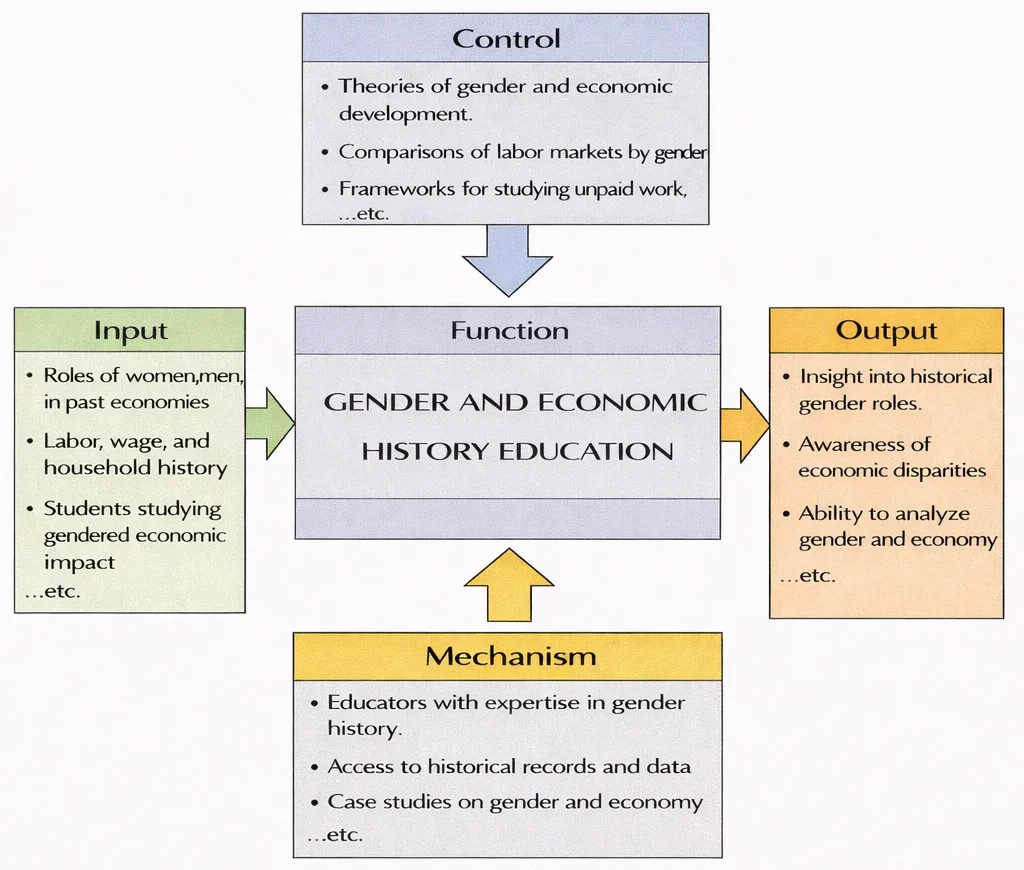

Participation, Power, and Access: Gender in Economic Systems
Gender & Economic History
Examines how roles, legal constraints, and resource access influence economic participation, division of domestic labor, and systemic outcomes.
Labor History
Highlights how workforce structures and union movements reflect differences in wage compensation, occupational segregation, and working conditions.
Industrial & Technological History
Shows how industrial mechanization, household technological shifts, and factory systems reshaped labor participation across gender boundaries.
Trade & Commerce History
Explores how market participation, informal merchant networks, and commercial entrepreneurship vary across distinct socio-cultural contexts.
Financial History
Connects historic legal barriers to property ownership, bank credit access, and capital markets with broader patterns of economic inclusion.
Comparative Economic History
Compares cross-societal models of workforce integration, family law structures, and state welfare protections across international regimes.
Economic Thought & Theory
Evaluates how classical and modern theoretical models interpret—or omit—unpaid care labor and non-market household economic contributions.
Environmental Economic History
Examines how natural resource access, agricultural sustainability, and environmental burdens intersect with traditional gender responsibilities.
Economic History – Overview
Provides the umbrella macroeconomic context linking demographic shifts, labor market evolution, and institutional policy to long-term development.
Key Focus Areas in Gender and Economic History
Gender Pay Gaps and Labor Segregation
The gender pay gap reflects long-standing institutional inequalities in wage compensation.
- Pre-Industrial & Industrial Eras: In pre-industrial societies, women performed essential agricultural and cottage textile work, but income was managed by male household heads. Industrialization created factory wage jobs, but women in British textile mills routinely earned one-third to one-half of male wages.
- Modern Structural Persistence: Disparities persist due to occupational segregation and the undervaluation of caregiving and education sectors.
Women’s Labor During Wartime and Crisis
Geopolitical conflicts historically forced emergency restructurings of national labor markets.
- World Wars I & II: Female workforce participation expanded dramatically into heavy industry, munitions, and agricultural support (such as Rosie the Riveter in the U.S. and the Women’s Land Army in Britain). Post-war demobilization often forced women back into domestic roles, seeding early feminist movements.
- Post-Conflict Reconstruction: In modern post-conflict societies like post-1994 Rwanda, women stepped forward to lead economic rebuilding and local governance.
Unpaid Care Economy and Entrepreneurship
Unpaid domestic care labor remains foundational to macroeconomic productivity.
- Unpaid & Care Labor: Childcare, eldercare, and household management are estimated to constitute 10% to 40% of GDP if formally monetized. The care economy underpins formal labor markets.
- Entrepreneurship & Microfinance: Women historically managed small-scale commerce and guild enterprises as widows. Modern initiatives, such as Grameen Bank microfinance, have empowered women-led micro-enterprises in developing economies.
Interactive Tool: Gender Wage Gap & Unpaid Care Labor Simulator
This interactive tool calculates how occupational segregation, wage gaps, and unpaid care hours compound over a multi-year career. Adjust the wage gap percentage, weekly unpaid care hours, and labor market participation rate to observe real-time impacts on lifetime earnings and total economic output.
Male Paid Lifetime Earnings: $1,500,000 | Female Paid Lifetime Earnings: $1,230,000
Lifetime Wage Gap Loss: $270,000 | Imputed Unpaid Care Value ($20/hr): $624,000
Why Study Gender and Economic History
Revealing Uncounted Labor & Structural Disparities
This field examines how domestic labor and caregiving underpin formal economic output. It provides analytical tools to evaluate how laws, property rights, and credit access historically constrained female economic independence.
Interdisciplinary Policy Research
By integrating economics, history, sociology, and political science, students build research skills to evaluate modern equal-pay laws, parental leave programs, and gender-responsive budgeting.
Gender and Economic History: Conclusion
Gender and economic history reveals the vital contributions of women and marginalized groups across formal and informal economies. From historical wage gaps to wartime industrial mobilization and modern care economy valuation, analyzing past gender dynamics provides an essential foundation for designing equitable economic policies today.
Frequently Asked Questions about Gender and Economic History
What is gender and economic history?
Gender and economic history studies how gender roles, identities, and legal power relations have shaped economic life over time, analyzing paid and unpaid work, household resource distribution, and institutional rights.
Why is gender essential when analyzing economic history?
Economic systems are not gender-neutral. Ignoring gender omits the contributions of large segments of the population and creates incomplete assessments of productivity and living standards.
How does this discipline treat unpaid care labor?
It treats unpaid care labor (cooking, childcare, eldercare) as essential macroeconomic infrastructure that directly supports paid labor market functionality.
What primary sources do scholars utilize?
Scholars analyze census data, wage ledgers, probate records, court cases, company archives, trade union documents, and oral histories.
Interactive Module: Key Concept Toggles
Click each summary toggle below to reveal detailed explanatory breakdowns of core gender and economic concepts:
Understanding the “Male Breadwinner” Ideology
Coverture Laws and Property Rights Restrictions
Occupational Segregation: Horizontal vs. Vertical
Comprehensive Practice & Assessment Module
Section 1: Foundational Review Questions
- What is gender and economic history and why is it essential to study?
Answer: It examines how gender roles, laws, and norms shaped historical production, wage structures, and resource allocation, giving a complete picture of past economies. - How did the transition to factory industrialization alter female labor patterns?
Answer: It shifted production out of household agrarian units into centralized factories, creating wage jobs for young women but establishing severe wage differentials. - What was the primary argument used to justify lower female wages in 19th-century factories?
Answer: Societal norms assumed men were primary family breadwinners, treating female earnings as supplementary income. - How did legal coverture impact married women’s economic autonomy?
Answer: It legally transferred a married woman’s property, independent wages, and contractual rights directly to her husband. - What role did female labor play in national defense industries during World War II?
Answer: Women filled industrial vacancies in munitions, shipbuilding, and aircraft assembly, comprising 37% of the U.S. workforce by 1945. - What is the economic definition of the “care economy”?
Answer: It encompasses both paid and unpaid caregiving work (childcare, nursing, eldercare, domestic management) essential for labor market reproduction. - How did early 20th-century protective labor laws affect female employment?
Answer: While protecting safety, they often restricted working hours and night shifts for women, inadvertently excluding them from higher-paying industrial jobs. - How do microfinance organizations like Grameen Bank assist female entrepreneurs?
Answer: They provide small, collateral-free credit loans directly to underbanked women to start local commercial ventures.
Section 2: Analytical & Scenario-Based Questions
- Analyze how incorporating unpaid care labor alters GDP calculation paradigms.
Answer: Incorporating unpaid care increases national GDP by 10% to 40%, re-evaluating household work as productive economic infrastructure rather than leisure. - How did postcolonial transitions alter traditional indigenous gender structures?
Answer: Imperial powers often imposed Western land ownership rules favoring male heads, marginalizing women’s traditional communal land rights. - Evaluate the long-term economic impact of expanding female suffrage during the 20th century.
Answer: Political voting power led to legislative reforms in property rights, equal pay, education access, and workplace safety. - Compare female workforce participation dynamics during wartime vs. peacetime demobilization.
Answer: Wartime creates rapid entry into heavy industrial roles; peacetime demobilization frequently forces women out to accommodate returning veterans. - How does occupational segregation reinforce gender pay gaps in modern economies?
Answer: Female-dominated fields (teaching, caregiving) are undervalued financially relative to male-dominated technical fields, depressing average female earnings. - In what ways did access to higher education transform women’s economic autonomy?
Answer: Higher education enabled entry into licensed professions (medicine, law, corporate management), shifting female employment from manual labor to high-wage professional careers. - How can modern gender-responsive budgeting improve public infrastructure development?
Answer: It ensures public funds support transit safety, public childcare, and healthcare, increasing female labor force participation.
Section 3: Numerical Problems & Calculation Solutions
- Unadjusted Gender Pay Gap Calculation: In a historic industrial sector, male factory workers earn an average annual wage of $40,000, while female factory workers earn an average annual wage of $26,000.
a) Calculate the raw Gender Pay Gap ratio (Female Wage / Male Wage × 100%).
b) Calculate the absolute annual wage penalty experienced by female workers.
Answer:a) Wage Gap Ratio:
Ratio = ($26,000 / $40,000) × 100% = 0.65 × 100% = 65% (Women earn 65 cents per male dollar).
b) Absolute Annual Gap Penalty:
Gap = $40,000 − $26,000 = $14,000 per year. - Monetized Value of Unpaid Care Labor: A community of 10,000 households performs an average of 35 hours of unpaid domestic care labor per household per week. If the market shadow wage for domestic care is set at $15 per hour, calculate the total annual imputed economic value generated by this unpaid labor.
Answer:Weekly Community Hours = 10,000 households × 35 hours = 350,000 hours/week.
Annual Hours = 350,000 hours × 52 weeks = 18,200,000 hours/year.
Total Annual Imputed Value = 18,200,000 hours × $15/hour = $273,000,000. - Wartime Female Workforce Growth Rate: Before a geopolitical conflict, 12,000,000 women were employed in formal national labor markets. At the peak of wartime mobilization, female formal employment rose to 18,600,000. Calculate the percentage increase in female formal labor participation.
Answer:Increase = 18,600,000 − 12,000,000 = 6,600,000 workers.
Percentage Growth = (6,600,000 / 12,000,000) × 100% = 0.55 × 100% = 55% increase. - Lifetime Accumulated Earnings Disparity: A male worker and female worker both enter the labor force at age 22 and retire at age 62 (40-year career). The male worker earns a constant average salary of $60,000 per year. Due to wage gaps and career interruptions for caregiving, the female worker earns an average of $45,000 per year. Calculate the lifetime cumulative earnings differential between them (ignoring compounding interest).
Answer:Male Cumulative Earnings = $60,000 × 40 years = $2,400,000.
Female Cumulative Earnings = $45,000 × 40 years = $1,800,000.
Lifetime Earnings Differential = $2,400,000 − $1,800,000 = $600,000 loss. - Imputed GDP Adjustment Calculation: A developing nation reports a official formal GDP of $100 billion. Economists conduct a time-use survey and determine that uncounted female domestic and care labor equates to 15,000,000,000 hours annually, valued at a shadow wage rate of $2.00 per hour.
a) Calculate the total value of uncounted domestic labor.
b) Calculate the revised total GDP including unpaid care work and determine the percentage increase over official formal GDP.
Answer:a) Value of Uncounted Labor:
15,000,000,000 hours × $2.00/hour = $30,000,000,000 ($30 billion).
b) Revised GDP & Percentage Increase:
Revised Total GDP = $100 billion + $30 billion = $130 billion.
Percentage Increase = ($30 billion / $100 billion) × 100% = 30% increase. - Female Entrepreneurial Microcredit Yield: A microfinance cooperative lends $500,000 total to 1,000 female market vendors ($500 per vendor). With capital access, each vendor increases her monthly net income from $120 to $200.
a) Calculate the individual monthly income gain per vendor.
b) Calculate the total annual net income increase generated across all 1,000 vendors.
Answer:a) Individual Monthly Gain:
$200 − $120 = $80 per month per vendor.
b) Total Annual Community Gain:
$80/month × 12 months = $960/year per vendor.
Total Annual Gain = $960 × 1,000 vendors = $960,000. - Pension Wealth Disparity Calculation: Due to a lifetime wage gap, a female worker retires with a pension fund balance of $200,000, whereas a male peer retires with $320,000. If both draw down their funds equally over a 20-year retirement period:
a) Calculate the annual retirement income available to each person.
b) Calculate the female annual retirement income deficit relative to the male worker.
Answer:a) Annual Retirement Income:
Male Annual Income = $320,000 / 20 years = $16,000 per year.
Female Annual Income = $200,000 / 20 years = $10,000 per year.
b) Annual Retirement Deficit:
$16,000 − $10,000 = $6,000 annual income deficit for the female retiree.