
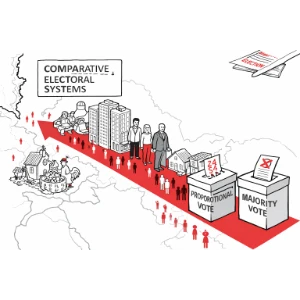
Analytical Concept: This line drawing contrasts how identical societies (comprising both rural and urban populations) are converted into political power through two distinct mechanisms: Proportional Representation versus Majority/Plurality Voting. The rules of conversion dictate the political makeup of the legislature.
Designing Democracy: How Electoral Systems Shape Power
Electoral History Overview
Curriculum Roadmap: Traces the historical evolution of voting systems from restricted franchises to universal participation, providing the foundational timeline for cross-national comparison.
Suffrage & Civil Rights Movements
Curriculum Roadmap: Examines how franchise expansions interact with specific electoral rules, determining whether newly enfranchised populations gain true representation or face systemic dilution.
Role of Technology in Elections
Curriculum Roadmap: Analyzes how mechanical, electronic, and digital infrastructure intersects with majoritarian or proportional voting designs to affect counting speed, auditability, and trust.
Political Campaigns
Curriculum Roadmap: Explores how campaign strategies, advertising budgets, and candidate selection are tailored to win under different electoral rules (e.g., district swing strategy vs. national party lists).
Electoral Fraud & Integrity
Curriculum Roadmap: Evaluates how vulnerabilities to gerrymandering, vote-buying, or ballot stuffing vary between single-member majoritarian systems and multi-member proportional lists.
Essential Elements in Comparative Electoral Systems
Definition and Purpose
Electoral systems are the rules and mechanisms by which votes are translated into seats or offices. They determine how individuals and parties compete for power and how citizens participate in governance.
Core Objectives
- Representation: Ensuring diverse demographic, ideological, and regional voices hold seats in governing bodies.
- Accountability: Allowing voters to reward or punish specific representatives or political parties through direct electoral sanction.
- Government Stability: Facilitating the formation of coherent, functional executive bodies capable of passing legislation.
Types of Electoral Systems
Electoral systems are broadly categorized based on how votes are cast, counted, and converted into political representation.
Majoritarian Systems
These systems emphasize a clear winner in each district, often prioritizing stable, single-party governance over strict proportionality.
- First-Past-The-Post (FPTP) / Plurality:
- The candidate with the highest number of votes in a single-member constituency wins, regardless of whether they achieve an absolute majority.
- Common in the United States, United Kingdom, Canada, and India.
- Advantages: Simple to understand; establishes a strong, direct link between voters and their local constituency representative; frequently creates single-party parliamentary majorities.
- Disadvantages: Produces high levels of vote disproportionality; leads to “wasted votes” for losing candidates; penalizes minor or geographically dispersed parties. Example: In the UK 2019 General Election, the Conservative Party won 43.6% of the vote but secured 56.2% of parliamentary seats.
- Two-Round System (Runoff):
- If no candidate achieves an absolute majority (>50%) in the initial vote, a second round is held between top-ranking candidates.
- Used in French presidential elections and numerous national legislatures.
- Advantages: Guarantees that the ultimate winner possesses majority support; allows voters to express secondary preferences in Round 2.
- Disadvantages: Requires double the administrative cost and voter mobilization efforts; can lead to tactical voting between rounds.
Proportional Representation (PR) Systems
These systems allocate legislative seats in multi-member districts to reflect the overall national or regional vote percentage won by each political party.
- Party-List Proportional Representation:
- Voters select a political party (or candidates within a list), and seats are distributed among parties proportional to their share of the popular vote (often utilizing thresholds like 5%).
- Used in South Africa, Israel, the Netherlands, and Spain.
- Advantages: High degree of electoral fairness and proportionality; reduces wasted votes; increases representation for minority groups and minor parties.
- Disadvantages: Weakens direct geographic links between local voters and individual representatives; can cause legislative fragmentation requiring volatile multi-party coalition governments.
- Single Transferable Vote (STV):
- Voters rank individual candidates in multi-member districts. Candidates reaching a calculated quota (e.g., Droop Quota) are elected, and surplus or eliminated candidates’ votes are transferred according to subsequent preferences.
- Used in Ireland, Malta, and Australian Senate elections.
- Advantages: Achieves proportionality while retaining voter choice over individual candidates rather than party bosses.
- Disadvantages: Complex ballot counting formulas and potentially confusing choices for voters.
Mixed Systems
These systems combine elements of majoritarian and proportional voting to balance local constituency representation with national proportionality.
- Mixed-Member Proportional (MMP):
- Voters cast two separate votes on one ballot: one for a local single-member district candidate (FPTP) and one for a national/regional party list (PR). Party-list seats are allocated to compensate for constituency imbalances.
- Used in Germany and New Zealand.
- Advantages: Delivers direct local constituency representation while maintaining overall legislative proportionality.
- Disadvantages: Creates two distinct tiers of legislators (constituency vs. list); can lead to “overhang seats” that enlarge parliament size.
Interactive Tool: Disproportionality Calculator (Gallagher Index)
The Gallagher Index (LSq) measures the electoral distortion between the percentage of votes a party receives and the percentage of seats it wins. Lower scores indicate higher proportional fairness (0 = Perfect Proportionality).
Vote %: Seat %:
Vote %: Seat %:
Vote %: Seat %:
Vote %: Seat %:
Electoral Systems in Practice: Global Case Studies
U.S. Presidential Elections (Electoral College)
- System: Indirect presidential election where each state is allocated electoral votes equal to its total congressional delegation (House seats + 2 Senators). Most states employ a winner-take-all rule.
- Impact: Candidates focus heavily on "swing states" rather than the national popular vote.
- Strengths: Preserves federalism by ensuring smaller states retain institutional weight.
- Criticisms: Can yield popular vote-electoral vote divergences where the national popular vote winner loses the presidency (e.g., 2000 Bush vs. Gore, 2016 Trump vs. Clinton).
UK Parliamentary Elections (First-Past-The-Post)
- System: Single-member plurality system across 650 parliamentary constituencies.
- Impact: Historically generated stable single-party governments, but consistently penalizes third parties with broad national appeal but no localized concentration.
- Strengths: Provides clear executive accountability and local MP-constituency representation.
- Criticisms: Leads to substantial electoral disproportionality and regional political distortion.
German Bundestag Elections (Mixed-Member Proportional)
- System: Voters cast two votes: one for a local district representative and one for a state party list. Additional "balance seats" (Ausgleichsmandate) are added to guarantee national party list proportionality.
- Impact: Combines direct local representation with national fairness, ensuring parliaments accurately mirror voter sentiment.
- Strengths: Balances local accountability with multi-party inclusivity.
- Criticisms: Can lead to an expanding, oversized parliament and requires multi-party coalition building.
Indian Lok Sabha Elections (FPTP in Multi-Ethnic Society)
- System: First-Past-The-Post across 543 single-member constituencies in the world's largest democracy.
- Impact: Accommodates regional and ethnic diversity by allowing distinct state-level parties to win localized pluralities, forming coalitions at the national level.
- Strengths: Highly intuitive ballot mechanics for a vast, highly diverse electorate.
- Criticisms: Can result in parties securing national parliamentary majorities on less than 40% of the popular vote.
Electoral Systems and Their Societal Effects
Electoral Reform Debates
Comparative scholarship directly informs national reform movements. For example, New Zealand successfully voted in 1993 to replace its legacy FPTP system with Mixed-Member Proportional (MMP) after voters grew dissatisfied with disproportionate election outcomes.
Conflict Management in Divided Societies
In deeply divided or post-conflict nations, electoral design can mitigate ethnic or religious violence. Power-sharing arrangements utilizing the Single Transferable Vote (STV) in Northern Ireland guarantee cross-community representation for Nationalist and Unionist populations.
Interactive Review: Comparing Electoral Rules
Click on the questions below to reveal comparative analyses of voting mechanisms:
What is Duverger's Law in comparative political science?
How does an electoral threshold affect small parties in Proportional Representation?
What are "overhang seats" (Überhangmandate) in Mixed-Member Proportional systems?
Frequently Asked Questions
What are comparative electoral systems?
Comparative electoral systems is the field of political science that systematically analyzes how different countries design rules to translate votes into seats, and how these rules influence governance, party structures, and voter participation.
Why study electoral systems comparatively?
It reveals that voting rules are deliberate design choices with predictable outcomes. Comparing systems helps explain why political behavior, cabinet stability, and minority representation vary across democracies.
What are the primary families of electoral systems?
The three major families are Majoritarian/Plurality systems (FPTP, Two-Round), Proportional Representation systems (Party-List, STV), and Mixed systems (MMP, Parallel Voting).
How does First-Past-The-Post differ from Proportional Representation?
FPTP elects single candidates per district based on pluralities, prioritizing single-party stability over vote accuracy. PR allocates multi-member seats based on vote percentages, prioritizing fair representation.
What is the Gallagher Index?
The Gallagher Index is a mathematical formula that quantifies electoral disproportionality by calculating the difference between the percentage of votes a party receives and the percentage of seats it wins.
What is Mixed-Member Proportional (MMP) voting?
MMP is a hybrid voting model where voters cast two votes: one for a local district representative and one for a national party list, ensuring both local connection and national proportionality.
How does district magnitude impact representation?
District magnitude refers to the number of legislative seats elected per district. Larger district magnitudes produce greater electoral proportionality and make it easier for small parties to win seats.
What is the Single Transferable Vote (STV)?
STV is a preferential proportional system where voters rank individual candidates in multi-member districts. Excess votes for winning candidates are transferred to voters' subsequent preferences.
Why do proportional systems tend to form coalition governments?
Because PR systems accurately distribute seats among multiple parties, single parties rarely achieve an absolute majority (>50%) of seats, requiring formal political alliances to govern.
How do electoral rules influence political polarization?
Winner-take-all FPTP systems can heighten polarization by creating binary "us vs. them" contests, whereas preferential and proportional systems incentivize parties to seek broader compromise.
What primary sources do comparative electoral scholars analyze?
Scholars analyze electoral laws, constitutional court rulings, precinct-level voting statistics, district maps, parliamentary seating records, and comparative voter survey data.
How do comparative electoral studies assist university-bound students?
It equips students with core analytical skills in institutional analysis, comparative methodology, statistical measurement of disproportionality, and critical political evaluation.
End-of-Page Practice Modules
Module 1: Foundational Review Questions
-
What are comparative electoral systems and why are they studied?
Answer: Comparative electoral systems involve the systematic study and comparison of different voting methods used by nations to elect representatives. They are studied to understand how voting rules impact seat distribution, party systems, voter turnout, and governance stability. -
How does First-Past-The-Post (FPTP) convert district votes into legislative seats?
Answer: FPTP awards a single legislative seat in a constituency to whichever candidate secures the highest number (plurality) of votes, regardless of whether they cross the 50% majority threshold. -
What is the main institutional goal of Proportional Representation (PR)?
Answer: To ensure that the percentage of seats won by a political party in the legislature closely matches the percentage of votes cast for that party by the electorate. -
Explain how a Two-Round System operates in presidential elections.
Answer: In Round 1, all candidates compete; if no candidate achieves an absolute majority (>50%), a runoff election is held between the top two vote-getters to ensure the winner holds majority backing. -
What are the two votes cast by citizens in a Mixed-Member Proportional (MMP) system?
Answer: The first vote is for a local single-member district representative (FPTP), and the second vote is for a national or regional political party list (PR). -
What is Duverger's Law?
Answer: The principle in political science stating that single-member district plurality voting systems (FPTP) tend to produce two-party political systems, while PR systems encourage multi-party systems. -
What function does an electoral threshold serve in list PR systems?
Answer: It establishes a minimum vote share (e.g., 5%) required for a party to enter parliament, preventing extreme party fragmentation and keeping unstable micro-factions out of coalition governments. -
How does the Single Transferable Vote (STV) preserve voter choice over individual candidates?
Answer: Voters rank candidates in order of preference in multi-member districts, allowing them to choose specific individuals across or within parties rather than selecting a rigid party list. -
Why do majoritarian systems often produce single-party majority governments?
Answer: Because the winner-take-all nature of single-member districts systematically exaggerates the seat share of the leading national party relative to its popular vote share. -
What is a "wasted vote" in electoral analysis?
Answer: A vote cast either for a losing candidate in a plurality district or a vote cast for a winning candidate in excess of what was required to win the seat.
Module 2: Analytical & Scenario-Based Inquiry
-
Analyze why a country transitioning from authoritarian rule might prefer Proportional Representation over First-Past-The-Post.
Answer: A emerging democracy often chooses PR to ensure that all social, ethnic, and regional factions gain legislative representation, preventing a single dominant group from monopolizing power through district pluralities. -
Evaluate the trade-offs between local constituency accountability and national legislative proportionality.
Answer: Systems like FPTP provide voters with a single, identifiable local representative to address local grievances, but sacrifice national vote fairness. List PR guarantees national vote fairness, but voters lack a direct local advocate. -
How can the Electoral College in the United States lead to a divergence between the national popular vote and the executive winner?
Answer: Because almost all states award 100% of their electoral votes to the state plurality winner, a candidate can accumulate narrow victories in key high-value states while losing by large margins in others, securing 270 electoral votes with fewer total national votes. -
In what ways do preferential voting systems like Ranked-Choice Voting incentivize moderate campaigning?
Answer: Candidates must appeal to rival campaigns' supporters to earn second-preference transfers, discouraging aggressive personal attacks that could alienate potential backup votes. -
Assess how district magnitude affects the representation of minor parties.
Answer: As district magnitude (seats per district) increases, the threshold of votes needed to win a seat drops, making it significantly easier for smaller or niche parties to secure legislative representation. -
How does Mixed-Member Proportional (MMP) attempt to solve the shortcomings of both majoritarian and PR systems?
Answer: MMP solves local disconnect by maintaining single-member FPTP district seats, while simultaneously solving disproportionality by using party-list seats as a top-up mechanism to match overall vote share. -
Why might coalition governments produced by PR systems experience higher executive instability than FPTP governments?
Answer: Coalition governments rely on multi-party agreements; if a junior partner withdraws over a policy disagreement, the government loses its legislative majority and may collapse, triggering early elections. -
Discuss how electoral system design can serve as a mechanism for post-conflict peacebuilding.
Answer: By utilizing PR or power-sharing STV mechanics, formerly warring factions are guaranteed seats in parliament proportional to their support, shifting political conflict from armed combat to parliamentary negotiation. -
How does algorithmic gerrymandering exacerbate the disproportionality of First-Past-The-Post systems?
Answer: Software enables political cartels to "pack" opposition voters into a few districts and "crack" remaining voters across multiple districts, ensuring the ruling party wins a disproportionate majority of seats regardless of statewide vote totals. -
Evaluate how turnout dynamics differ between proportional and majoritarian elections.
Answer: PR systems generally achieve higher voter turnout because nearly every vote contributes to seat allocation nationwide, whereas FPTP voters in safe, non-competitive districts often feel their votes carry little weight.
Module 3: Step-by-Step Numerical Problems & Electoral Formulas
-
Calculate the Hare Quota for an STV election in a district returning 4 members where 50,000 valid votes were cast.
Answer: Step 1: Formula for Hare Quota = Total Valid Votes / Total Seats.
Step 2: Apply values = 50,000 / 4.
Calculation: Quota = 12,500 votes. -
Calculate the Droop Quota for an STV election in a district returning 3 members where 40,000 valid votes were cast.
Answer: Step 1: Droop Quota formula Q = [Total Votes / (Seats + 1)] + 1.
Step 2: Q = [40,000 / (3 + 1)] + 1.
Step 3: 40,000 / 4 = 10,000.
Step 4: 10,000 + 1 = 10,001.
Calculation: Droop Quota = 10,001 votes. -
In a parliamentary election using the D'Hondt method, Party X wins 120,000 votes, Party Y wins 80,000 votes, and Party Z wins 40,000 votes for 3 available seats. Determine which parties win each of the 3 seats step-by-step.
Answer: Step 1: Formula for quotient = Votes / (Seats already won + 1).
Step 2: Round 1 Quotients (0 seats each): Party X = 120,000; Party Y = 80,000; Party Z = 40,000. Seat 1 goes to Party X (120,000).
Step 3: Round 2 Quotients: Party X (1 seat) = 120,000 / 2 = 60,000; Party Y (0 seats) = 80,000; Party Z = 40,000. Seat 2 goes to Party Y (80,000).
Step 4: Round 3 Quotients: Party X (1 seat) = 60,000; Party Y (1 seat) = 80,000 / 2 = 40,000; Party Z (0 seats) = 40,000. Seat 3 goes to Party X (60,000 highest quotient).
Final Seat Allocation: Party X wins 2 seats, Party Y wins 1 seat, Party Z wins 0 seats. -
Calculate the Sainte-Laguë quotient divisor sequence for Party M (which has 90,000 votes) for its 1st, 2nd, and 3rd potential seats.
Answer: Step 1: The Sainte-Laguë method uses odd integer divisors: 1, 3, 5, 7, etc. Formula = Votes / (2s + 1).
Step 2: Seat 1 divisor (s = 0): 90,000 / 1 = 90,000.
Step 3: Seat 2 divisor (s = 1): 90,000 / 3 = 30,000.
Step 4: Seat 3 divisor (s = 2): 90,000 / 5 = 18,000. -
In a FPTP election with 4 candidates, Candidate A receives 15,001 votes, Candidate B receives 15,000 votes, Candidate C receives 14,999 votes, and Candidate D receives 10,000 votes. Calculate Candidate A's vote percentage and state whether Candidate A wins the seat.
Answer: Step 1: Total votes = 15,001 + 15,000 + 14,999 + 10,000 = 55,000 votes.
Step 2: Candidate A percentage = (15,001 / 55,000) × 100 = 27.27%.
Step 3: Under FPTP, the candidate with the plurality wins. Since 15,001 is the highest single total, Candidate A wins the seat despite securing only 27.27% of the total vote. -
A nation has a 5% national threshold in a PR election. Party Alpha receives 4.9% of the national vote (490,000 votes out of 10,000,000 cast). How many parliamentary seats does Party Alpha receive in a 100-seat legislature?
Answer: Step 1: Compare party vote share to threshold: 4.9% < 5.0%.
Step 2: Party Alpha fails to cross the threshold.
Result: Party Alpha receives 0 seats. All 100 seats are allocated among parties crossing 5%. -
In a country using an MMP system with 100 total seats (50 district FPTP seats and 50 list PR top-up seats), Party Red wins 40 local district seats and secures 30% of the national party vote. Calculate how many list seats Party Red receives.
Answer: Step 1: Calculate total entitled seats based on party vote: 100 total seats × 30% = 30 entitled seats.
Step 2: Compare entitled seats to already won district seats: Party Red won 40 district seats.
Step 3: Since Party Red already holds 40 seats (which exceeds its entitlement of 30), it receives 0 list seats.
Note: The extra 10 seats become "overhang seats." -
Calculate the Gallagher Index (LSq) for a two-party election where Party 1 wins 60% of the vote and 80% of the seats, while Party 2 wins 40% of the vote and 20% of the seats.
Answer: Step 1: Calculate differences (Vi - Si):
Party 1: 60 - 80 = -20.
Party 2: 40 - 20 = +20.
Step 2: Square the differences: (-20)2 = 400; (+20)2 = 400.
Step 3: Sum squared differences = 400 + 400 = 800.
Step 4: Divide by 2 = 800 / 2 = 400.
Step 5: Take square root: √400 = 20.
Calculation: Gallagher Index LSq = 20.00 (Indicates severe disproportionality). -
In a Ranked-Choice election with 12,000 valid ballots, determine the majority quota needed to win without elimination. If Round 1 results are Candidate A = 5,000; Candidate B = 4,500; Candidate C = 2,500, detail the Round 2 redistribution if 60% of Candidate C's voters picked B as second choice and 40% picked A.
Answer: Step 1: Majority quota = (12,000 / 2) + 1 = 6,001 votes.
Step 2: No candidate has 6,001 in Round 1. Candidate C (2,500 votes) is eliminated.
Step 3: Transfer Candidate C's votes:
To Candidate B: 2,500 × 0.60 = 1,500 votes.
To Candidate A: 2,500 × 0.40 = 1,000 votes.
Step 4: Round 2 Totals:
Candidate A: 5,000 + 1,000 = 6,000 votes.
Candidate B: 4,500 + 1,500 = 6,000 votes.
Result: Candidates are tied at 6,000 votes each, right below the 6,001 threshold.